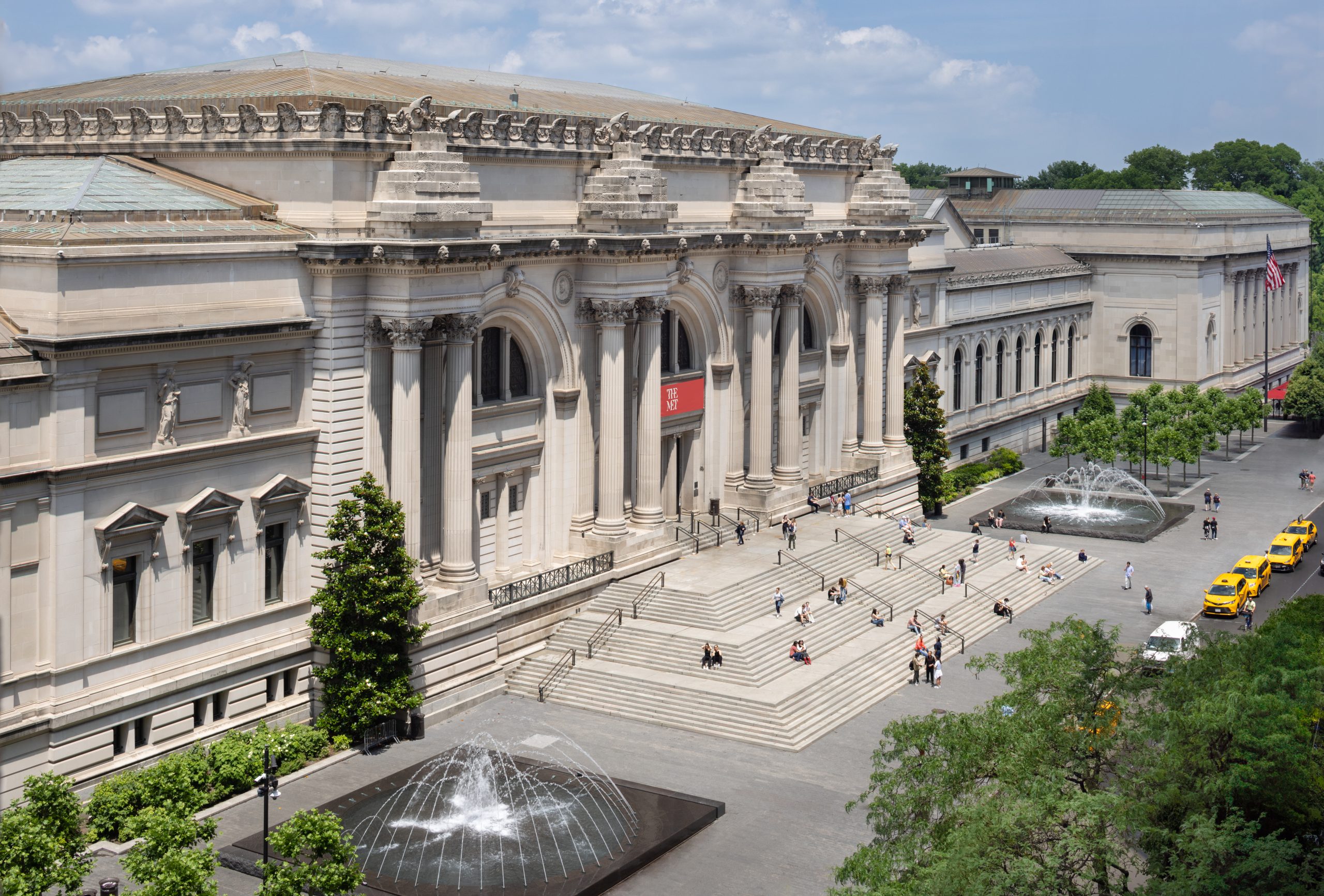
Summary
15 famous masterpieces of Western art to see at the Metropolitan Museum of Art:
- Duccio’s rare painting blends Byzantine influences with early Renaissance naturalism. The painting’s original frame reflects its past as a private devotional piece.
- Raphael’s Colonna Altarpiece marks his shift from Perugino’s style to the innovations of the Florentine Renaissance. It is now the only large altarpiece by the artist in the Americas.
- Bruegel’s The Harvesters captures Flemish rural life with unprecedented naturalistic detail, making it the first modern landscape in Western art.
- This still life by Clara Peeters showcases her precision and subtle vanitas references. Acquired by the Met in 2020, it highlights the museum’s effort to address the historical neglect of women artists.
- Gentileschi’s Esther Before Ahasuerus uses dramatic chiaroscuro to depict Esther’s courage, showcasing the artist’s powerful, psychologically intense style.
- Velázquez’s portrait of Juan de Pareja conveys dignity and individuality, skillfully rendering light and texture. It marks an early representation of a marginalized, Black individual.
- Rembrandt’s late masterpiece uses his rich, textured palette to depict Aristotle contemplating Homer, blending emotional depth with reflections on worldly desires.
- Vermeer’s Girl with a Red Hat at the Met is one of his tronie paintings, echoing the famous Girl with a Pearl Earring with its delicate scarf and pearl earring.
- David’s The Death of Socrates presents the philosopher as calm and heroic, embodying moral and intellectual strength and highlighting his choice to face death.
- Leutze’s Washington Crossing the Delaware is a monumental, heroic painting in the American Wing at the Met, famous for its scale and patriotic impact despite historical inaccuracies.
- Ingres’s portrait of Pauline de Broglie is a refined Neoclassical masterpiece, showcasing the artist’s meticulous draftsmanship. It is one of the most famous paintings at the Met.
- Rosa Bonheur’s The Horse Fair is a monumental painting of horse markets that cemented her international fame as one of history’s most celebrated women painters.
- Mary Cassatt’s The Boating Party showcases her Impressionist style and focus on contemporary women, marking her as the only American in the group.
- Sargent’s Portrait of Madame X caused a scandal at the 1884 Paris Salon for its provocative pose and is now celebrated as one of his greatest masterpieces.
- Van Gogh’s Wheat Field with Cypresses, painted during his Saint-Rémy period, showcases his fascination with the spindly trees and vivid outdoor detail.
Instead of trying to see everything at the Met, we are zeroing in on famous masterpieces of European painting, hidden gems, and corners where art history comes alive. No guide can cover it all; this is simply a way in. Think of it as an invitation to explore your own Met highlights!
📚Brief art historical background ⁉️Why should you care!?
1. Madonna and Child by Duccio
Gallery 635
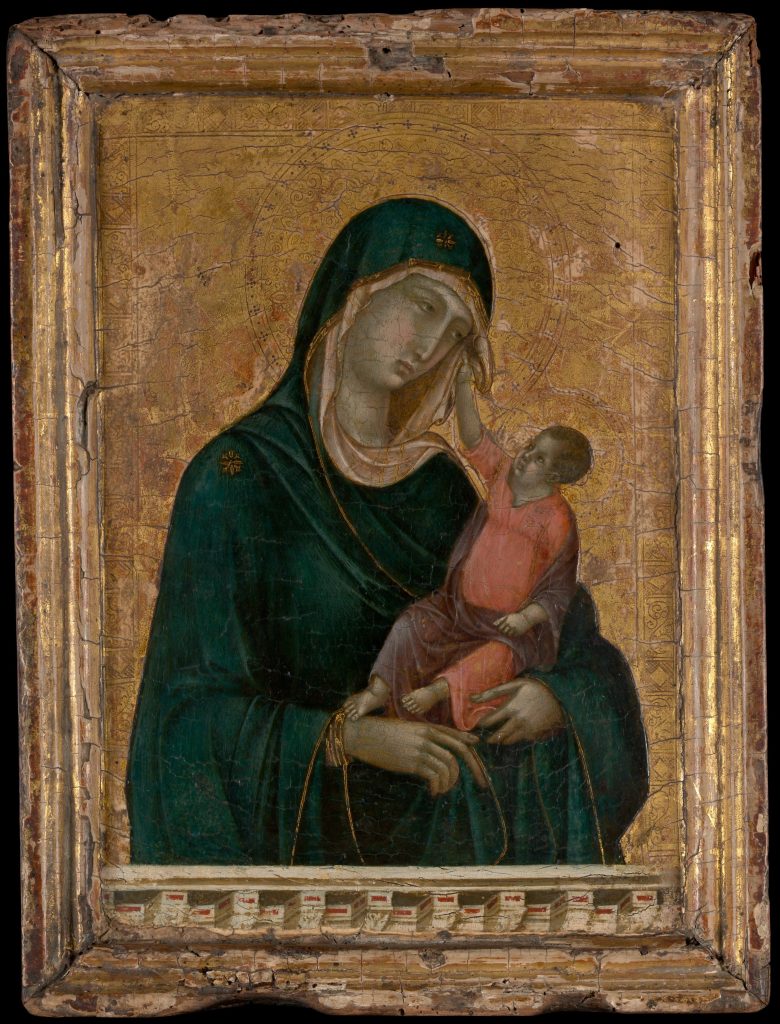
Duccio, Madonna and Child, ca. 1290–1300, Metropolitan Museum of Art, New York City, NY, USA.
📚 This exceptionally rare independent work by Duccio, often called the father of Sienese painting, caused a stir when the Met famously bought it for a record $45 million in 2004. The tiny painted surface (only 9 3/8 x 6 1/2 in.—23.8 x 16.5 cm) captures a fascinating shift from medieval iconography toward early Renaissance naturalism. While the gold background recalls Byzantine icons, the gentle gestures add warmth and intimacy, and the suggestion of the edge of a balcony at the bottom of the composition gives the figures a sense of occupying real space.
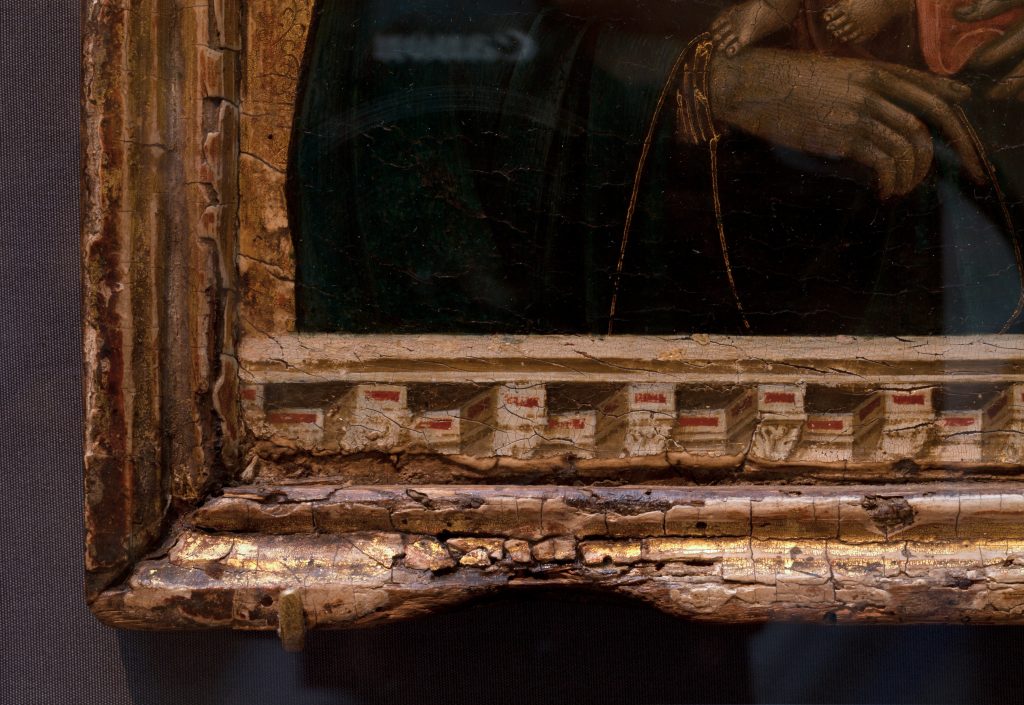
Duccio, Madonna and Child, ca. 1290–1300, Metropolitan Museum of Art, New York City, NY, USA. Detail of the 13th-century original frame, rare in any museum; the bottom edge is marked by candle burns.
⁉️ Only a handful of Duccio’s works survive today, most of them in Europe. When the Met acquired this masterpiece, it was described as “the last known Duccio still in private hands.” The frame is original—the oldest in the Met’s collection—and shows three distinctive candle burns from its previous life as a private devotional image.
2. Madonna and Child Enthroned with Saints by Raphael
Gallery 609
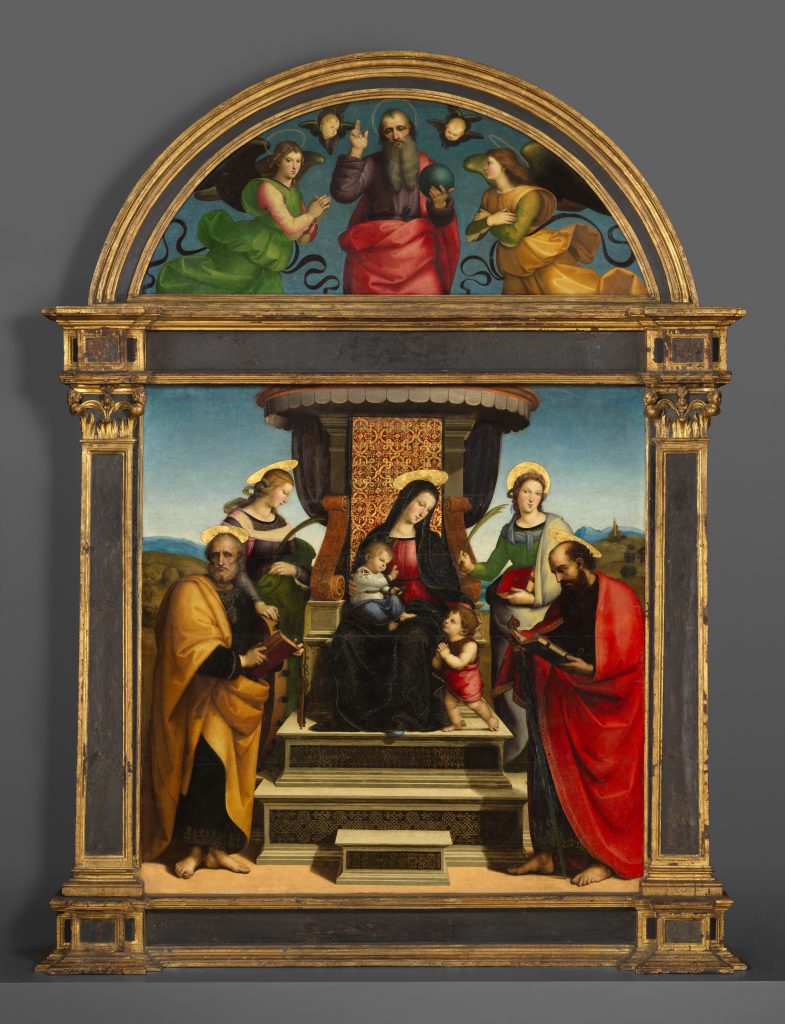
Raphael, Madonna and Child Enthroned with Saints, ca. 1504, Metropolitan Museum of Art, New York City, NY, USA.
📚 Commissioned for a Franciscan convent in Perugia, Raphael painted this altarpiece at just 21 or 22, shortly before leaving for Florence. Even at that age, his talent was already remarkable and in high demand. The work captures a moment of transition, as he moved from the polished, conservative approach of his master Perugino toward the fresh innovations of the Florentine Renaissance, shaped by artists such as Fra Bartolomeo, Leonardo da Vinci, and Michelangelo.
⁉️ The altarpiece remained in situ until 1678, when the powerful Colonna family of Rome acquired it after the original convent dismantled and sold it in parts to help with financial difficulties—giving it its familiar name, the Colonna Altarpiece. It went on to have a colorful history fragmented across European collections before becoming the only large altarpiece by the “Prince of Painters” in the Americas.
3. The Harvesters by Pieter Bruegel the Elder
Gallery 638
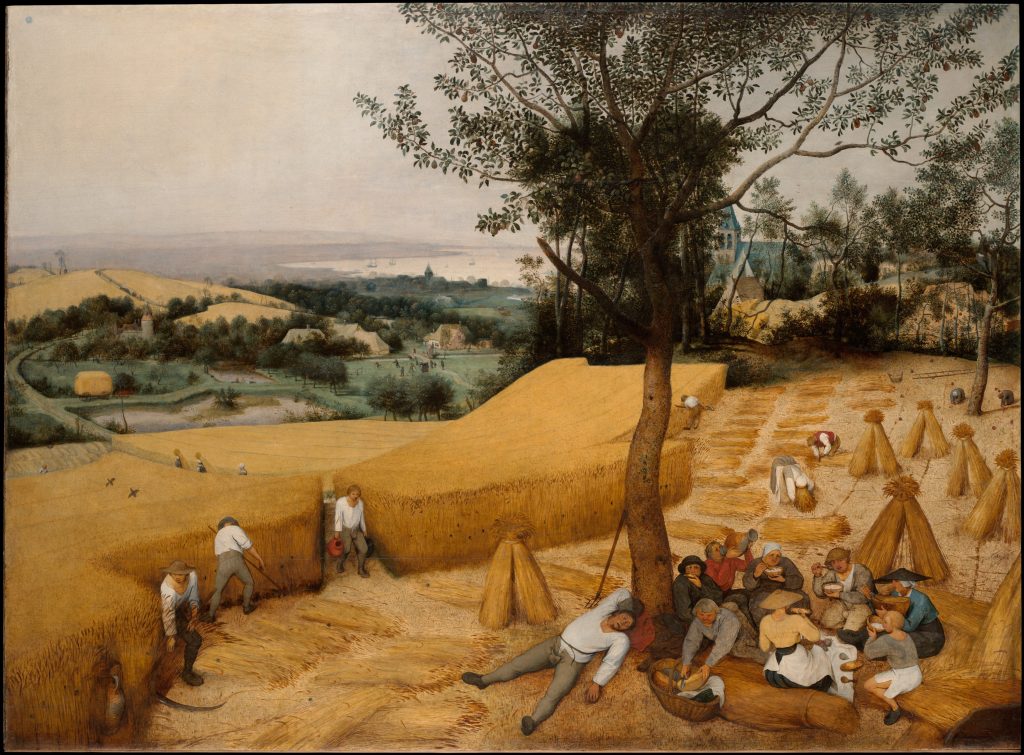
Pieter Bruegel the Elder, The Harvesters, 1565, Metropolitan Museum of Art, New York City, NY, USA.
📚 Bruegel was a pioneer in elevating peasant life to fine art. This masterpiece is one of five surviving works from a six-part series on the labors of the months commissioned by an Antwerp merchant for his estate. A turning point in Western art, the series includes this panel, in which Bruegel captures the rhythms of rural life in Flanders during the wheat harvest of July and August. He uses the landscape to tell stories of ordinary people, depicting scenes drawn from real places and careful observation rather than idealization.
⁉️ The Met describes this famous painting as “the first modern landscape in Western art” because the large, richly detailed canvas, full of naturalistic depth, was entirely new in its time. It stood out among other Northern Renaissance works, which focused on devotional, historical, and aristocratic themes. Very few of Bruegel’s works are in the U.S., and this is the only panel from the series in an American museum.
4. Bouquet of Flowers by Clara Peeters
Gallery 617
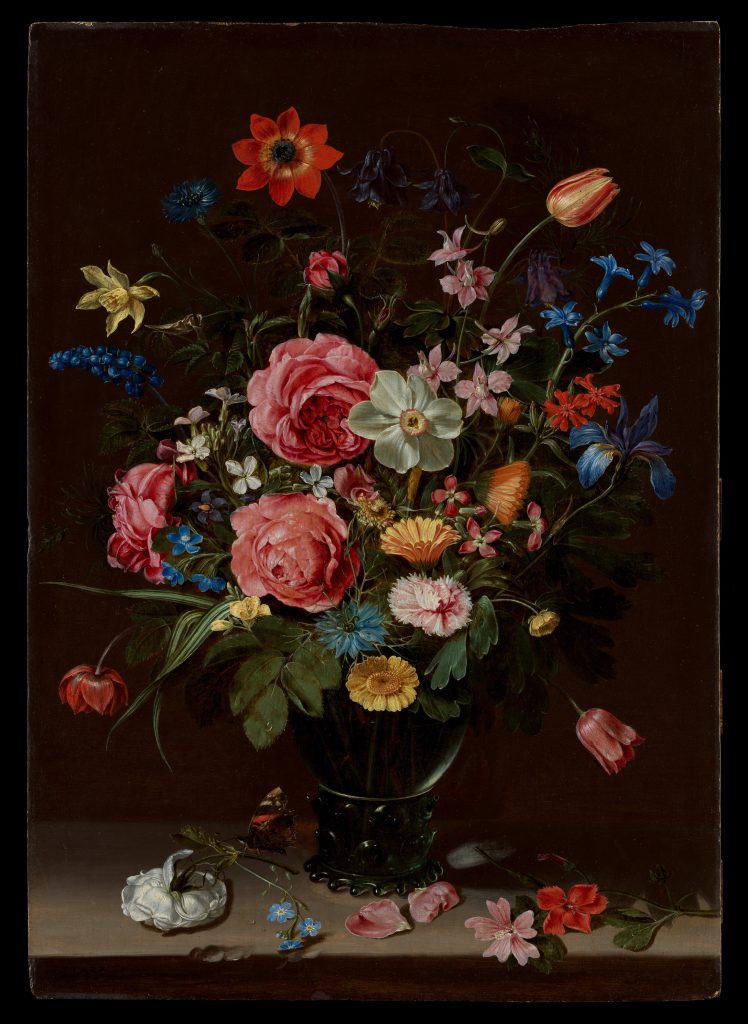
Clara Peeters, Bouquet of Flowers, ca. 1612, Metropolitan Museum of Art, New York City, NY, USA.
📚 Peeters was a Flemish still-life painter and a pioneer in a genre popular with women artists, who faced limited training opportunities and were barred from studying the nude figure. This bouquet depicts her groundbreaking hyper-realistic style, full of naturalistic details with scientific-like precision. Many of her images hint at life’s fleeting beauty—falling petals, insects, or half-eaten bread—an early nod to vanitas.
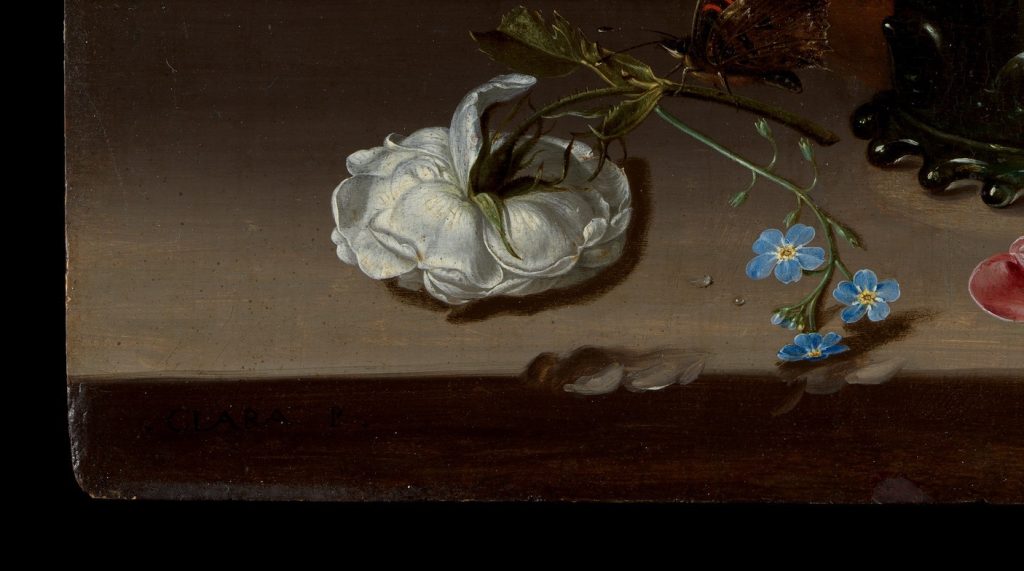
Clara Peeters, Bouquet of Flowers, ca. 1612, Metropolitan Museum of Art, New York City, NY, USA. Detail of the stone ledge with the artist’s signature: “Clara P.”
⁉️ Peeters was one of the first women to boldly assert herself in the male-dominated art world by signing her name (“Clara P.”), often integrating it into objects in the painting. Her work shaped the practice of contemporaries across Europe, but over time it fell into obscurity, a consequence of the historical neglect of women artists. The Met acquired this painting in 2020 to help correct the long-standing underrepresentation of women in its collection.
5. Esther Before Ahasuerus by Artemisia Gentileschi
Temporarily off view/expected to return
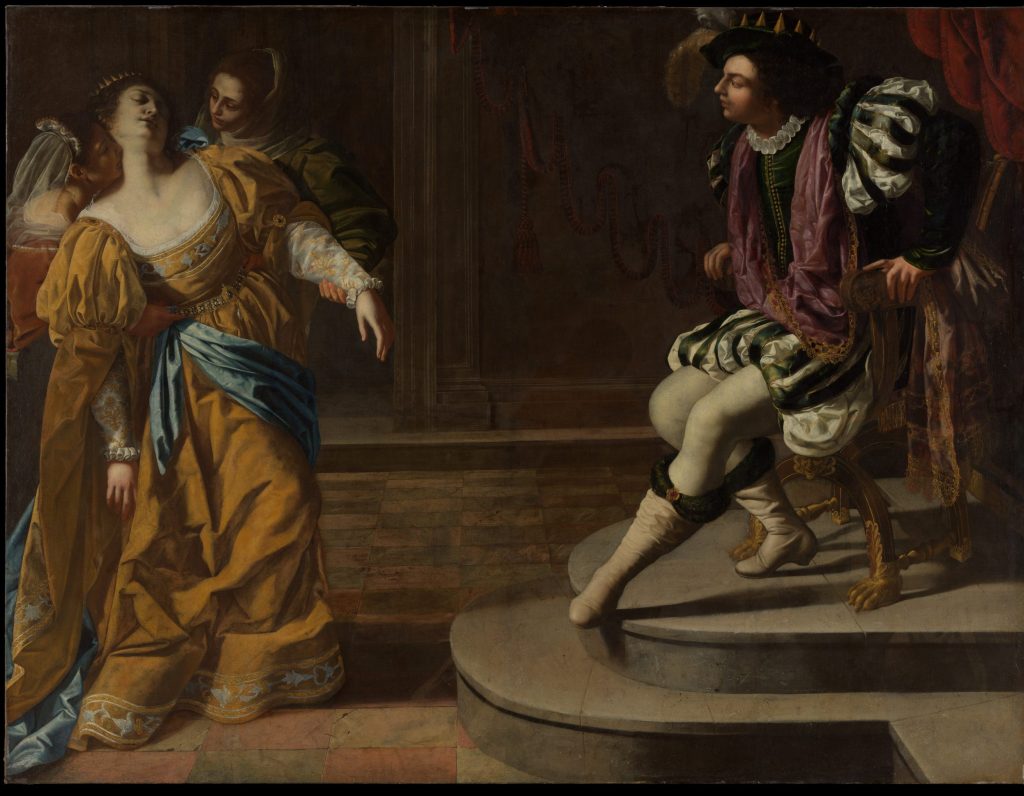
Artemisia Gentileschi, Esther Before Ahasuerus, 1620s, Metropolitan Museum of Art, New York City, NY, USA.
📚 Artemisia Gentileschi combined chiaroscuro with theatrical staging to depict the story of the Jewish heroine Esther, who risked death by appearing uninvited before the King of Persia to plead for her people. In one of her largest and most ambitious canvases (at about 7 ft × 9 ft—2.1 x 2.7 m), Gentileschi portrayed the biblical story as a contemporary performance, with Esther’s dramatic swoon underscoring her moral courage. The painting is a fusion of Caravaggio’s influence and her unique powerful portrayal of female characters.
⁉️ Artemisia overcame early trauma to develop into one of 17th-century Italy’s most celebrated artists. A proto-feminist figure, self-taught in reading and writing, she was trained by her father Orazio Gentileschi and influenced by Caravaggio, earning acclaim for psychologically intense compositions that often celebrated courageous women. A servant restraining a dog, painted out by the artist, has become partially visible to the left of the king’s knee, likely a nod to earlier treatments of the story that included the figure, such as by Veronese.
6. Juan de Pareja by Diego Velázquez
Gallery 625

Diego Velázquez, Juan de Pareja, 1650, Metropolitan Museum of Art, New York City, NY, USA.
📚 This is one of the most striking portraits painted by Velázquez. He depicted Afro-Hispanic painter Juan de Pareja (ca. 1608–1670), who was a slave in Velázquez’s studio before becoming an artist himself. Pareja’s expression conveys a sense of dignity and individuality, rare in portraits of enslaved or low-status people in 17th-century Spain. Many historians believe Velázquez chose Pareja as a subject to showcase his extraordinary skill in rendering skin, texture, and light.
⁉️ Painted in Rome, the portrait was shown at the Pantheon in March 1650 to huge acclaim, boosting Velázquez’s international reputation. It has inspired extensive discussions in art history and critical race theory as an early example of representing marginalized individuals. Remarkably, the exhibition occurred six months before Pareja’s manumission, launching his career as a free man and painter, though he remained in service to Velázquez and his family.
7. Aristotle with a Bust of Homer by Rembrandt
Gallery 616
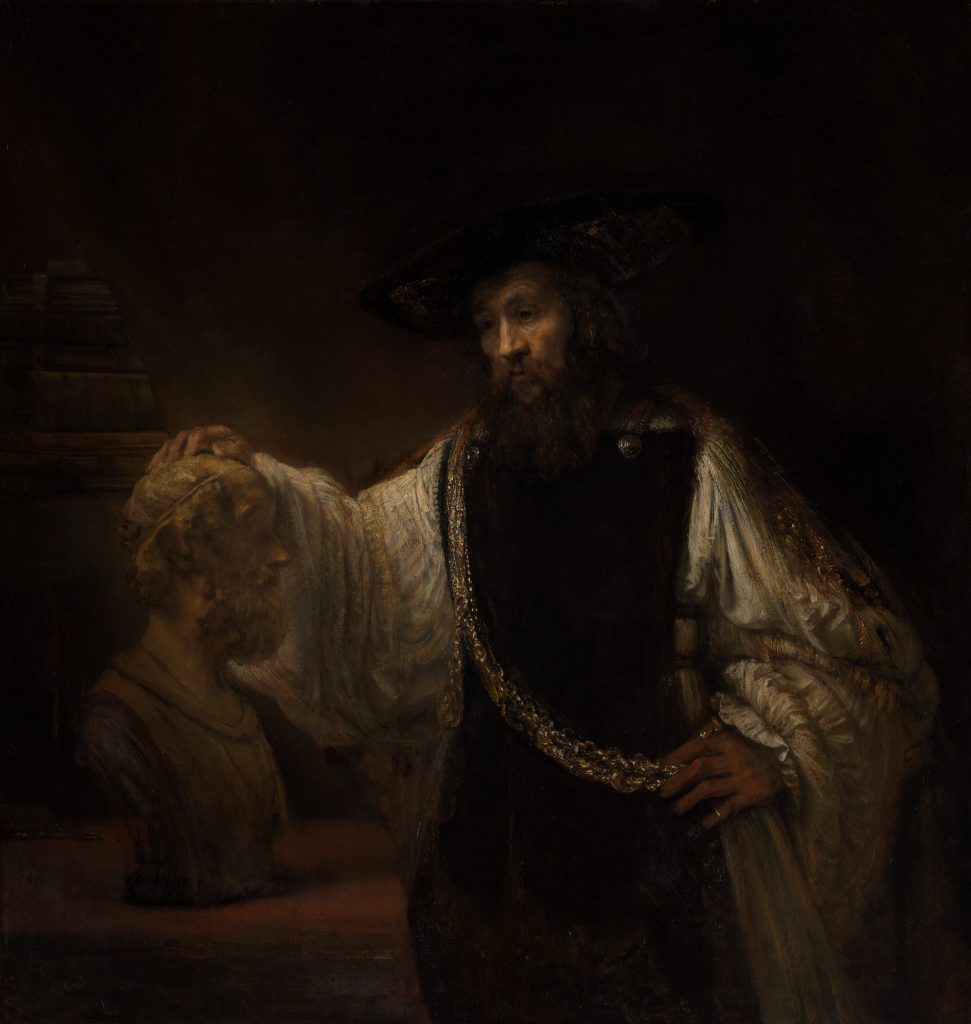
Rembrandt, Aristotle with a Bust of Homer, 1653, Metropolitan Museum of Art, New York City, NY, USA.
📚 In this late masterpiece, Rembrandt portrays three eminent figures of antiquity with his signature dark, richly textured palette, which adds depth and emotional intensity. The painting was commissioned by Don Antonio Ruffo, a Sicilian nobleman and rare non-Dutch patron, who granted Rembrandt full creative freedom. In this imaginative composition, Aristotle rests his hand on a bust of Homer—the poet traditionally credited with the epic poems of The Iliad and The Odyssey. His formidable pupil, Alexander the Great, appears on a medallion suspended from a gold chain.
⁉️ Aristotle’s gaze has inspired countless readings and is widely understood, following art historian Julius Held’s seminal 1969 interpretation, to reflect on worldly desires. As described by the Roman rhetorician Quintilian, Homer was remarkable for his oratorical power, humility, and all-encompassing intellect, qualities Aristotle appears to weigh against the allure of Alexander’s wealth and prestige. In his Nicomachean Ethics, Aristotle argued that the highest form of happiness comes not from fleeting gratification but from exercising our capacity to reason and contemplate universal truths.
8. Study of a Young Woman by Johannes Vermeer
Gallery 614
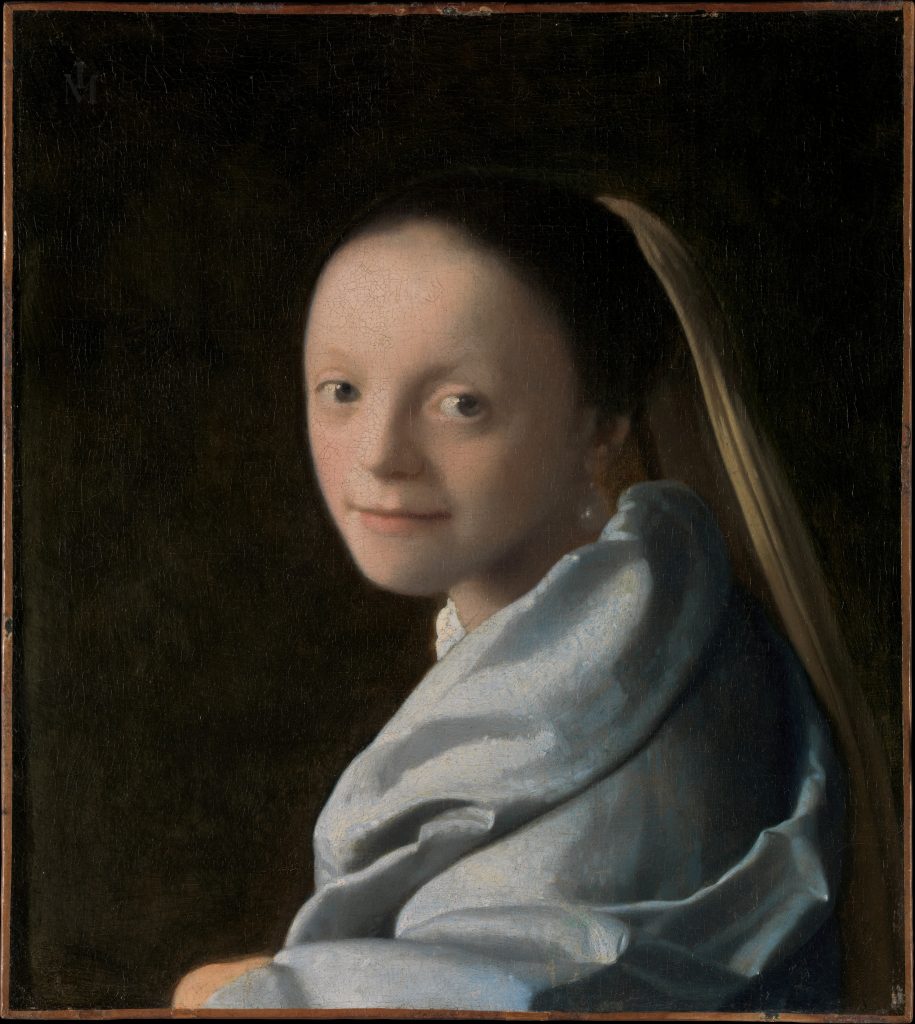
Johannes Vermeer, Study of a Young Woman, ca. 1665–1667, Metropolitan Museum of Art, New York City, NY, USA.
📚 This is one of only 34 firmly recognized Vermeer paintings and one of the most remarkable in its simplicity. This exquisite bust-length portrait of a single female sitter has only one comparable artwork in Vermeer’s oeuvre, the notorious Girl with a Pearl Earring, likely painted around the same time. As her famous counterpart in the painting in The Hague, our girl at the Met also wears a delicate scarf and a pearl earring. Both works are examples of a Dutch tronie—paintings based on live models but not meant as portraits, created to explore expressions, features, or exotic costumes.
⁉️ Though now one of the most admired Dutch artists, Vermeer remained largely unknown until rediscovered in the 19th century by French art historian Théophile Thoré-Bürger. The Met holds five Vermeers—more than any museum in the world—while New York City is home to a quarter of all known Vermeer paintings, including the famous three at the Frick Collection and one in private hands.
9. The Death of Socrates by Jacques-Louis David
Temporarily off view/expected to return
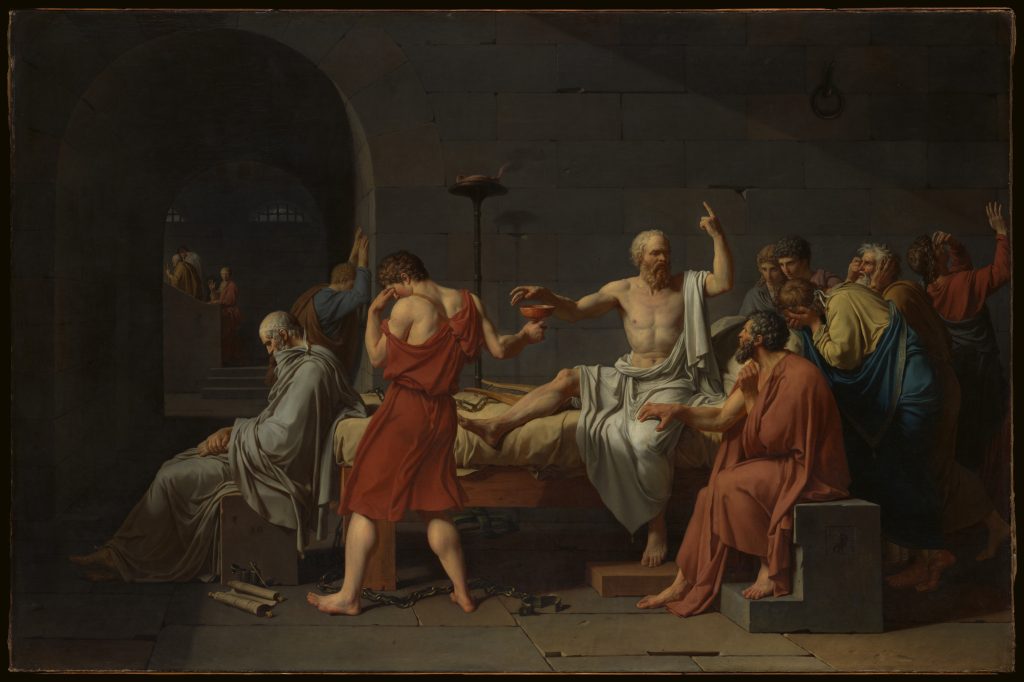
Jacques Louis David, The Death of Socrates, 1787, Metropolitan Museum of Art, New York City, NY, USA.
📚 This is a masterpiece of David’s mature Neoclassical style, and it shaped how later generations pictured the Athenian philosopher Socrates: rational, composed, and fearless until his final moments. His decision to accept death rather than compromise his principles was seen as a parallel to the rising sentiment in pre-Revolutionary France. At Socrates’s feet sits his prominent student, Plato, who was not present at the execution but documented the events in his moving dialogue Phaedo.
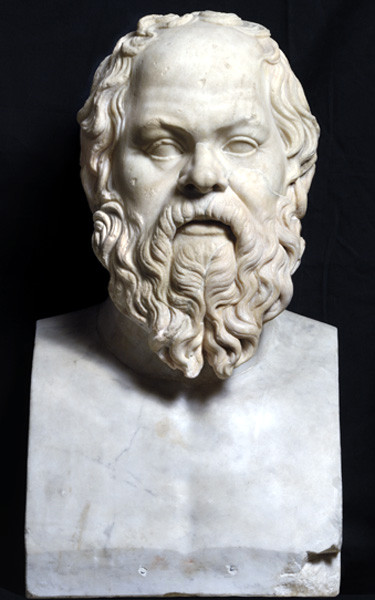
Herm depicting Socrates, 4th century BCE, Capitoline Museums, Rome, Italy.
⁉️ The painting premiered at the 1787 Paris Salon to widespread acclaim. Its frieze-like composition is one of the most celebrated visual portrayals of an ancient philosopher. The Met has identified an ancient bust, now at the Capitoline Museums, as the likely model for Socrates. Although the historical Socrates was elderly and frail, David presents him with a sculptural, heroic physique, employing the classical form to express moral and intellectual strength rather than literal appearance.
10. Washington Crossing the Delaware by Emanuel Leutze
Gallery 760
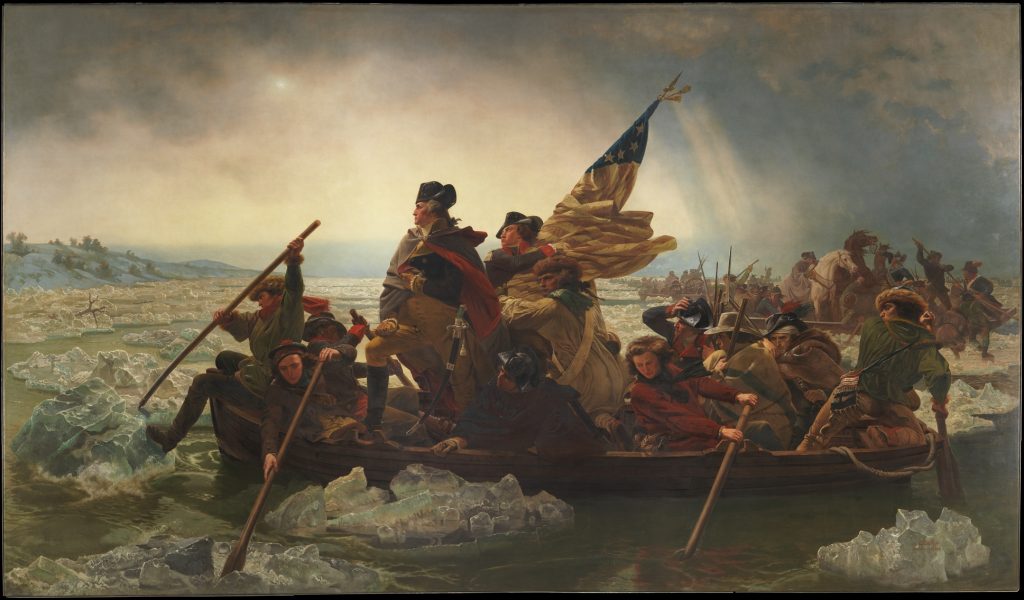
Emanuel Leutze, Washington Crossing the Delaware, 1851, Metropolitan Museum of Art, New York City, NY, USA.
📚 It is hard for modern audiences to comprehend the impact of monumental paintings before the advent of the moving image. In 1851, Leutze experienced the equivalent of a Hollywood blockbuster: 50,000 visitors attended the first exhibition of this epic canvas, which honors a pivotal moment in the American Revolutionary War. The work was created by Leutze while in Germany during the 1848 European revolutions, and he hoped it would inspire liberal reformers. At about 12 x 21 ft (4 x 6.5 m), it is a famous showstopper in the American Wing and the largest framed painting at the Met.
⁉️ This is Leutze’s second attempt; the original painting was damaged in a studio fire and later destroyed in World War II. It is considered a visual feast of heroism but known to be far from historically accurate (wrong time of day, incorrect flag, minuscule boat, absurd icy conditions, etc.), which has led to endless commentary and parody. Modern art critics have dismissed it as melodramatic and sentimental but its patriotic resonance has cemented it as an icon of the Met.
Fun fact: Both towns on either side of the Delaware River are now named Washington Crossing!
11. The Princesse de Broglie by Jean Auguste Dominique Ingres
Gallery 957
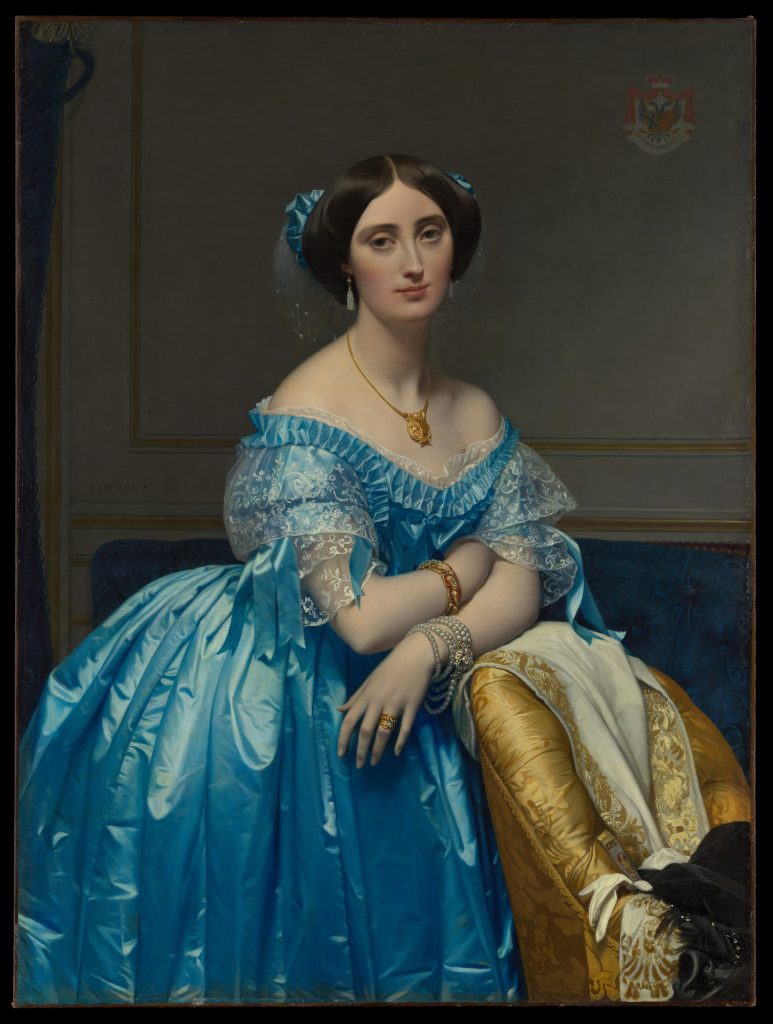
Jean Auguste Dominique Ingres, The Princesse de Broglie, 1851–1853, Metropolitan Museum of Art, New York City, NY, USA.
📚 Ingres was a Neoclassical portraiture rockstar, and Joséphine-Éléonore-Marie-Pauline de Galard de Brassac de Béarn (1825–1860) was his last sitter for a society portrait, which stands as one of his greatest and most refined works. Ingres showcases his consummate draftsmanship, evident in his meticulous rendering of her beauty, sumptuous costume, and well-known shyness. His characteristic practice of subtle anatomical exaggeration to attain ideal beauty also lends the princess a heightened grace.
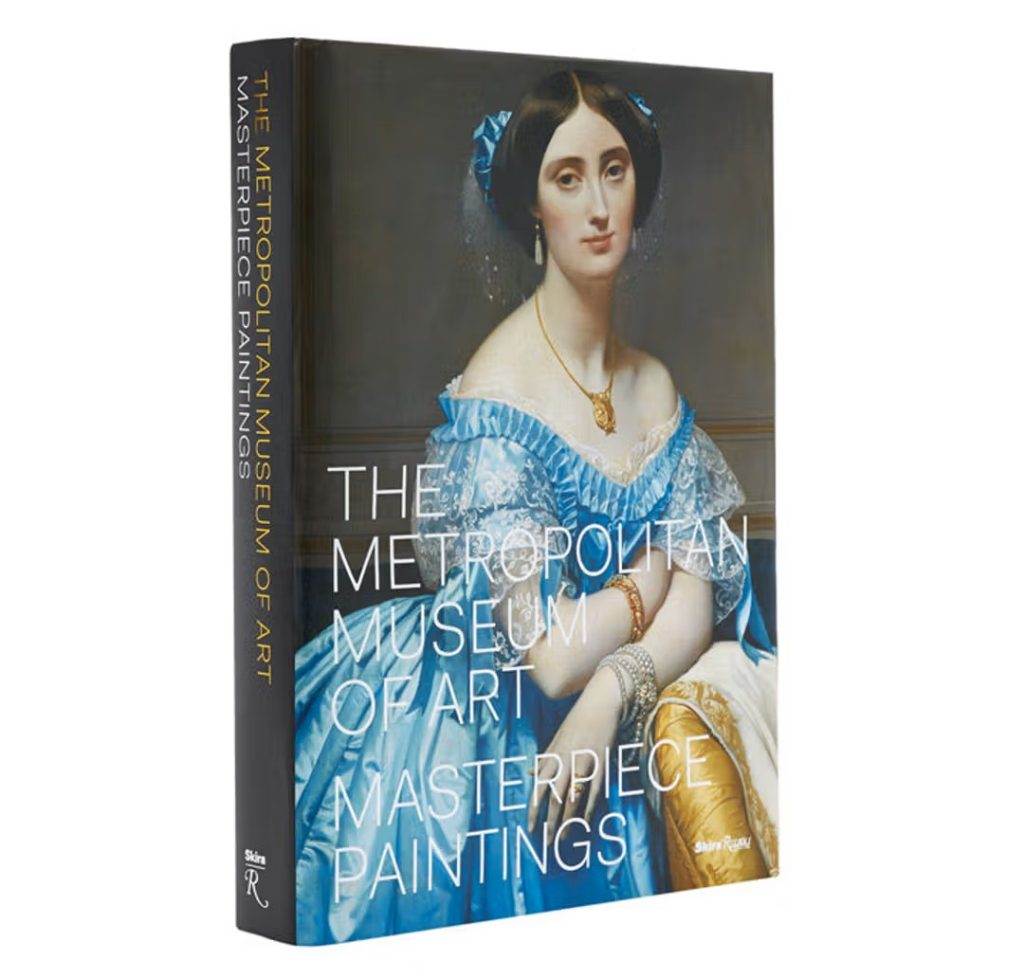
Cover of Kathryn Calley Galitz, The Metropolitan Museum of Art: Masterpiece Paintings, Skira Rizzoli/Metropolitan Museum of Art, New York 2016.
⁉️ Although viewers today may see the portrait’s delicacy as a premonition of the Pauline de Broglie’s later fragile health, Ingres could not have known this. He began it in 1851, when she was 26, completing it two years later. Its poignancy grew after Pauline de Broglie died from tuberculosis at age 35, leaving five sons. The painting’s significance was highlighted when it was chosen for the cover of the Met’s first complete survey of its famous painting collection, an award-winning book published in 2016.
12. The Horse Fair by Rosa Bonheur
Gallery 812
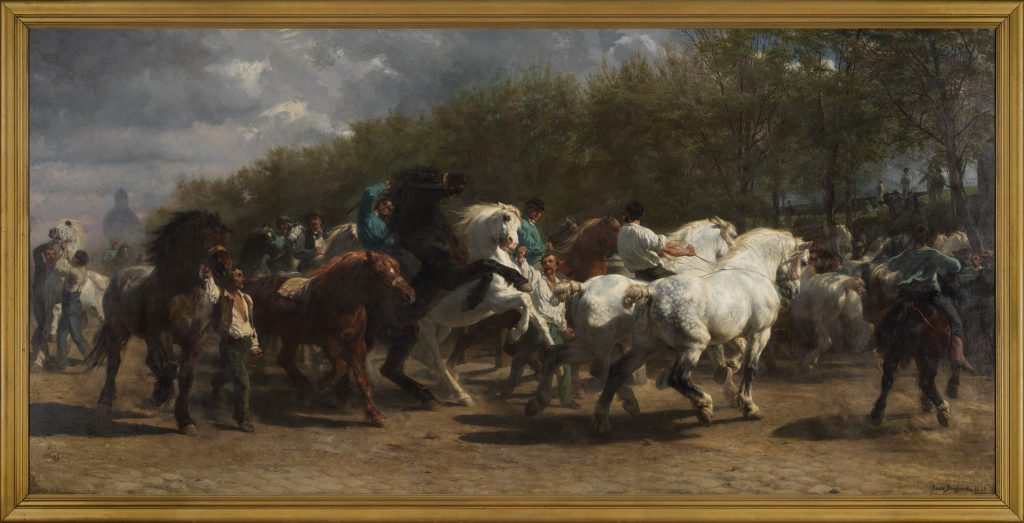
Rosa Bonheur, The Horse Fair, 1852–1855, Metropolitan Museum of Art, New York City, NY, USA.
📚 Rosa Bonheur, one of the most successful women painters of all time, was already well known in 1840s France for her animal paintings, many exhibited at the Paris Salon. She reached superstar status in 1853 with The Horse Fair, first showing a smaller version (now in London) before expanding it into this monumental canvas. With a permission de travestissement—a police permit allowing her to wear men’s clothing, which she called “a protection to me—avoiding disagreeable comments”—Bonheur spent over a year at the weekly horse fairs on the Boulevard de l’Hôpital, sketching, absorbing the atmosphere, and transforming the untamed spirit of the equine world into high art.
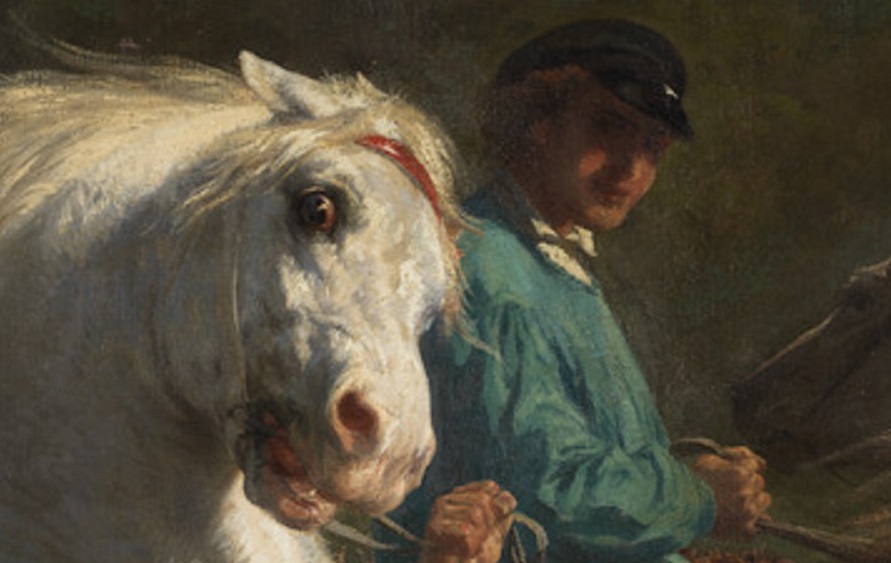
Rosa Bonheur, The Horse Fair, 1852–1855, Metropolitan Museum of Art, New York City, NY, USA. Detail.
⁉️ This masterpiece was exhibited across Europe and the United States, establishing Bonheur as an international celebrity. She was later exalted to the Legion of Honour and became one of the first women to be awarded France’s highest and most prestigious national order of merit. In 1991, historian James Saslow argued convincingly that the blue-smocked figure near the center, looking at the viewer, is a self-portrait of Bonheur.
13. The Cup of Tea by Mary Cassatt
Gallery 760
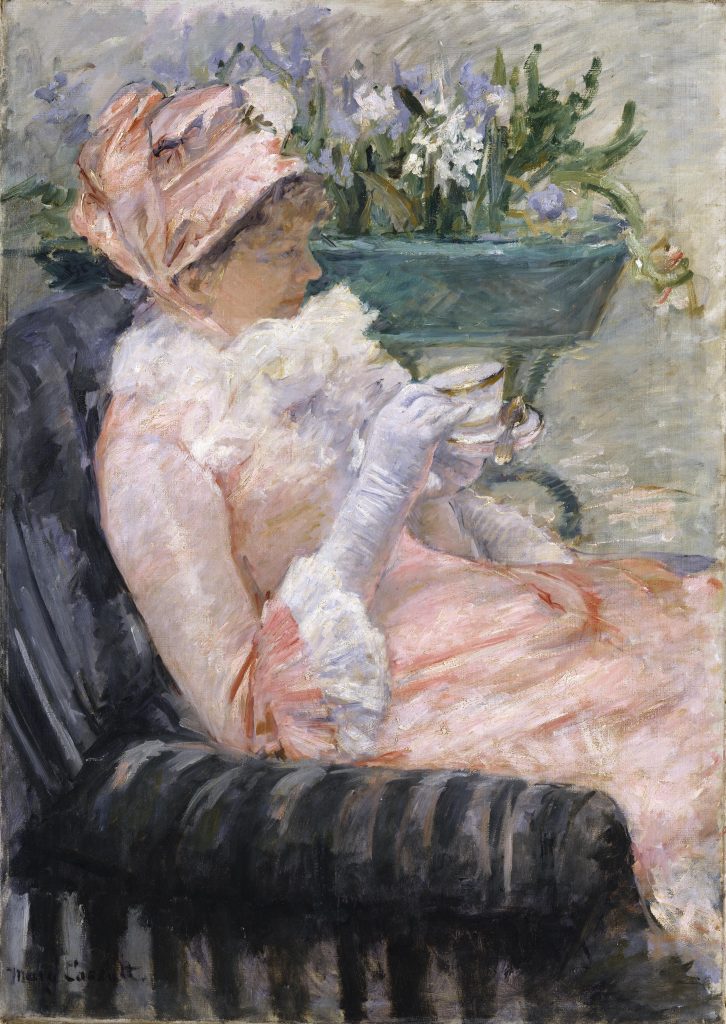
Mary Cassatt, The Cup of Tea, ca. 1880–1881, Metropolitan Museum of Art, New York City, NY, USA.
📚 Born into a well-to-do Pennsylvania family, Mary Cassatt studied at the Pennsylvania Academy of the Fine Arts, one of the first schools to train women alongside men, before moving to Paris in 1865. There she became the only American to join the Impressionists, and her techniques evolved under their influence and that of the French avant-garde, especially Manet and Degas. She boldly portrayed contemporary women across multiple mediums, while daringly exploring activities deemed suitably “feminine” at the time.
⁉️ Cassatt showed this canvas to great acclaim at the 1881 Impressionist exhibition. Defying expectations for women of her time, she defined herself by her work—writing in a 1918 passport application: “I am an American artist, temporarily residing abroad for professional work. I have been for long periods in France, studying and practicing art, my profession.” By then, cataracts had ended her painting career, but true to form, she turned her energy to the U.S. suffrage movement.
14. Madame X by John Singer Sargent
Gallery 771
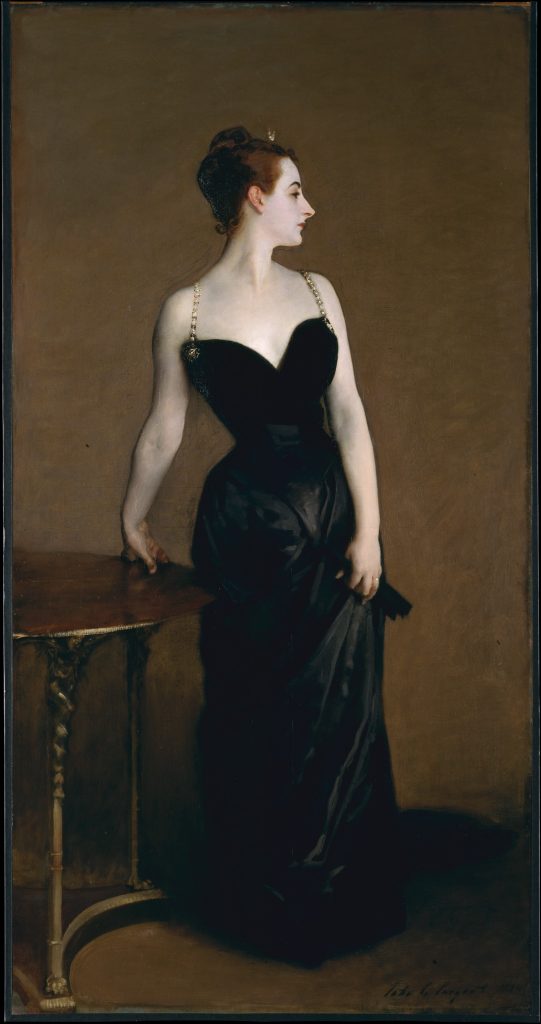
John Singer Sargent, Madame X, 1883–1884, Metropolitan Museum of Art, New York City, NY, USA.
📚 This striking portrait of American-born Paris socialite Virginie Avegno Gautreau (1859–1915) by Sargent infamously caused outrage among the guardians of “taste” at the 1884 Paris Salon. Her fallen dress‑strap (later repainted), assertive pose, and pale skin shocked polite society, and the scandal ultimately prompted Sargent to leave Paris. At 27, Sargent was a rising star and highly regarded expatriate painter, successful at the Salon and connected to elite artistic circles.
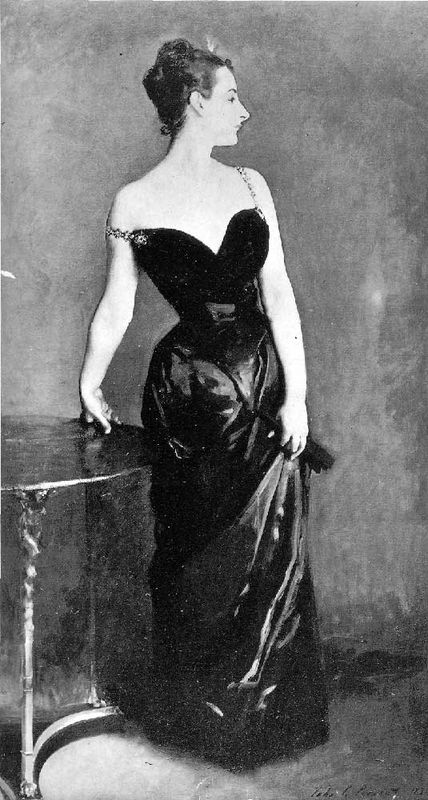
John Singer Sargent, Madame X as exhibited at the 1884 Paris Salon, before Sargent repainted the strap.
I suppose it is the best thing I have done.
Letter to Met Director Edward “Ned” Robinson. Metropolitan Museum of Art.
⁉️ Sargent asked Gautreau to pose for the portrait—not as a commission but at his own request. Over two years, he produced around 30 preparatory studies to capture her distinctive profile. A few years after his daring composition was met with ridicule, Sargent relocated to London and established one of the era’s most remarkable careers in grand manner portraiture. He repainted the shoulder strap and kept the work for more than 30 years. In 1916, Sargent sold the canvas to the Met, stating it was the best thing he had done.
15. Wheat Field with Cypresses by Vincent Van Gogh
Gallery 760
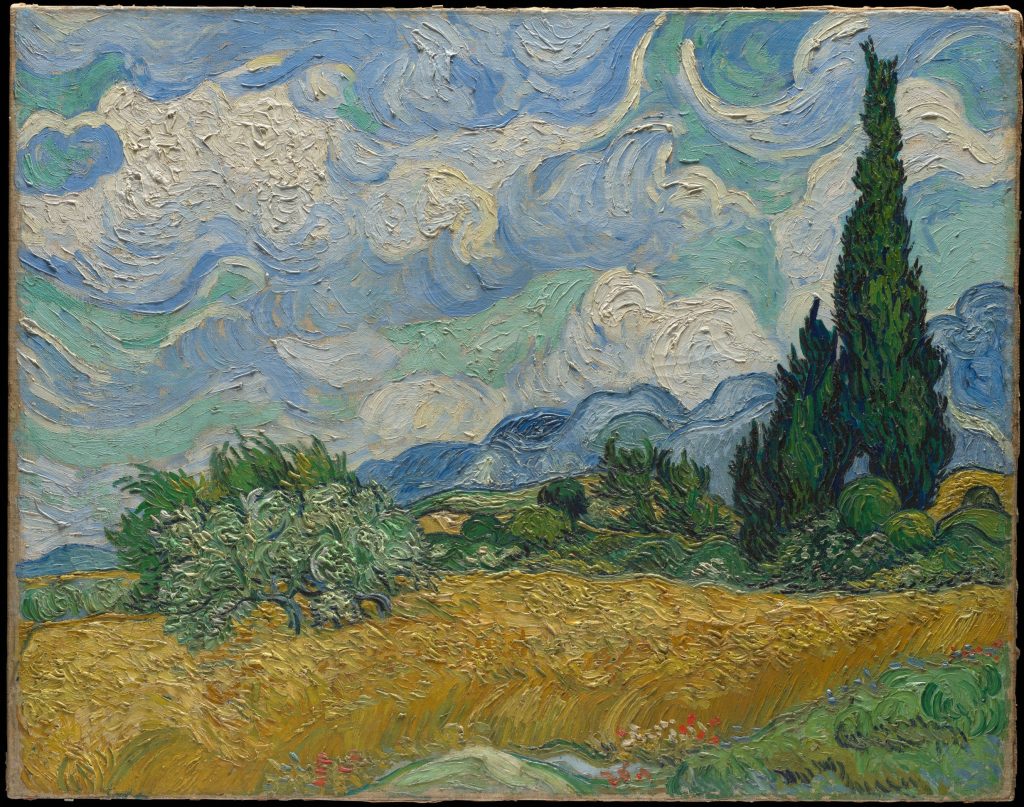
Vincent van Gogh, Wheat Field with Cypresses, 1889, Metropolitan Museum of Art, New York, NY, USA.
📚 This is one of three compositions with cypresses that Van Gogh created in 1889, around the same time as his iconic Starry Night at MoMA. He first painted cypresses in Arles in 1888; they became a major focus after he moved to the asylum at Saint-Rémy. In letters to his brother Theo, Van Gogh described his fascination with the spindly trees. In June, 1889 he wrote, “The cypresses still preoccupy me… it astonishes me that no one has yet done them as I see them.“ In July, referring to this composition, he added: “I have a canvas of cypresses with some ears of wheat, some poppies, a blue sky like a piece of multicoloured Scotch plaid…”
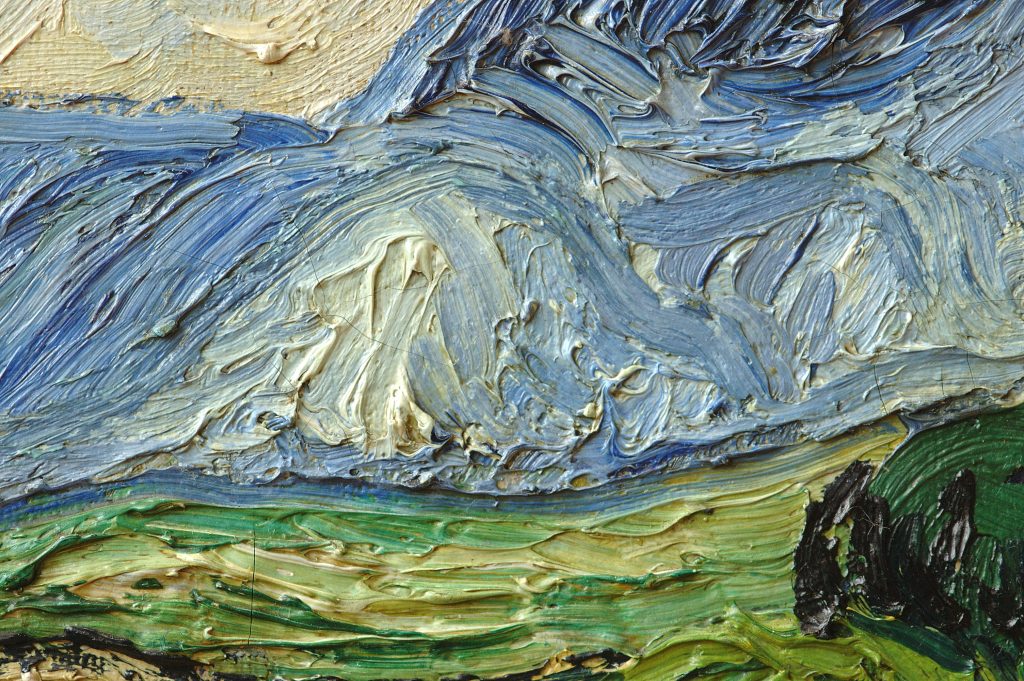
Vincent van Gogh, Wheat Field with Cypresses, 1889, Metropolitan Museum of Art, New York, NY, USA. Detail.
⁉️ In 2016, a provocative book claimed the Met’s famous painting was a forgery by Émile Schuffenecker, a known forger who once owned the canvas. While the book raised intriguing questions, it offered no solid evidence, and the claim remains a debunked fringe theory. Due to donor restrictions, this work cannot be lent and is viewable only in New York.
Fun fact: Imaging by the Met revealed tiny pebbles and corn husks embedded in the paint, evidence that this famous painting was created outdoors.