Masterpiece Story: Woman on Charpoy by Amrita Sher-Gil
Amrita Sher-Gil’s work has long been examined through the binaries of modernist and traditional, East and West. These debates have often...
Shivani Gupta 8 November 2026
8 November 2026 min Read
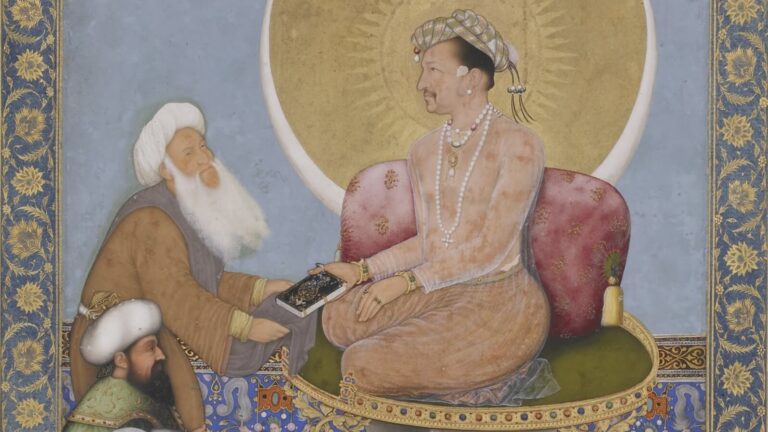
Bichitr, Jahangir Preferring a Sufi Shaikh to Kings from the Saint Petersburg Album, ca. 1615–1618, Freer Gallery of Art, National Museum of Asian Art, Smithsonian, Washington, DC, USA. Detail.
Why would a powerful emperor place a spiritual leader above other rulers, including the King of England? Bichitr’s Jahangir Preferring a Sufi Shaikh to Kings is a visual allegory of spiritual guidance over worldly powers and is a masterpiece of Mughal art.
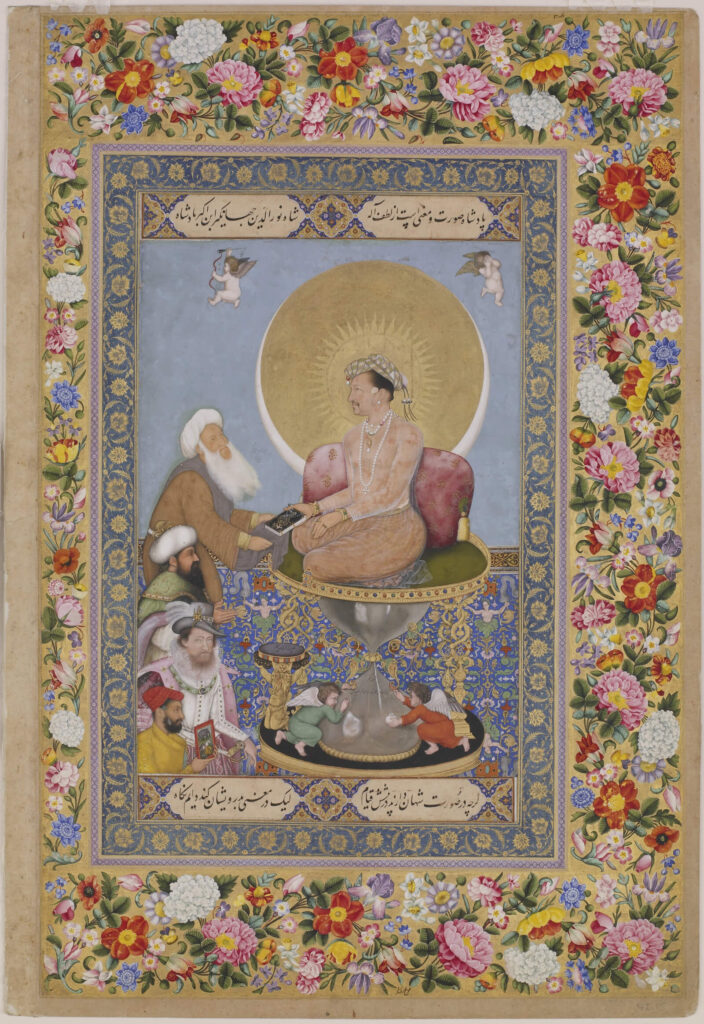
Bichitr, Jahangir Preferring a Sufi Shaikh to Kings from the Saint Petersburg Album, ca. 1615–1618, Freer Gallery of Art, National Museum of Asian Art, Smithsonian, Washington, DC, USA.
India has a long and rich artistic history spanning back millennia. One of its most famous artistic periods was the Mughal Empire (1526–1867), when Islamic emperors ruled over the subcontinent. The Mughal Empire was founded by Babur, a Muslim prince, who defeated local rulers at the Battle of Panipat in 1526.
He declared himself the first Mughal emperor, with “Mughal” meaning “descended from the Mongols.” He established his imperial capital at Delhi and founded an imperial art workshop by soliciting and employing skilled Persian masters to train local artists. Within four years, by 1530, the Mughal Empire was consolidated, and the court workshop was operational. A powerful dynasty and a new art school were quickly founded and growing.
Bichitr, Jahangir Preferring a Sufi Shaikh to Kings from the Saint Petersburg Album, ca. 1615–1618, Freer Gallery of Art, National Museum of Asian Art, Smithsonian, Washington, DC, USA. Detail.
Fast-forward 12 years to 1542, and the Mughal Empire was thriving under Babur’s grandson, Akbar the Great, as the third emperor (r. 1542–1605). When Jahangir later ascended as the fourth emperor (r. 1605–1627), the artistic and commercial wealth of the Mughal Empire was almost unparalleled in Indian history.
The East India Company (an English company founded in 1600) was selling and trading European luxury goods such as globes, sand hourglasses, and books with Indian merchants. Therefore, Emperor Jahangir’s reign was marked by a distinctly artistic international flair with Persian origins, Indian accomplishments, and English influences. This rarefied and cosmopolitan atmosphere sparked numerous beautiful artworks such as Mughal miniature paintings.
Bichitr, Jahangir Preferring a Sufi Shaikh to Kings from the Saint Petersburg Album, ca. 1615–1618, Freer Gallery of Art, National Museum of Asian Art, Smithsonian, Washington, DC, USA. Detail.
One of the most famous and beautiful of these miniature masterpieces is Jahangir Preferring a Sufi Shaikh to Kings. It is a full-page illustration from the Saint Petersburg Album, now owned and housed in the Freer Gallery of Art at the Smithsonian Institution in Washington, DC, USA. It measures 46.9 × 30.7 cm (18 7/16 × 12 1/16 in.) and is made from watercolor, ink, and gold on paper. It was created between 1615 and 1618 by Bichitr (active 1615–1640) under the commission of Emperor Jahangir.
Bichitr, Jahangir Preferring a Sufi Shaikh to Kings from the Saint Petersburg Album, ca. 1615–1618, Freer Gallery of Art, National Museum of Asian Art, Smithsonian, Washington, DC, USA. Detail.
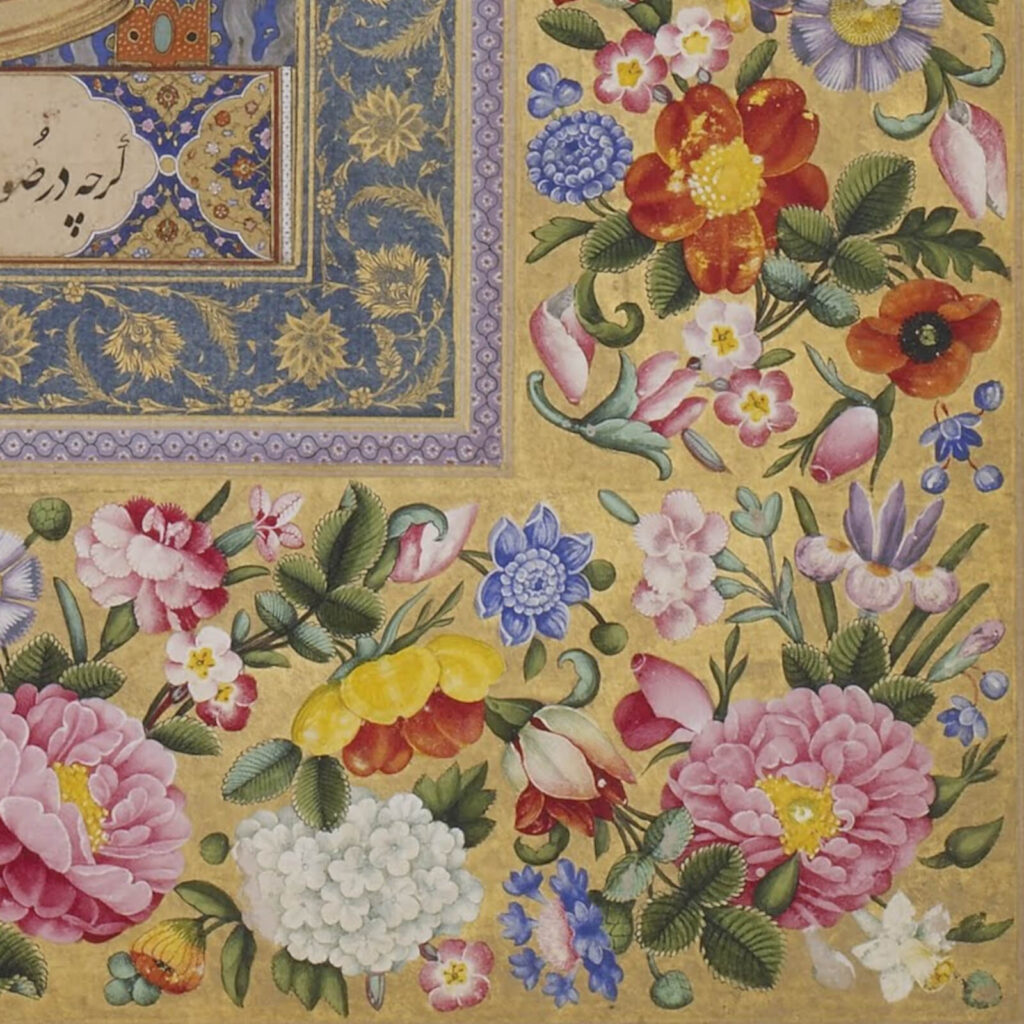
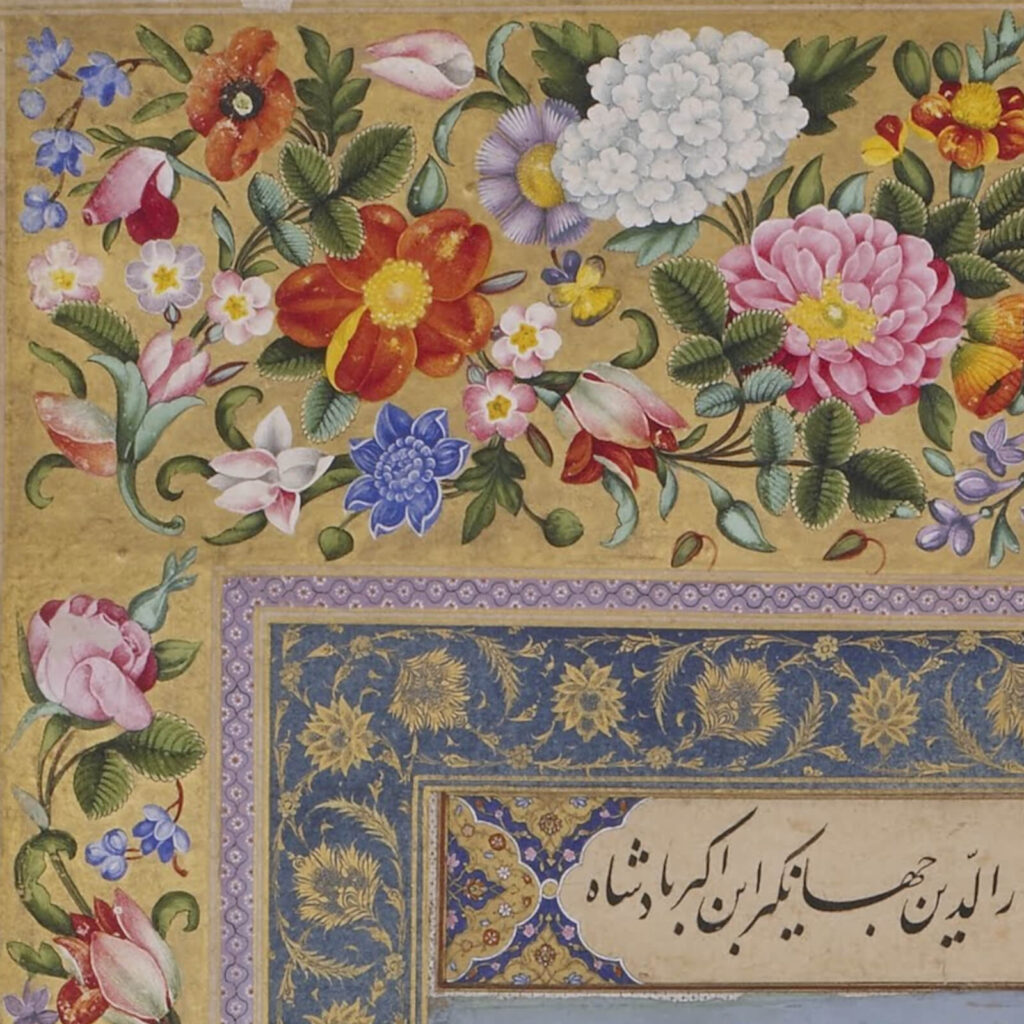
The composition is very elaborate with a profusion of patterns and figures filling the page. The outermost border is filled with flowers such as pink roses, blue irises, and red poppies. This floral border is a later 18th-century addition, dated around 1747–1748, and done by an unknown artist. While beautiful and graceful, it is not original to the central figural image and not the creation of Bichitr.
Bichitr, Jahangir Preferring a Sufi Shaikh to Kings from the Saint Petersburg Album, ca. 1615–1618, Freer Gallery of Art, National Museum of Asian Art, Smithsonian, Washington, DC, USA. Detail.
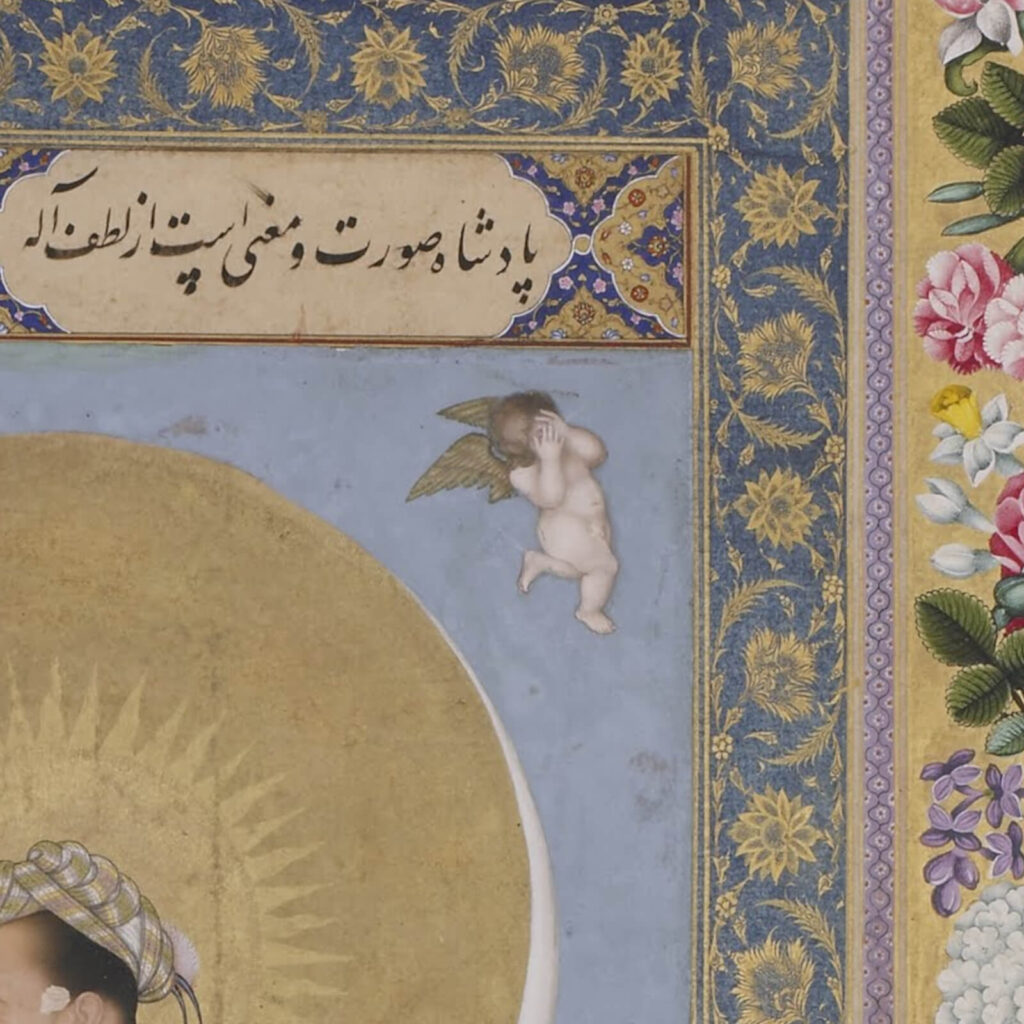
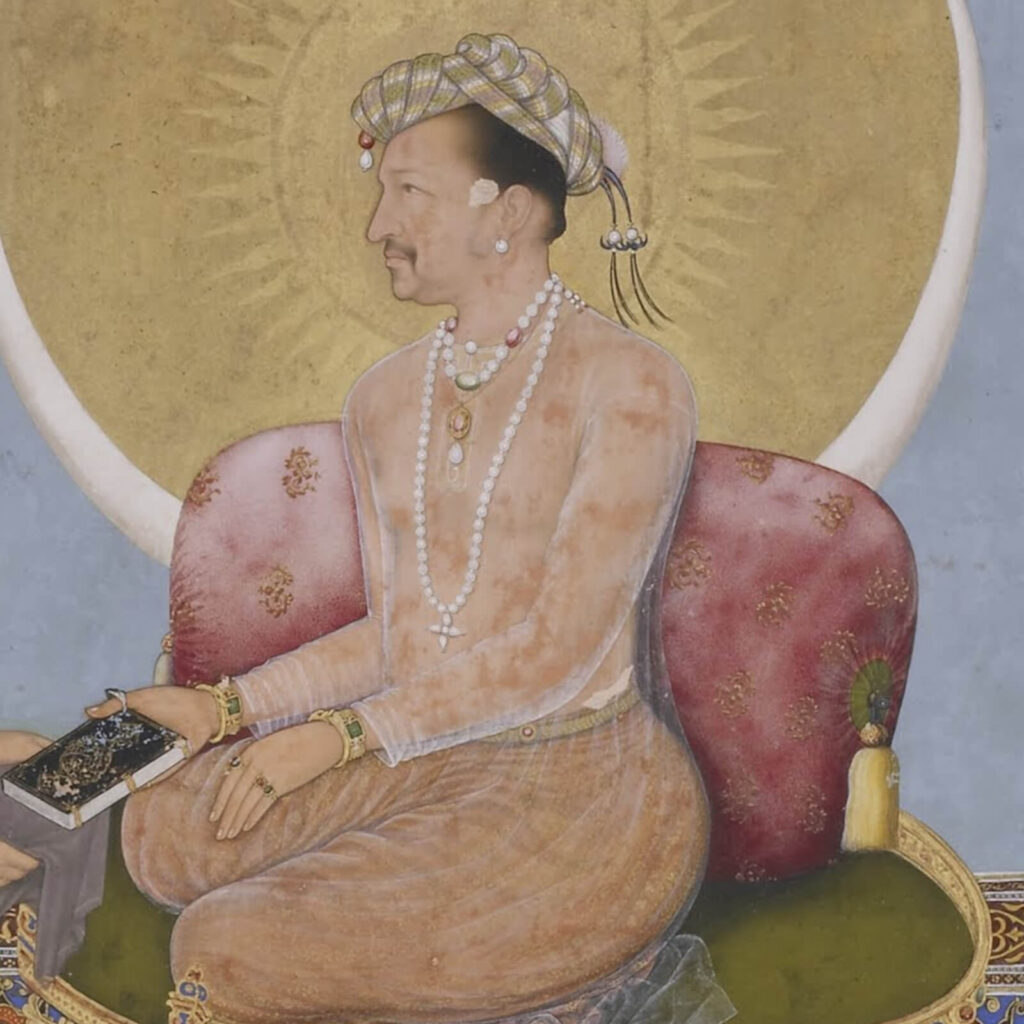
The innermost panel, measuring 25.3 × 18 cm (9 15/16 × 7 1/16 in.), is the real showstopper. It expresses the genius and mastery of Bichitr. It presents the Emperor Jahangir sitting on a large hourglass surrounded by figures. Behind the emperor is a round golden halo. On closer inspection, the halo is the sun and a crescent moon, combined to represent Jahangir’s heavenly and cosmic importance. He is the center of the universe (well, at least the center of Mughal society), and he radiates light as if he were a divine figure on earth. A nearby inscription states the “Light of the Faith.”
Bichitr, Jahangir Preferring a Sufi Shaikh to Kings from the Saint Petersburg Album, ca. 1615–1618, Freer Gallery of Art, National Museum of Asian Art, Smithsonian, Washington, DC, USA. Detail.
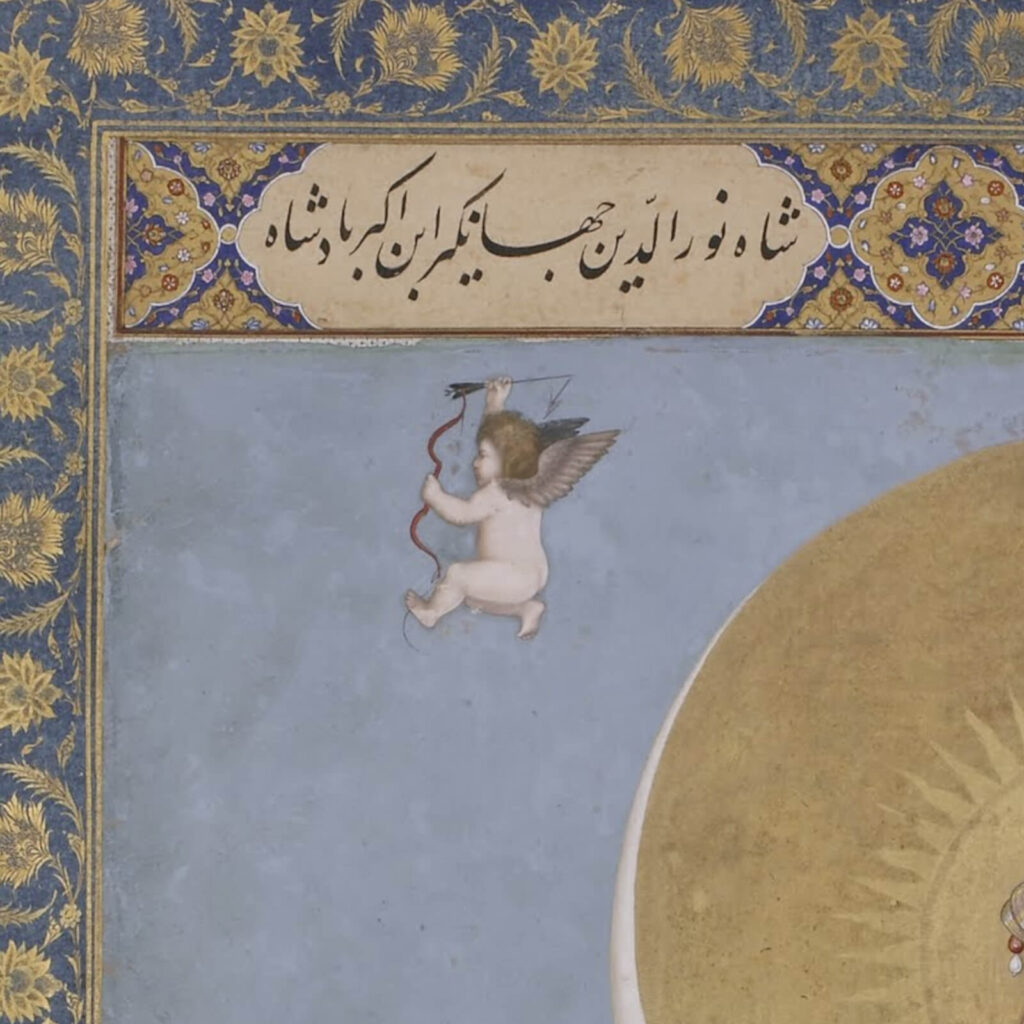
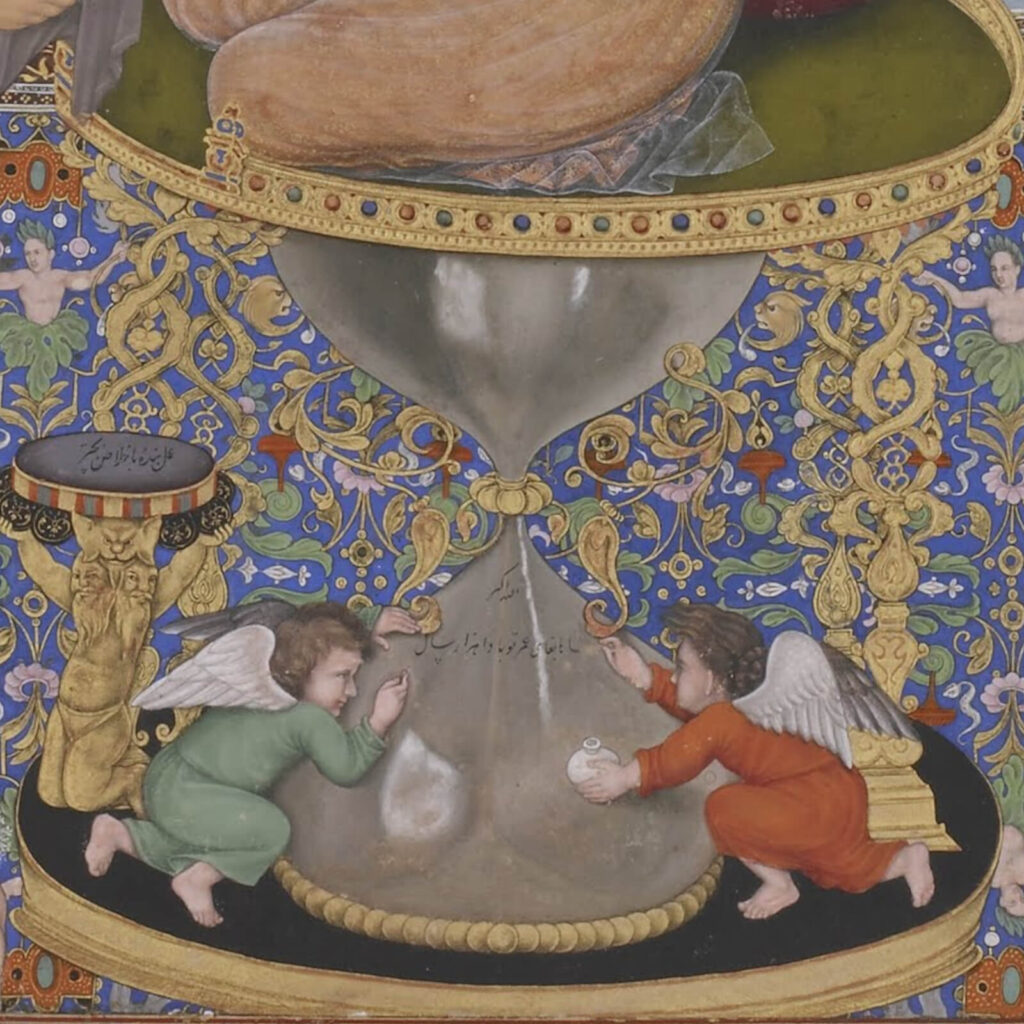
Emperor Jahangir sits atop a large hourglass, a European invention, which represents the passing of time. The emperor is attempting to control time by asserting his dominance. However, below, the sand trickles, implying the approaching end of his life and reign. Two clothed Cupids below cannot stop the sand, so they are writing a verse of blessing for the emperor to live 1000 years. It is an allegory of wishful longevity.
It is interesting to note that while two nude Cupids fly above Jahangir’s head, the two Cupids below are fully clothed. These four Cupids express strong European influence, as Cupids are not known in pre-Mughal Indian art; however, the clothing expresses strong Islamic influence of modesty. A nude Cupid wishing longevity would not have fit into the official imperial artistic repertoire, but a clothed Cupid could be tastefully acceptable.
Bichitr, Jahangir Preferring a Sufi Shaikh to Kings from the Saint Petersburg Album, ca. 1615–1618, Freer Gallery of Art, National Museum of Asian Art, Smithsonian, Washington, DC, USA. Detail.
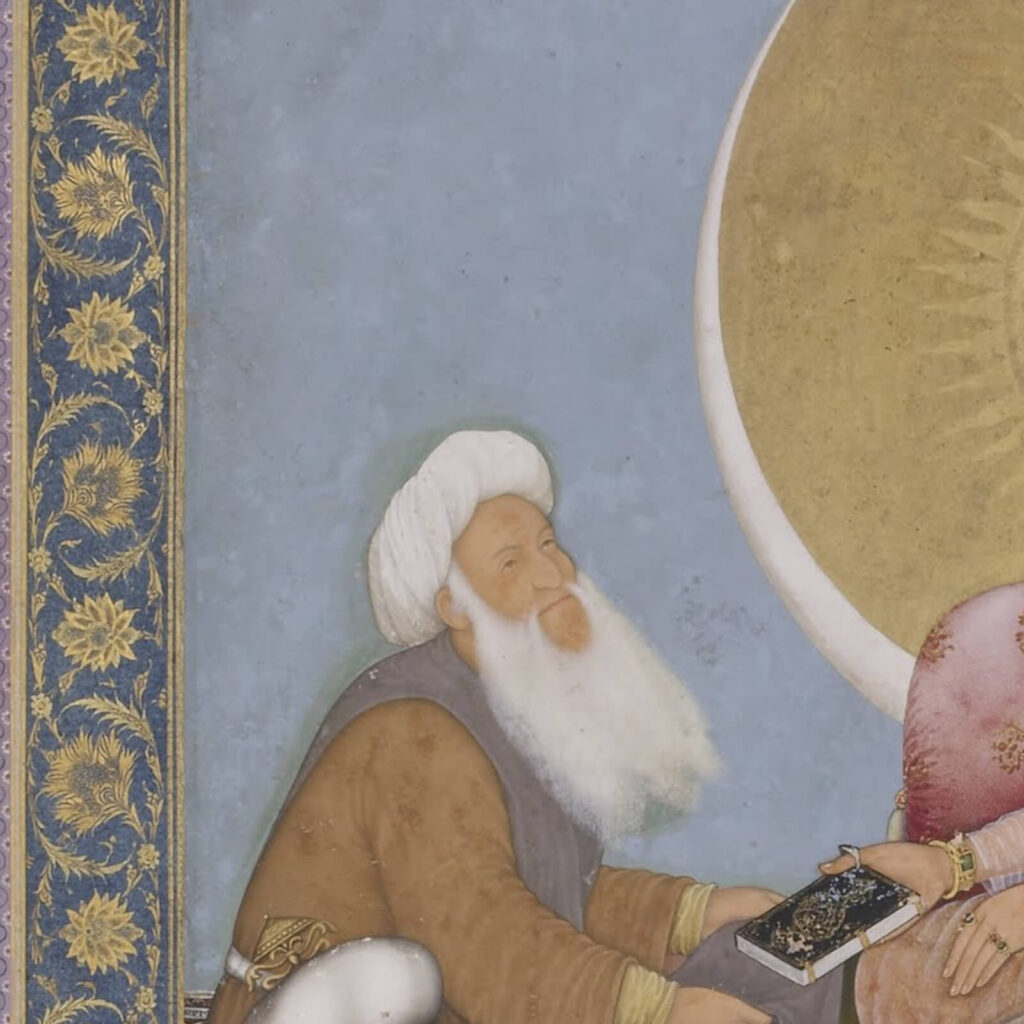
Before Jahangir are four distinct male figures who descend down the left side of the page. Their placement on the page indicates their social position relative to the Mughal emperor. Facing Jahangir is the most important figure, a Muslim Sufi shaykh (mystic saint) with his white turban and long white beard.
According to imperial records, Jahangir’s father (Emperor Akbar) visited the shaykh many years earlier and requested prayers for a son and heir. Later in 1569, with the birth of Jahangir, Akbar’s prayers were answered and then fulfilled in 1605 with Jahangir’s ascension. However, records do not indicate if the mystic was ever rewarded. Therefore, Jahangir rewarded the mystic during his reign with a luxurious and costly book, presumably an Islamic holy text, as an overdue reward. Jahangir shows gratitude for his life and reign through the divine influence of the shaykh.
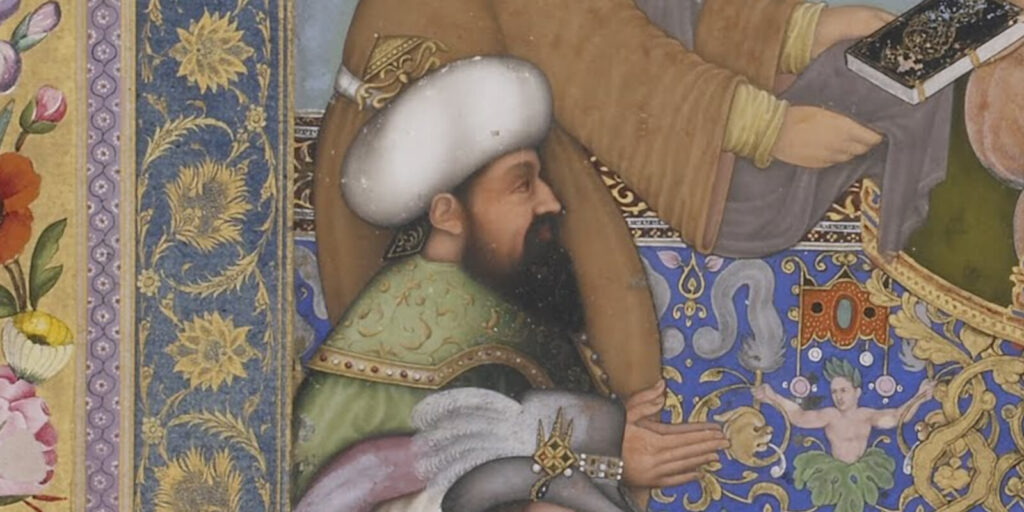
Bichitr, Jahangir Preferring a Sufi Shaikh to Kings from the Saint Petersburg Album, ca. 1615–1618, Freer Gallery of Art, National Museum of Asian Art, Smithsonian, Washington, DC, USA. Detail.
Below the shaykh is a Turkish sultan with his white turban and green clothing. Despite his individualized features, most art historians do not believe it to be a portrait of a specific sultan. It is merely a symbolic social placement that Turkish rulers are below mystic saints.
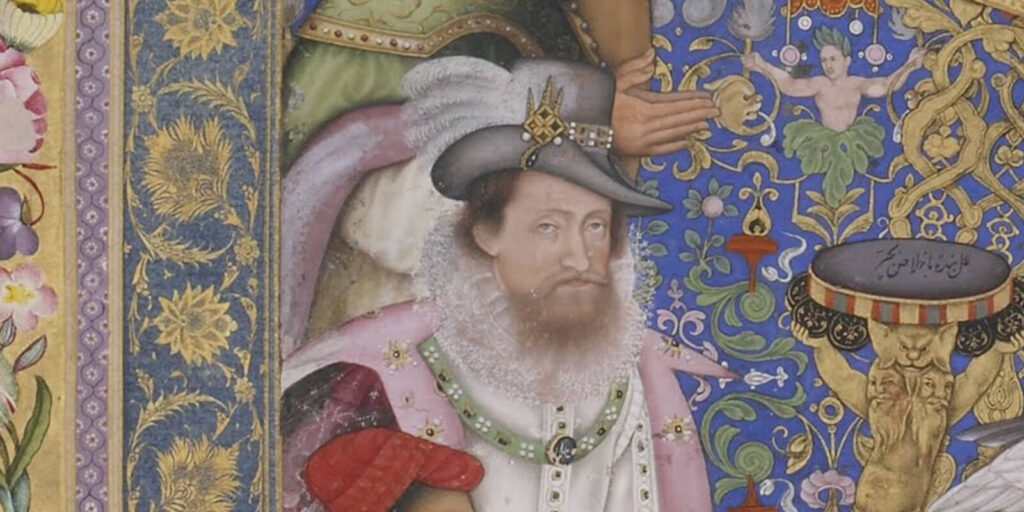
Bichitr, Jahangir Preferring a Sufi Shaikh to Kings from the Saint Petersburg Album, ca. 1615–1618, Freer Gallery of Art, National Museum of Asian Art, Smithsonian, Washington, DC, USA. Detail.
Below the Turkish sultan is a portrait of King James I of England (r. 1603–1625). This English ruler is mostly famous for his sponsorship of the King James Version (KJV) of the Christian Bible (1604–1611). However, how did Bichitr know the appearance of King James I of England? An authenticated royal portrait of the king was gifted to Jahangir as a diplomatic gesture of goodwill prior to the commissioning of the miniature. The gifted portrait was created by the celebrated royal English court painter John de Critz. Therefore, an English-commissioned and English-gifted portrait of King James I was at the heart of the Mughal court when Bichitr painted this miniature.
The king’s likeness is realistically captured. However, it is very striking to see that the English king takes a less prestigious position than a Turkish sultan and even further below a shaykh. Clearly, this painted miniature was not intended for the eyes and knowledge of King James I of England.
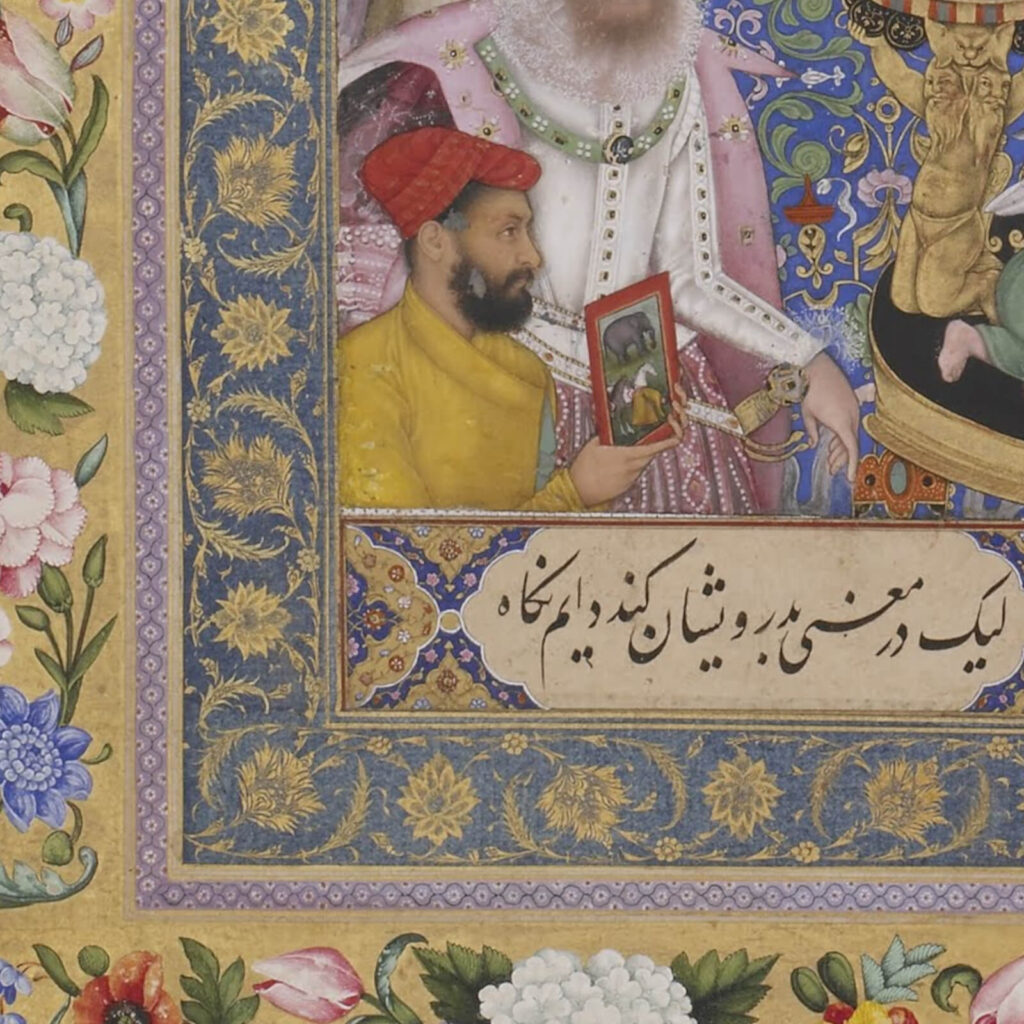
Bichitr, Jahangir Preferring a Sufi Shaikh to Kings from the Saint Petersburg Album, ca. 1615–1618, Freer Gallery of Art, National Museum of Asian Art, Smithsonian, Washington, DC, USA. Detail.
Finally, at the lowest placement is Bichitr, the Hindu painter himself, a self-portrait, in a red turban. He holds a small painting of two horses and an elephant, which were gifts from Emperor Jahangir to the artist. Bichitr even includes a miniature of himself on the painting with him bowing forward in gratitude.
However, his modesty did not prevent him from including his name within the composition of the miniature. Look at the footstool, to the left of Jahangir and before the face of King James I of England. Bichitr’s name is inscribed to identify him as the creator of this larger image. Interestingly, Bichitr counteracts his boastful inscription by its very placement on the footstool. The emperor literally steps on the artist’s name when he surmounts the hourglass. The artist’s name is trampled underfoot. It is a curious clue as to how humbly artists were regarded in Mughal court society. Artists were valued more than in previous Indian empires. Most artists under the previous Hindu and Buddhist empires are left nameless. Their masterpieces are unnamed and undocumented. Is there a correlation between the faiths and the artists’ social prestige? Probably not. It is simply a progression over time of artists’ appreciation and recognition in the art world.
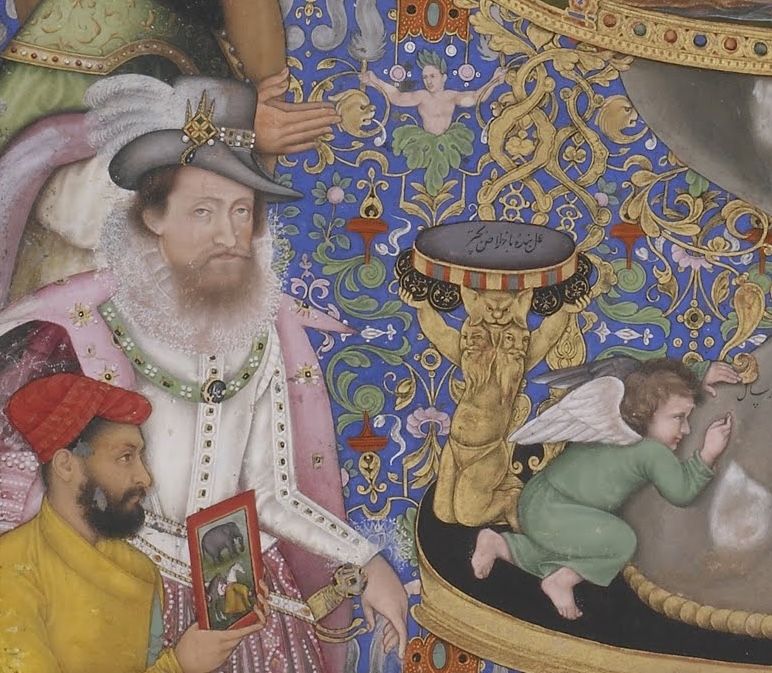
Bichitr, Jahangir Preferring a Sufi Shaikh to Kings from the Saint Petersburg Album, ca. 1615–1618, Freer Gallery of Art, National Museum of Asian Art, Smithsonian, Washington, DC, USA. Detail.
Jahangir Preferring a Sufi Shaikh to Kings is a visual allegory of how a Mughal emperor can prefer spiritual guidance over worldly power. The surrounding larger inscription reads, as if in summary, “Although to all appearances kings stand before him, Jahangir looks inwardly towards the dervishes [Islamic holy men] for guidance.” It is a forceful message of the divine over the secular, all within the scope of the materially rich and international court of the Mughal Empire.
The image is therefore a masterpiece of Mughal art, Indian miniature painting, and the larger scope of Indian art history. Its small composition packs a punch of Islamic symbols, international influences, and vibrant colors.
Bichitr, Jahangir Preferring a Sufi Shaikh to Kings from the Saint Petersburg Album, ca. 1615–1618, Freer Gallery of Art, National Museum of Asian Art, Smithsonian, Washington, DC, USA. Detail.
Gardner, Helen, Fred S. Kleiner, and Christin J. Mamiya. Gardner’s Art Through the Ages. 12th ed. Belmont, CA, USA: Thomson Wadsworth, 2005.
“Jahangir Preferring a Sufi Shaikh to Kings.” Collection. Freer Gallery of Art, Smithsonian Institution, Washington, DC, USA. Retrieved 25 October 2026.
DailyArt Magazine needs your support. Every contribution, however big or small, is very valuable for our future. Thanks to it, we will be able to sustain and grow the Magazine. Thank you for your help!

James W. Singer is an art historian and fine art photographer. He earned a Bachelor of Arts in Art History from the University of Florida. He later moved to Paris, France. He currently writes “Masterpiece” articles for DailyArt Magazine.

Amrita Sher-Gil’s work has long been examined through the binaries of modernist and traditional, East and West. These debates have often...
Shivani Gupta 8 November 2026
Judith and Holofernes is a Caravaggio masterpiece that captures Biblical murder and drama. Rarely has death been captured so intensely and violently...
James W Singer 13 September 2026
Explore an astonishing 1915 nude self portrait by American modernist painter Florine Stettheimer.
Candy Bedworth 21 September 2026
Winslow Homer (1836–1910) was one of the leading American Realist painters. His painting The Veteran in a New Field is a masterpiece of late...
James W Singer 30 August 2026