

Masterpiece Story: The Veteran in a New Field by Winslow Homer
Winslow Homer (1836–1910) was one of the leading American Realist painters. His painting The Veteran in a New Field is a masterpiece of late...
James W Singer 30 August 2026
13 September 2026 min Read
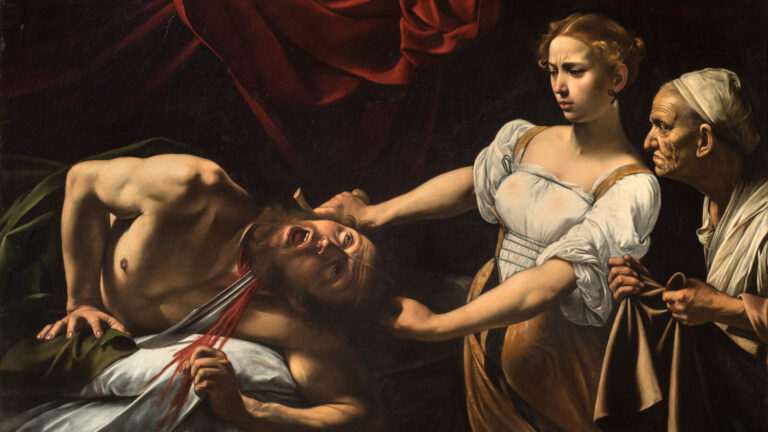
Caravaggio, Judith and Holofernes, ca. 1598–1602, Galleria Nazionale d’Arte Antica, Palazzo Barberini, Rome, Italy. Detail.
Judith and Holofernes is a Caravaggio masterpiece that captures Biblical murder and drama. Rarely has death been captured so intensely and violently as in Caravaggio’s Holofernes.
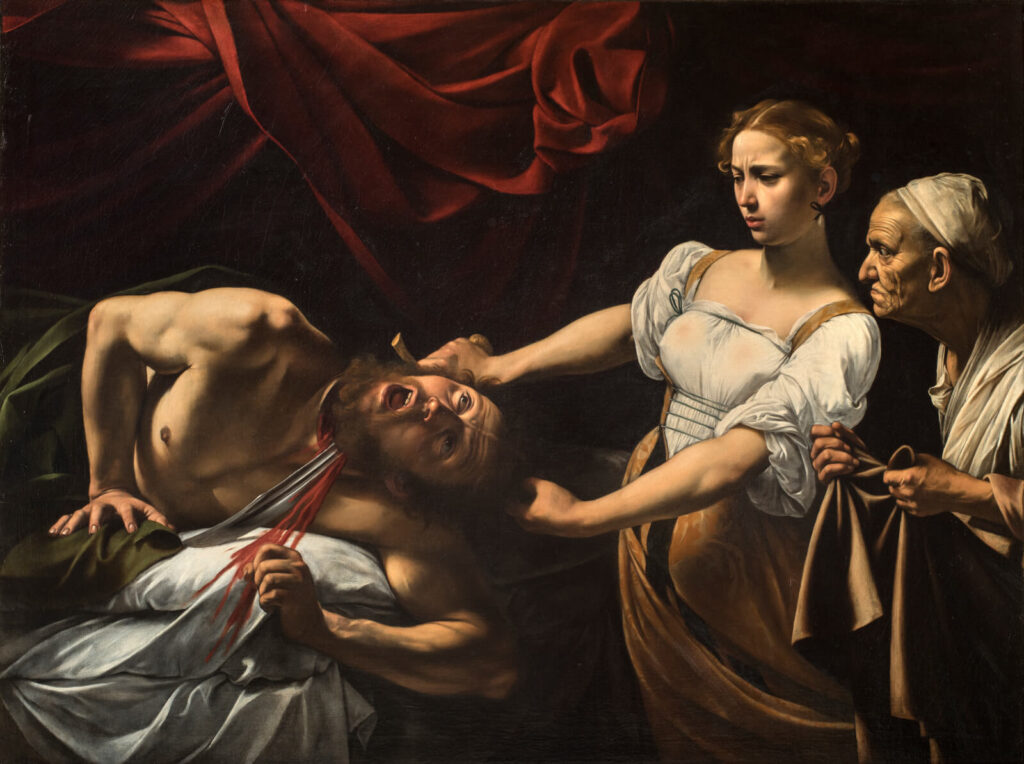
Caravaggio, Judith and Holofernes, ca. 1598–1602, Galleria Nazionale d’Arte Antica, Palazzo Barberini, Rome, Italy.
Caravaggio (1571–1610) is one of the most influential painters in Western art history. His signature style of dramatic lighting, intense emotions, and unidealized bodies became a cornerstone of Baroque art. During his 38 years, Caravaggio painted between 40 and 80 canvases, with many works lost or unidentified until they were rediscovered centuries later. For example, Judith and Holofernes (or Judith Beheading Holofernes), a previously unknown masterpiece, was discovered and attributed to Caravaggio in 1950. It is a perfect example of Caravaggio’s distinctive theatrical paintings. The intense murder scene is captured at its most dramatic and bloody moment!
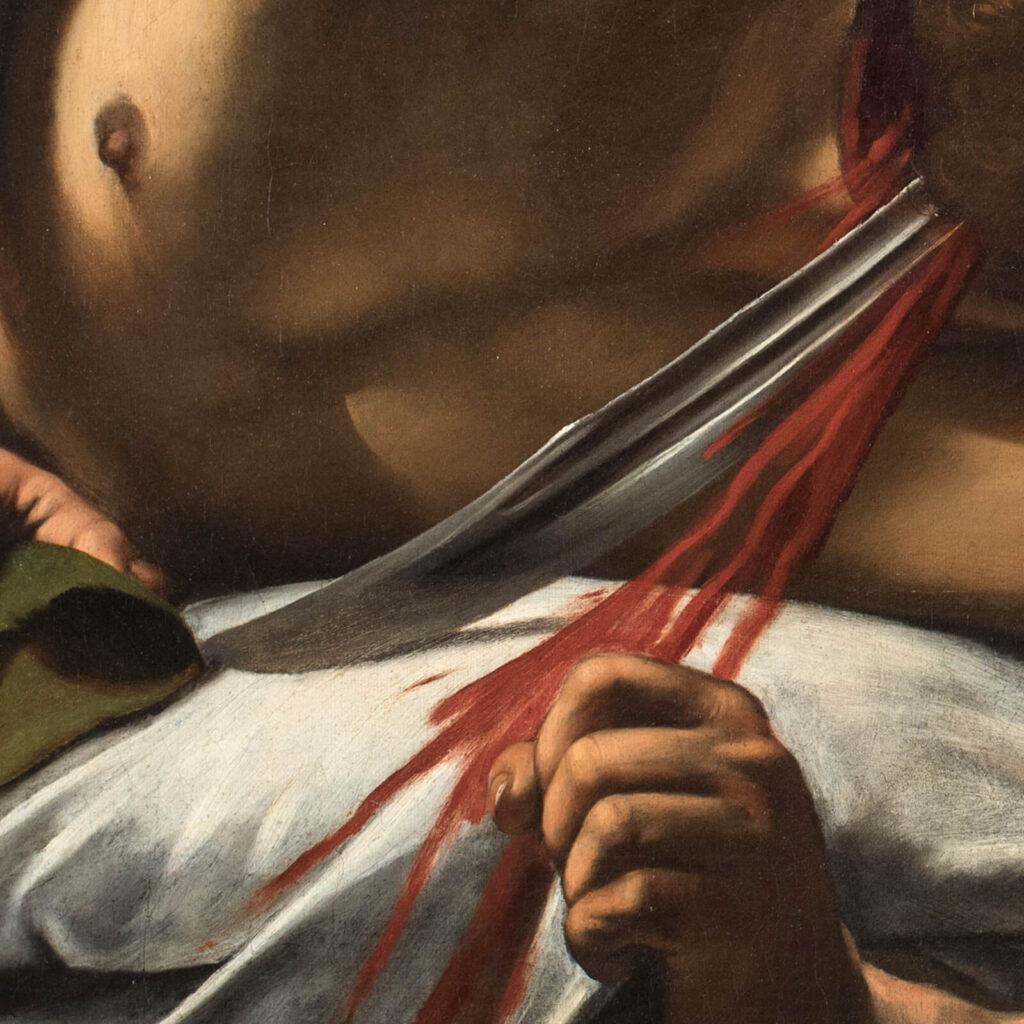
Caravaggio, Judith and Holofernes, ca. 1598–1602, Galleria Nazionale d’Arte Antica, Palazzo Barberini, Rome, Italy. Detail.
Judith and Holofernes was painted between 1598 and 1602 as a commission for Ottavio Costa (1554–1639), a wealthy, aristocratic Genoese banker. Costa lived and worked in Rome’s high society; therefore, he probably knew Caravaggio’s first major patron, Cardinal Francesco Maria del Monte. Costa was probably introduced to Caravaggio by del Monte, since del Monte introduced and exposed Caravaggio to several elite banking families. Hence, Judith and Holofernes is most likely an artistic product of professional networking.
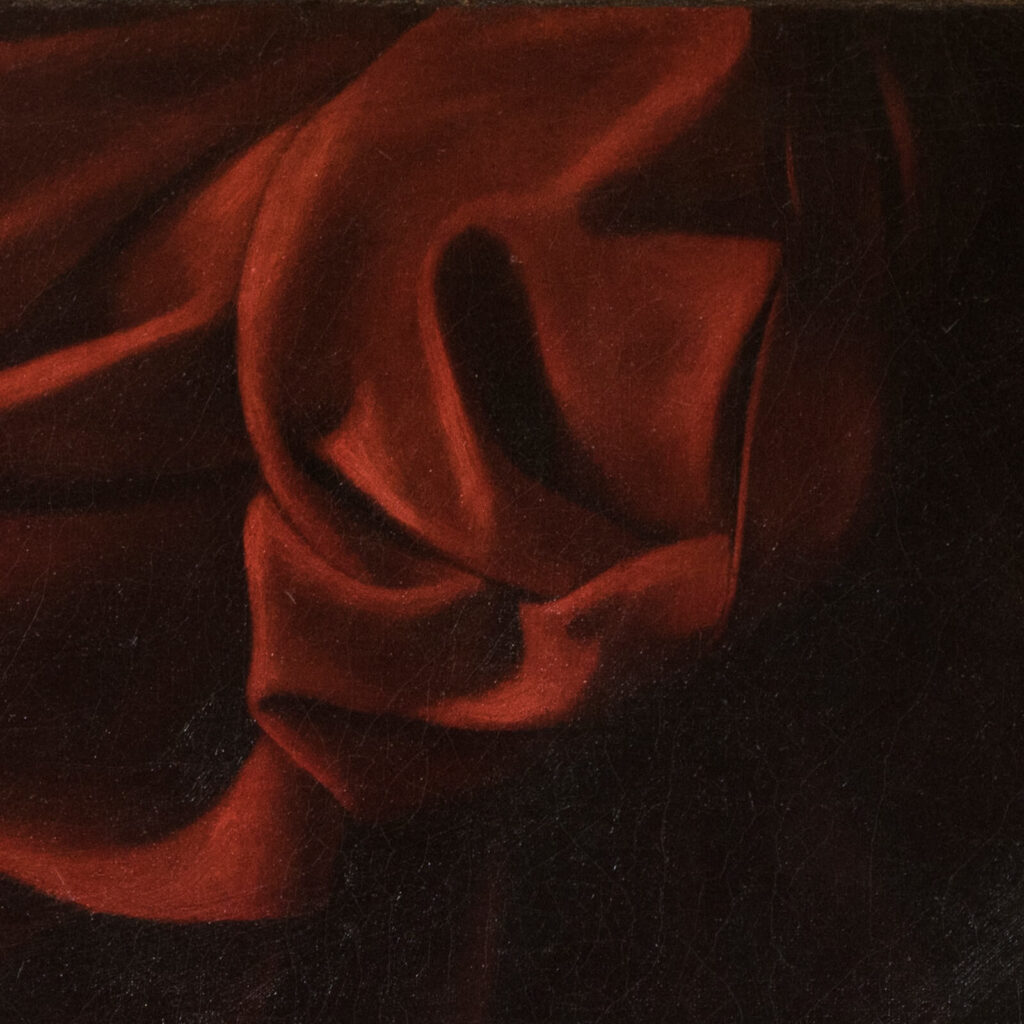
Caravaggio, Judith and Holofernes, ca. 1598–1602, Galleria Nazionale d’Arte Antica, Palazzo Barberini, Rome, Italy. Detail.
Judith and Holofernes is a horizontal oil on canvas measuring 145 by 195 cm (57 × 77 in.). The scene is set at night inside a general’s bedroom. The background is absorbed in black shadow while the foreground is highlighted with bold directional lighting.
Three figures dominate the foreground. Holofernes, an Assyrian general, fills the left area. Judith, a young Jewish widow, stands near the right. An old woman, Judith’s unnamed maid, stands on the far right, projecting from the canvas edge. Judith is decapitating Holofernes with a sword as the maid observes. But why? What is the story?
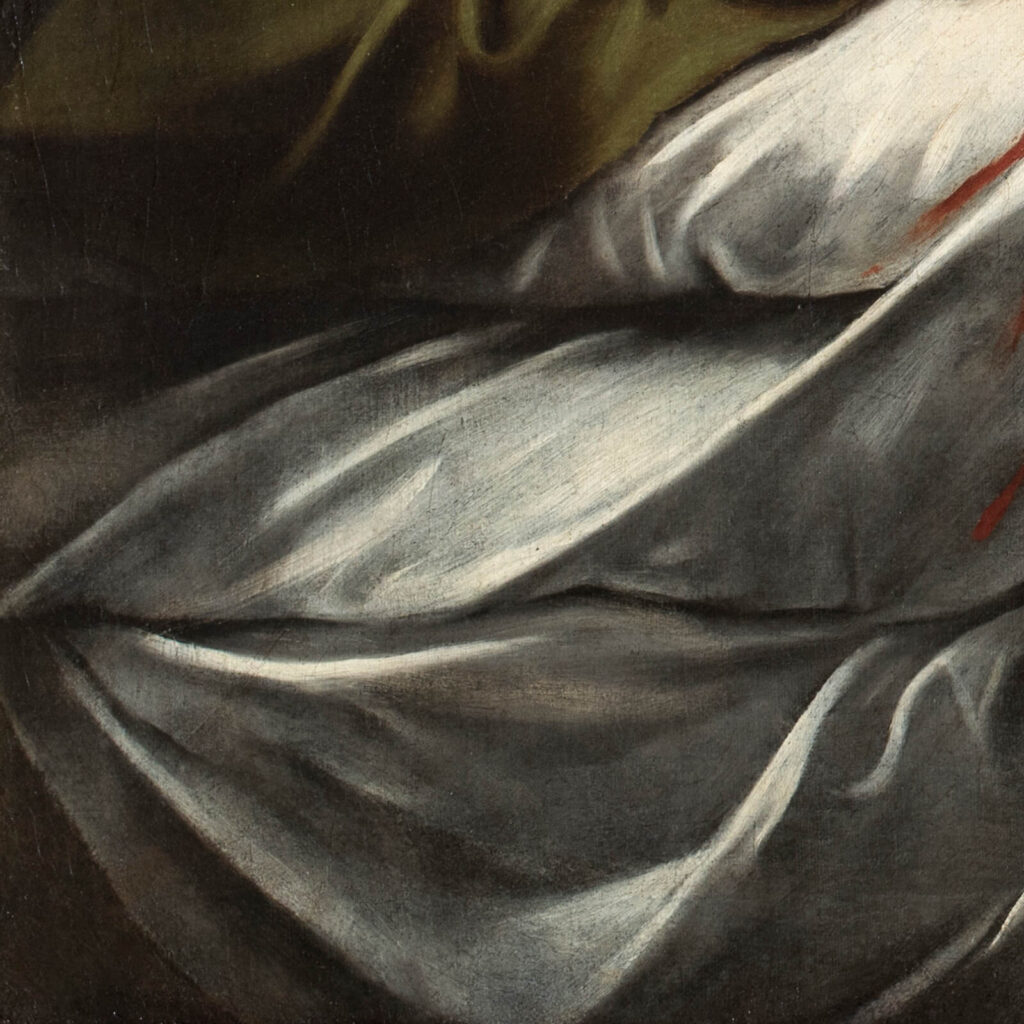
Caravaggio, Judith and Holofernes, ca. 1598–1602, Galleria Nazionale d’Arte Antica, Palazzo Barberini, Rome, Italy. Detail.
The Catholic Bible retains many volumes that were eliminated by the Protestant Reformation (1517–ca. 1618). The Book of Judith is one such example, and in Chapter 13 it explains and describes Judith’s murderous scene.
According to the text, the Assyrian general Holofernes was attempting to besiege the Jewish city of Bethulia, the hometown of the widow Judith. After much conflict, the city leaders decided that they would surrender the city in five days. Judith was disgusted and believed that her Jewish neighbors could be saved if she took bold action. She removed her somber mourning clothes, bathed, and dressed in her finest and brightest clothing and jewelry. She passed through the main city gates and walked towards the Assyrian camp. When the Assyrian patrol stopped her, she stated that she was fleeing Bethulia and that she could aid Holofernes in capturing the city. Judith’s beauty and charm captivated the soldiers, who then led her directly to the general’s tent.
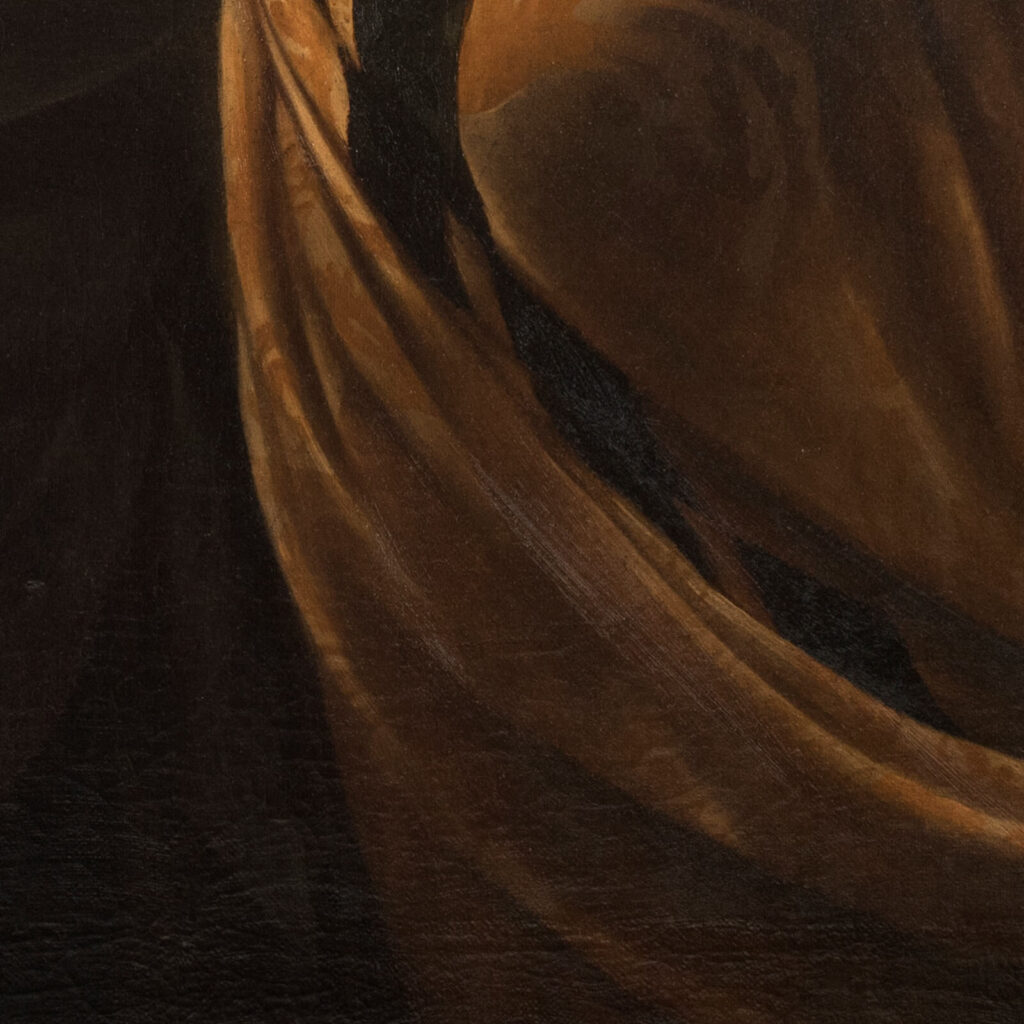
Caravaggio, Judith and Holofernes, ca. 1598–1602, Galleria Nazionale d’Arte Antica, Palazzo Barberini, Rome, Italy. Detail.
Judith then charmed Holofernes and slowly gained his trust over the next four days. She first began by praising Holofernes’s king, Nebuchadnezzar, and stating that he was right to conquer the Israelites. Then she said the Israelites were doomed to surrender because they had sinned against God. She then claimed religious purity by declining the Assyrian food rations, eating her own provisions, and excusing herself every night to leave the camp to pray.
By the fourth night, Holofernes was enamoured with Judith and physically desired her. He invited her to a banquet where he drank lots of wine. Late in the evening, Judith invited the intoxicated Holofernes back to his tent, where he quickly fell asleep. Judith, perfectly sober, then seized the general’s sword and decapitated him. Judith’s maid stood nearby to collect the head and place it in a bag.
Judith then returned to her hometown, showed the enemy’s decapitated head, and inspired her people to attack. When the Assyrian army discovered that its powerful general was dead, it panicked and fled in chaos. Ultimately, they were defeated by the Israelite army, and Judith was pronounced a heroine.
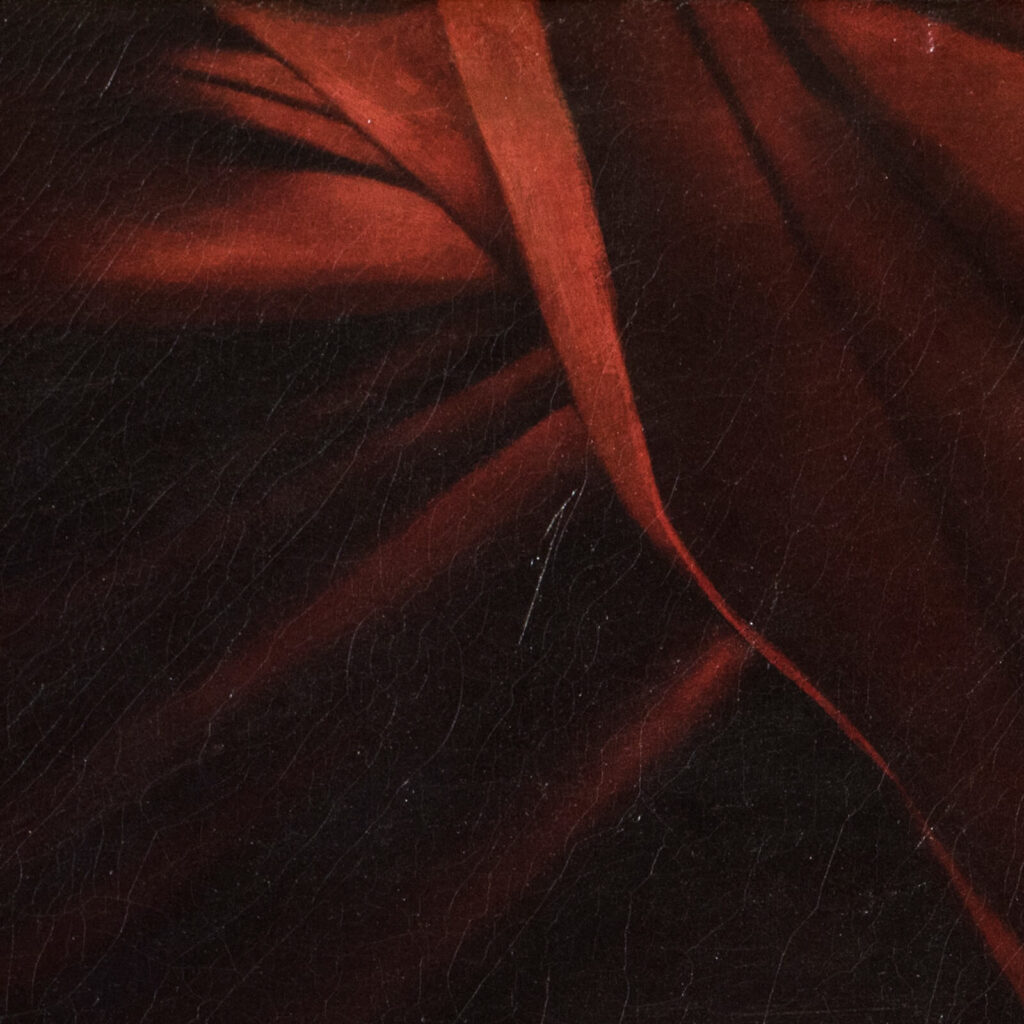
Caravaggio, Judith and Holofernes, ca. 1598–1602, Galleria Nazionale d’Arte Antica, Palazzo Barberini, Rome, Italy. Detail.
Caravaggio captures on canvas the most dramatic moment of the story. It is the moment of Judith beheading Holofernes with his own sword. Her face appears calm but engaged. Her eyebrows furrow with a look of determination despite the undercurrent of repulsion due to the explosion of blood. Her white pearl and black ribbon earrings sway as her body moves with the momentum of slicing the thick general’s neck. She is majestically engaged in this brutal and bloody act of heroism.
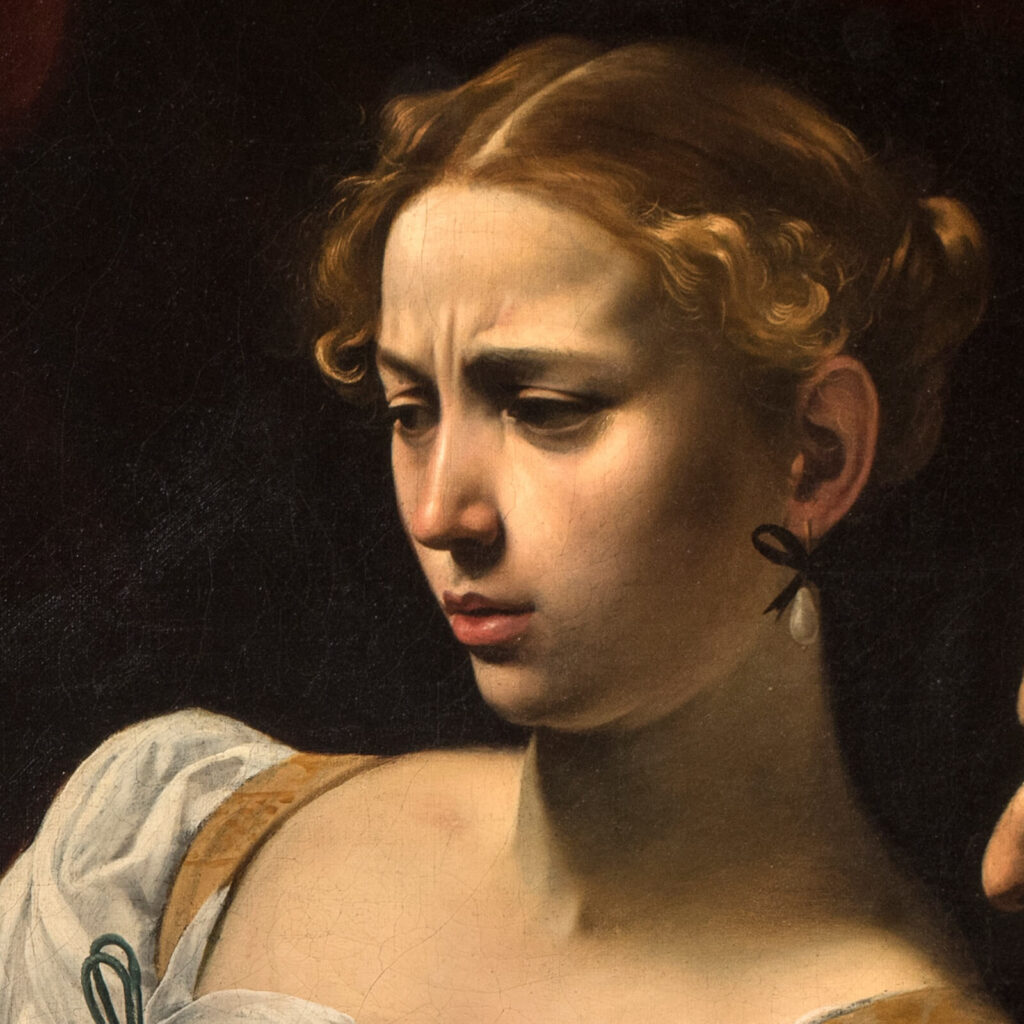
Caravaggio, Judith and Holofernes, ca. 1598–1602, Galleria Nazionale d’Arte Antica, Palazzo Barberini, Rome, Italy. Detail.
The face of Holofernes is a vision of torture. Rarely has death been captured so intensely and so violently as Caravaggio’s Holofernes. His eyes bulge in surprise. His mouth gasps for air and omits a scream. His entire body ripples with pain and shock as his shoulders flex under strain while his hands grasp the stained bed sheets. A jet stream of blood pours from the slashed neck. His body is a fountain of fluid. Redness floods the sheets. The sword is only halfway through the neck. Holofernes is neither alive nor dead. He is being murdered. He is dying. The viewer is a witness to the crime.
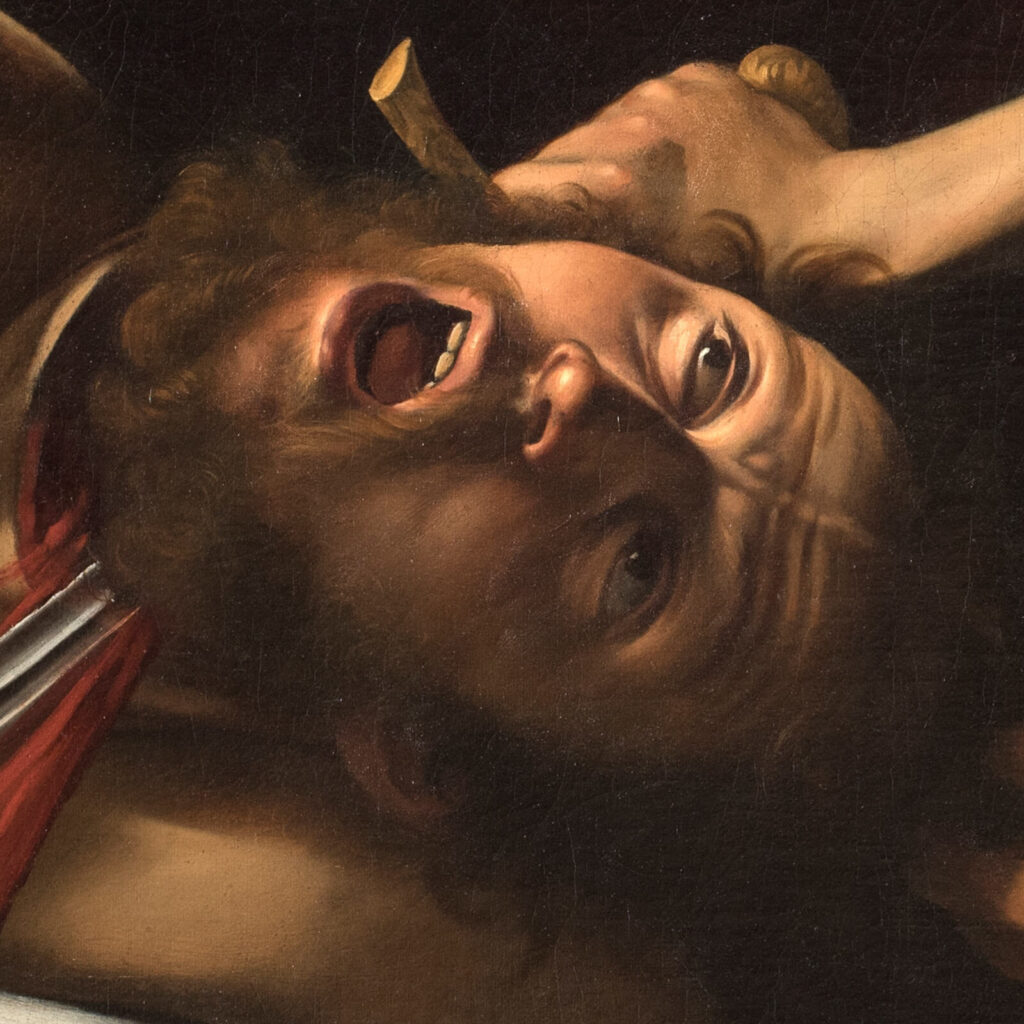
Caravaggio, Judith and Holofernes, ca. 1598–1602, Galleria Nazionale d’Arte Antica, Palazzo Barberini, Rome, Italy. Detail.
According to the Book of Judith, the maid was not inside the tent at the time of Holofernes’s assassination. She was outside the tent keeping guard for Judith. Caravaggio, however, uses artistic license to include the maid in the scene. She stands in profile on the far right of the composition. Her presence increases the visual interest of the scene.
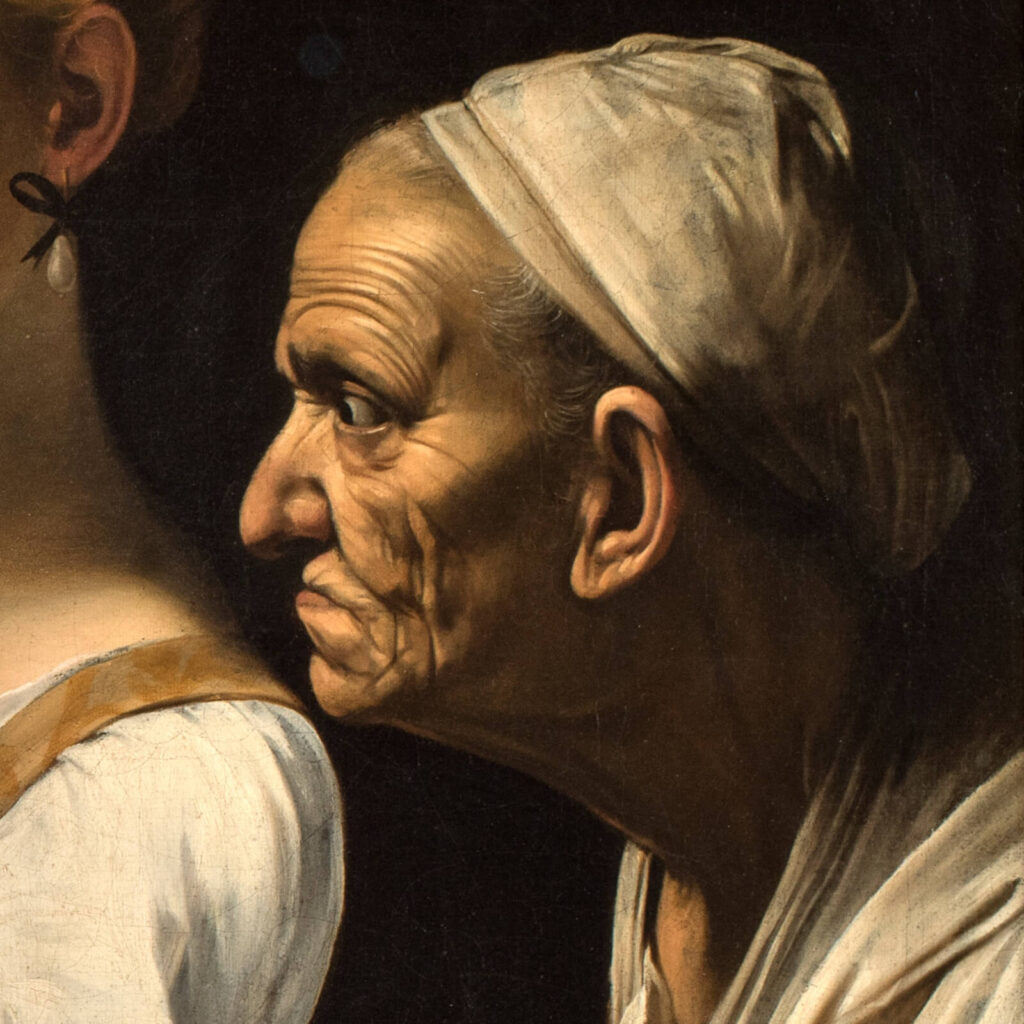
Caravaggio, Judith and Holofernes, ca. 1598–1602, Galleria Nazionale d’Arte Antica, Palazzo Barberini, Rome, Italy. Detail.
Firstly, her aged, weathered appearance acts as a foil to Judith’s youthful beauty, which enhances Judith’s attractiveness to Holofernes and to the heterosexual male viewer—that canonical male gaze of the West. Why else display Judith’s pert and sensual breasts under a sheer dress fabric? Violence and sex have always been passionate topics that captivate societies’ imaginations.
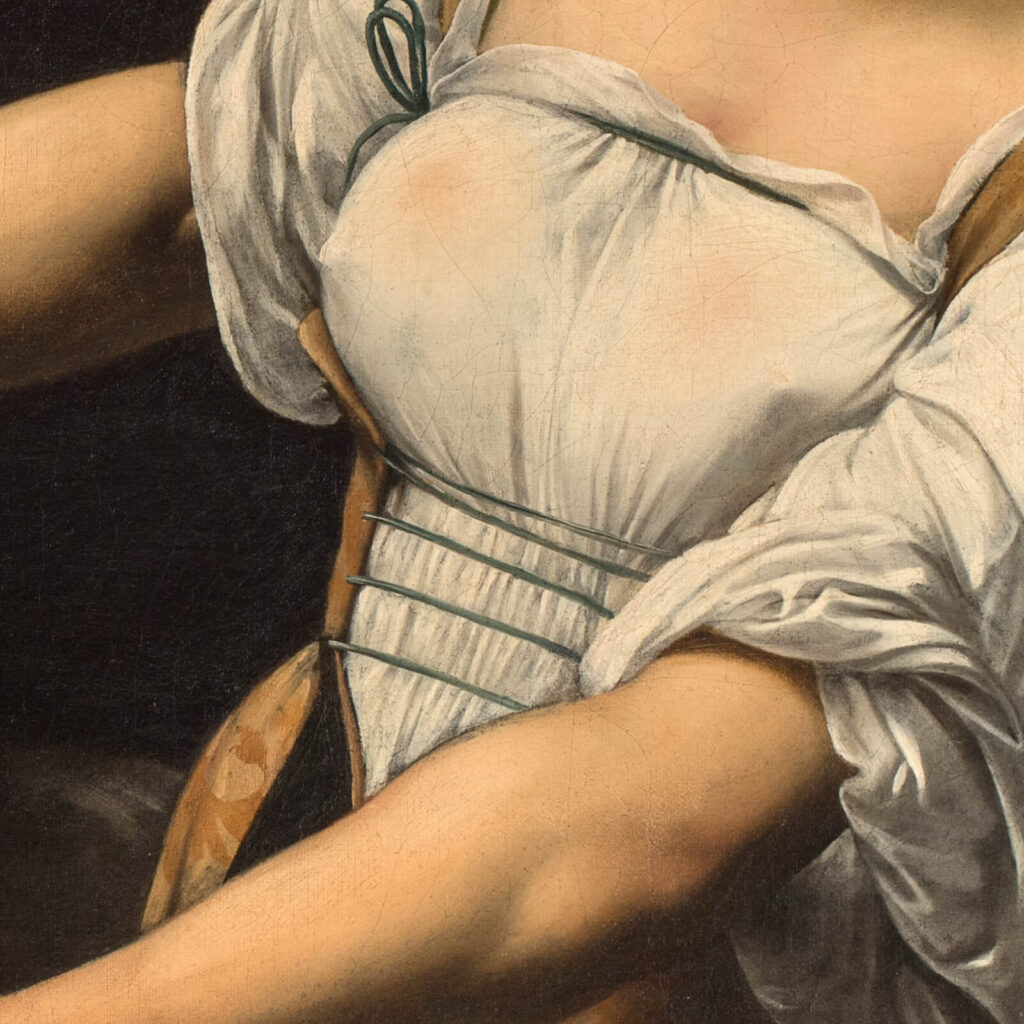
Caravaggio, Judith and Holofernes, ca. 1598–1602, Galleria Nazionale d’Arte Antica, Palazzo Barberini, Rome, Italy. Detail.
Secondly, her presence adds context to the narrative. She is holding the food sack that she and Judith have used for the past four days to store their food provisions. It is the same sack that the head of Holofernes will soon be placed inside and smuggled out of the Assyrian army camp.
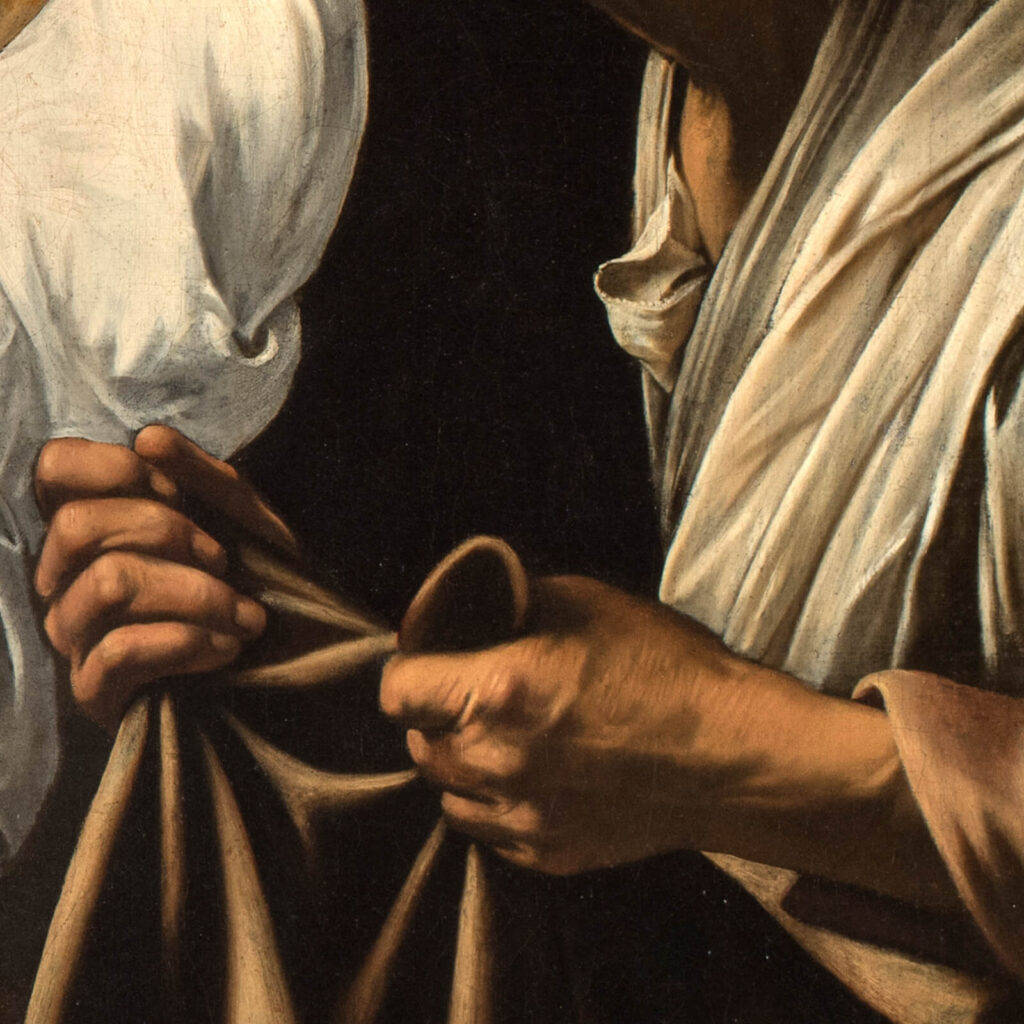
Caravaggio, Judith and Holofernes, ca. 1598–1602, Galleria Nazionale d’Arte Antica, Palazzo Barberini, Rome, Italy. Detail.
Thirdly, the maid adds dramatic effect because she is, like the viewer, a silent witness to the murder. She is not actively committing the murder, but she is a murderer by association. She is an accomplice. However, her face shows no guilt. To her, and to the biblical Israelites, this is not murder. This is self-preservation.
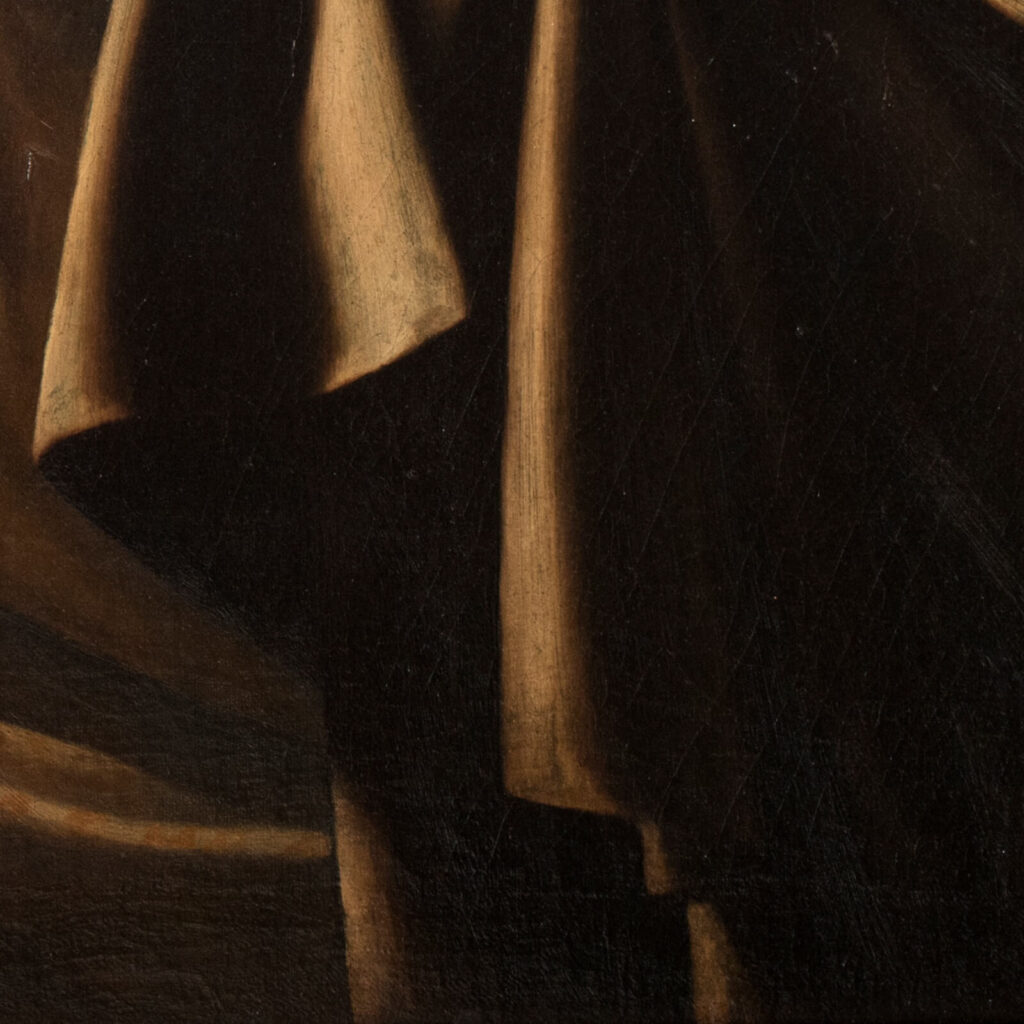
Caravaggio, Judith and Holofernes, ca. 1598–1602, Galleria Nazionale d’Arte Antica, Palazzo Barberini, Rome, Italy. Detail.
Caravaggio’s Judith and Holofernes displays the typical Baroque panache of intensity and theatrics. It captures death in convulsions, neither a still nor a silent death. It is a death in colorful motion. Caravaggio heightens the theatrical nature of the scene through his restricted color palette of two primary colors, red and yellow; one secondary color, green; and two neutrals, black and white. The limited palette creates a visual intensity that punches with impact and clarity. Caravaggio essentially uses just three colors with shadows and highlights to dominate the scene. It is restrained but effective.
Judith and Holofernes was acquired by the Gallerie Nazionali di Arte Antica in 1971. It is on permanent display at the Palazzo Barberini in Rome, Italy. Viewers can marvel at its bloodiness, its drama, and its energy. It is a Caravaggio masterpiece, and it is a national treasure. Biblical murder has rarely looked so amazing.
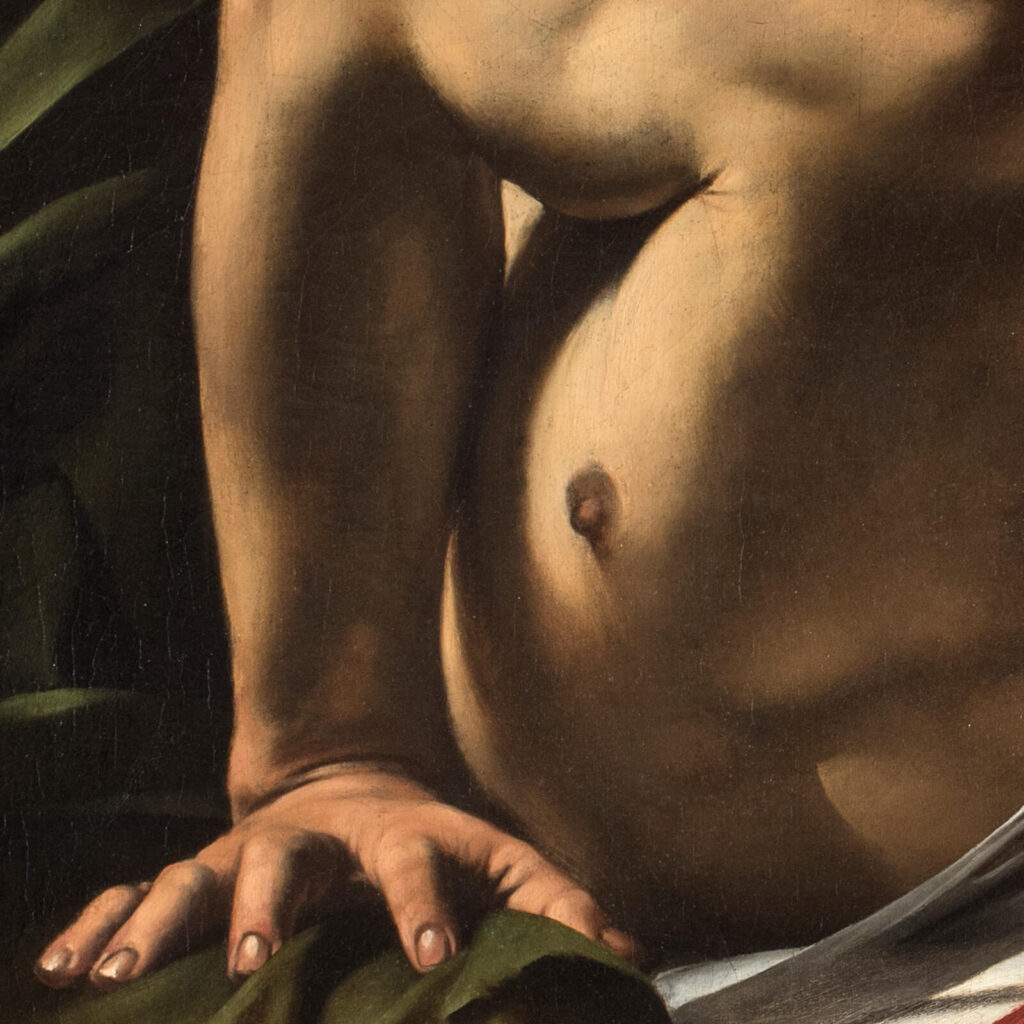
Caravaggio, Judith and Holofernes, ca. 1598–1602, Galleria Nazionale d’Arte Antica, Palazzo Barberini, Rome, Italy. Detail.
“Judith and Holofernes.” Galleria Nazionale d’Arte Antica Online Collection. Acessed: August 29, 2026.
“Judith Beheads Holofernes.” Revised Standard Version Catholic Edition (RSVCE). BibleGateway. Accessed: August 29, 2026.
DailyArt Magazine needs your support. Every contribution, however big or small, is very valuable for our future. Thanks to it, we will be able to sustain and grow the Magazine. Thank you for your help!

James W. Singer is an art historian and fine art photographer. He earned a Bachelor of Arts in Art History from the University of Florida. He later moved to Paris, France. He currently writes “Masterpiece” articles for DailyArt Magazine.

An admirer of antiquity, art, and architecture. An avid reader and amateur photographer. Always curious, always on an adventure.
Winslow Homer (1836–1910) was one of the leading American Realist painters. His painting The Veteran in a New Field is a masterpiece of late...
James W Singer 30 August 2026
At first glance, A Goldsmith in His Shop (1449) appears to depict an ordinary visit to a jeweller. Yet Petrus Christus transformed an ordinary...
Shivani Gupta 23 August 2026
With Virgin and Child as a cornerstone of her reputation, Elisabetta Sirani should be recognized as an important Italian Baroque artist. Far more...
James W Singer 16 August 2026
Anthony van Dyck was one of the great portraitists of the 17th century. It is largely through his eyes that we now view the doomed reign of Charles I...
Catriona Miller 17 August 2026