
10 Alphonse Mucha Artworks You Need to Know
Czech Alphonse Mucha is a legend of the art world, a pioneer in Art Nouveau whose work still lives on through his larger-than-life artworks, mostly...
Frank Schildiner 20 August 2026

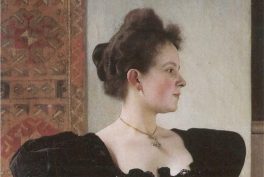
Gustav Klimt, Portrait of Emilie Flöge, 1902, Vienna Museum, Vienna, Austria. Detail.
Gustav Klimt’s lavish gold motifs, intricate patterns, and sensuous nudes were as innovative as they were controversial. Breaking from his classical training to form the Vienna Secessionist movement, Klimt was an important Art Nouveau figure and created some of the most enduring works of the 20th century.
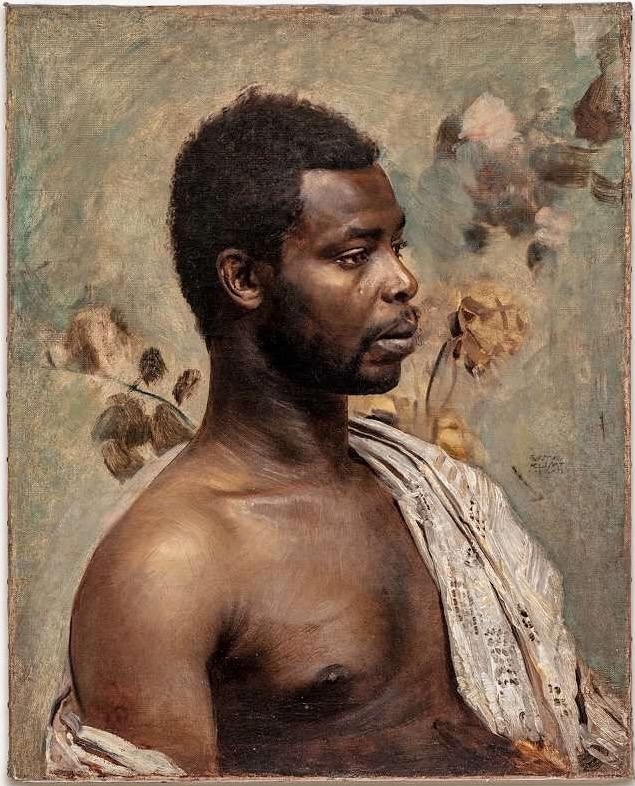
Gustav Klimt, Prince William Nii Nortey Dowuona, 1897, private collection. Wikipedia Commons (public domain).
Classically trained at the State School of Applied Arts in Vienna, Gustav Klimt began his career painting murals, decorative ceilings, and creating portraits from photographs. Prince William Nii Nortey Dowuona is an early Klimt work, and while it shows his mastery of portraiture and some flourishes in the background, Klimt had not yet fully developed the distinct, lavish stylistic accents that are found in The Kiss or that became hallmarks of Art Nouveau.
The subject in this painting, Prince William Nii Nortey Dowuona of the Osu tribe, visited the Tiergarten am Schüttel, a private zoo that hosted a racist and dehumanizing exhibit of people and animals, drawing around 10,000 people a day. It’s likely the prince sat for Klimt and fellow artist Franz Matsch there. Matsch’s painting from the encounter hangs in the National Museum of Archaeology, History, and Art in Luxembourg.
In 1923, a wealthy Jewish family bought the painting, but it was lost when the owners fled the Nazi regime in 1938. Rediscovered recently, the painting is valued at around $16 million.
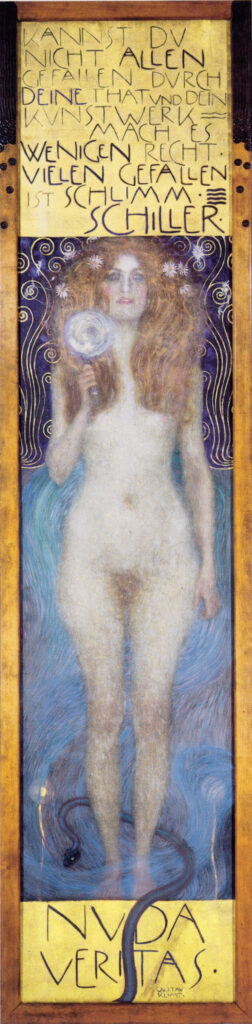
Gustav Klimt, Nuda Veritas, 1899, Austrian Theatre Museum, Vienna, Austria.
In 1897, Gustav Klimt and several other artists formed the Association of Visual Artists Vienna Secession. They wanted to create art for the sake of art, and not in response to the market. Also, the secessionists believed in the power of decorative art and design as equally important as fine art. They fit well within the larger Art Nouveau movement of the time, a complete aesthetic encompassing design, architecture, and painting. Within several years, Klimt and the secessionists had enough money to commission their own building. Above the entrance was the motto “To every age its art, to every art its freedom.”
In the same rebellious spirit, the text at the top of Nuda Veritas is a quote from Friedrich von Schiller and translates to “If your deed and your art cannot please everyone, please a few. To please many is terrible.” The female figure, the naked truth, holds a mirror up to the viewer.
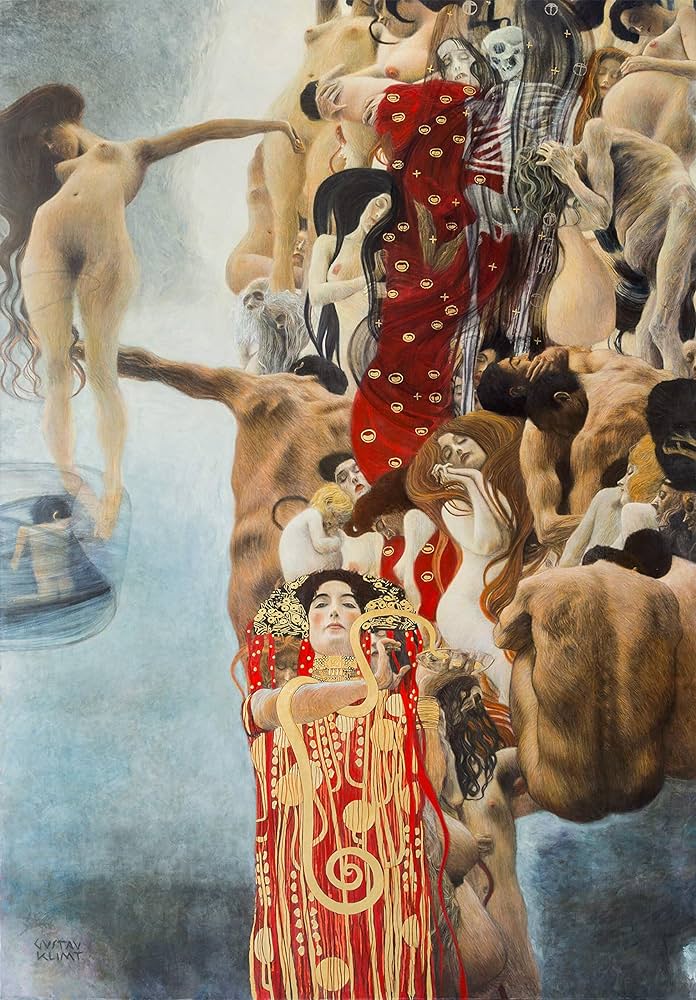
Gustav Klimt, Medicine (destroyed; recolored with Artificial Intelligence), 1900–1907, University of Vienna, Vienna, Austria. Google Arts & Culture. © Österreichische Galerie Belvedere.
The University of Vienna commissioned Klimt and Franz Matsch to create several large-scale paintings for their festival hall. Klimt set to work creating paintings on the themes of philosophy, medicine, and jurisprudence. It’s likely the university had in mind classical depictions of these academic pursuits, and Klimt’s resume at this time would have included numerous works of this style. However, the span of the commission overlapped with Klimt’s break from tradition.
As a result, Philosophy shows an ethereal face peeking out of swirling stars, a column of nude human figures ascending beside it. His depiction of Jurisprudence includes a man imprisoned by the grip of an octopus while three female nudes watch on in judgment. At the bottom of his painting for Medicine, Klimt created a representation of Hygeia, the Greek goddess of health, holding a snake. Above her looms a collection of mostly nude bodies in various stages of life, some sick, dead, or dying, and others in good health. The floating female nude, her pubis pointed at the viewer, was no doubt viewed as especially objectionable. Female pubic hair was deemed particularly lurid at the time.
The paintings did not meet approval from the university and were never displayed in the great hall. Klimt bought them back himself. Eventually, the paintings became part of the Lederer Collection. In 1945, the Nazis burned the paintings. Only black-and-white photos remain, and all colorized versions are imagined reconstructions.
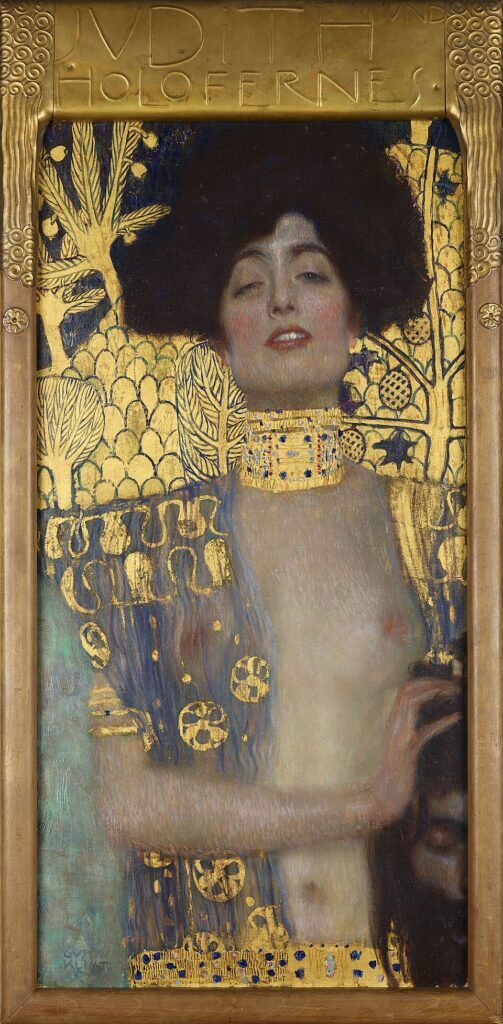
Gustav Klimt, Judith I, 1901, Österreichische Galerie Belvedere, Vienna, Austria.
In the biblical story of Judith, the Jewish widow puts on her finery and heads toward the enemy army with aspirations of subterfuge. When the Assyrian general Holofernes tries to seduce her, she eats and drinks with him until he has overimbibed. Then, she beheads him. Many Renaissance and Baroque paintings recount this story, perhaps the most famous being the works of Caravaggio and Artemisia Gentileschi. In both of these cases, the artists show the struggle of the climactic scene of the story—the violent beheading.
Klimt’s portrait of Judith, however, focuses on the beauty and sensuality of the biblical figure. Draped in gold elegance, Judith looks upward, eyes soft and half closed, her lips parted sensuously, all the while holding Holofernes’ severed head. In Klimt’s world, female beauty is paramount, almost divine. The artist returned to this story again in his painting Judith II, this time showing a more abstract version of the biblical figure.

Gustav Klimt, center panel of the Beethoven Frieze, 1902, Secession Building, Vienna, Austria.
The 14th Vienna Secession exhibition featured Beethoven-themed artwork, and once again, Klimt courted controversy with his enormous, 34-meter-wide (approximately 112 feet) Beethoven Frieze inspired by the final movement of Beethoven’s Ninth Symphony, commonly called Ode to Joy. In the first panel of the piece, a knight is pictured setting off on a quest, a hopeful yearning for happiness.
The middle panel, shown above, represents the hostile forces in the knight’s way. An ominous beast dominates one side of the panel. The three women to the left of the beast are his daughters, stand-ins for sickness, madness, and death. On the other side of the creature are women portraying sins like temptation, unchastity, and gluttony. The figure shrouded in a black veil is grief.
The final panel shows salvation in poetry, singing angels, and love. However, for many viewers in 1902, the final panel did not redeem the grotesque display of sin in the center panel. The piece shocked many viewers at the time.
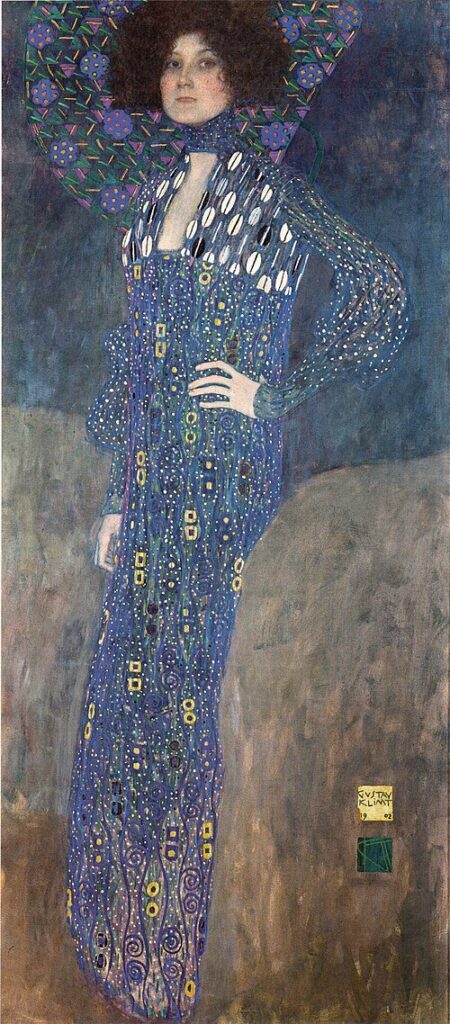
Gustav Klimt, Portrait of Emilie Flöge, 1902, Vienna Museum, Vienna, Austria.
Rumors about Klimt’s sexual relationships swirled, and certainly, the eroticism in his paintings did little to quell any gossip. He never married, but he did develop a significant relationship with Emilie Flöge, a fashion designer and the sister of Helene Flöge, who had briefly been married to Klimt’s brother. Though Klimt never lived with Emilie, the two remained close, and he requested that she be present in his last moments before death.
In this stunning portrait, Emilie appears almost regal in the gallantry of her ornate dress. The detailed patterns overtake her form, a recognizable feature of many of Klimt’s most famous portraits. The deep blue colors offer a stark contrast to her pale skin.
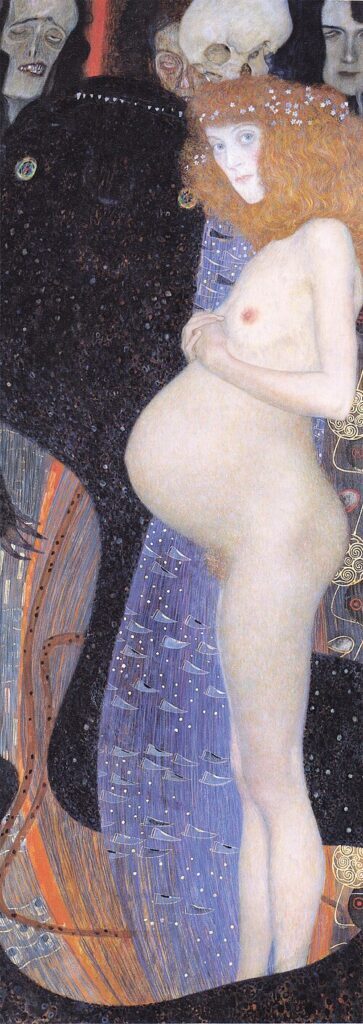
Gustav Klimt, Hope I, 1903, National Gallery of Canada, Ottawa, Canada.
Herma was one of Klimt’s favorite models, and he once claimed she had a backside with more beauty and intelligence than the faces of many men. One day, Herma did not show up for work, and upon inquiring about her, he learned she was pregnant. Klimt asked her to model nonetheless, and the result is Hope I. In this work, new life and hope are represented by the woman’s pregnancy, though death looms in the background. Klimt painted Herma’s pregnancy again in Hope II.
The facts around Klimt’s romantic relationships are obscure. It is rumored that he had sex with many of his models, and after his death, several women claimed he had fathered their children. Three of these claims were held up in court. Could this painting show Herma pregnant with Klimt’s child? If so, it would certainly inform the gaze that the painting’s subject gives the viewer.
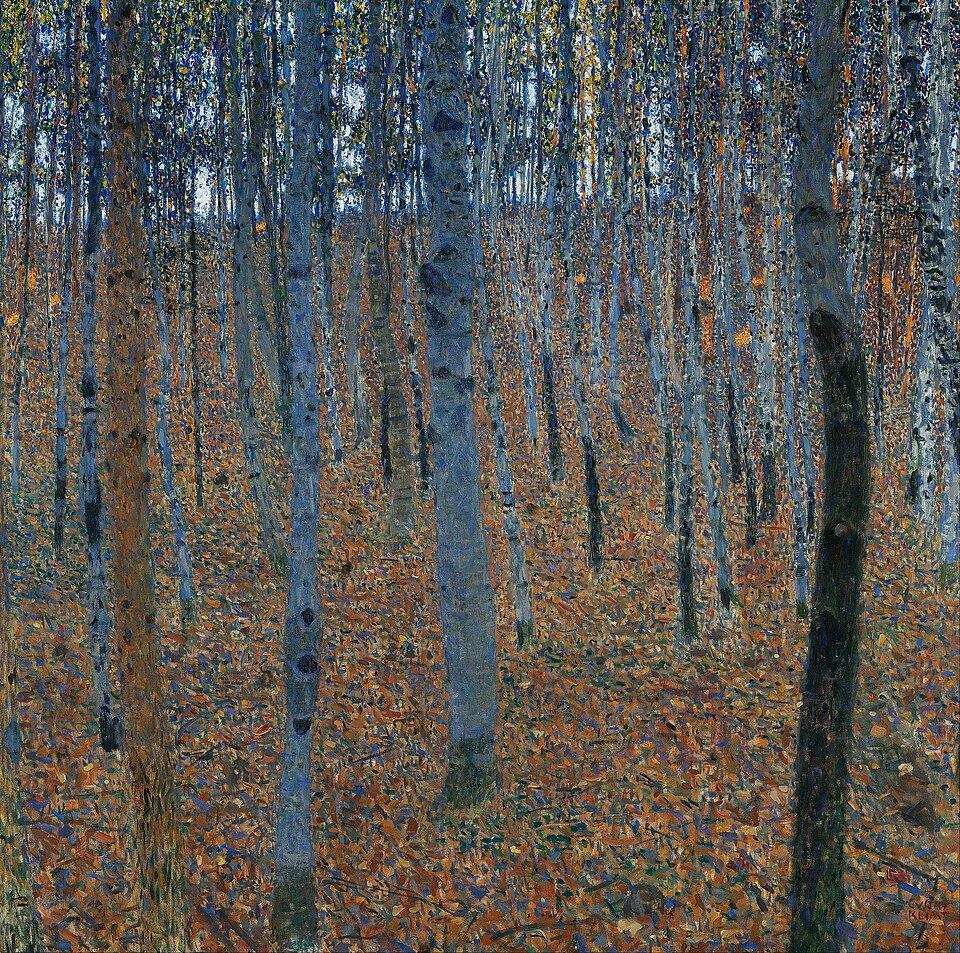
Gustav Klimt, Beech Grove I, ca. 1902, Galerie Neue Meister, Staatliche Kunstsammlungen Dresden, Dresden, Germany.
While best known for his striking and recognizable stylized portraits, Klimt painted over 50 landscapes. He created many of these works in plein air while on summer holiday. While quite different from his other work in terms of subject matter, Beech Grove I again shows Klimt’s fascination with patterns. The trees are repeated almost endlessly to the horizon line.
The colorful foliage is reminiscent of the complex garments worn by his portrait subjects. Likewise, just as Klimt played with perspective, flattening his human subjects and sometimes bending them into geometric designs, these beech trees cut through the colors of the ground cover with sharp contrast and little shading or rounding of the trunks.
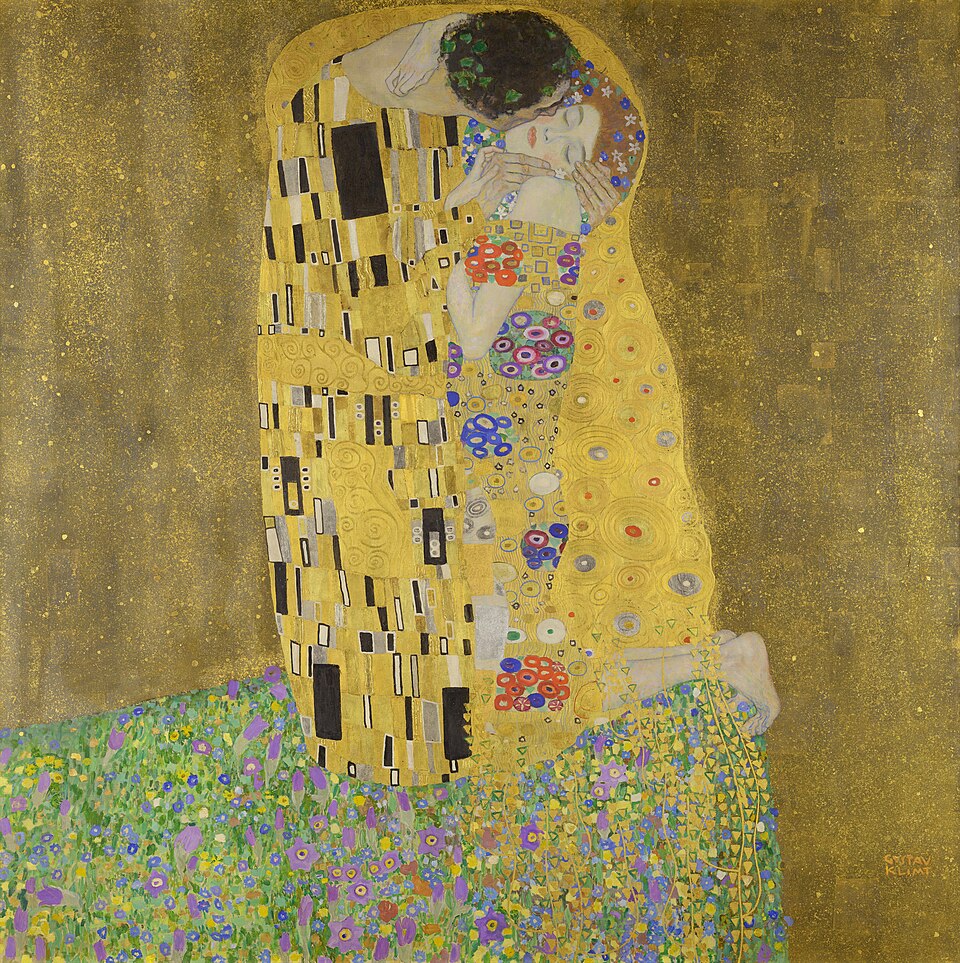
Gustav Klimt, The Kiss, 1908–1909, Österreichische Galerie Belvedere, Vienna, Austria.
Undoubtedly, Klimt’s most famous painting, The Kiss, was preceded by works of the same title by Auguste Rodin, who first showed his sculpture publicly in 1887, and Edvard Munch’s 1897 painting. Rodin’s sculpture showcased his mastery of the human form, while Munch’s painting is discomforting and morose. Klimt’s Kiss is draped in decadence.
Brilliant use of gold coloring and gold leaf are recognizable hallmarks of Klimt. He certainly knew how to work with the material, as his father was a goldsmith and engraver. Also, Klimt was heavily influenced by Byzantine art, where gold added brilliance and importance to religious subject matter. The flattened patterns in both the couple’s clothing and in the figures themselves are reminiscent of Byzantine mosaics.
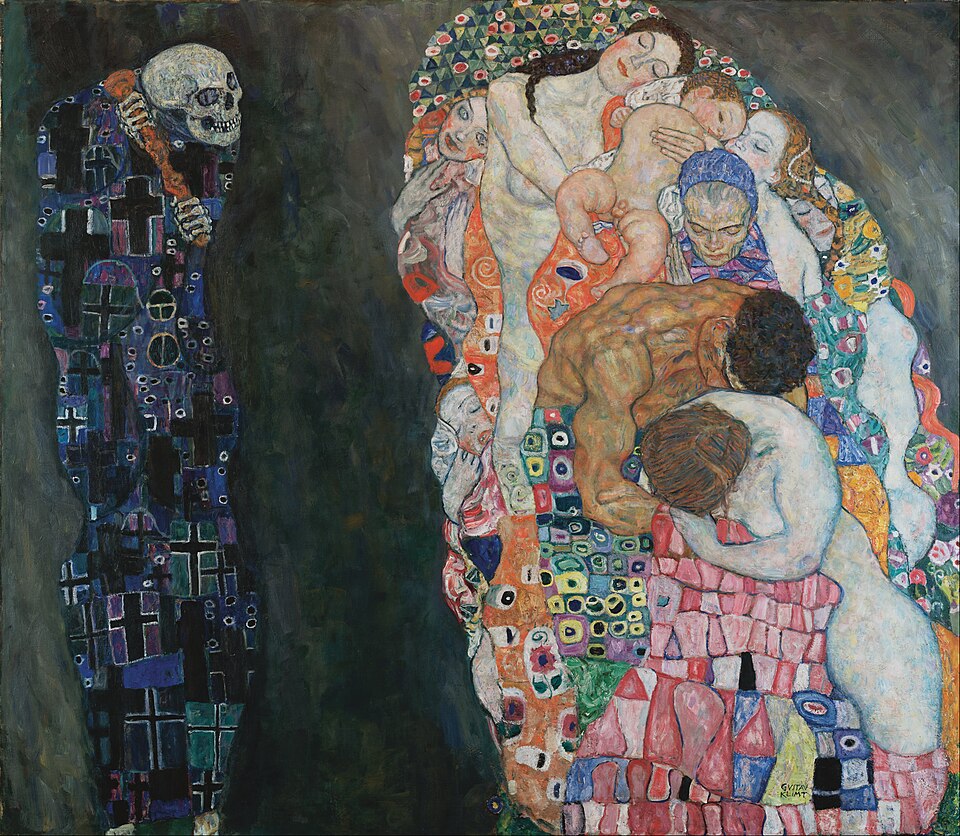
Gustav Klimt, Death and Life, 1910–1916, Leopold Museum, Vienna, Austria.
Several of Gustav Klimt’s paintings wrestle with the vibrancy of life while death looms in the background. However, this painting addresses the theme of mortality most directly as Death watches in anticipation as several people go through various stages of life. Klimt is carrying on the theme of memento mori, Latin for “remember you have to die,” prevalent in Western art. Klimt would die three years after completing this painting.
Gustav Klimt’s mastery of human figures and innovative use of pattern make his work distinct and recognizable. He pushed boundaries, broke from his traditional training, and painted with undeniable sensuality. Today, his work survives as part of the canon of Western art.
P.S. You can find Gustav Klimt’s masterpieces in our Vienna Secession Weekly Planner!
DailyArt Magazine needs your support. Every contribution, however big or small, is very valuable for our future. Thanks to it, we will be able to sustain and grow the Magazine. Thank you for your help!

Theodore Carter is the author of several books including "Stealing The Scream" and "Frida Sex Dreams and Other Unnerving Disruptions". You can see his art out in the streets of Washington, DC, and on his website: https://theodorecarter.com.

Czech Alphonse Mucha is a legend of the art world, a pioneer in Art Nouveau whose work still lives on through his larger-than-life artworks, mostly...
Frank Schildiner 20 August 2026
Ephraim Moses Lilien was an Art Nouveau artist who reimagined traditional Jewish motifs for the modern day. He was also an early supporter of the...
Bec Brownstone 15 December 2025
A dragonfly woman, a golden serpent of opals and rubies, and a woman waiting for an octopus are three short descriptions of authentic Art Nouveau...
Jimena Escoto 24 July 2026
Aubrey Beardsley’s legacy endures, etched into the contours of the Art Nouveau movement. His distinctive style, marked by grotesque imagery and...
Lisa Scalone 14 December 2025