



Discovering the Netherlands with James McNeill Whistler
American artist James Abbott McNeill Whistler trained in Paris, lived in London, and fled to Venice after his infamous libel trial. He is much less...
Catriona Miller 16 October 2026
11 June 2026 min Read

Gustav Klimt, Portrait of Elisabeth Lederer, 1914–1916, private collection. Wikimedia Commons (public domain). Detail.
The gavel falls, and the Sotheby’s auction room in New York explodes into applause. Gustav Klimt’s Portrait of Elisabeth Lederer has just shaken up the history of the art market. With a winning bid of 236.4 million dollars, the masterpiece sets a new auction record for the artist. Furthermore, it became the most expensive piece of modern art ever sold at auction, as well as the greatest historical success for the house of Sotheby’s.
New York, November 18, 2025. Tuesday’s auction at Sotheby’s marks one of the most anticipated events of recent years: the sale of the private collection of Leonard Lauder, heir to the cosmetics empire and legendary art collector.
The room is packed; hundreds of people have queued for hours to gain entry. No one wants to miss the auction of the mysterious and little-known Gustav Klimt painting up for sale: Portrait of Elisabeth Lederer. This canvas is historically significant for its extreme rarity, as only two full-length Klimt portraits remain in private hands. One belongs to a private collection that may never come onto the market; the other is this one.

Gustav Klimt, Elisabeth Lederer, Sotheby’s, New York City, NY, USA. Bonart.
The bidding opens at 130 million dollars. For more than 19 minutes, six collectors engage in a relentless bidding war. They aren’t just competing for a masterpiece; they are unknowingly pricing a miracle. With every million added over the phones, the canvas carries the weight of a desperate daughter’s lie, a narrow escape from the ashes of a burning castle, and the ultimate irony of surviving because it was deemed “worthless” by the Nazis. In the end, as the hammer falls on a historic winning bid, the price tag reveals its true meaning: it is the cost of owning a piece of history that refused to die.
To understand how a canvas came to be worth 236 million dollars in the 21st century, one must travel back to Vienna at the beginning of the 20th century. August Lederer, a Jewish-born industrial magnate whose fortune was surpassed in the country only by the Rothschilds, built together with his wife, Serena Pulitzer, one of the most distinguished art collections of the era. Funded by his success in the distillery and starch industries, the family collection housed everything from valuable Renaissance works by masters such as Cranach and Cellini to more than 11 paintings and hundreds of drawings by Gustav Klimt.
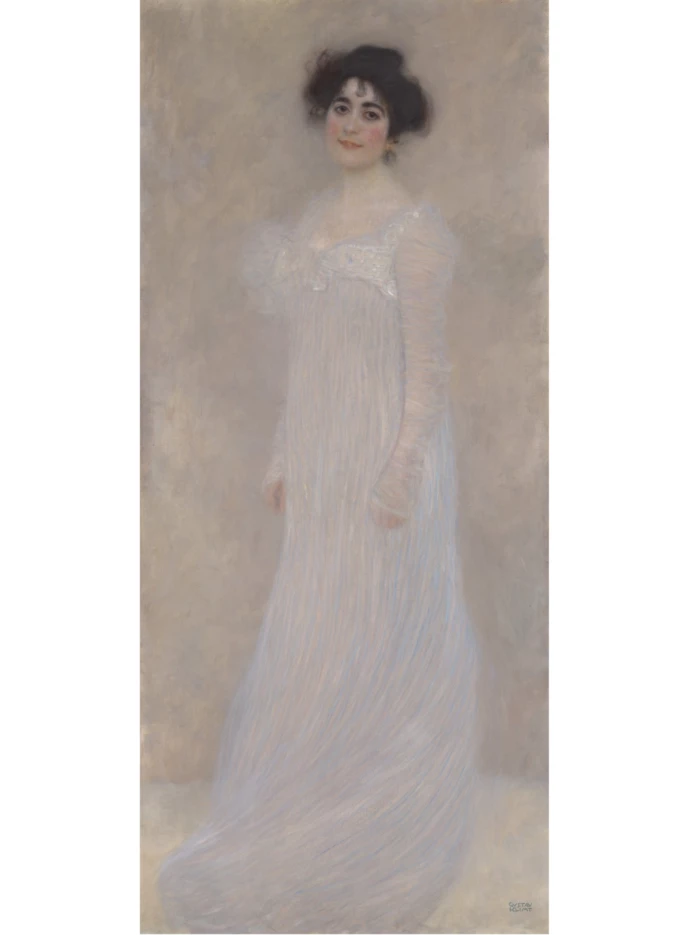
Gustav Klimt, Portrait of Serena Lederer, 1899, Metropolitan Museum of Art, New York City, NY, USA.
The story began with the commission of the Portrait of Serena Lederer, a work that sparked a 20-year-long friendship. Klimt became a regular guest at the family’s dinners and gatherings, which led to the Portrait of Elisabeth Lederer, the second piece in a fascinating trilogy in which the artist immortalized three generations of women from the clan.
The commission for the Portrait of Elisabeth Lederer came in 1914, when Elisabeth was still a young woman living in the family home. Klimt was at the height of his career and worked on the canvas for more than two years. In fact, he refused to consider it finished. In 1916, exasperated by the artist’s reluctance to part with the painting, Serena Lederer secretly removed it from the studio, fearing it would otherwise never leave.
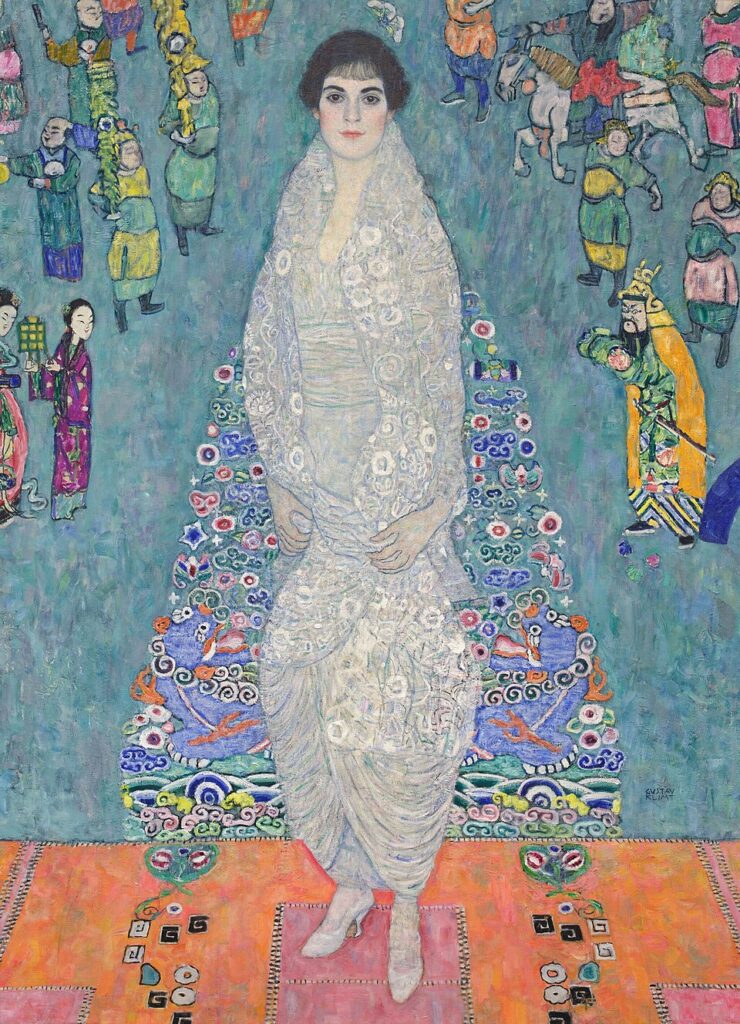
Gustav Klimt, Portrait of Elisabeth Lederer, 1914–1916, private collection. Wikimedia Commons (public domain).
The canvas stands as a testament to Klimt’s final period. Elisabeth, posed frontally and dressed in white, is set against an exuberant Orientalist background that replaces the gold leaf of his “Golden Phase” with motifs drawn from Chinese mythology, composed of flowers and warriors. Technically, it is a play of contrasts: a face sculpted with three-dimensional realism set against a flat, vibrant, and purely ornamental environment.
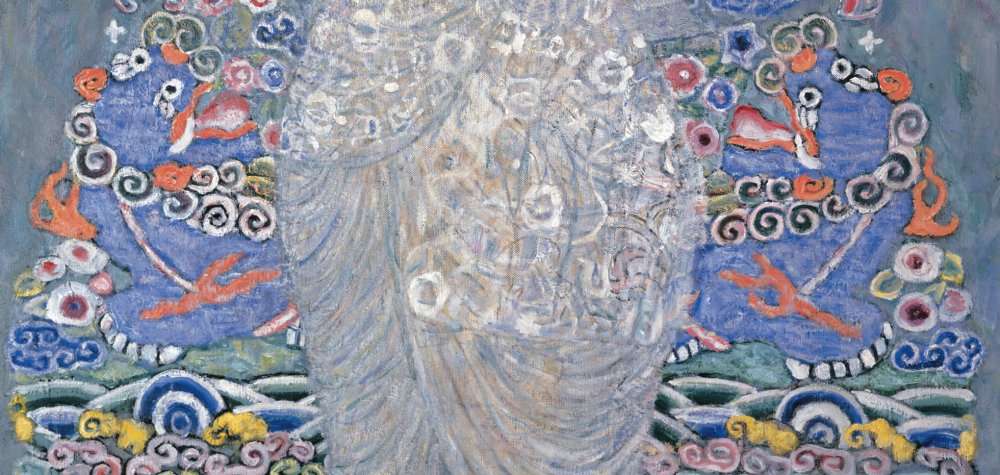
Gustav Klimt, Portrait of Elisabeth Lederer, 1914–1916, private collection. Wikimedia Commons (public domain). Detail.
From the very beginning, the painting was shrouded in controversy. While Europe was bleeding out in the trenches of the First World War, Klimt chose instead to immortalize a refuge of aristocratic calm detached from the conflict, an apparent indifference to the global tragedy that earned him harsh criticism.
Before continuing with our story, it is worth pausing to talk about the model, because Elisabeth’s story is just as fascinating as her portrait. Elisabeth’s life took a dramatic turn in 1921, when she left the Jewish community to marry Baron Wolfgang Bachofen von Echt. However, her status collapsed in 1938 after the Anschluss: her only son died prematurely, and her husband divorced her, leaving her vulnerable and at the mercy of Nazi antisemitism.
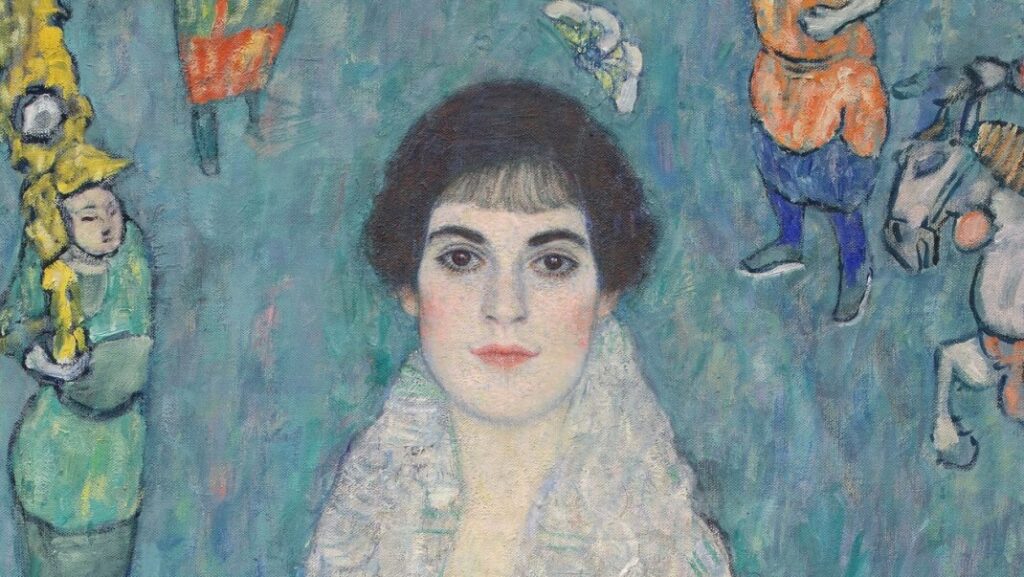
Gustav Klimt, Portrait of Elisabeth Lederer, 1914–1916, private collection. Wikimedia Commons (public domain).
Being both Jewish and single, Elisabeth devised a bold survival strategy: she claimed that Gustav Klimt, famous for his countless lovers, was her true biological father. To support the deception, her mother, Serena, signed a certificate acknowledging the alleged affair. After passing various examinations and thanks to the influence of her former brother-in-law, a high-ranking Nazi official, the Reich validated the lie. As a result, Elisabeth was saved from extermination. She survived in Vienna until her death from illness in 1944. Today, she rests in the Hietzing Cemetery, coincidentally just a few meters away from the painter who, even after his death, saved her life.
With the annexation of Austria by Nazi Germany in 1938, the Lederer family was driven into exile, and their celebrated art collection was looted and transferred to a state storage facility. The story took a dramatic turn in 1943, when the Nazi authorities in Vienna organized the commemorative exhibition, Gustav Klimt, Ausstellung, and included 11 works from the Lederer collection. However, the threat of Allied bombing forced the exhibition to close prematurely. In an attempt to safeguard the paintings, those 11 works were hastily evacuated to Immendorf Castle in Lower Austria, a decision that ultimately doomed most of the collection.
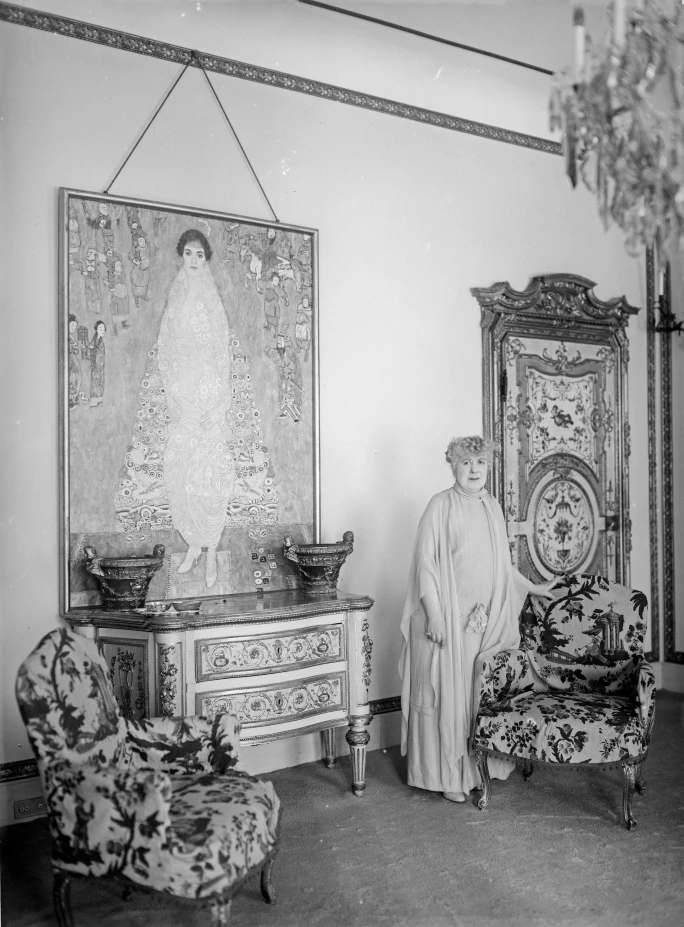
Photograph of Serena Lederer in her residence with Portrait of Elisabeth Lederer, 1930. Sotheby’s
In May 1945, during the final days of the war, retreating German forces set fire to Immendorf Castle to prevent the artistic treasure from falling into Soviet hands. The blaze destroyed the works stored there. Yet the family portraits, the Familienbilder, survived through a twist of fate. Under the racial laws of the Reich, images of Jews were exempt from official confiscation, and so they had been excluded from the exhibition and sent instead to the Dorotheum, Vienna’s auction house. The Lederer portraits survived the war only because the Nazis considered them unworthy of being stolen.
After the war, the portraits of Serena and Elisabeth Lederer resurfaced on the art market. In 1948, the Dorotheum in Vienna scheduled them for auction, but the sale was canceled in time, and both works were returned to Erich Lederer, who had survived the conflict in exile in Switzerland.
The painting remained in his possession until 1983, when he sold it to the renowned art dealer Serge Sabarsky. Just two years later, in 1985, the canvas became part of Leonard A. Lauder’s private collection. Far removed from looting, bunkers, and bomb threats, Klimt’s masterpiece hung for decades above the dining table in his Fifth Avenue residence in New York.
With such a history behind it, and after spending decades hidden away in a Fifth Avenue dining room, the painting had been waiting for the perfect moment to reclaim the art market’s attention and, as expected, the entire world turned its gaze toward it.

Gustav Klimt, Woman with a Fan, 1917–1918, private collection. Wikimedia Commons (public domain).
The sale of Portrait of Elisabeth Lederer shattered the record for a Klimt painting at auction, surpassing the 108 million dollars achieved by Woman with a Fan in 2023. It also exceeded the 195 million paid for Andy Warhol’s iconic Shot Sage Blue Marilyn, establishing itself as the second most expensive artwork ever sold at auction, surpassed only by Leonardo da Vinci’s unattainable Salvator Mundi, which sold in 2017 for 450 million dollars.
DailyArt Magazine needs your support. Every contribution, however big or small, is very valuable for our future. Thanks to it, we will be able to sustain and grow the Magazine. Thank you for your help!

Javier is a journalist and cultural manager with a passion for art and its history. In his free time he loves reading and researching the lives of artists and their works. He loves everything related to the Middle Ages, the Italian Renaissance and the mysteries behind lost works of art.

An admirer of antiquity, art, and architecture. An avid reader and amateur photographer. Always curious, always on an adventure.
American artist James Abbott McNeill Whistler trained in Paris, lived in London, and fled to Venice after his infamous libel trial. He is much less...
Catriona Miller 16 October 2026
Three figures hover in the air, their bodies angled downward as they descend upon a limp man below. His arms stretch outward, his body slack, as if...
Frank Schildiner 28 May 2026
Every Old Master canvas speaks in two registers at once: one for the eye, one for those who know how to read the flowers. Artists used flower...
Errika Gerakiti 18 May 2026
Too wild for the canon, too slippery for nationalism, and too early to be officially celebrated: that’s Georges Papazoff—a 20th-century Bulgarian...
Katie Mikova 2 April 2026