
10 Japanese Artworks Where Animals Steal the Show
From playful monkeys and majestic tigers to sleepy cats and elegant egrets, animals have always held a special place in Japanese art. Let’s explore...
Lisa Scalone 10 September 2026
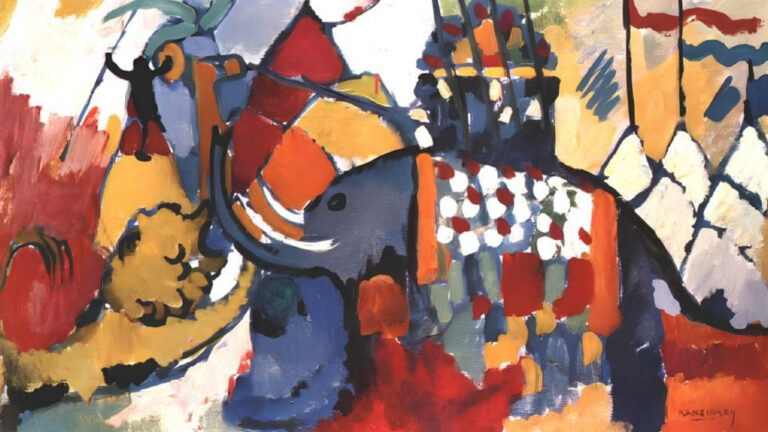
Wassily Kandinsky, The Elephant, 1908, private collection. WikiArt. Detail.
Elephants hold a profound place in art across cultures around the world, appearing as sacred creatures, symbols of power, and mysterious beings. Their meaning has changed across cultures and eras, but their imposing presence has remained captivating. Let’s take a closer look at elephants in art and the many ways artists have imagined these extraordinary animals.
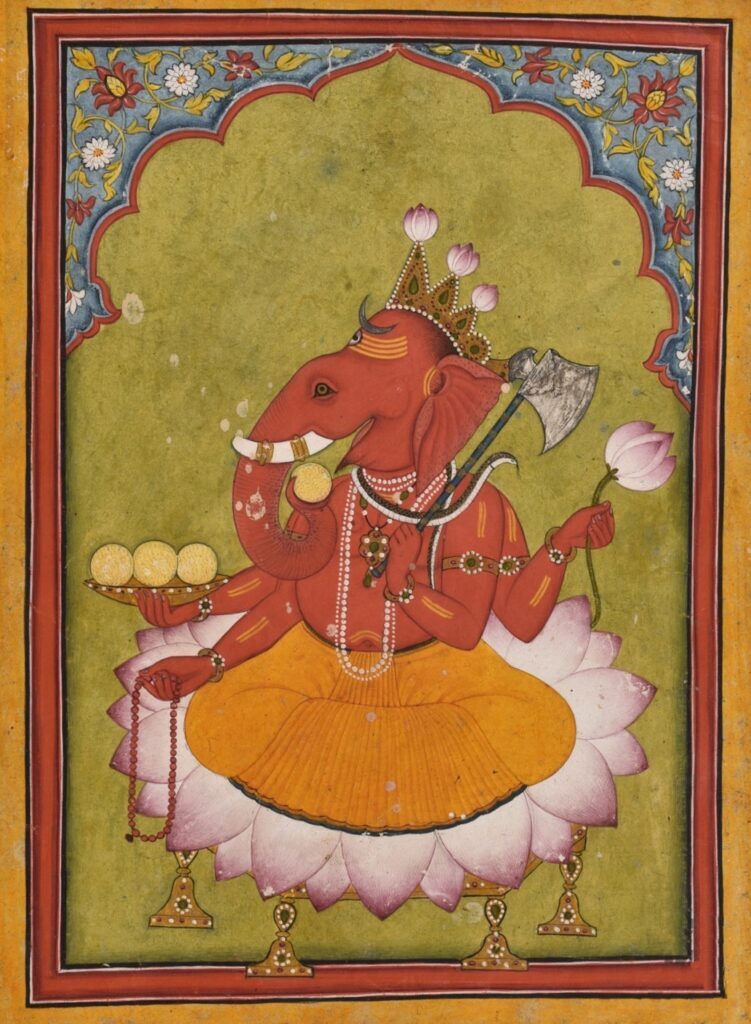
Lord Ganesha relishing modakas, ca. 1730, National Museum, New Delhi, India. Wikimedia Commons (public domain).
In Eastern traditions, the elephant is not only respected but is also the personification of divine and cosmic purity. The famous Basohli miniature shows Ganesha, the Hindu deity of wisdom, intellect, and fortune, preparing to throw a lotus flower at the demon of selfishness (Mamasura). The axe (parashu) cuts worldly attachments and obstacles, the lotus flower (padma) represents enlightenment, the rosary (akshamala) points to the pursuit of divine knowledge, and the sweets (modaka) celebrate spiritual reward.
Vedic myths also describe Airavata, the multicultural elephant that carries the god Indra. He has the power to create clouds and bring rain, representing the fertility of the earth and the direct connection to heaven.
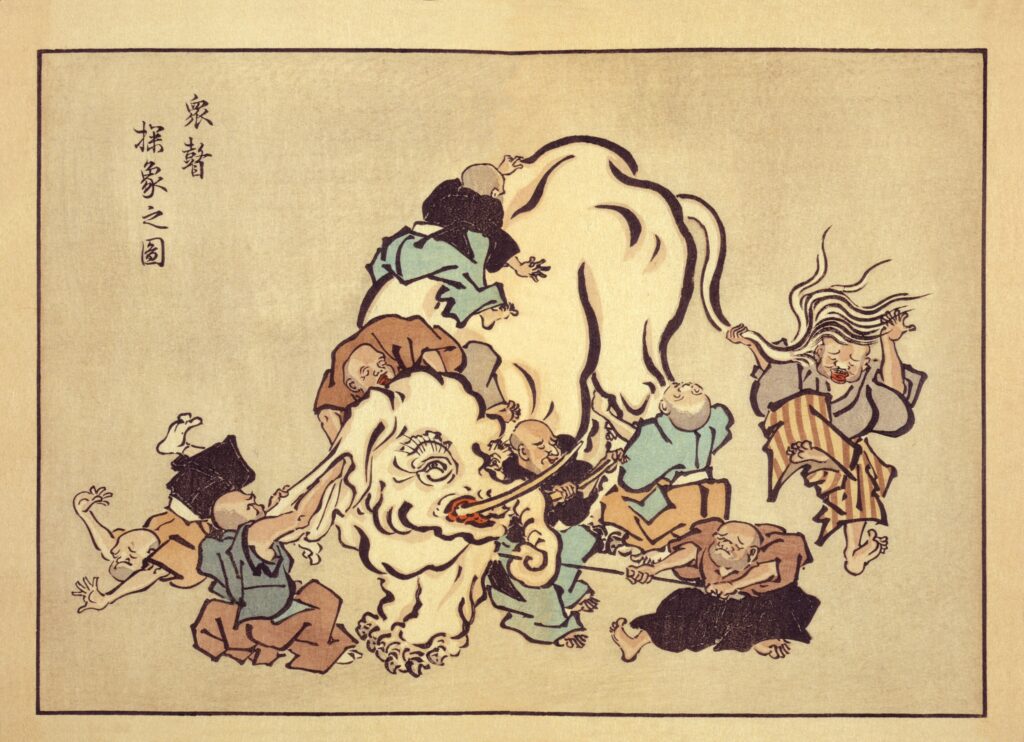
Hanabusa Itchō, Blind Monks Examining an Elephant, 1652–1724, Library of Congress, Washington, DC, USA.
In Buddhist tradition, Queen Maya, before giving birth to Siddhartha Gautama, dreamed of a white elephant that offered her a lotus flower. White elephants carry an aura of spiritual royalty, enlightenment, and inner peace. With Blind Men Examining an Elephant, a famous ukiyo-e woodblock print by Hanabusa Itchō (1652–1724), the haiku poet illustrates the ancient Buddhist parable where sightless monks touch different parts of an elephant, incorrectly concluding the entire animal resembles a wall, rope, tree, or fan based on their limited individual experience. The humorous and educational illustration serves as a metaphor for intellectual humility, subjective perception, and the nature of truth.
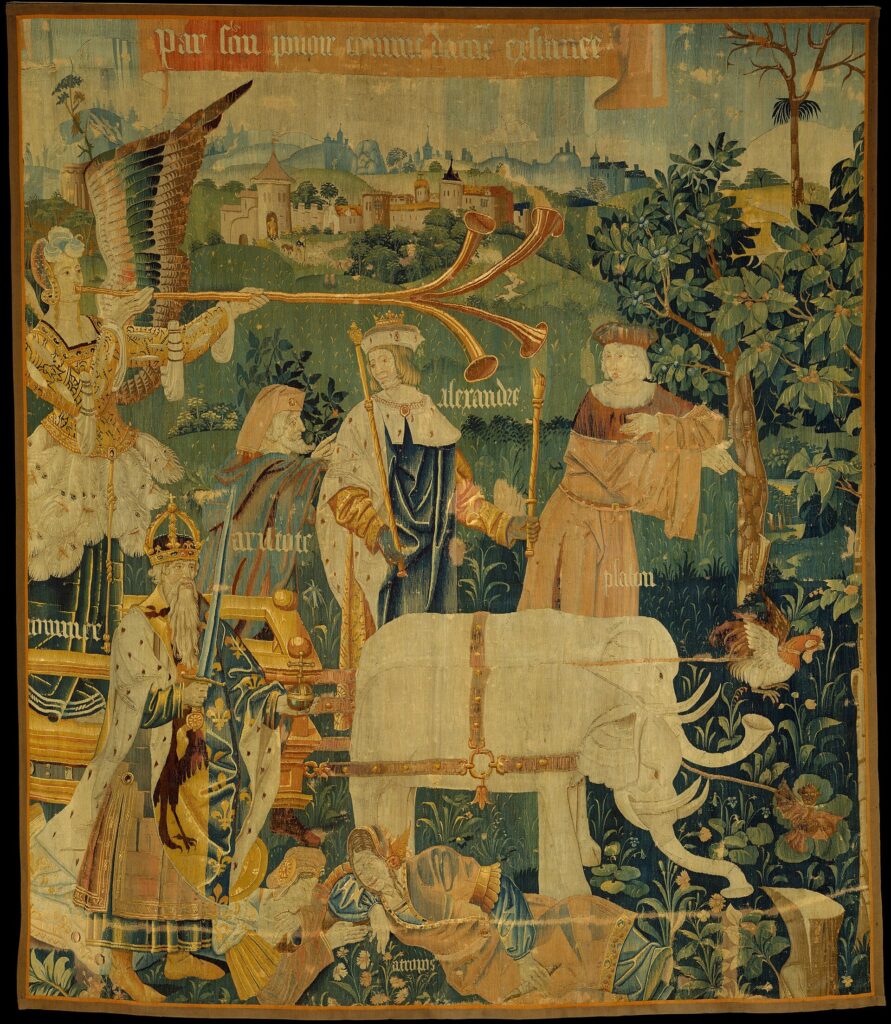
The Triumph of Fame over Death, ca. 1500–1530, Metropolitan Museum of Art, New York City, NY, USA.
From Hannibal crossing the Alps to the kings of Thailand, the elephant was the pinnacle of ancient military engineering and political prestige throughout history, standing out in all battles. The Flemish tapestry The Triumph of Fame over Death was based on the series of poems Triumphs by the Italian poet Francesco Petrarch. It is one of the richest representations of Renaissance thought, where elephants symbolize immortality, historical memory, and the indestructible strength of the human legacy.
The winged figure of Fame, guided by white elephants—embodying purity and virtue—overwhelms Death, guiding great heroes and philosophers of antiquity and the Middle Ages, immortalizing their achievements over time. Among them are Plato, Aristotle, Alexander the Great, and Charlemagne. At the beginning of the 16th century, Flemish tapestries, produced collectively based on literary manuscripts, were the most luxurious goods in Europe and were commissioned by kings and nobles to demonstrate political power and erudition.
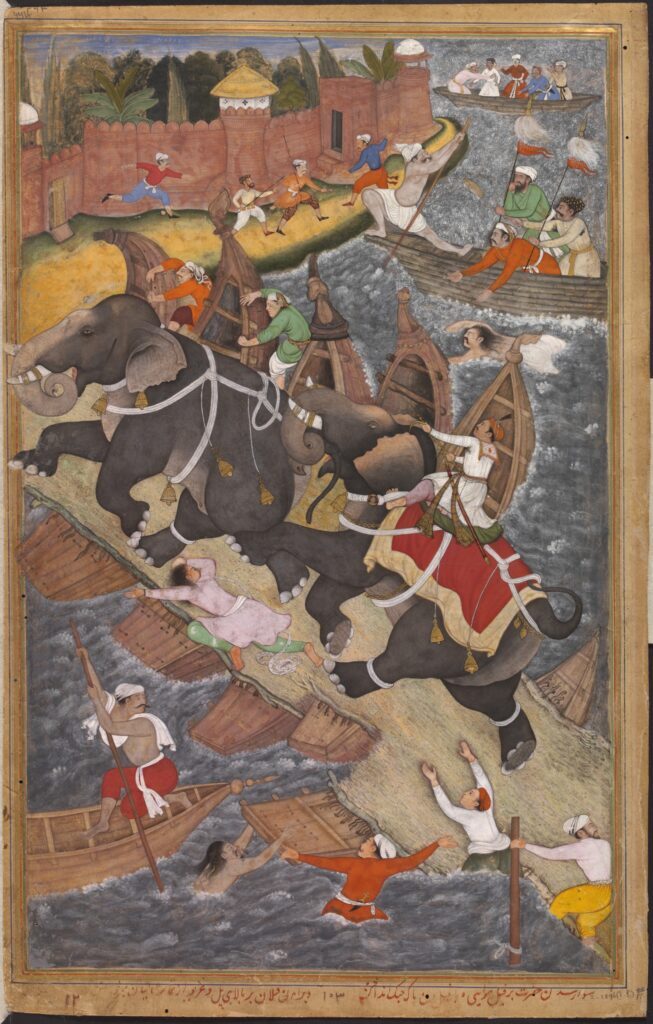
Basawan and Chetar, Akbar, illustration from Akbarnama (Book of Akbar), ca. 1590–1595, Victoria and Albert Museum, London, UK.
This masterpiece from the Akbarnama manuscript is celebrated for immortalizing the wild fury of Hawai’i being subdued by the divine bravery of the young Emperor Akbar, serving as a visual metaphor for the ruler’s absolute control over the chaos of his empire. In the Mughal court, mastering elephants that had killed their handlers was the ultimate test of leadership and bravery, proving the emperor was divinely ordained to rule. Drawn by Basawan and colored by Chetar, this artwork stands out for its tension and vivid detail, showing stacked perspective and a vibrant palette that includes ultramarine blue.
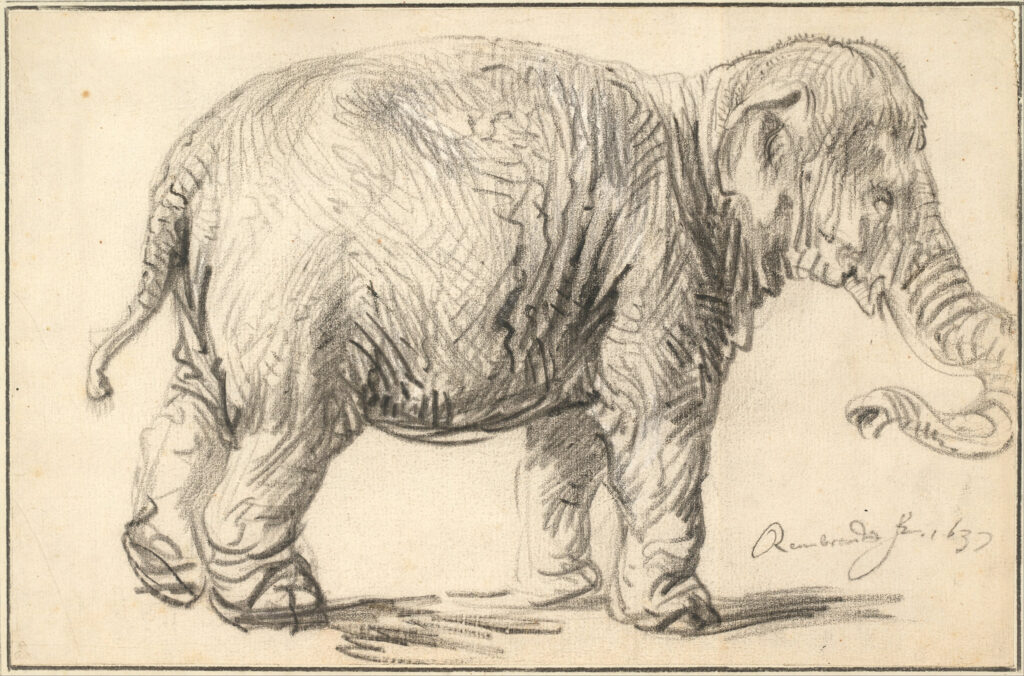
Rembrandt, An Elephant, 1637, Albertina, Vienna, Austria.
In the Middle Ages, most European painters had never seen an elephant. Based on written accounts, they drew hybrid creatures that mixed horses or wild boars with trumpet-like trunks. Rembrandt‘s (1606–1669) legendary study of the famous Asian elephant Hansken is celebrated for its historic realism. Hansken was a female elephant that traveled through Europe in the 17th century performing tricks.
The drawing is an accurate, detailed anatomical depiction of the animal, capturing the wrinkles of the skin and the heavy texture. Adam and Eve in Paradise (1638) is another famous Rembrandt etching where the artist discreetly inserts the elephant figure in the background as a symbol of chastity and virtue, contrasting with the temptation and imminent sin in the foreground.
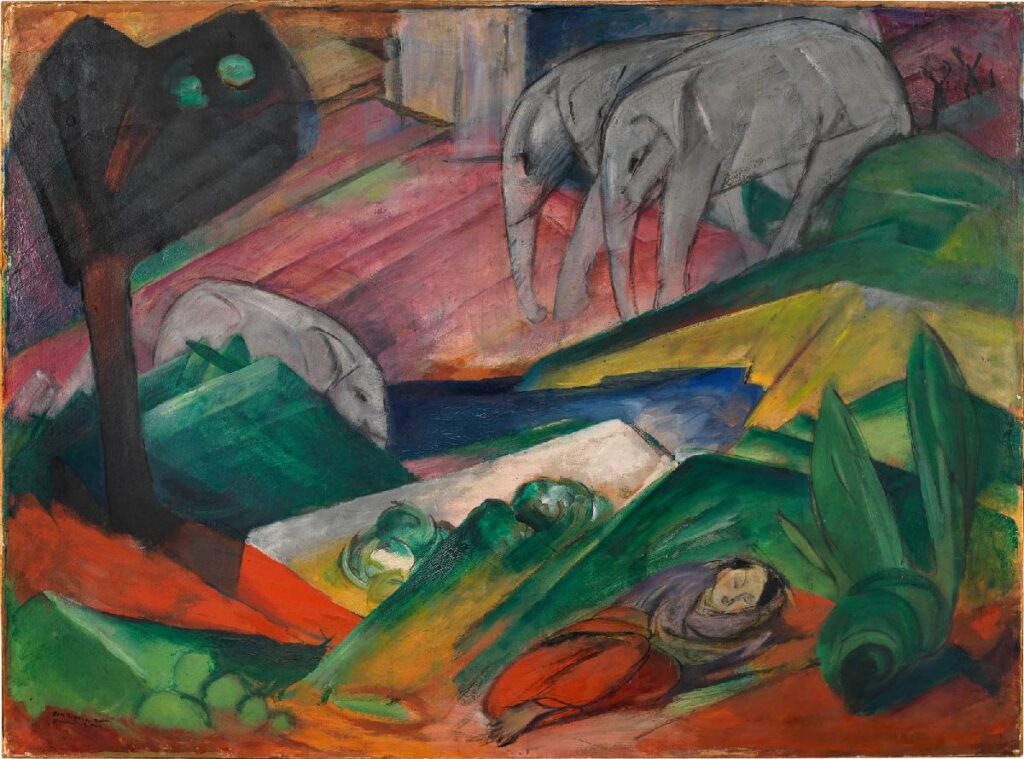
Franz Marc, Traum, Kunstmuseum Bern, Switzerland.
In Franz Marc’s (1880–1916) Traum, the elephant serves as a vital symbol of earthly weight and cosmic harmony, positioning these gentle giants as protective guardians within the subconscious dreamscape. The German Expressionist painter, a leading figure of Der Blaue Reiter movement, intentionally moved away from realistic depictions to create a deeply symbolic “animalization of art,” believing animals possessed a divine purity that humanity had lost.
Franz Marc did not paint animals from an objective, human perspective; his goal was to paint from the perspective of the animal itself to capture its unique soul. Through his strict, self-developed spiritual color vocabulary and using dynamic abstraction (influenced by Cubism and Italian Futurism), Marc breaks down the landscape and the animals into interlocking, geometric planes.
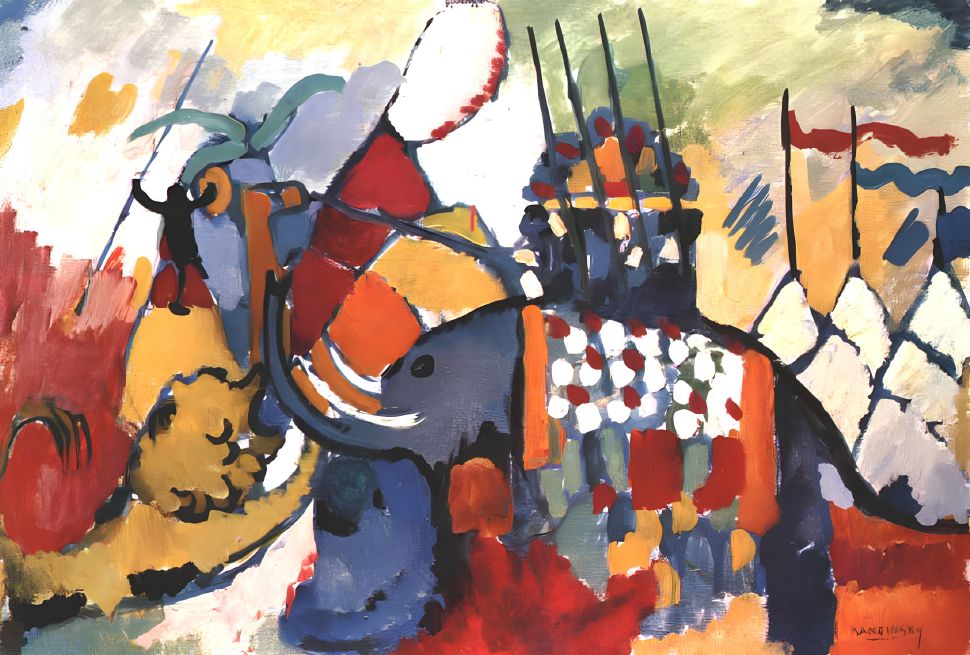
Wassily Kandinsky, The Elephant, 1908, private collection. WikiArt.
Wassily Kandinsky’s (1866–1944) painting The Elephant marks the change during his Expressionist period, shifting away from realistic depiction toward pure abstraction. Merging loose brushwork with vivid, non-naturalistic colors typical of Der Blaue Reiter period. Kandinsky believed art should reflect an “inner sound” rather than copy physical nature. The elephant acts as a recognizable vessel used to channel this spiritual truth, proving that even a massive earthly creature possesses a deeper, immaterial essence.
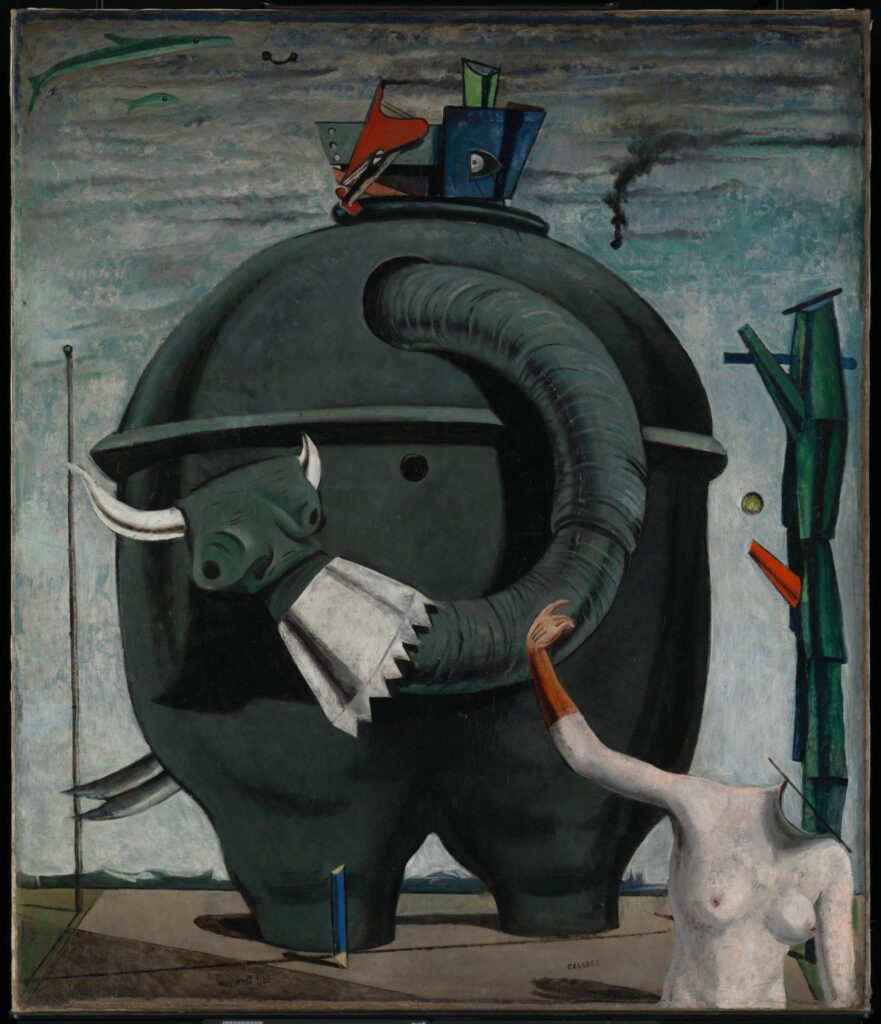
Max Ernst, Celebes, 1921, Tate Modern, London, UK. © ADAGP, Paris and DACS, London 2026.
Celebes, Max Ernst‘s (1891–1976) pioneering Surrealist masterpiece, combines the irrational, cut-and-paste aesthetic of Dadaism with the dreamlike symbolism of Surrealism. The colossal, boiler-like elephant resembles a tank and a gas mask, representing the dehumanizing mechanization of WWI. The body was inspired by a Sudanese corn bin, while the name Celebes originates from a scatological German children’s rhyme about a demon-like elephant.
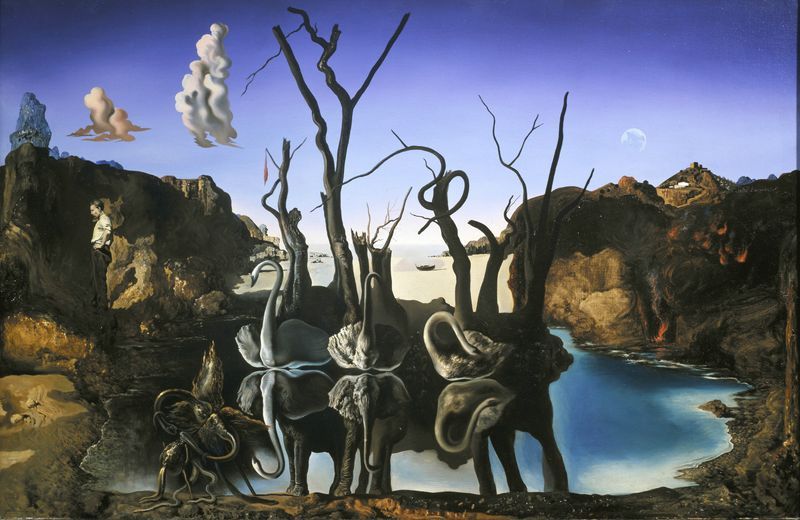
Salvador Dalí, Swans Reflecting Elephants, 1937, private collection. Fundació Gala-Salvador Dalí.
Salvador Dalí (1904–1989) used the elephant in several of his works (The Elephants, The Temptation of Saint Anthony) as a powerful and ambiguous symbol, which served to question logic and challenge perception. Swans Reflecting Elephants is a prime example of his signature double imagery and paranoiac-critical method. It features three swans on a serene, reflective lake: the swans’ necks form the trunks of elephants, while the barren trees behind them become the elephants’ legs and bodies. Dalí juxtaposed the graceful, delicate swan with the massive, heavy elephant to challenge human perception and blur the line between reality and illusion.
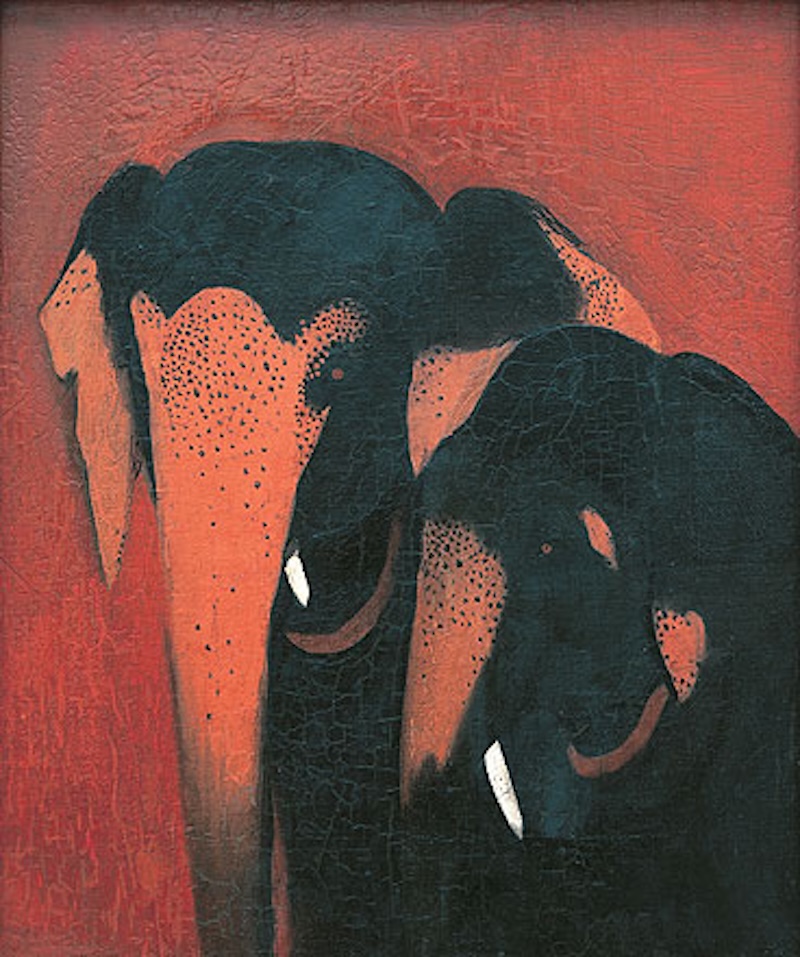
Amrita Sher-Gil, Two Elephants, 1940, National Gallery of Modern Art, New Delhi, India.
In Amrita Sher-Gil‘s (1913–1941) work, the elephant acts as a symbolic bridge between India’s rich cultural heritage, indigenous traditions, and the daily lives of everyday people. She used the elephant as a quintessential Indian motif to anchor her art in local mythology, much like the traditional Mughal and Rajput miniatures she so admired.
Just as she depicted Indian women as both majestic and suppressed by patriarchal realities, the elephant is a paradox in her work. It symbolizes the historical strength and pride of India, yet also represents the heavy, ponderous burdens carried by the land’s inhabitants.
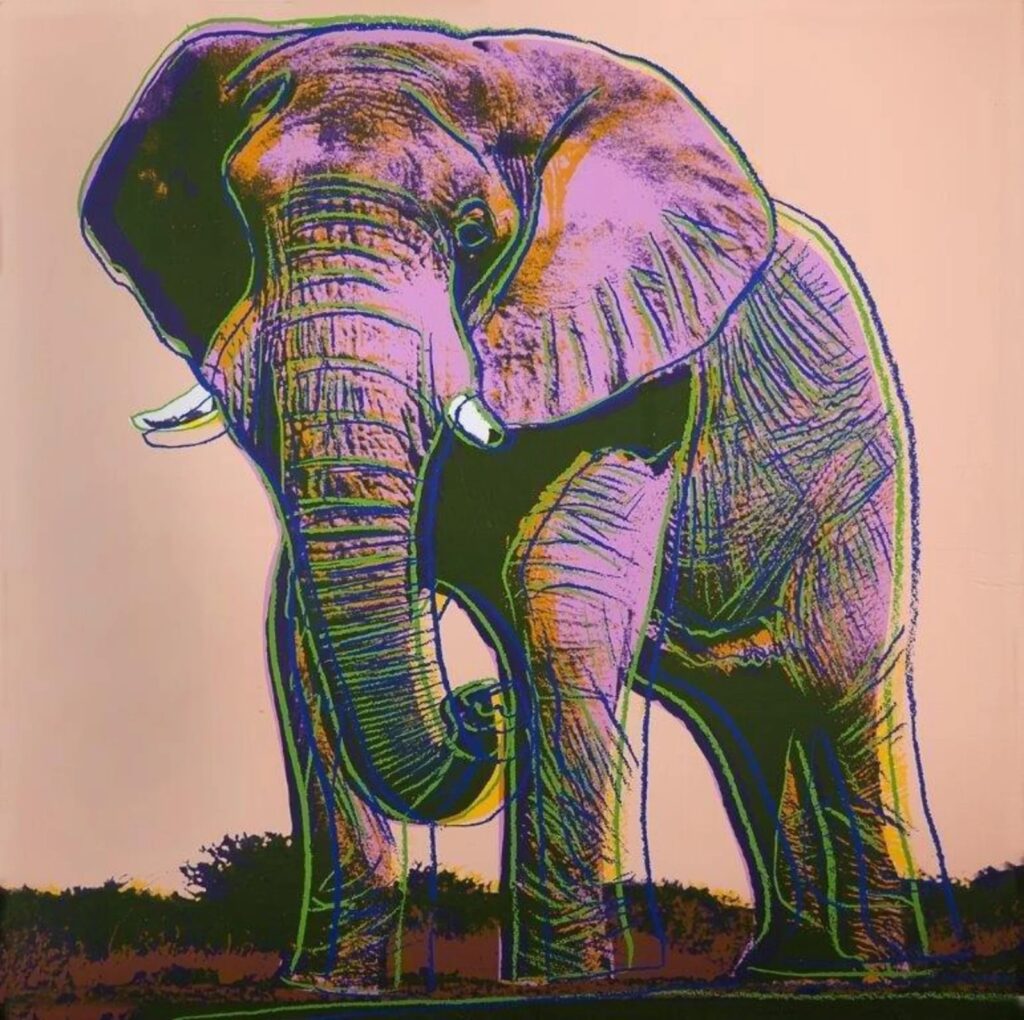
Andy Warhol, African Elephant, 1983, Galeries Bartoux Singapore, Singapore. Artsy.
In his 1983 Endangered Species series, Andy Warhol (1928–1987) used the African elephant to symbolize both monumental majesty and extreme vulnerability. Commissioned to mark the 10th anniversary of the Endangered Species Act, Warhol gave the elephant “celebrity” status, using bold, unnatural colors to elevate a threatened creature into an unignorable pop-culture icon.
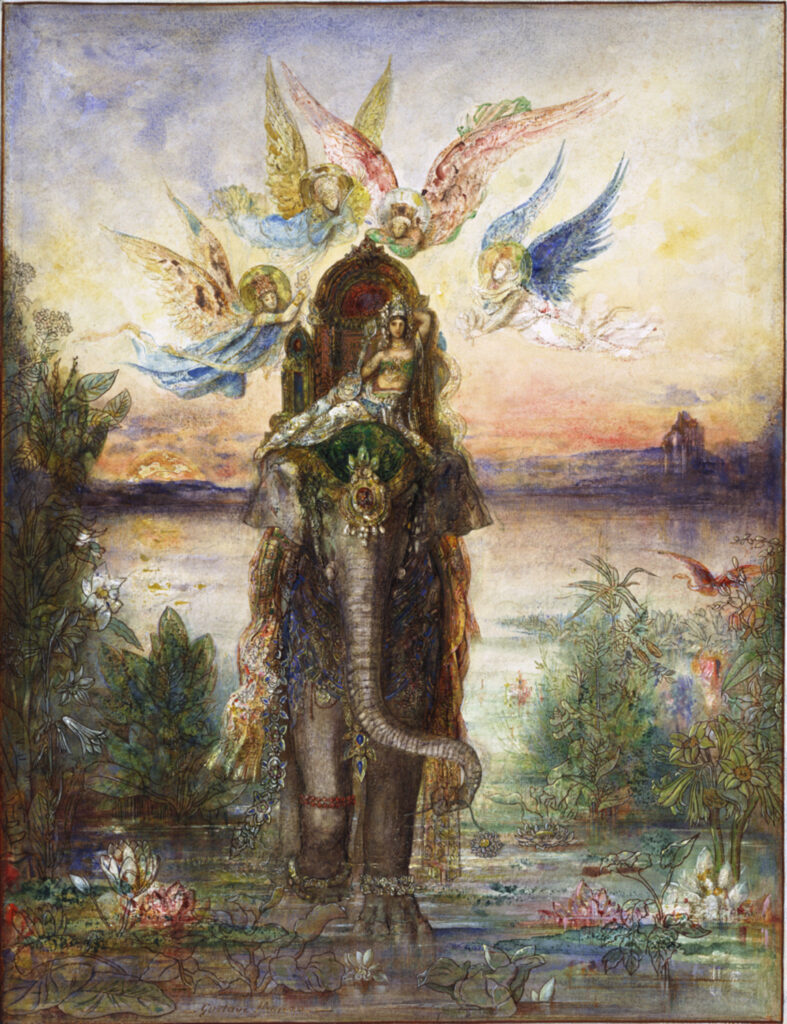
Gustave Moreau, The Sacred Elephant (Péri), 1826–1898, National Museum of Western Art, Tokyo, Japan.
Inspired by his unparalleled syncretic-religious imagination, and through a Symbolist lens, Gustave Moreau’s (1826–1898) The Sacred Elephant depicts an ornate, glowing creature of wisdom, carrying a divine figure through a mystical, lotus-filled lake as the sun is setting. The elephant likely acts as a vahana (sacred mount) for a central figure modeled after Lakshmi, the goddess of wealth and beauty. Four-winged, angelic figures hold stringed instruments and other flowers, blending motifs of traditional Western angels with Eastern mythology. The use of translucent chromatic overlays and visual jewels evoke an eternal ritual suspended in time, a visual poem that remains forever in our memory.
Beyond all the roles described so far, these marvelous beings, endowed with complex communication skills, a long childhood and social learning period, strong family ties, and mourning for the dead, surpass human ecological capabilities. They are the architects and gardeners of the forest and possess tactile hearing, listening to the world with their feet. Despite being venerated and portrayed as gods throughout art history, elephants have been exploited and mistreated for a long time, and their preservation is the only worthy compensation that all humans should grant them.
P.S. If you love animals and art as much as we do, we’ve got something special for you: Animals Postcards, featuring marvelous depictions of animals from across the history of art!
Author’s bio:
Cristina Correia is an internal medicine doctor and art lover from Portugal—an old soul with a special passion for cinema, museums, painting, and music. She is an everyday Fauvist who loves traveling and studying history. Despite being a scientist, she watched Alice in Wonderland endlessly during her childhood and believes that art can show us the best way.
DailyArt Magazine needs your support. Every contribution, however big or small, is very valuable for our future. Thanks to it, we will be able to sustain and grow the Magazine. Thank you for your help!

This is our guest profile for occasional authors. If you have an interesting story about art to tell, send it to our Editor-in-chief Kate at [email protected]. You might be the next here!

Melanie is a freelance editor, proofreader, and writer within humanities fields. Follow her on Twitter @melaniesdemmer.
From playful monkeys and majestic tigers to sleepy cats and elegant egrets, animals have always held a special place in Japanese art. Let’s explore...
Lisa Scalone 10 September 2026
The lamb serves as an enduring and multifaceted symbol that connects ancient pre-Christian ritual with the long history of Christian art. Throughout...
Maya M. Tola 4 May 2026
One cannot, while hoping to make a very valid argument, say dogs and humans are anything but almost entirely alike. After all, they share the same...
Guest Author 30 April 2026
Owls have captured the attention of artists since art began. Their knowing eyes, nocturnal wonderings, and global ubiquity have made them symbols of...
Theodore Carter 23 April 2026