Summary
- Amrita Sher-Gil blends European academic training with Indian heritage to pioneer modern art in India.
- Her early Self-Portrait demonstrates Sher-Gil’s technical mastery and independent spirit that would shape her artistic identity.
- Young Girls earned the 19-year-old artist election as an Associate of the Paris Grand Salon, making her one of its youngest members.
- Inspired by Paul Gauguin, Self-Portrait as a Tahitian is a transitional piece that marks Sher-Gil’s shift away from European artistic conventions toward her true calling in India.
- Three Girls, widely regarded as Sher-Gil’s first major Indian masterpiece, captures the dignity of rural women through subtle social observation.
- In Hill Women, Sher-Gil portrayed rural women with quiet strength, developing a modern social realism rooted in their humanity.
- Bride’s Toilet reflects the influence of the Ajanta cave murals. Sher-Gil used simplified forms and a subdued palette to bridge classical Indian visual tradition with 20th-century modernism.
- South Indian Villagers Going to Market represents the peak of her mature style, combining Western structural discipline with indigenous visual rhythms.
- Siesta shows Sher-Gil’s reinterpretation of Indian miniature traditions, replacing Western perspective with flattened space.
- Elephant Promenade features a rhythmic, highly stylized procession reflecting influences from ancient sculpture and Mughal miniature painting.
- Haldi Grinders fuses European structure, Ajanta’s rhythm, and Indian compositional clarity to celebrate the quiet grandeur of daily labor.
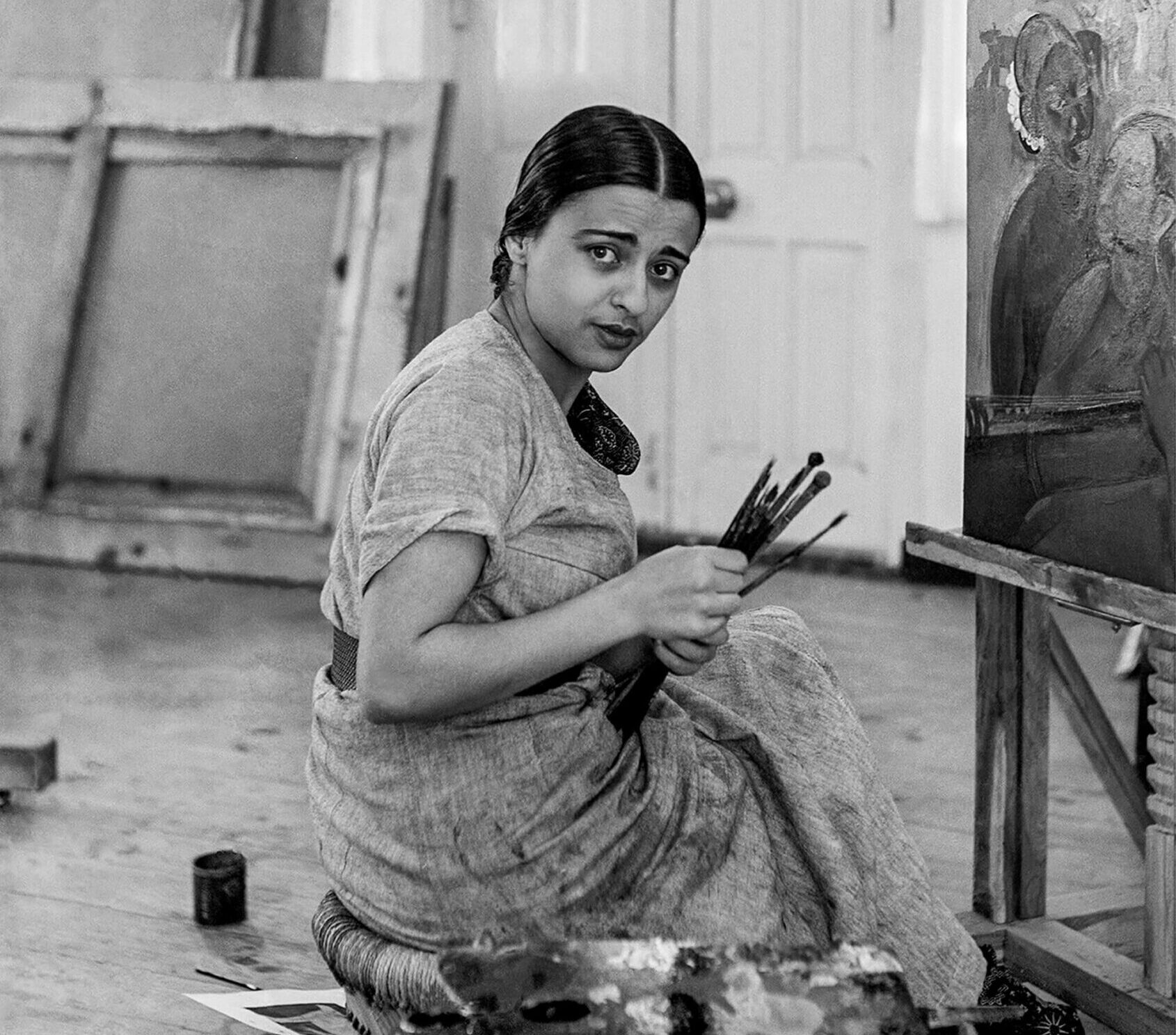
Born on 30 January 1913 in Budapest to the Sikh aristocrat and scholar Umrao Singh Sher-Gil Majithia and the Hungarian musician Marie Antoinette Gottesmann, Amrita Sher-Gil grew up between Hungary, India, and France. She is often compared to Frida Kahlo for her cosmopolitan life, uncompromising artistic vision, and tragically brief career. Her enduring achievement lies not merely in bridging cultures but in demonstrating that modernism in India could emerge from its own social realities, histories, and people.
In a letter to her parents Sher-Gil wrote, “My professor had often said that judging by the richness of my coloring, I was not really in my element in the grey studios of the West and that my artistic personality would find its true atmosphere in the color and light of the East”. Despite success in Europe where she honed her skills and garnered attention, Amrita Sher-Gil felt “haunted by an intense longing to return to India” (as written in her letter to the renowned Indian art critic Karl Khandalavala). She believed that her true fate as an artist lay in the richness of her Indian roots.
The 10 paintings that follow trace this extraordinary artistic journey—from the academic realism of her Paris years to the powerful, introspective works that redefined the course of modern Indian art.
1. The Making of an Artist—Self-Portrait (7)
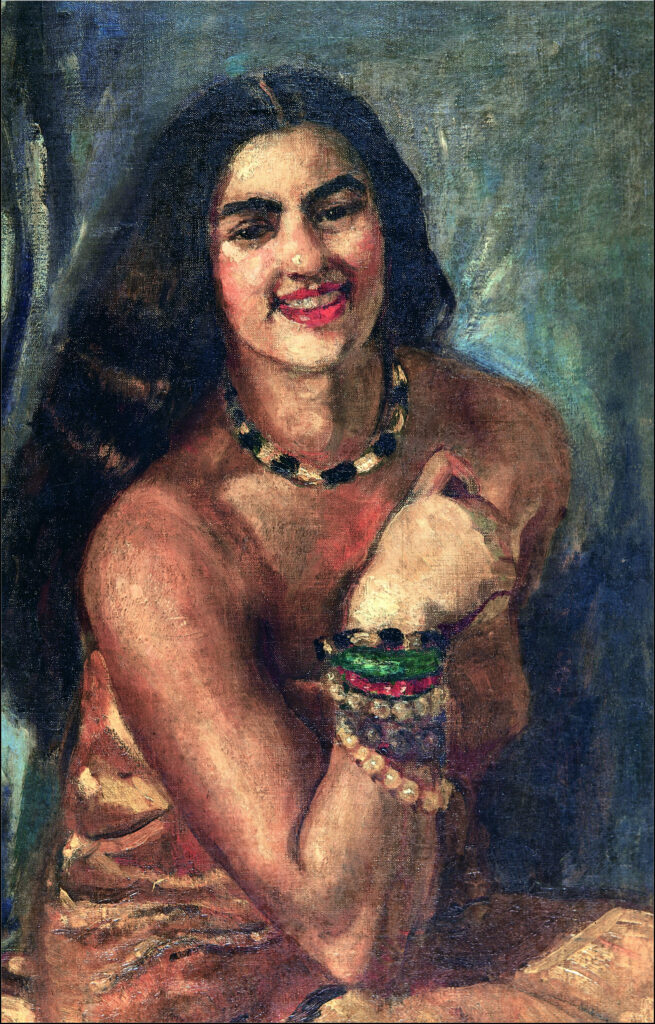
Amrita Sher-Gil, Self-Portrait (7), 1930, National Gallery of Modern Art, New Delhi, India.
During her student years in Paris, Amrita Sher-Gil established herself through a series of striking self-portraits. Self-Portrait from 1930 reveals a young artist acutely aware of her own presence and ambition. Rather than presenting herself as an idealized beauty, she adopts a direct, introspective gaze that reflects confidence and intellectual maturity.
The painting demonstrates her command of academic drawing, modeling, and color acquired through European training, while also hinting at an independent temperament unwilling to conform to conventional expectations of female portraiture. It marks the beginning of Sher-Gil’s lifelong engagement with self-definition, introducing the artist not merely as a subject but as a modern creative force determined to shape her own identity.
2. Triumph in Paris—Young Girls
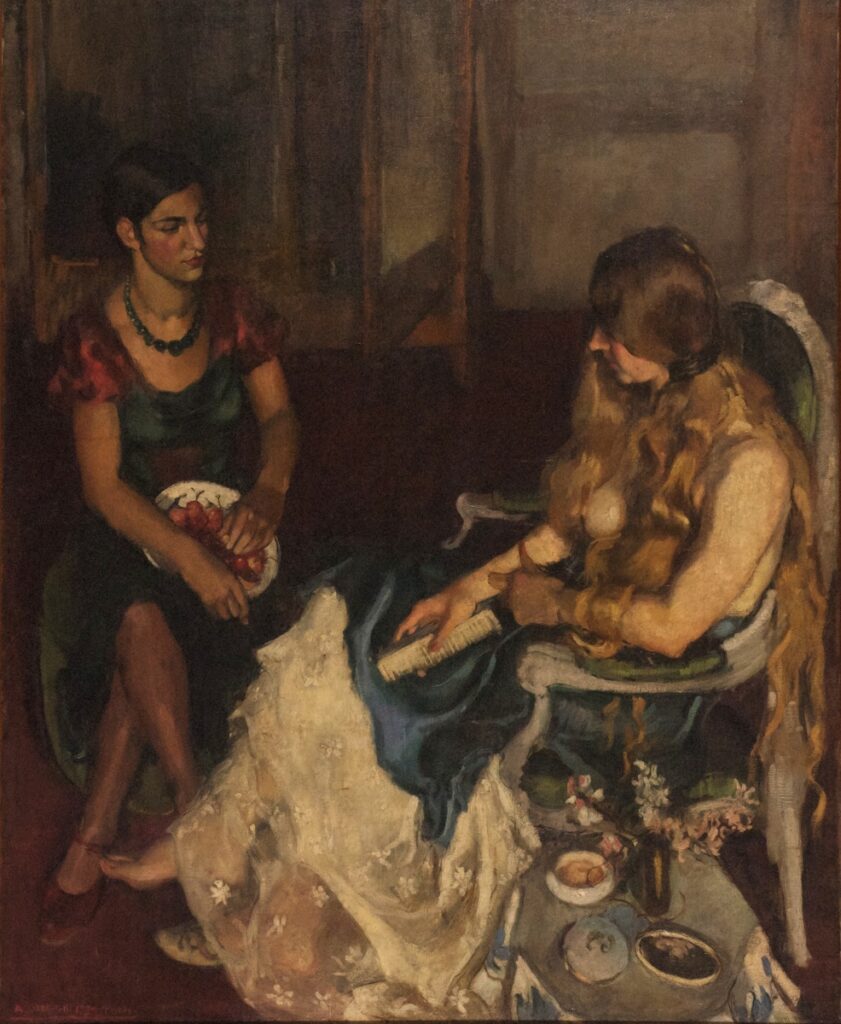
Amrita Sher-Gil, Young Girls, 1932, National Gallery of Modern Art, New Delhi, India.
At just 19, Amrita Sher-Gil achieved what many artists spend years striving for. Her painting Young Girls was exhibited at the Paris Salon and, in 1933, earned her election as an Associate of the Grand Salon, making her one of its youngest members and the first Asian woman to receive the honor. The work reflects the rigorous academic training she received at the École des Beaux-Arts under Lucien Simon. Its carefully modelled figures and balanced composition reveal technical mastery, while its simplified forms hint at the influence of Paul Cézanne.
The painting depicts two girls, modelled her sister Indira and friend Denise Proutaux, whose contrasting expressions and restrained interaction create a subtle psychological tension, demonstrating Sher-Gil’s growing interest in inner emotional states rather than outward appearances. Influenced by Post-Impressionist color and composition, she balanced careful observation with expressive simplification.
Europe belongs to Picasso, Matisse, and Braque. India belongs only to me.
Amrita Sher-Gil: A Self-Portrait in Letters and Writings, ed. Vivan Sundaram, Vol. I, Tulika Books, 2010.
3. Between Europe and India—Self-Portrait as a Tahitian
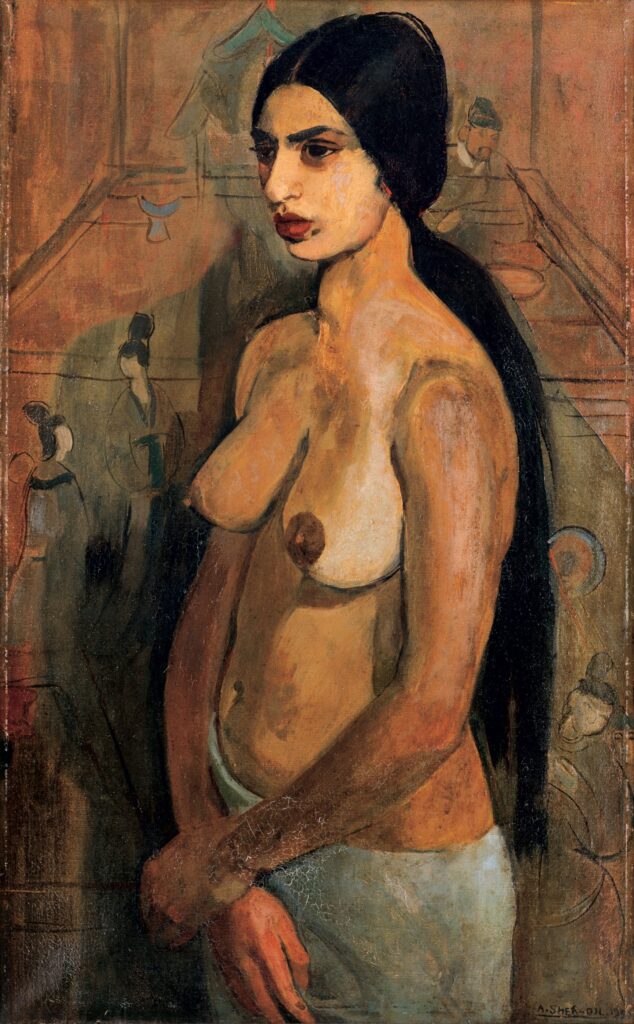
Amrita Sher-Gil, Self-Portrait as a Tahitian, 1934, Kiran Nadar Museum of Art, New Delhi, India. Smart History.
Few artists examined themselves as persistently as Amrita Sher-Gil. Throughout her career, she painted more than 20 self-portraits, using them to explore identity and artistic purpose. Painted shortly before her return to India, Self-Portrait as a Tahitian reflects Sher-Gil’s growing dissatisfaction with European artistic conventions and her search for a more authentic cultural identity.
Inspired by Paul Gauguin‘s Tahitian portraits, she adopts neither an exotic persona nor a direct imitation of his style, but uses the image to explore questions of belonging and artistic direction. The simplified forms, rich colors, and introspective mood demonstrate her engagement with modernist experimentation with an increasing desire to move beyond its limitations. More than a portrait, the work symbolizes a moment of transition, standing between the European training and the Indian artistic language she was about to discover. It is the final expression of her Paris years before her creative journey turned decisively towards India.
I realized that a painter’s picture is only worth something if he is expressing the spirit of the land in which he lives. (…) I have come to the conclusion that my destiny as a painter lies in India. I wish to paint the picture of India in all its richness and misery.
Letter to Denise Proutaux, March 25, 1936.
4. Discovering India—Three Girls
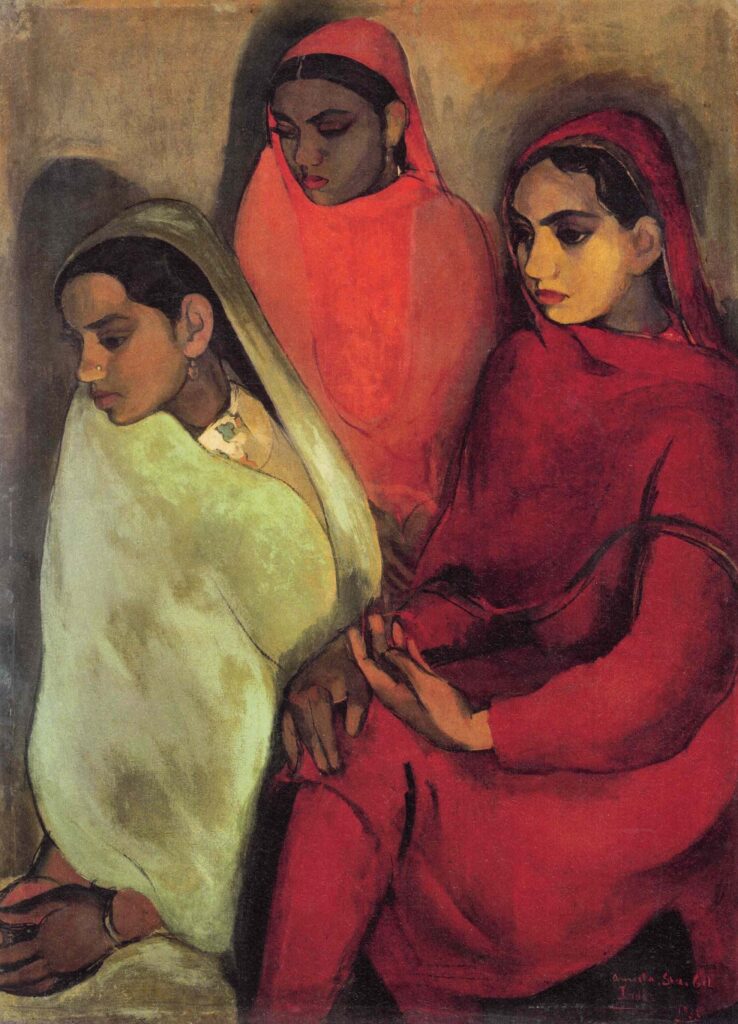
Amrita Sher-Gil, Three Girls (Group of Young Girls), 1935, National Gallery of Modern Art, New Delhi, India.
Soon after returning to India in 1934, Sher-Gil abandoned European subjects in favor of the lives of ordinary Indian people, and Three Girls became the first great expression of this transformation. The painting portrays three rural women seated together in silence. Their introspective expressions convey quiet dignity rather than narrative drama.
Rejecting romanticized images of India, Sher-Gil instead revealed the emotional weight of everyday existence through earthy colors and restrained composition. The work marked her realization that modern Indian art could emerge not by imitating European models but by engaging honestly with Indian life.
Widely regarded as her first major Indian masterpiece, Three Girls established empathy, psychological depth, and social observation as defining qualities of her mature style.
As soon as I put my foot on Indian soil, my painting underwent a change… becoming more Indian. I realized my mission then: to interpret the life of Indians and particularly of the poor Indians, pictorially, to paint the silent images of infinite submission and patience, to depict the angular brown bodies, strangely beautiful in their ugliness, to reproduce on canvas the impression their sad eyes created on me.
Letter written to Karl Khandalavala, January 1938. Asia Art Archive.
5. Monumentality and Social Realism—Hill Women
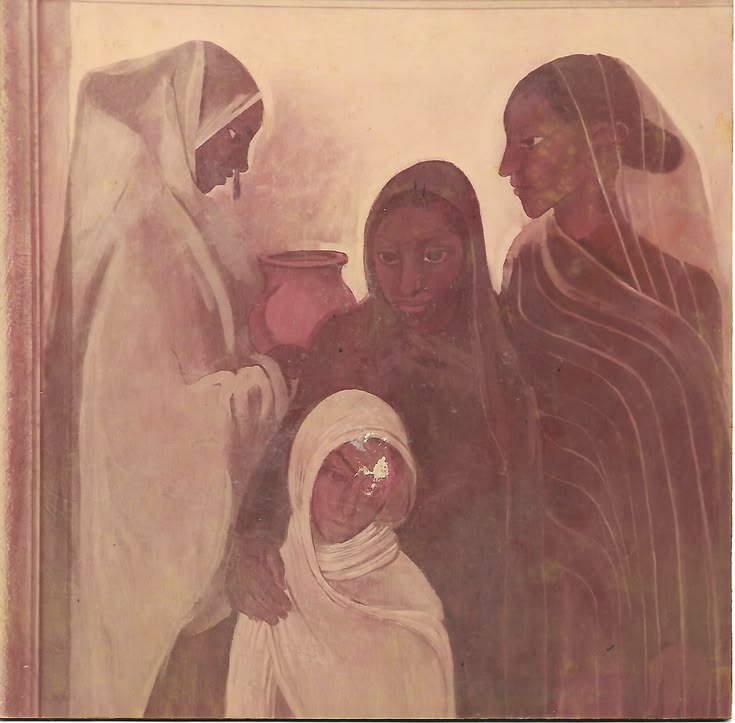
Amrita Sher-Gil, Hill Women, 1935, private collection of Vivan Sundaram and Navina Sundaram, Sher-Gil Sundaram Arts Foundation, New Delhi, India. Gaga Archives. Detail.
Sher-Gil continued her engagement with rural India shifting her attention from psychological intimacy to the monumental presence of ordinary people. The women are rendered with broad simplified forms, minimal movement, and sculptural solidity, giving them a timeless dignity rarely afforded to rural subjects in contemporary painting.
Rather than emphasizing poverty or sentimentality, Sher-Gil presents them with quiet strength and restraint, transforming figures into enduring symbols of human resilience. The muted palette and carefully balanced composition further reinforce this sense of permanence. Through this work, she developed a distinctly modern form of social realism that celebrated the humanity of her subjects without reducing them to objects of sympathy.
6. The Legacy of Ajanta—Bride’s Toilet
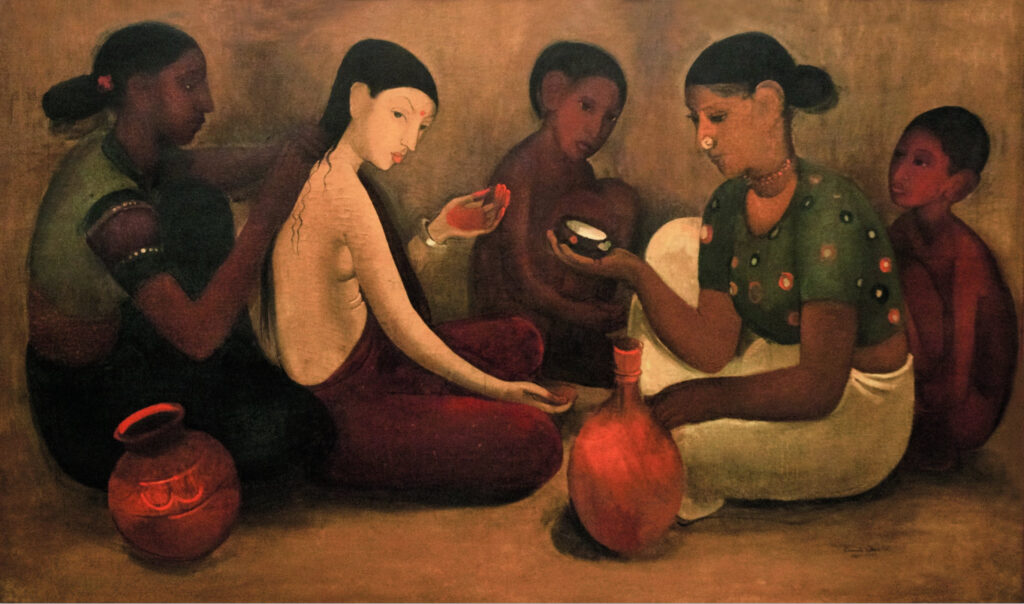
Amrita Sher-Gil, Bride’s Toilet, 1937, National Gallery of Modern Art, New Delhi, India.
Sher-Gil’s visit to the Ajanta caves in 1936 profoundly reshaped her artistic vision. She defined them as “vital, sublime and utterly lovely,” and Bride’s Toilet is among the earliest and finest expressions of this transformation. Inspired by the sculptural modelling and subdued palette of the Ajanta murals, she abandoned the heavier European treatment of form in favor of greater harmony and simplicity.
The figures possess a quiet monumentality, while their gestures unfold with a calm, almost ceremonial rhythm. Rather than copying the Ajanta style, Sher-Gil absorbed its underlying principles and reinterpreted them within a modern idiom. The result is a painting that successfully bridges India’s classical artistic heritage with 20th-century modernism, marking a decisive turning point in her search for a national visual language.
7. A Modern Indian Vision—South Indian Villagers Going to Market
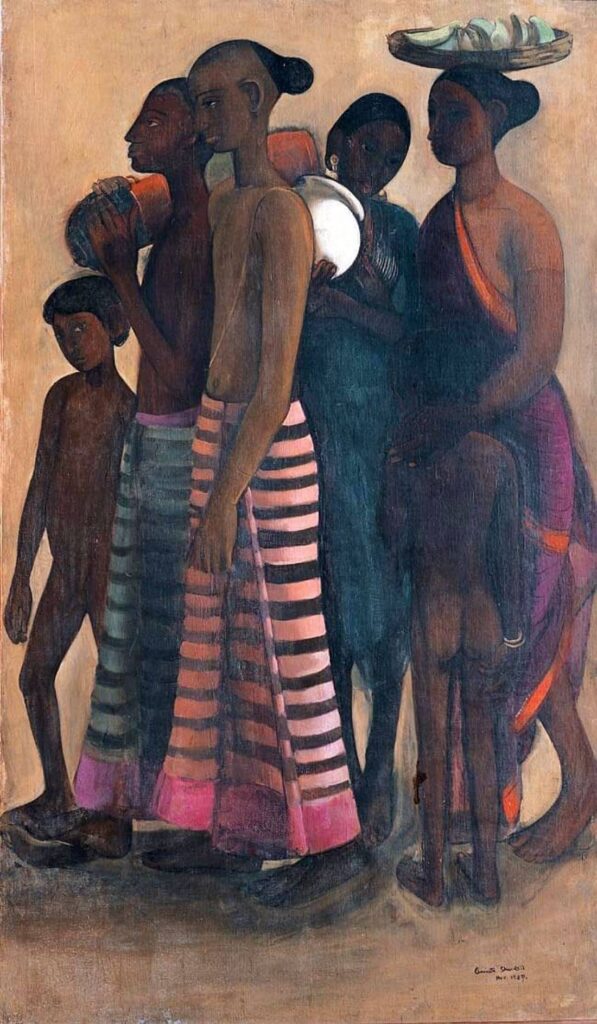
Amrita Sher-Gil, South Indian Villagers Going to Market, 1937, private collection of Vivan and Navina Sundaram, Sher-Gil Sundaram Arts Foundation, New Delhi, India.
Painted after her journey through South India, South Indian Villagers Going to Market represents the fullest realization of Sher-Gil’s mature artistic language. The procession of villagers moves across the picture with measured rhythm, their simplified forms unified by a rich yet restrained palette. Individual identity gives way to collective experience, emphasizing the timeless continuity of everyday life rather than a specific narrative moment.
Drawing upon lessons from Ajanta while retaining the structural discipline of European modernism, Sher-Gil achieved a remarkable balance between observation and abstraction. The painting demonstrates her conviction that modern Indian art could emerge from indigenous visual traditions without abandoning contemporary artistic concerns, making it one of the defining works of Indian modernism.
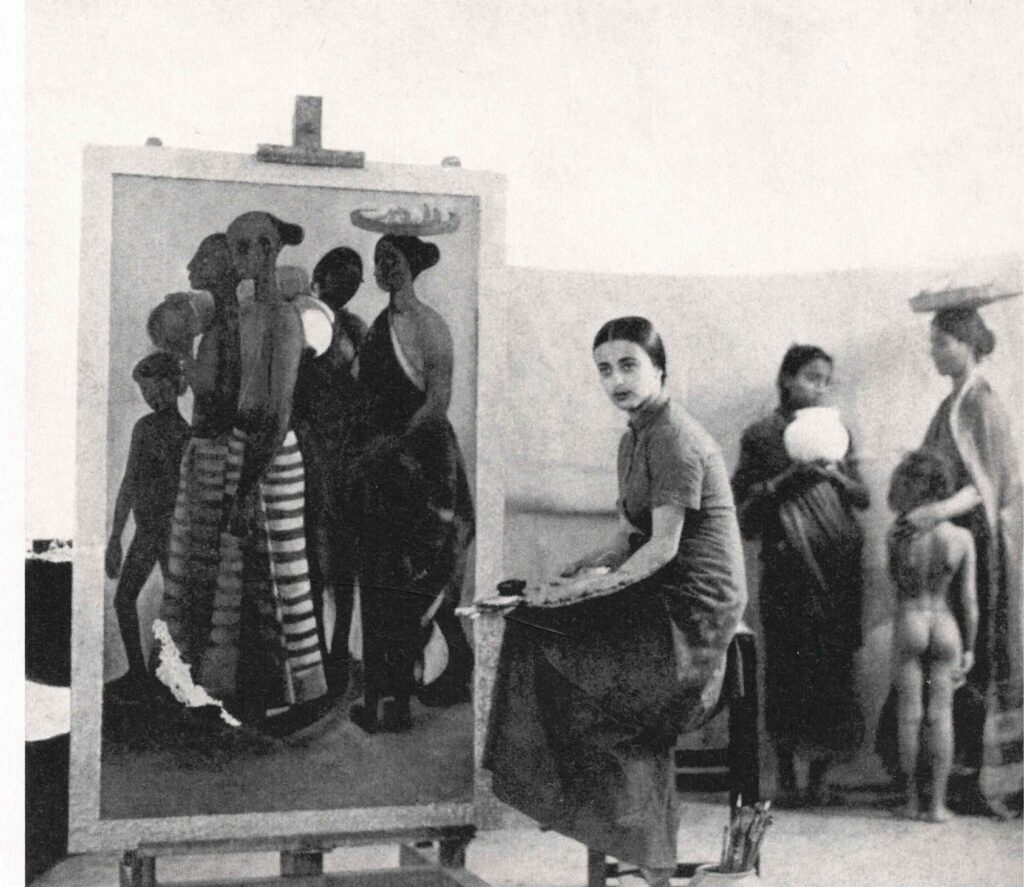
Amrita Sher-Gil painting South Indian Villagers Going to Market with three of the models at her home in Simla, 1937. Wikimedia Commons (public domain).
Another period of transition is approaching…. one of greater reflection, of more conscious painting, more observation, and more stylization in the sense of nature.
Amrita Sher-Gil: A Self-Portrait in Letters and Writings, ed. Vivan Sundaram, Vol. II, New Delhi 2010.
8. Reimagining the Miniature Tradition—Siesta
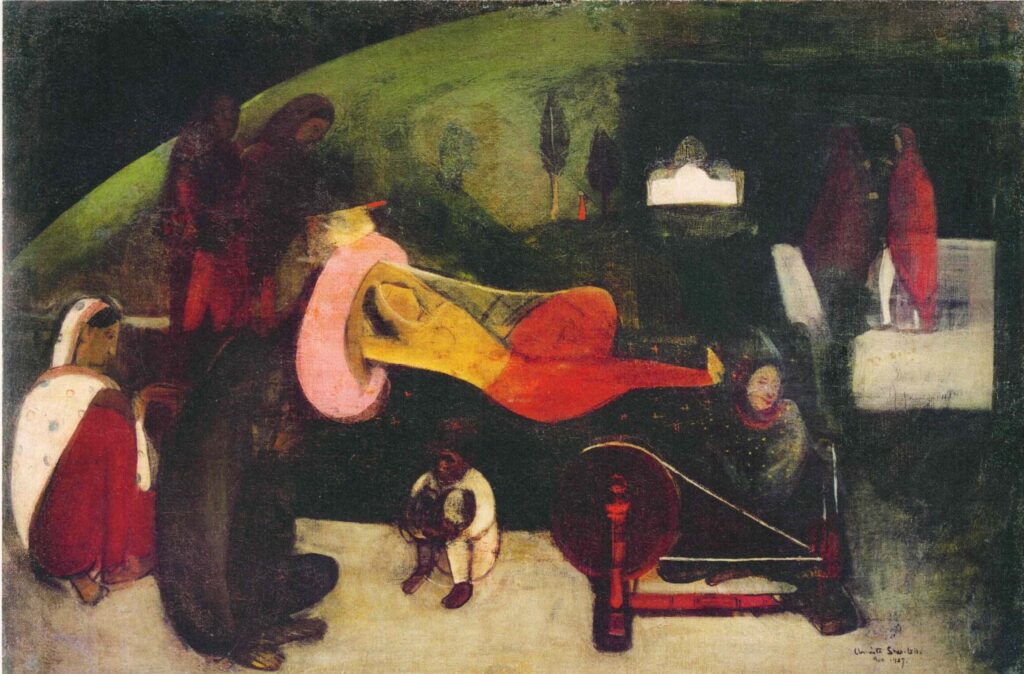
Amrita Sher-Gil, Siesta, 1937, National Gallery of Modern Art, New Delhi, India.
By the late 1930s Sher-Gil’s interest had expanded beyond Ajanta to include the visual language of Rajput and Pahari miniature painting. In Siesta, flattened pictorial space and decorative balance replace conventional Western perspective, creating an atmosphere of quiet contemplation.
Yet the painting is far from a revival of miniature art. Sher-Gil transformed an intimate domestic moment into a modern meditation on rest and stillness. The work demonstrates her ability to absorb diverse Indian traditions and reinterpret them without imitation, further enriching the visual vocabulary she had begun to develop after her return from Europe.
9. Towards a Timeless Indian Aesthetic—Elephant Promenade
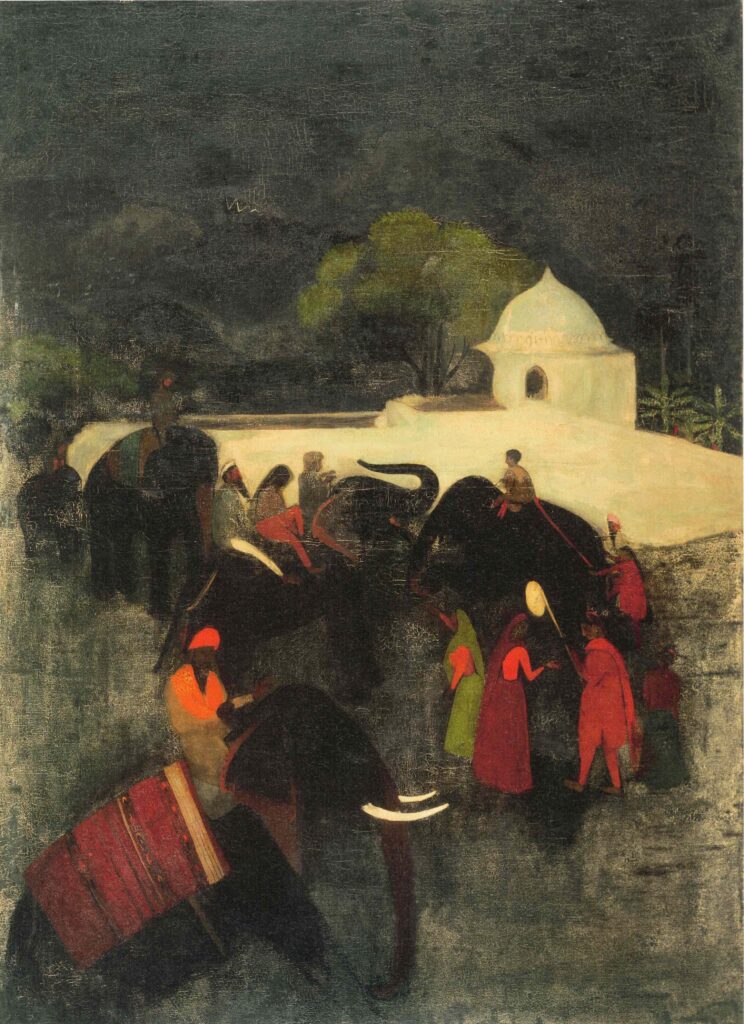
Amrita Sher-Gil, Elephant Promenade, 1940, National Gallery of Modern Art, New Delhi, India.
Created during her final years at Saraya, India, Elephant Promenade reflects Sher-Gil’s growing fascination with rhythm, stylization, and the enduring forms of Indian art. Rather than depicting a realistic scene, she arranges the elephants in a measured procession that recalls the visual cadence of ancient Indian sculpture and early mural traditions. The emphasis on mass, repetition, and controlled movement reveals a shift away from descriptive naturalism toward a more distilled and symbolic language.
At the same time, her study of Mughal and early Rajput painting contributed to the painting’s refined sense of order and balance. The work represents a mature synthesis of observation and historical tradition, demonstrating how Sher-Gil was forging an increasingly original modern aesthetic rooted in India’s artistic past.
10. The Culmination of a Modern Indian Style—Haldi Grinders
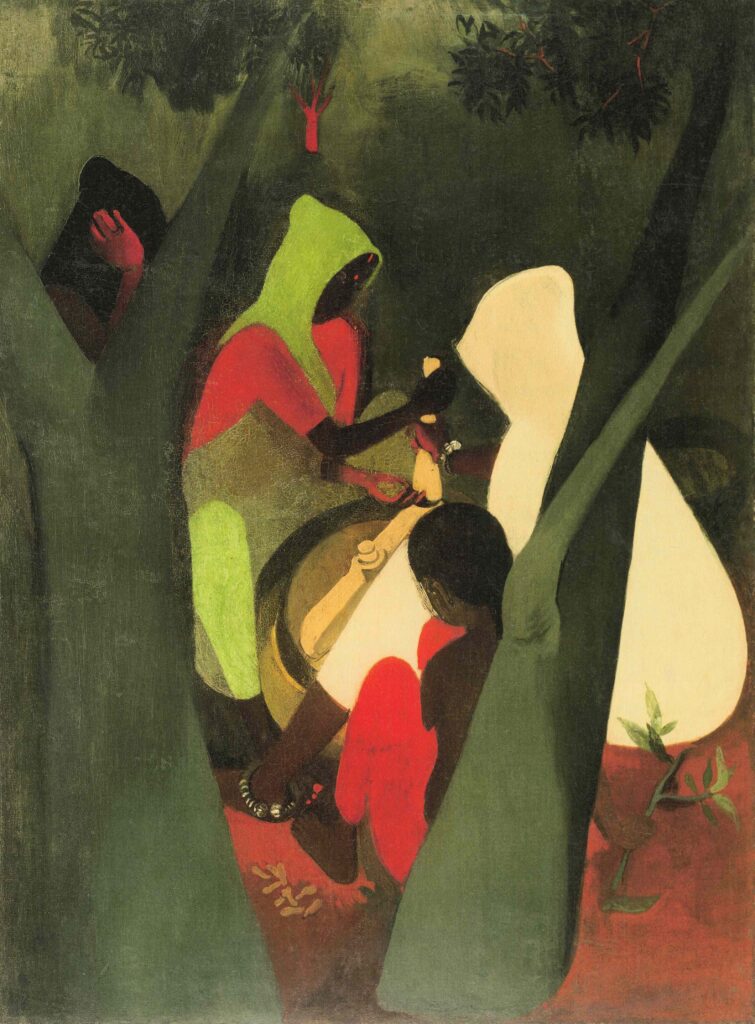
Amrita Sher-Gil, Haldi Grinders, 1940, National Gallery of Modern Art, New Delhi, India.
Painted during the final phase of her career, Haldi Grinders brings together the many artistic discoveries that had shaped Sher-Gil’s remarkable journey. The women engaged in the everyday task of grinding turmeric are rendered with simplified forms, sculptural solidity, and a restrained yet luminous palette that transform ordinary labour into a scene of quiet grandeur.
European structure, the rhythmic harmony of Ajanta, and the compositional clarity of Indian painting are seamlessly integrated into a visual language that is entirely her own. Free from anecdote or sentimentality, the painting celebrates the dignity of work through balance and formal refinement. It stands as the fullest realization of Sher-Gil’s vision of a modern Indian art—one rooted in indigenous traditions yet unmistakably contemporary—and remains one of the defining masterpieces of 20th-century Indian painting.
An Unfinished Revolution
As she famously declared, “Success is not what interests me. Painting does.” Amrita Sher-Gil sought to create “a new technique, which though not necessarily Indian in the traditional sense of the word, will yet be fundamentally Indian in spirit.” That ambition became her greatest achievement. Her paintings remain a testament to an artist who refused to choose between East and West, tradition and modernity, and instead created a language entirely her own—one that continues to define the story of modern Indian art. “Art, indeed, has no end…. and the aim of every artist should be to create something living and contemporary,” as she writes in her letters.
P.S. You’ll find Amrita Sher-Gill’s paintings in both of our Women Artists Postcards, featuring works by the amazing female artists!