



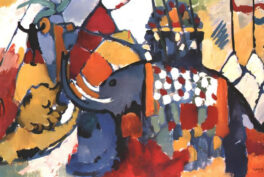
From Ganesha to Warhol: 12 Elephants in Art
Elephants hold a profound place in art across cultures around the world, appearing as sacred creatures, symbols of power, and mysterious beings.
Guest Author 17 September 2026
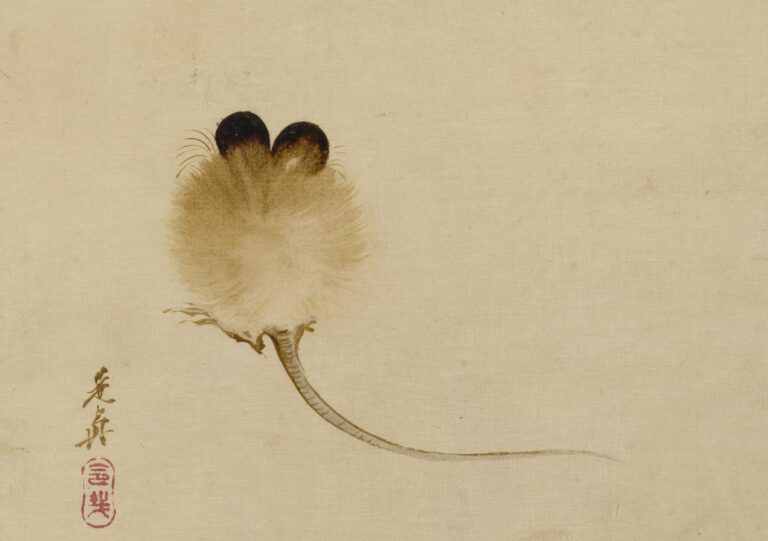
Shibata Zeshin, Mouse, 19th century, British Museum, London, UK. Detail.
From playful monkeys and majestic tigers to sleepy cats and elegant egrets, animals have always held a special place in Japanese art. Let’s explore 10 delightful artworks and discover the stories, symbols, and artistic styles behind these fascinating creatures.
Dedicated to all animal lovers, who have always found inspiration in animals as spirit guides or companions in life, or simply in their elegance and clumsiness, our set of 50 postcards, Animals in Japanese Art, is available in the online shop.
To whet your appetite, I have decided to select 10 postcards to give you a sneak peek. I have arranged them chronologically, so we can enjoy the changing styles across different periods, while creating a home zoo as varied as possible in terms of both fauna and artistic representation. But let’s not linger any longer—let the tour begin.
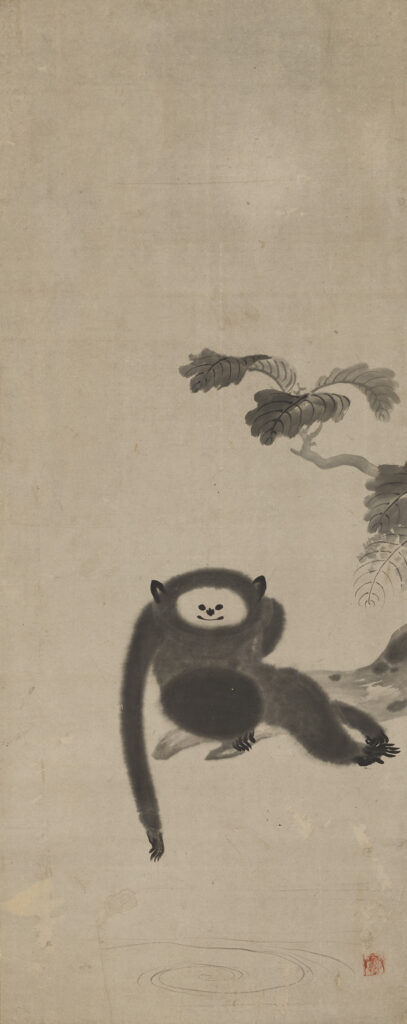
Kanō Sanesetsu, Monkey, 17th century, Tokyo National Museum, Tokyo, Japan.
The first little animal that immediately struck me as particularly charming and joyful is Kanō Sanesetsu’s monkey. Using a simple, essential style and nothing but shades of grey, the Japanese master and leading figure of the Kanō school was able to capture the playfulness and happiness of this little monkey smiling at us from a branch.
Could she have been up to some mischief behind our backs?
In Japan, the monkey acts as a link between the divine and human worlds. It offers protection against evil and is an archetypal animal associated with intelligence, cunning, and curiosity. The artist was masterful in painting the monkey’s fur. You can almost feel with your eyes how soft and fluffy its coat is.
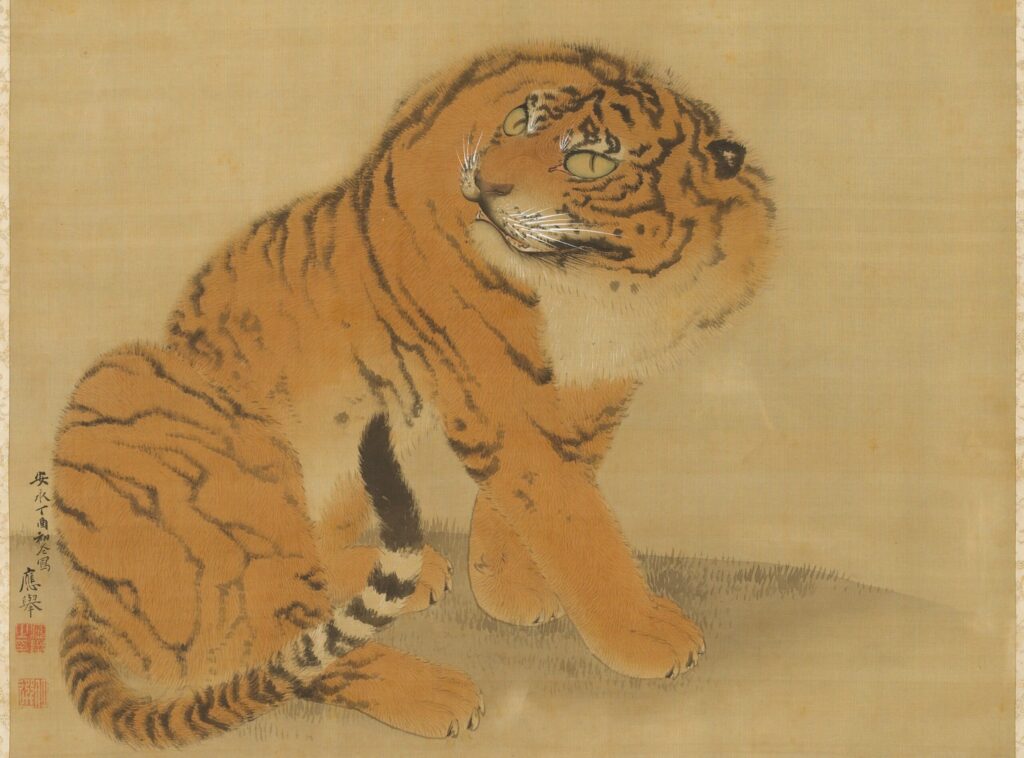
Maruyama Ōkyo, Sitting Tiger, 1777, Minneapolis Institute of Art, Minneapolis, MN, USA.
A tiger was an essential part of my personal selection of 10 postcards. Proud, elegant, and cunning. A majestic animal with a magnetic gaze, a symbol of strength and courage, it probably entered Japanese art from ancient Chinese culture (it was not an animal that lived in Japan in the 18th century).
Maruyama Ōkyo gives us a surprisingly realistic work, especially in the detailed rendering of the tiger’s coat. Could he have taken inspiration from watching his own cats wandering around the house? He was an innovator of his time, successfully combining influences from Chinese culture with a typically Western naturalistic style while remaining firmly rooted in the Japanese pictorial tradition. The eyes of this beautiful tiger, like fiery pyrite gems, cannot leave you indifferent.
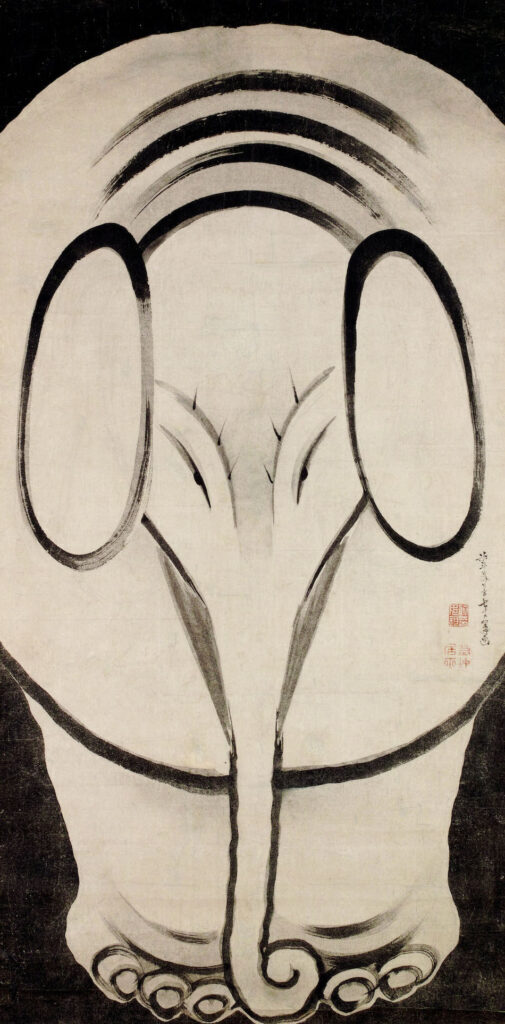
Itō Jakuchū, Elephant, c. 1790, Tokyo Fuji Art Museum, Tokyo, Japan.
Here we have very few strokes and a grey palette verging on black and white. We are confronted by a massive animal with a long trunk and small ears. It looks at us motionlessly, filling the entire scene and leaving us nowhere to escape.
Once again, we encounter an animal that was not typically Japanese, but was closely connected to Buddhist traditions. The painter Itō Jakuchū also received commissions from Buddhist temples and therefore depicted animals that did not necessarily belong to his native environment but carried strong symbolic associations with Buddhism. A sacred and wise animal, gentle in spirit, that we would all love to have by our side as a spirit guide.
What is striking is the extremely modernist style of this work, which is difficult to associate with the 18th century. We find the same elephant in the beautiful Animals in the Flower Garden, which I recommend seeing for its wonderful colors and animals. A true earthly paradise.
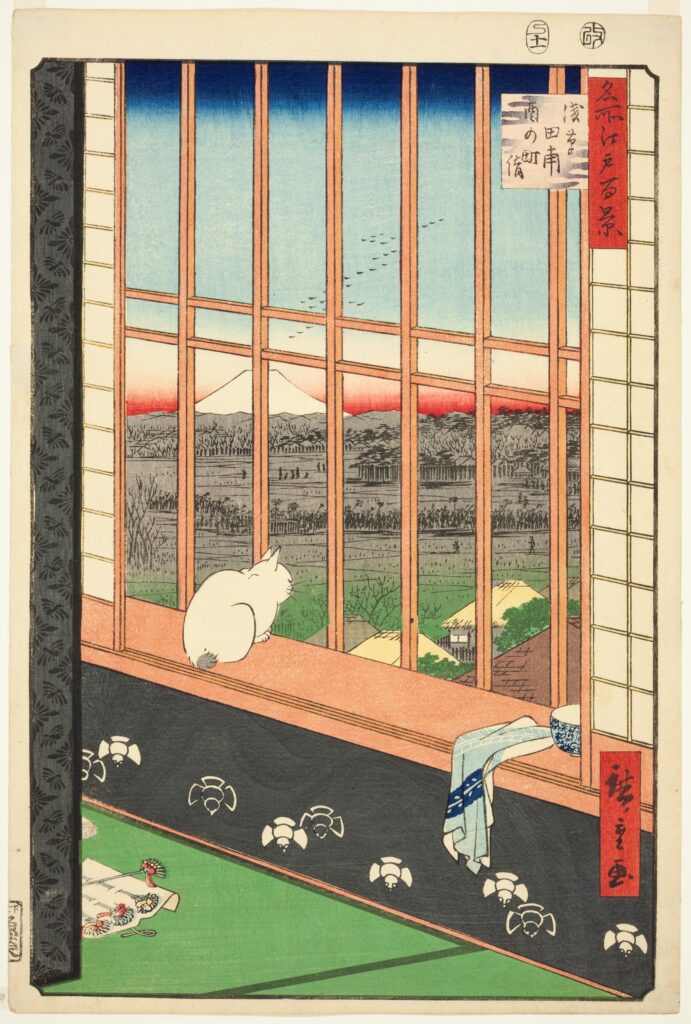
Utagawa Hiroshige, Asakusa Ricefields and Torinomachi Festival, No. 101 from the series One Hundred Famous Views of Edo, 1857, Brooklyn Museum, New York City, NY, USA.
This scene will feel very familiar to anyone who owns a domestic cat. Cats love watching the outside world from a window. They can spend hours observing what is happening beyond the glass, and this beautiful scene by Hiroshige is a perfect example.
We are given a view from inside the house, almost as if we were standing there ourselves, admiring a cat absorbed in watching a beautiful sunset. Mount Fuji rises on the horizon in reddish tones. Above it, the sky is growing darker. The landscape lies in shadow, and the fields, rice paddies, and people are now almost indistinguishable. The Torinomachi Festival is taking place in the distance. Only a few village houses remain brighter in the twilight.
The work is a typical Japanese color woodblock print on paper (ukiyo-e), produced by carving several blocks from the original design, each used to apply a different color and then print it onto the paper. One block contained only the red elements, another the white elements, and so on. Utagawa Hiroshige was a great master of this technique and is considered one of the greatest Japanese landscape artists of the 19th century.
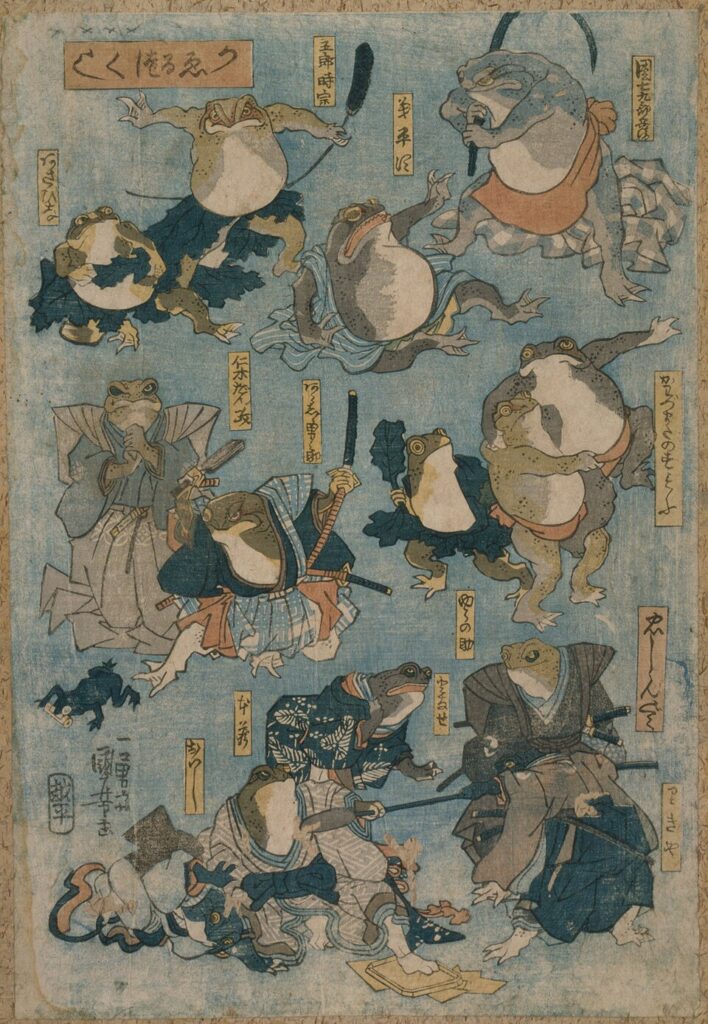
Utagawa Kuniyoshi, Famous Heroes of the Kabuki Stage Played by Frogs, c. 1875, Library of Congress, Washington, DC, USA.
It is time to take a look at anthropomorphized animals—and this artwork is full of them. There are countless frogs engaged in all sorts of scenes. We see samurai and sumo wrestlers, all dressed in the traditional clothing of the period and depicted in the characteristic poses of Kabuki theatre actors.
Master Kuniyoshi introduces a satirical touch into an otherwise serious setting. The use of caricature opens the door to subtly disguised social criticism, hidden within seemingly harmless scenes. Kuniyoshi is truly masterful here in the way he depicts the faces and emotions of these creatures. In Japan, the frog is a symbol of prosperity. Perhaps Kuniyoshi wanted to point us toward one of the great riches of Japanese culture: theater and its heroes.
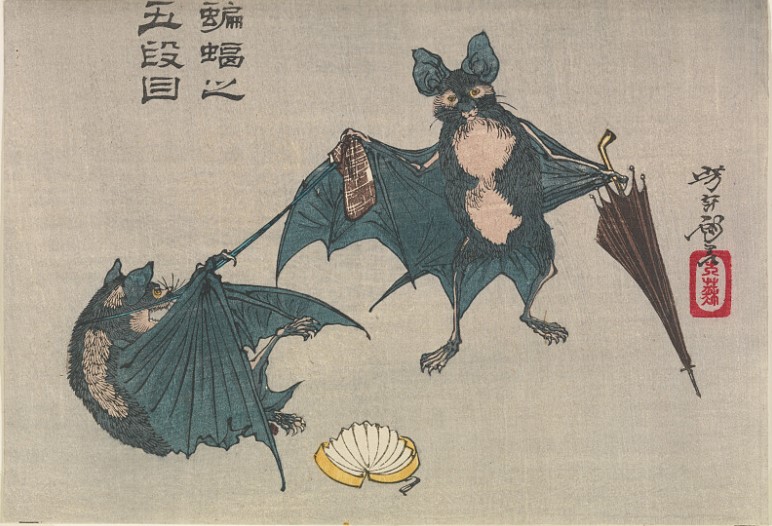
Tsukioka Yoshitoshi, Komori no godanme (Bats in the Fifth Act of “Chushingura”) from an untitled series known as Yoshitoshi ryakuga (Sketches by Yoshitoshi), 1880–1883, Fine Arts Museums of San Francisco, San Francisco, CA, USA.
We do not move very far from the previous work in this case. Once again, we have anthropomorphized animals: two bats appearing in a climactic scene from Chushingura, a classic of the Kabuki theater tradition. A parody. Once again, the choice of animal falls upon a creature associated with wealth and prosperity—a meaning quite different from the one traditionally attributed to bats in Western culture.
A duel is taking place. What should be a confrontation between two samurai is instead represented by two bats: one lying on the ground with two swords, the other standing with a handkerchief and umbrella. The scene should be highly dramatic—an assassination is taking place on a rainy day—yet we cannot help but smile as we watch these two little creatures interact.
Yoshitoshi, a worthy student of Kuniyoshi, inherited his master’s caricatural yet realistic style. He would become the last great master of ukiyo-e, helping Japanese art make the transition from the feudal era to the modern age.
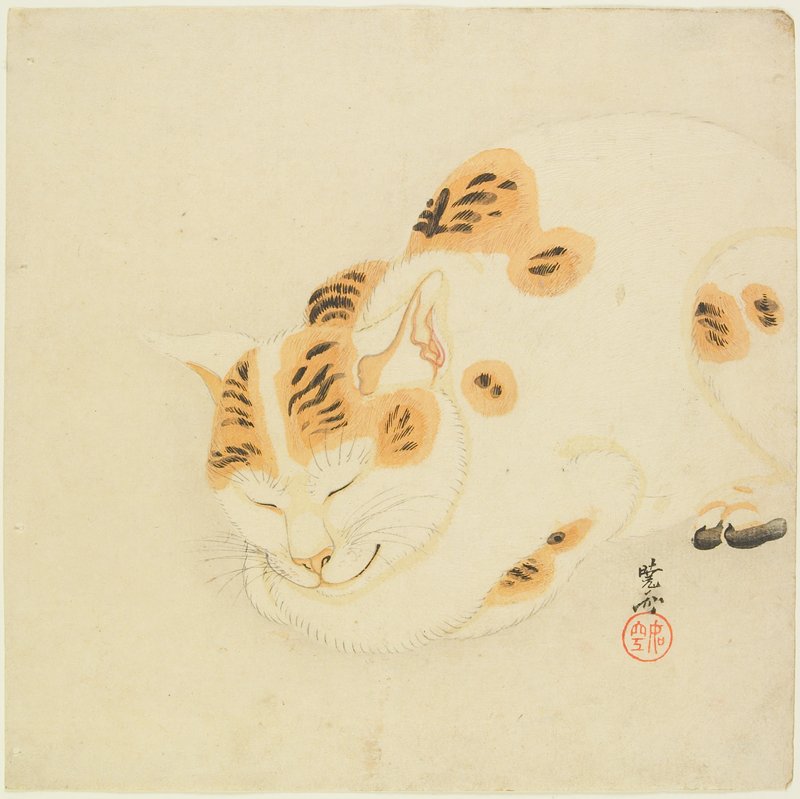
Kawanabe Kyōsai, Sleeping Cat, 19th century, Minneapolis Institute of Art, Minneapolis, MN, USA.
Yes, it’s true. At the beginning, I promised to show you the most diverse fauna possible, and yet here we have another cat. In fact, a female cat! Her beautiful coat displays three dominant colors.
I admit that I am a cat lover, and therefore I am easily tempted whenever I see depictions of felines. Here, the scene is one of pure relaxation. The background is anonymous, while the cat fills the composition, resting in the typical “loaf” position, with her front paws tucked underneath her body. What looks like complete abandonment is actually an alert resting position. She can spring away immediately if necessary.
Kyōsai is considered the spiritual heir of Hokusai because of his affinity with the worlds of spirits and nature. Looking at this contented little cat resting, we can almost hear her purring. Pawsome!
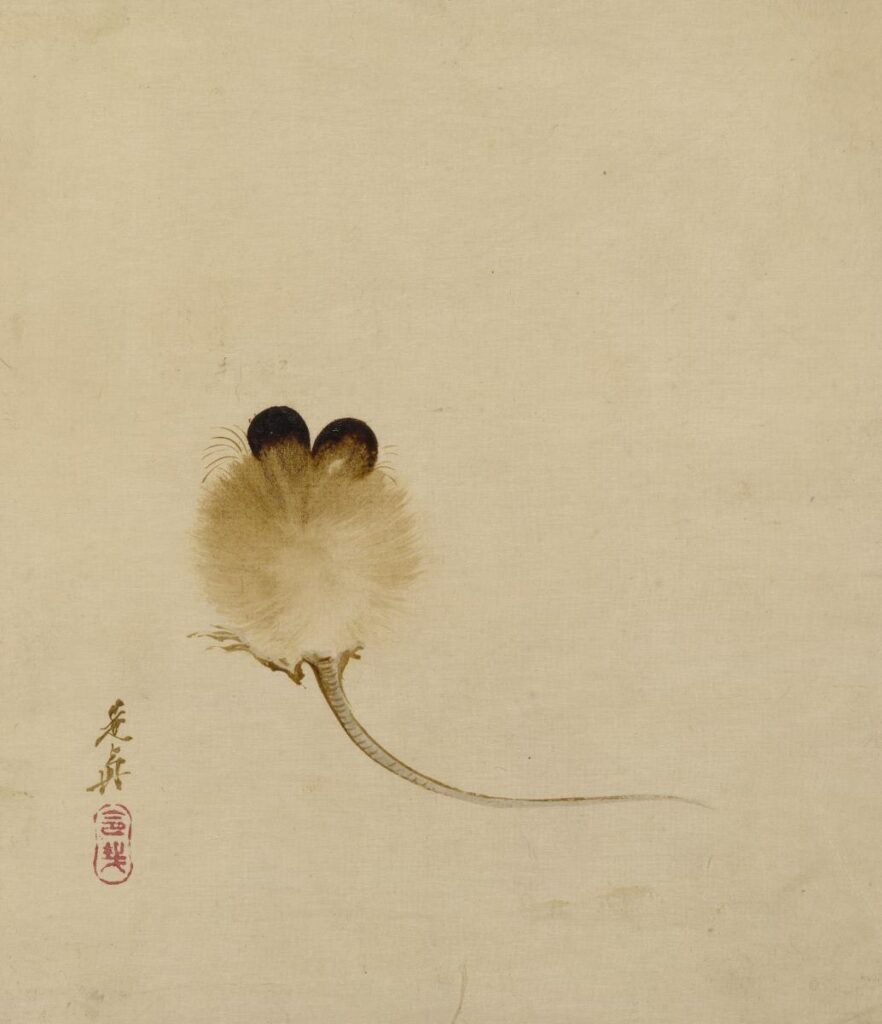
Shibata Zeshin, Mouse, 19th century, British Museum, London, UK.
Here we have a beautiful little ball of fluff. A few tiny details reveal that we are looking at a wonderful little mouse. Its tail, paws, ears, and barely suggested whiskers masterfully transform what might otherwise appear to be nothing more than a splash of water and color accidentally formed on the sheet.
It is a small artistic poem by the great master Zeshin, who delicately and realistically gives us an animal that in Japan is a symbol of prosperity and fertility. A remarkable balance between minimal, precise brushstrokes and delicate washes of color makes this work gentle to look at. A little joy.
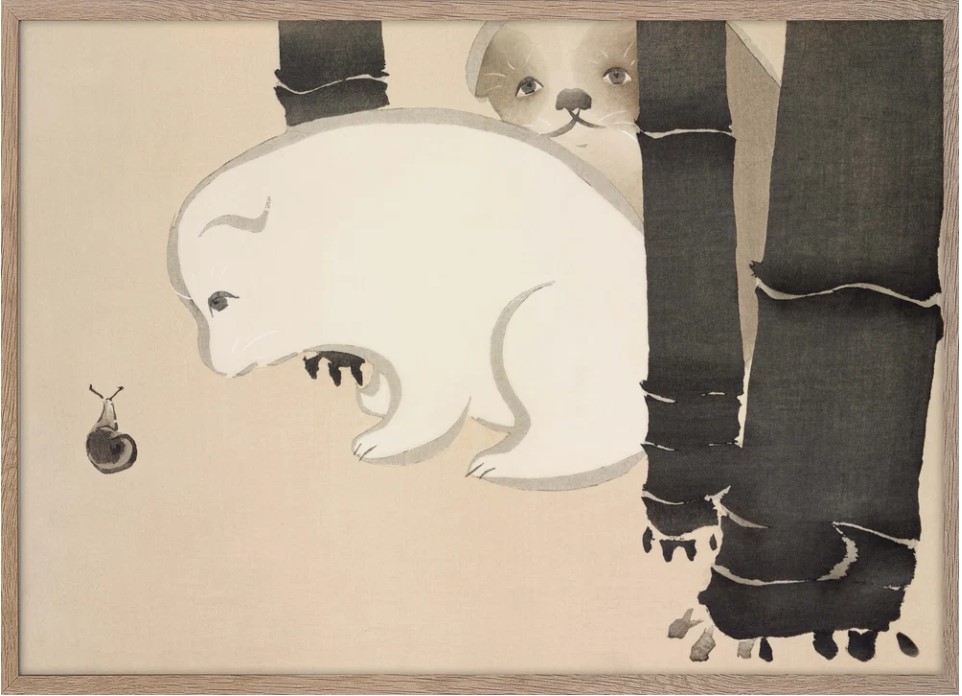
Kamisaka Sekka, Dog and a Snail from the series Momoyogusa (A World of Things), 1909, private collection.
We are reaching the end of our selection and entering the 20th century, when the Japanese pictorial and printmaking tradition began to mingle with minimalist modernism. This work is a clear example. The scene is described through just a few elements: a snail, two curious little dogs, and bamboo stalks. The artist’s line is essential, as is the choice of soft colors. We are looking at a Zen-like representation.
We see two adorable puppies discovering the world around them. One looks straight into our eyes, almost as if including us in the excitement of discovery, while the other is amusingly absorbed in watching a little snail slowly making its way across the ground. We can almost sense the contrast between the snail’s slowness and the puppies’ excitement. This small masterpiece belongs to the Momoyogusa series, the pinnacle of Sekka’s artistic work. It is a three-volume collection comprising a total of 60 color woodblock prints, celebrated for its visual synthesis and use of empty space. Looking at this work feels like taking a deep breath and discovering a sense of inner calm.
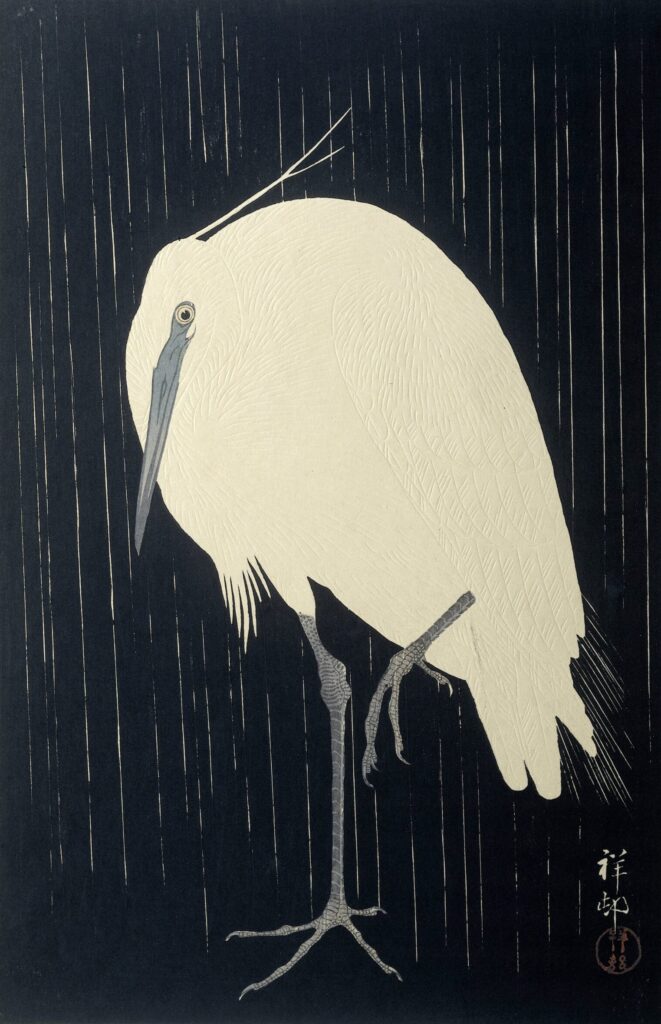
Ohara Koson, Egret in the Rain, 1925–1936, Rijksmuseum, Amsterdam, Netherlands.
Here we find a beautiful white egret, standing on one leg beneath a downpour. The contrast between the black background and the bird’s white plumage is fantastic. The bird looks at us with an almost inquisitive expression.
Koson devoted much of his career to depicting nature, especially birds and flowers, seeking strong contrasts in his compositions. These might be contrasts of color, background and subject, or of weight—light and heavy. This work is a clear example. When depicting birds and flowers, he often chose subjects with strong symbolic associations, especially in relation to Buddhism. The egret shown here is a symbol of purity.
I hope you have enjoyed this little journey and had the chance to appreciate the diversity of animals and artistic styles represented in Japanese art. This was only a small taste, and if you are still hungry for more, I recommend checking out the beautiful set of 50 Animals in Japanese Art postcards! That way, you can share these wonderful illustrations with your loved ones—or keep them all for yourself 😉
DailyArt Magazine needs your support. Every contribution, however big or small, is very valuable for our future. Thanks to it, we will be able to sustain and grow the Magazine. Thank you for your help!

I am a Publishing Editor with a PhD in Physics. During my free time, I enjoy reading art articles, attending exhibitions, and nurturing my curiosity and interest in painting, photography, literature, and music.

Melanie is a freelance editor, proofreader, and writer within humanities fields. Follow her on Twitter @melaniesdemmer.
Elephants hold a profound place in art across cultures around the world, appearing as sacred creatures, symbols of power, and mysterious beings.
Guest Author 17 September 2026
The lamb serves as an enduring and multifaceted symbol that connects ancient pre-Christian ritual with the long history of Christian art. Throughout...
Maya M. Tola 4 May 2026
One cannot, while hoping to make a very valid argument, say dogs and humans are anything but almost entirely alike. After all, they share the same...
Guest Author 30 April 2026
Owls have captured the attention of artists since art began. Their knowing eyes, nocturnal wonderings, and global ubiquity have made them symbols of...
Theodore Carter 23 April 2026

.jpg)