

10 Japanese Artworks Where Animals Steal the Show
From playful monkeys and majestic tigers to sleepy cats and elegant egrets, animals have always held a special place in Japanese art. Let’s explore...
Lisa Scalone 10 September 2026
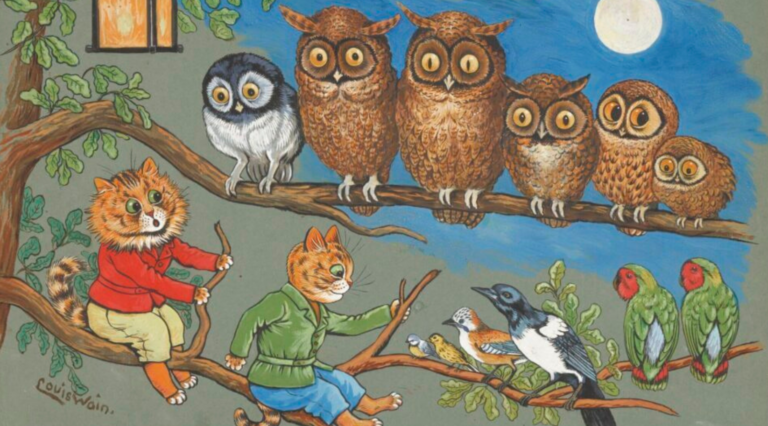
Louis Wain, Moonlight Sonata, ca. 1900–1910, Victoria and Albert Museum, London, UK. Detail.
Owls have captured the attention of artists since art began. Their knowing eyes, nocturnal wonderings, and global ubiquity have made them symbols of mystery, wisdom, and mysticism. Here are some of the great owls of art history.
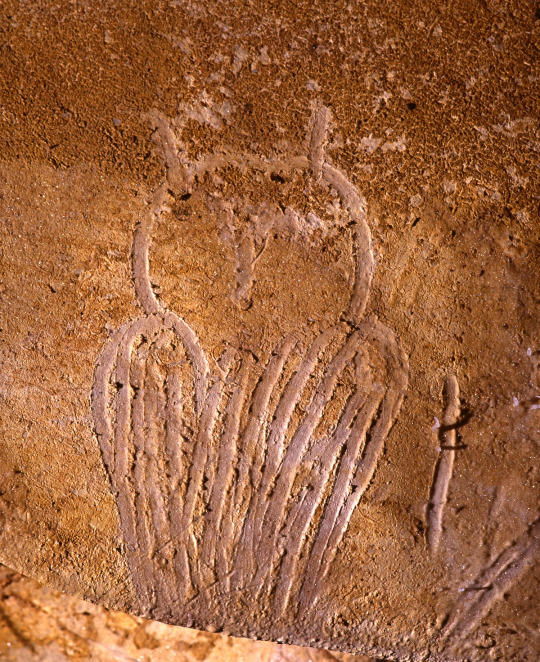
Ancient owl drawing, 32,000-30,000 BCE, Chauvet Cave, Ardèche, France. Carnegie Museum of Natural History.
The Chauvet-Pont-d’Arc Cave contains some of the oldest known works of art in human history. Thousands of drawings depict the natural world, including mammoths, bears, bison, and lions. The artists who made these works shaded their figures and used color. This is one of the earliest known depictions of an owl.
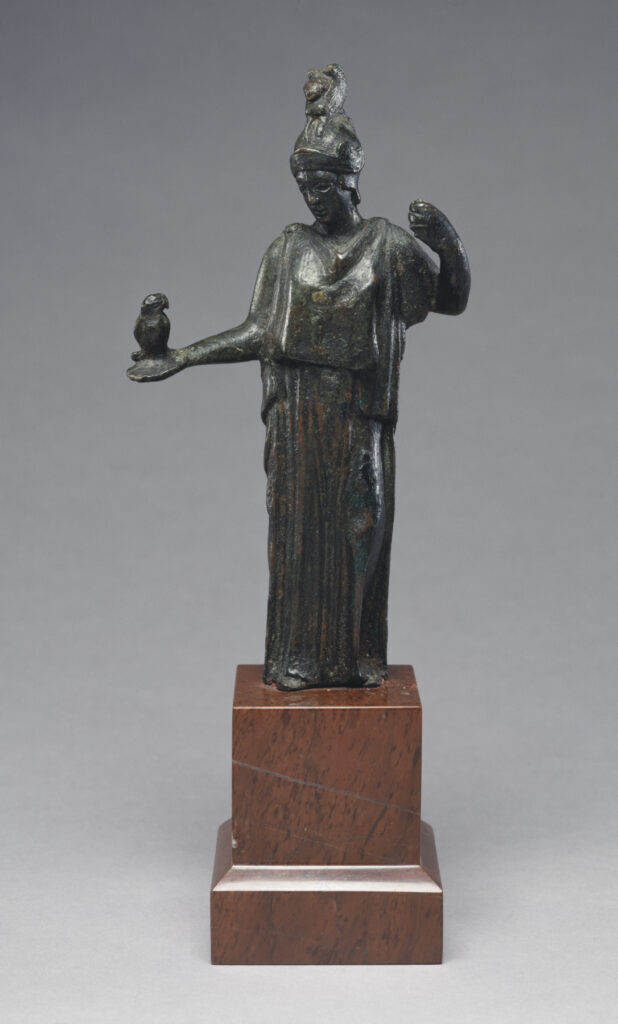
Athena with an Owl, ca. 450 BC, Walters Art Museum, Baltimore, MD, USA. Museum’s website.
The Greek goddess Athena is often shown with a companion owl to signify her wisdom. Owls appeared often in the artwork in ancient Greece, particularly in Athens, where the owl became a symbol of the city. At one time, in Athens, coins showed Athena on one side and the head of an owl on the other. Owls were also a common motif on pottery at the time.
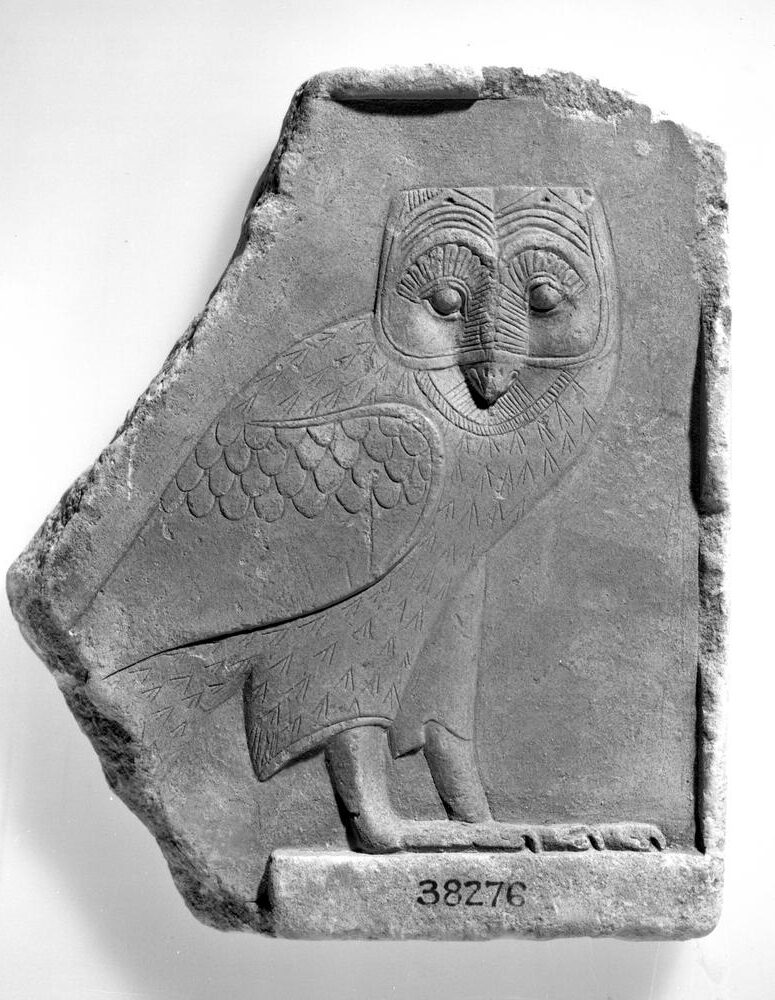
Egyptian relief trial-piece, Ptolemaic period, British Museum, London, UK. Museum’s website.
This Egyptian owl relief dates to the Ptolemaic period, considered the final era of ancient Egypt, which ended with the death of Cleopatra. This owl represents a hieroglyphic sign. Owls often appeared in funerary art and in statuary as well. Archaeologists have also discovered mummified owls. In ancient Egyptian culture, owls were sometimes associated with death and the afterlife.
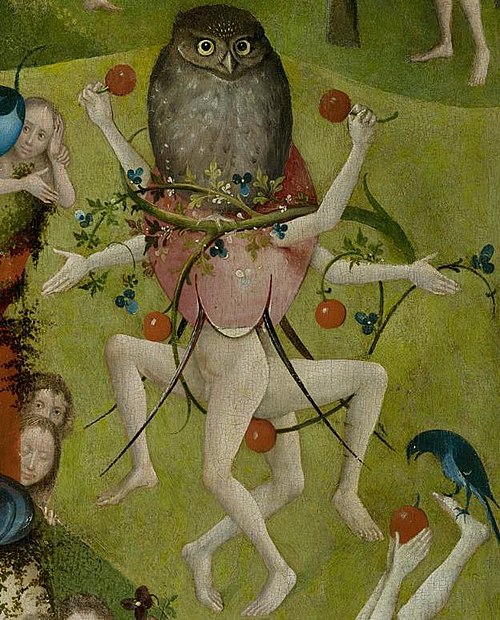
Hieronymus Bosch, The Garden of Earthly Delights, 1503–1515, Museo del Prado, Madrid, Spain. Detail.
Owls haunt the corners of many Bosch paintings, often lurking over the central scene or peering out from corners. And while there are several prominent paintings that highlight Bosch’s owls, The Garden of Earthly Delights, Bosch’s most famous work, remains his most chaotic, unusual, and intriguing painting. It includes several owls or owl-like creatures, most of them showing decorum exceeding that of their headinistic human subjects in the painting.
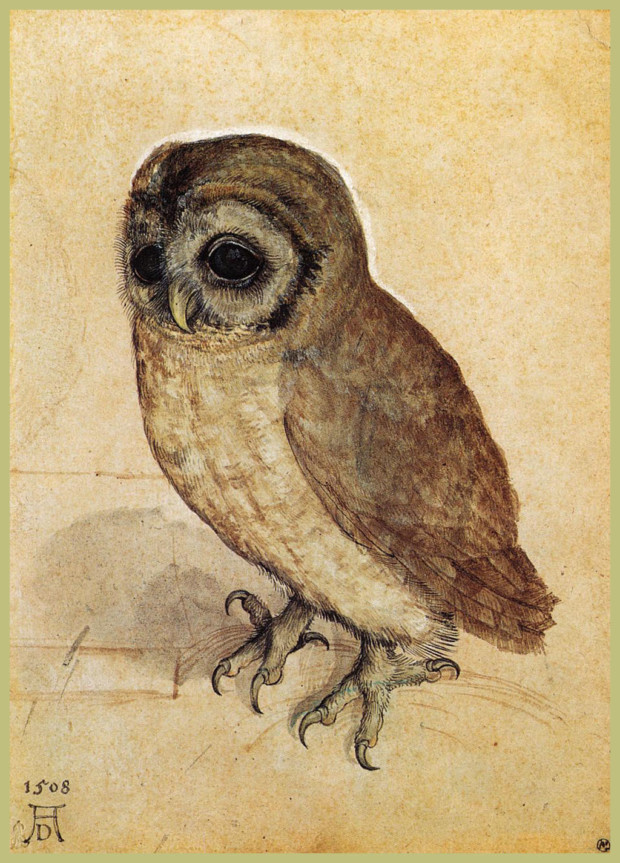
Albrecht Dürer, Little Owl, 1508, Albertina, Vienna, Austria.
Renaissance artist Albrecht Dürer created several masterful realist works portraying animals. Young Hare is one of his most famous and recognizable pieces. This owl likewise showcases Dürer ‘s attention to detail and ability to make lifelike animals with pen, ink, and watercolor.
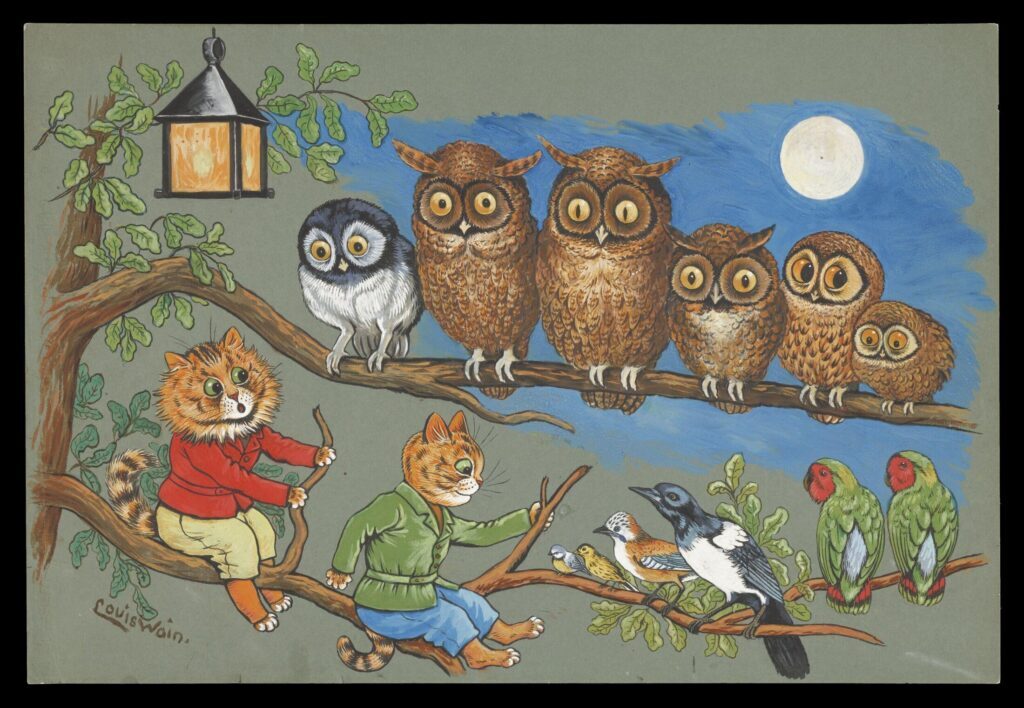
Louis Wain, Moonlight Sonata, ca. 1900–1910, Victoria and Albert Museum, London, UK.
Best known for his anthropomorphized cat illustrations, several Louis Wain works feature owls as well. Wain’s owls, like his cats, are expressive characters within larger narrative scenes. Wain’s illustrations include owls putting a cat to bed, owls smoking cigarettes, owls in nightcaps, bonnets, and top hats, and owls in what appears to be a court proceeding in Judge and Jury.
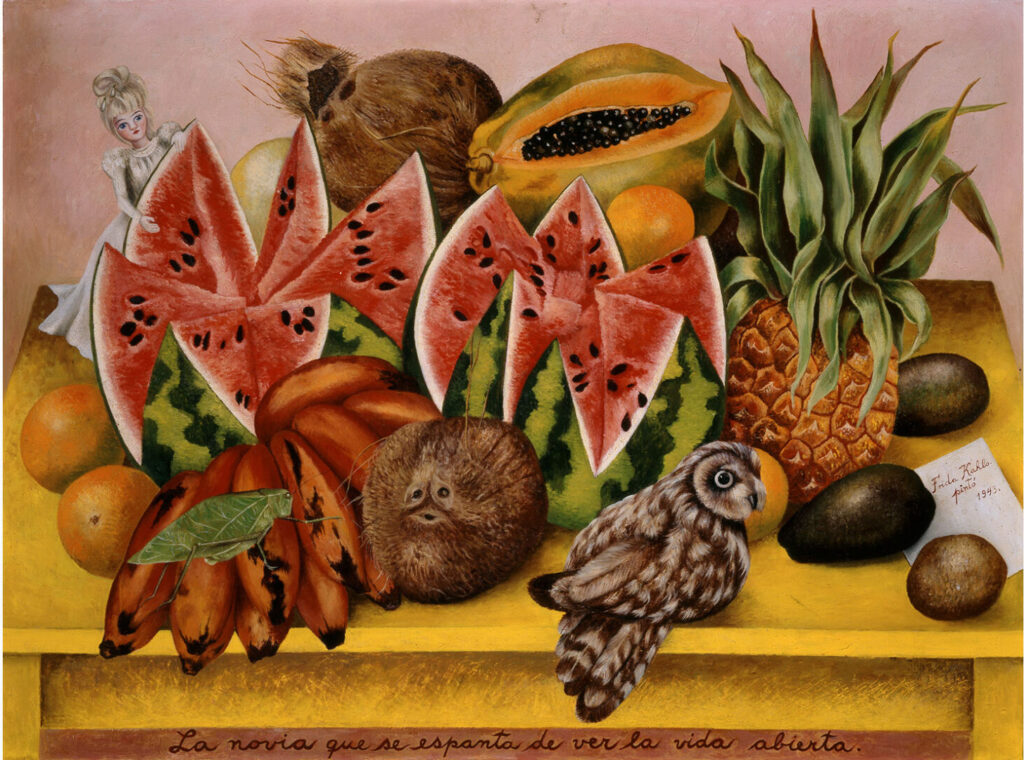
Frida Kahlo, The Bride Frightened at Seeing Life Opened, 1943, Jacques and Natasha Gelman Collection, Mexico City, Mexico. Portland Museum of Art.
Frida Kahlo loved animals and cared for numerous pets, including monkeys, dogs, a deer, and parrots. Often, these animals showed up in her paintings as well. This still life features what appears to be a crepuscular pygmy owl, native to Mexico. Given the title of the painting, the elements on the table can be interpreted as symbolic stand-ins for frightening new knowledge. The fruit suggests this new knowledge is an understanding of sexuality. Perhaps, the owl, too, represents newfound wisdom.
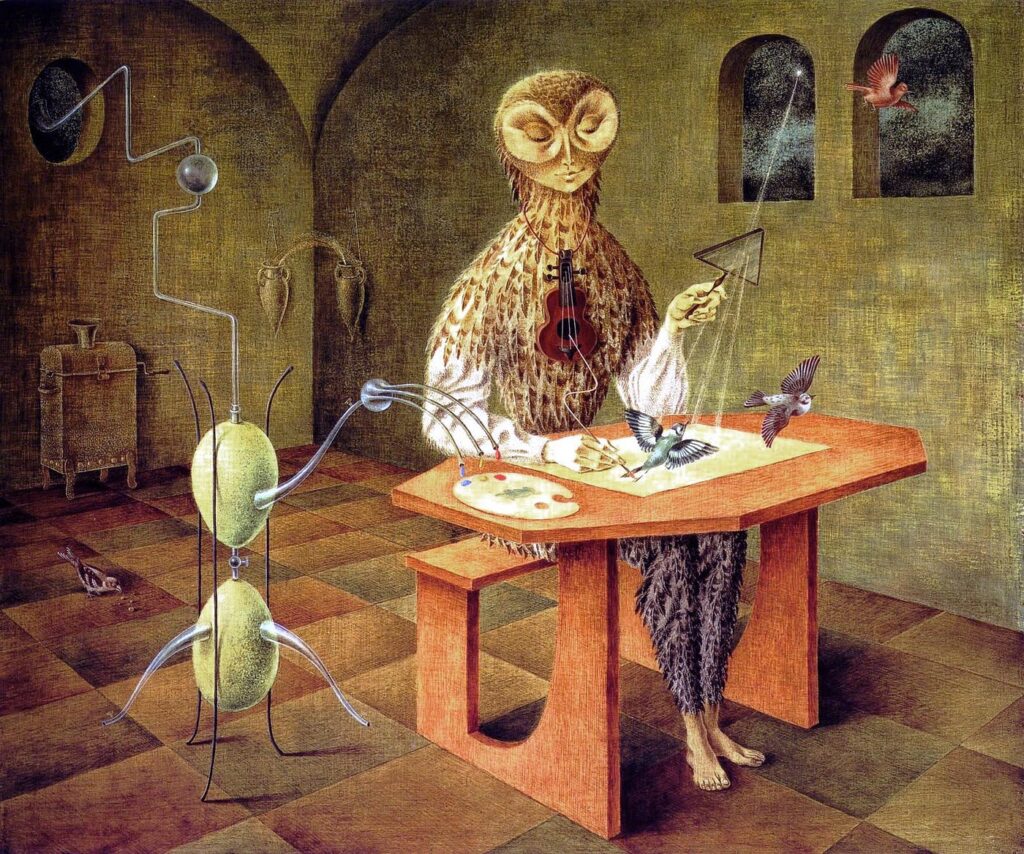
Remedios Varo, The Creation of Birds, 1957, Museo de Arte Moderno, Mexico City, Mexico. Singulart.
This owl-like figure is practicing some intricate alchemy as it utilizes the cosmos and machinery to create life. Remedios Varo’s work often shows an imagined form of science mixed with mysticism in her surrealist scenes. Her work is complex, full of symbols, mesmerizing in its ability to invent a realm where the unreality folds into sophisticated processes. In this work, the humanoid owl is at the center, a possible creator or transformer.
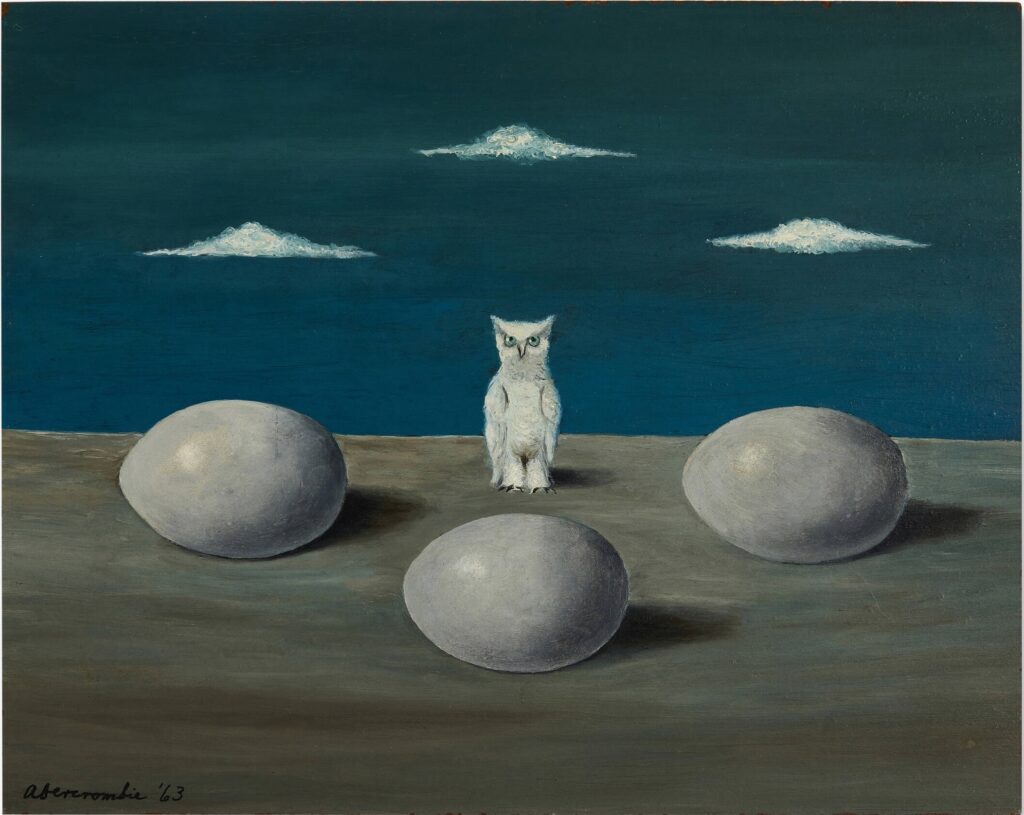
Gertrude Abercrombie, Owl with Eggs, 1963, private collection. Wright.
American surrealist Gertrude Abercrombie developed an entire language of repeating imagery with which she built an eerie oeuvre of a world entirely her own. In this dark, dreamlike world, owls feature prominently. Sometimes they’re perched in trees, sometimes they serve as the central figure, and sometimes they appear to be companions to her lonely, haunting, dress-wearing female subjects.
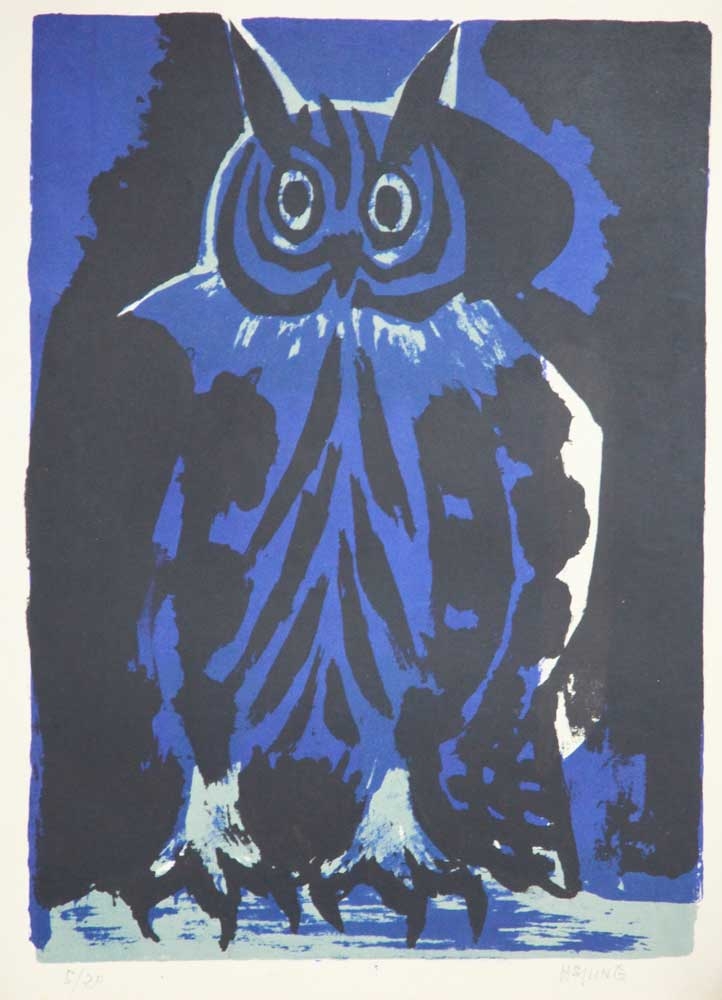
Hsiung Ping-Ming, Owl, ca. 1958, National Gallery of Art, Washington, DC, USA. Museum’s website.
An artist of fantastic range, Hsiung Ping-Ming created sculpture, calligraphy, prints, and ink paintings. While sometimes he worked abstractly, he also produced realistic sculptures of the human form. Animals, particularly birds, were a favorite subject. In addition to this fantastic, bold owl lithograph, he sculpted several playful owls as well.
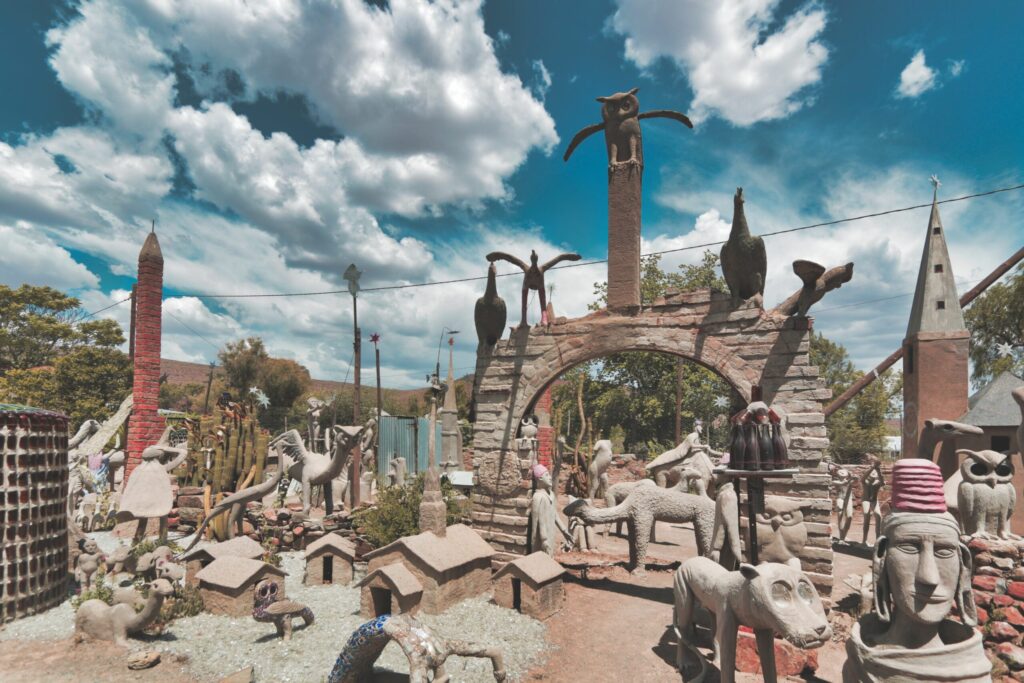
Helen Martins, Owl House, 1945–1978, Nieu-Bethesda, South Africa. karooheartland.com
This built environment in Nieu-Bethesda, South Africa, is the result of decades of work by Helen Martin. In addition to the many owls hidden within this enormous art piece are camels, snakes, and people. Martin started work on the Owl House around 1945. When arthritis slowed her work, she hired Koos Malgas to cement her vision into reality. The two continued to add to Owl House until Martin died in 1976. Today, the house exists as a museum.
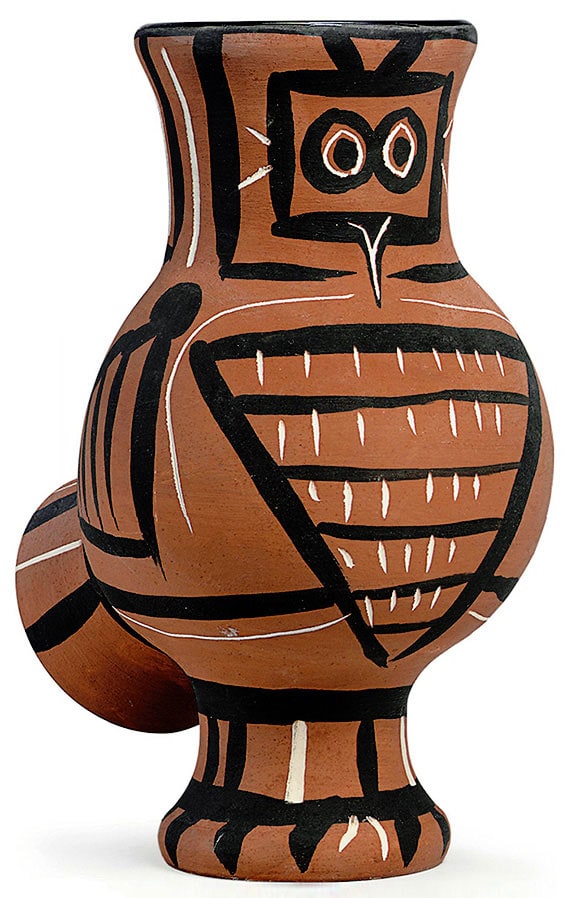
Pablo Picasso, Mat-Wood Owl, 1958, private collection. Masterworksfineart.com.
The pioneering cubist painter Pablo Picasso began working with clay in the late 1940s. Around this same time, there is a story that he found an injured owl and nursed it back to health. The conjunction of the two events resulted in a wide variety of Picasso ceramic owls varying in style. In addition, Picasso created several owl paintings during the late 1940s. Owls remained a recurring subject throughout his career, appearing across his paintings, sculptures, and ceramics.
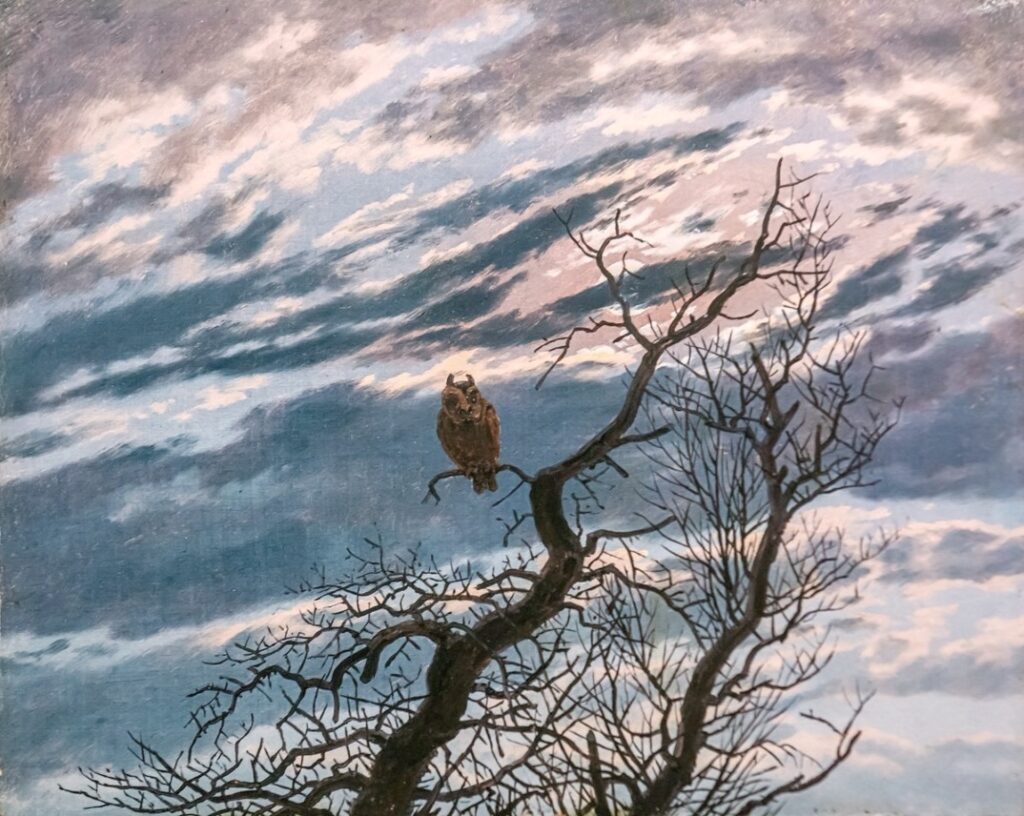
Caspar David Friedrich, Owl on a Tree / An Owl on a Bare Tree, 1834, private collection. Wikimedia Commons (public domain).
Romantic artist Caspar David Friedrich’s stirring landscapes portrayed natural beauty as a spiritual experience. Often, his work includes a silhouette, a contemplative human figure. Here, Friedrich gives us a lone, thoughtful owl. While this work does not include a vast landscape, the richly textured and colored clouds still show nature’s power. This is one of several owl paintings by Friedrich during the last years of his life. In other works, owls appear on top of a gravestone and on a coffin.
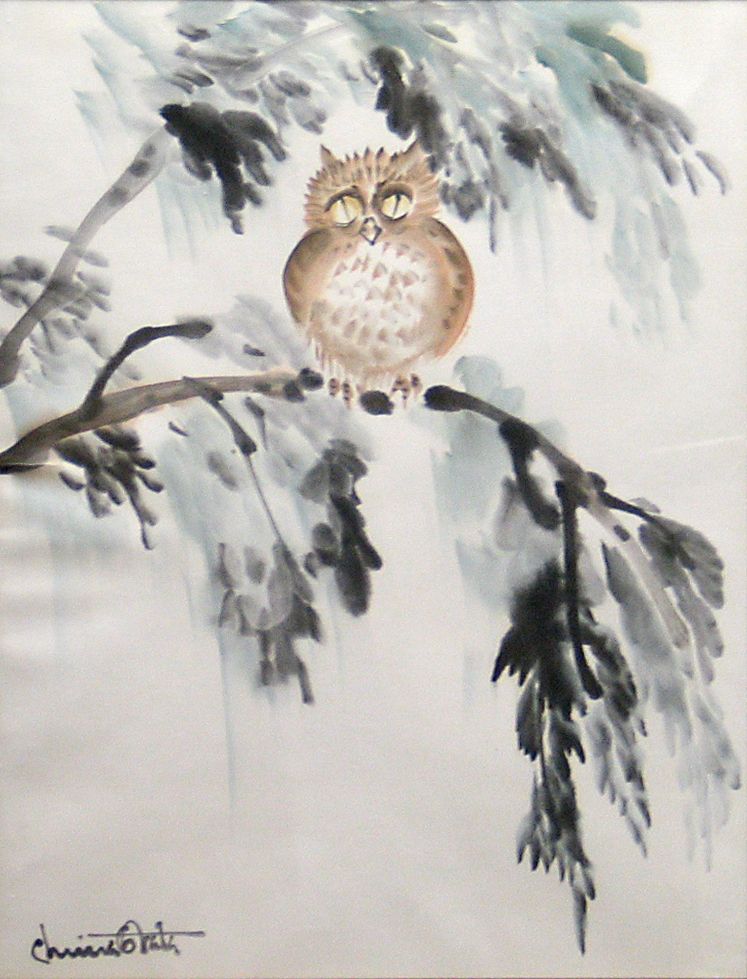
Chiura Obata, Owl Study, ca. 1930–1960, private collection. bonhams.com.
Chiura Obata brought traditional Japanese painting styles to California, and his landscapes, particularly those of Yosemite, are some of his most iconic works. At the same time, his ink paintings and watercolors, like this one, showcased how much can be achieved in a single brushstroke. This playful owl painting is one of several “study” pieces that appeared in auction collections as part of grouped lots.
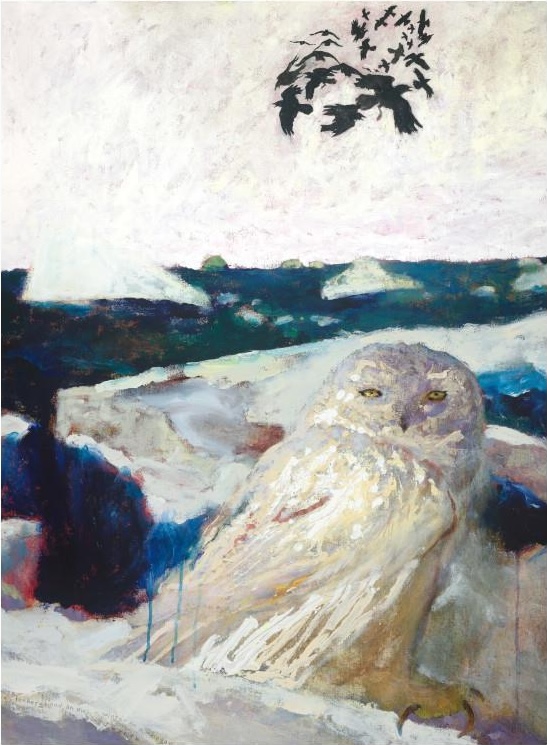
Jamie Wyeth, Snow Owl—Fourteenth in a Suite of Untoward Occurrences on Monhegan Island, 2020, Phyllis and Jamie Wyeth Collection. © Jamie Wyeth/Artists Rights Society (ARS), NY. Ralston Gallery.
Whether painting dogs, cats, seagulls, pigs, or owls, Jamie Wyeth has a way of capturing an animal’s spirit. His seven-foot-long (2.1 meters) Portrait of Pig is a fan favorite at the Brandywine Museum of Art. This snow owl’s steely gaze looks out at the viewer as if it knows something you do not. The grandson of N.C. Wyeth and the son of Andrew Wyeth, Jamie Wyeth, is part of one of the most prominent artistic families
The wise and mysterious owl spans the entirety of art history. The regal bird appears as the subject of art pieces in almost every style and art movement. These owls are just a small representation of many hiding in the nooks and hollows of museums and galleries around the world.
DailyArt Magazine needs your support. Every contribution, however big or small, is very valuable for our future. Thanks to it, we will be able to sustain and grow the Magazine. Thank you for your help!

Theodore Carter is the author of several books including "Stealing The Scream" and "Frida Sex Dreams and Other Unnerving Disruptions". You can see his art out in the streets of Washington, DC, and on his website: https://theodorecarter.com.
From playful monkeys and majestic tigers to sleepy cats and elegant egrets, animals have always held a special place in Japanese art. Let’s explore...
Lisa Scalone 10 September 2026
Elephants hold a profound place in art across cultures around the world, appearing as sacred creatures, symbols of power, and mysterious beings.
Guest Author 17 September 2026
The lamb serves as an enduring and multifaceted symbol that connects ancient pre-Christian ritual with the long history of Christian art. Throughout...
Maya M. Tola 4 May 2026
One cannot, while hoping to make a very valid argument, say dogs and humans are anything but almost entirely alike. After all, they share the same...
Guest Author 30 April 2026