Summary
- Joan Martelli structures The Widow Van Gogh as a triptych following Vincent, Theo, and Jo Bonger, whose story culminates in her role as guardian of Vincent’s art and letters.
- After Theo’s death, Jo Bonger takes on the task of promoting Vincent van Gogh’s work, drawing on her education and early appreciation of his art.
- At 32, Vincent van Gogh had abandoned several careers before turning to art. Repeated romantic rejections left him isolated and unhappy with his family.
- Despite carefully preparing The Potato Eaters, Van Gogh faced disappointment when Theo failed to find an exhibition for it and fellow artists criticized the work, marking an early professional setback.
- Theo supported Vincent financially and introduced him to the Paris art scene, where Impressionism transformed his use of color and brushwork.
- Tensions, financial worries, and ill health lead the brothers to decide that Vincent should move to Arles, while Jo arrives in Paris determined to take charge of her own future.
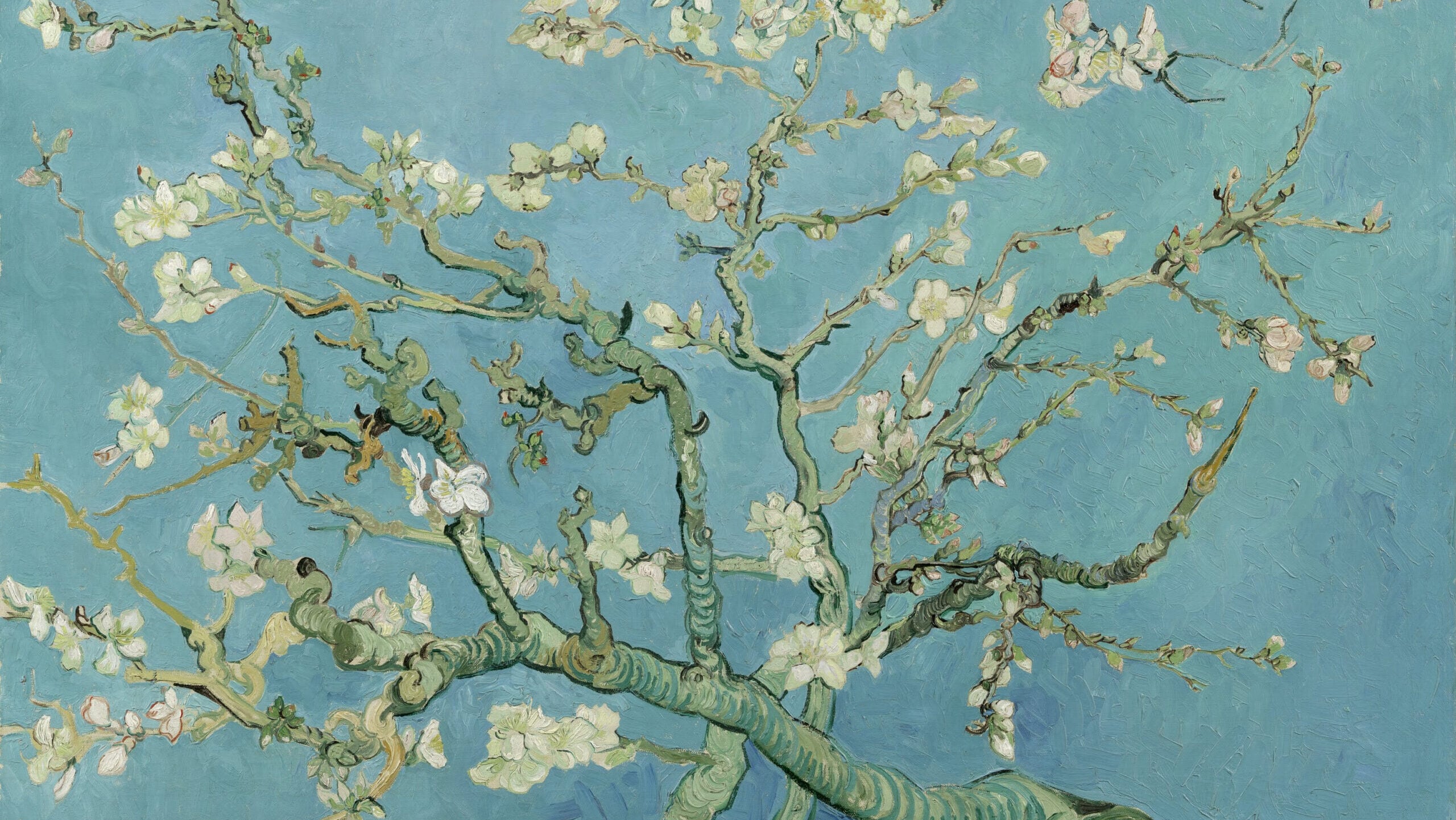
- Vincent’s breakdown in Arles coincides with Theo and Jo’s marriage and the birth of their son, for whom Vincent paints Almond Blossom, capturing the fleeting happiness of the moment.
- Vincent’s final months bring family tensions and emotional turmoil, reflected in his experimental painting Tree Roots.
- After Theo’s death, Jo dedicates herself to cataloguing Vincent’s letters and promoting his art, driven by her own deep belief in his work.
- Jo overcomes prejudice and personal loss to promote Vincent’s work through exhibitions and letters, helping secure its growing recognition, including the National Gallery’s acquisition of Sunflowers.
A Triptych

Vincent van Gogh, La Berceuse (Woman Rocking the Cradle), 1889, Metropolitan Museum of Art, New York City, NY, USA.
Joan Martelli begins with a note the readers which explains her intention “to write a book that is nonfiction but reads more like a novel.” Partly to achieve this, she organizes the structure of The Widow Van Gogh around the idea of a triptych, which Vincent van Gogh himself described in a letter, in which two of his Sunflowers flanked one of his paintings of La Berceuse. The triptych in the book is Vincent van Gogh himself, his loyal and loving brother, Theo, and, in the centre, the maternal and nurturing “widow” of the title, Theo’s wife, Johanna (Jo) Bonger.
The narrative itself is also structured in three parts. An introductory section discusses the lives of the protagonists in alternating chapters. The middle relates the period of Theo and Jo’s marriage. Meanwhile, the last portion of the book focuses on Jo herself, now widowed and custodian of Vincent’s paintings and letters.
Jo
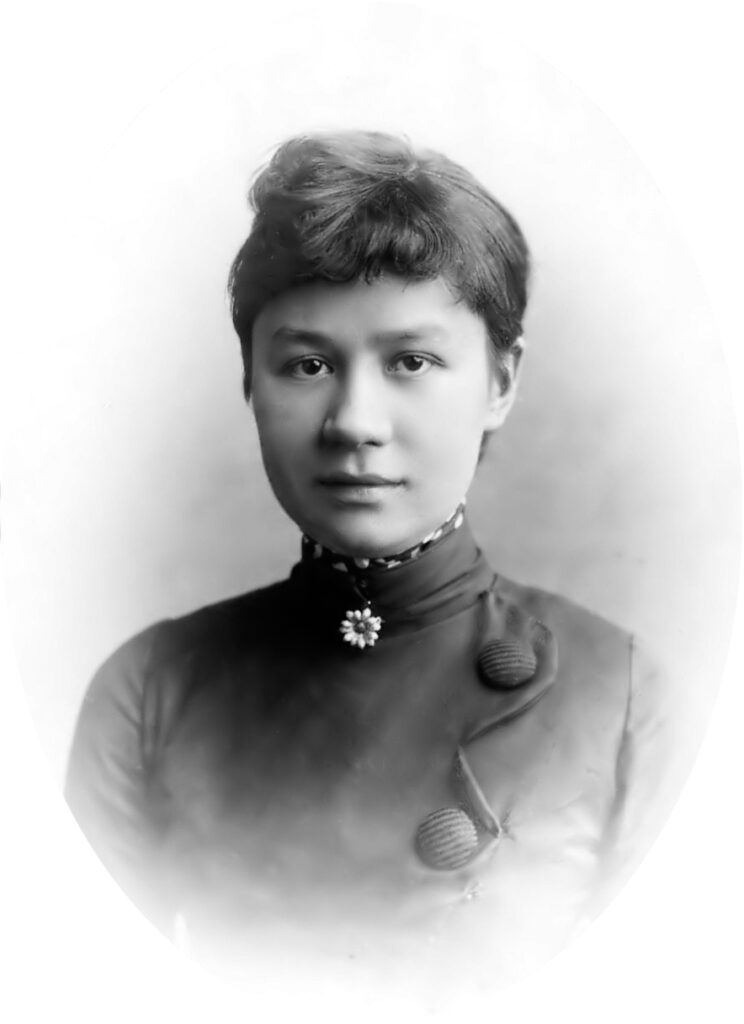
Johanna van Gogh-Bonger, 1889. Wikimedia Commons (public domain).
Johanna Bonger (1862–1925) is the heart of The Widow Van Gogh, and appropriately she is the first character we meet, introduced at one of the worst periods of her life. Newly widowed, mother to a young son and taking on a new boarding house business to support herself, she is having an evening walk in a symbolic summer storm. It is at this moment, according to Martelli, that Jo decides she must do something about the legacy of paintings and letters which she holds. She must promote the work of her dead brother-in-law, Vincent van Gogh.
Jo was a well-educated, independent Dutch woman from a large family. She had spent time in London working on her thesis on the poet Percy Bysshe Shelley at the British Museum—something which would later stand her in good stead when she was translating Vincent’s letters. She was employed as a teacher when introduced to Theo by her brother, when both men are part of the Dutch ex-pat community in Paris. After a slightly awkward courtship, in which Theo rushed to propose before they had really got to know each other, the couple married in April 1888.
From the start, Jo is empathetic towards Vincent and feels a strong affinity for his art.
Vincent

Vincent van Gogh, Self-Portrait with Grey Felt Hat, 1887, Van Gogh Museum, Amsterdam, Netherlands.
The narrative proper opens on the day of Reverend Theodorus van Gogh‘s funeral, which was also his son, Vincent’s, 32nd birthday. It was a period when Vincent van Gogh (1853–1890) was back living unhappily with his family. He had already proved a disappointment, having failed to hold down a job at Goupil art dealers, where his uncle worked. He had tried to be a teacher and a lay preacher, but given both up. Now, encouraged by his brother, he had turned his attention to art.
Alongside his professional difficulties were a succession of failed romances. He had proposed to a widowed cousin, Kee Vos-Stricker, and refused to accept her rejection. There had been Sien Hoorknik, older, unmarried with a child and an occasional sex worker. A secret romance with Margot Begemann had led to her trying to kill herself after both families opposed the idea of marriage. Rejection and loneliness hang heavy in the air.
The Potato Eaters
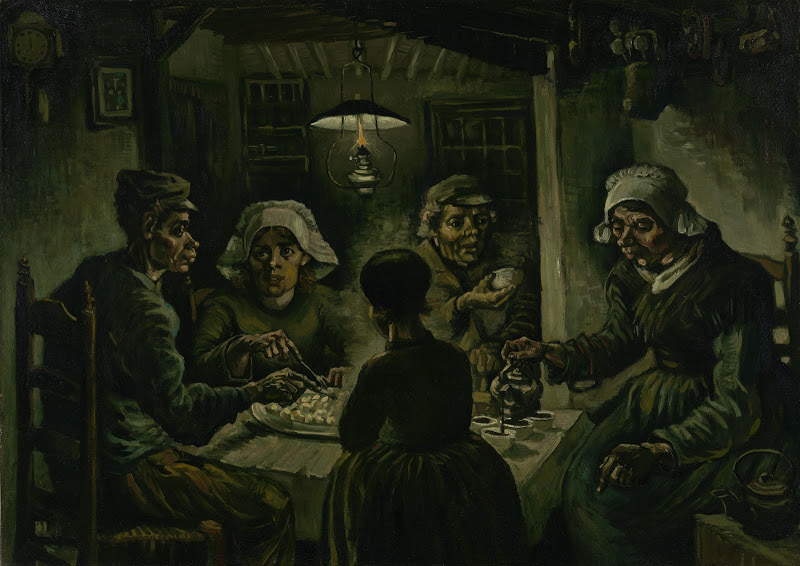
Vincent van Gogh, The Potato Eaters, 1885, Van Gogh Museum, Amsterdam, Netherlands.
In the days after his father’s funeral and his sister’s blunt suggestion that he should move out, Vincent paints The Potato Eaters, which was to remain one of his favorite works. Vincent spent a lot of time making preparatory sketches, although the final figures have heavy outlines and an almost cartoonish crudeness in their features. He also took pains over the color which was originally lighter. The final earthy tones he likened to “a really dusty potato, unpeeled of course.”
The painting was sent to Theo in Paris, with high hopes. However, he could not get it exhibited and the comments he did receive from those who saw it were critical. Anthon van Rappard, another Dutch artist whom Vincent considered a friend wrote: “such work isn’t intended seriously. You can do better than this.” It was the first in a long series of professional set-backs.
Theo
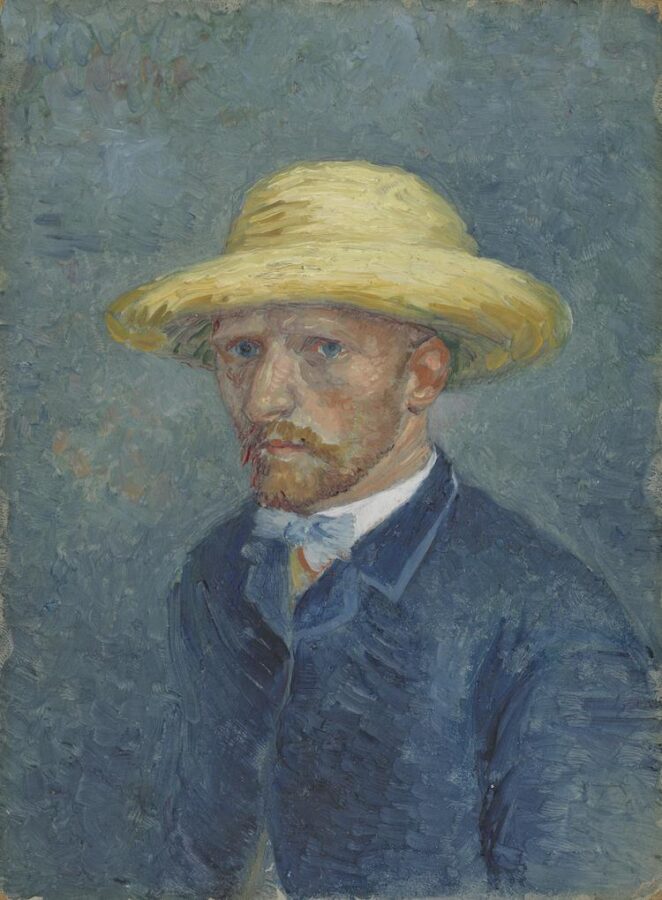
Vincent van Gogh, Portrait of Theo van Gogh (presumed), 1887, Van Gogh Museum, Amsterdam, Netherlands.
The one family member whom Vincent could count on was his younger brother, Theo van Gogh (1857–1891), who had followed him into the art trade and by the opening of the narrative was living in Paris. Theo supported Vincent financially from the time he decided to become an artist until his death and much of their correspondence involved requests and subsequent thanks for gifts of money. Theo also gave Vincent contacts within the wider art world and the opportunity to live in Paris. He was actively involved in promoting the work of Impressionists, holding private, after-hours viewing of paintings by Claude Monet, Camille Pissarro, and Pierre-Auguste Renoir.
The period when the brothers lived together in the French capital changed Vincent’s style and palette, from the earthiness and simplified outlines of The Potato Eaters ito the bright primaries and thick, dashed brushstrokes of his mature style. He started to think of “colors that make each other shine… that make a couple” and starting using red and green, and blue and orange combinations in his work.
New Beginnings
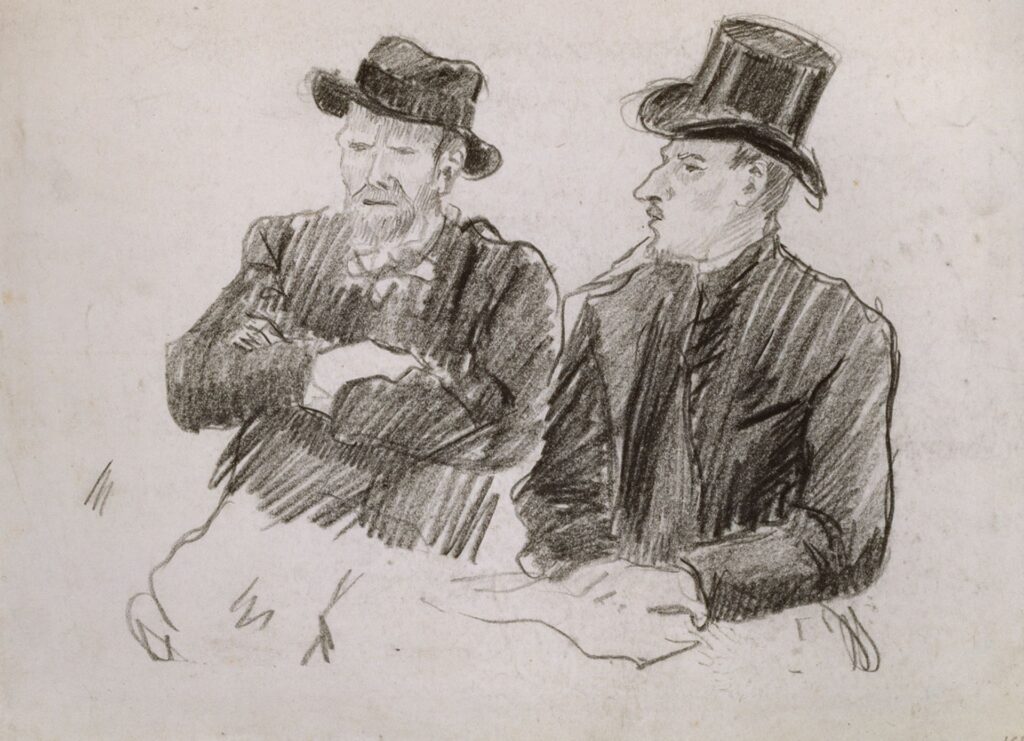
Lucien Pissarro, Drawing of Vincent and Theo van Gogh in a conversation, 1887, Ashmolean Museum, Oxford, UK. Wikimedia Commons (public domain).
The brothers’ Paris life is like that of many bohemian young men of the period. They live cheaply, frequent bars and brothels, meet artist and writer friends. They are also frequently ill—illness, physical and mental, is a recurring specter which haunts the book—and they sometimes quarrel. Vincent is not easy to live with, Theo worries about money. For both these reasons they decide that Vincent should head south to Arles.
At the same time, Jo is arriving in the French capital with the intention of giving Theo another chance. His first proposal had come out of the blue, at a time when she had feelings for someone else. Now, she plans an “accidental” meeting. Jo is very much a “new woman,” one of the generation who were taking advantage of opportunities to be independent, making their own choices and taking charge of their own destiny.
Marriage, Birth, and Death

Vincent van Gogh, Almond Blossom, 1890, Van Gogh Museum, Amsterdam, Netherlands.
The initial optimism and subsequent disaster of Vincent’s period in Arles is a well-told story. Martelli interweaves chapters about Paul Gauguin‘s stay at the Yellow House and his acrimonious departure which led to Vincent’s self-mutilation, with the engagement and marriage of Theo and Jo. The pressure of expectation as Jo goes through the public ritual of marriage, the excitement of arriving in their new flat in Paris, and the inevitable difficulties of having to adjust to life shared with someone else in a new environment, all resonant with Vincent’s experiences.
Jo quickly falls pregnant, and here too Martelli is very good at capturing the uncertainty and genuine fear which surrounds childbirth during the period. Death is a constant, looming in the background of the book, and occasionally surfacing, as when a heavily pregnant Jo writes to Vincent “if I have to leave him, you tell him.” The reader feels the irony, too—ultimately Jo will be the only one who survives. That sense of transient happiness is represented by the gift of Almond Blossom which Vincent paints for his new-born nephew.
1890
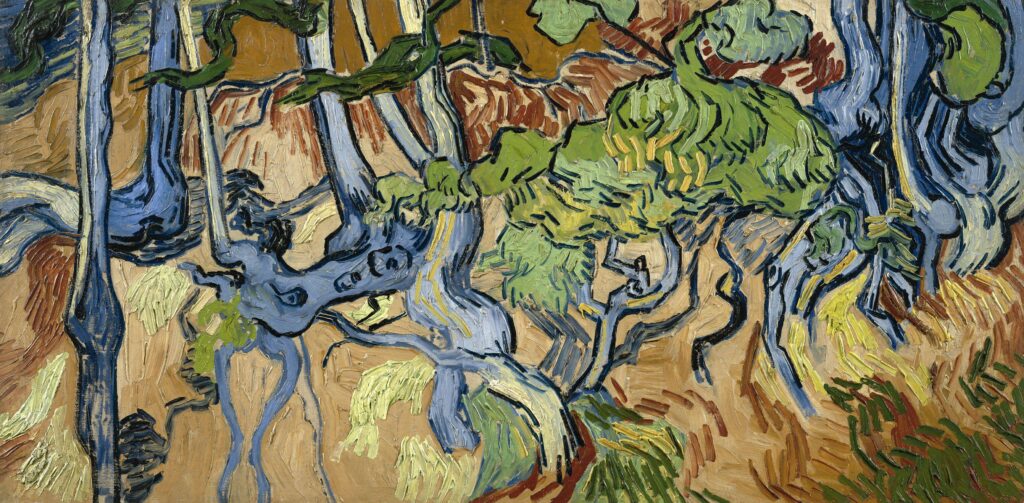
Vincent van Gogh, Tree Roots, 1890, Van Gogh Museum, Amsterdam, Netherlands.
The ups and downs of the final months of Vincent’s life: his institutionalization at St Remy, his move to Auvers, are related not as a sweeping narrative towards his inevitable death but as the daily ups and downs of family life. There are, to quote two chapter titles, good days and bad days. Marital squabbles which take on exaggerated proportions, moments of quiet bonding between Vincent and his namesake nephew, and the feeling of isolation and exhaustion of a young mother.
Meanwhile, Vincent is producing some of his most experimental work. Tree Roots, painted on one of the double square canvases he worked on in Auvers, has no horizon, no base, no framing composition, but simply a tangle of abstracted roots. He had previously written about “fervently rooting oneself… and yet being half torn up by the storm” and it is almost impossible not to read emotional trauma into this, one of Vincent’s last works.
The Widow
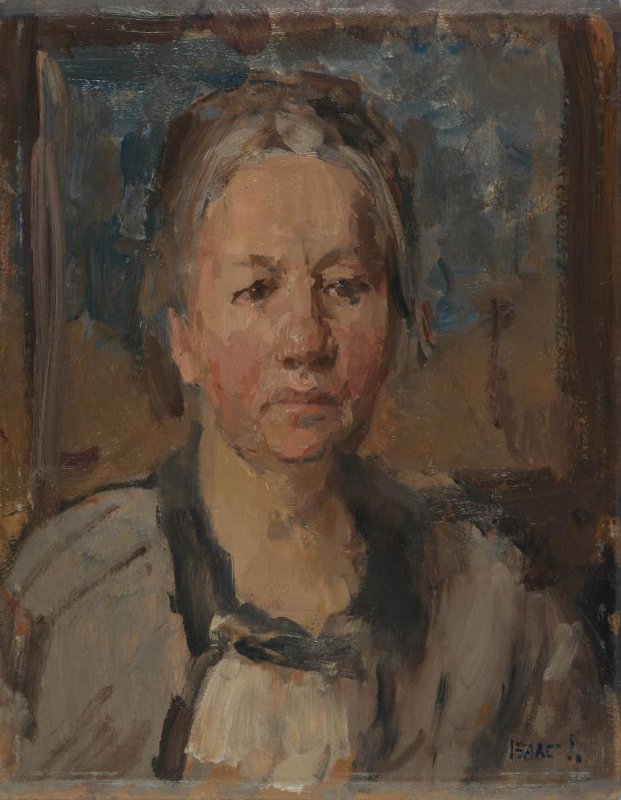
Isaac Israëls, Portrait of Johanna van Gogh-Bonger, 1924, Van Gogh Museum, Amsterdam, Netherlands.
The emotional heart of the book is not Vincent’s death, from which Jo is shielded by distance and slow communications, but the horror of Theo’s only months later. Taken away in a strait-jacket, he spends his last days in an asylum, suffering seizures and delirium likely caused by syphilis. Jo is 28. Yet out of this tragedy comes what will end up becoming her life’s work. The reader can sense that even in the depths of her loss, she can appreciate that once again she is her own woman in control of her own destiny.
Jo decides to continue the work which Theo had started, sorting and cataloguing Vincent’s hundreds of letters. She pledges to find ways of promoting and selling the many works that she is now in possession of. This is not just an exercise in keeping busy, or of fulfilling her husband’s wishes. Nor is she motived by a mercenary desire to secure her son’s inheritance. Jo is motivated by a deep affinity with Vincent’s art. She wanted the world to love the paintings as much as she did.
The Battle is Won
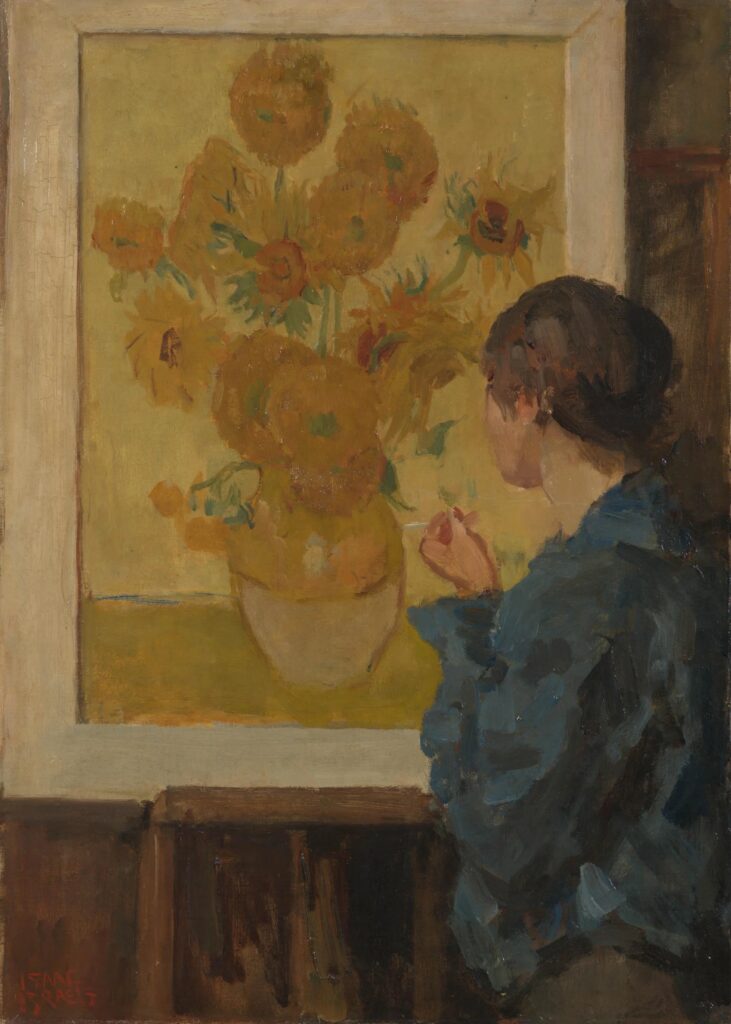
Isaac Israëls, Woman Standing in Front of Van Gogh’s Sunflowers, 1920, Van Gogh Museum, Netherlands.
In many ways the last section of Martelli’s The Widow Van Gogh is the most interesting. It charts the slow progress towards an acceptance of Vincent’s work, and ends with the moment London’s National Gallery acquired one of his Sunflowers. Although the tide of art history was probably already turning in his favor, much was a direct result of Jo’s actions, from her publishing (and later translating) his letters, to sinking her own money into the 1905 exhibition of his work at the Stedelijk Museum.
Inevitably, Jo had to overcome prejudice from male dealers and critics who thought her campaign was based on ignorance and obsession. She also had to navigate life as a widowed mother and although she remarried in 1901, her second husband died 11 years later. The book also charts her close relationship with the artist Isaac Israëls, who painted a series of homages to Vincent showing women posing in front of the Sunflowers.
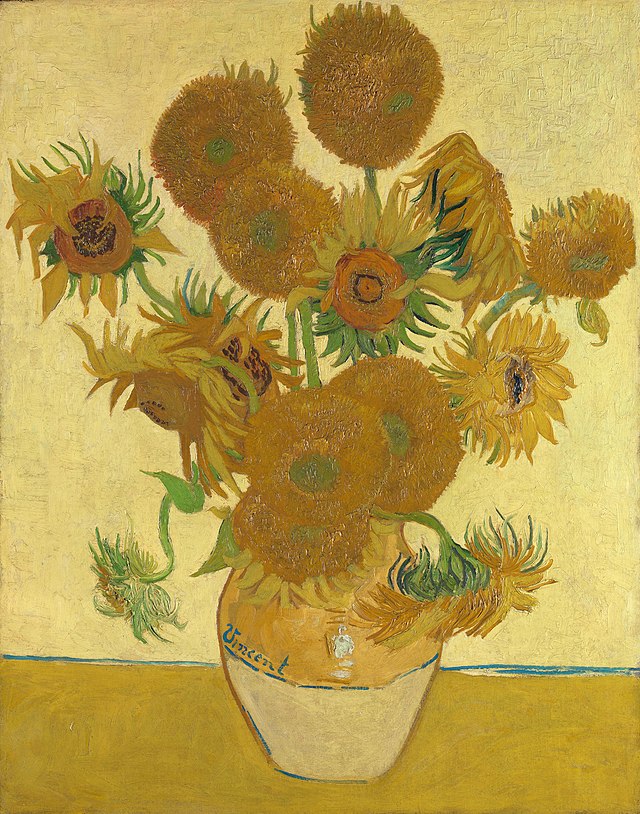
Vincent van Gogh, Sunflowers, 1888, National Gallery, London, UK.
There have been other biographies of Johanna van Gogh-Bonger and she is thankfully a better known figure than she once was. Her role in popularising Vincent van Gogh’s work is undisputed. However, what Joan Martelli does so effectively in The Widow Van Gogh, is to focus on her as a woman rather than simply her achievements. By giving Jo a voice and believable relationships with both Vincent and Theo, she becomes a rounded and empathetic character. Equally, by focusing on those relationships, the men, especially Vincent, are cast in a new light. There is tragedy and triumph, certainly, but also the daily lives, hopes, and fears of three closely bonded individuals.
The Widow Van Gogh. Tragedy, Triumph, and the Woman Who Made Vincent van Gogh a Legend: A Life of Johanna van Gogh-Bonger by Joan Martelli is published by Pegasus Books from October 27, 2026.