

Between the Body, Nature, and Image: Ana Mendieta at Tate Modern
It is not uncommon for an artist to become known primarily through the circumstances of their life rather than through the complexity of their work.
Ania Kaczynska 6 August 2026
23 September 2026 min Read
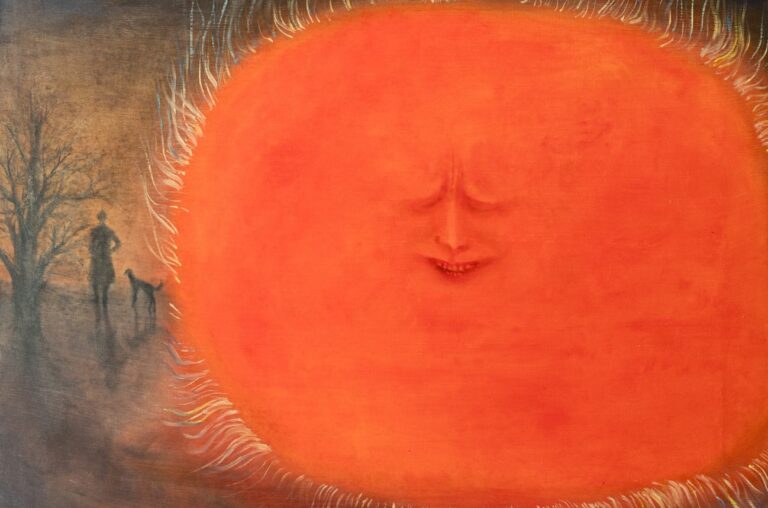
Aleksandra Waliszewska, Untitled. Culture.pl. Detail.
A golden figure and a dance of the dead haunt rooms of the Benaki Museum in Athens, Greece. There, Polish painter Aleksandra Waliszewska stages a confrontation between her haunting Symbolist visions and Greece’s ancient past. Irruption of Antiquity pairs 16 of her paintings with ancient artifacts. Together, they reveal how old myths still pulse through today’s imagination.
Aleksandra Waliszewska was born in Warsaw, Poland in 1976. She trained at the city’s Academy of Fine Arts and now paints dark, atmospheric scenes steeped in art historical knowledge. Waliszewska could be considered a contemporary heir to Symbolism, the movement that flourished at the turn of the 20th century. Sex and death intertwine throughout her dense visual narratives.
Empowered female protagonists dominate her canvases. Apocalyptic scenes surround them, filled with animals, imaginary creatures, zombies, and hybrid monsters. Many of her paintings work allegorically, probing fear, anxiety, desire, and death as fundamental human conditions.
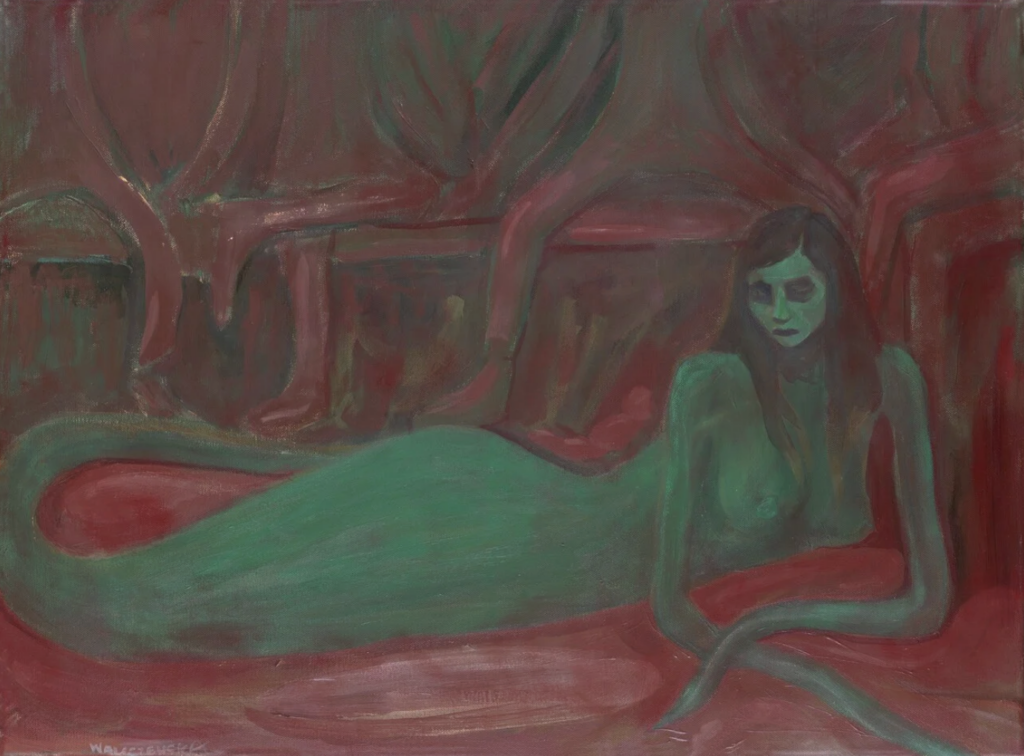
Aleksandra Waliszewska, Untitled, 2023. Most Magazine.
Curator Alison M. Gingeras has followed Waliszewska’s work for years, and the two have built a close relationship. One day, Gingeras saw the artist working on a painting that included a terracotta piece featuring Dionysus. Waliszewska was already studying the Benaki Museum’s collections at the time, a project her husband had inspired her to do. The idea for an exhibition grew from there. Gingeras reached out to the museum, and soon found herself on a plane to Athens to meet the curatorial team.
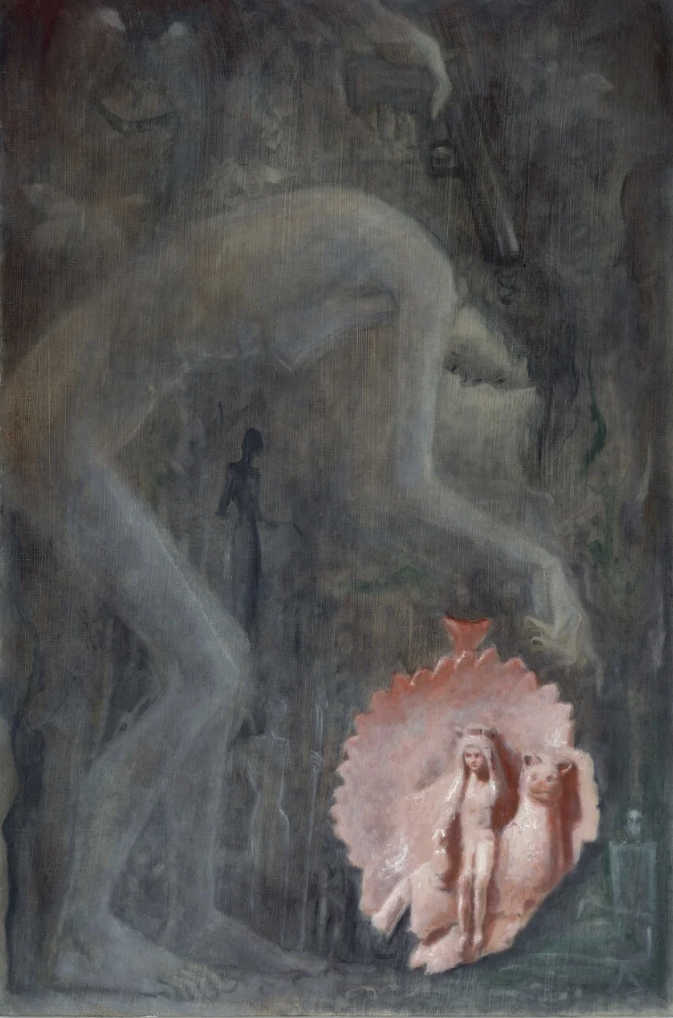
Aleksandra Waliszewska, Untitled, 2025. Most Magazine.
The exhibition spans two floors of the Benaki Museum of Greek Culture and brings together 16 paintings by Waliszewska. Each painting is paired with objects from Neolithic Greece, classical antiquity, Byzantium, and modern Greece. Together, they honor Greece as the birthplace of figurative, narrative art and a foundation of Western visual culture. At the same time, the show traces how that legacy still shapes the visual imagination today. Waliszewska’s intense psychological scenes capture moments of “irruption,” the sudden, forceful entry of ancient visual tropes into the present.
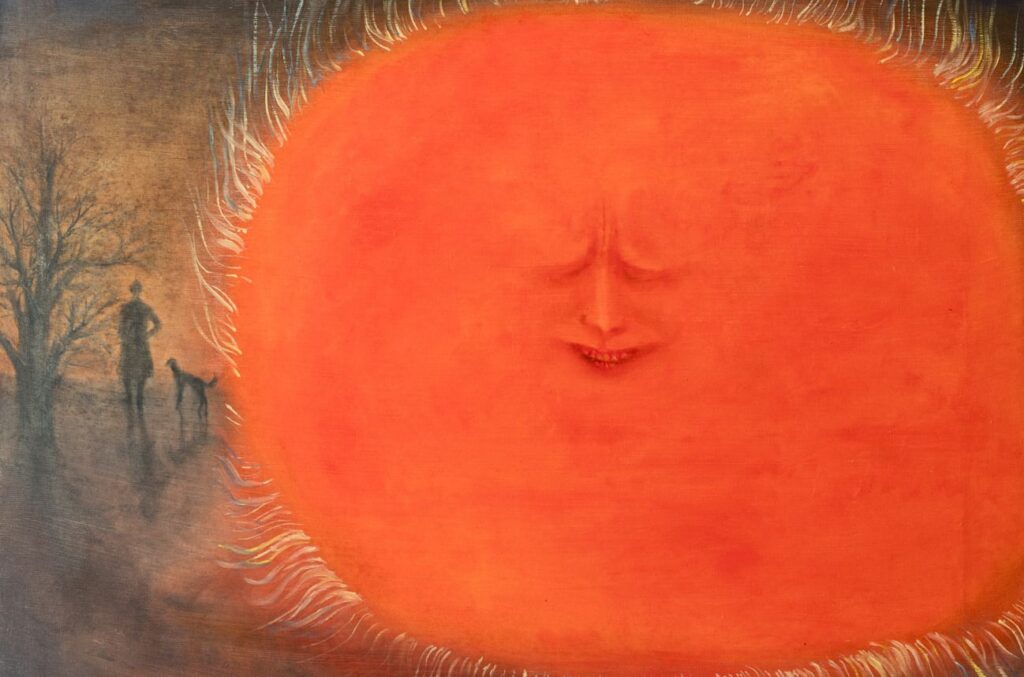
Aleksandra Waliszewska, Untitled. Culture.pl.
Every exhibition needs a framework, but this one draws on an especially rich source. Its title borrows from Aby Warburg’s unfinished masterwork, the Mnemosyne Atlas. Warburg began the project in 1928 and died before finishing it in 1929. He named the atlas after the Greek goddess of memory and built it as a purely visual argument. Warburg divided his material into 12 thematic chapters that traced the Renaissance back to classical Greece and Rome. Across more than a thousand images, he tried to map collective cultural memory without a single word of explanation.
Irruption of Antiquity stands among Warburg’s most compelling chapters, and it gives this show its name. The phrase fits a transhistorical exhibition that unites the Benaki’s varied collections with Waliszewska’s visual world. Gingeras says the idea of irruption struck her first as an image. Objects can seem to leap through time, arriving suddenly in the present. The exhibition follows that logic. It groups works by theme rather than chronology.
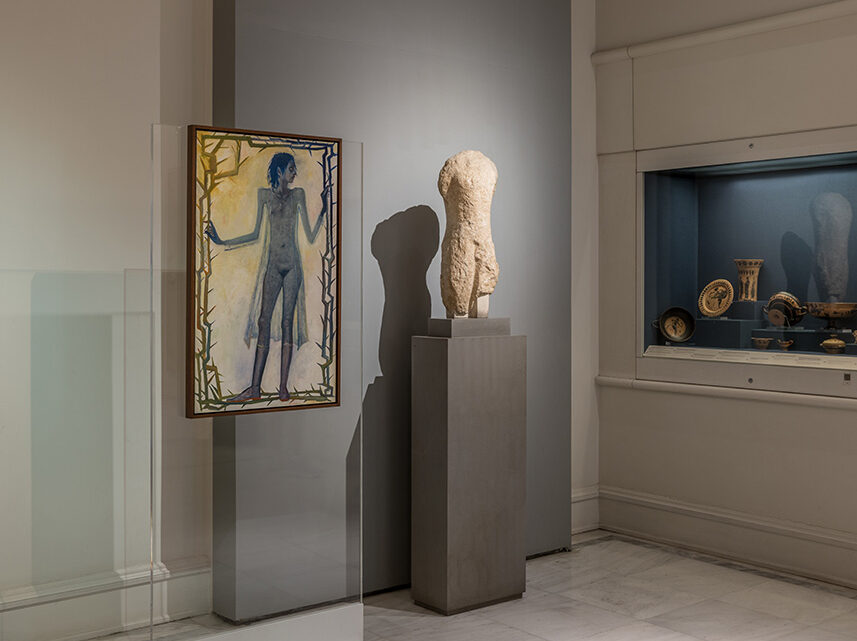
Installation view of Aleksandra Waliszewska: Irruption of Antiquity, Benaki Museum, Athens, Greece. DESTE Foundation.
Waliszewska’s paintings echo the models Warburg imagined. They testify to the long survival of Greek culture into the present day. Ancient gods, myths, symbols, and religious figures surface throughout her unsettling pictorial world. They do not appear as relics of a distant past. Instead, they act as unstable, often disturbing forces that continue to shape how we see. In this light, Irruption of Antiquity treats antiquity not as inherited heritage but as ongoing pressure. It becomes a reservoir of images and emotions that keep resurfacing and refuse to stay contained within history.
Gingeras did not build this exhibition around gender. Almost all of Waliszewska’s protagonists are women, but the show foregrounds what each scene depicts, not who appears. Violence marks these women again and again, yet they still read as empowered rather than victimized. Greek literature from the Baroque period also produced strikingly strong female figures. Irruption of Antiquity celebrates that lineage among its many layers. The deeper viewers dig, the more connections they find. Gingeras describes art history as cannibalistic: contemporary artists feed on the past. Waliszewska does not simply repeat what came before. She transforms her sources into something contemporary, speaking to today’s audiences and current affairs. Symbolism remains her guiding lens throughout.
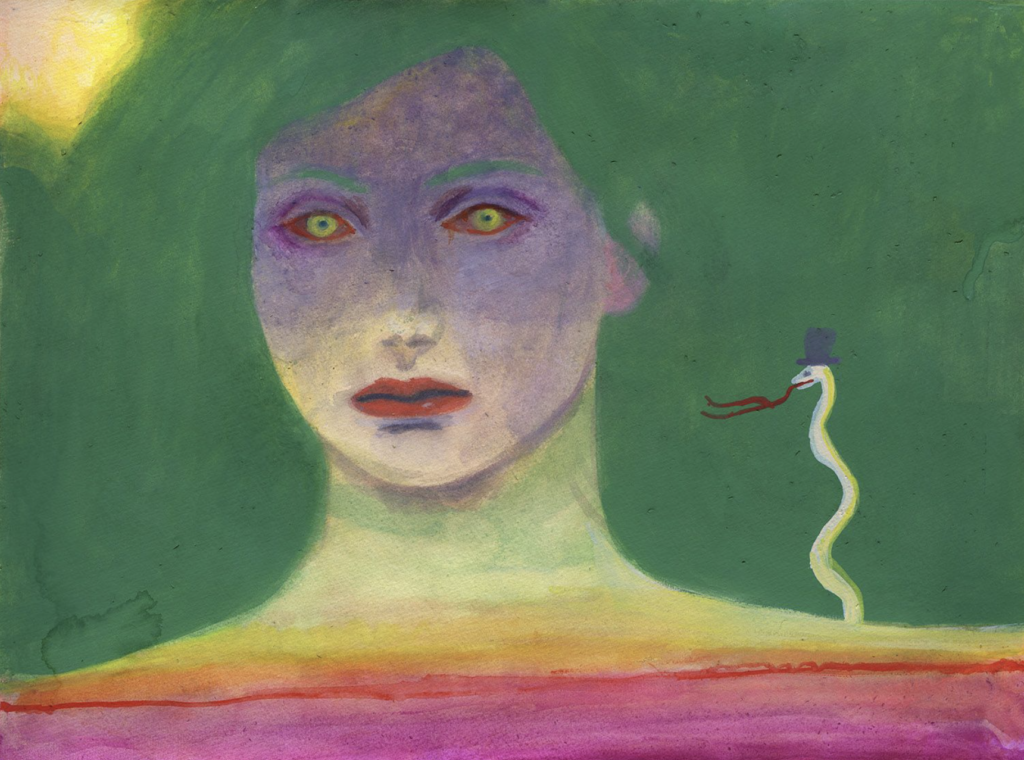
Aleksandra Waliszewska, Untitled, 2022. Culture.pl.
The exhibition also plays with scale, moving between the deeply local and the universal. Waliszewska draws imagery from Polish folklore, yet renders it in a visual language that reads as universal. Only a viewer who already knows the reference can trace it back to Poland. Her living dead figures offer a clear example. These figures stem from Polish folklore, yet they read as universal symbols that exist outside normal chronology.
One painting captures this tension especially well: a playful cat set inside a lavishly decorated Ottoman room. The room’s rich textures and colors evoke real Ottoman interior design. Behind the cat, a dance of the dead unfolds. The pairing feels deliberately anachronistic, as if the cat wandered in from a different century entirely.
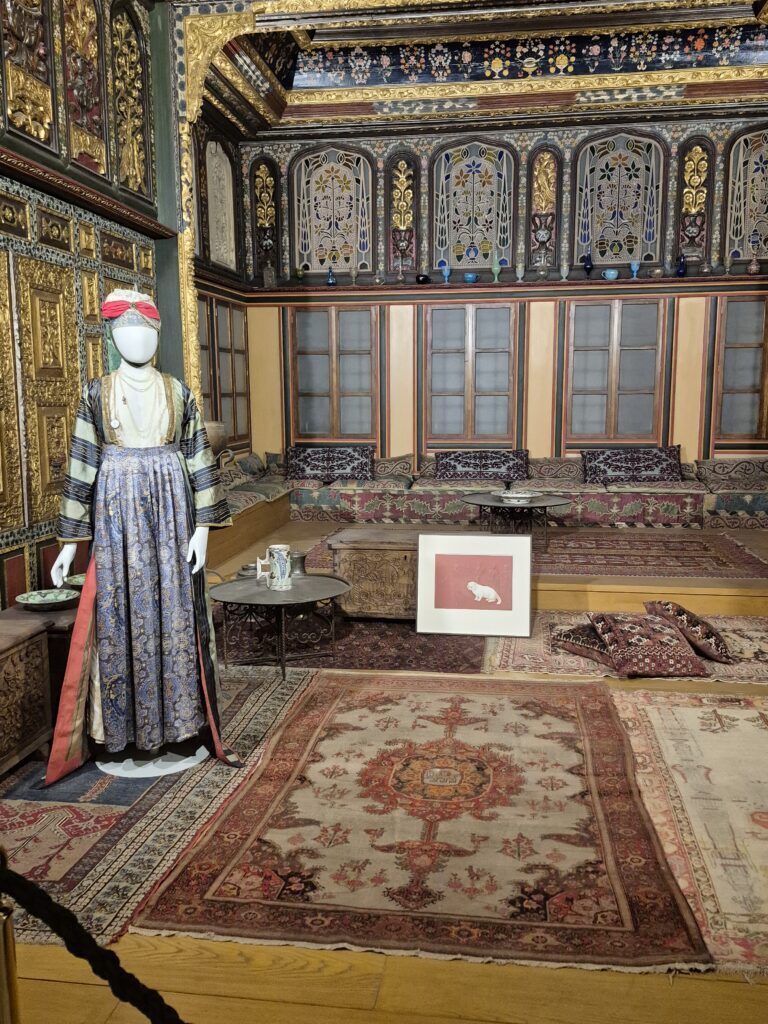
Installation view of the exhibition Aleksandra Waliszewska: Irruption of Antiquity. Photograph by the author.
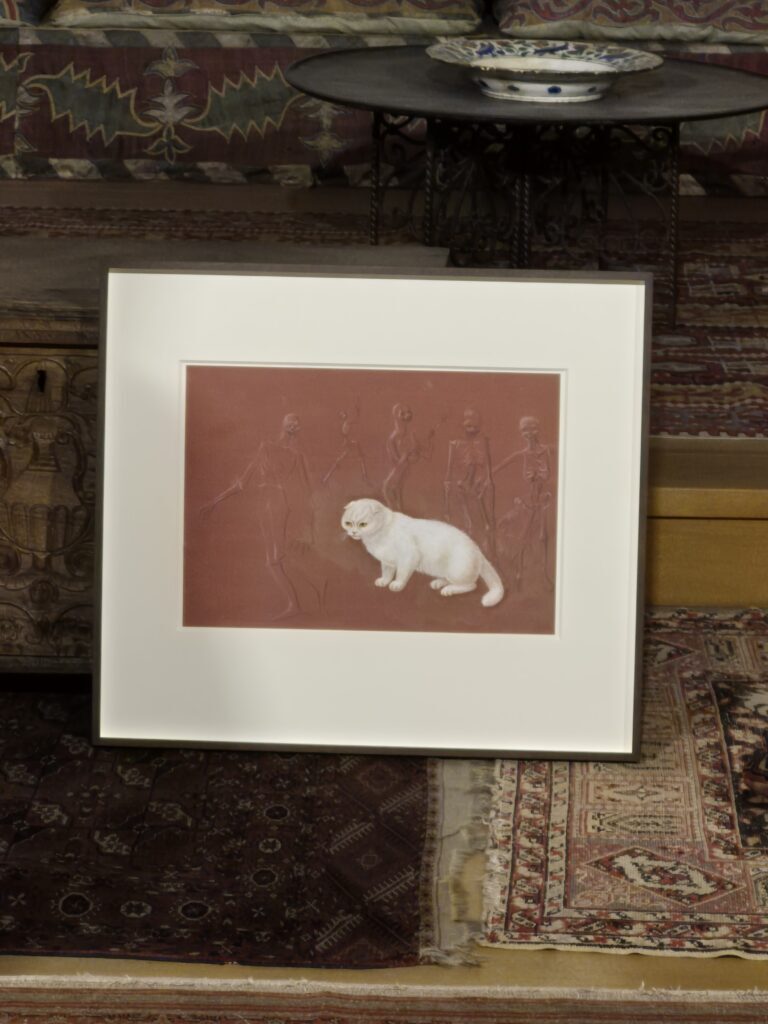
Close-up of the cat painting. Photograph by the author.


This is a view of the Ottoman room with the cat painting, adding a playful touch to a lush and lavish interior.
What makes this painting particularly odd and playful at the same time is the Dance of the Dead right behind the cat.
Some placements posed real challenges, and the painting below stands out as the most striking. Gingeras anticipated that deeply religious viewers might take offense. That reaction, though, misses the point entirely. The painting works as a mystical, eerie image, not as heresy or blasphemy. Instead, it crackles with a kind of electric tension. Its narrative remains deliberately ambiguous, yet it draws on centuries of iconography around the lamentation of Christ and his entombment. Waliszewska’s version paganizes that tradition and centers a female figure. It enters into direct dialogue with an extraordinary early 14th-century embroidery from the Benaki collection, depicting the dead Christ’s body lying full length.
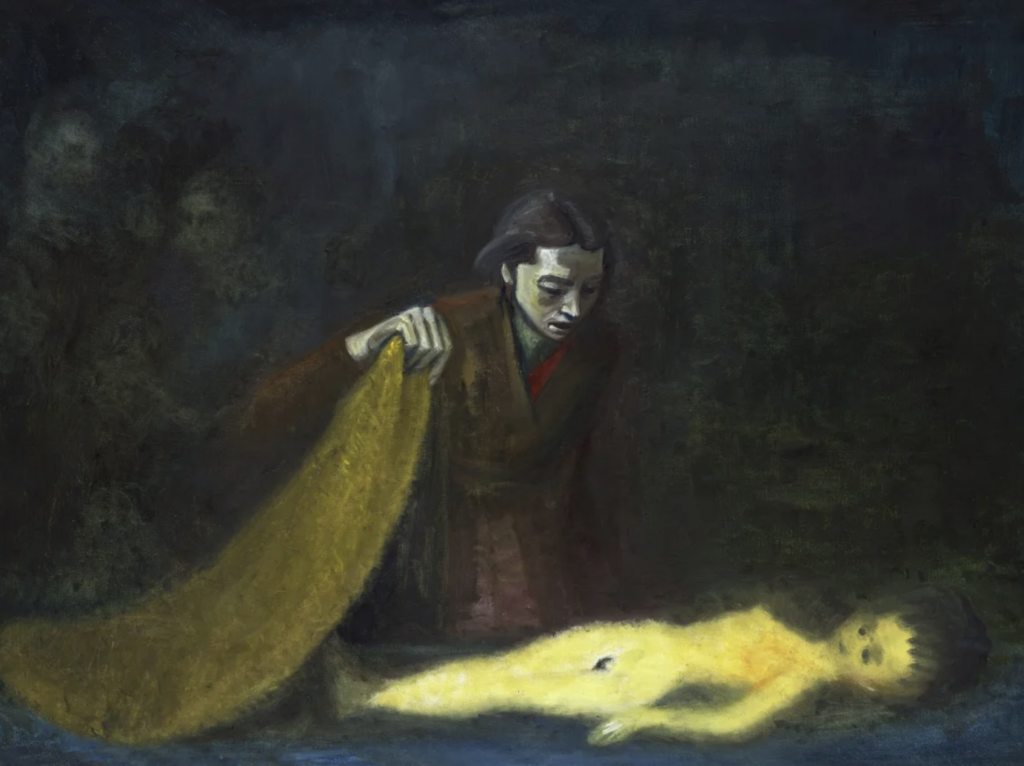
Aleksandra Waliszewska, Untitled, 2024. Most Magazine.
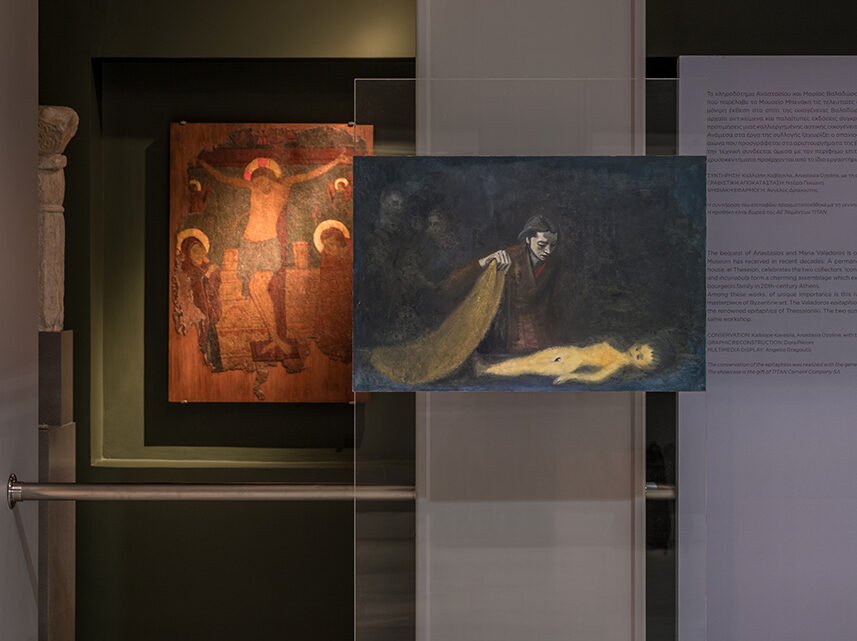
Installation view of the exhibition Aleksandra Waliszewska: Irruption of Antiquity. DESTE Foundation.
Female figures take center stage in a painting heavily inspired by Christ’s entombent, giving it an eerie and mystical feeling.
One of the most interesting paintings in the exhibition is this Byzantine relic with the painting. It is as if the two time periods share a strong connection through time and create a powerful, almost metaphysical, feeling.
Aleksandra Waliszewska: Irruption of Antiquity runs through September 27, 2026 at the Benaki Museum in Athens, Greece. Visitors short on time can also explore a detailed exhibition catalogue.
DailyArt Magazine needs your support. Every contribution, however big or small, is very valuable for our future. Thanks to it, we will be able to sustain and grow the Magazine. Thank you for your help!

I'm Errika Gerakiti, an art writer and curator based in Athens. I write about modern and contemporary art, fashion, and cinema — with a particular interest in the overlooked, the uncomfortable, and the underrepresented. When I'm not writing, I'm curating exhibitions, reading, painting, sculpting, or reading. For longer reads, personal essays, and an occasional science-fiction or horror story, find me on Substack.
It is not uncommon for an artist to become known primarily through the circumstances of their life rather than through the complexity of their work.
Ania Kaczynska 6 August 2026
Very few artists can claim to be as ubiquitous and iconic as Frida Kahlo. This hotly anticipated exhibition at Tate Modern delves into how and why...
Edoardo Cesarino 6 July 2026
Few museums can trace their origins to an act of collective generosity. Fewer still continue to build their identity around that same principle...
Zuzanna Stańska 17 August 2026
Back in 1998, the Hayward Gallery was the first to host a major exhibition of Anish Kapoor’s work in the UK. Now, in the year of the Southbank...
Edoardo Cesarino 22 June 2026