



The Evacuation That Saved Spain’s Artistic Heritage
In November 1936, the Prado Museum became a temporary refuge while Madrid was under bombardment. Its galleries were emptied, its masterpieces were...
Javier Abel Miguel 13 July 2026
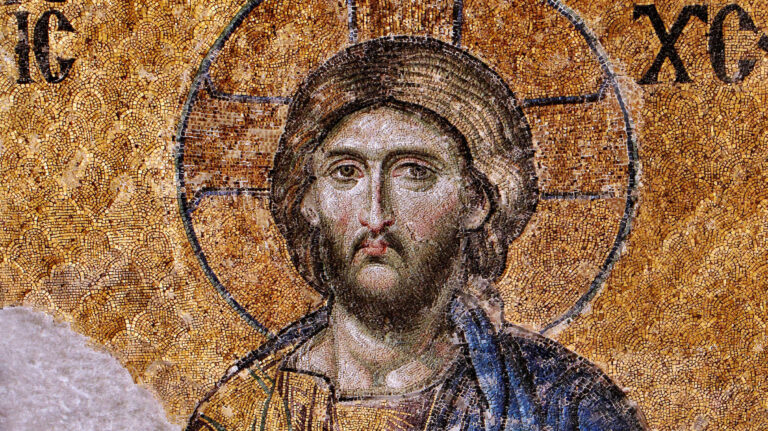
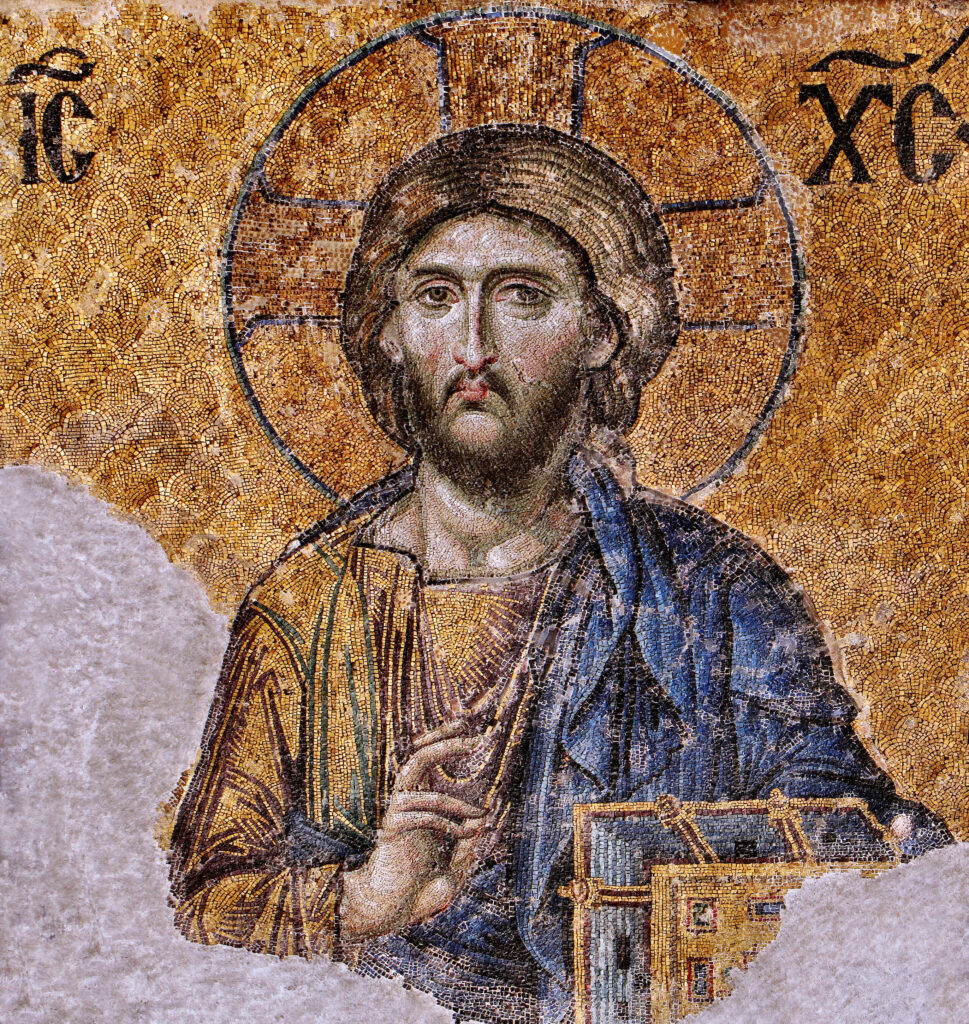
Christ Pantocrator mosaic, c. 1261, Hagia Sophia, Istanbul, Turkey. Photograph by Dianelos Georgoudis via Wikimedia Commons (public domain). Detail.
Sacred figures travel remarkably well. They cross borders, but they rarely remain visually unchanged. Jesus, the Virgin Mary, the Buddha, and biblical prophets have all been repeatedly reimagined through local artistic traditions. Their faces, clothing, and physical features often reflected the cultures that portrayed them rather than historical reality.
Perhaps no figure demonstrates this more clearly than Jesus of Nazareth. Historically speaking, there is no physical description of him in any contemporaneous source. No portrait, no sketch, no confirmed likeness. And yet Jesus of Nazareth may be the most painted human figure in all of art history—more than any emperor, general, or philosopher. His face has been reproduced on wood panels and cathedral ceilings, on village church walls and smartphone screens, across two thousand years and every continent on Earth.
And here is the astonishing thing: wherever he went, he looked like the people already there.
The earliest Christians relied primarily on symbols rather than fixed portraits. A fish scratched into stone, a shepherd carrying a lamb, a chi-rho monogram on catacomb walls. The emphasis was entirely on what Jesus represented, not on what he looked like. The image itself was considered dangerous—a distraction from theology, uncomfortably close to the idol worship Christianity opposed.
But as Christianity spread and became a mass religion, something shifted. People wanted a face. And once artists began supplying one, the face changed with every border it crossed.
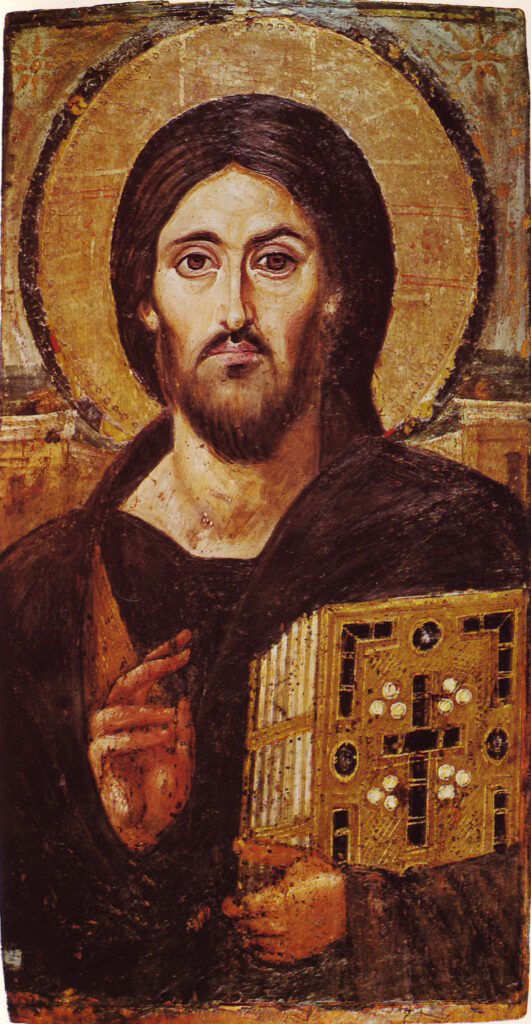
Christ Pantocrator, 6th century, Saint Catherine’s Monastery, Sinai, Egypt.
The Byzantine tradition gave Western art its first settled image of Christ: elongated face, deep-set eyes, long dark hair parted at the center, severe composure. This was not an attempt at historical portraiture. Byzantine iconographers were not asking “what did he look like?” They were asking “how do we make divinity legible?” The answer was a face human enough to recognize and otherworldly enough to revere.
What is striking, in retrospect, is how closely that face resembled the people producing it. The dark eyes and angular features of Byzantine icons belong to the Eastern Mediterranean—Greek, Syrian, Anatolian. Holiness, in Byzantium, had a Levantine face.
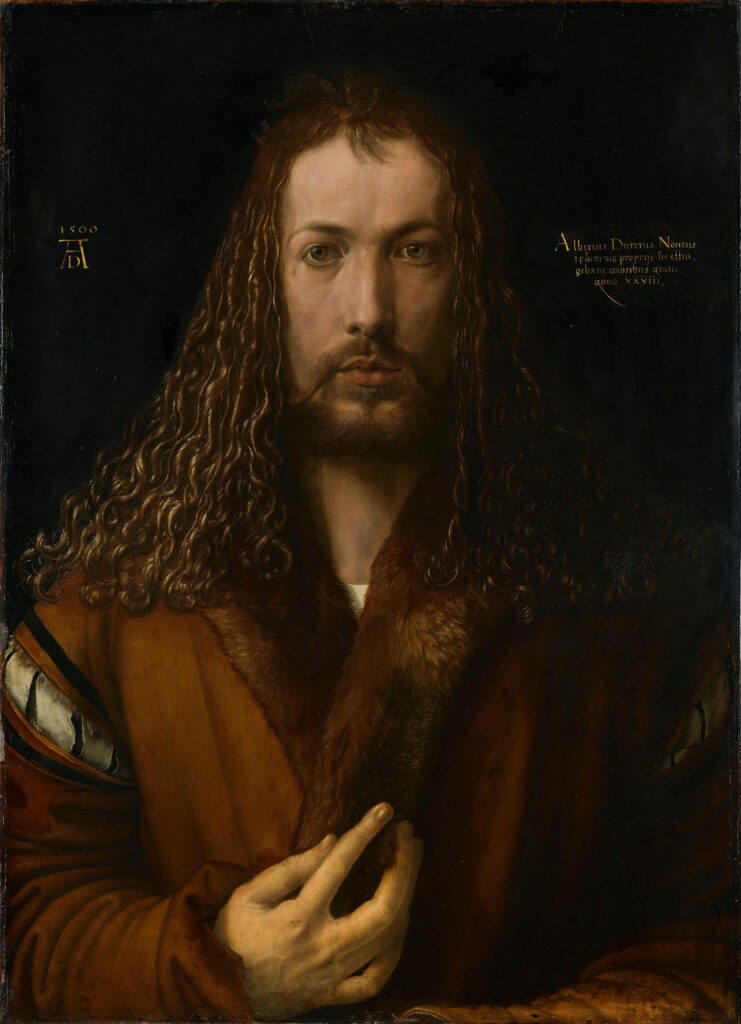
Albrecht Dürer, Self-Portrait at 28 Years Old Wearing a Coat with Fur Collar, 1500, Alte Pinakothek, Munich, Germany.
As Christianity moved north and west through medieval Europe, the face moved with it—and changed. By the high medieval period and through the Renaissance, Christ in Northern European painting was becoming lighter: fairer skin, golden hair, sometimes blue eyes. The image we now call “classical” was largely assembled in Flanders, Germany, and the Low Countries between the 13th and 16th centuries.
The message, whether conscious or not, was unmistakable: the divine is not foreign. He looks like your father, your neighbor, your reflection. Albrecht Dürer pushed this so far that his famous self-portraits look almost deliberately Christ-like—the long hair, the frontal gaze, the controlled seriousness. Artist and savior locked in a strange visual mirror.
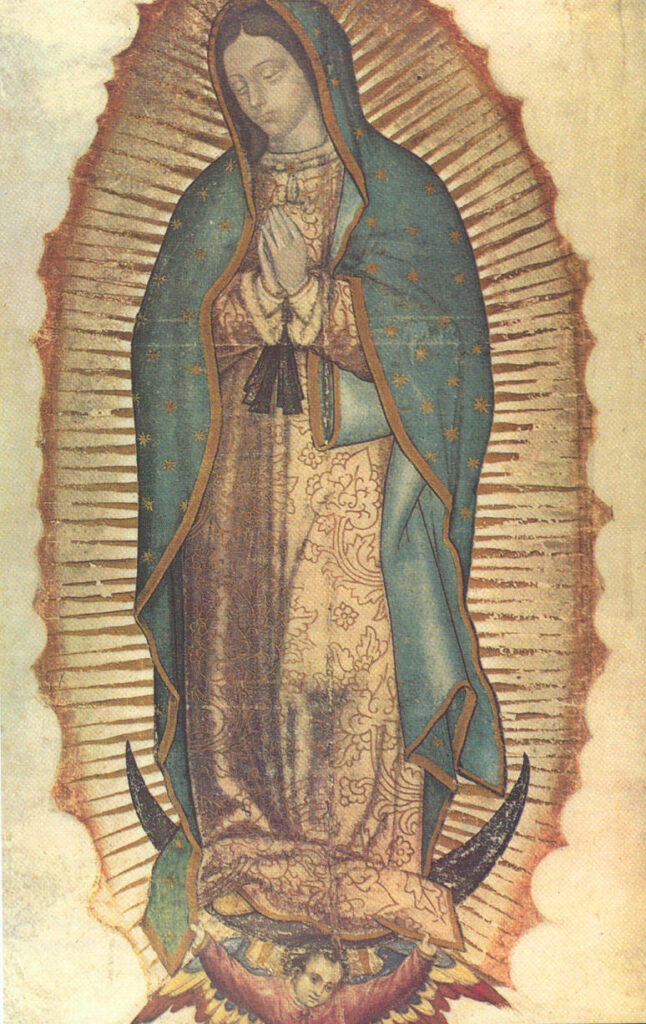
Our Lady of Guadalupe, 1531, Basilica of Our Lady of Guadalupe, Mexico City, Mexico.
The most dramatic example of sacred image adaptation may not involve Jesus at all, but his mother. In 1531, according to Catholic tradition, the Virgin Mary appeared to an indigenous man named Juan Diego outside Mexico City. The image said to have been imprinted on his cloak—the Virgin of Guadalupe—shows a woman who is unmistakably mestiza: dark-skinned, with indigenous features, Aztec symbols woven into her clothing, her posture drawing on pre-Columbian visual vocabulary.
Historians debate the origins of the image endlessly. But undeniable is its effect. The Virgin of Guadalupe became one of the most influential symbols in the spread of Catholicism in colonial Mexico. The theology had been preached for decades. The image worked where words had failed. A divine figure who looked like you, who wore symbols you recognized—that was a presence worth trusting.
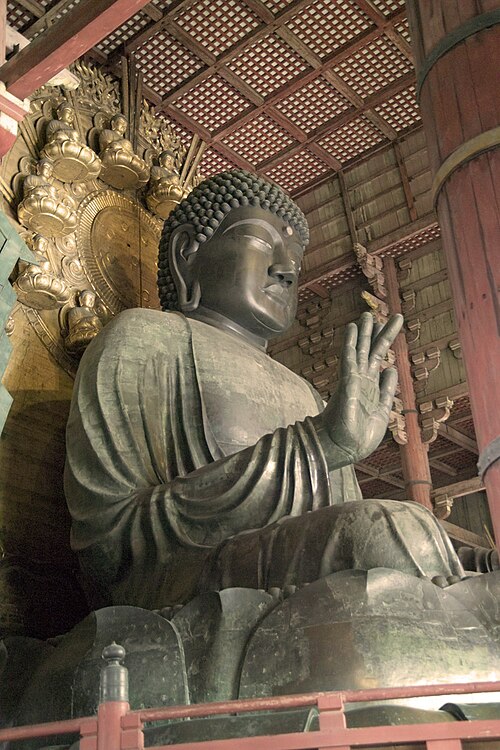
The Great Buddha, 8th century, Tōdai-ji Temple, Nara, Japan. Wikimedia Commons (public domain).
This mechanism was not unique to Christianity. Siddhartha Gautama, the historical Buddha, was born into a warrior-caste family in what is now southern Nepal. But as Buddhism spread across Asia, its founder’s face traveled with it, and changed at every stop. In Tang Dynasty China, the sculptures show eyes that elongate, cheekbones that rise; the face belongs to the Yellow River basin, not the foothills of the Himalayas. Move into Southeast Asia and the features shift again: the colossal Bayon Temple faces in Cambodia carry the physiognomy of the Khmer kingdom—broad nose, full lips, an expression of inward calm that reads as distinctly local. In Japan, the great Daibutsu of Tōdai-ji Temple in Nara grew more abstract and geometric, the face less recognizably human and more timelessly serene.
The Buddha never reached Europe. But his story did.
An ancient tale traveled the Silk Road into Byzantium—a prince sealed inside a palace, who steps outside and encounters suffering for the first time, and is transformed. Europe embraced it, Christianized it, and entered “Saint Josaphat” into the church calendar. Nobody had noticed that Josaphat was a corruption of Bodhisattva—that is, the Buddha himself.
The visual transformation was equally total. The cross-legged, shaven-headed figure gave way to a fair-skinned, blond European holding a gospel. For centuries, Christians venerated a saint whose story ultimately descended from the life of the Buddha.
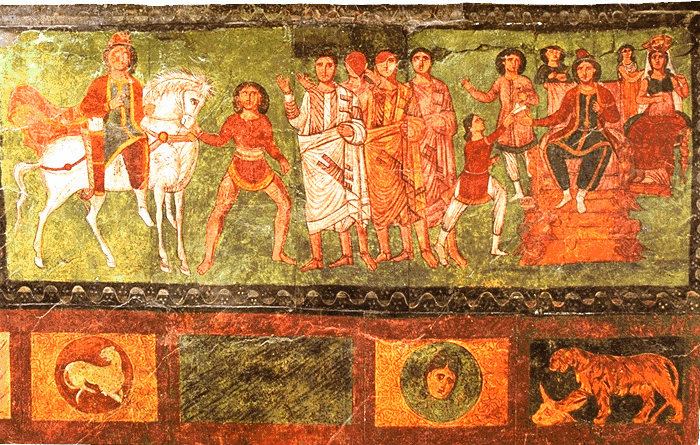
Fresco of Esther and Mordechai, c. 244 CE, Dura-Europos Synagogue, Dura-Europos, Syria.
This mechanism was not exclusive to Christians or Buddhists. In the Syrian desert, close to what is now the Iraqi border, archaeologists uncovered a synagogue from the 3rd century CE. The synagogue of Dura-Europos was covered floor to ceiling with scenes from the Torah: Moses, David, Esther, Mordecai, Elijah. But these figures were not wearing ancient Canaanite dress. They carried the most powerful and prestigious image of their time: embroidered Persian tunics, loose trousers, pointed caps. Mordecai on his white horse was not an Israelite. He was a Sasanian prince.
For the Jewish community living in that landscape, the highest symbols of status, nobility, and power were Persian court clothes. When they wanted to honor their heroes, they dressed them in the most magnificent garments they knew. The language of the sacred has always borrowed from the language of prestige.
There is a temptation to read all of this as simple manipulation—priests and rulers reshaping religion for political ends. And sometimes that was precisely what it was. The Spanish missionaries who commissioned indigenous-looking saints in colonial Mexico knew exactly what they were doing.
But the story is more complicated than cynicism allows. People do not only accept images that look like themselves—they create them, spontaneously, because imagining the divine at a distance is genuinely difficult. Abstraction is hard to love. A face is easier. And if the face carries the physical grammar of your own world, something that might otherwise remain theological becomes, suddenly, intimate.
Art historians call this process inculturation. Theologians argue about whether it represents authentic faith or cultural distortion. Anthropologists simply recognize it as one of the most reliable patterns in human history: we domesticate the sacred by giving it our own face.
Christ Pantocrator mosaic, c. 1261, Hagia Sophia, Istanbul, Turkey. Photograph by Dianelos Georgoudis via Wikimedia Commons (public domain).
Looking at images of Jesus across cultures—the Black Christ of Esquipulas, Chen Yuandu’s The Birth of Jesus, the Byzantine Pantocrator, the fair-haired Christ of Northern European altarpieces—you are not looking at competing claims about what a 1st-century Galilean carpenter actually looked like. Nobody knows. All of these works are doing something else entirely. They are asking: where does the sacred live? And they are answering, each in their own visual language: here. Among us. In a face we recognize.
What the history of sacred portraiture ultimately reveals is less about religion and more about the human need to be included in the stories that matter. The face of the divine is always, finally, a self-portrait of the community that painted it. And perhaps that is not a distortion of faith. Perhaps that is faith itself.
Hans Belting, Likeness and Presence: A History of the Image before the Era of Art, Chicago: University of Chicago Press, 1994.
Jaś Elsner, Imperial Rome and Christian Triumph: The Art of the Roman Empire AD 100–450. Oxford: Oxford University Press, 1998.
Jeanette Favrot Peterson, “Creating the Virgin of Guadalupe: The Cloth, the Artist, and Sources in Sixteenth-Century New Spain,” The Americas, Vol. 61, no. 4 (2005), p. 571–610.
David Freedberg, The Power of Images: Studies in the History and Theory of Response, Chicago: University of Chicago Press, 1989.
Donald S. Lopez Jr., Peggy McCracken, In Search of the Christian Buddha: How an Asian Sage Became a Medieval Saint, New York: W. W. Norton, 2014.
DailyArt Magazine needs your support. Every contribution, however big or small, is very valuable for our future. Thanks to it, we will be able to sustain and grow the Magazine. Thank you for your help!

Tunacan Tuna is a culture writer and journalist exploring art history, museums, cultural heritage, cultural memory, and the ways people connect with places, objects, and stories.

As an educator, writer, and neurodivergent creative, I enjoy learning and sharing through nature, the arts and novel experiences.
In November 1936, the Prado Museum became a temporary refuge while Madrid was under bombardment. Its galleries were emptied, its masterpieces were...
Javier Abel Miguel 13 July 2026
When British agent James Bond, played at the time by a young Sean Connery, enters Dr. No’s secret base, he stops in front of a painting resting...
Javier Abel Miguel 16 April 2026
Portraits of five regal bad boys. We scratch at the paint on the canvas to find the tyranny, treachery and devilish debauchery behind paintings of rotten royals.
Candy Bedworth 16 April 2026
The production of Persian rugs has traveled from ancient looms to modern living rooms. By blending artistry with science, weavers of antiquity...
Maya M. Tola 24 April 2026