
Why Sacred Images Look Different in Every Culture
Sacred figures travel remarkably well. They cross borders, but they rarely remain visually unchanged. Jesus, the Virgin Mary, the Buddha, and...
Tunacan Tuna, 31 August 2026
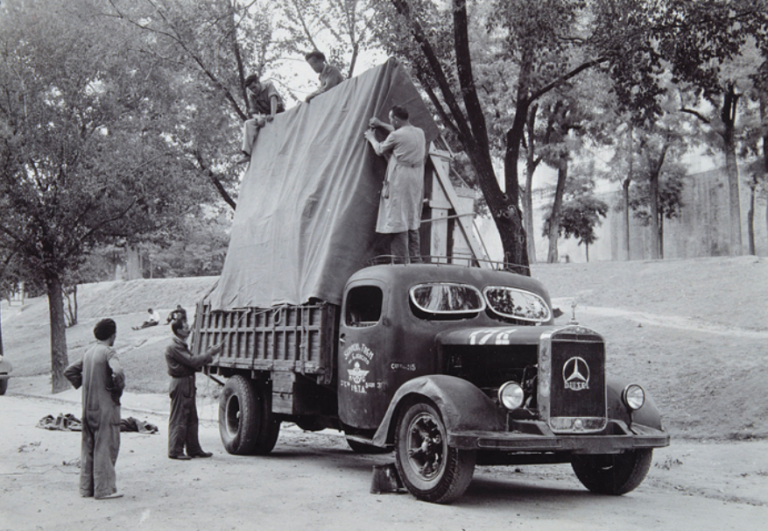
A military truck provided to transport the artworks from the Prado Museum. Museo del Prado.
In November 1936, the Prado Museum became a temporary refuge while Madrid was under bombardment. Its galleries were emptied, its masterpieces were moved down into the basements, and some of the most important paintings in the history of art began an uncertain journey. Works by Velázquez, Goya, El Greco, Titian, and Rubens left the museum doors. They traveled on trucks to cross dangerous roads through a country at war in search for a safe place where they could survive.
On July 18, 1936, the military uprising against the government of the Republic marked the beginning of the Spanish Civil War. Just a few weeks later, on August 30, the Prado Museum closed its doors. Madrid was no longer a safe city. Fearing air attacks, the most important artworks were removed from the upper galleries and taken to the basement of the building. More than 5,000 paintings were stored there, placed in corners, “like they were scared to death,” waiting for an uncertain future.
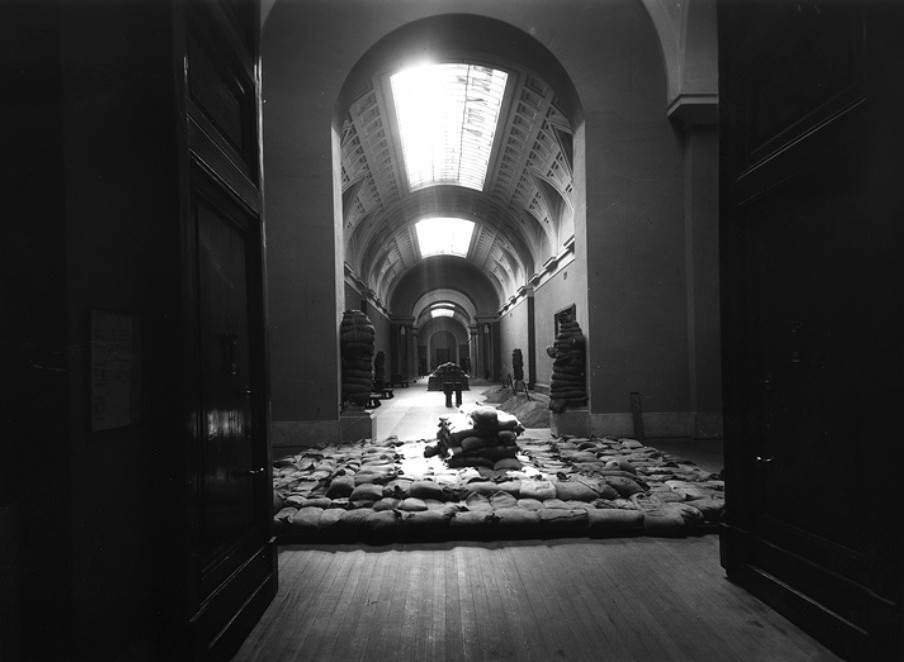
The Central Gallery of the Prado Museum, dismantled and protected with sandbags in October 1936. Museo del Prado.
The fear was, unfortunately, not just an imagination. On November 16, 1936, despite its isolated location and the warning signs placed to protect it, the Prado Museum was hit by incendiary bombs. The precautions taken in the previous weeks prevented a greater tragedy. Inside, the damage was limited. However, the building still keeps some of the marks from that bombing on its façade and on some of its walls, as if the Prado had decided not to completely forget those precarious days.
With Madrid under bombardment, the government ordered the transfer of the Prado’s masterpieces. It was not only about moving them away from bombs, but also about protecting them from other dangers in a city at war: looting, vandalism, fires, and theft. In the middle of the chaos, the government could only try to protect the artistic heritage while it remained under its control. And when the government had to flee to Valencia, it decided to take its artistic treasures with it.
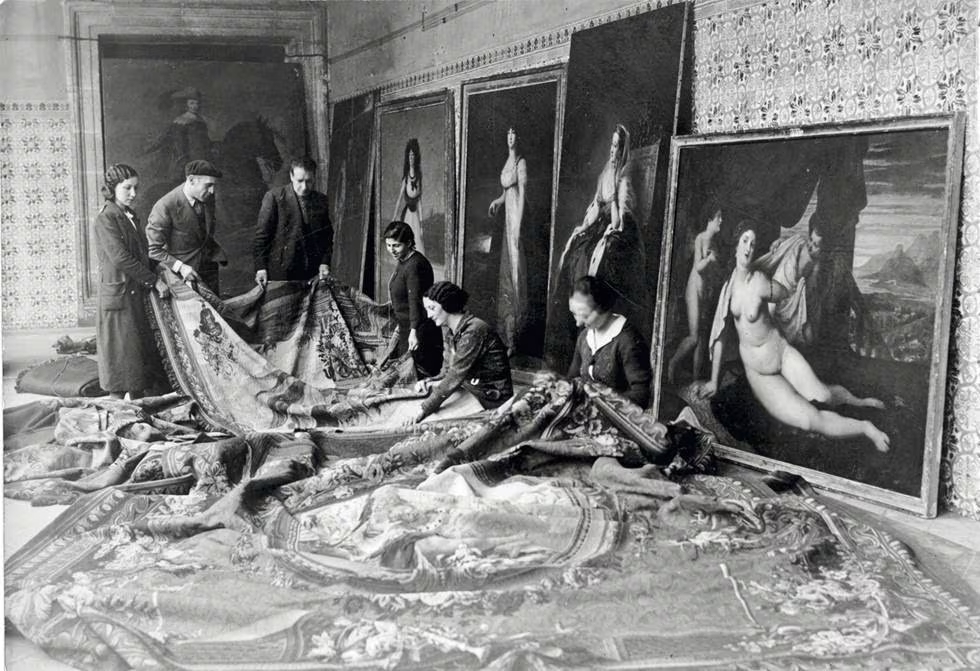
The relocation of Spain’s artistic heritage treasures. El País.
The Prado thus became the first major museum to organize the systematic evacuation of its masterpieces. Years later, other European museums would make similar decisions: the Louvre did so in the face of the Nazi advance on Paris, and so did the British Museum during the bombings of London. But in that autumn of 1936, the Spanish operation had opened an unprecedented path.
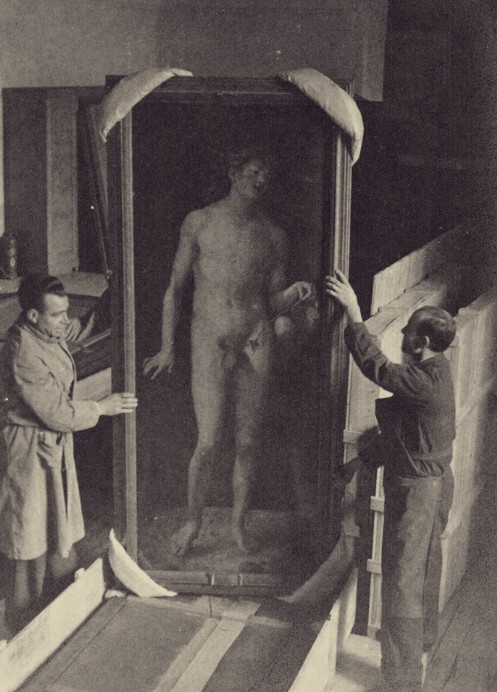
Placing Albrecht Dürer’s Adam in its shipping box. Museo del Prado.
On November 5, 1936, the management of the Prado Museum received the order to begin the transfer to Valencia. The artworks were carefully prepared to withstand the elements during the journey. Whenever possible, the paintings traveled on their original frames, avoiding being rolled up. The crates were protected with waterproof and fire-resistant materials, then closed, sealed, and secured to the vehicles to reduce shocks and vibrations. It was not just about transporting paintings. It was about moving, in the middle of a war, an irreplaceable part of art history.
The first truck left Madrid on November 5, 1936, and took 24 hours to reach Valencia. It would not be the last. In total, 22 convoys were organized to the city of Valencia, with 71 trucks transporting 1,868 crates containing paintings by some of the great masters in art history. Valencia remained the base of the Republican government until October 31, 1937, when it moved to Catalonia. And wherever the government went, the artworks went too. In March 1938, faced with the risk that communications between Valencia and Catalonia might be cut off, the transfer of the Treasures to Figueres was ordered.
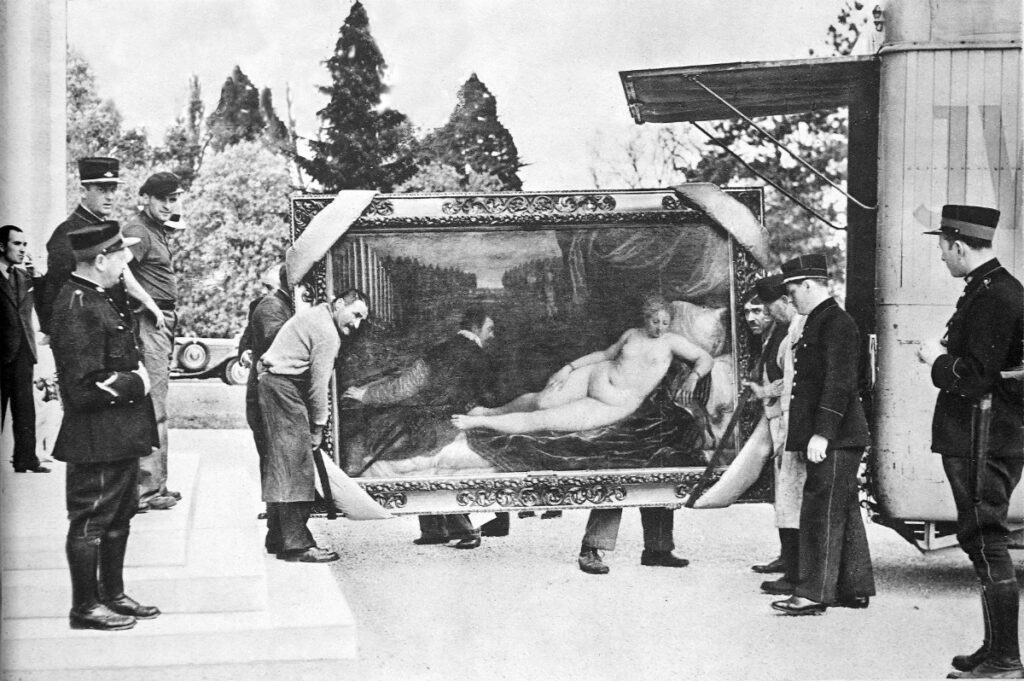
Transporting a Titian’s painting in front of the Swiss Police. El Mundo
In February 1939, shortly before the fall of Catalonia, the newly created International Committee for the Rescue of Spanish Art Treasures—led by a diverse group of French, British, Swiss, Dutch, Belgian, American, and Spanish delegates—signed an agreement with the Republican government to evacuate the artworks to the headquarters of the League of Nations in Geneva, and make them stay until the end of the war. Between February 4 and 9, the crates crossed the border into France. There, they were loaded onto train wagons that left Perpignan on February 12. Five days later, the precious cargo arrived in Geneva. The Prado, now turned into a wandering museum, had finally found a temporary refuge.
Those treasures did not save themselves. Many unseen men and women devoted themselves to saving the heritage. Among them, Manuel Arpe y Retamino stood out. He was the only Prado Museum affiliate who accompanied the artworks for close to three years while they remained away from Madrid.
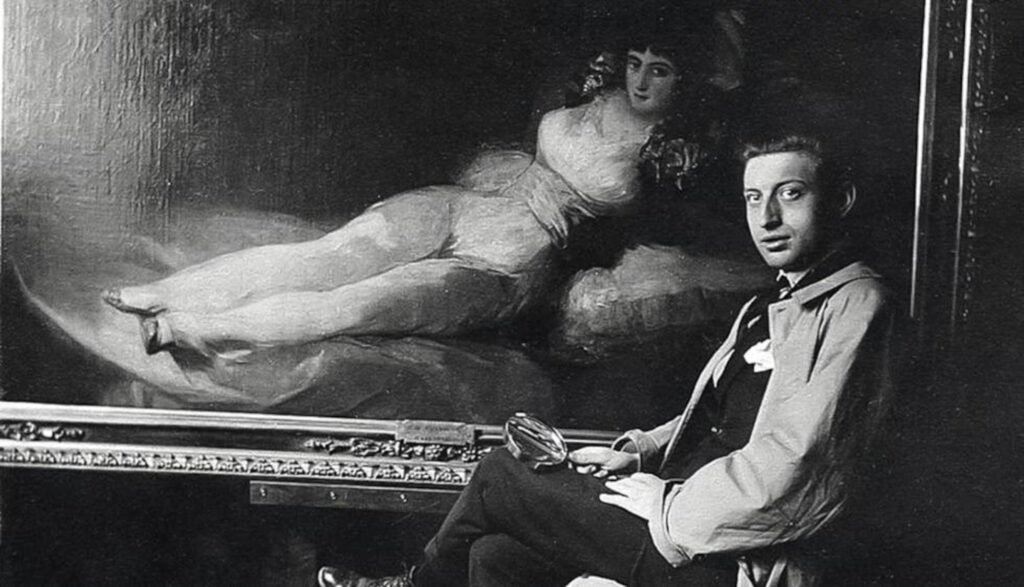
Manuel de Arpe, conservator at the Prado Museum, next to Goya’s The Clothed Maja. El País.
The journey began on December 26, 1936, when he received orders to urgently travel to Valencia. Gaspar de Guzmán, Count-Duke of Olivares, on Horseback, painted by Velázquez, had suffered serious damage during the journey. Rain had leaked into the crate carrying it, and water had run across the surface of the canvas, stripping away parts of the varnish. The painting was in danger. Arpe left immediately for Valencia and, from that moment on, he never separated from the Spanish artistic treasure. He even traveled sitting in the back of a van, among stacks of unwrapped drawings by Goya.
What happened with the Count-Duke of Olivares was only a warning. In March 1938, during the transfer from Valencia to Catalonia, one of the vehicles had an accident. The causes were never fully clear. It may have been due to an air raid or simply the exhaustion of a driver overcome by fatigue. In any case, that truck was carrying two masterpieces by Goya, The Charge of the Mamluks and The Third of May 1808.
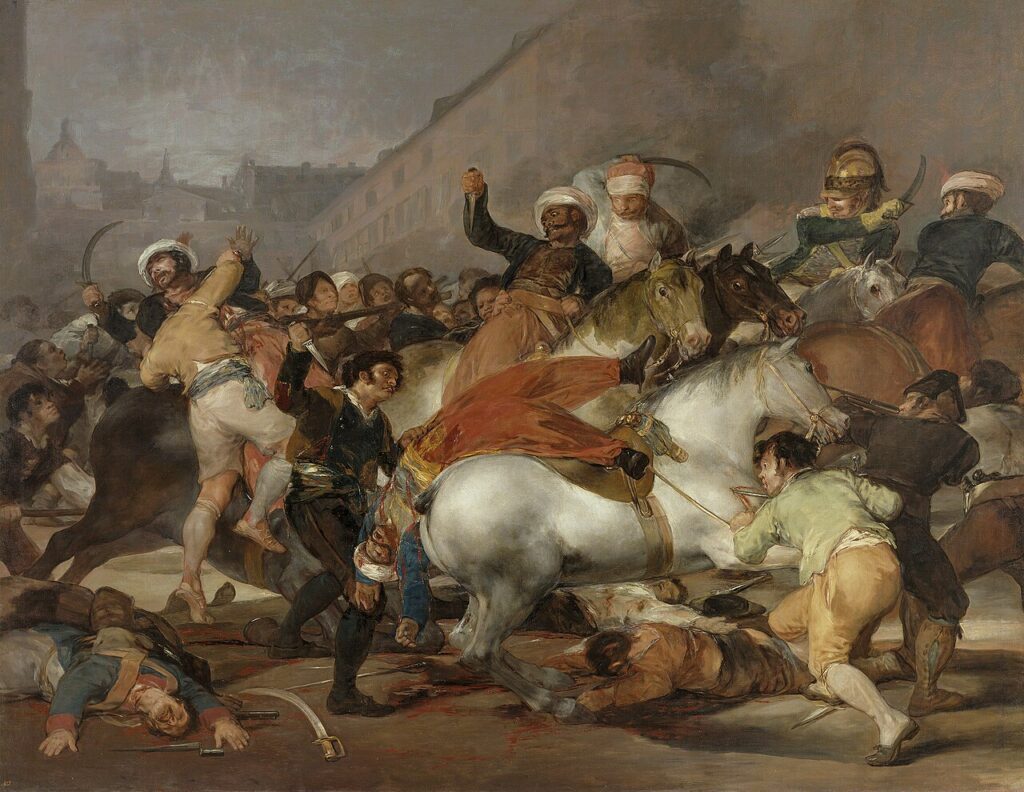
Francisco de Goya, The Second of May 1808, 1814, Museo del Prado, Madrid, Spain.
The Charge of the Mamluks suffered the most. It was torn into 18 fragments. “The paintings were in a disastrous state,” Manuel Arpe would later write in his memoirs. As best he could, he gathered the remains, rolled them up, and stored them until they reached a safe place. Later, he improvised a restoration workshop in the kitchen of Peralada Castle, and tried to repair that disaster. Years later, the works would be restored again in Madrid. But without that first emergency intervention, who knows if we would still be able to see these two masterpieces today.
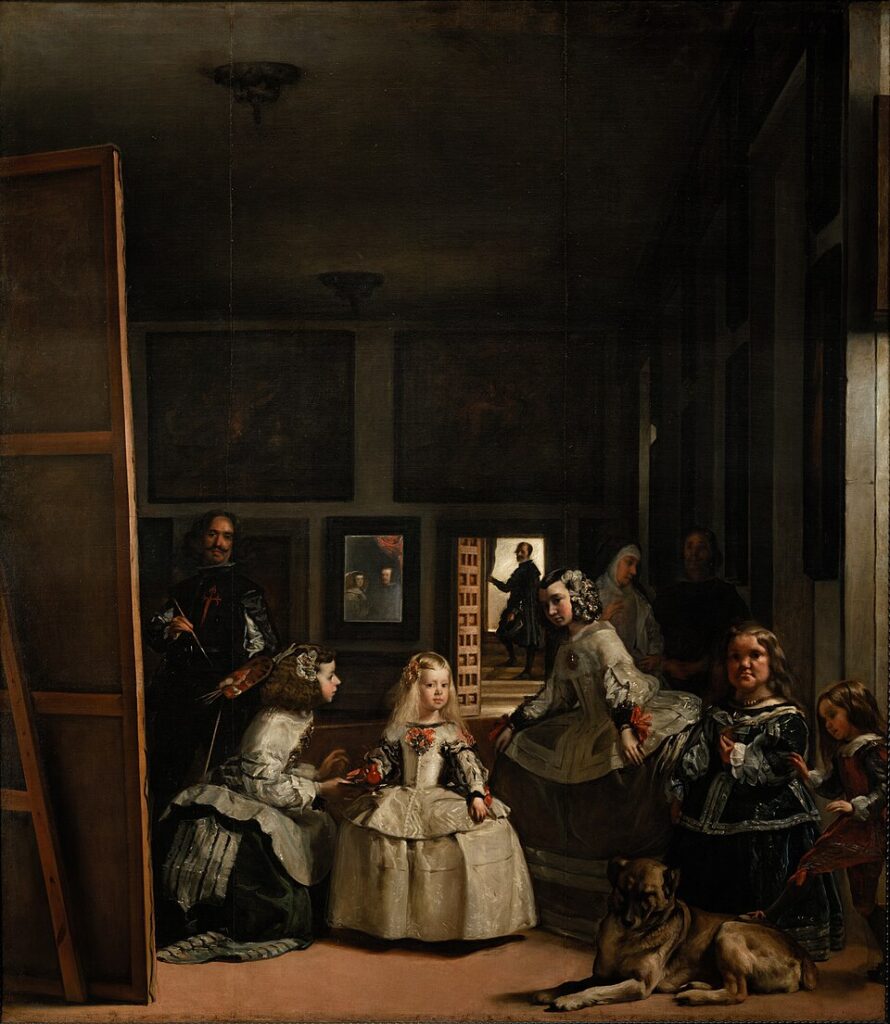
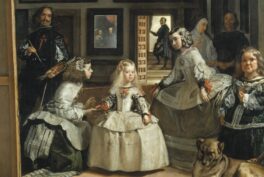
Diego Velázquez, Las Meninas, 1656, Museo del Prado, Madrid, Spain.
Las Meninas did not escape the disasters of the journey either. When the convoy reached a bridge, it had to stop because the crate protecting Velázquez’s monumental painting was too tall to pass through. The officer in charge then suggested removing the painting from its frame, rolling it up, and continuing the journey. Arpe refused. He managed to convince the officer to take the crate down from the truck instead, and to have several soldiers place it on rollers so it could be slowly moved across the bridge to the other side.
Despite the bombings, the accidents, the constant transfers, and the shocks along the way, the Spanish Artistic Treasure managed to arrive safely in Geneva. During its brief stay in the city, the masterpieces from the Prado Museum were exhibited at the Museum of Art and History. The exhibition, made up of a selection of the evacuated works, remained open throughout July and August 1939 and was considered one of the major cultural events of the year in Europe. More than 400,000 people came to see works by Velázquez, Goya, El Greco, Titian, Bosch, and Dürer.
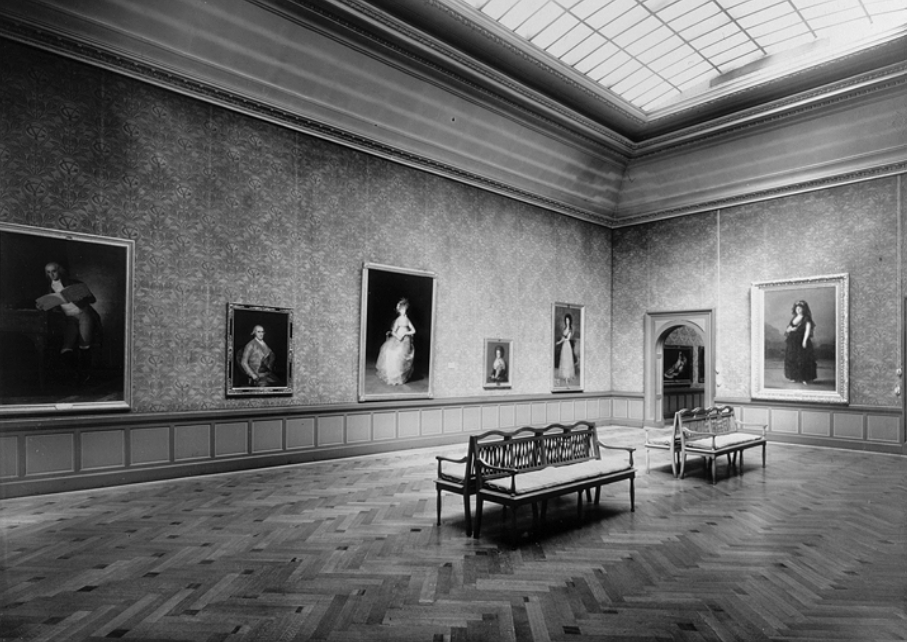
Exhibition view of the Masterpieces from the Prado Museum in Geneva. Museo del Prado.
The artworks eventually left Geneva and returned to Spain on September 9, 1939. They did so just one week after the start of another war in which art would, once again, involuntary take the center stage. It was the Second World War.
DailyArt Magazine needs your support. Every contribution, however big or small, is very valuable for our future. Thanks to it, we will be able to sustain and grow the Magazine. Thank you for your help!

Javier is a journalist and cultural manager with a passion for art and its history. In his free time he loves reading and researching the lives of artists and their works. He loves everything related to the Middle Ages, the Italian Renaissance and the mysteries behind lost works of art.

Sacred figures travel remarkably well. They cross borders, but they rarely remain visually unchanged. Jesus, the Virgin Mary, the Buddha, and...
Tunacan Tuna, 31 August 2026
When British agent James Bond, played at the time by a young Sean Connery, enters Dr. No’s secret base, he stops in front of a painting resting...
Javier Abel Miguel 16 April 2026
Portraits of five regal bad boys. We scratch at the paint on the canvas to find the tyranny, treachery and devilish debauchery behind paintings of rotten royals.
Candy Bedworth 16 April 2026
The production of Persian rugs has traveled from ancient looms to modern living rooms. By blending artistry with science, weavers of antiquity...
Maya M. Tola 24 April 2026