

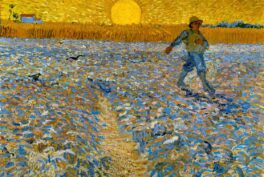
10 Radiant Summer Paintings by Vincent van Gogh
The luminous color of Van Gogh’s mature style took shape in Paris, where he spent two years living with his brother Theo among the avant-garde.
MJ Rivera 29 July 2026
16 November 2026 min Read
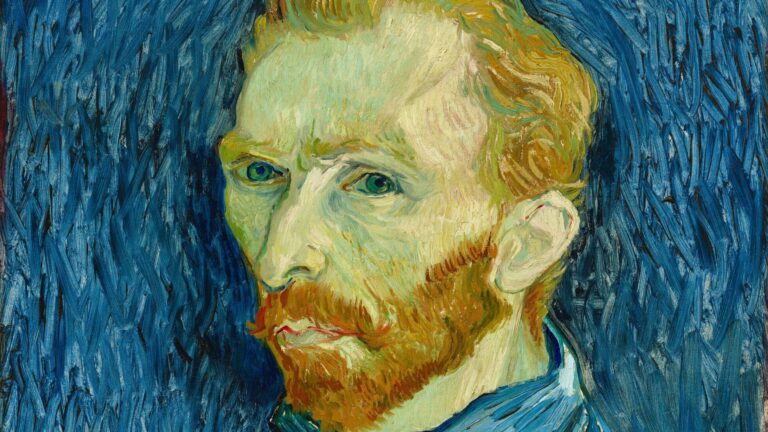
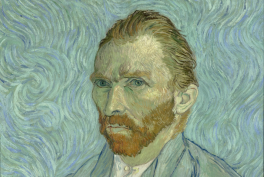
Vincent van Gogh, Self-Portrait, 1889 National Gallery of Art, Washington, DC, USA. Detail.
Vincent van Gogh spent most of 1889, the year before his death, confined voluntarily at the asylum housed in the former monastery of Saint-Paul-de-Mausole near Saint-Rémy-de-Provence in the South of France. There he created around 150 paintings, including his celebrated Starry Night. We bring you 10 paintings Van Gogh made at Saint-Paul that help challenge the glamorization of madness as a muse, and support modern scholarship in arguing that great art demands both genius and lucidity.
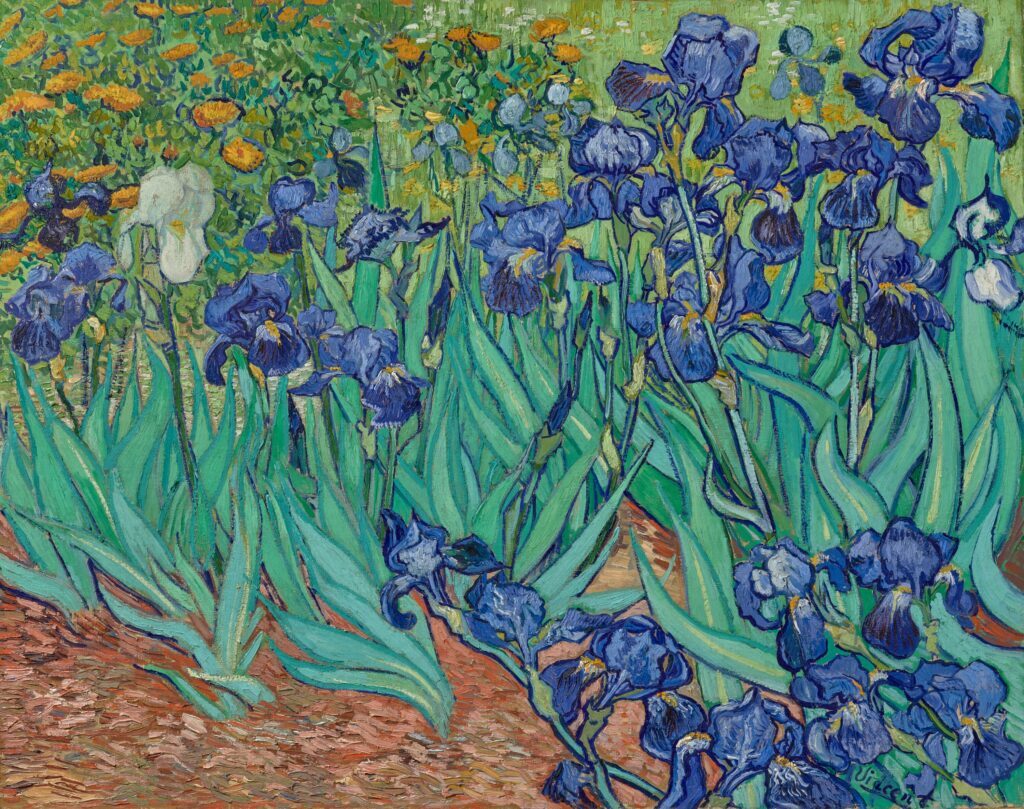
Vincent van Gogh, Irises, 1889. J. Paul Getty Museum, Los Angeles, CA, USA.
Vincent van Gogh arrived at Saint-Paul on May 8, 1889. By the following day, he wrote to his brother Theo about having two paintings underway. One was Irises. Having voluntarily entered the asylum, he obtained permission from its medical director, Dr. Théophile Peyron, to paint in the garden. He filled the canvas with flowers so exuberant that the hardships of confinement in a 19th-century mental institution disappear from view.
Leaves overlap and curl; individual blossoms turn in all directions. A white iris interrupts a mass of blue-violet ones; color contrasts are sharpened by yellow-orange flowers and exposed soil. The arrangement might look unruly, but it is very purposeful: the hospital garden allowed Vincent to work on his awareness of complementary colors. Theo recognized its artistic merit and submitted the canvas to the Salon des Indépendants.
The irises Van Gogh began in May 1889 were violet. Getty Museum conservators found that he mixed cobalt blue with geranium lake, a red pigment that fades when exposed to light. Van Gogh’s own letters speak of “violet irises,” which likely created more vivid contrasts. A fragment of a pine cone was found embedded in the painting, and in 2022, its sourcing allowed the Getty researchers to identify the likely spot in the garden where Van Gogh painted the irises.
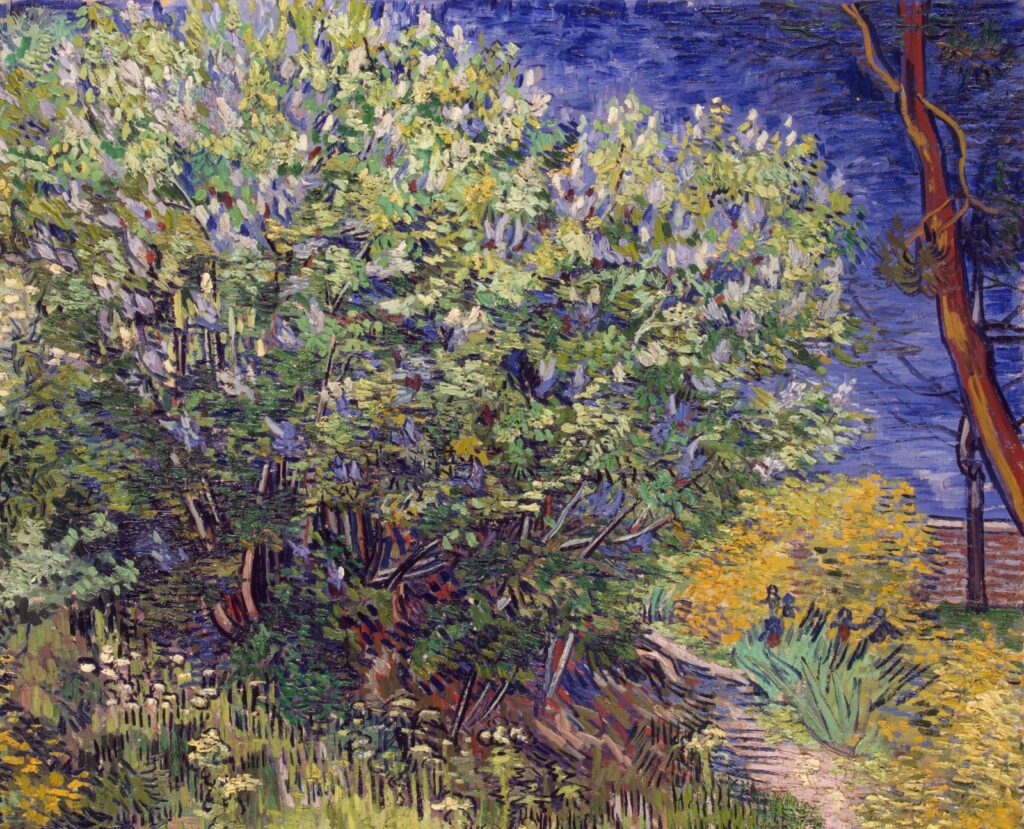
Vincent van Gogh, Lilac Bush, 1889, Hermitage Museum, St Petersburg, Russia.
Van Gogh had an audience at Saint-Paul, but they knew to leave him alone. Writing to Theo and his sister-in-law Jo, he described fellow patients coming over while he worked in the garden as “more discreet and more polite” than “the good citizens of Arles.” In a July letter, he singled out this canvas, as well as Irises, as ones that could hold their own against some of his best pictures.
In Lilac Bush, he gave shrubbery the attention usually reserved for more distinguished subjects; the bush is a study in shape, texture, and color. Blossoms are scattered through a mass of leaves and branches, and sprouting irises line a path leading to a glimpse of a brick wall. It is notable that the asylum architecture stays on the margins. He also inscribed it “Vincent,” a finishing touch surprisingly rare for the artist—a recent study by the Van Gogh Museum in Amsterdam identified signatures in only about 15 percent of his surviving paintings.
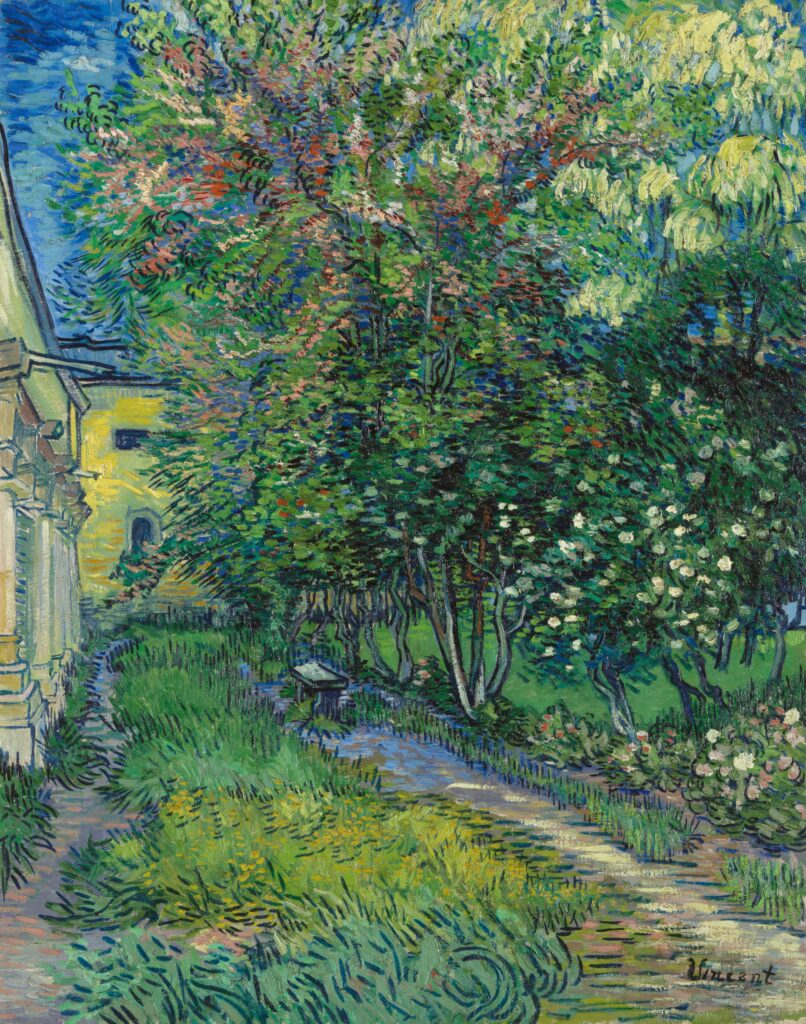
Vincent van Gogh, The Garden of the Asylum at Saint-Rémy, 1889, Kröller-Müller Museum, Otterlo, Netherlands.
At the beginning of his stay at Saint-Paul, Van Gogh could not leave the grounds. He was given an additional room to use as a studio, but would not receive permission to paint outside the asylum walls until a month later, in early June.
Van Gogh continued painting nature from inside the asylum. He told Theo that he required several studies before he could arrive at a composition that had enough character—though calling this canvas a study seems excessively modest. Standing beside the hospital wall, Vincent chose to paint an angled view of the overgrown garden, using the diagonal path and stone bench to set distance and lead the eye. The vegetation is painted in thick, tangled strokes, giving the painting its energy, while the arrangement provides focus and order.
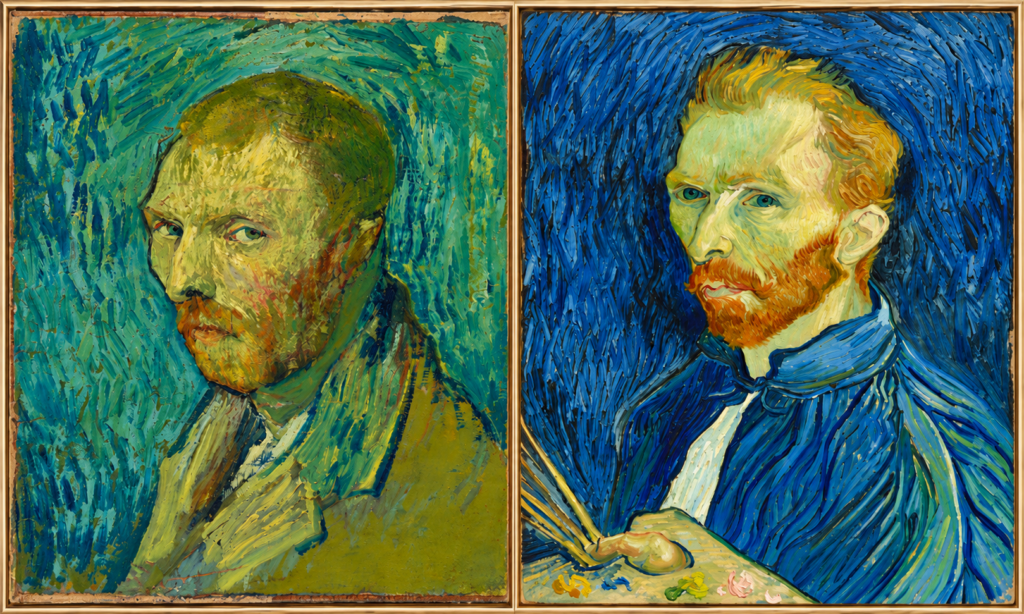
Left: Vincent van Gogh, Self-Portrait, 1889, Nasjonalmuseet, Oslo, Norway; Right: Vincent van Gogh, Self-Portrait, 1889, National Gallery of Art, Washington, DC, USA.
As he continued to struggle with his mental health, Vincent went through a period where he did not “set a foot outside for six weeks.” Nonetheless, Van Gogh referred to painting as “the best lightning conductor” for his mental instability; working consistently inside his studio, he began to depict himself. Vincent had engaged in self-portraiture when unable to secure models who’d pose for him, whether due to financial constraints or bouts of illness.
In the more finished canvas on the right, an Instagram icon at the National Gallery in D.C., Van Gogh included his brushes and palette. He presents himself with the tools of his trade, as countless artists did before him, including self-portrait-master and fellow Dutchman Rembrandt. Vincent’s correspondence discusses self-portraiture as both practical and demanding work.
The authenticity of the Oslo Self-Portrait (on the left) was questioned for decades due to the unusual handling of paint and incomplete ownership history. Research into its materials, technique, and provenance confirmed the attribution in 2020; the Van Gogh Museum has connected it with a self-portrait he called “an attempt from when I was ill.”
People say—and I’m quite willing to believe it—that it’s difficult to know oneself, but it’s not easy to paint oneself either.
Letter to Theo van Gogh, September 5–6, 1889.
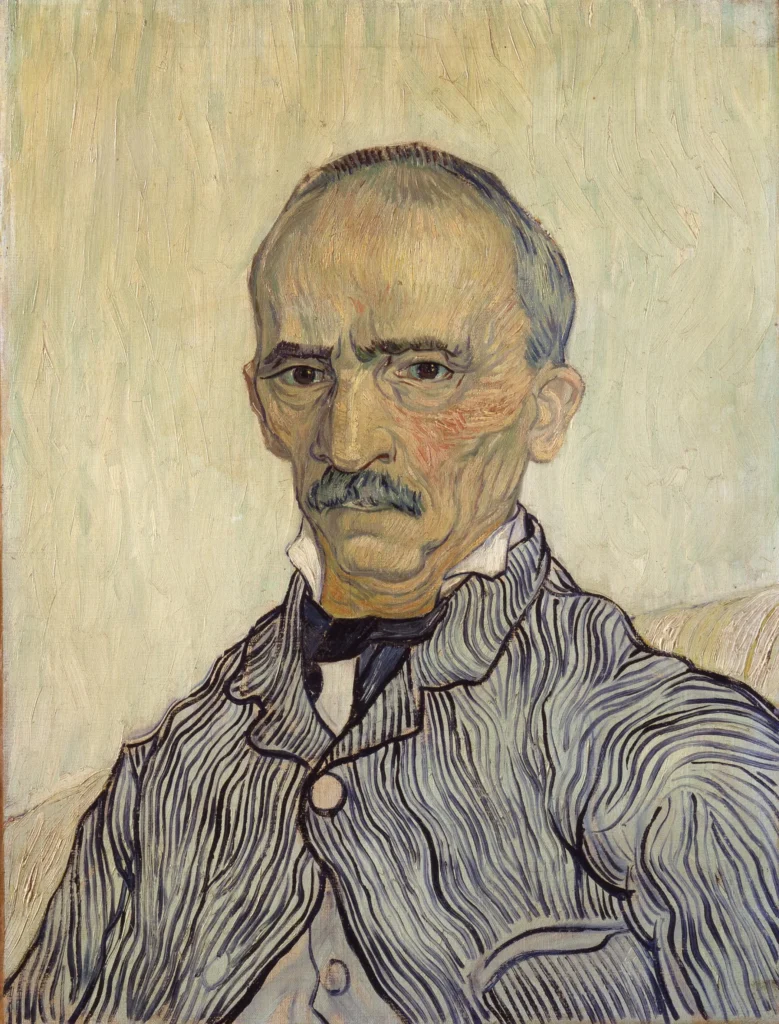
Vincent van Gogh, Portrait of Charles-Elzéard Trabuc, 1889, Kunstmuseum Solothurn, Solothurn, Switzerland.
Van Gogh completed a portrait of Saint-Paul’s chief orderly and made a copy for Theo by September 1889. That reproduction is the painting currently held in Switzerland. The location of the first version, given to Trabuc himself, is unknown.
Trabuc had worked through two cholera epidemics in Marseille, and Van Gogh associated his contemplative expression with the suffering he had witnessed. He described his appearance as “a real bird of prey” tempered “by an intelligent gaze and an expression of kindness.” Van Gogh also painted Trabuc’s wife, Jeanne, whom he met while painting olive trees by their home, near the asylum; he was drawn to her worn, unassuming appearance. Her surviving portrait is now at the Hermitage Museum in St. Petersburg, Russia.
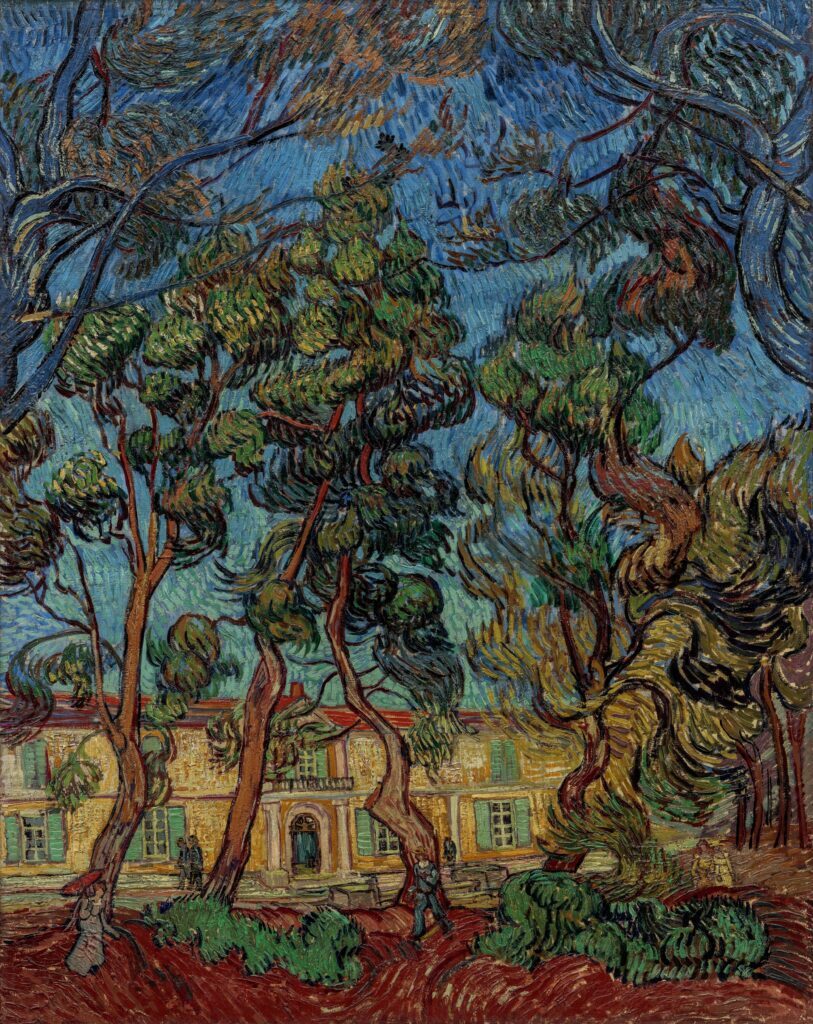
Vincent van Gogh, Hospital at Saint-Rémy, 1889, Hammer Museum, Los Angeles, CA, USA.
By autumn, Van Gogh knew the grounds well. In depicting Saint-Paul’s architecture, he tried to give it somewhat of a makeover. He talked about making the images more “agreeable” by “simplifying and accentuating the proud, unchanging nature of the pines and the cedar bushes against the blue.” In Hospital at Saint-Rémy, the yellowish building sits partly screened behind pines, whose twisting branches press against a blue sky. The trees upstage the architecture, but the color choices hold the scene together.
Van Gogh complained in a letter to his brother that he could not work outdoors at sunset, when the surrounding hills offered the color contrasts and effects he wanted to paint. While his circumstances limited when and where he could work, this canvas might support how focused he was on expanding his vision beyond the asylum walls.
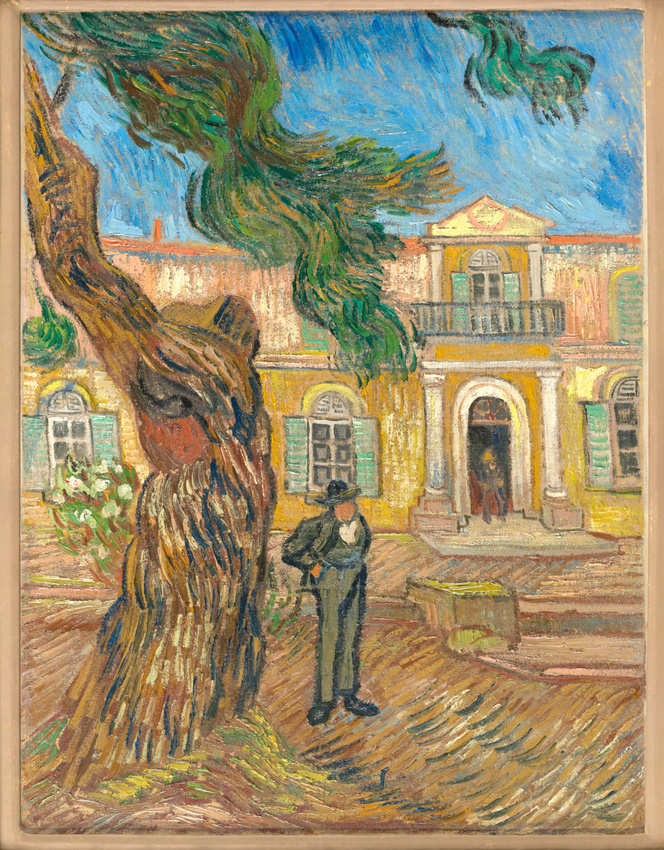
Vincent van Gogh, Hôpital Saint-Paul at Saint-Rémy-de-Provence, 1889, Musée d’Orsay, Paris, France.
Van Gogh made this view of Saint-Paul for Dr. Peyron. The Musée d’Orsay records the gift in a November 3, 1889 letter, when Vincent told Theo he had completed a painting of a house with a tall pine for the doctor. In the same letter, he complained that the studio was damp and his canvases were drying slowly, delaying their shipment. Van Gogh’s letters describe the doctor as kind, and as someone who indulged him with considerable freedom.
Vincent told his friend, artist Émile Bernard, that he had completed about a dozen studies as his health improved. Scholarly research identifies this canvas as one of them. He hoped Bernard would visit Theo to see the autumn studies and like them more than his summer paintings. Vincent believed that capturing a true Provençal character could show that he hadn’t “gone soft.” This painting is a smaller variant of the previously listed Hospital at Saint-Rémy.
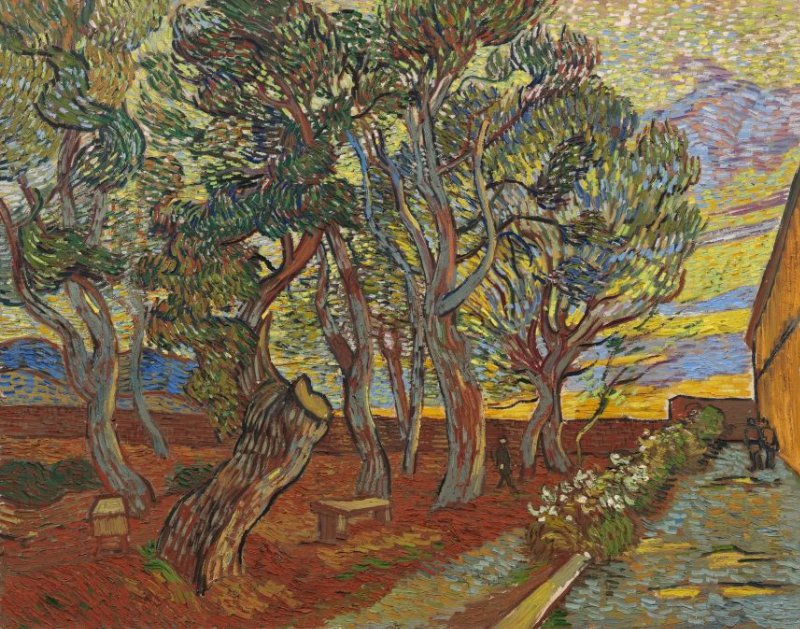
Vincent van Gogh, Garden of the Asylum, 1889, Van Gogh Museum, Amsterdam, Netherlands.
Van Gogh made a pointed argument about religious art in letters exchanged with Bernard and Paul Gauguin, objecting to an approach that did not include observed reality. He offered an example he knew intimately as an alternative: the grounds of Saint-Paul. In a late-November letter to Bernard, Van Gogh described trying to translate the anxiety of his fellow patients into paint; scholars believe that view is this canvas.
An asylum garden, Van Gogh thought, could express anguish, without having to reconstruct a biblical scene: “… to give an impression of anxiety, you can try to do it without heading straight for the historical garden of Gethsemane.” Vincent likened the damaged pine, toppled by lightning and sawn off, to a strong person brought to their knees, and associated the red-ochre earth, dark greens, and black outlines with the unsettling feeling of “seeing red.”
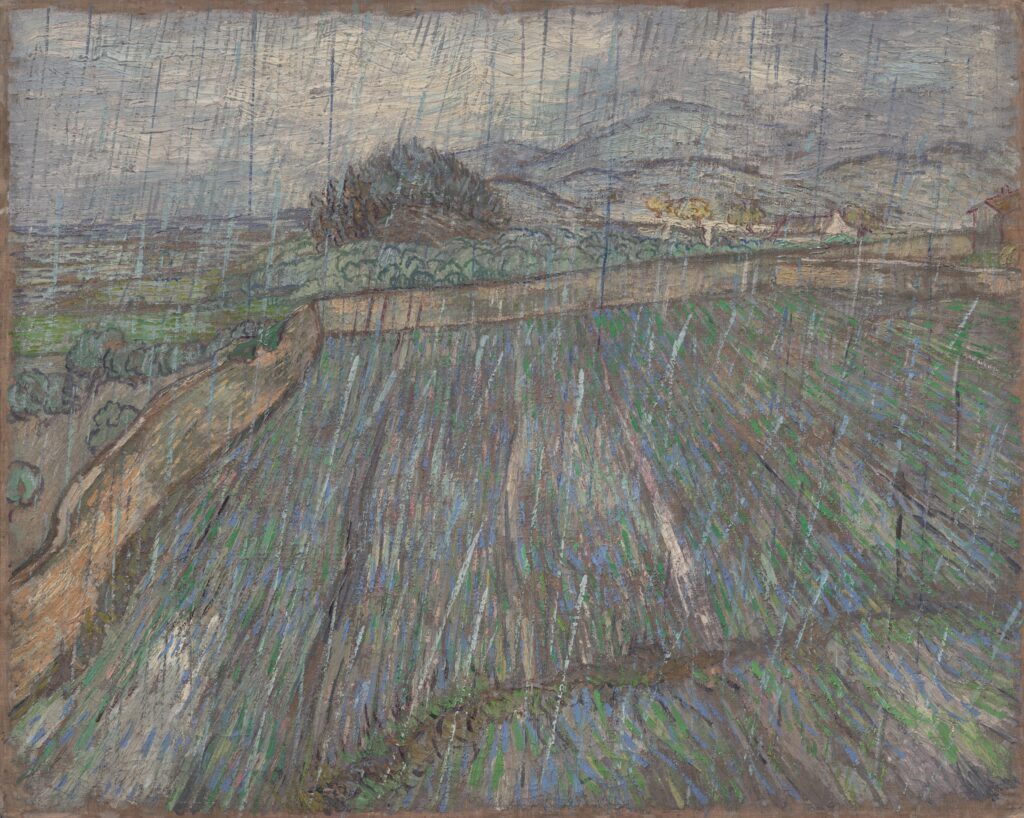
Vincent van Gogh, Rain, 1889, Philadelphia Museum of Art, Philadelphia, PA, USA.
Van Gogh continued to make the enclosed cultivated plot outside his bedroom window a recurring subject, drawing and painting it about a dozen times as the seasons and crops changed. In Rain, the precipitation itself seems to be the focus; he used diagonal strokes that emulate similar depictions of rain showers in Japanese woodblock prints.
Although his room window had iron bars, Vincent deliberately excluded them from the composition, like he did in his famous Starry Night. Writing to Theo in early November, he reported a “rain effect” in progress. He used soft violets and muted greens to build a melancholic landscape, and blue to give the distant hills a misty appearance. He also shifted the viewpoint toward the left to bring more of the enclosure into the composition, and tilted the perspective so it appears to climb toward the hills.
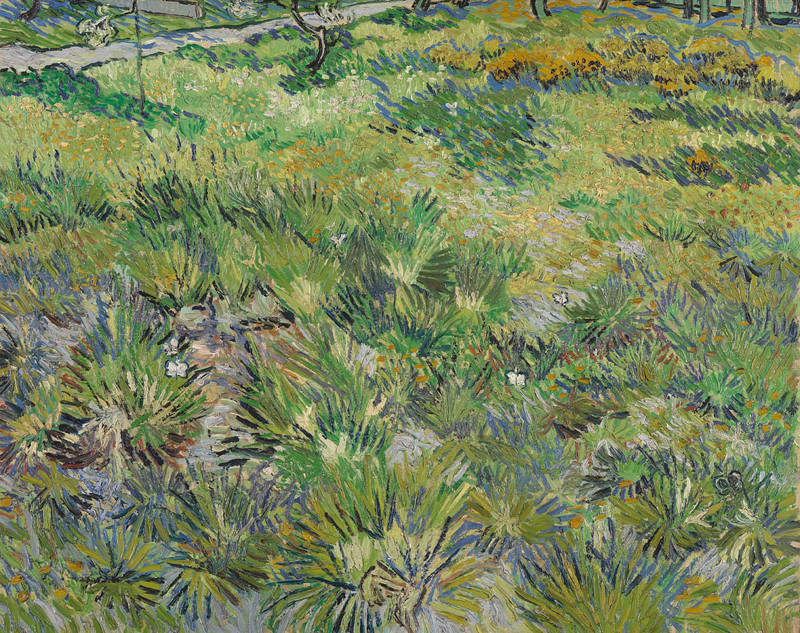
Vincent van Gogh, Long Grass with Butterflies, 1890, National Gallery, London, UK.
In early May 1890, Vincent pressed Theo to arrange his release from the asylum. In a fragment of an unsent letter to his sister Willemien, written after his departure, he recalled working intensely during his last few days at Saint-Rémy. Van Gogh spent about a year at Saint-Paul; this patch of grass was one of his last subjects within its grounds.
Because Van Gogh did several small studies of butterflies and grass, The National Gallery in London sees this painting as an enlarged detail of a work held at the Kröller-Müller Museum, Tree Trunks in the Grass. Read together, they show how a simple change in focus could produce an entirely different picture. Van Gogh left parts of the base layer visible, and conservators found marks from other canvases in its thick paint that may have resulted from rolling for shipment or flat storage.
Vincent van Gogh was officially discharged on May 16 and left for Paris the same day. After visiting Theo and his family, he moved to the nearby village of Auvers-sur-Oise. There he continued painting through the final months of his life, which ended on July 29, 1890, from a self-inflicted gunshot wound. Nonetheless, the tragedy of Van Gogh’s death should not eclipse the intelligence and discipline these paintings reveal behind his artistic genius.
DailyArt Magazine needs your support. Every contribution, however big or small, is very valuable for our future. Thanks to it, we will be able to sustain and grow the Magazine. Thank you for your help!
Rivera is a New York City–based journalist with more than two decades of experience, well-known for thriving in a media capital that tests endurance as much as talent. Reporting has taken her from the World Cup to the Louvre. Her wide-ranging interests in art history have been shaped by years of extensive study and research in major museums in New York, London, Paris, and many leading art institutions around the world.

Leigh is a writer, reader, art lover, radio nerd and herbalist based in Nashville, TN.
The luminous color of Van Gogh’s mature style took shape in Paris, where he spent two years living with his brother Theo among the avant-garde.
MJ Rivera 29 July 2026
Spring blossoms held a special power for Vincent van Gogh and inspired paintings of remarkable beauty, often concealing the difficulties he faced...
MJ Rivera 20 March 2026
Vincent van Gogh is often celebrated for his expressive self-portraits, but his landscapes are equally powerful. He created some of his most vivid...
Anastasia Manioudaki, 19 January 2026
Paul Cézanne (1839–1906) was one of the most influential and greatest of the Post-Impressionist painters. Here is a list of ten different...
Sam Malone 30 December 2025