

10 Harlem Renaissance Paintings That Defined a Cultural Movement
The Harlem Renaissance paintings capture one of the most influential cultural movements in American history. These extraordinary artists transformed...
Errika Gerakiti 20 July 2026
8 October 2026 min Read
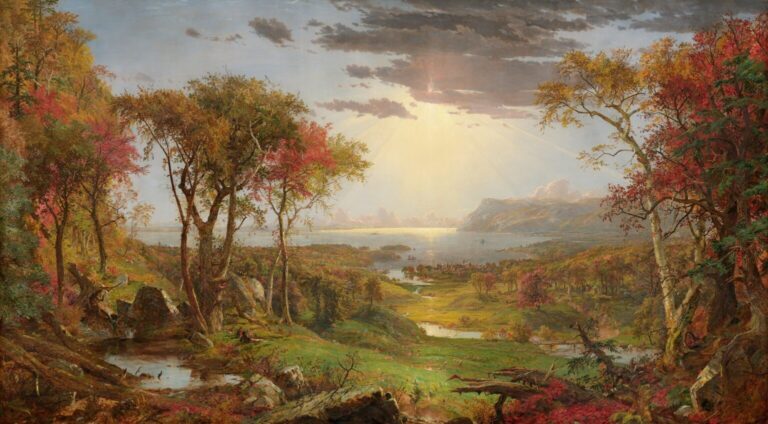
Jasper Francis Cropsey, Autumn–On the Hudson River, 1860, National Gallery, Washington, DC, USA.
Autumn has arrived, and the Hudson River School artists are here to remind us how beautiful it is. Through their stunning landscapes, they captured the colors and atmosphere of the season. Let us review some of these masterpieces.
The Hudson River School was the first major American artistic movement from the mid-19th century. Although the name takes after the river in New York State, artists went as far as South America and Europe to portray stunning views of the natural world. The painters of this school marveled at the landscapes they saw in places that were yet to be colonized and forever altered by human intervention.
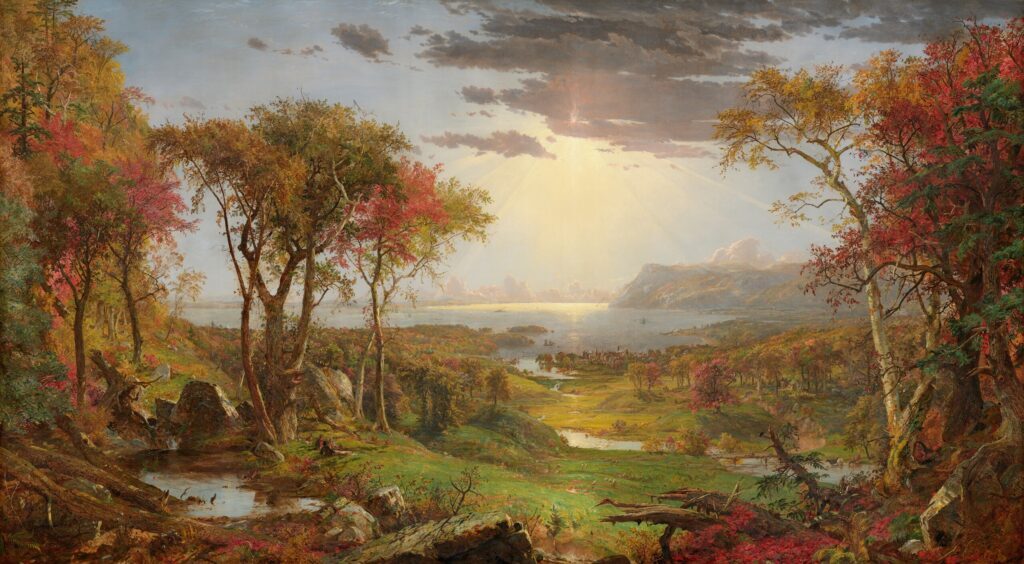
Jasper Francis Cropsey, Autumn–On the Hudson River, 1860, National Gallery, Washington, DC, USA.
Jasper Francis Cropsey (1823–1900) is known as “The Painter of Autumn” for his extraordinary depiction of the American landscape during fall. He created this autumnal view with such detail that each tree species is recognizable, from elms to maples and American chesnuts. The canvas is big, measuring 60 in. tall by 108 in. wide (152 x 274 cm). The sun hides behind clouds, but the way the light shines and covers the canvas is majestic. Although the focus of this work is nature, humans have entered the space. Cropsey added boats and a small group of people sitting near the pond in the lower-left corner of the canvas, enjoying, like us, the magnificent view in front of them.
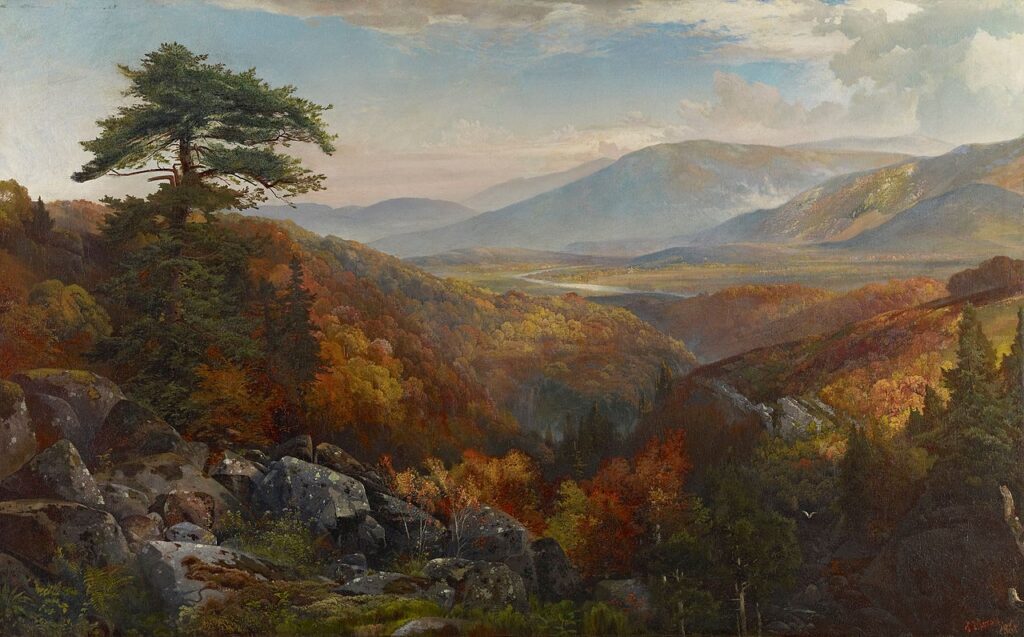
Thomas Moran, Valley of the Catawissa in Autumn, c. 1862, Crystal Bridges Museum of American Art, Bentonville, AR, USA.
Thomas Moran (1837–1926) embarked on an expedition to Catawissa, a town near the Susquehanna River in Pennsylvania, in 1861. A year later, he painted this view of the valley. Moran omitted the railroad that passed through the area, a notable choice since he traveled there to illustrate the Catawissa Railroad for an article at Harper’s Magazine. Many Hudson River School artists lamented the loss of the American natural landscape as men and technology spoiled it, which may have influenced Moran to restore the view to its state before the railroad existed.
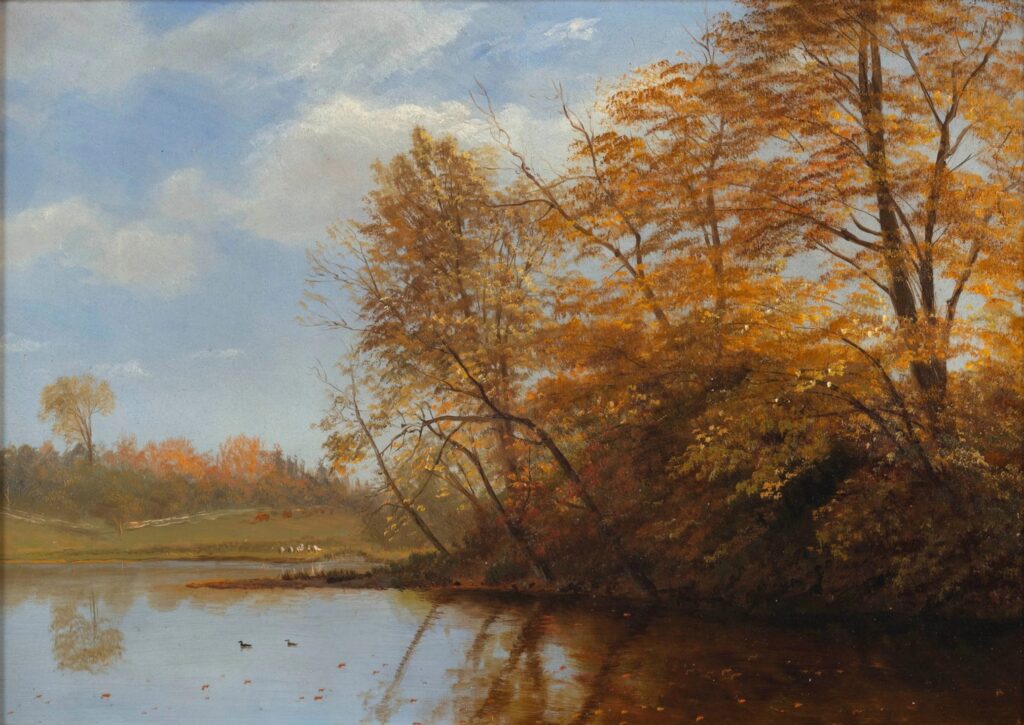
Albert Bierstadt, Waterville Pond in Autumn, c. 1885, Schoelkopf Gallery, New York City, NY, USA.
Albert Bierstadt (1830–1902) painted several autumnal landscapes throughout his career. This one depicts his property in Waterville, New York. The brushstrokes are much freer than the ones in Cropsey and Moran’s paintings. In fact, he only used a handful of them to form the fence and cows in the foreground and the ducks in the pond. A closer look at the trees reveals just one or two touches of paint for each leaf. The canvas is well balanced by complementary colors: the orange of the autumn leaves and the blue of the sky and water.
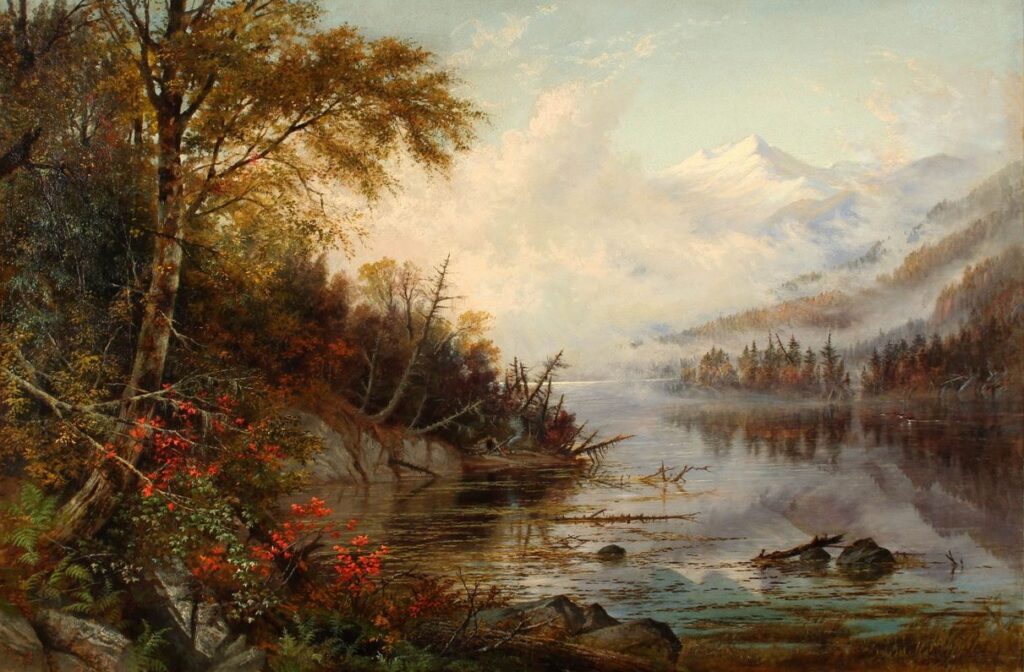
Susie M. Barstow, Mountain Lake in Autumn, 1873, private collection. Thomas Cole National Historic Site.
Susie M. Barstow (1836–1923) was an adventurer. Coming from an upper-middle-class family, she traveled around the world, from the mountains of Maine to Japan, taking in all the landscapes she saw. She also enjoyed hiking the highest peaks she encountered, hence the inclusion of mountains in many of her paintings. Mountain Lake in Autumn shows us a landscape in the process of transformation, with some trees already changing colors, while others retain their greenery. Autumn was a recurrent season in her works of equal or smaller format.
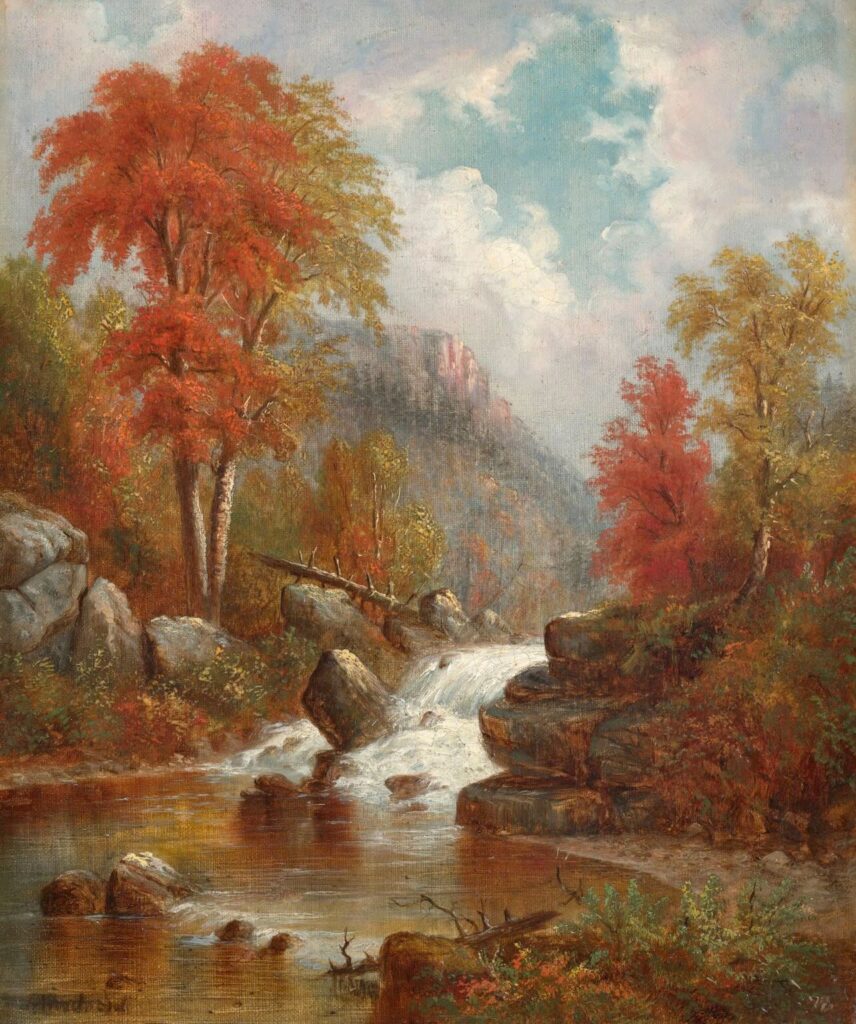
Laura Woodward, Autumn, 1878, Baltimore Museum of Art, Baltimore, MD, USA.
Another woman artist from the Hudson River School was Laura Woodward (1834–1926). Her most famous works come from the later part of her career, when she moved to Florida in the 1880s. However, she was already an accomplished landscape artist in New York before moving south. Like Barstow, she hiked mountains such as the Catskill and Adirondack Mountains in New York, the White Mountains in New Hampshire, and the Green Mountains in Vermont, looking for incomparable views for her artworks. In contrast to the other works listed here, the scope is much smaller. It is as if we zoomed in on another painting to see the waterfall in detail.
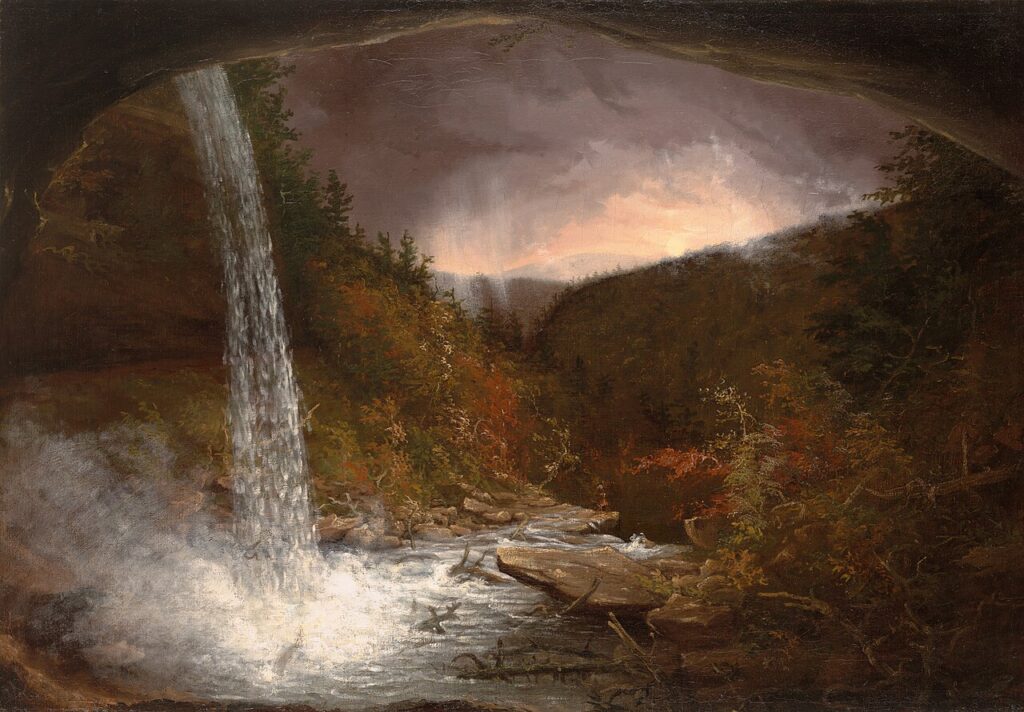
Thomas Cole, Kaaterskill Falls, 1826, Wadsworth Atheneum, Hartford, CT, USA.
Lastly, here is an autumn landscape by one of the most important painters of the Hudson River School and one of its founders. Thomas Cole (1801–1848) emigrated to the United States in 1819 and brought the British landscape tradition with him. He made two versions of the same falls. The one above gives the viewer a lateral view of the falls and is framed at the top by the ceiling of a cave, as if the viewer were standing inside.
Meanwhile, the one below takes the viewer to the front of the waterfall, where they get a clearer view of the oncoming storm. The weather conditions are much more dramatic than the other, rather peaceful environments of his American colleagues. Cole also added a tiny human figure standing at the top, a bit to the left of the waterfall. This man evidences the size and strength of the natural world around him, emphasizing its sublimity.
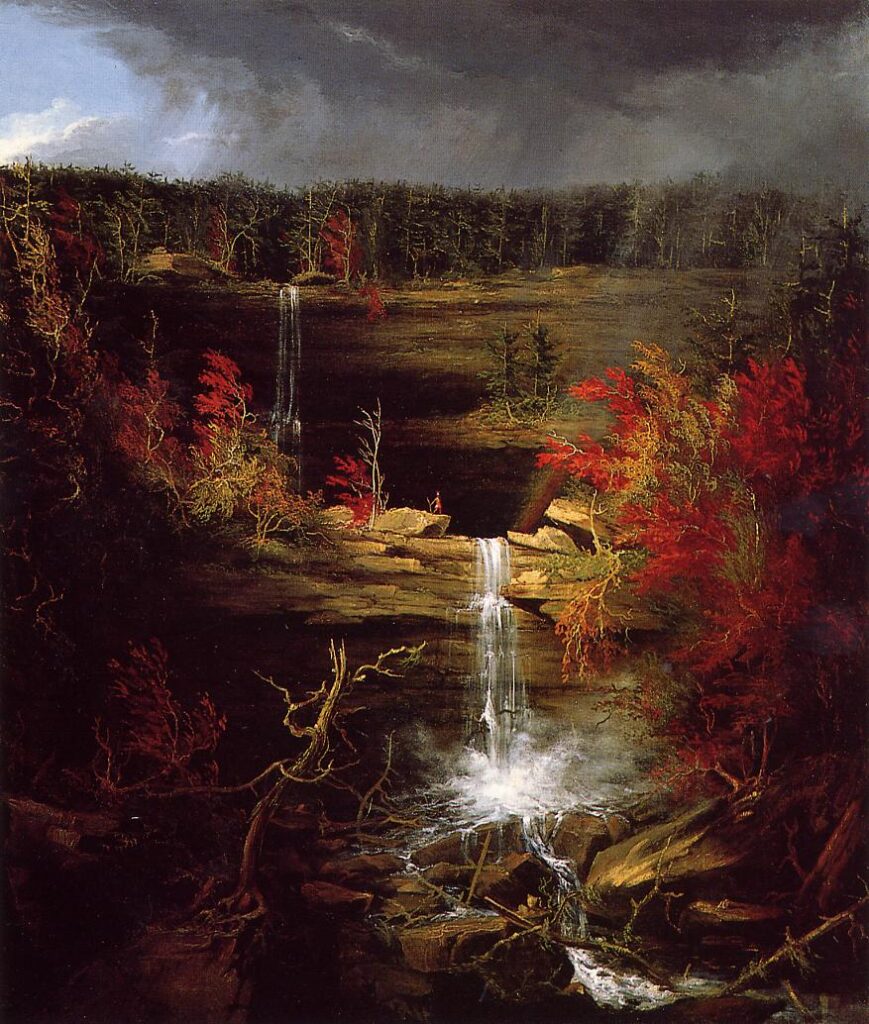
Thomas Cole, Kaaterskill Falls, 1826, private collection. Wikimedia Commons (public domain).
Autumn has always captivated landscape artists. It might be the way the leaves transform and color an entire wood in oranges, reds, and yellows. It is the perfect opportunity to expand the palette and play with it. Perhaps it is also the visual representation of change that adds meaning to a piece. We are lucky to have such works of art, and that they allow us to enjoy nature as few can. If these autumn landscapes made you want to bring a little of their beauty home, take a look at our landscape postcard set.
Dulce Román: Celebrating Women’s History Month: Laura Woodward in Florida, 2026, Harn Museum of Art.
Nancy Siegel: Susie M. Barstow: Redefining the Hudson River School, 2023, Art Herstory.
DailyArt Magazine needs your support. Every contribution, however big or small, is very valuable for our future. Thanks to it, we will be able to sustain and grow the Magazine. Thank you for your help!

An International Relations graduate and an art lover. I prefer art prior to the 20th century, in general. I'm interested in art from Mexico and by female artists.

Univ. of New Orleans, Fine Arts and History; Fine Artist, Professional Graphic Designer, Art Historian, Historian, Musician, worked at the New Orleans Museum of Art and MS Museum of Art; learning enthusiast!
The Harlem Renaissance paintings capture one of the most influential cultural movements in American history. These extraordinary artists transformed...
Errika Gerakiti 20 July 2026
By transforming discarded objects into part of an organic environment and turning personal experience into visual language, Nellie Mae Rowe created...
Carlotta Mazzoli 11 May 2026
Edward Hopper was one of the most iconic American Realist painters and printmakers. He was celebrated for his striking portrayals of American life,...
Zuzanna Stańska, Szymon Jocek 27 March 2026
William H. Johnson’s paintings show a breadth of styles ranging from realism to Post-Impressionism, and later a folk art aesthetic that would...
Theodore Carter 12 February 2026