Summary
- The Harvest portrays a sun-drenched Provençal harvest, with bold yellows, whites, and blues making the heat almost palpable.
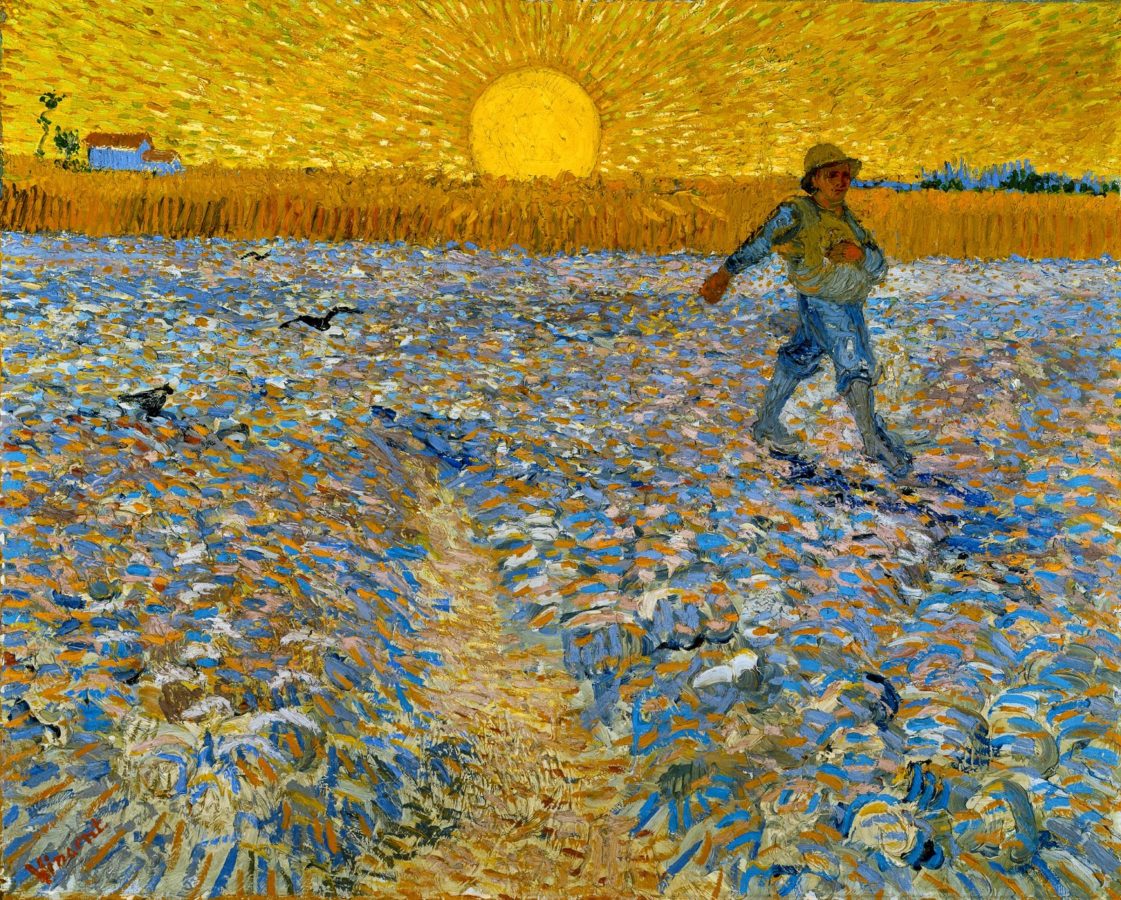
- Drawing from Millet’s The Sower, Van Gogh turns the sower’s work into a radiating vision of nature’s life cycle.
- Seascape near Les Saintes-Maries-de-la-Mer captures the Mediterranean’s changing colors through vivid contrasts and thick, dynamic brushwork.
- Sunflowers became Van Gogh’s signature motif, with vibrant blooms symbolizing nature and friendship.
- Portrait of a Peasant marks a shift toward expressive portraiture, with bold colors replacing realistic depiction.
- In The Stevedores in Arles, the artist turns an ordinary dockside job into a vision of a summer evening inspired by Hokusai’s approach to color.
- Wheatfield with Cypresses reflects Van Gogh’s fascination with the cypresses’ distinctive forms.
- Olive Trees reflects Van Gogh’s time after the asylum, with twisted forms and vivid colors that may echo the artist’s own thoughts.
- Painted in Van Gogh’s final weeks, Bank of the Oise at Auvers is a river scene reminiscent of Monet and Renoir, shaped by short brushstrokes.
- Using a vast panoramic format, Wheatfield Under Thunderclouds expresses extreme loneliness through empty fields and overwhelming skies.
1. The Harvest, June 1888

Vincent van Gogh, The Harvest, 1888, Van Gogh Museum, Amsterdam, Netherlands.
In a letter to Theo describing his first summer in the town of Arles in the south of France, Vincent said it was scorching with bronze, copper, and “old gold” tones, under a “heated white-hot” sky. And while 1888 might not have been as sizzling as 2026, this image of the dry, bright fields of La Crau is the perfect representation of peasant work on a full summer day in the Provençe-Alpes-Côte d’Azur region.
Fascinated by the panoramic flat vistas from the nearby hills of Montmajour, Van Gogh turned the image of a summer harvest into a balanced, expansive landscape, all drenched in unforgiving sunshine. His brushstrokes make the high temps almost palpable; heat is represented through color, notably contrasting strong yellows with whites and blues under a pale sky. In the same letter, Vincent called it one of his best works, a canvas that “absolutely kills all the rest.”
2. The Sower, June 1888
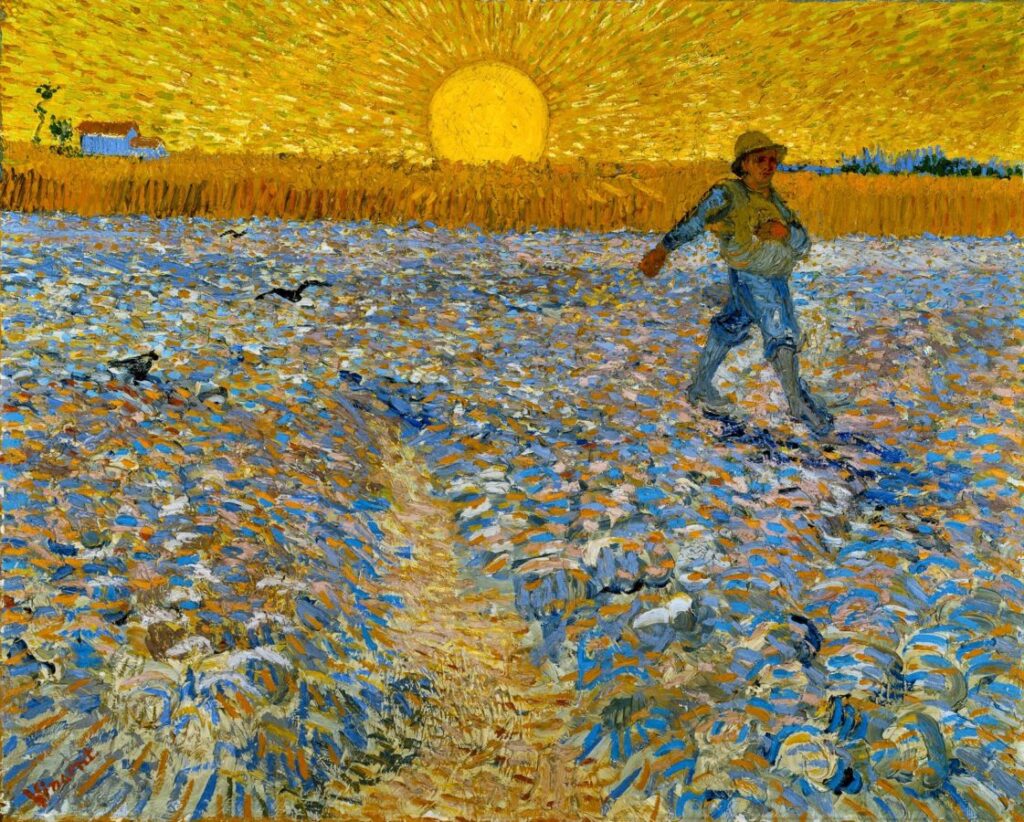
Vincent van Gogh, The Sower, 1888, Kröller-Müller Museum, Otterlo, Netherlands.
Jean-François Millet was one of Van Gogh’s artistic heroes and his inspiration for turning peasant labor into serious, expressive art. This painting was inspired by Millet’s The Sower from 1850, where the French Barbizon artist turned a humble peasant into a heroic, almost spiritual figure. Peasants had traditionally been treated as background figures in art, but Millet pushed the laborer to the front, enlarged him, and made him physically commanding as an idealized symbol of the dignity of hard work.
Van Gogh knew Millet through reproductions and had admired him for years before becoming an artist. He first saw Millet’s work in person in Paris in 1875 at a private sale and treated the experience almost as sacred. When he began his training, Vincent made copies after prints as an artistic exercise, and Millet was one of his most important models. Van Gogh’s version turns Millet’s peasant into a radiating vision of nature’s life cycle, while the sower was widely understood at the time as suggesting a religious figure spreading God’s word.
3. Seascape, Les Saintes-Maries-de-la-Mer, June 1888
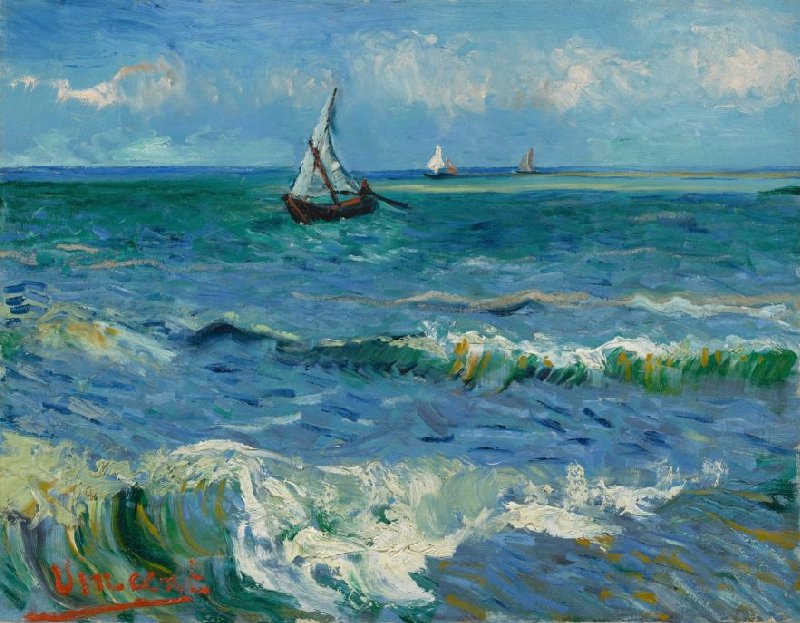
Vincent van Gogh, Seascape near Les Saintes-Maries-de-la-Mer, 1888, Van Gogh Museum, Amsterdam, Netherlands.
Van Gogh journeyed from Arles to Saintes-Maries-de-la-Mer at the end of May 1888 to see the Mediterranean Sea “at last” for the first and only time in his career. Over a few days on the coast, he sketched fishing boats on the beach and studied the changing colors of the water and the sky, producing nine drawings and several paintings of beach scenes—including this rare seascape. He was so impressed by the intensity of the colors of the Mediterranean that he described them as “like mackerel… you don’t always know if it’s green or purple—you don’t always know if it’s blue—because a second later, its changing reflection has taken on a pink or grey hue.”
The compressed composition features high horizons and flattened space partly inspired by Van Gogh’s love of Japanese prints. He built the surface of the water with swirling, rhythmic blue and white strokes, partly using a palette knife, adding light green and yellow to catch the light. He added the Vincent signature in “very outrageous red,” explaining he “wanted a red note in the green,” drawing on contemporary color theory by placing complementary shades side by side, but going beyond it, using color to intensify both the visual and emotional force of the image.
4. Sunflowers, August 1888
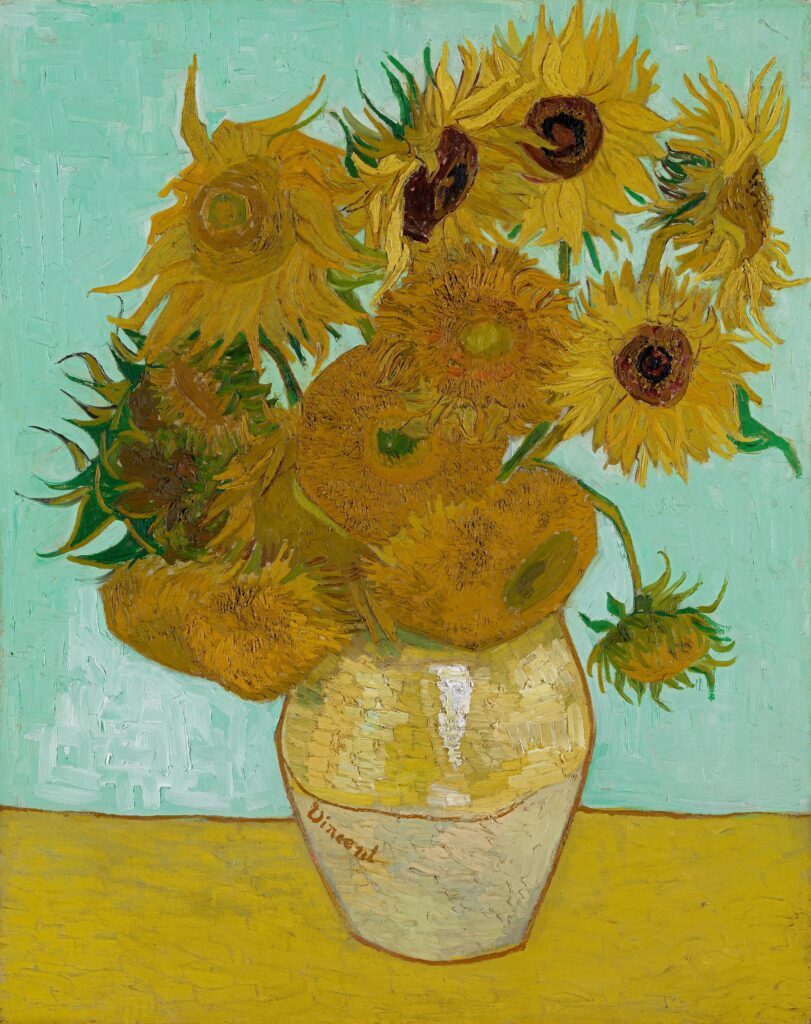
Vincent van Gogh, Sunflowers, 1888, Neue Pinakothek, Munich, Germany.
Van Gogh made sunflowers his own, and they have become forever intertwined with his name. He painted seven versions between 1888 and 1889; one was destroyed in World War II, one is in private hands, and the other five are centerpieces of museum collections around the world. This version from Munich’s Neue Pinakothek dazzles with a cool turquoise-blue background that makes a sharp contrast with the warm, harsh yellow of the sunflowers.
This canvas was painted by Van Gogh in Arles in August 1888, partly to decorate a room in the Yellow House for Paul Gauguin, whom Vincent hoped would join his “Studio of the South.” It is the counterpart to the famous yellow-background version with 15 sunflowers at the National Gallery in London. The flowers are shown at every stage, from budding to withering, using thick, energetic strokes of paint. For Van Gogh, sunflowers suggested nature itself, gratitude, friendship, and the glowing yellow heat of Provençe.
5. Portrait of a Peasant (Patience Escalier), August 1888
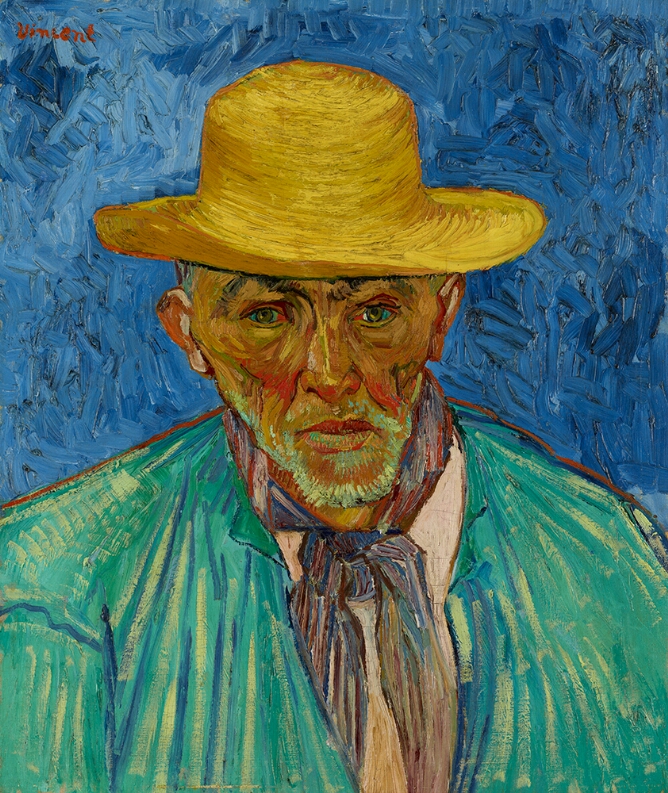
Vincent van Gogh, Portrait of a Peasant (Patience Escalier), 1888, Norton Simon Museum, Pasadena, CA, USA.
While in Arles, Van Gogh continued exploring the idea that color could carry emotion rather than simply describe reality—this canvas marks a decisive shift in his portraiture style. Patience Escalier (though his identity has never been fully confirmed) was one of Van Gogh’s few sitters. In letters to Theo, Vincent said models were scarce because his work was panned as “badly done” for not aiming for academic perfection in the style of William-Adolphe Bouguereau. He explained his focus was not smooth pictures but “full of painting” instead, ironically, what Van Gogh is widely admired for today.
The blue background highlights the intensity of the face, built from thick strokes of ochre, orange, red, and green, making the head almost luminescent. Van Gogh wrote extensively about the portrait, describing Escalier as “a sort of man with a hoe, an old Camargue oxherd.” The figure echoes the dignity of the hard work of Millet’s peasants, but Van Gogh made color the basis for the painting’s idea, energy, and symbolism. The increasingly expressive character he developed in Arles is evident in Escalier, who has the “sunlit and burnt, weather-beaten quality of the strong sun and strong air.” The intense color choices indicate long days under the Provençal sun but are deliberately non-naturalistic. Vincent explained going beyond depicting exactly what stood before him by using color “more arbitrarily” to express himself “with force.”
6. The Stevedores in Arles, August 1888
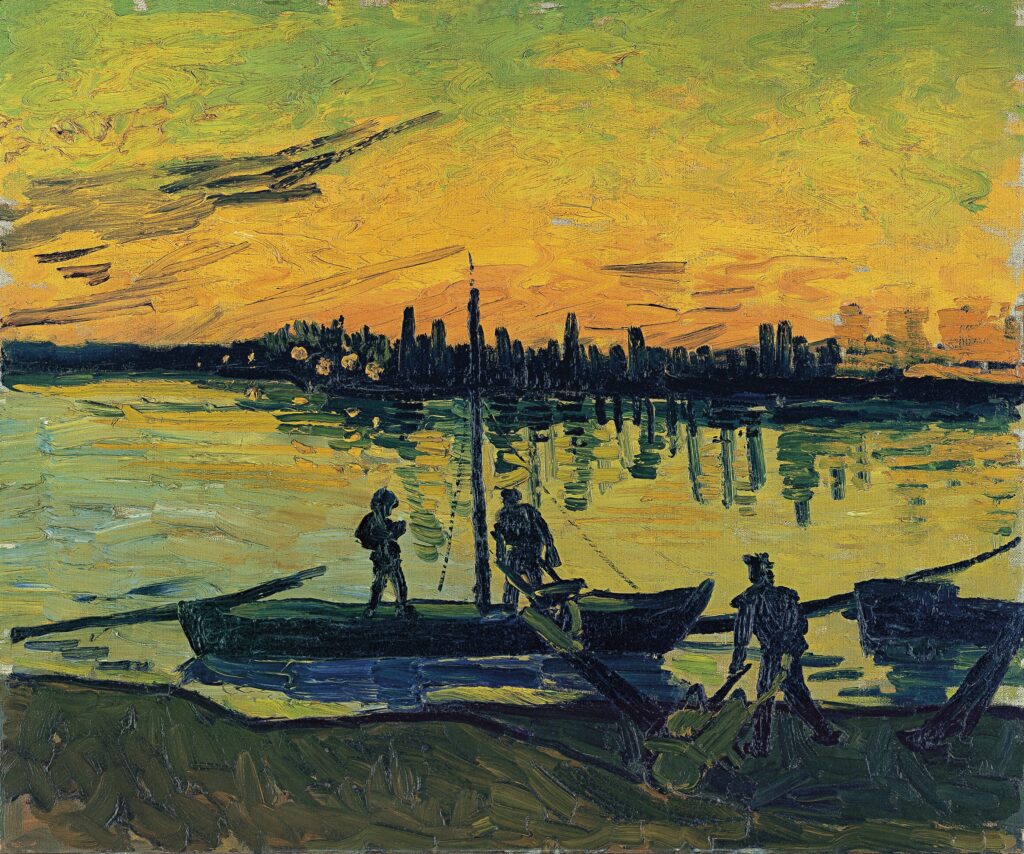
Vincent van Gogh, The Stevedores in Arles, 1888, Thyssen-Bornemisza Museum, Madrid, Spain.
Van Gogh painted these dockworkers unloading boats on a hot summer evening by the Rhône River using lively, elongated brushstrokes that give the image a rough physicality. The heat and drama are provided by the color contrasts of the dark boats and the workers against a glowing sunset. Van Gogh is not just recording labor; he turned an ordinary dockside job into a striking vision of a summer evening.
The bold colors and sharp contrasts allowed Van Gogh to reproduce a scene he had seen earlier that month. He described it in detail in a letter to Theo in July 1888, reiterating his admiration for Katsushika Hokusai, the 19th-century Japanese printmaker behind The Great Wave. Vincent considered him a master of expressive line and a model for modern painting. He wrote, “I saw a magnificent and very strange effect this evening (. . .) the water was a white yellow and clouded pearl-grey, the sky lilac and an orange strip in the west, the town violet. (. . .) It was pure Hokusai.”
7. Wheatfield with Cypresses, June 1889
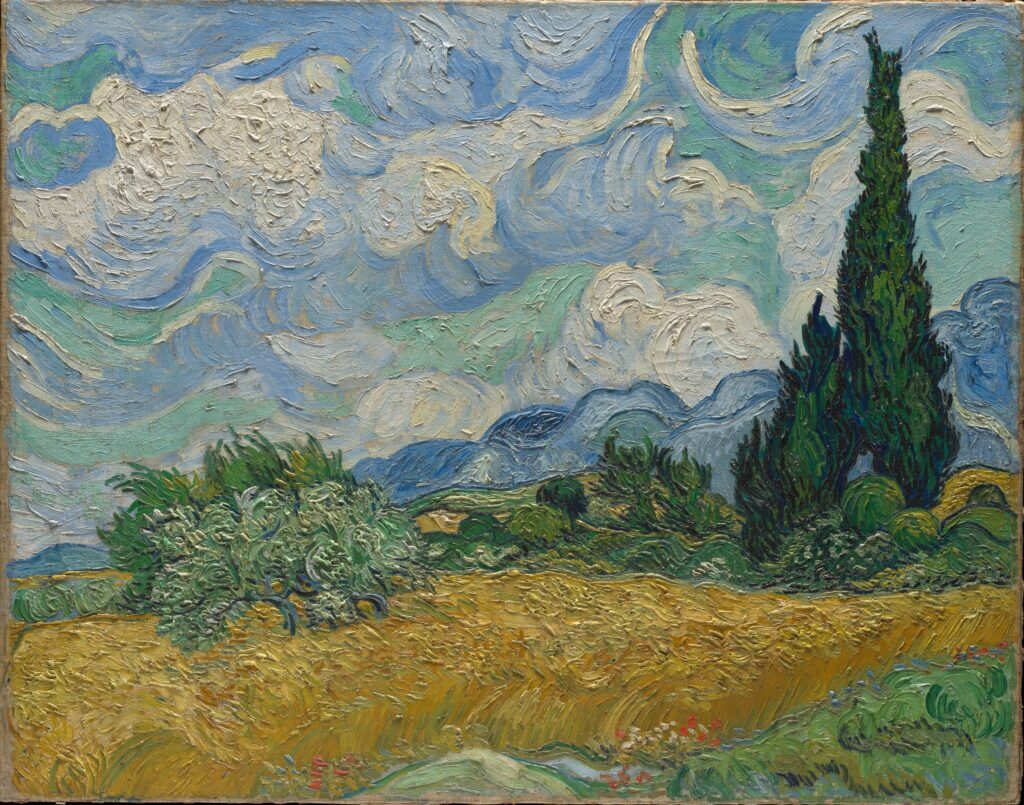
Vincent van Gogh, Wheat Field with Cypresses, 1889, Metropolitan Museum of Art, New York City, NY, USA.
The dream Van Gogh had of creating a shared artists’ studio in the south of France fell apart after weeks of tension with Paul Gauguin. Just before Christmas 1888, the two had a fiery argument that led to Vincent having a mental breakdown and infamously cutting off his ear. His mental state kept deteriorating, and in May 1889, Van Gogh voluntarily entered the asylum at Saint-Paul-de-Mausole in Saint-Rémy. It was later that June when he painted the Met’s Wheatfield with Cypresses.
Van Gogh said he was focused on the shape of the cypresses because of their beautiful lines and proportions, “like an Egyptian obelisk.” He started painting them that summer “like the canvases of the sunflowers, because it astonishes me that no one has yet done them as I see them.” There are two versions of the painting—the one at the Met is a late-June 1889 outdoor version, rougher and more immediate, with pebbles lodged from painting outdoors—a more controlled studio version, painted later, is held at the National Gallery in London. Vincent described the painting in a letter to Theo as “very yellow and very bright, perhaps the brightest canvas I’ve done.”
8. Olive Trees, June/September 1889
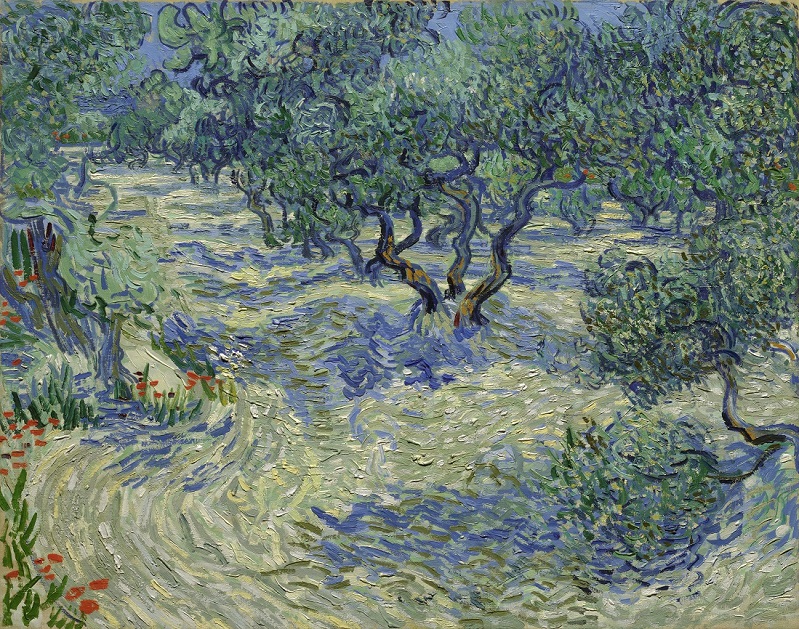
Vincent van Gogh, Olive Trees, 1889, Nelson-Atkins Museum of Art, Kansas City, MO, USA.
In summer 1889, Van Gogh was allowed to leave the asylum grounds at Saint-Rémy. He walked into the olive groves nearby and painted these twisting trees under the hot Provençal sun. Olive trees carry a deep meaning in Christianity. According to the Bible, Jesus prayed in an olive garden at Gethsemane the night before he was crucified. When he was 25, Vincent worked as a lay preacher in a coal-mining district in Belgium—evangelizing and living among the miners in poverty before turning to art two years later.
Vincent painted at least 14 olive canvases with an intensity that may have mirrored his own thoughts. His energetic brushwork and bold color help enhance the trees’ twisted shapes and shifting hues, though the color relationships have faded with time. He worked outdoors in the mistral, the region’s notorious sharp wind. In 2017, Nelson-Atkins conservators spotted a tiny grasshopper pressed into the thick impasto, more than a century old and almost invisible. It is still there today, a tiny witness to a summer filled with striking olive trees by day . . . and one virtuoso Starry Night.
9. Bank of the Oise at Auvers, July 1890
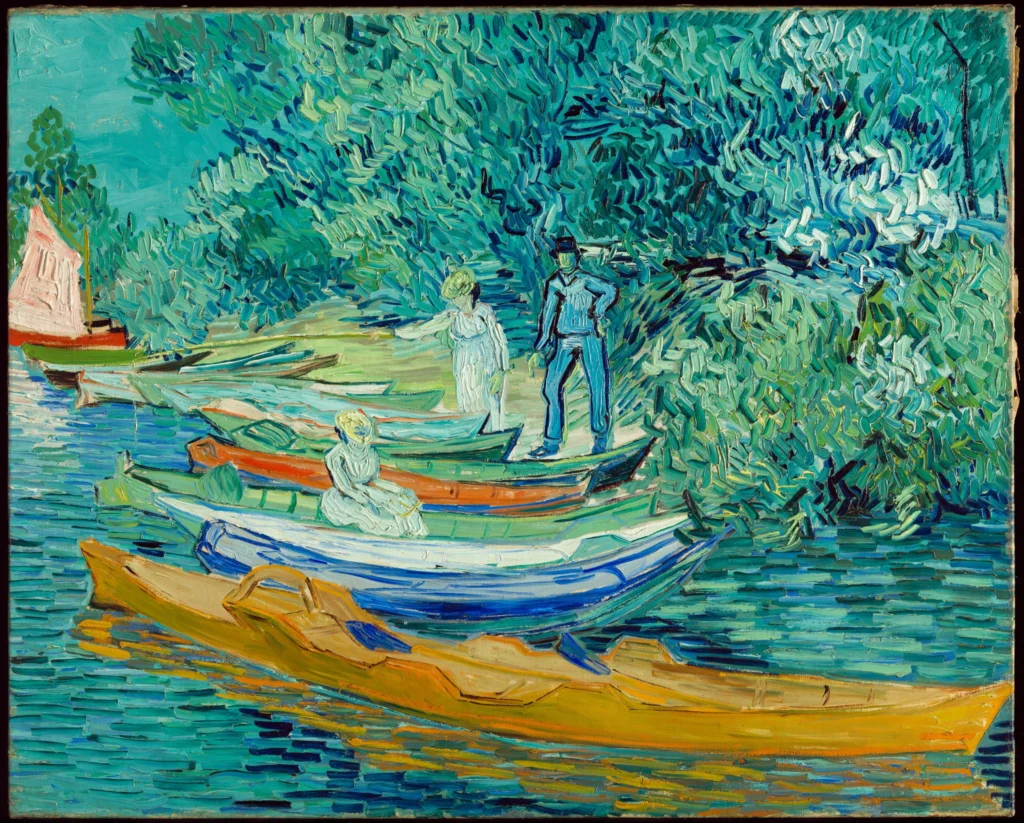
Vincent van Gogh, Bank of the Oise at Auvers, 1890, Detroit Institute of Arts, Detroit, MI, USA.
After a year in the asylum at Saint-Rémy, Van Gogh moved to Auvers-sur-Oise in May 1890 to be closer to Theo and receive specialized care from Dr. Paul Gachet; Vincent died at the end of July. He created around one painting per day in the final summer of his life; working at speed, Van Gogh mostly painted Auvers’s wheat fields, cottages, and gardens. Produced in his last weeks, this is the only known oil painting in which he focused directly on the Oise River. The setting is probably Chaponval, a small hamlet west of Auvers where people went boating, fishing, and socializing.
The tight composition is made alive by the short, energetic brushstrokes Van Gogh mastered in his mature style, with some of the figures almost absorbed into the movement of the paint. The space is compressed, and short strokes turn the riverbank into a dense surface of movement. The vivid sun-lit scene is dominated by blues and greens, but orange and red boats cut sharply through them. The yellow-green riverbank and dark foliage are brought forward by sunny white highlights and a balancing of the cool tones in the water and background. The subject recalls river scenes by Monet and Renoir, but Vincent’s stronger contrasts and thick impasto give the image more intensity when compared to the signature atmospheric leisure of the Impressionists.
10. Wheatfield Under Thunderclouds, July 1890
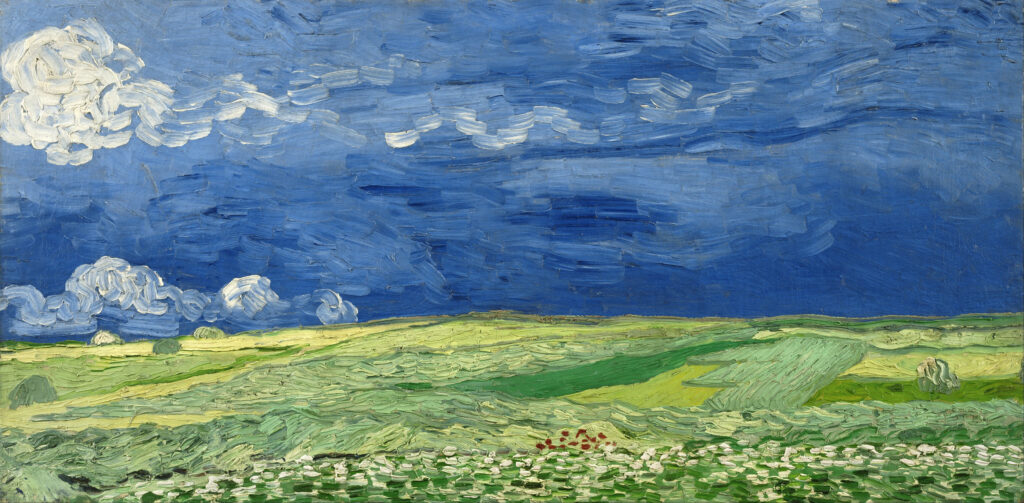
Vincent van Gogh, Wheatfield Under Thunderclouds, 1890, Van Gogh Museum, Amsterdam, Netherlands.
This canvas is part of Van Gogh’s late experimentation with panoramic landscapes, choosing this wide format—roughly twice as wide as it is high—to intentionally move beyond perspective. The flat horizon makes the countryside look like a continuous frieze, a design trick that makes the viewer feel small and overwhelmed by nature. “Knowing clearly what I wanted, I’ve painted another three large canvases (. . .) They’re immense stretches of wheatfields under turbulent skies, and I made a point of trying to express sadness, extreme loneliness.” Van Gogh added the phrase “de la solitude extrême” (extreme loneliness) later, before dispatching the letter, one of his last, to his brother Theo.
The layout reduces the landscape to two broad bands: a low, massive empty field of green and ripening yellow wheat and a menacing dark sky—a simple but powerful layout that makes the weather feel enormous. Broken strokes move through the wheat, while looser paint gives weight to the clouds. Unlike most traditional landscape paintings at the time, Van Gogh did not include trees, houses, people, or any signs of life. This complete emptiness removes any normal sense of scale, forcing a feeling of quiet isolation. The energetic brushwork remains unmistakably Van Gogh. The result holds two feelings at once—isolation and unease—but also the comfort that Vincent found in the “healthy” and “fortifying” countryside until the end: “I’d almost believe that these canvases will tell you what I can’t say in words.”