


Mesmerizing Autumn Landscapes from the Hudson River School
Autumn has arrived, and the Hudson River School artists are here to remind us how beautiful it is. Through their stunning landscapes, they captured...
Jimena Escoto 8 October 2026

Dan Flavin, greens crossing greens (to Piet Mondrian who lacked green), 1966, Solomon R. Guggenheim Museum, New York Panza Collection 91.3705 © Dan Flavin, VEGAP, Bilbao 2026. Photo: Erika Ede. Detail.
Dan Flavin, the renowned American Minimalist, did not begin his artistic career with fluorescent light. His early practice included drawing and painting, shaped in part by the influence of Abstract Expressionism. It was his experiments with mixed media in the late 1950s and early 1960s that eventually led him toward a radically different artistic language: electric light.
In 1963, Dan Flavin (1933–1996) began incorporating ordinary fluorescent tubes into his work, turning a mass-produced industrial object into an entirely new artistic medium.
The newly opened exhibition Dan Flavin: Some Light, on view at the Guggenheim Museum Bilbao, Spain, traces this development through works spanning the 1960s to the 1980s. Visitors encounter his early experiments with white fluorescent light before moving toward colorful constructions that transform entire gallery spaces.

Dan Flavin, untitled (fondly to Margo), 1986, Panza Collection, gift to Fondazione per l’Ambiente Italiano, 1996, on permanent loan to the Solomon R. Guggenheim Foundation, New York, L200.93 © Dan Flavin, VEGAP, Bilbao 2026. Photo: Erika Ede.
Flavin’s artistic vocabulary was built around commercially manufactured fluorescent tubes. Rather than producing his own pigments or altering the tubes’ colors, he worked with the limited palette industrial manufacturers offered. His artistic intervention lay elsewhere: in the careful arrangement of the fixtures, their positioning, and the technical adjustments that allowed each installation to achieve its intended visual effect.
One example is greens crossing greens (to Piet Mondrian who lacked green), presented at the Guggenheim Museum in Bilbao. Flavin used green fluorescent light to create an expansive composition. Subtle technical decisions, including the use of plastic sleeves around the tubes, helped control the intensity of the light and prevent the green glow from becoming overwhelming. The result is a work that brings together the geometric discipline associated with Mondrian and Flavin’s own dedication to the natural world and its landscapes.

Dan Flavin, greens crossing greens (to Piet Mondrian who lacked green), 1966, Solomon R. Guggenheim Museum, New York Panza Collection 91.3705 © Dan Flavin, VEGAP, Bilbao 2026. Photo: Erika Ede.
There is something particularly fascinating about Flavin’s choice of material. Fluorescent lighting was once an entirely ordinary feature of everyday environments, found in offices, shops, corridors, and public buildings. Yet Flavin recognized its artistic potential and transformed this functional object into something capable of producing extraordinary spatial experiences. Light gave his work a sense of dynamism and seemingly endless perspective, extending far beyond the physical dimensions of the fixtures themselves.
And yet, as exhibition curator Lauren Hinkson emphasized, this “endless” perspective has a limit. Fluorescent tubes eventually burn out and must be replaced. As regulations increasingly restrict the manufacture and availability of certain fluorescent lamps, the future maintenance of these works presents an additional challenge. The very material that allowed Flavin to create his distinctive artistic universe may not remain available indefinitely.

Dan Flavin, untitled, 1964, Solomon R. Guggenheim Museum, New York, Panza Collection 91.3700 © Dan Flavin, VEGAP, Bilbao 2026. Photo: Erika Ede.
One of the most remarkable aspects of Dan Flavin’s work is that it can never be fully experienced through documentation alone. Photographs may capture the arrangements of fluorescent tubes and their immediate surroundings, but they cannot reproduce the constantly shifting relationship between light, color, architecture, and the viewer. Flavin’s installations are dynamic in a way that becomes apparent only when encountered in person. The exhibition at the Guggenheim gives us the perfect opportunity to experience that.

Dan Flavin, untitled (to Barbara Nüsse), 1971, Solomon R. Guggenheim Museum, New York Panza Collection, Gift 92.4118 © Dan Flavin, VEGAP, Bilbao 2026. Photo: David Heald.
Colors that initially seem clearly defined begin to change as the eyes adjust to the light. A particular combination may produce one impression when viewed from within the installation and an entirely different one from an adjacent room. Moving through the gallery becomes part of experiencing the work: the colors overlap, intensify, or recede depending on the viewer’s position. At certain points in the exhibition, some gallery corners appear softly rounded, even though their walls meet at perfectly ordinary right angles. It is a subtle optical illusion, yet a striking one: without moving a single wall or altering the building’s structure, Flavin’s installations seem to reshape the architecture itself.
Daylight adds another dimension to this experience. At the Guggenheim Museum Bilbao, visitors have the opportunity to see Flavin’s fluorescent compositions in dialogue with natural light entering the museum. This interaction makes the installations feel particularly alive, as their appearance is influenced not only by the artist’s carefully selected arrangements but also by the changing conditions of the surrounding space. It is a remarkable meeting of the artificial and the natural, the industrial and the organic.

Dan Flavin, an artificial barrier of blue, red and blue fluorescent light (to Flavin Starbuck Judd), 1968, Solomon R. Guggenheim Museum, New York Panza Collection 91.3707 © Dan Flavin, VEGAP, Bilbao 2026. Photo: Erika Ede
This is perhaps where Flavin’s artistic paradox becomes most apparent. He used ordinary, mass-produced objects to create works that resist being reduced to their physical components. Their meaning and visual impact extend into the surrounding architecture, the light already present in the room, and the movement of the people encountering them. The artwork is therefore never quite contained within its own structure.
Despite being closely associated with Minimalism, Flavin’s work is not devoid of references and dedications. Throughout his career, he dedicated numerous installations to artists, writers, historical figures, and people close to him. His tribute to Henri Matisse, untitled (to Henri Matisse), is one particularly compelling example. It is a beautiful encounter between two great colorists, born 63 years apart and working in remarkably different artistic languages.
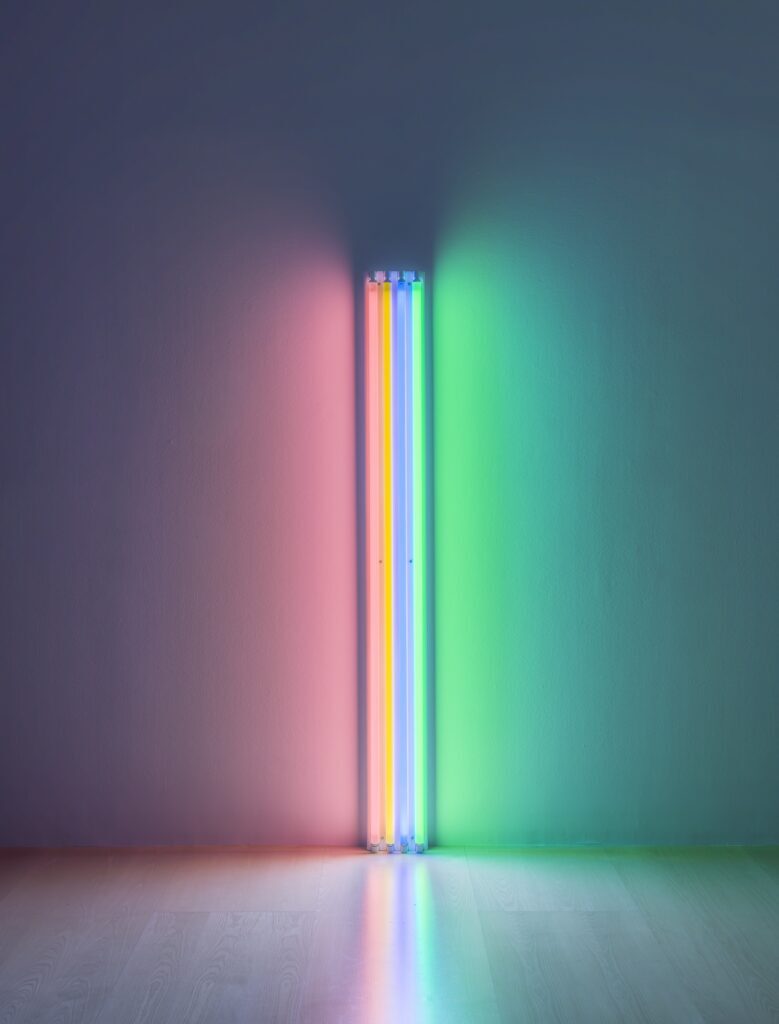
Dan Flavin, untitled (to Henri Matisse), 1964, Solomon R. Guggenheim Museum, New York Panza Collection, Gift 92.4113 © Dan Flavin, VEGAP, Bilbao 2026. Photo: David Heald.
These dedications introduce a personal and cultural dimension into compositions that might otherwise appear strictly formal or anonymous. There is also something unexpectedly monumental about the way his installations occupy architectural space. The Guggenheim Bilbao provided an ideal setting for Flavin’s work, allowing its architecture to bring out the full potential of his artworks. Rather than simply housing them, the museum seemed to amplify their qualities.
Fluorescent tubes, ordinary objects associated with offices and public buildings, can transform an entire gallery into an immersive environment. At times, the interaction between the works and the architecture of the Guggenheim Bilbao evokes the atmosphere of a cathedral. Light fills the space, colors seem to float beyond their physical sources, and the visitor becomes part of an environment that feels almost contemplative.
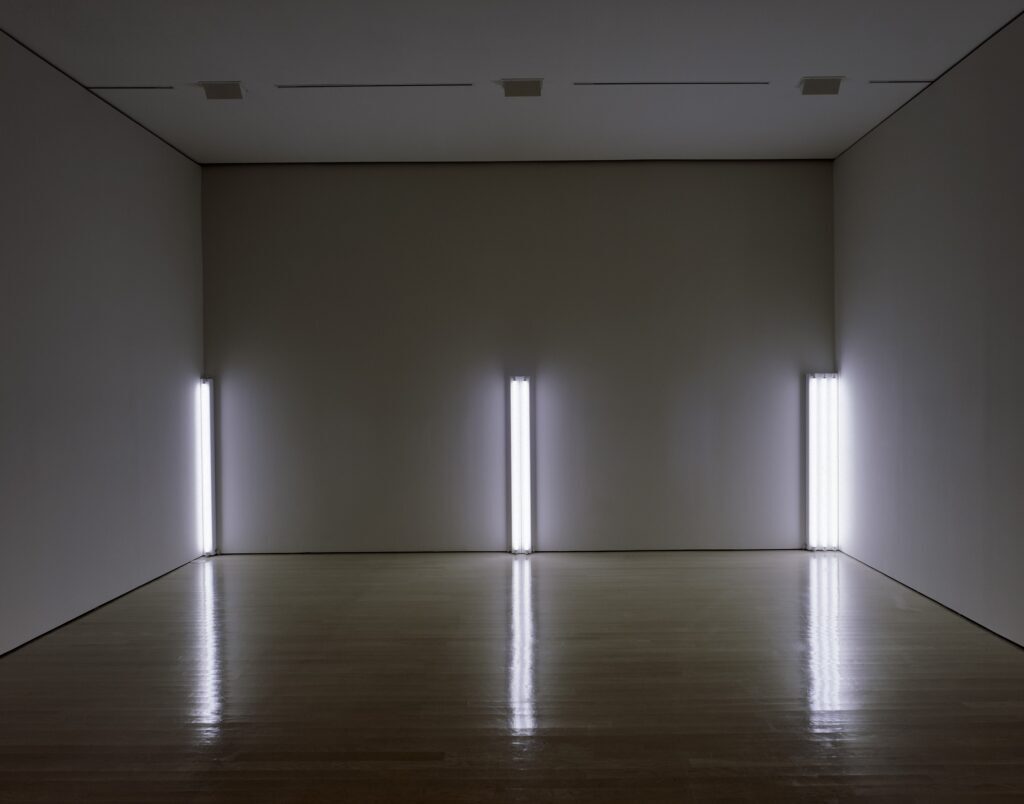
Dan Flavin, the nominal three (to William of Ockham), 1963, Solomon R. Guggenheim Museum, New York Panza Collection, Gift 91.3698 © Dan Flavin, VEGAP, Bilbao 2026. Photo: Erika Ede.
This spiritual quality is particularly intriguing given the apparent simplicity of Flavin’s materials. The artist himself was reluctant to attribute such metaphysical or spiritual meanings to his work, preferring to focus on its material and perceptual properties. Yet the monumental scale of the installations, combined with the architecture surrounding them, can produce an experience that feels almost transcendent.
Perhaps this is another contradiction at the heart of Flavin’s art: the extraordinary emerging from the ordinary, the monumental from the industrial, and an apparently endless spatial experience from objects that are, by their very nature, replaceable and finite.
Dan Flavin: Some Light at the Guggenheim Museum Bilbao offers a rare opportunity to experience Flavin’s work as it was intended: not as an image on a screen, but as an encounter with light, color, and architecture. The exhibition gives each artwork the space to fully unfold, creating an experience that can only truly be understood in person.
The exhibition Dan Flavin: Some Light is on view at the Guggenheim Museum Bilbao, Spain, until April 4, 2027.
DailyArt Magazine needs your support. Every contribution, however big or small, is very valuable for our future. Thanks to it, we will be able to sustain and grow the Magazine. Thank you for your help!

Art historian interested the most in the Polish art market, the history of art collecting and contemporary art.

Autumn has arrived, and the Hudson River School artists are here to remind us how beautiful it is. Through their stunning landscapes, they captured...
Jimena Escoto 8 October 2026
The Harlem Renaissance paintings capture one of the most influential cultural movements in American history. These extraordinary artists transformed...
Errika Gerakiti 20 July 2026
By transforming discarded objects into part of an organic environment and turning personal experience into visual language, Nellie Mae Rowe created...
Carlotta Mazzoli 11 May 2026
Edward Hopper was one of the most iconic American Realist painters and printmakers. He was celebrated for his striking portrayals of American life,...
Zuzanna Stańska, Szymon Jocek 27 March 2026