Summary
- Aaron Douglas’ Aspects of Negro Life traces African-American history from enslavement to the pursuit of equality.
- Archibald Motley’s Nightlife celebrates Black urban life through rhythm and movement.
- In Girl in Pink Dress, Laura Wheeler Waring uses sensitive portraiture to celebrate the individuality and dignity of African Americans.
- In The Ascent of Ethiopia, Lois Mailou Jones portrayed a journey from enslavement to freedom through African symbolism and cultural heritage.
- Balancing creative ambition with social reality, The Janitor Who Paints reflects Palmer Hayden’s exploration of Black identity and artistic recognition.
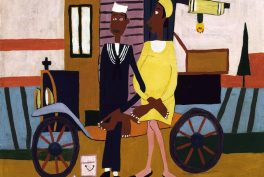
- Street Life, Harlem captures the energy of everyday life through William H. Johnson’s bold colors, simplified forms, and folk-inspired modern style.
- Jazz Club reflects Charles Alston’s connection between music and visual art, capturing the energy of Harlem’s jazz culture.
- Can Fire in the Park transforms an ordinary urban scene into an expression of resilience through Beauford Delaney’s emotional use of color and light.
- Hale Woodruff’s The Mutiny on the Amistad depicts the 1839 slave ship uprising as a story of resistance and freedom.
- Malvin Gray Johnson’s Self-Portrait presents the artist as a creator of his own identity, combining modernist influences with themes of Black heritage and cultural pride.
1. Aaron Douglas, Aspects of Negro Life Murals, 1934
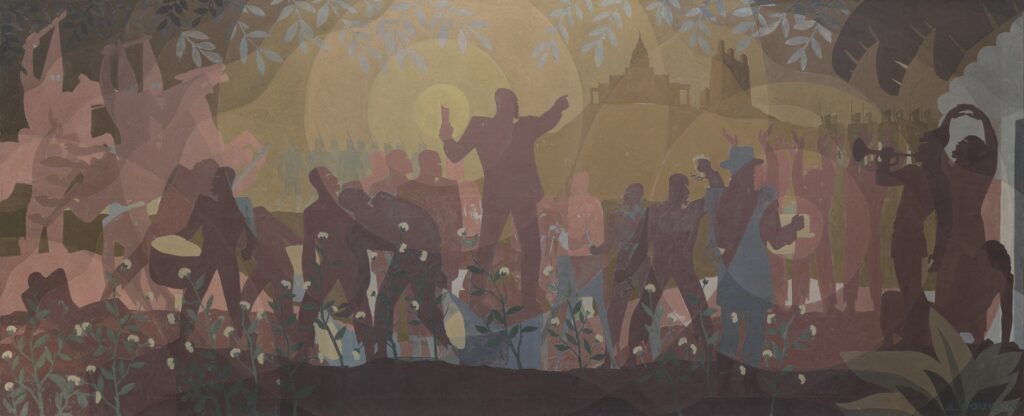
Aaron Douglas, Aspects of Negro Life: From Slavery to Reconstruction, 1934, New York Public Library, New York City, NY, USA.
Few Harlem Renaissance paintings capture the spirit of the era as powerfully as Aaron Douglas’ Aspects of Negro Life murals. The Harlem Renaissance movement emerged in New York during the 1920s, as the Great Migration brought thousands of African Americans to northern cities. Writers, musicians, and African-American visual artists responded with bold new ideas that celebrated Black identity, challenged racial stereotypes, and reshaped American art. Douglas stood at the center of this cultural awakening and developed a modern visual language that soon became one of its defining symbols.
Commissioned for the 135th Street branch of the New York Public Library in 1934, Aspects of Negro Life murals trace African-American history across four mural panels—from enslavement to the pursuit of equality. Douglas combined geometric forms, silhouetted figures, and concentric circles to create rhythmic compositions that echo jazz while guiding viewers through centuries of struggle and resilience. His style drew inspiration from African sculpture, European modernism, and Art Deco. However, he transformed these influences into something entirely original.
The murals reward close observation with layers of symbolism. Musicians, laborers, and freedom seekers appear beside factories, trees, and radiant circles of light that connect African heritage with modern Black life. Douglas rejected traditional realism, using simplified forms and overlapping shapes to suggest movement, memory, and progress. His work reflects the optimism and intellectual ambition of the Harlem Renaissance movement, which encouraged artists to reclaim their history and define their own cultural identity. Nearly a century later, Aspects of Negro Life murals remain a landmark of Black-American art and one of the movement’s most enduring visual achievements.
2. Archibald Motley, Nightlife, 1943
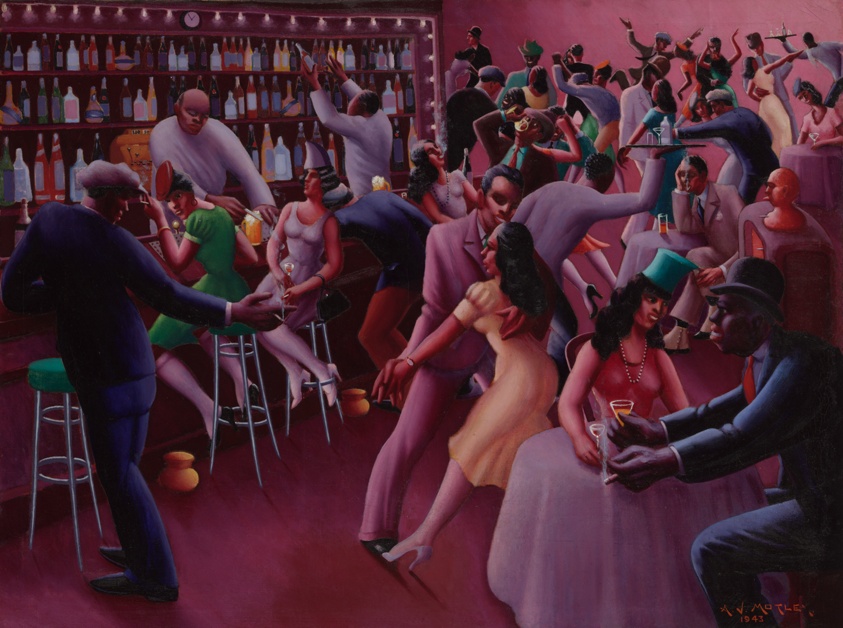
Archibald Motley, Nightlife, 1943, Art Institute of Chicago, Chicago, IL, USA.
Although Archibald John Motley Jr. lived and worked in Chicago, his art embodied the energy and confidence of the Harlem Renaissance movement. The cultural awakening that began in New York soon inspired artists across the United States, especially in cities transformed by the Great Migration. Motley turned his attention to Chicago’s Bronzeville neighborhood, where music, dance, and social life flourished. His paintings celebrate the joy and resilience that defined Black-American art during the first half of the 20th century.
Painted in 1943, Nightlife bursts with movement, color, and rhythm. Jazz musicians fill the stage while elegantly dressed couples dance beneath glowing lights. Every figure contributes to the lively atmosphere, and the crowded composition draws viewers into the celebration. Motley’s exaggerated poses, facial expressions, and vibrant colors captured the excitement of an evening out rather than a realistic scene. The result reflects the pulse of jazz and the optimism that shaped much of African-American art during this period.
Although Nightlife appeared after the Harlem Renaissance reached its peak, it carries the movement’s artistic vision into the following decade. Motley portrayed African Americans with dignity, sophistication, and confidence at a time when mainstream American art often ignored or misrepresented Black communities. His work challenged stereotypes by presenting modern urban life through the eyes of those who experienced it. Nightlife remains a vivid testament to the Harlem Renaissance’s enduring cultural legacy.
3. Laura Wheeler Waring, Girl in Pink Dress, ca. 1927
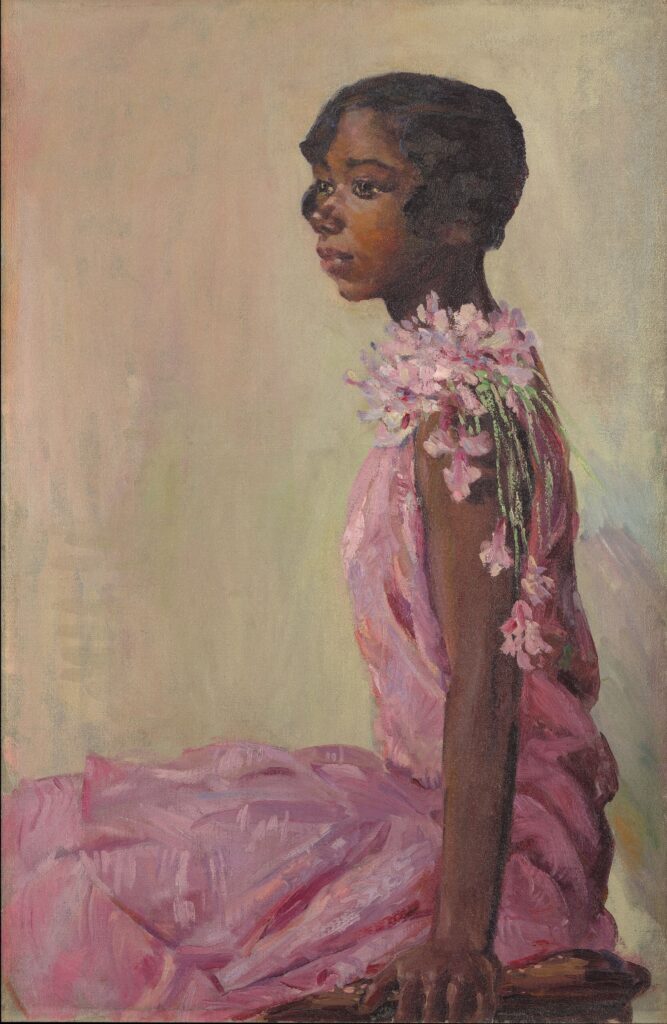
Laura Wheeler Waring, Girl in Pink Dress, ca. 1927, Metropolitan Museum of Art, New York City, NY, USA.
Laura Wheeler Waring devoted much of her career to portraying African Americans with dignity, grace, and psychological depth. At a time when racial stereotypes dominated popular culture, her portraits offered a striking alternative. As one of the leading women of the Harlem Renaissance movement, she helped redefine portraiture and expand the visibility of African American art through images that celebrated individuality rather than prejudice.
Girl in Pink Dress, painted in 1927, demonstrates Waring’s remarkable sensitivity as a portraitist. The sitter looks calmly away from the viewer, creating a quiet, contemplative atmosphere. Her delicate pink dress brightens the otherwise subdued composition, while soft light and careful brushwork model her features with elegance and restraint. Instead of relying on dramatic gestures or elaborate settings, Waring allowed expression and posture to reveal her subject’s character.
European training shaped Waring’s technical approach, yet she remained deeply committed to portraying Black life with honesty and respect. Her work appeared in exhibitions organized by the Harmon Foundation, which played a vital role in promoting African-American painters during the early 20th century. Through portraits such as Girl in Pink Dress, Waring demonstrated that representation could become a form of cultural affirmation.
4. Lois Mailou Jones, The Ascent of Ethiopia
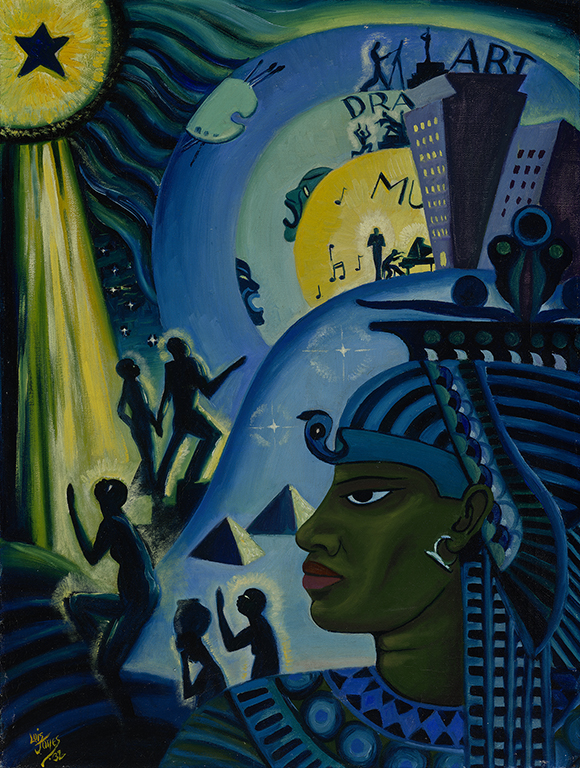
Lois Mailou Jones, The Ascent of Ethiopia, 1932, Milwaukee Art Museum, Milwaukee, WI, USA. © Lois Mailou Jones.
History rises through every figure in The Ascent of Ethiopia. Lois Mailou Jones painted this monumental composition in 1932 to celebrate the resilience and achievements of people of African descent. At a time when the Harlem Renaissance movement encouraged artists to reconnect with their cultural roots, Jones embraced African symbolism and transformed it into a powerful vision of progress. Her work helped broaden the scope of African-American art, proving that modernism and cultural heritage could exist in perfect harmony.
Jones arranged the composition as a visual journey from oppression to liberation. Figures ascend a steep staircase, leaving behind scenes of enslavement and hardship as they move toward knowledge, freedom, and artistic achievement. Rich colors, stylized forms, and geometric patterns reinforce the painting’s symbolic message, while references to African sculpture and textiles strengthen its connection to ancestral traditions. Every detail contributes to a narrative of perseverance rather than victimhood, inviting viewers to reflect on both the past and the future.
Unlike many of her contemporaries, Jones enjoyed a long career that extended well beyond the Harlem Renaissance. She continued to explore African themes through extensive travels and remained an influential educator for decades. The Ascent of Ethiopia nevertheless stands as one of her defining achievements because it captures the optimism and intellectual ambition that shaped the era. The painting also reminds us that women played an essential role in the development of Black-American art, even though history often celebrated their male counterparts more prominently.
5. Palmer Hayden, The Janitor Who Paints, ca. 1937
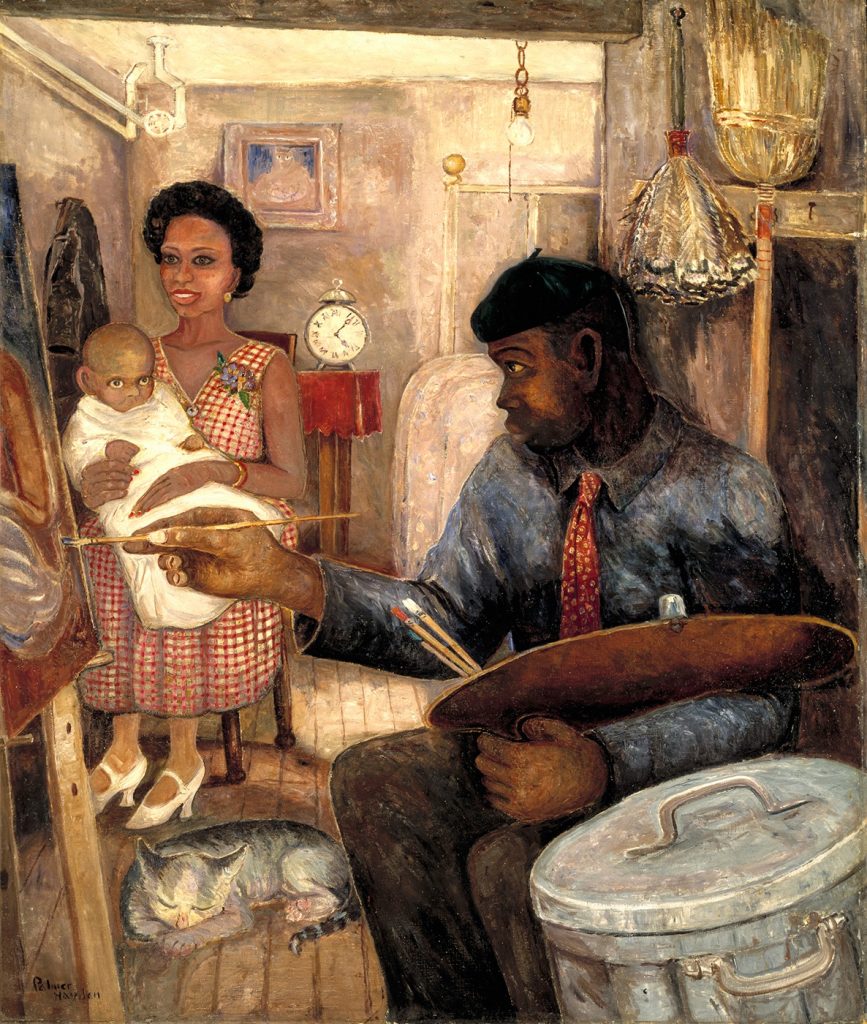
Palmer Hayden, The Janitor Who Paints, ca. 1937 (repainted after 1940), Smithsonian American Art Museum, Washington, DC, USA.
Palmer Hayden built much of his career around a persistent tension: how to portray Black life without reducing it to stereotype or sentimentality. Within the Harlem Renaissance movement, this question shaped many debates. Hayden’s work often reflected this struggle, and his paintings reveal both his ambition and his uncertainty about representation in African-American art during this time.
The Janitor Who Paints presents an introspective scene that centers on an artist figure engaged in creative work while holding a dual social identity. The composition suggests both labor and aspiration. It places the act of painting within a broader conversation about artistic legitimacy. Hayden uses muted tones and simplified forms to emphasize mood over realism. Thus, he allows the viewer to focus on the psychological weight of the scene rather than narrative detail.
Rather than offering a straightforward celebration, Hayden’s painting introduces ambiguity into the visual language of the Harlem Renaissance. It reflects a moment when Black artists actively questioned how they should represent themselves and their communities in a society shaped by racial hierarchy. Hayden’s work occupies a complex position within Black-American art, not because it resolves these tensions, but because it makes them visible.
6. William H. Johnson, Street Life, Harlem, ca. 1939–1940
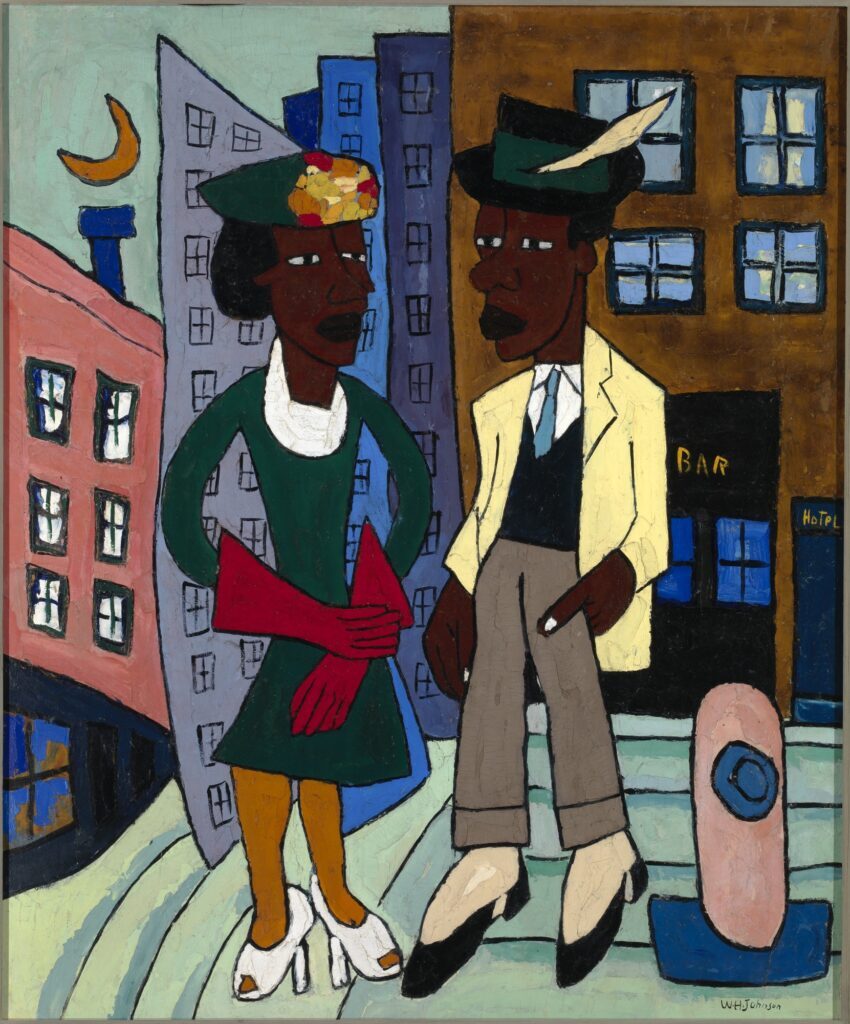
William H. Johnson, Street Life, Harlem, ca. 1939–1940, Smithsonian American Art Museum, Washington, DC, USA.
Bold colors and simplified forms define William H. Johnson’s mature style. They also give Street Life, Harlem its unmistakable energy. Johnson abandoned academic realism in favor of a direct visual language inspired by folk art and modernism. His approach enriched African-American art and reflected the creative spirit of the Harlem Renaissance movement.
The painting captures the rhythm of daily life in Harlem. Neighbors gather on the sidewalk, children play, and brightly dressed figures animate the busy street. Johnson reduces each form to its essentials, yet every character feels distinct and expressive. Flat areas of color replace detailed modeling, while strong outlines unify the lively composition. The result feels spontaneous and joyful, much like the neighborhood itself.
Johnson studied in New York and Europe before developing the style that made him famous. His travels exposed him to modern European movements, but he ultimately turned his attention to Black-American communities and their stories. That decision marked a defining moment in his career. Rather than imitate European traditions, he celebrated ordinary people with honesty and warmth.
7. Charles Alston, Jazz Club, ca. 1938–1939
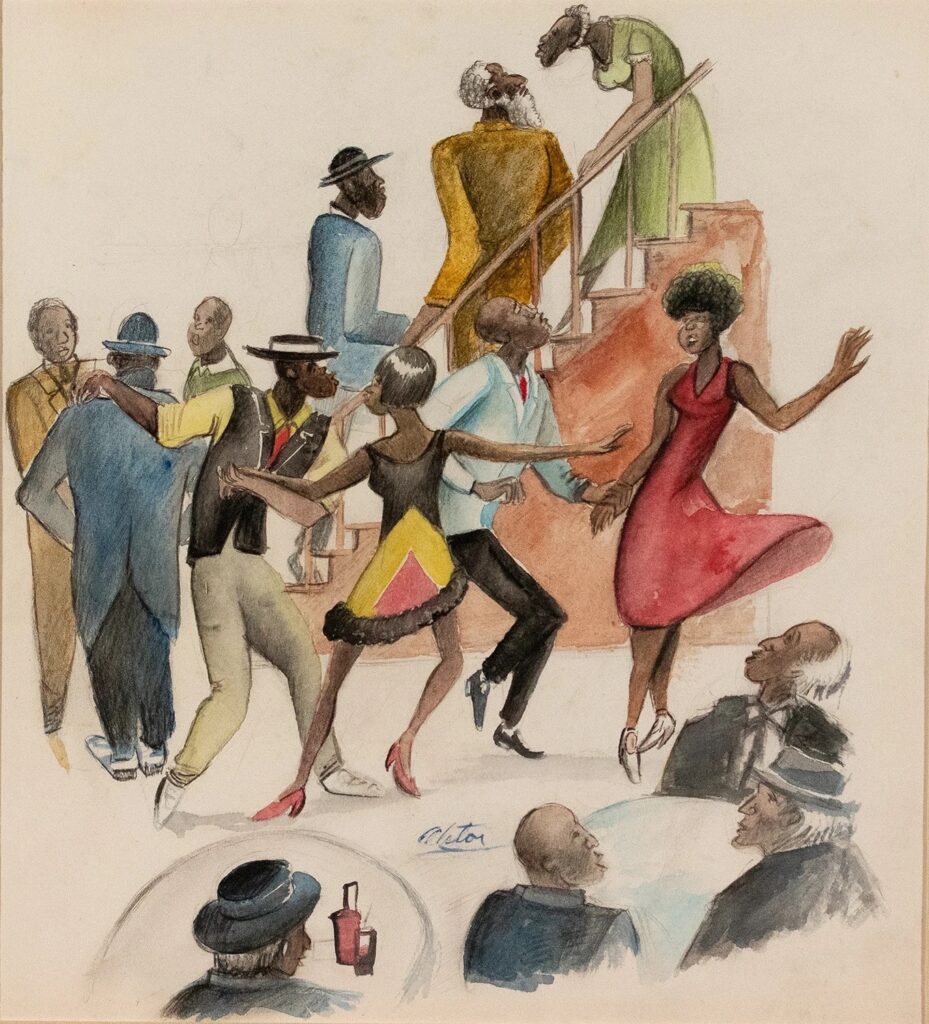
Charles Alston, Jazz Club, ca. 1938–1939. MutualArt.
Jazz shaped the sound of the Harlem Renaissance movement, but it also transformed its visual culture. Charles Alston understood that connection better than most. He spent years at the heart of Harlem’s creative community, where musicians, writers, and African-American painters exchanged ideas and inspired one another. His paintings often reflect that vibrant atmosphere and the music that defined the Harlem Renaissance era.
In Jazz Club, Alston fills the composition with musicians, dancers, and elegantly dressed guests. Their overlapping forms create a lively sense of movement without overwhelming the viewer. Warm colors and expressive lines echo the rhythm of the performance, while the intimate setting draws us into the club. Rather than focusing on a single figure, Alston presents jazz as a shared experience. The painting captures the excitement, confidence, and cultural pride that fueled African-American art during the late 1930s. Alston conveyed that energy with remarkable economy of line.
Alston contributed as much outside the studio as he did inside it. He cofounded the Harlem Artists Guild, established the Harlem Art Workshop, and became the first African-American supervisor of the Federal Art Project in New York. Through these efforts, he supported countless young artists and strengthened Harlem’s cultural institutions. Jazz Club reflects that same collaborative spirit.
8. Beauford Delaney, Can Fire in the Park, 1946
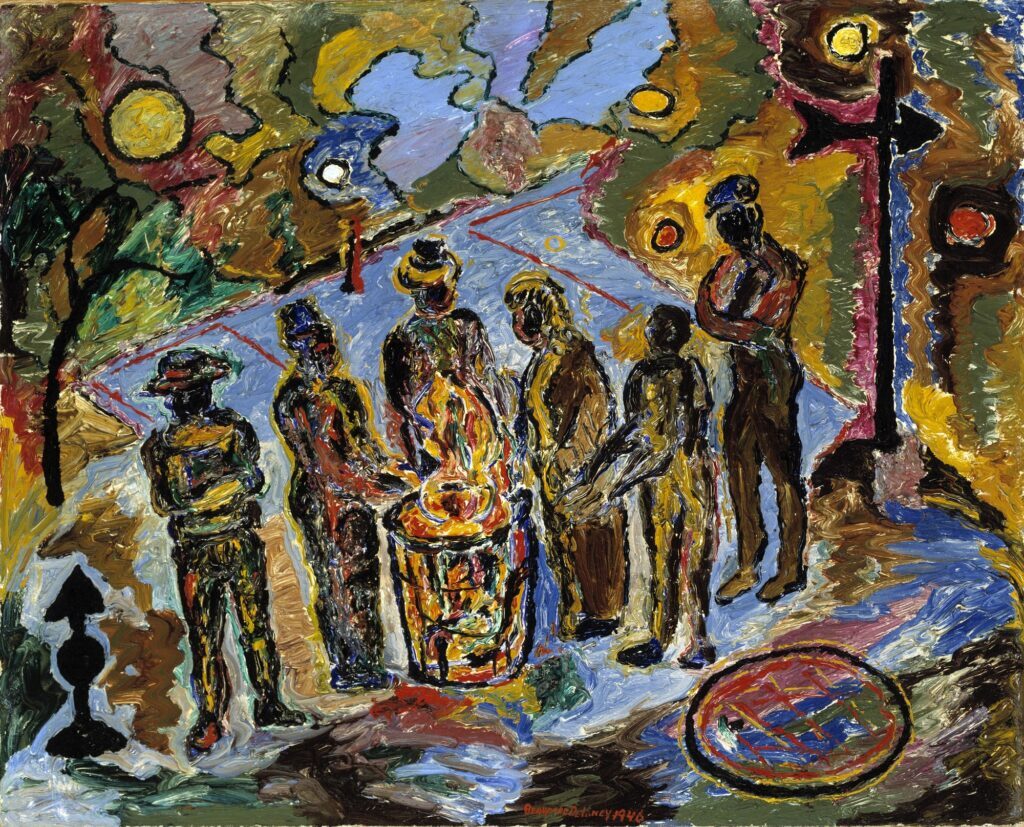
Beauford Delaney, Can Fire in the Park, 1946, Smithsonian American Art Museum, Washington, DC, USA.
Light became one of Beauford Delaney’s most powerful artistic tools. Throughout his career, he used color to express emotion rather than simply describe a scene. After moving to New York in 1929, Delaney found inspiration in Harlem’s creative circles and formed friendships with writers, musicians, and fellow African-American painters. His work gradually moved away from strict realism, yet it remained deeply rooted in the experiences of Black urban life.
Can Fire in the Park presents a group of men gathered around a small fire on a cold night. The scene appears simple at first glance, but thick brushstrokes and luminous colors transform it into something almost spiritual. Bright streetlamps, moonlight, and the glow of the fire surround the figures with swirling waves of yellow, blue, and green. Delaney includes recurring urban motifs, such as streetlights and fire escapes, which became visual signatures in his work. Rather than emphasizing hardship alone, he highlights companionship and shared humanity in the middle of an unforgiving city.
Delaney experienced financial hardship for much of his life, and many scholars believe the painting reflects his empathy for people living in poverty. Yet the work never loses its sense of hope. Color and light elevate an ordinary moment into a quiet meditation on resilience. Painted after the Harlem Renaissance reached its peak, Can Fire in the Park carries forward the movement’s humanist ideals.
9. Hale Woodruff, The Mutiny on the Amistad, 1939
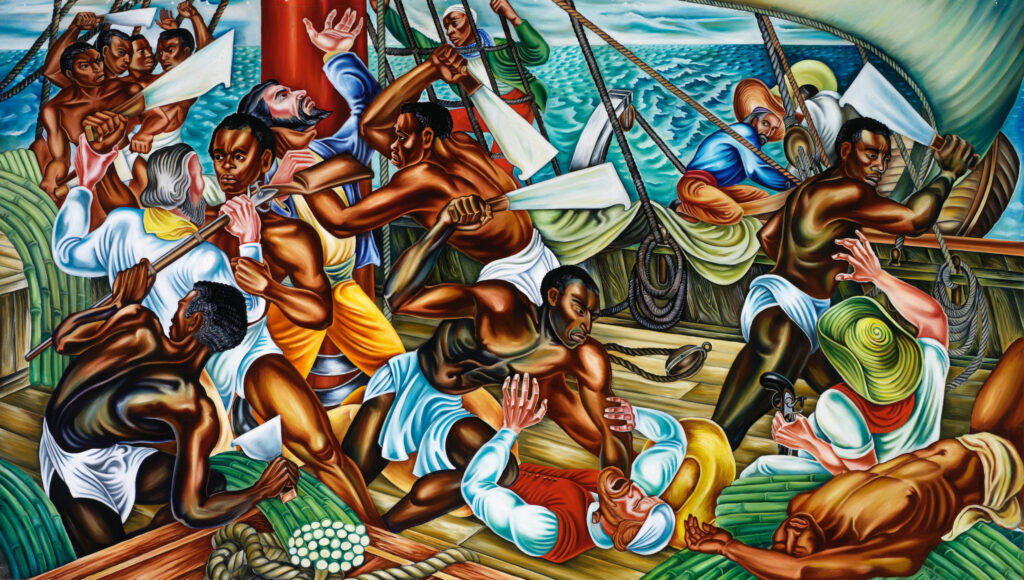
Hale Woodruff, The Mutiny on the Amistad, 1939, Talladega College, Talladega, AL, USA. The New York Times.
Resistance stands at the heart of Hale Woodruff’s The Mutiny on the Amistad. Rather than portray enslaved Africans as passive victims, Woodruff presents them as determined people fighting for their freedom. The mural reflects one of the central ambitions of the Harlem Renaissance movement: to reclaim Black history through the eyes of those who lived it. By transforming a forgotten episode into a monumental work of African-American art, Woodruff challenged generations of historical silence.
The painting captures the dramatic uprising aboard the Spanish slave ship La Amistad in 1839. Powerful bodies fill the composition, leaving almost no empty space. Raised machetes, tangled ropes, and twisting figures create a relentless sense of movement. Every gesture heightens the tension, while the vivid colors amplify the emotional intensity of the scene. Woodruff drew inspiration from the bold compositions of the Mexican muralists, especially Diego Rivera, but he developed a visual language that remained distinctly his own.
Talladega College commissioned the Amistad murals in 1938 for its new library. Woodruff spent months researching the revolt before painting the three monumental panels, which depict the mutiny, the Supreme Court trial, and the captives’ return to Africa. The series honored the centennial of the uprising while celebrating the enduring struggle for freedom and justice. It also established Woodruff as one of the leading African-American painters of his generation.
10. Malvin Gray Johnson, Self-Portrait, 1934
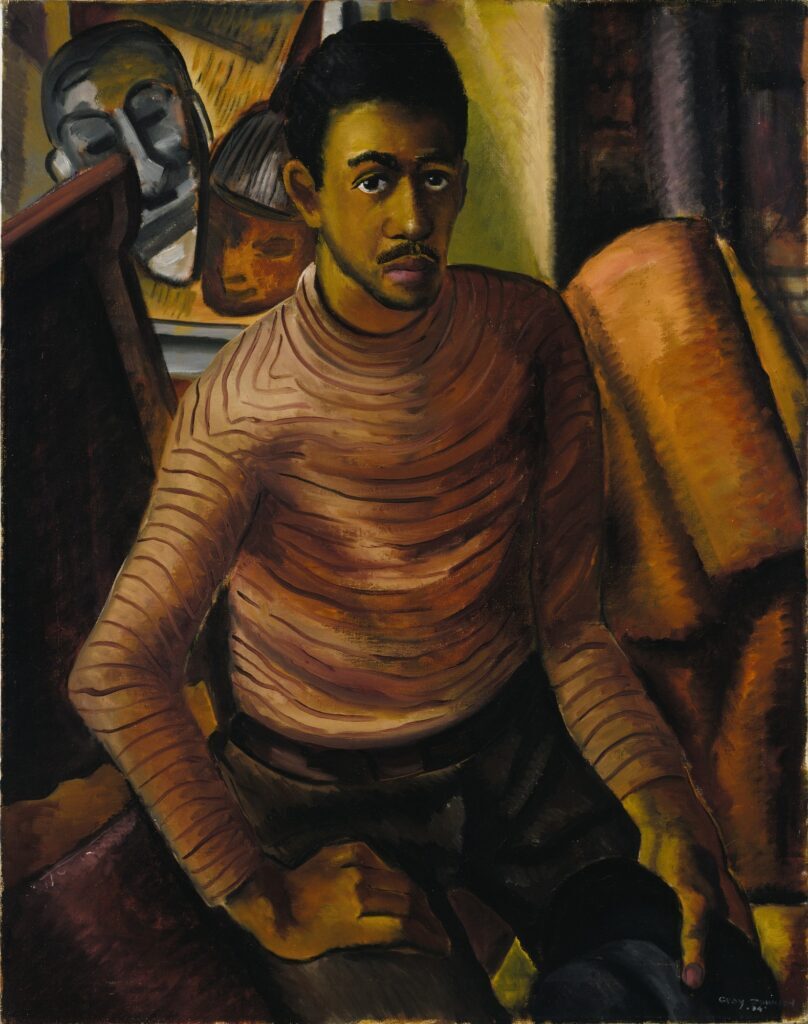
Malvin Gray Johnson, Self-Portrait, 1934, Smithsonian American Art Museum, Washington, DC, USA.
At the end of the Harlem Renaissance, few images captured the role of the Black artist as powerfully as Malvin Gray Johnson’s Self-Portrait. Painted in 1934, the work presents Johnson as a modern artist shaping his own identity and place within American culture. Like many Harlem Renaissance painters, he used portraiture as a way to challenge stereotypes and assert the complexity of the African-American experience.
Johnson depicts himself holding his hat, meeting the viewer’s gaze with a quiet intensity. Behind him appears his earlier painting Negro Masks (1932), creating a layered reflection on identity and heritage. The compressed space, simplified forms, and modernist approach reveal the influence of European avant-garde movements while remaining deeply connected to African-American traditions and expressing his own cultural perspective.
Active during the height of the Harlem Renaissance movement, Johnson explored themes of Black history, spirituality, and everyday life. His paintings often combined bold compositions with references to African heritage, reflecting the broader search for cultural pride that defined the era. Although his life was tragically cut short in 1934 at the age of 38, he left behind a body of work that demonstrated the possibilities of Black-American art.
Self-Portrait makes a fitting conclusion to this selection of Harlem Renaissance paintings. It reminds us that the movement was not only about representing communities and histories. It was also about artists claiming visibility, authorship, and a lasting place in the story of American art.