Édouard Manet‘s (1832–1883) A Bar at the Folies-Bergère depicts a barmaid with a distinctive, somewhat ambiguous expression that could be interpreted as boredom, disdain, melancholy, or perhaps introspection. Despite the elaborate scene surrounding her, she appears psychologically detached from her environment. Manet reinforces this sense of isolation through the composition. Positioned centrally and almost monumentally within the canvas, the woman remains conspicuously still against the fragmented bustle of Parisian nightlife. Her physical presence at the center of this social world therefore contrasts with her apparent emotional distance from it, suggesting both participation and alienation.
Manet uses the mirror to reveal what remains concealed from direct view: the lively environment, the reverse of the barmaid’s body, and an apparently affluent male customer leaning close to her face. His intrusive proximity offers a possible explanation for her unsettled expression, transforming the mirror into a means to expose social dynamics. Her position thus invites an uncomfortable analogy between the barmaid and the entertainment, indulgence, and spectacle. Standing behind a counter with objects for consumption, she too appears placed on display, suggesting that within the commercialized leisure of the Folies-Bergère, the female body itself risks becoming another object of male observation, desire, and consumption.
2. Roy Lichtenstein
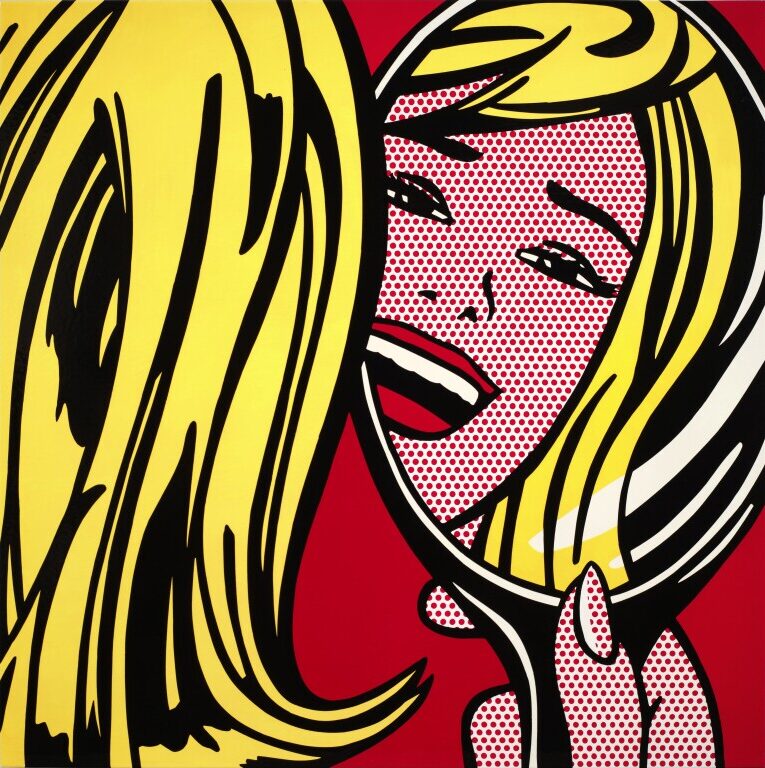
The image of a woman as a commodity reappears in Roy Lichtenstein‘s (1923–1997) Girl in Mirror. An artist well known for drawing inspiration from the increasing consumerism of the 20th century, Lichtenstein explores the relationship between women and mirrors in the age of mass media and consumer culture. Rather than capturing self-recognition or contemplation, the Ben-Day dot technique creates a static depiction that presents the woman’s face as an image in itself, as though from an advertisement or a comic.
This is particularly interesting given the historical association between mirrors and female vanity. By the 20th century, women’s self-perception increasingly existed within a culture saturated with advertising, cinema, magazines, and idealized images of femininity. The question consequently becomes: is she looking at herself, or at the cultural image she is expected to resemble?
3. Diego Velázquez
The Rokeby Venus is a provocative exploration of desire, intimacy, and the gaze, inviting the viewer into an apparently private space while simultaneously withholding complete access to its subject. Venus, the goddess of love and the personification of beauty, turns her back to the spectator, exposing her body while denying the direct encounter conventionally offered by the female nude.
The mirror appears to promise an alternative form of access, yet its dark, indistinct reflection obscures rather than reveals her face, intensifying her elusiveness. The viewer is denied the clarity of a reciprocal gaze, creating a tension between exposure and concealment. Her reflection in the mirror seems less concerned with self-recognition than with the spectator’s desire to see her.
Unlike many artists depicting of goddesses, Diego Velázquez (1599–1660) uses a muted palette and striking naturalism. Divested of the elaborate mythological attributes that ordinarily distinguish Venus, the reclining figure appears startlingly human; only the presence of her son, Cupid, identifies her. His intimate position beside her consequently seems less ethereal and mythological than an intrusion into a private, almost domestic moment. Yet, this apparent proximity remains illusory with the inclusion of the mirror, which only partly unveils Venus’s identity and expression.
4. Dante Gabriel Rossetti
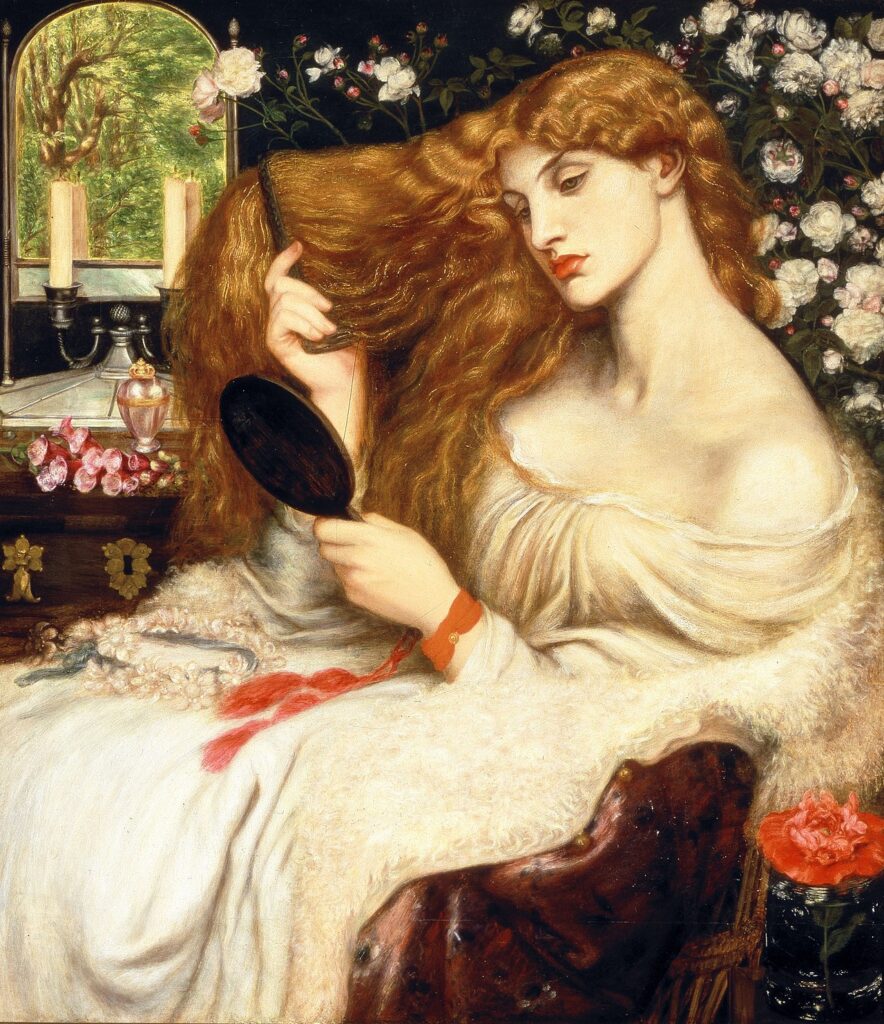
In Jewish mythology, Lilith is identified as Adam’s first wife, who refused to submit to his authority and subsequently fled the Garden of Eden. Later traditions characterize her as a demonic and sexually transgressive figure, associated with the deaths of infants and the temptation and bewitchment of men.
Dante Gabriel Rossetti (1828–1882) uses the hand-held mirror as a device in which to portray Lilith’s vanity, self-obsession, and seductive nature. His depiction of Lilith, an early incarnation of the femme fatale, articulates not only broader male anxieties surrounding the early feminist movement, but also what was perceived as one of its most threatening implications: women’s escape from male control over their sexuality. Here, Lilith controls her own self-perception.
Lilith, like the femme fatales who followed her, does more than entice and destroy men; she threatens the structures through which masculine dominance is asserted. By claiming autonomy over her own sexuality, she disrupts male authority over both sexual possession and reproduction, undermining the patriarchal imperative to perpetuate itself through women and, ultimately, to reproduce its own image.
5. Berthe Morisot
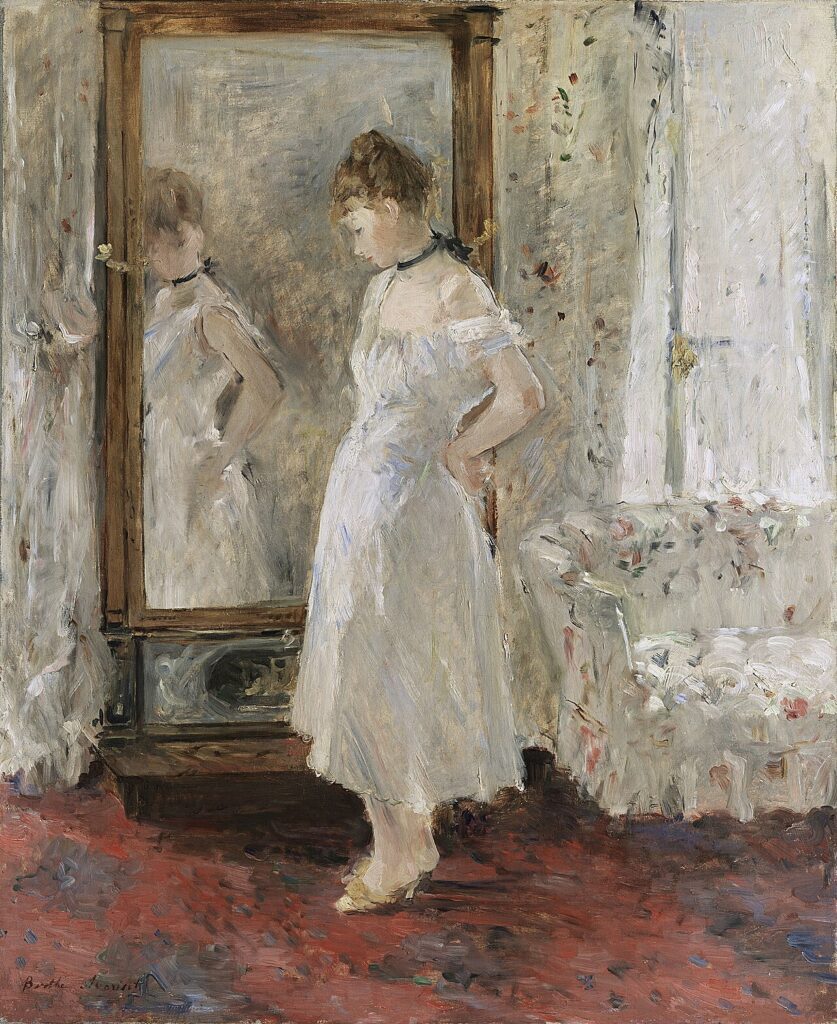
In the 19th century, women were largely excluded from public spaces unaccompanied. Founding Impressionist Berthe Morisot (1841–1895) therefore drew inspiration from her own experience of intimacy within domestic spheres, depicting women “lamenting their lack of independence but also celebrating their small freedoms.”1
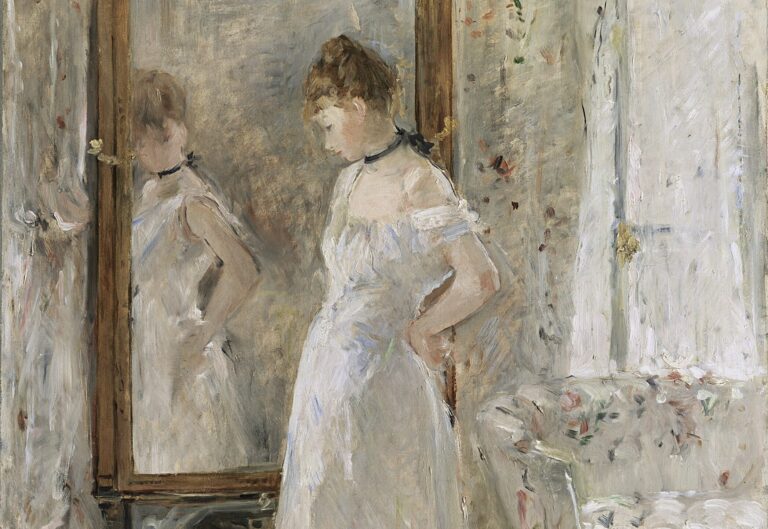
In The Psyche Mirror, Morisot subverts the mirror’s typical symbolism as a representation of vanity and self-obsession. Her depiction of a contemplative woman fastening her own dress in a serene, sun-lit bedroom could represent self-fashioning—the woman does not simply discover an existing identity in the reflection but also participates in producing the appearance through which she will be socially perceived. This process remains private, presenting the woman as the possessor of her own gaze rather than an object offered to the spectator.
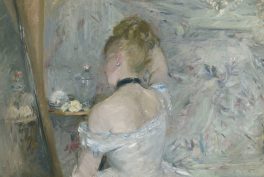
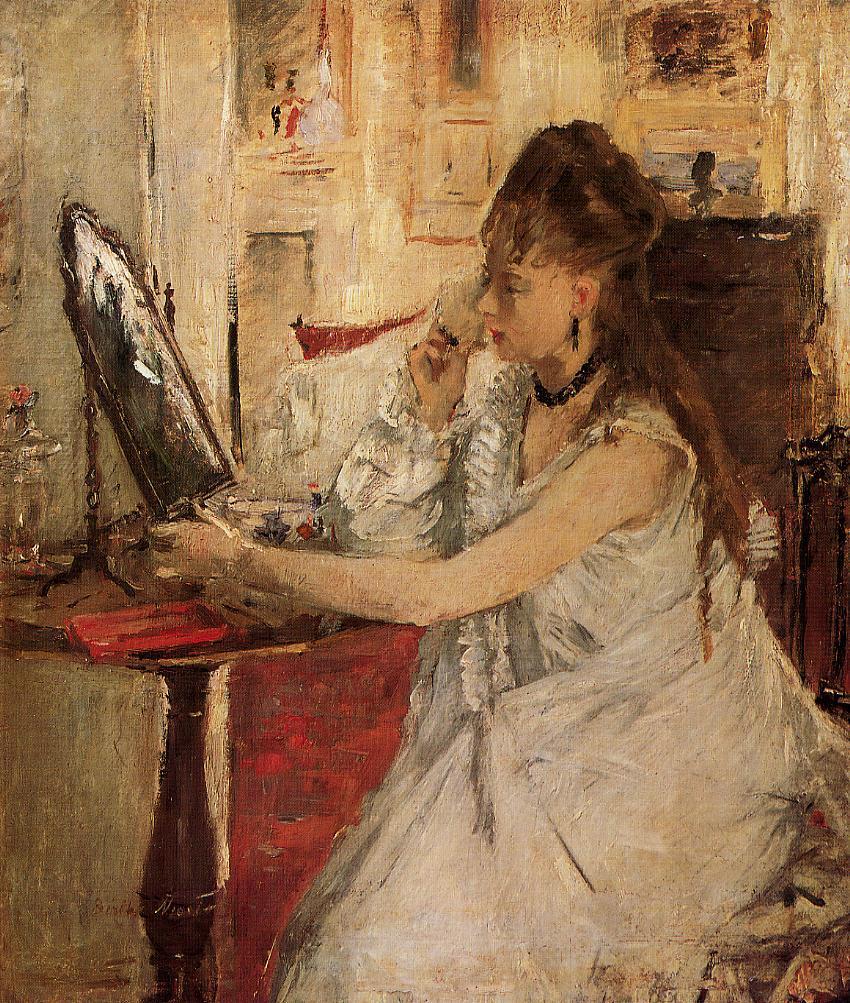
Similarly, in Young Woman Powdering Her Face, Morisot depicts feminine self-presentation as an intimate ritual. Significantly, the woman’s reflection is withheld and what she sees belongs to her gaze alone. Morisot thus shifts the mirror from a device of female display toward one of self-perception and visual autonomy.
6. Gordon Parks
Through his photography, Gordon Parks (1912–2006) captured the life of Ella Watson, a janitor and charwoman (cleaner) in 1940s America. As with Morisot’s work, this portrayal often involved depicting intimate domestic scenes. In the photograph above, Parks uses a mirror as a symbol of identity and a reflection on Black life in mid-century America.
The photograph depicts Watson sitting with her grandchildren beside a mirror, which reveals the reflection of her adopted daughter. By the mirror, there is a photograph of a couple. The different forms of identity capture the three stages considered intrinsic to a woman’s life: a girl, a wife, and a mother. This is further emphasized by the three forms of imagery: physical, in a photograph, and in the mirror’s reflection.
Watson appeared in many of Parks’ photographs, acting as an inspiration for his “record of one woman’s position within the racial, professional, and economic hierarchies that stratified the nation’s capital and [a] visual reckoning with the realities of Black life in racially segregated Washington, D.C.”2
7. Nan Goldin
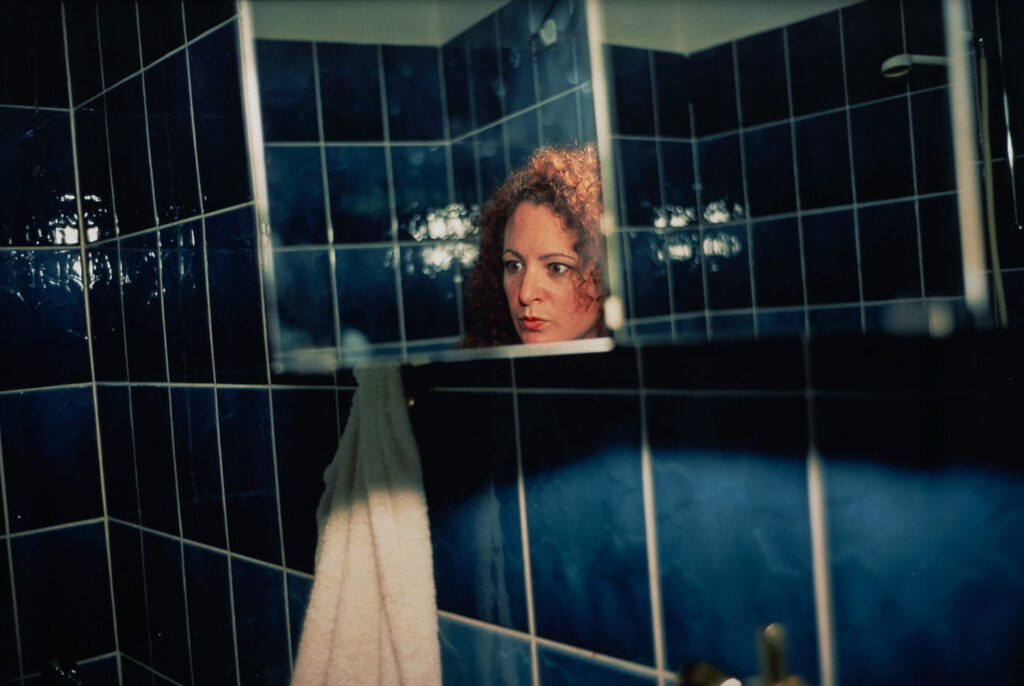
Known for documenting the queer and youth culture of the 1980s, as well as deeply personal reflections on isolation, abuse, and friendship, Nan Goldin‘s (b. 1953) use of the mirror acts as a tool of self-expression, capturing a private moment of self-recognition.
Goldin’s photographs Self-Portrait in Blue Bathroom, London (1980) and Self-Portrait in My Blue Bathroom, Berlin (1991) were taken 11 years apart, yet both depict the artist alone in a blue bathroom, with her reflection in the mirror serving as the focal point. In the London photograph, Goldin positions herself at a distance from the mirror, while the light illuminating her face contrasts with the muted palette of her surroundings, creating a quiet and contemplative atmosphere.
By contrast, the later Berlin photograph presents a darker yet more vibrant reflection. Its heightened color and closer, more assertive composition create a bold and confrontational image, marking a distinct shift from the serenity of the earlier work.
Despite depicting similar scenes, the two photographs reveal Goldin in markedly different states of mind, shaping the distinct emotional atmosphere conveyed by each image, notably through her expression, stance, and proximity to her reflection.