
Mirrors in Art: Reflections of Femininity
The mirror has functioned as a recurring symbol throughout art, particularly in representations of women. Historically, its presence in art has often...
Martha Teverson 24 August 2026
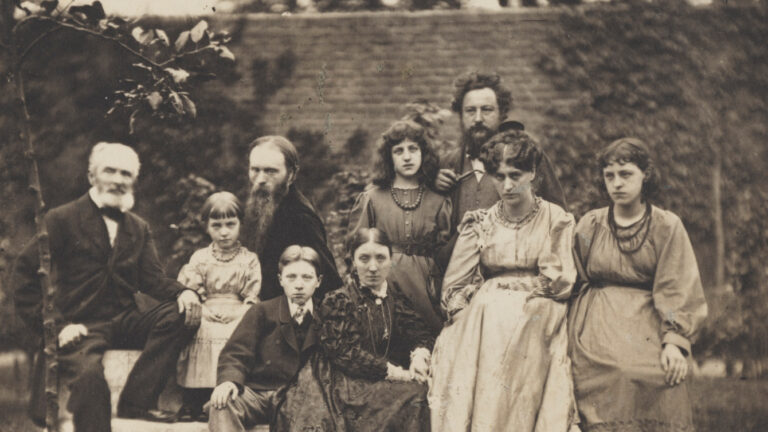
The Burne-Jones and Morris families (The Morrises are on the right: May, William, Jane, and Jenny), 1874, National Portrait Gallery, London, UK. Detail.
The Morris family stood at the centre of the 19th-century Arts and Crafts movement and were an integral influence on the Pre-Raphaelites. While William Morris is widely recognized for his textile design, his wife, Jane, and daughters, May and Jenny, also made significant contributions.
To this day, Morris & Co. designs can be seen on wallpaper, stationery, and homeware. However, the textiles and prints the family designed and crafted carried deep significance, embodying a rejection of industrialization and mass consumerism. These convictions shaped the Morrises’ craft as they pioneered a revival of beauty in design, set against the mass production sweeping through the Industrial Revolution. Beyond William’s pioneering of these artistic values, Jane, May, and Jenny also advanced these ideals substantially through their own artistic practice and instrumental support of the Morris & Co. business.
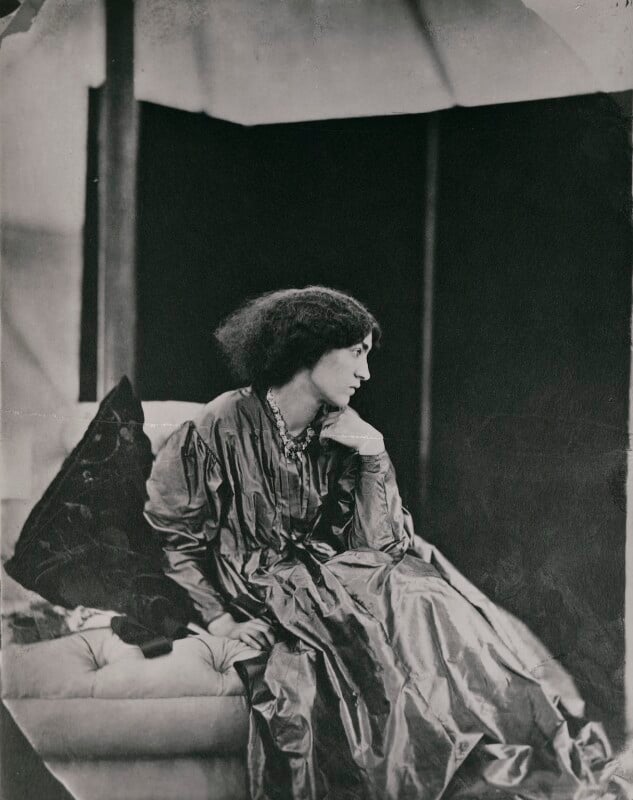
Jane Morris (née Burden), 1865, National Portrait Gallery, London, UK. Photograph by John Robert Parsons.
Jane Morris came from a poor and largely illiterate background, only entering the world of middle-class artists and intellectuals after marrying William Morris in 1859. Her unconventional beauty and distinctive presence captivated many of the artists within William’s circle, who regularly gathered at their home, Red House, to exchange artistic, literary, and political ideas.
Jane went on to feature prolifically in Pre-Raphaelite paintings, most notably as an adored muse of Dante Gabriel Rossetti. With her dark hair, angular features, and piercing eyes, her striking appearance came to embody the peculiar ethereality of Pre-Raphaelite beauty. Rumoured to have been having an affair, Rossetti’s obsession with Jane’s likeness formed his depiction of the femme fatale that recurs throughout his paintings.
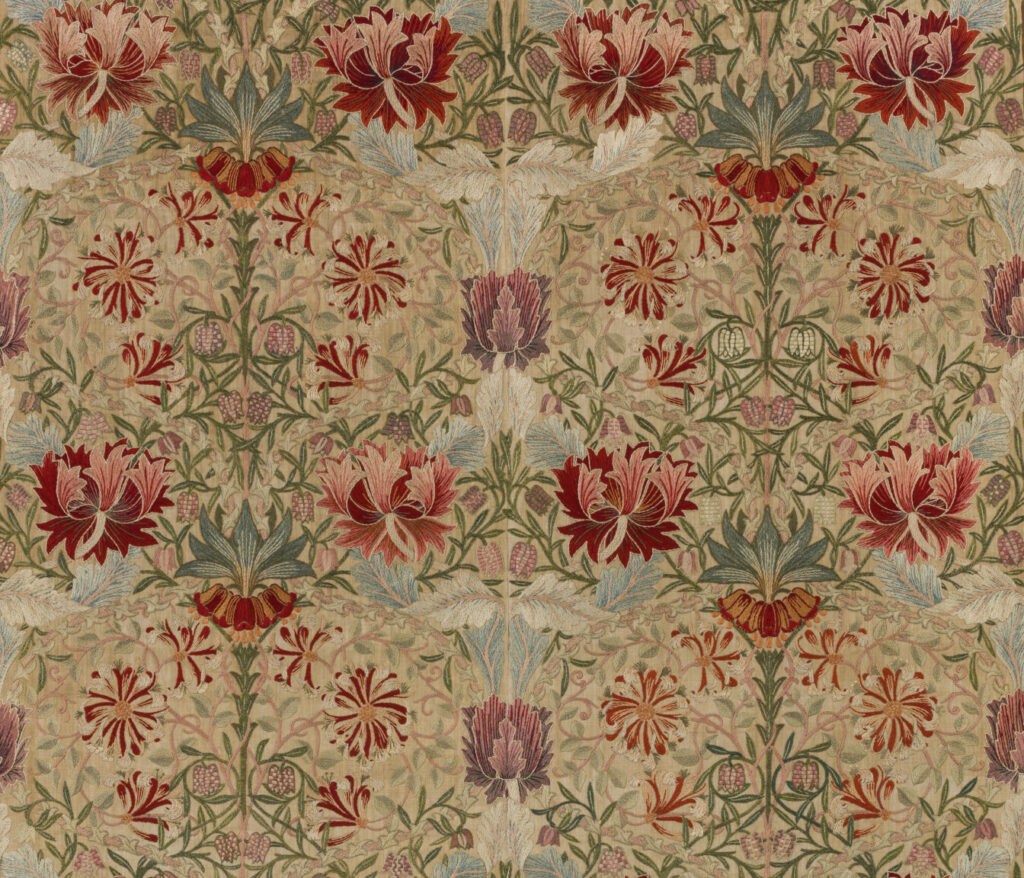
Jane Morris, Honeysuckle, design 1876, production 1880s, William Morris Gallery, London, UK. Detail.
Beyond her influence as a model, Jane pioneered traditional hand embroidery as a serious decorative art, in keeping with the Arts & Crafts emphasis on craftsmanship and handmade production. She worked on pattern designs by William, among others, while also contributing her own knowledge of stitches, materials, and techniques to form richly decorated domestic environments. Her designs celebrated the integrity of handmade furnishings and decor, which were both functional and beautiful. Red House became an ode to these values and a hub for collaboration between bohemian intellectuals and creatives.
Embodying the bohemian ideals of the Pre-Raphaelite circle, Jane became closely associated with the emerging Artistic Dress movement, which rejected the restrictive corsetry, elaborate construction, and rigid silhouettes of conventional Victorian fashion in favour of looser, flowing garments inspired by medieval and historical dress. Her distinctive style helped establish an alternative ideal of feminine beauty and dress that contrasted sharply with Victorian convention.
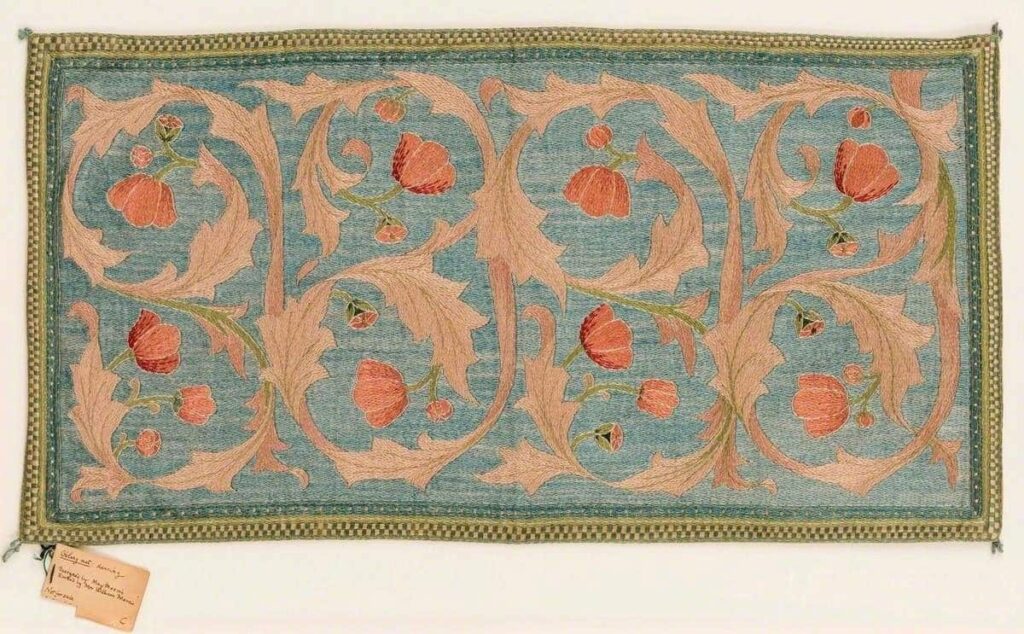
Jane Morris, Embroidered bag, 1878, Kit Kemp [online].
Jane’s legacy is one of beauty, but also of challenging the social conventions of her time. Her artistic skill, intelligence, and distinctive creative identity contributed to William’s work and the wider artistic world they built together. Her influence continued through her daughters, Jenny and May, who inherited both her creative talents and her willingness to pursue lives beyond conventional Victorian expectations.
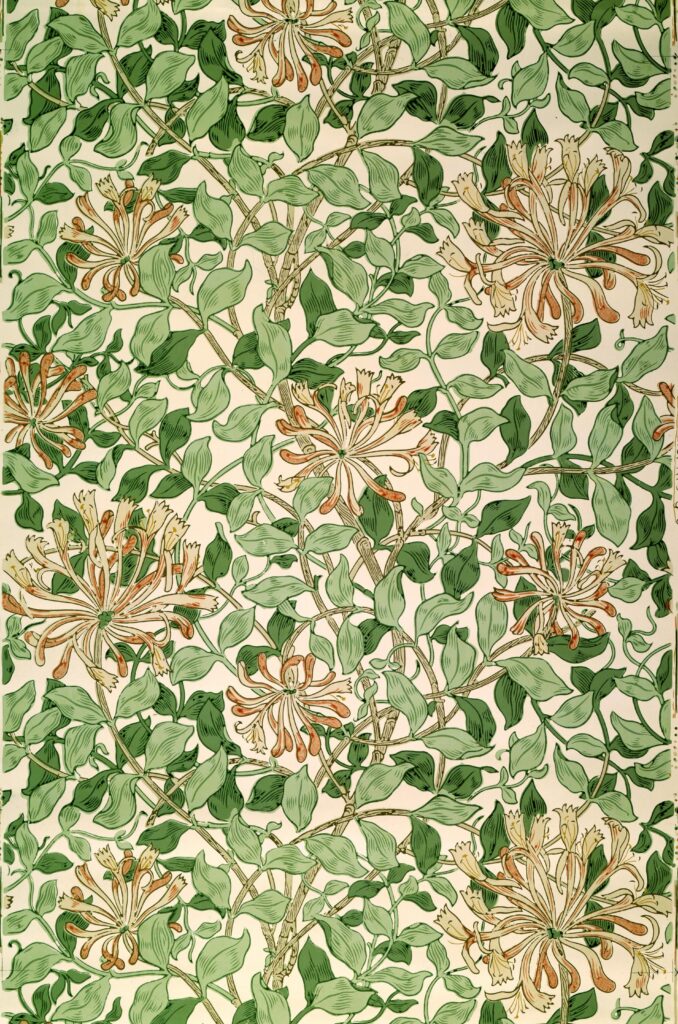
May Morris, Honeysuckle, design 1883, printed before 1940, William Morris Gallery, London, UK.
Growing up at Red House, Jenny and May Morris were born into a world of art, literature, and progressive political ideas. Both assisted their parents with creative projects, while their mother and aunt taught them embroidery, encouraging them to develop their own artistic skills. This upbringing also shaped their political outlook and later involvement in the Socialist movement.
May, in particular, became deeply involved in the artistic, political, and social ideals championed by her parents. A highly accomplished designer in her own right, she developed intricate floral patterns that complemented the distinctive style associated with her father. Some of her designs were historically misattributed to William, contributing to her own role within Morris & Co. being overlooked. In 1885, aged just 23, May became Director of the company’s embroidery department, where she developed more expressive approaches to embroidery and established exceptionally high standards of craftsmanship.
Her political beliefs were also reflected in the way she managed the department. At a time when exploitation and poor working conditions were widespread within the textile industry, May sought to provide fairer pay and shorter working hours. She recruited and trained women from a range of backgrounds, combining the Morris family’s artistic principles with its commitment to social reform.
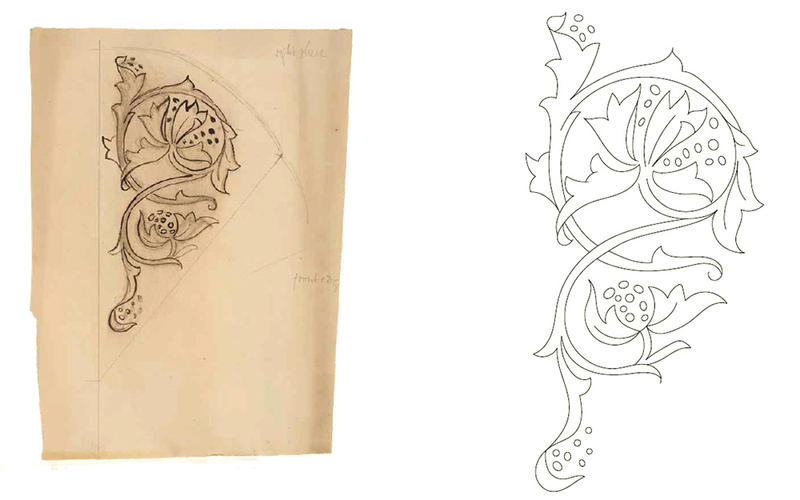
May Morris, Peony and acanthus design for garments (design and pattern outline), c. 1890–1900, Ashmolean Museum, Oxford, UK.
Although best known for her embroidery and later for communicating her expertise through lecturing and writing on the subject, May’s creative career extended beyond textiles. She also worked in jewellery and fashion design, producing finely crafted pieces that frequently incorporated the floral and natural forms characteristic of her work. Her remarkable career, spanning textiles, jewellery, academia, business, and pioneering workers’ and women’s rights, demonstrates her distinctive contributions to the decorative arts. While following in the footsteps of her parents, she carved out her own expertise and success, reflected in her pursuit of taking embroidery from a domestic activity to an elevated and respected art form, and further in co-founding the Women’s Guild of Arts in 1907.
Sadly, as a result of debilitating epilepsy (considered a form of insanity at the time), Jenny’s intellectual and creative capabilities never reached their full potential. That is not to say, however, that she did not express the same brilliance as her family. In 1878, Jenny Morris started creating her own handwritten and illustrated magazine, The Scribbler, which included the early writing of Rudyard Kipling and fashion articles, revealing her passion for literature and the arts. She also modelled for Dante Gabriel Rossetti and assisted her father in his work; it has been noted that her academic aptitude and curiosity were extraordinary.
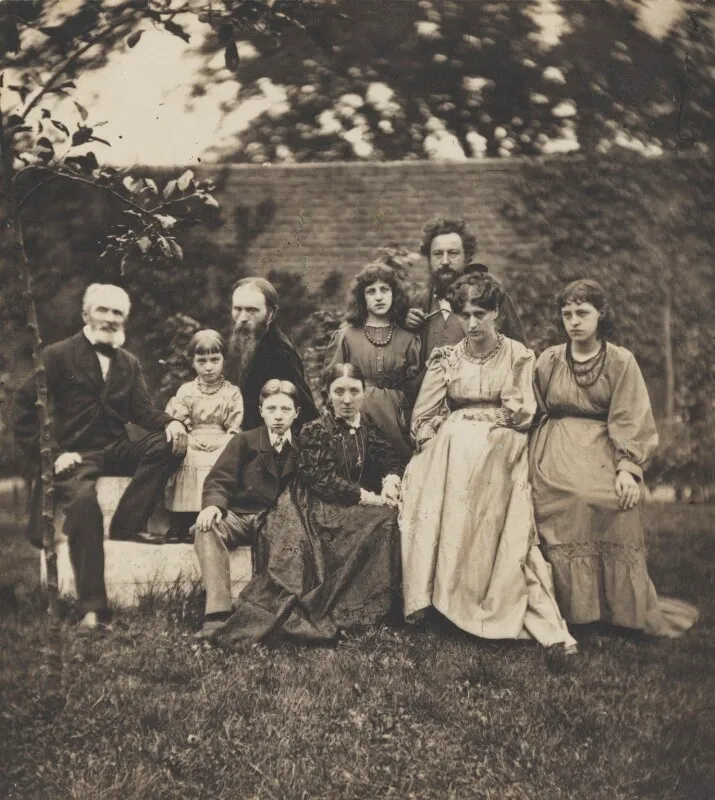
The Burne-Jones and Morris families (The Morrises are on the right: May, William, Jane, and Jenny), 1874, National Portrait Gallery, London, UK.
The memory of William Morris is one of profound influence on design and the decorative arts. However, the women within his family reveal that his achievements, and those of the artists around him, emerged from a wider environment of collective creativity, shared values, and artistic exchange. Jane, Jenny, and May possessed considerable artistic and intellectual talents of their own, contributing to and expanding the creative world with which the Morris name became synonymous. The Morris family were remarkable for the extent to which art, politics, and craftsmanship permeated both their work and their domestic lives, creating a shared legacy that extended far beyond William Morris alone.
Arts and Crafts: an Introduction, Victoria and Albert Museum. Accessed: Oct 12, 2026.
Rossetti’s Obsession: Images of Jane Morris, National Museums Liverpool. Accessed: Oct 12, 2026.
Suzanne Fagence Cooper, Jane Morris: A Life Transformed, Ace Cultural Tours. Accessed: Oct 12, 2026.
Lynn Hulse, The Many Talents of May Morris, Ashmolean Museum. Accessed: Oct 12, 2026.
DailyArt Magazine needs your support. Every contribution, however big or small, is very valuable for our future. Thanks to it, we will be able to sustain and grow the Magazine. Thank you for your help!

Historian of nineteenth and early-twentieth-century art, particularly drawn to themes relating to gender expression, spirituality, magic, and mythologies.

Leigh is a writer, reader, art lover, radio nerd and herbalist based in Nashville, TN.
The mirror has functioned as a recurring symbol throughout art, particularly in representations of women. Historically, its presence in art has often...
Martha Teverson 24 August 2026
Explore the stigma of syphilis in Victorian art and society. Science was advancing in this transformative era, but societal attitudes lagged behind. How did the art world respond?
Candy Bedworth 15 June 2026
Rosita Mauri was one of the most talented dancers of her generation, and her mastery on stage drew the attention of countless artists. They created...
Jimena Escoto 11 June 2026
Explore the world of Tove Jansson's Moomins, where adventure, friendship and a love of nature create a delightful narrative for readers of all ages.
Candy Bedworth 2 April 2026