
Beyond William Morris: The Artistic Family of the Morrises
The Morris family stood at the centre of the 19th-century Arts and Crafts movement and were an integral influence on the Pre-Raphaelites. While...
Martha Teverson 19 October 2026
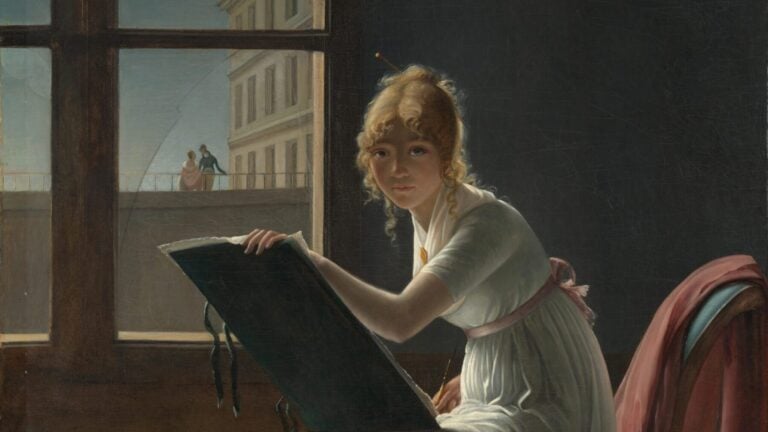
Marie-Denise Villers, Portrait of Charlotte du Val d’Ognes, 1801, Metropolitan Museum of Art, New York City, NY, USA. Detail.
,
For decades, visitors to the Metropolitan Museum of Art believed they were looking at a portrait by Jacques-Louis David. When the museum bought it in 1917, it was attributed to him and soon became known as “the New York David.” For years, the name of one of France’s most famous painters was attached to the young woman sitting at the drawing table.
But the painter behind this work was Marie-Denise Villers, a French artist who exhibited the portrait at the Paris Salon in 1801 under her own name. As the painting passed through different hands, Villers’s name was lost, and it would take almost two centuries for her authorship to be recognized. The young woman in the portrait, however, has an even more complicated story.
Look closely at the young woman in the painting. She has stopped drawing and turned towards us, almost as if someone has just walked into the room. She sits in a darkened studio with a drawing portfolio on her lap, holding a brass porte-crayon in her right hand.
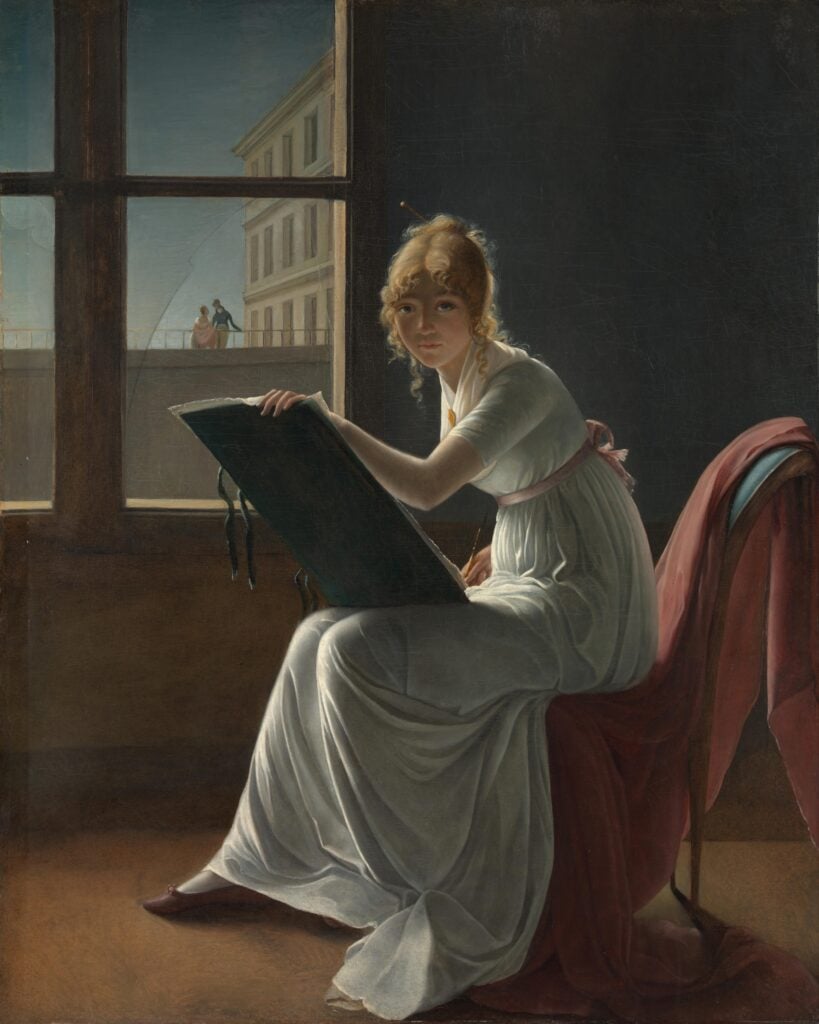
Marie-Denise Villers, Portrait of Charlotte du Val d’Ognes, 1801, Metropolitan Museum of Art, New York City, NY, USA.
The room is one of the studios for women artists in the Louvre. Behind her, a pane of the large window is broken, and through it we can see a man and a woman walking along the Quai Malaquais, beside the Seine. The broken glass is easy to miss, but it gives the quiet room a slightly strange detail.
The sitter wears a white cotton gown with a high waist and a pink ribbon tied around it. The same pink color appears on her silk shoes, while a shawl hangs over the back of her chair. The dress reflects the fashion of the late 1790s and early 1800s, when Greek-inspired clothing was becoming popular in France. The woman is Marie Joséphine Charlotte du Val d’Ognes, who was born in 1786 and aged 16 when Marie-Denise Villers (1774–1821) painted her. Her face is turned directly towards us, and there is nothing distant about her expression. She looks as though she has simply looked up from her work and noticed the person standing in front of her.
Her drawing tools are just as important as her clothes. The portfolio rests across her lap, the paper bends beneath her hand, and the porte-crayon is still in her fingers. She is not shown simply as a young woman sitting for a portrait. She is shown drawing. That matters because Villers was an artist too. The woman in front of the canvas is holding the tools of an artist, while the woman behind the canvas is painting her.
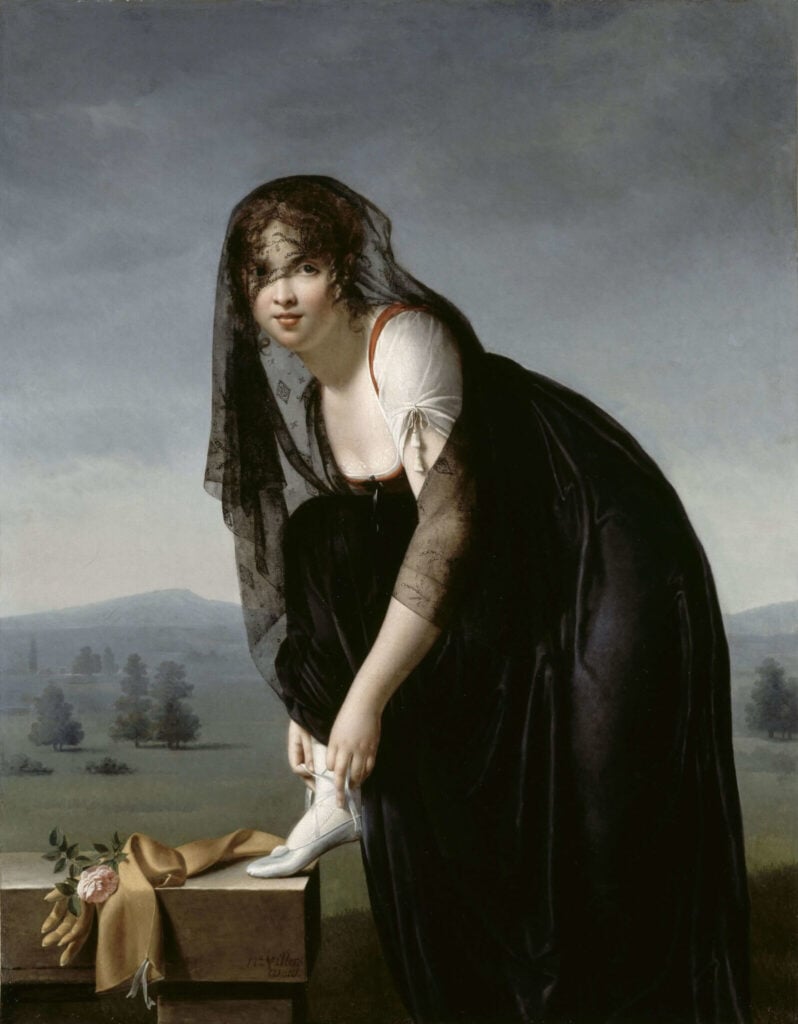
Marie-Denise Villers, Self-Portrait, 1802, Louvre, Paris, France.
Marie-Denise Villers was born in Paris in 1774 into a family of artists. Her sister Marie-Victoire Lemoine was an established painter, while another sister, Marie-Élisabeth Gabiou, also pursued an artistic career. Their cousin Jeanne-Élisabeth Chaudet was a painter too.
Villers studied with Anne-Louis Girodet-Trioson, a pupil of Jacques-Louis David (1748–1825), and became part of the artistic circles of Paris. She exhibited at the Salon in 1799 and returned in 1801 with this portrait. The Paris art world was changing around her. Women had gained access to the Salon in 1791, and several new studio spaces opened to women artists after the French Revolution. At the Louvre, women could study, draw from life, work alongside one another, and pose for each other. Villers flourished in that new artistic environment.
When the portrait appeared at the Salon in 1801, Villers’s name was attached to it. There was no mystery about its authorship at the time. Her name simply did not remain with the painting.
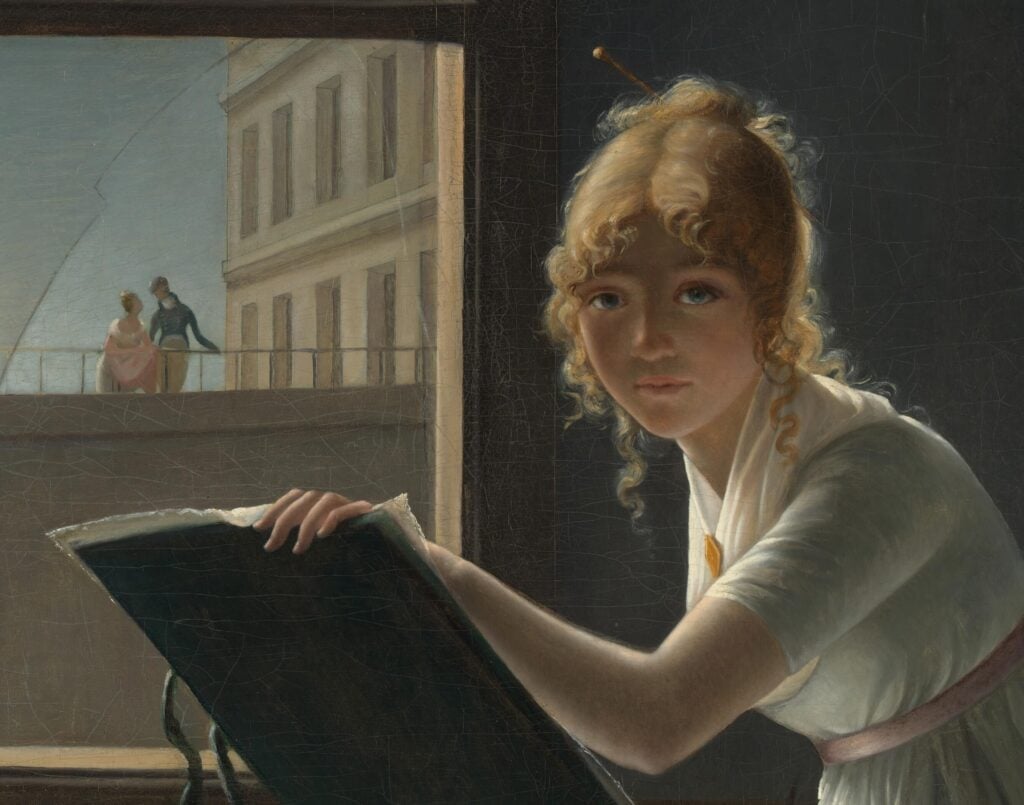
Marie-Denise Villers, Portrait of Charlotte du Val d’Ognes, 1801, Metropolitan Museum of Art, New York City, NY, USA. Detail.
After the Salon exhibition, the portrait belonged to Charlotte du Val d’Ognes and remained with her family. At some point, Villers’s name disappeared from the painting’s history, and it came to be regarded as a work by Jacques-Louis David. The new attribution changed the way the portrait was seen. David was one of the leading painters of French Neoclassicism, and a painting believed to be his carried a very different reputation.
When the Metropolitan Museum of Art bought the painting in 1917, it accepted David as the artist and paid $200,000 for it. The portrait quickly became a popular attraction and was promoted as “the New York David.”
There was a problem with the story, though. The portrait had been exhibited at the 1801 Salon under Villers’s name, while David had not participated in that year’s exhibition. Moreover, records linked the painting to a female artist, yet for years, visitors to the museum admired the young woman at the drawing table, convinced they were looking at a work by David.
The David attribution was questioned in 1951 by the Met curator Charles Sterling. He proposed another artist, Constance Marie Charpentier (1767–1849). Charpentier was also a French painter who had connections to David’s circle. Her name remained attached to the portrait for several decades.
In 1996, art historian Margaret Oppenheimer proposed Marie-Denise Villers as the painter. Her conclusion came from looking again at the painting’s early history and the evidence surrounding the 1801 Salon. Villers’ training and surviving work also gave the attribution a stronger foundation. There was no newly discovered signature hidden beneath the paint. The story changed because an art historian went back through the evidence and reconsidered a painting that had spent decades carrying the wrong name.
The Metropolitan Museum of Art eventually accepted Oppenheimer’s attribution. After nearly two centuries, Marie-Denise Villers’s name returned to the portrait she had exhibited in 1801.
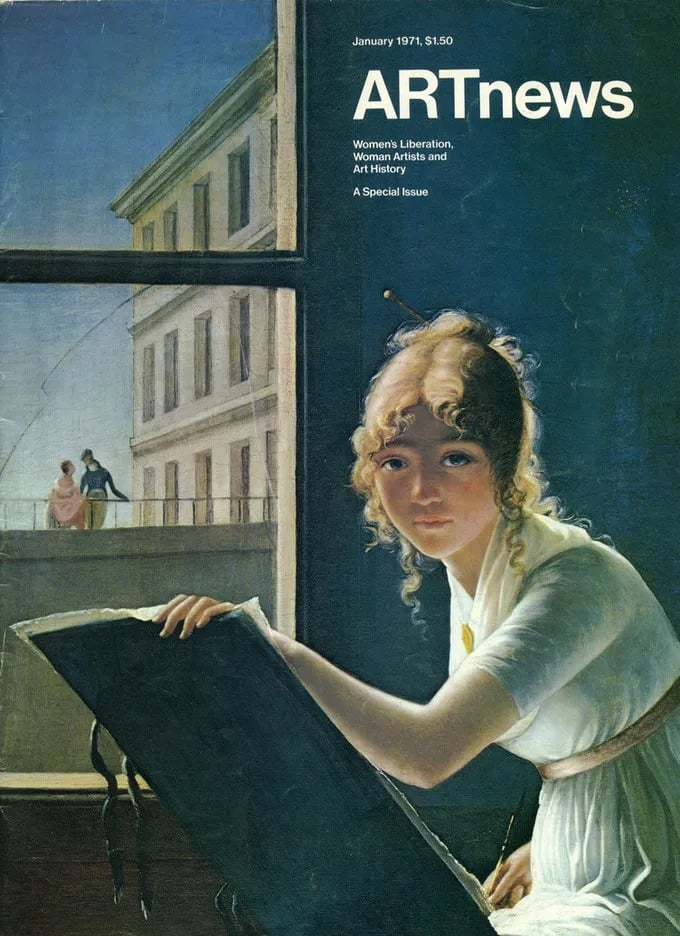
Cover of the special issue of ARTnews, January 1971. National Museum of Women in the Arts.
The painting had already become part of a larger conversation about women and art. In 1971, while the portrait was still attributed to David, it appeared on the cover of ARTnews for an issue featuring Linda Nochlin’s influential essay “Why Have There Been No Great Women Artists?”
There is an obvious irony in that image. A painting of a young woman artist was being used for a discussion about women being left out of art history, while the woman who had actually painted it was still hidden behind the name of a male artist. Villers’s name would not return to the painting until 1996.
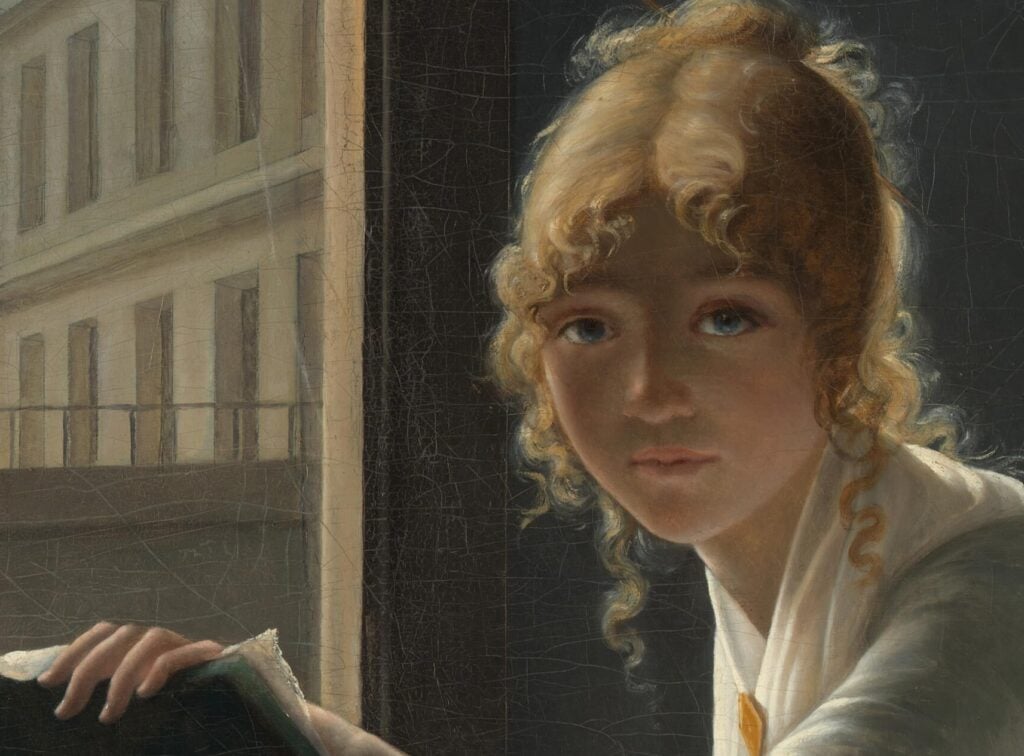
Marie-Denise Villers, Portrait of Charlotte du Val d’Ognes, 1801, Metropolitan Museum of Art, New York City, NY, USA. Detail.
Finding the artist did not settle the identity of the sitter. The Metropolitan Museum identifies her as Marie Joséphine Charlotte du Val d’Ognes. She belonged to the same circle of young women studying art in Paris.
Another possibility has also been raised. Art historian Anne Higonnet has suggested that the woman could actually be Marie-Denise Villers herself. If that is correct, the painting would be a self-portrait. Looking at the picture with that possibility in mind changes some of its details. The woman is sitting in a studio with a drawing portfolio and porte-crayon in her hands. She is not merely surrounded by the signs of art; she is shown working as an artist. She also looks directly at us.
The Metropolitan Museum continues to identify the sitter as Charlotte du Val d’Ognes. So while Villers’s name has been recovered, the identity of the woman looking out from the canvas remains open to interpretation.
Marie-Denise Villers continued to exhibit after 1801. She showed work at the Salon again in 1802 and later exhibited a portrait of the Duchess of Angoulême in 1814. She died in Paris in 1821. The painting, long separated from her name, would eventually become her best-known work. And the woman looking back at us may still have another story to tell.
P.S. This masterpiece is featured in Women Artists 50 Postcards Set, available in our online shop. Be sure to check it out!
Author’s bio:
Shashin Prabodh is a Sri Lankan writer, book reviewer, and content creator whose work explores film, literature, art, and culture. His writing has appeared in High on Films, Film Threat, IndieReader, UP Magazine, and other publications.
DailyArt Magazine needs your support. Every contribution, however big or small, is very valuable for our future. Thanks to it, we will be able to sustain and grow the Magazine. Thank you for your help!

This is our guest profile for occasional authors. If you have an interesting story about art to tell, send it to our Editor-in-chief Kate at [email protected]. You might be the next here!
The Morris family stood at the centre of the 19th-century Arts and Crafts movement and were an integral influence on the Pre-Raphaelites. While...
Martha Teverson 19 October 2026
The mirror has functioned as a recurring symbol throughout art, particularly in representations of women. Historically, its presence in art has often...
Martha Teverson 24 August 2026
Explore the stigma of syphilis in Victorian art and society. Science was advancing in this transformative era, but societal attitudes lagged behind. How did the art world respond?
Candy Bedworth 15 June 2026
Rosita Mauri was one of the most talented dancers of her generation, and her mastery on stage drew the attention of countless artists. They created...
Jimena Escoto 11 June 2026