Summary
- Any list of 10 famous works by Warhol has to start with Campbell’s Soup Cans, where repetition became an artistic method.
- Marilyn Diptych—the publicity image of Marilyn Monroe that Warhol turned into an iconic representation of the cost of fame.
- Ethel Scull 36 Times—the portrait that made Ethel Scull world famous for certainly more than 15 minutes.
- Mustard Race Riot is one of Warhol’s most politically charged images, which continues to challenge viewers today.
- Chelsea Girls entered the U.S. Film Registry as the most fully realized film of Warhol’s Factory scene.
- A press photograph of Sing Sing’s execution chamber became a commentary on death by electrocution.
- Mao—the Warhol portrait treatment that transformed the “most famous person in the world” into a drag queen.
- The image of Prince that turned into a legal case and made it all the way to the Supreme Court.
- The “fright wig” self-portraits become the most revealing at the end of Warhol’s career.
- 100 versions of Leonardo’s Last Supper were a poignant commentary during the AIDS crisis.
1. Campbell’s Soup Cans (1962)
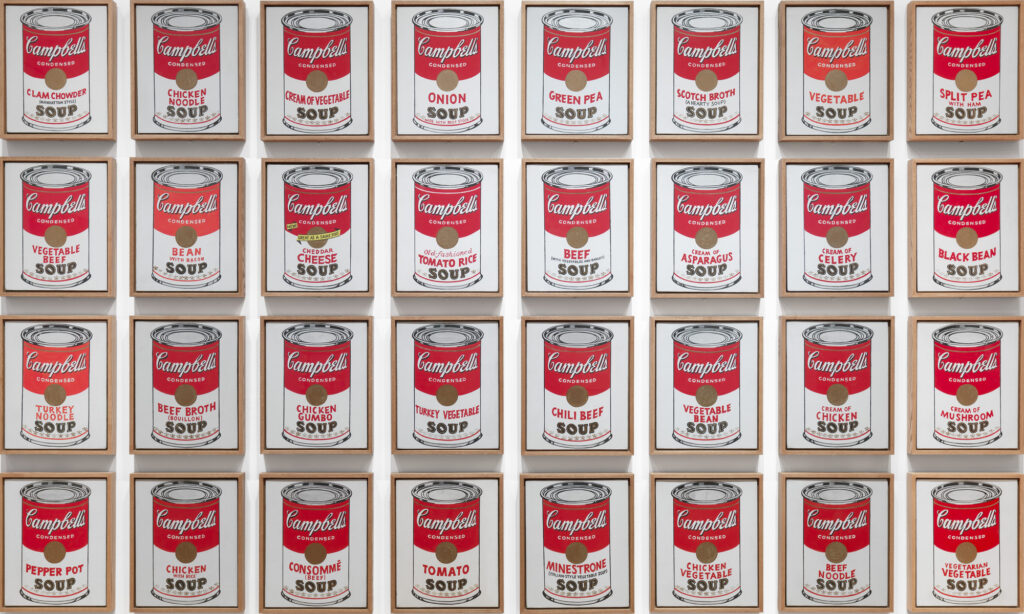
Andy Warhol in 10 Artworks: Andy Warhol, Campbell’s Soup Cans, 1962, Museum of Modern Art, New York City, NY, USA.
A list of Warhol’s defining works has to start here. In the summer of 1962, the Ferus Gallery in Los Angeles gave Warhol his first solo painting exhibition. The show consisted of 32 nearly identical canvases on a narrow shelf—like a grocery aisle—one for each variety of soup Campbell’s then sold. Warhol had figured out the method that would carry him through the rest of his career—serial repetition of a mass-produced subject. At the time, only five canvases sold, and the gallery’s director bought them back so the set could stay together.
MoMA acquired the full series in 1996 for a reported $15 million. Warhol grew up eating Campbell’s soup in Pittsburgh, and as he put it, “…used to have the same lunch every day for 20 years…” In 1964, Warhol expanded the concept of serial repetition to sculpture with Brillo Boxes, plywood replicas of supermarket cartons that have kept company with Marcel Duchamp’s Fountain (1917) in every serious argument about what counts as art.
2. Marilyn Diptych (1962)
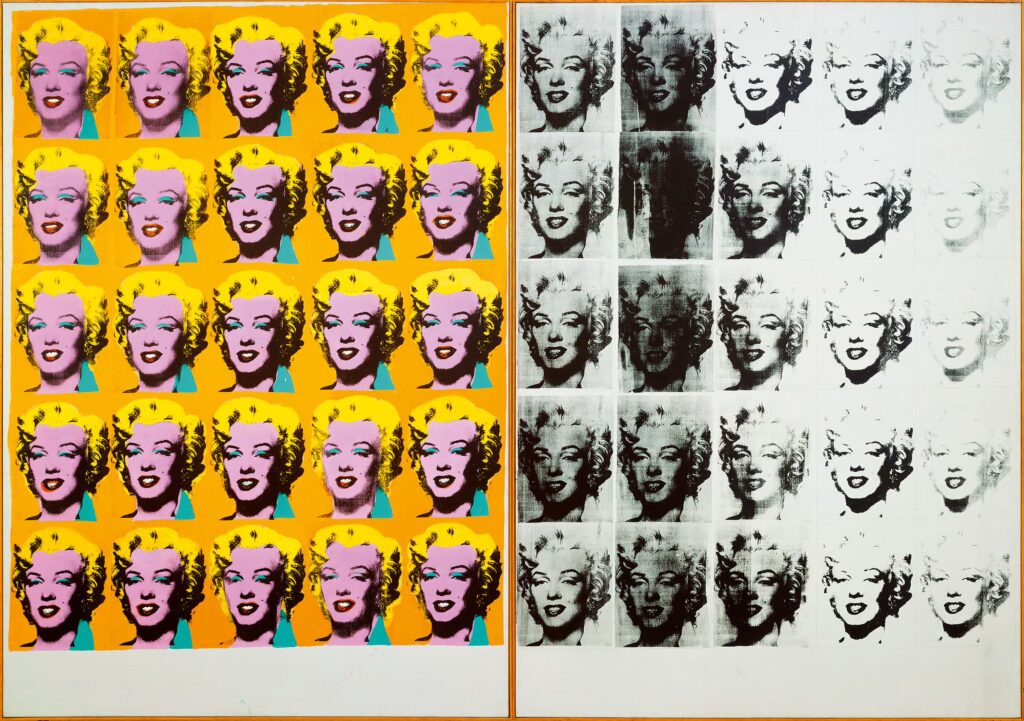
Andy Warhol in 10 Artworks: Andy Warhol, Marilyn Diptych, 1962, Tate Modern, London, UK. Photograph by The Andy Warhol Foundation for the Visual Arts/Artists Rights Society/DACS. The Guardian.
Marilyn Monroe, the biggest movie star of her generation, died from a barbiturate overdose on August 4, 1962. Warhol started silkscreening her image that same month. One side of the diptych contains 50 images of Marilyn in electric yellow, turquoise, and hot pink—her celebrity as a sexy consumer product. On the other side, the same 50 images drain toward gray, the ink slipping out of alignment, faces beginning to ghost and dissolve.
Warhol made over 20 works depicting Monroe by the end of the year, all from a publicity still for the movie Niagara (1953), using a technique that was new for him at the time and is now inseparable from his name. Collector Emily Hall Tremaine suggested joining the two canvases, and Warhol agreed. He went on to make hundreds of Marilyn-themed works in his career. The work established the silkscreen as Warhol’s medium and the celebrity (dead or alive) as subject, setting the scene for some of his most recognizable images beyond Monroe, such as his depictions of Elizabeth Taylor, Jackie Kennedy, and Elvis.
3. Ethel Scull 36 Times (1963)
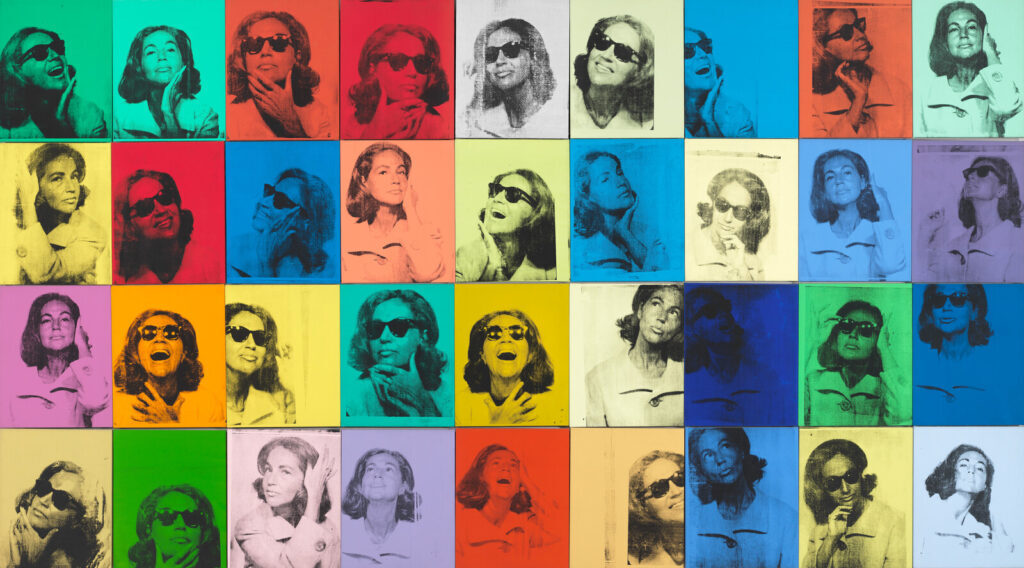
Andy Warhol in 10 Artworks: Andy Warhol, Ethel Scull 36 Times, 1963, Whitney Museum, New York City, NY, USA.
Pop art collectors were dazzled by Warhol’s Marilyns, among them Robert Scull, who commissioned a portrait of his wife in that same style. Ethel Scull arrived at the Factory, Warhol’s studio on East 47th Street in Manhattan, expecting to sit for a session. The artist instead put her in a taxi, took her to a Times Square photobooth, and fed coins into the machine while directing her posing through over 100 images. After selecting 36, he gave the pictures the full Warhol treatment, arranging the multicolored canvases in a 12-foot (3.7 m) grid.
This was the start of Warhol’s commissioned portrait practice; he would go on painting wealthy patrons throughout his career. Some of his famous sitters include Mick Jagger, Muhammad Ali, Yves Saint Laurent, and fellow artists Jean-Michel Basquiat and queer icons Robert Mapplethorpe and Keith Haring. The portrait can be seen as an early nod to Warhol’s ultimate concept of celebrity, summarized in the iconic phrase, “In the future, everybody will be world famous for 15 minutes.” (Fun fact: the quote cannot be fully attributed to Warhol, having originated from a 1968 exhibition text at Moderna Museet.)
4. Mustard Race Riot (1963)
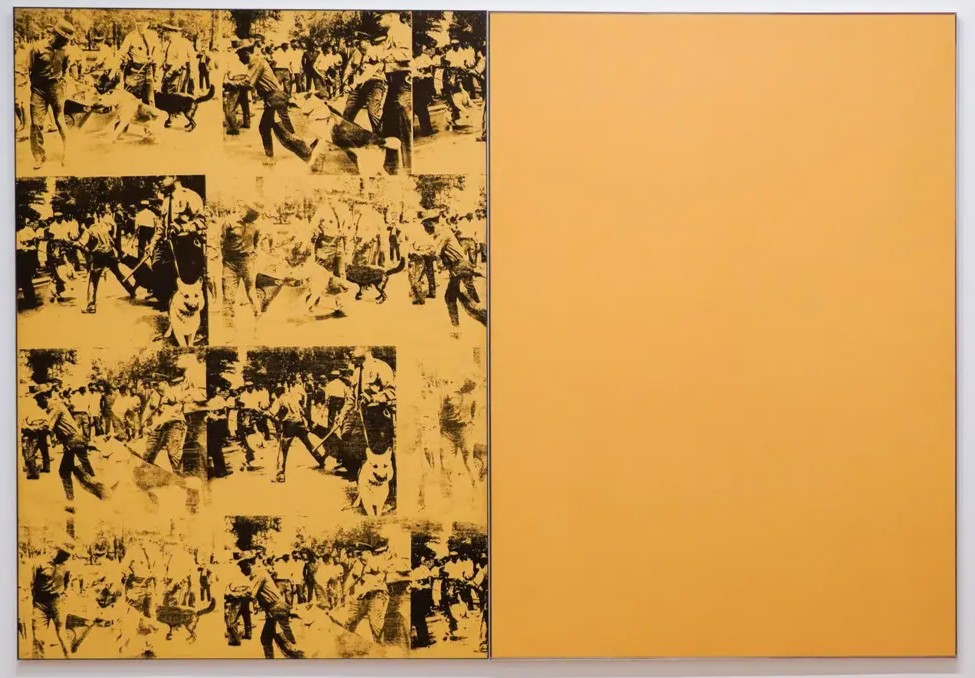
Andy Warhol in 10 Artworks: Andy Warhol, Mustard Race Riot, 1963. The Andy Warhol Foundation for the Visual Arts, Inc./Artists Rights Society (ARS), New York, Photograph by Rebecca Smeyne. New York Times. Detail.
Mustard Race Riot belongs to the Death and Disaster series Warhol developed for his first European show, held in Paris in 1964. The series explored modern tragedies, gruesomely ranging from suicide scenes to nuclear annihilation. This nearly 13-foot (4 m) diptych is densely printed with images of police dogs attacking peaceful civil rights protesters in Alabama. One of the two mustard-yellow monochrome panels that give the work its name is blank, widely accepted as a commentary on how these media images shock, then fade from public memory.
The painting is built on photographs by Charles Moore, published in Life magazine on May 17, 1963, which Warhol repeated across like film strips. Moore sued Warhol over unauthorized use, settling out of court, the first in a sequence of copyright cases against his estate spanning almost 60 years. The Race Riot canvases are Warhol’s only overtly political works, likely the reason why contemporary Black artists have continued to engage with them. In the 2018 Warhol retrospective at the Whitney, artist Hank Willis Thomas remarked that Warhol made those images “more iconic and, in some ways, more important.”
5. Chelsea Girls (1966)
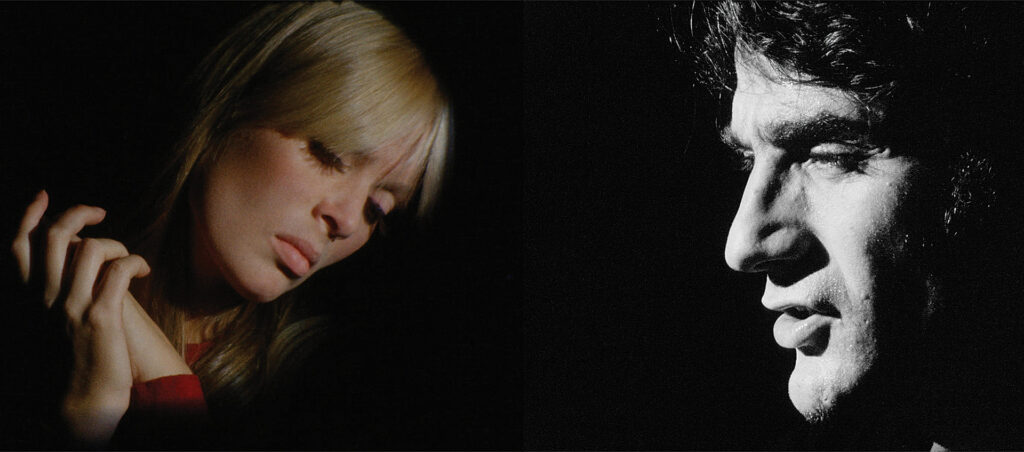
Andy Warhol in 10 Artworks: Film still from Andy Warhol, Chelsea Girls, 1966; pictured Nico (left) / Ondine (right). © 2019 The Andy Warhol Museum, Pittsburgh, PA; film still courtesy The Andy Warhol Museum. Wexner Center.
Most people know Warhol for his paintings, but he was also a filmmaker, and a busy one; the Andy Warhol Museum houses over 400 of his films. Chelsea Girls is a 3.5-hour double-projection film—two reels play side-by-side with alternating soundtracks, so no two screenings are ever the same. Warhol shot the film in 1966 at the Hotel Chelsea in Manhattan, a bohemian residential hotel and gathering place for writers, musicians, and artists, where many of his Factory regulars lived. It includes 12 different 35-minute reels, in color and black-and-white, each representing one room of the hotel.
Chelsea Girls is the most fully realized film of the Factory scene at its peak. Factory regulars perform versions of themselves or invented personas, among them close-ups of Nico crying under colored lights, Ondine’s manic confessional, Brigid Berlin in a drug-filled room, Mary Woronov as the sadistic Hanoi Hannah, and Eric Emerson delivering a lengthy striptease monologue. In December 2024, the Library of Congress selected Chelsea Girls for the U.S. National Film Registry, the second Warhol film to receive the designation after the infamous Empire in 2004, his marathon 8-hour, one-shot, stationary film of the Empire State Building.
6. Big Electric Chair (ca. 1967–1968)
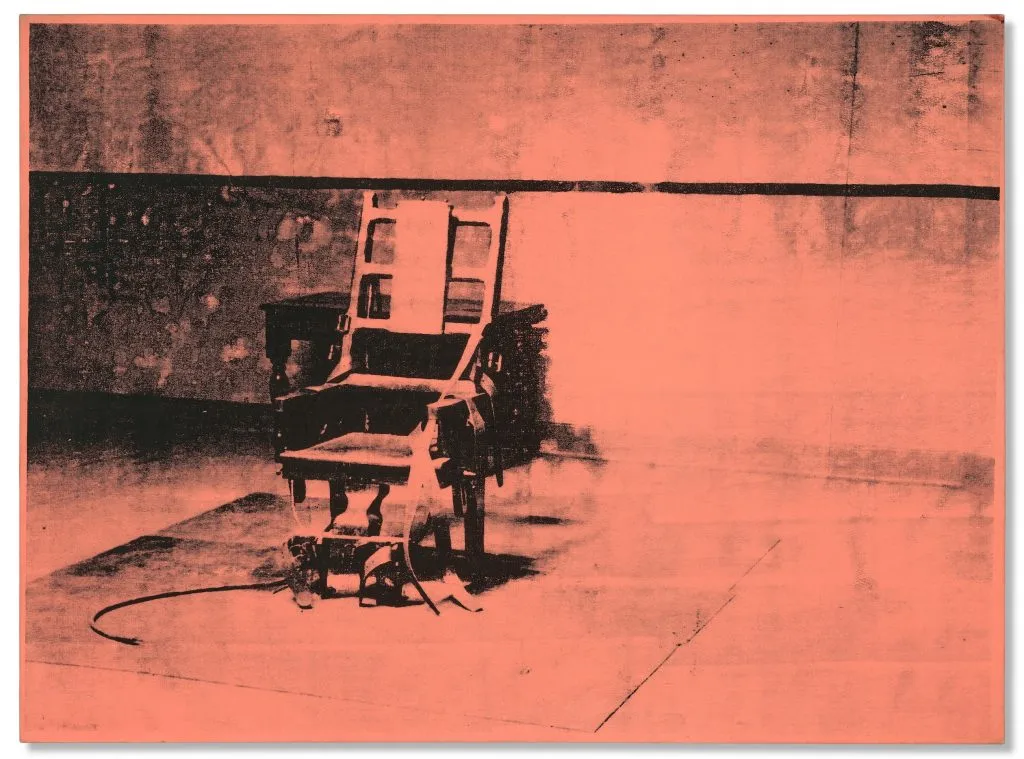
Andy Warhol in 10 Artworks: Andy Warhol, Big Electric Chair, 1967–1968. Courtesy Christie’s. Artnet.
Big Electric Chair is a later entry in the Death and Disaster series, the project Warhol initiated for the 1964 Sonnabend Gallery show in Paris, when he first exhibited Mustard Race Riot. Warhol captured a moment when attitudes toward capital punishment were beginning to shift. He formally began the series in 1963, the same year New York State carried out its last electrocution. Warhol kept returning to the Electric Chair subject into the 1970s, creating an extensive body of work that includes around 14 large paintings, 40 small ones, and 250 copies of a portfolio of 10 silkscreens.
All works derive from the same source image, varying in color from silver and black to orange and bubblegum pink. They are based on a 1953 press photograph of the death chamber at Sing Sing Correctional Facility in New York, the location where Julius and Ethel Rosenberg were executed after being convicted of conspiracy to commit espionage for the Soviet Union. It is one of the most haunting and widely collected Warhol series—an always empty chair, leaving the viewer to imagine it occupied.
7. Mao (1972)
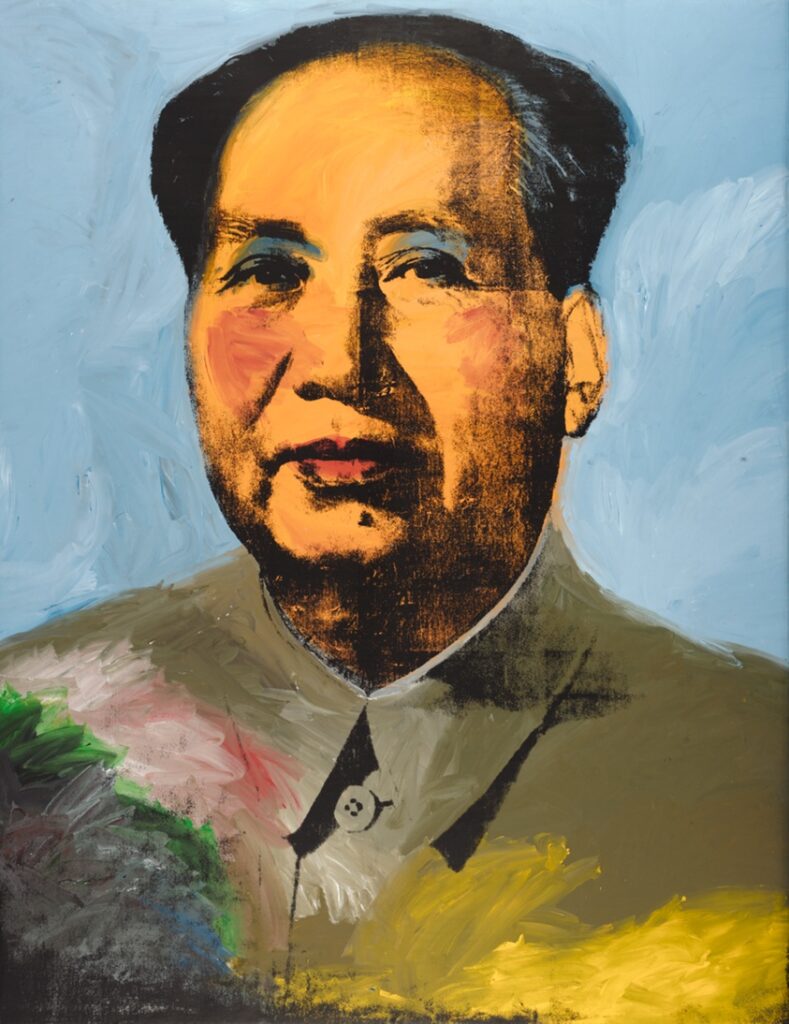
Andy Warhol in 10 Artworks: Andy Warhol, Mao, 1972, Art Institute of Chicago, Chicago, IL, USA. © 2018 The Andy Warhol Foundation for the Visual Arts, Inc. / Artists Rights Society (ARS), New York.
After several years of prioritizing film, Warhol returned to painting to portray one of the most famous faces of the 20th century, Mao Zedong, the founding father of the People’s Republic of China. After President Nixon’s visit in 1972, Mao’s official portrait was everywhere, which, for Warhol, was less propaganda than opportunity. Warhol made 199 Mao paintings in five different sizes between 1972 and 1973.
Warhol read in Life magazine that Mao was the most famous person in the world, so he approached his image the way he did Marilyn, as one that had taken on a life of its own. In some versions, Warhol applied cosmetic brushwork over the silkscreens, adding blush, lipstick, and eyeshadow, transforming the Chairman into something that reads as portraiture, propaganda, and drag at the same time. Three monumental, dragged-out Maos—15 feet tall and 11 feet wide (4.5 x 3.5 m)—are held by Hamburger Bahnhof in Berlin, the Art Institute of Chicago, and the Met.
8. Prince (1984)
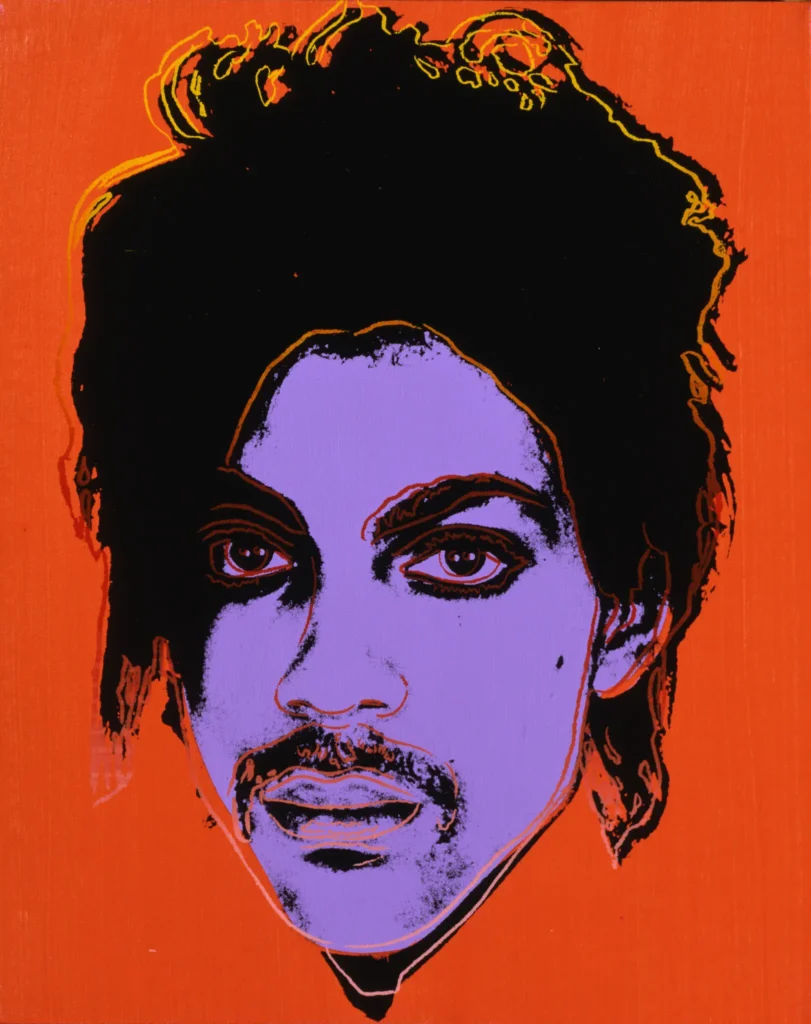
Andy Warhol in 10 Artworks: Andy Warhol, Prince, 1984; based on a photograph by Lynn Goldsmith. The Andy Warhol Foundation for the Visual Arts, Inc./Licensed by Artists Rights Society (ARS), New York. The New York Times.
In 1984, Warhol was commissioned by Vanity Fair to create a portrait of Prince for an article called Purple Fame. Warhol worked off a studio portrait taken three years earlier by Lynn Goldsmith, a photographer on assignment for Newsweek who received $400 when the photo was licensed for one-time use. Warhol created Purple Prince for the November issue and 15 additional color variations for his personal collection. The Prince Series remained largely unnoticed for over 30 years.
After the pop star’s untimely death in 2016, media giant Condé Nast—Vanity Fair‘s parent company—licensed Orange Prince from the Andy Warhol Foundation for a commemorative issue, paying 25 times more than what the photographer had initially received. Goldsmith got nothing at first. She sued after seeing the cover of the tribute issue. After years of legal wrangling, in 2023, the case reached the Supreme Court, which ruled in Goldsmith’s favor. The Court determined that commercial licensing did not qualify as fair use, a landmark decision that narrowed down what counts as a new and original artwork made from someone else’s image. The four Prince variations not in private collections are in the Andy Warhol Museum.
9. Self-Portrait (1986)
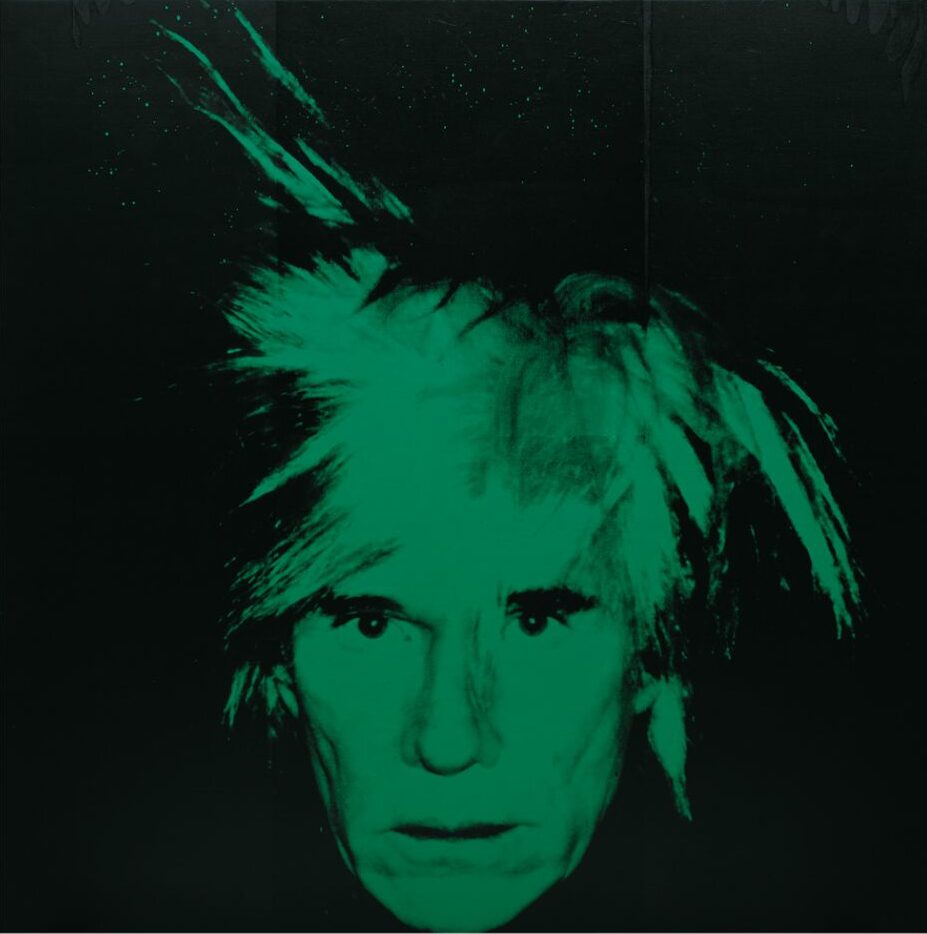
Andy Warhol in 10 Artworks: Andy Warhol, Self-Portrait, 1986, Solomon R. Guggenheim Museum, New York, NY, USA. © 2023 The Andy Warhol Foundation for the Visual Arts, Inc./Artists Rights Society (ARS), New York.
This is part of Warhol’s “fright wig” series, the last self-portraits he made for his London dealer, Anthony d’Offay, in 1986. There are believed to be five color versions on this monumental scale (106 in/269.2 cm square). Warhol used portraiture throughout his career to construct a public identity, making hundreds of self-portraits across photographs, prints, and paintings. But in this series, finished the year before his death, Warhol locked in the image that people still remember him by.
Warhol’s earlier self-portraits generally follow the system he used for celebrity portraiture: photograph, silkscreen, color, repeat. His last self-portraits use those tools too, but strip the image down completely. While not confessional or sentimental, they are among his most revealing self-images. Unlike most portraits, the body is almost non-existent. Warhol’s head appears spectral, in the Guggenheim version almost glowing in acid green, disembodied against a dark background, sporting his signature silver wig in spikes. The painting has the feel of a vanitas, as he becomes a brand in his own right—the Andy Warhol persona as his greatest work of art.
10. The Last Supper (1986)
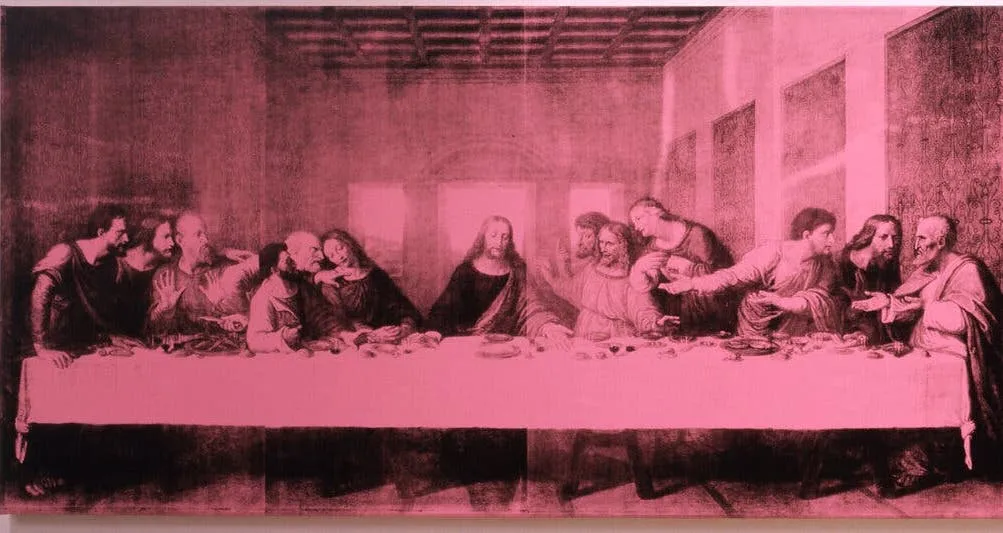
Andy Warhol in 10 Artworks: Andy Warhol, The Last Supper, 1986. The Andy Warhol Foundation for the Visual Arts, Inc./Artists Rights Society (ARS), New York. Artnet. Detail.
In his final major body of work, Warhol produced nearly 100 variations on Leonardo’s Last Supper. Commissioned by gallerist Alexandre Iolas, the exhibition opened in Milan in January 1987 at a palazzo directly opposite Santa Maria delle Grazie, the church and convent that house Leonardo’s original. Warhol did not work from Leonardo directly, but from low-grade reproductions that he cropped, enlarged, colored, and rearranged. By blending art history, religion, and advertising, the series shows how sacred images become clichés through endless reproduction.
The Last Supper series was also created at a time of great suffering for the gay community during the AIDS crisis. The disease impacted Warhol’s close circle; his boyfriend, Jon Gould, died of AIDS in 1986 at age 33, and Iolas was in the late stages of the illness at the Milan opening, dying a few months later. Warhol attended Catholic mass his entire adult life, a fact he kept mostly private. The series is often understood as an expression of the conflict between his faith and his sexuality. Warhol died of cardiac arrhythmia following routine gallbladder surgery one month after the show’s opening, on February 22, 1987.