Summary
- Lady Gaga, Beyoncé, and a dress made out of living microorganisms make an appearance.
- Old colonial systems challenged in a Monet-like composition.
- Check out some delectable Bad Fruits.
- Felipe Baeza presents a window to the soul.
- Arte Povera icon Giuseppe Penone going strong at 80.
- Way before Bad Bunny there was Sophie Rivera.
- Vaughn Spann flies the flag for (All) Americans.
- A Filipino artist channels Hieronymus Bosch.
- A preview of the Hammershøi 2027 show.
- Frieze highlights Latin American art.
- Comme des Garçons makes a rare NYC appearance.
- Modern “tapestries” in unsettling pastel colors.
This is not a definitive list of works, nor even an attempt at a consensus. It is the kind of list that could be rewritten a dozen more times, each with 12 completely different selections. But that is part of the fun. Somewhere between the overload, the genuinely great work, and the occasional thing that makes you wonder what everyone else is seeing, certain pieces manage to cut through the noise. Let us now take a deep breath and enjoy DailyArt Magazine’s highlights of New York Art Week 2026!
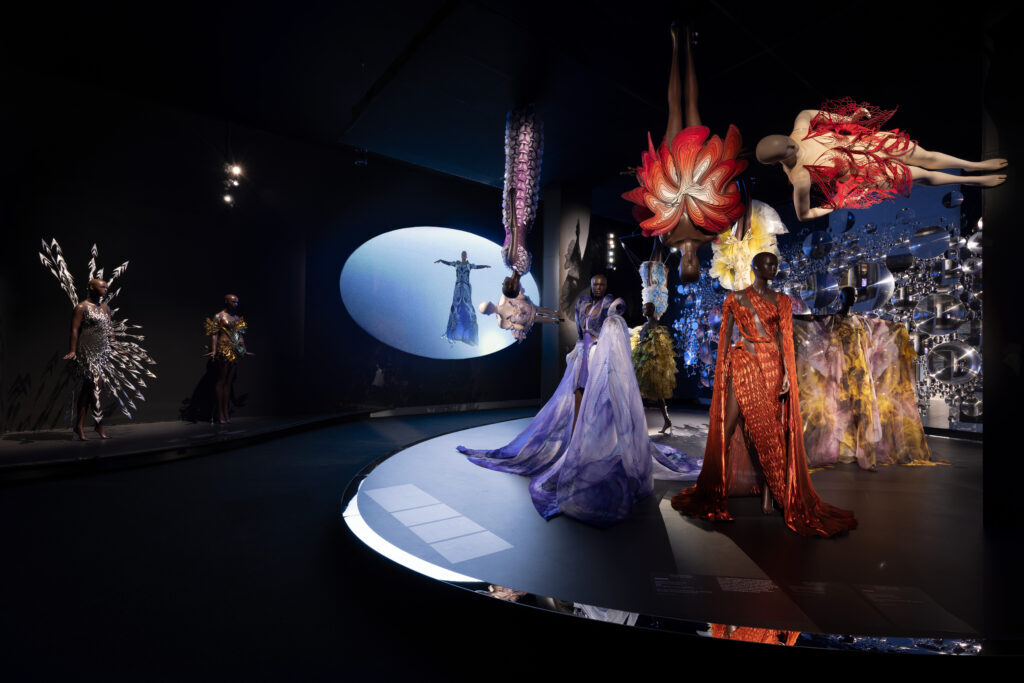
Installation view Iris van Herpen: Sculpting the Senses, Brooklyn Museum, 2026. (Photo: On White Wall) Courtesy Brooklyn Museum.
1. Nature Is the Best Artist—Iris van Herpen
The Met may have held the gala, but the Brooklyn Museum is now the House of Van Herpen, hosting the Dutch designer’s first major New York retrospective. Iris van Herpen: Sculpting the Senses displays more than 140 haute couture pieces next to the fossils, old scientific drawings, artworks, and music that inspired them. The numerous highlights include Chromatica-era looks Lady Gaga wore in 2020, Beyoncé’s Heliosphere Dress from the 2023 Renaissance tour, and the original 2016 bubble dress, the Seijaku, getting fresh attention because Eileen Gu wore a newer version to this year’s Met Gala.
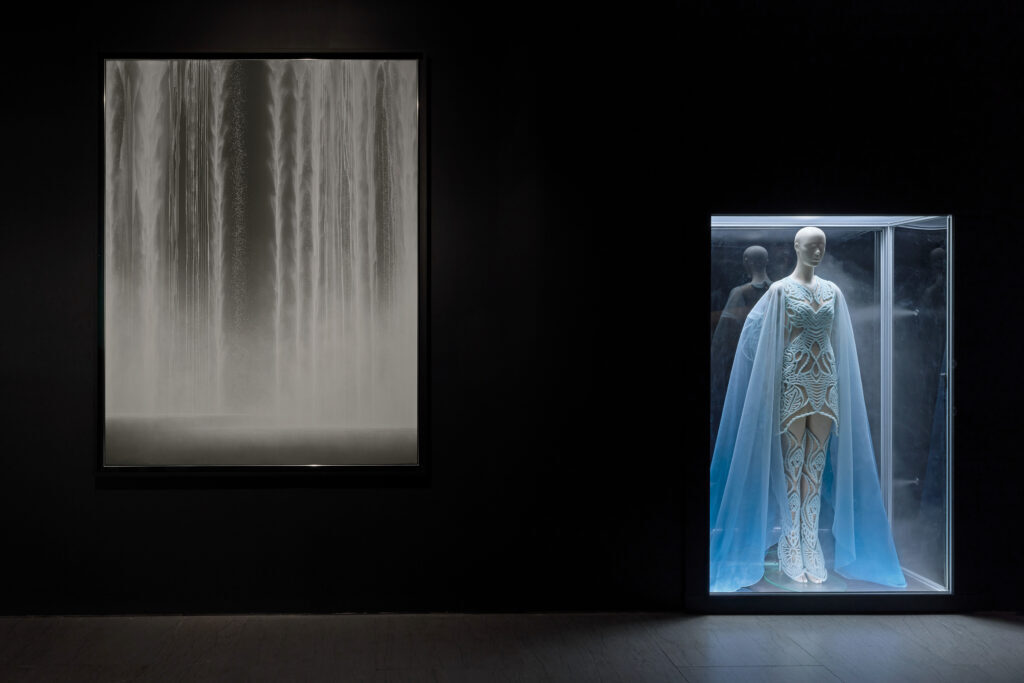
Installation view Iris van Herpen: Sculpting the Senses, Brooklyn Museum, 2026. (Photo: On White Wall) Courtesy Brooklyn Museum.
But the main event is the Living Algae look, the first garment of its kind, built from 125 million bioluminescent algae that give off light when the wearer moves. Van Herpen created it with help from biodesigner Chris Bellamy and researchers at the University of Amsterdam. The algae were grown in seawater baths over months, then set into a nutrient gel behind a protective membrane. The microorganisms remain alive inside the structure and make the material read as cloud-like, luminescent lace. The museum displays the garment in a climate-controlled chamber, underscoring Van Herpen’s thesis: “Nature is the best artist.”
2. It’s the Firelei Báez Show
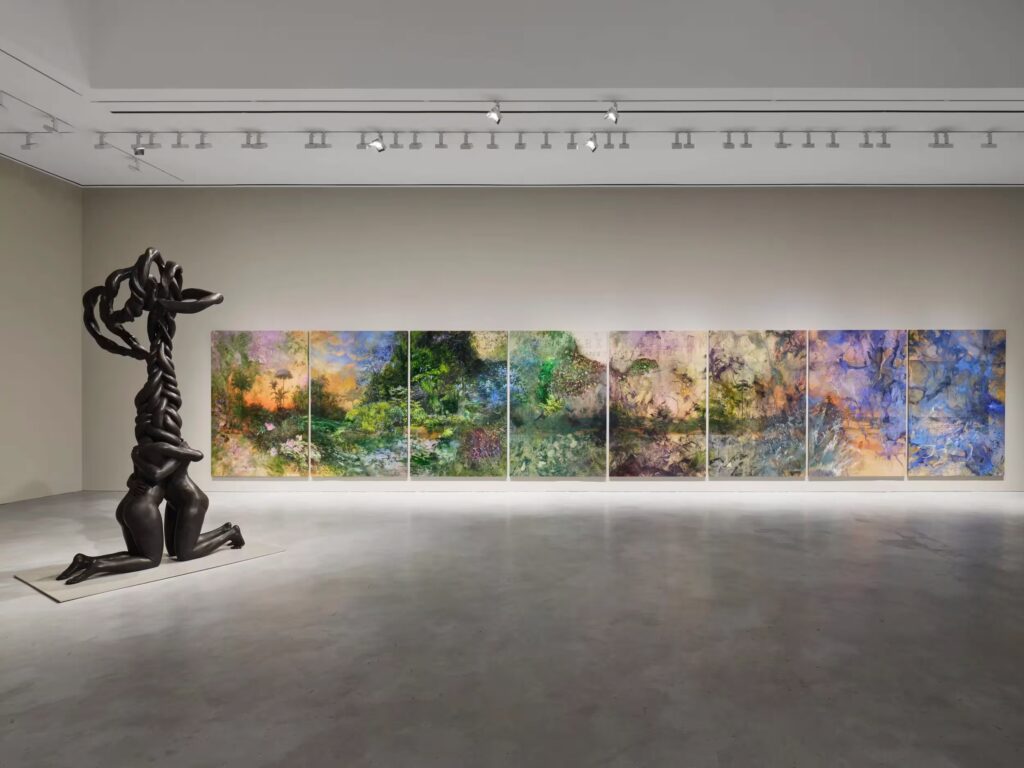
Firelei Báez, View of Nature (Existing not in the cycles themselves but only in the interactions of the cycles), 2026 / Artists Rights Society (ARS), New York. Photo: Sarah Muehlbauer (Hauser & Wirth).
Firelei Báez’s newest exhibition features the stunning eight-panel Monet-reminiscent composition View of Nature (2026) stretching across the gallery’s back wall. Based on an 1852 scientific engraving by Scottish geographer John Emslie mapping climate zones, Báez transforms a fixed system of measurement and classification into a multilayered visual field where forms dissolve and shift from tropical greens and oranges into icy blues and whites.
Báez was born in the Dominican Republic, and her work frequently addresses the legacy of colonialism in the Caribbean. Báez uses things like maps, scientific diagrams, and historical imagery to challenge the tools of power of old colonial systems. She distorts and breaks them apart with layers and flowing paint to show that identity and history are not fixed or cleanly organized. The striking show follows a string of major museum exhibitions across Europe and the United States. It includes an expansion of Báez’s practice: two monumental bronze sculptures based on ciguapas, shape-shifting female beings from Dominican folklore. Báez uses the ciguapa as a symbol of transformation and resistance to imposed identity.
3. Too-Good-to-Be-Bad Fruits
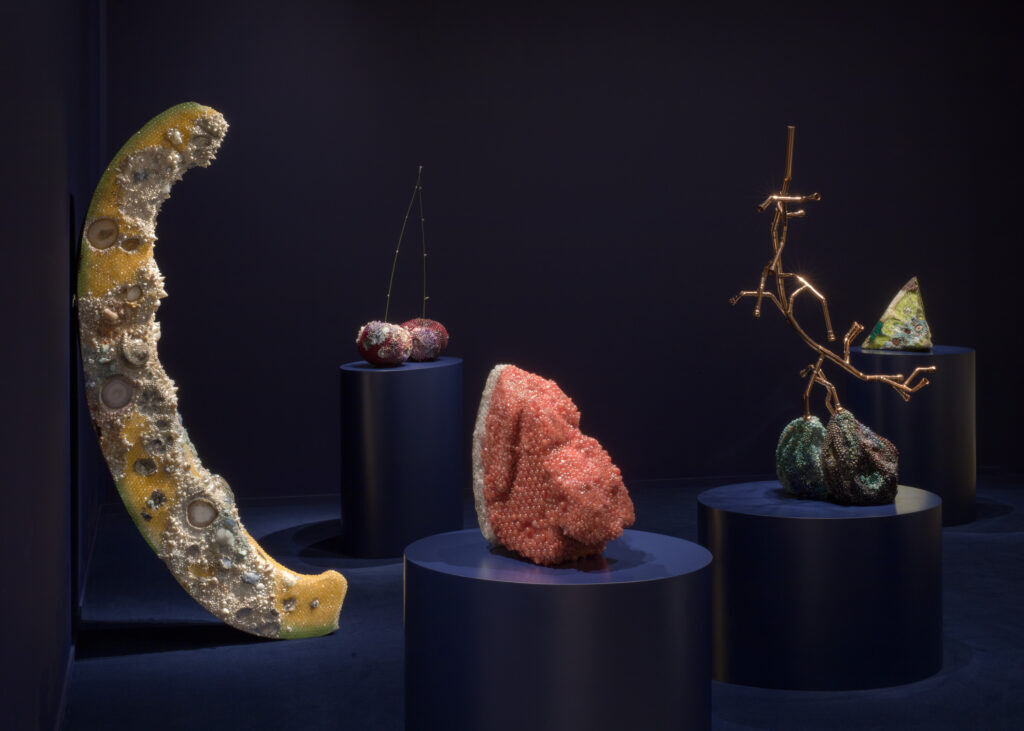
TEFAF New York Installation view Gagosian New York © Kathleen Ryan—Photo: Lance Brewer. Courtesy Gagosian.
Art world darling Kathleen Ryan’s Bad Fruit sculptures are once again a sensation, and for good reason. The artist reimagines rotten produce as jewelry rather than compost. Ryan assembles her sculptures from layered minerals and salvaged industrial waste, highlighting her masterful handling of beads, stones, pearls, quartz, and even bits of old cars.
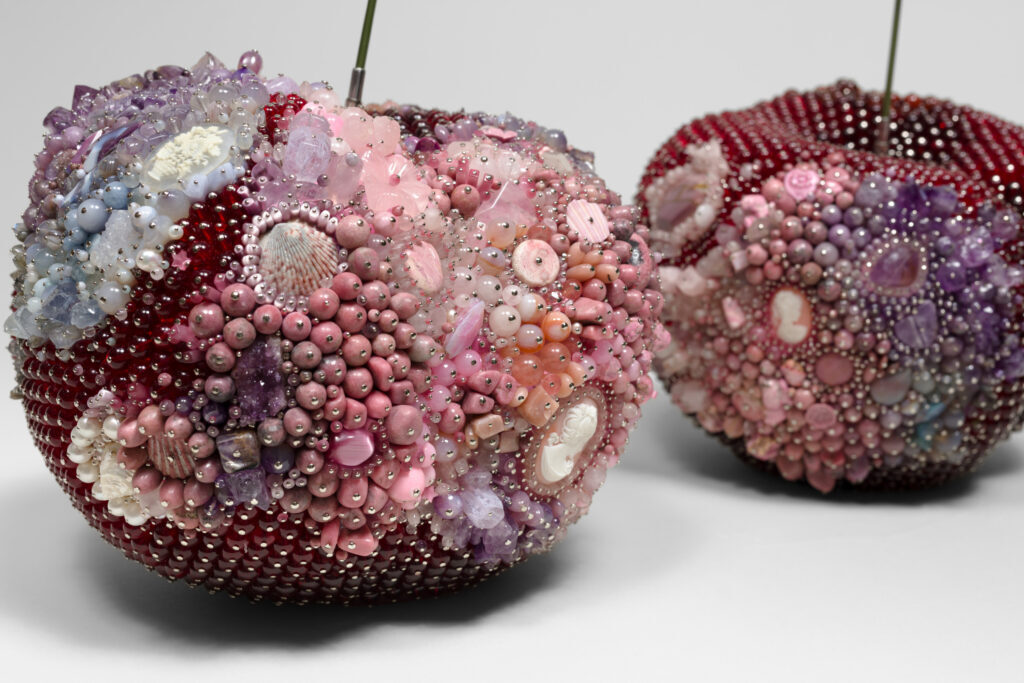
Detail. Kathleen Ryan, Bad Cherries (Princess), 2026 © Kathleen Ryan—Photo: Lance Brewer. Courtesy Gagosian.
Ryan began the beautifully decaying still-life series in 2018 by drawing on Dutch vanitas still lifes and mid-century American faux fruit. A reflection of a postwar fantasy of abundance, permanently “fresh” artificial fruit was a common part of suburban decoration in the 1940s–1960s. Ryan scales up cherries, oranges, grapes, melons, and limes so they lose their domestic feel and become oversized, jewel-like objects that read more like geology or industrial debris than home décor.
4. The Soulful Eyes of Felipe Baeza
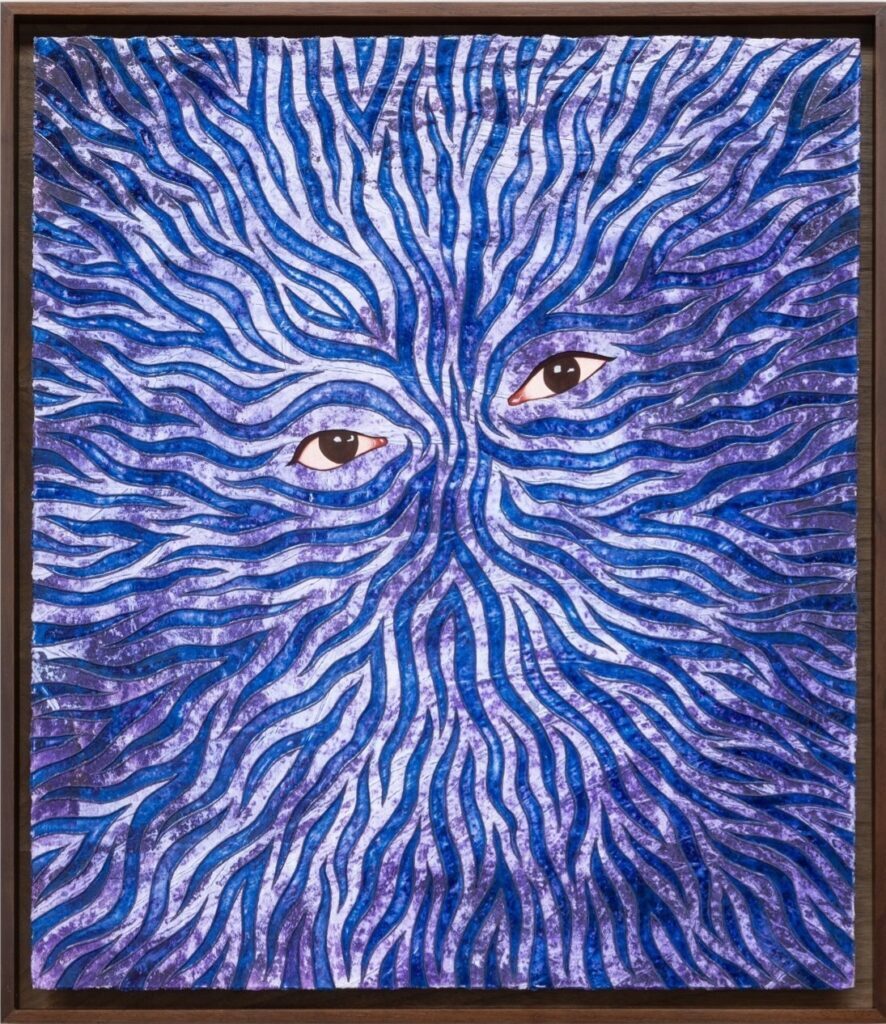
Felipe Baeza, Sonder (James), 2025, was part of the exhibition Felipe Baeza: Anima at New York Print Center. Courtesy of the artist, kurimanzutto Mexico City / New York (OndaMX).
The captivating Sonder series focuses on the eyes of figures inspiring to artist Felipe Baeza, among them American novelist James Baldwin and transgender activist Sylvia Rivera, a pioneer in the gay liberation movement that followed the Stonewall uprising. Baeza explores queer and migrant themes through gazes and bodies that are only partly recognizable, as if resisting a fixed identity. Felipe Baeza: Anima at the Print Center is the first exhibition in New York to survey the artist’s practice. Its title—taken from the idea of a person’s soul or spirit, and from the earliest piece on display—sets the tone for an artist preoccupied with what lies beneath the surface.
Born in Mexico in 1987 and now based in Brooklyn, Baeza makes figurative art that combines printmaking, collage, and painting. Baeza has invented new techniques in printmaking integral to the artist’s practice. Treating paper almost like skin, Baeza scrapes, soaks, and layers it so it stretches and absorbs pigment over time. Baeza describes the muted palette of blues, purples, grays, and pinks as colors holding both “tenderness and a slight unease,” allowing these enigmatic figures to emerge and dissolve. Baeza had a breakout institutional appearance in the 2022 Venice Biennale.
5. Arte Povera Enters the Bronze Age
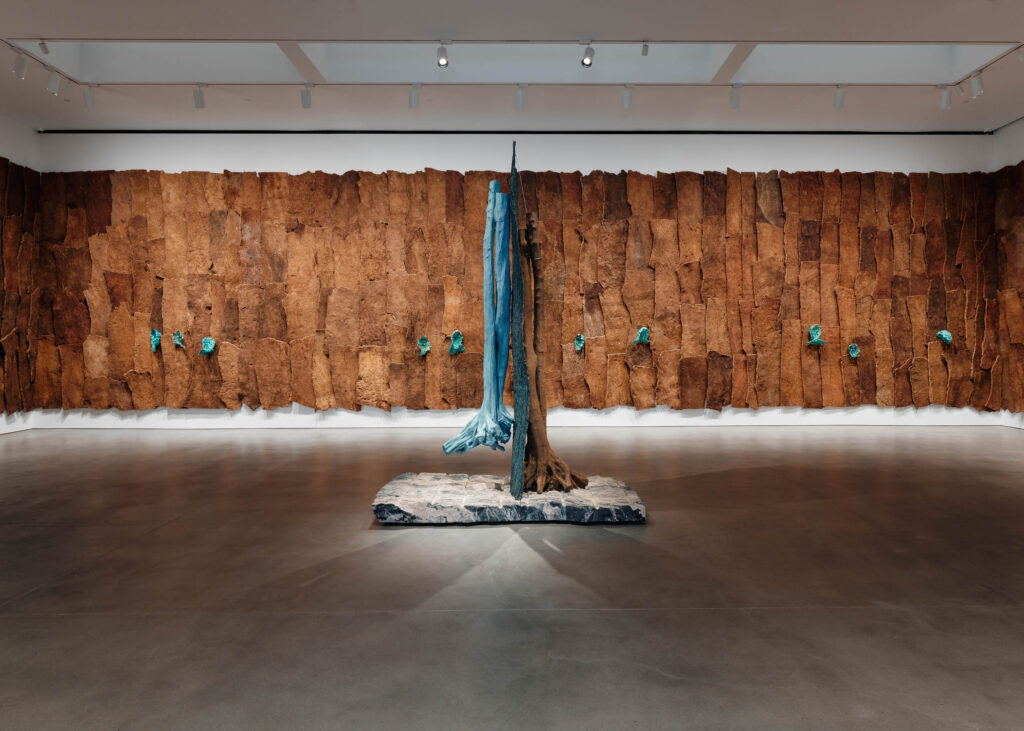
Giuseppe Penone, Marsia (Marsyas), 2024, Giuseppe Penone/2026 Artists Rights Society (ARS), New York/ADAGP, Paris. Photo: Maris Hutchinson (Gagosian)
In the hands of Italian artist Giuseppe Penone, bronze is a living material: molten metal runs like tree sap and patina grows like skin. The Reflection of Bronze brings together historical and new works to create an immersive environment, and the imposing first room of the exhibition makes it onto our list. The large cork-covered space evokes the atmosphere of a forest and features a stripped tree trunk referencing the Greek myth of Marsyas, who was flayed for having the fatal overconfidence of defying the god Apollo.
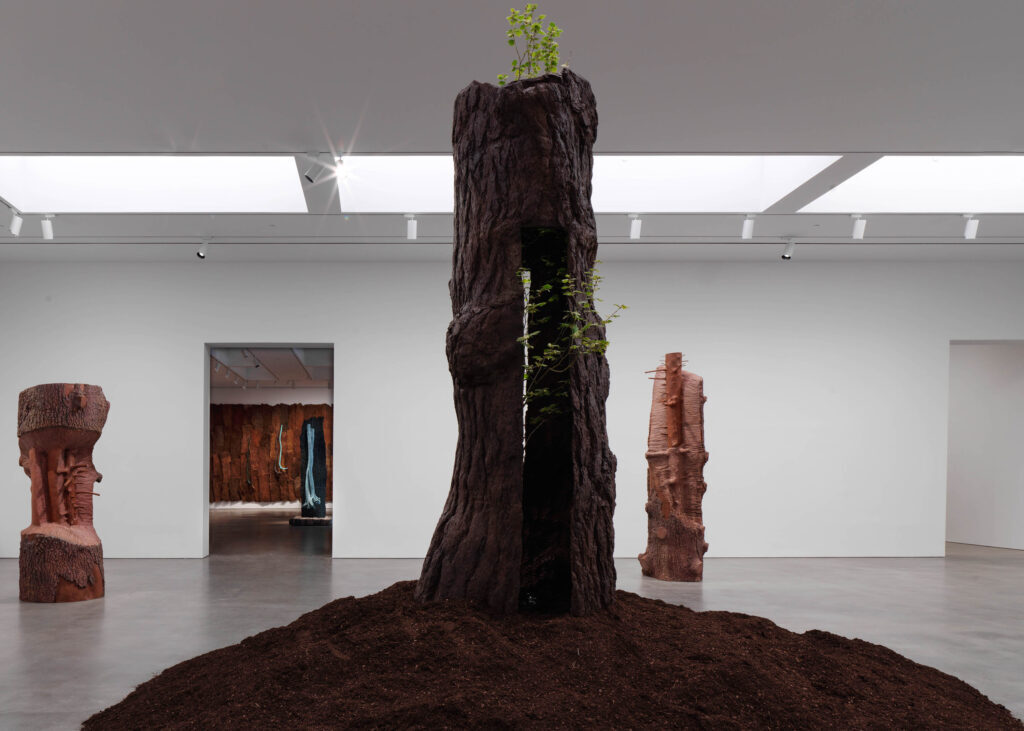
Giuseppe Penone, A Year of Bronze–Larch, 2024 / Giuseppe Penone/2026 Artists Rights Society (ARS), New York/ADAGP, Paris. Photo: Maris Hutchinson (Gagosian).
Penone is interested in the juxtaposition of a material used for thousands of years—meant to outlast human life—and treating it like a living system. The artist has been subverting conventions since the 1960s Arte Povera movement, which challenged expensive, traditional artistic materials. One of his earliest works involved gripping a tree so that its growth would gradually envelop the imprint of his hand, later cast in bronze. By treating bronze as “alive,” Penone links sculpture to trees and natural cycles. (There is even a live tree growing as part of the exhibition!)
6. Visibility Through Sophie Rivera’s Lens
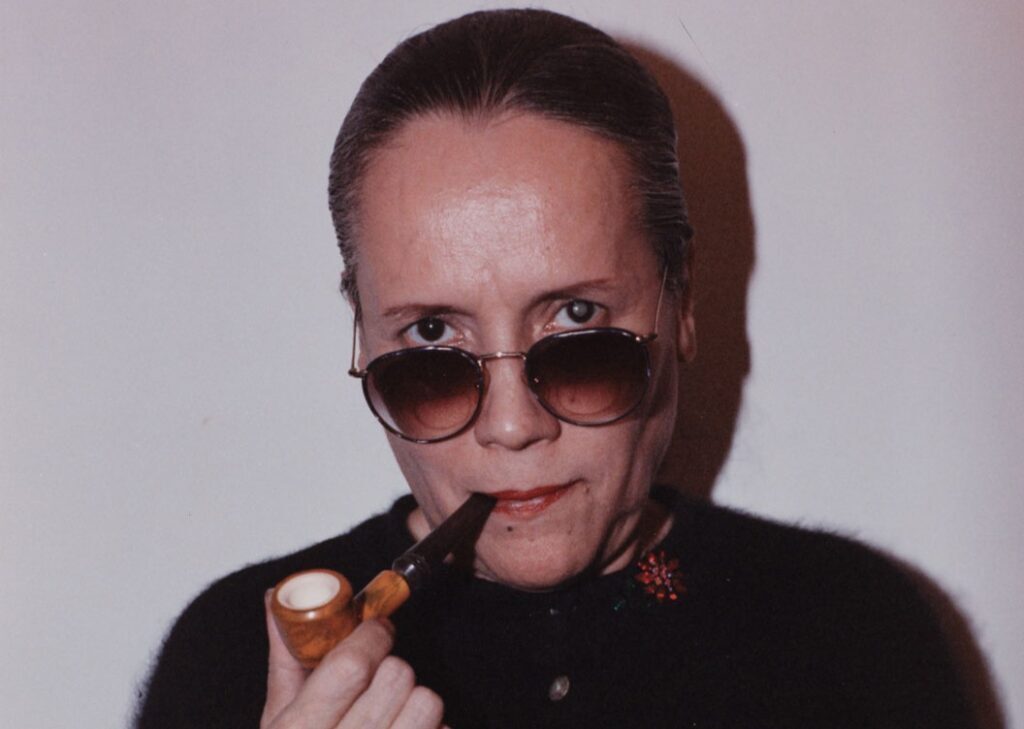
Detail. Sophie Rivera, Untitled, c. mid-1980s. Rivera’s color self-portrait shows her with a tobacco pipe, the one a doctor blamed for the cataracts seen obscuring her eyesight. (El Museo del Barrio).
Long before Puerto Rican artist Bad Bunny became the world’s most-streamed performer and headlined the 2026 Super Bowl halftime show in Spanish, Sophie Rivera worked on redefining the image of Latinos in the U.S. In the 1970s, when negative racial and ethnic stereotyping saturated popular culture, Rivera celebrated everyday Puerto Ricans in pictures that were later exhibited at large scale in the subway system. Her role in shaping New York City’s visual culture is explored in Sophie Rivera: Double Exposures, the first career survey of her place in American photography.
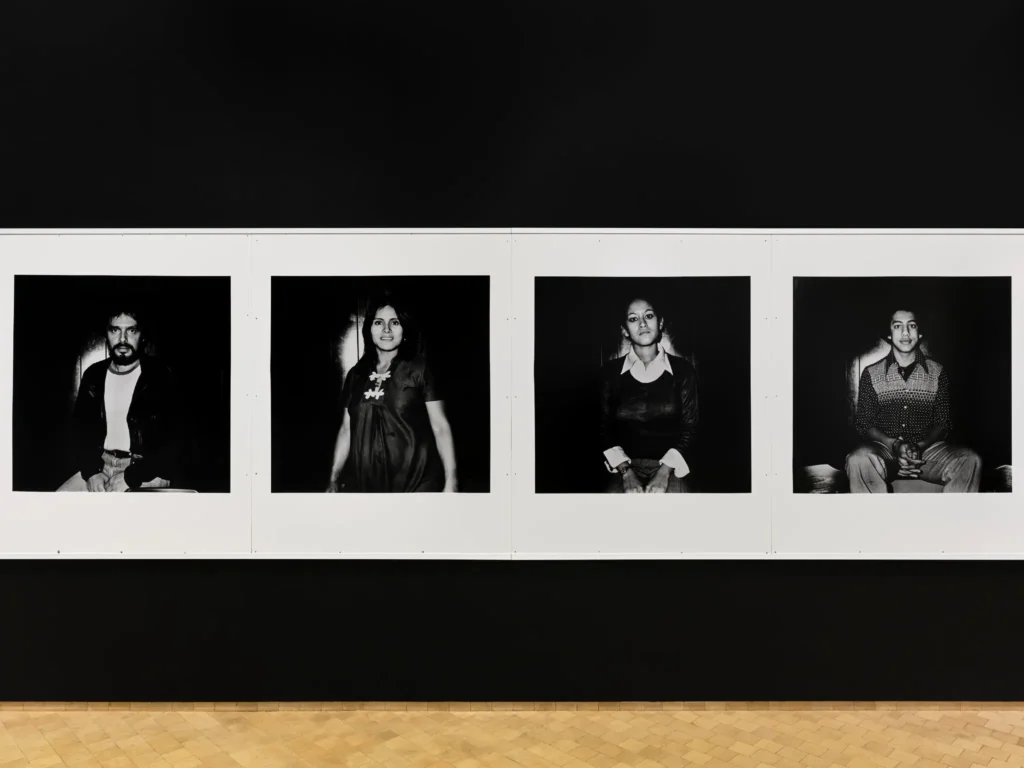
Installation view Sophie Rivera: Double Exposures, El Museo del Barrio, New York, 2026. Photograph by Matthew Sherman/ El Museo del Barrio, New York City, NY, USA.
Shown in their original scale (4 ft x 4 ft), Rivera’s subway portraits may be conventional in format but are radical in style. The pictures, manipulated to feature halos of light, were shown at a time when no other mainstream art in New York documented the Latino experience. The exhibition at El Museo del Barrio brings together portraits, street photography, subway scenes, and double-exposure experiments, emphasizing Rivera’s sustained engagement with city life and a rare focus on the importance of Latinx voices in the broader story of American art.
7. The Star-Spangled Banner, Remixed
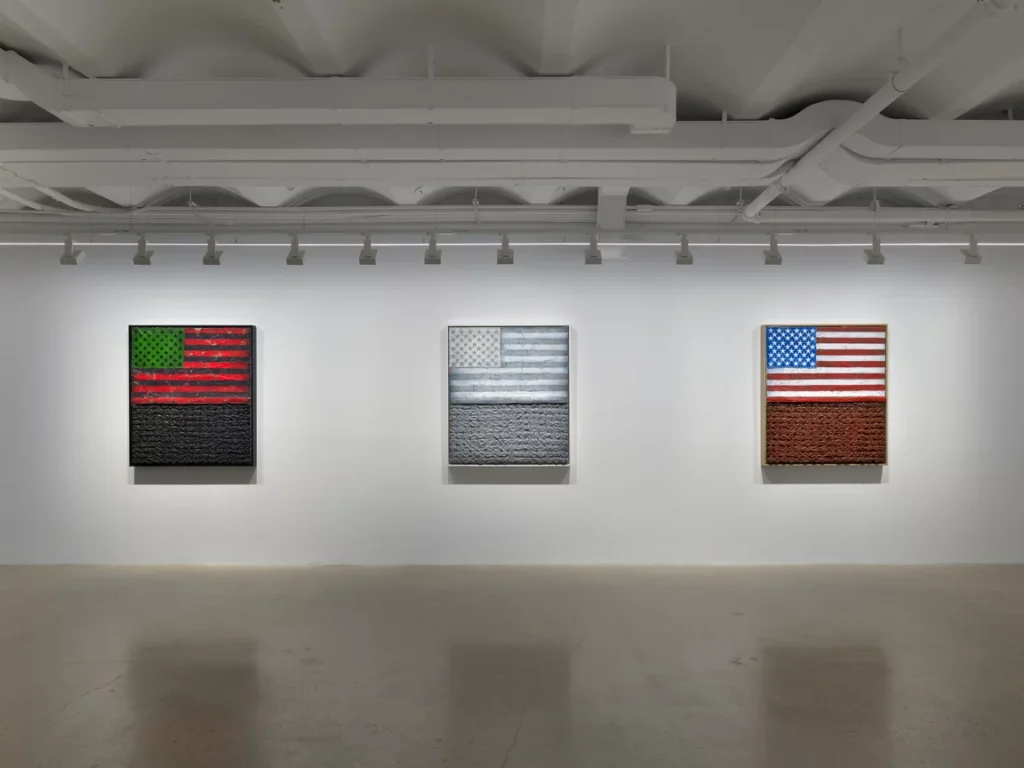
Installation view Vaughn Spann, (All) Americans, Almine Rech New York, 2026. Photo: Dan Bradica. (Almine Rech).
Vaughn Spann’s (All) Americans exhibition uses flag paintings to question national pride and belonging. Drawing on the experience of Black Americans, Spann explores how the anthem and flag promise home and freedom to all U.S. citizens, yet many feel excluded. While Jasper Johns famously used the American flag as a repeated, pre-existing image to explore perception and how symbols function when they become paintings, Spann expands and reworks the imagery to directly address the Black experience.
A poignant mixed-media work in the exhibition is America (In Grey). Spann transforms the red-white-and-blue stars and stripes by removing almost all color, which can be read as ashes and the mourning of the loss of the American Dream. Spann positions flags as shifting between hope and despair, depending on the viewer’s position, emphasizing it as a contested American symbol tied to exclusion and belonging in the current charged political environment.
8. A Pinoy Garden of Earthly Delights
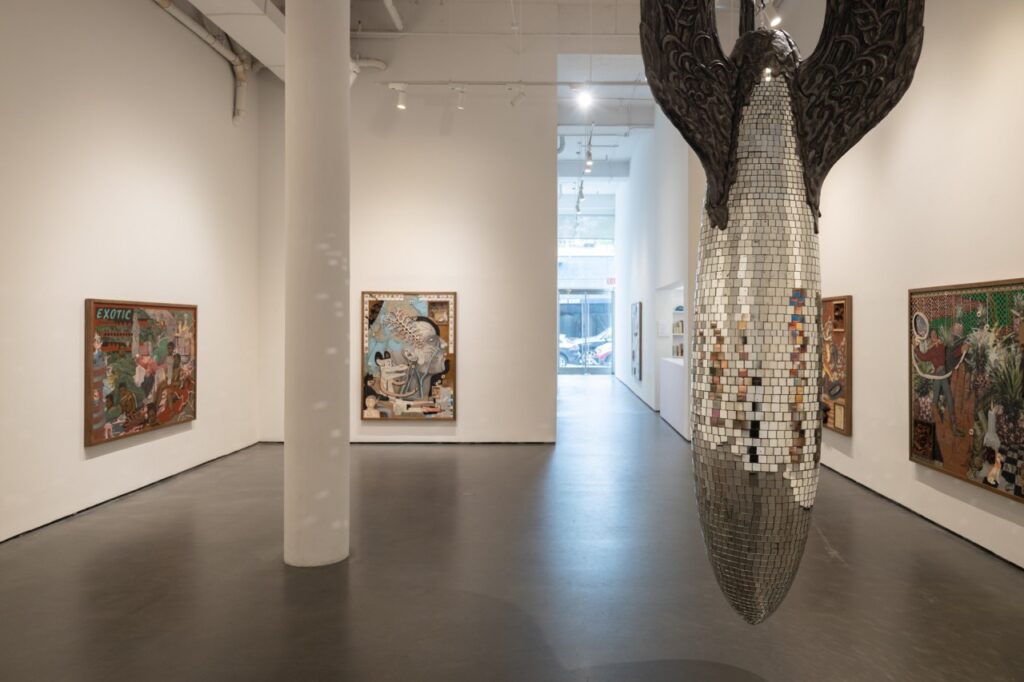
Kawayan de Guia’s Exotic Adventures in the land of not so plenty on view on the left of the bomb-turned-disco-ball at Silverlens Gallery.
Multidisciplinary artist Kawayan de Guia turns a bomb into a disco ball and the Silverlens Gallery into a collection of large-scale assemblage paintings that address the Philippines’ present and its long colonial past. Composed of scavenged indigenous and colonial objects, de Guia’s assemblages depict abundance as spectacle, while scarcity remains the inescapable condition of the people whose lives and work sustain such wealth. His imagery is excessive to the point of absurdity; Asian stereotypes on steroids.
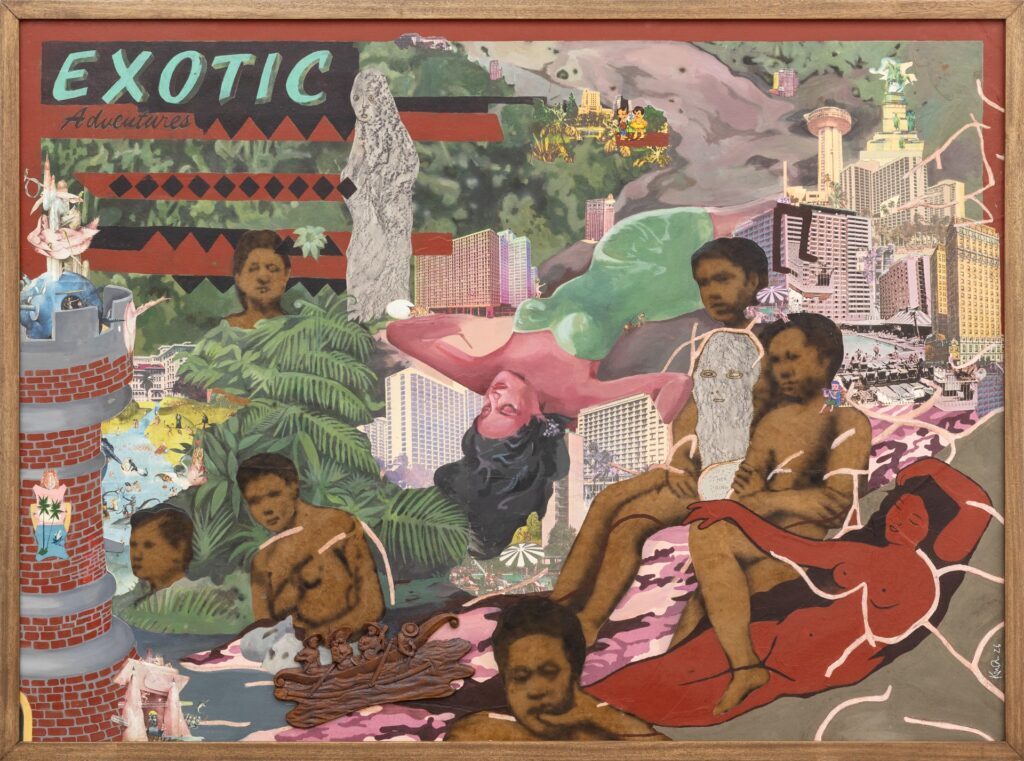
Kawayan de Guia, Exotic Adventures in the land of not so plenty, 2026, Silverlens Gallery.
The themes explored by de Guia come through most sharply in one assembled work: Exotic Adventures in the land of not so plenty. Along the left side, de Guia collaged a reproduction of Hieronymus Bosch’s Garden of Earthly Delights, splicing in a colonial-era resort hotel into the garden. Bosch’s painting is one of the most famous visions of paradise in Western art, a sprawling fantasy of naked figures and earthly pleasures that has been read for five centuries as a moral warning that temptation and consumerism lead to damnation. It is the O.G. false paradise in art history, and de Guia builds his own on top of it.
9. A Snapshot of Hammershøi 2027
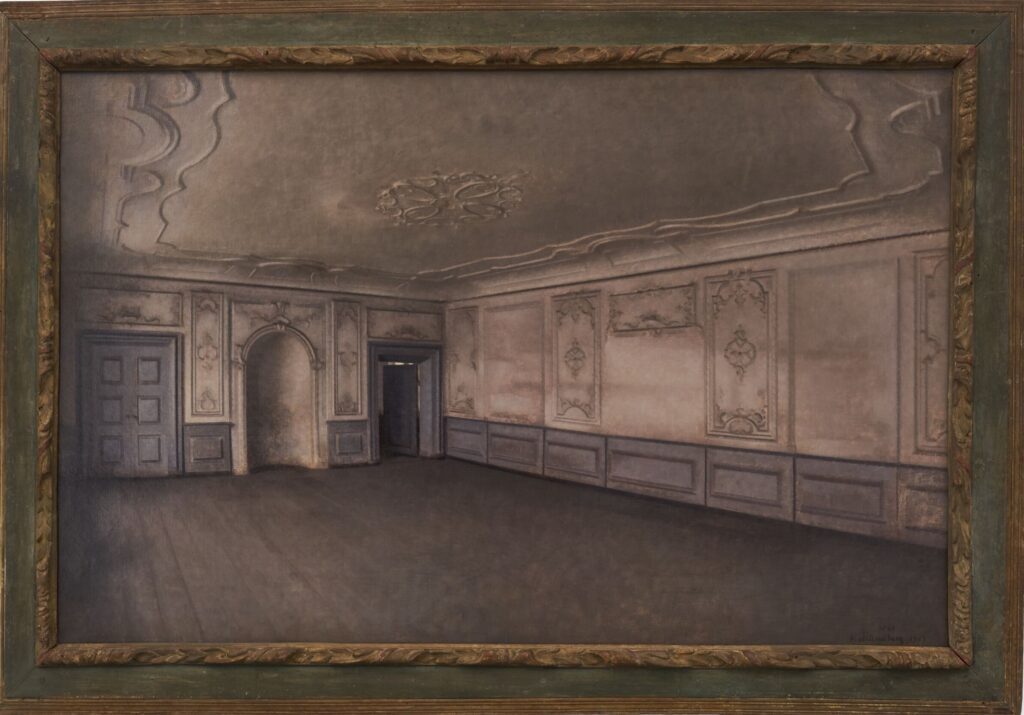
Vilhelm Hammershøi, Interior of the Great Hall in Lindegaarden, 1909, private collection. Photo: Annik Wetter (Hauser & Wirth).
Before the first comprehensive Vilhelm Hammershøi museum show travels to the U.S. in 2027, Hauser & Wirth dedicated a solo booth at TEFAF to the Danish painter, known for quiet interior scenes from his Copenhagen apartment. His visual vocabulary often employs low, diffused light in almost-empty rooms, soft gray-green and taupe tones, doors left ajar, and figures often turned away. Hammershøi’s Interior of the Great Hall in Lindegaarden (1909) expertly uses doorways and varying planes in perspective to tell a story about the evocative geometry of an empty room.
The artist has been widely shown and studied in Denmark, gaining a cult following in Europe and the U.S. Earlier this year, Museo Thyssen-Bornemisza held the first large-scale presentation of his work in Spain. The exhibition, which places Hammershøi’s work in a broader European artistic context, will move on to Switzerland before traveling to an American museum TBD. Hammershøi is often compared to Vermeer and Hopper for the way he turns everyday interiors into studies of light, stillness, and psychological distance.
10. Latin American Art Takes Center Stage
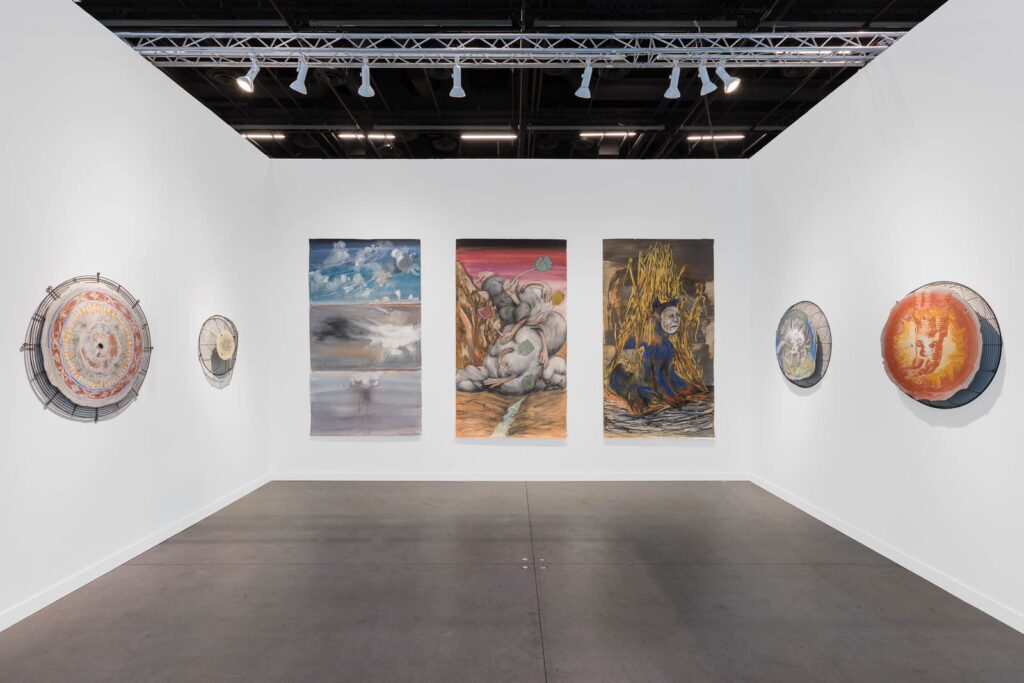
Campeche’s booth at Frieze New York 2026, featuring work by artist Abraham González Pacheco. Photos by Mark Blower. Courtesy of the artist and Campeche, Mexico City.
Frieze New York 2026 was marketed as having “a particularly strong representation of Latin American art.” We are, to be clear, doing a little booth-level aggregation here rather than pretending this is all cleanly legible at the single-work scale. Still, Fátima González at Mexico City’s Campeche and Omayra Alvarado at Colombia’s Instituto de Visión make a convenient one-two punch for a fair edition that counted 14 galleries from Latin America.
Campeche took a genuine gamble on a practice that doesn’t yet have a market with a solo presentation of Abraham González Pacheco, an artist known for large-scale graphite drawings and concrete works. González Pacheco’s star is on the rise after producing a mural-based commission for the Carnegie International. The earthy, conceptually dense works that he calls “archaeological fictions” draw on pre-Hispanic and colonial history. In Nahual (2025), González Pacheco summons one of Mesoamerica’s most unsettling figures, a shape-shifter who slips from human form at night, an image he built out of oral histories from his own grandfather.
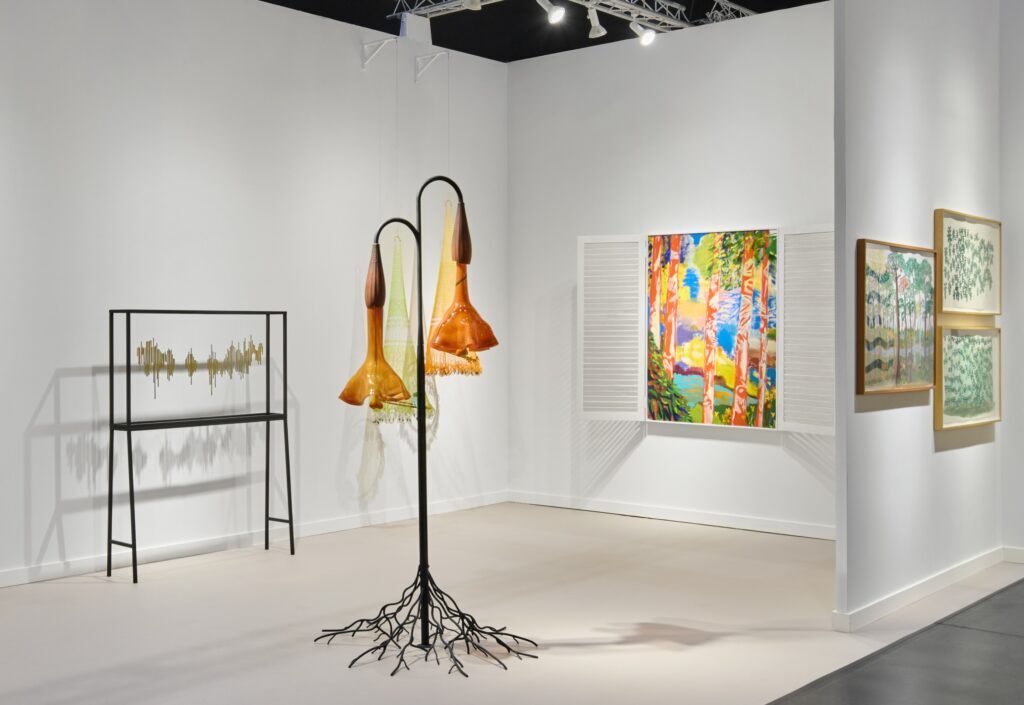
Installation view, Instituto de Visión, Frieze New York 2026. (Instituto de Visión).
Instituto de Visión brought star power and showstoppers. Carolina Caycedo, currently in the Venice Biennale’s main show In Minor Keys, suspended two real fishing nets, hand-dyed yellow-green, each cradling an embroidered frog or crab. Pia Camil, who filled the Guggenheim’s rotunda with a large-scale installation of secondhand T-shirts from immigrant communities in 2019, mounted blazing forest paintings inside working white shutters that swing open like windows. And Tania Candiani, who represented Mexico at the 2015 Venice Biennale, brought two sound sculptures, including the clever Prosperidad y Abundancia (2026), which attempts to catch sound waves in midair with dozens of brass tubes on a black frame reflecting a shadow waveform on the wall behind it.
11. Comme des Garçons Reverses the Runway
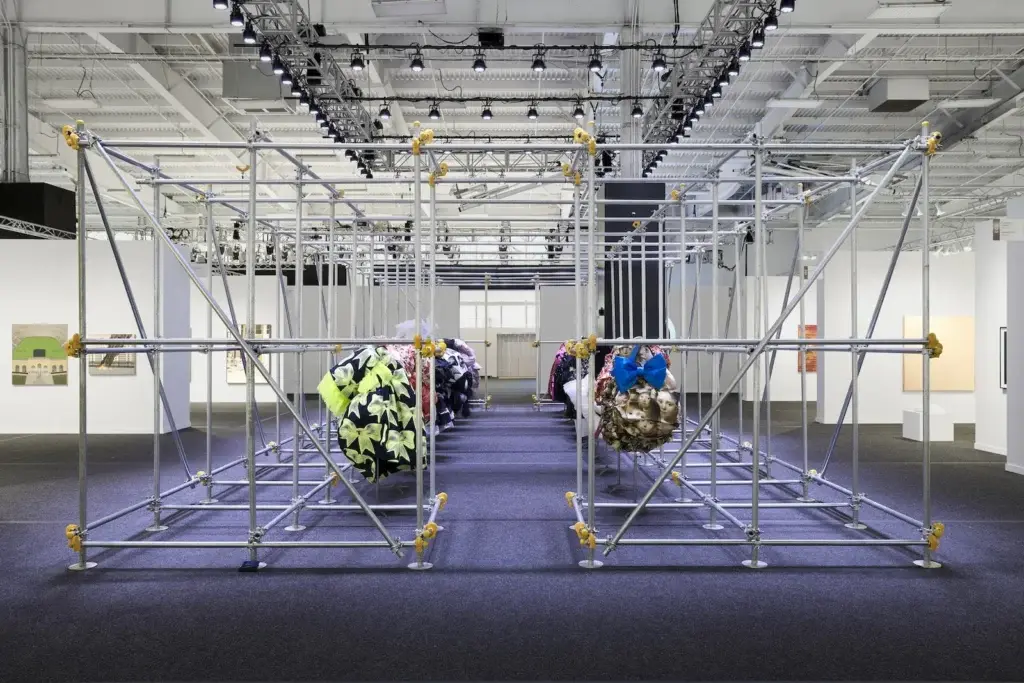
Comme des Garçons special installation conceived by Rei Kawakubo at the Independent Art Fair. Photography by Andy Romer / CKA. Courtesy of Independent.
The 17th edition of the Independent art fair included a fashion-focused installation featuring 20 creations by the fashion house Comme des Garçons selected by Rei Kawakubo; a rare showing in New York of the Japanese designer’s work since the 2017 Met Costume Institute exhibition. Presented within a scaffolding-like structure, the installation reversed runway roles, with visitors walking the catwalk while garments occupy both sides. All garments were for sale.
The showpieces selected by Kawakubo were from collections spanning the last decade, highlighting Comme des Garçons’ sculptural style, emphasis on distorted silhouettes, and artistic references. As fairs continue to reinvent the conventional art-market format, the display blurred the lines between fashion and sculpture, fitting Independent’s aim to merge fashion, art, and exhibition design.
12. Genesis Belanger’s Sad Pastels
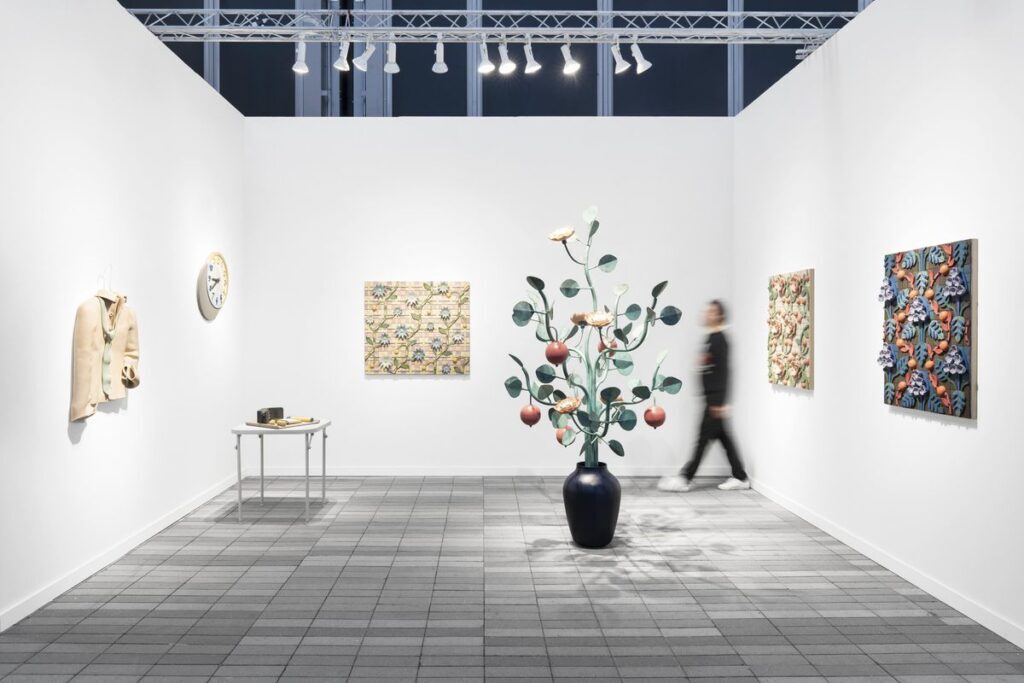
At Frieze New York 2026, Perrotin dedicated a booth to a solo presentation of Genesis Belanger’s work. (Perrotin).
Genesis Belanger is well known for sculptural installations of finely detailed porcelain and stoneware objects that move between emotional tension and simple humor. The colors are soft and pastel, but the mood is often unsettling—the artist calls her palette “sad pastel.” The New York-based artist, who had her first solo museum show in 2020, blends influences from Surrealism to Pop Art while drawing on consumer culture.
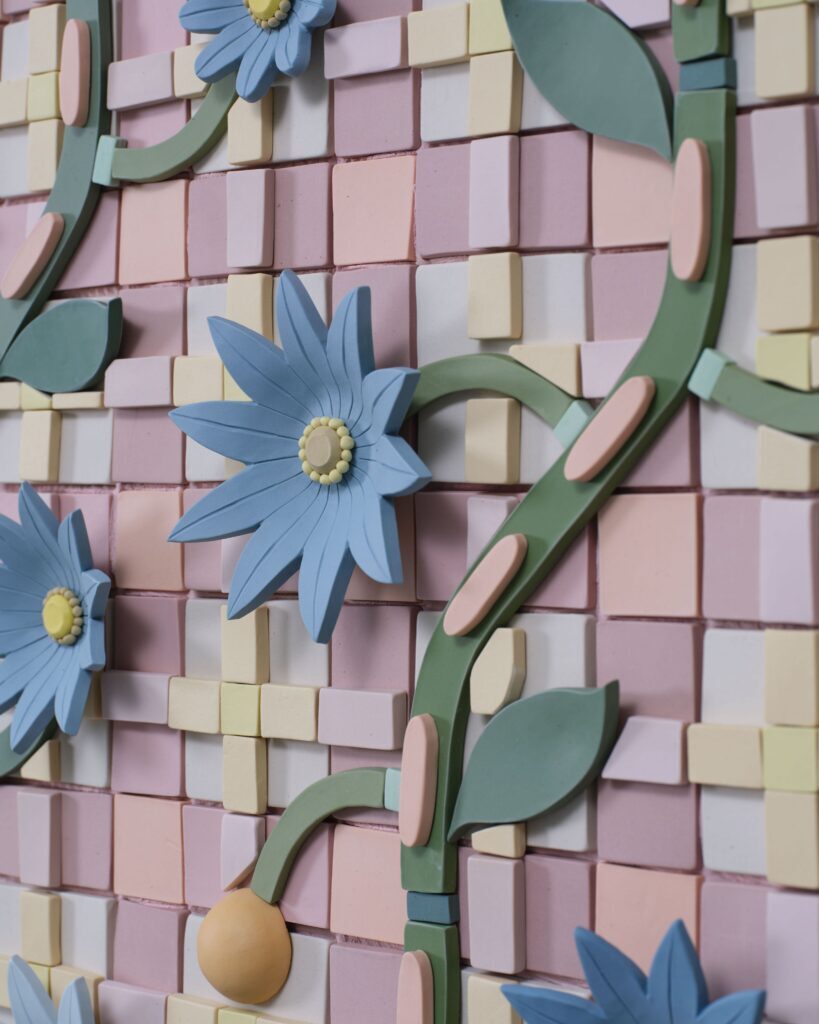
Genesis Belanger, Sun Bleached Boogie-Woogie, 2026. (Perrotin).
In a nod to Piet Mondrian‘s iconic painting at MoMA, Sun Bleached Boogie-Woogie is the latest in Belanger’s three-dimensional floral mosaic series, for which she drew on a long art-historical tradition of nature imagery. Think medieval tapestries for the modern, digital imagery-saturated world. Frieze previewed Belanger’s work ahead of her Heads or Tails Public Art Fund commission, a much-anticipated series of sculptural vignettes at City Hall Park scheduled for June 2026.