




5 Spots Not to Miss in Upper Silesia with German-Polish Heritage
Upper Silesia in Poland is a beautiful and extremely interesting off-the-beaten-track region to visit for its historic, natural, and cultural values.
Kate Wojtczak 9 July 2026
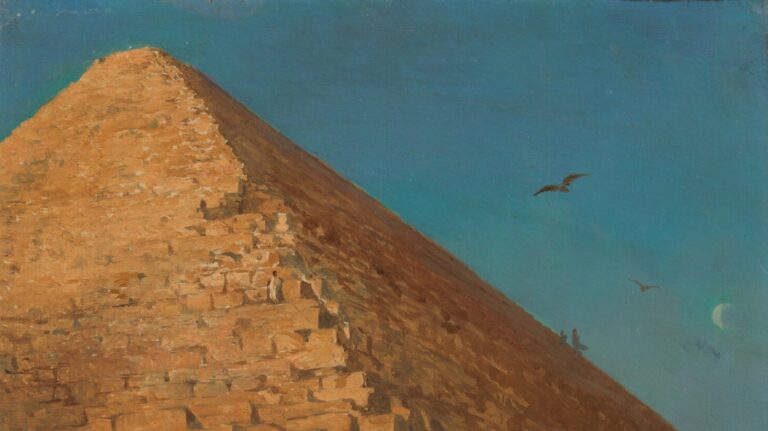
Famous locations in art: Adrien Dauzats, The Great Pyramid, Giza, ca. 1830, Metropolitan Museum of Art, New York City, NY, USA. Detail.
Art and travel share a deeply symbiotic relationship, leading to vibrant portrayals of famous locations around the world. Artworks capture the essence of these notable sites, transforming them into compelling visual narratives that ignite curiosity and wanderlust. Here are eight artistic depictions that preserve the charm of these sought-after locations and reveal the emotional connection between the artist and the destination.
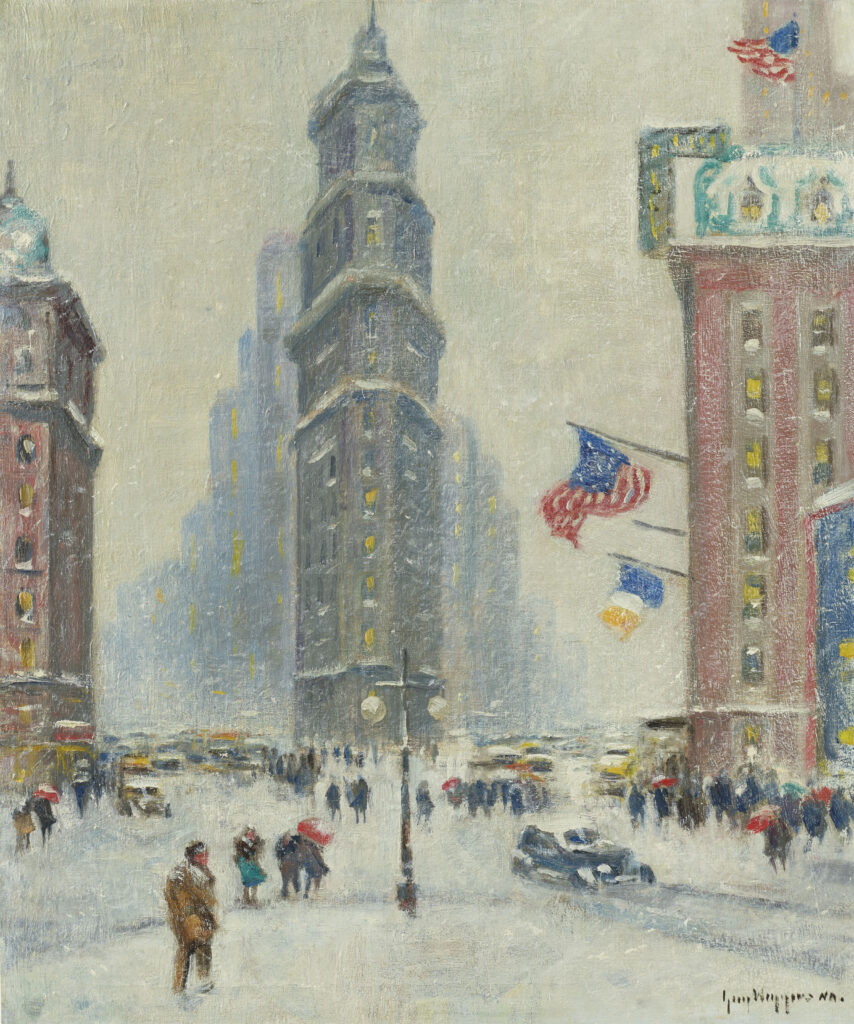
Famous locations in art: Guy C. Wiggins, Times Square, Winter. Christie’s.
Guy C. Wiggins was a prominent American Impressionist painter active during the first half of the 20th century. His father, the accomplished landscape painter Carleton Wiggins, was his first teacher and an early influence. Wiggins later studied at the National Academy of Design in New York, reportedly training under legendary masters William Merritt Chase and Robert Henri. Gaining recognition early in his career, he became especially known for his paintings of New York City landmarks and streets blanketed in snow.
Among the New York subjects attributed to Wiggins is Times Square, one of the world’s most heavily visited tourist destinations. Originally called Longacre Square, it was renamed in 1904 when The New York Times moved its headquarters to the newly constructed Times Building (now One Times Square). The square is also the site of the annual New Year’s Eve ball drop, a tradition that began in 1907.
In this painting, Wiggins contrasts the apparent tranquility of falling snow with the energy and architecture of one of New York City’s most recognizable locations.
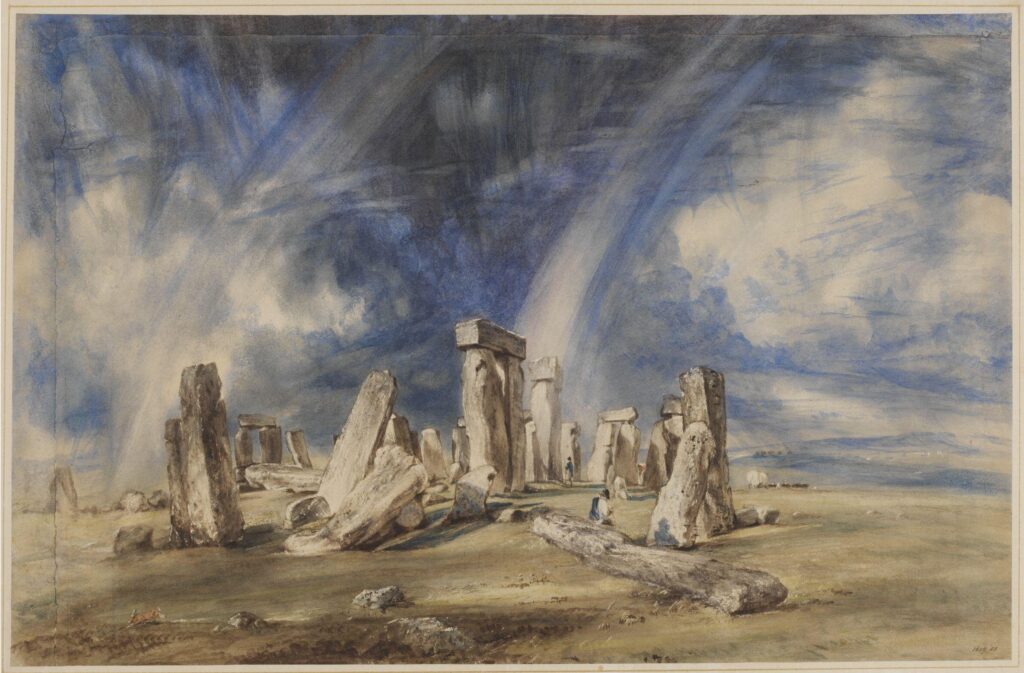
Famous locations in art: John Constable, Stonehenge, 1835, Victoria & Albert Museum, London, UK.
John Constable’s watercolor of Stonehenge offers an evocative interpretation of this famous ancient monument during a poignant period in his life. Known for his landscapes, Constable captures Stonehenge amidst a sweeping sky and rolling countryside, emphasizing the grandeur and mystery of the stones while blending seamlessly with the natural landscape. This portrayal not only highlights the timeless presence of Stonehenge but also reflects Constable’s personal melancholy.
At the time of painting, Constable was grieving the loss of his wife, Maria, and his close friend, John Fisher, as well as the departure of his two eldest sons. The watercolor conveys a sense of solitude and introspection, subtly revealing the artist’s emotional state while inviting viewers to contemplate the immense and mysterious significance of Stonehenge.
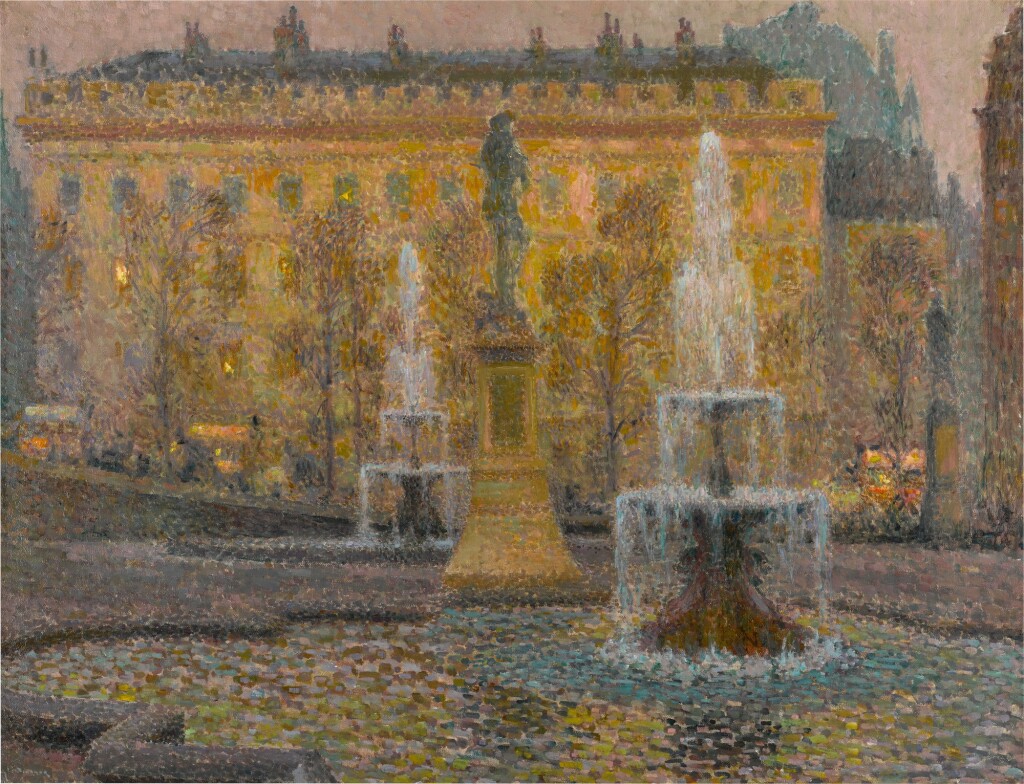
Famous locations in art: Henri Le Sidaner, Trafalgar Square, Londres, 1908. Sotheby’s.
Painted in a rich palette of gold ochre and dusky mauve, this depiction of Trafalgar Square captures the essence of London during a trip made in the winter of 1907. Trafalgar Square, a significant landmark since the 1200s, is a public space located in the City of Westminster, Central London. Established in the early 19th century, the square was built around the historic area of Charing Cross and serves as a commemoration of the Battle of Trafalgar, a crucial British naval victory in the Napoleonic Wars on October 21, 1805.
The painting prominently features the statue of General Charles George Gordon, sculpted by Hamo Thornycroft, which originally stood in the square but has since been relocated to the Victoria Embankment. Framed by flowing fountains on either side, the scene is infused with a tender, soft, and silent atmosphere. Known for his meticulous observation and memory, the artist would often pause to scrutinize the horizon, committing the nuances of light and shadow to memory. In this piece, the play of dusk’s fading light creates a dreamlike and mystical quality, transforming Trafalgar Square into an ethereal vision.
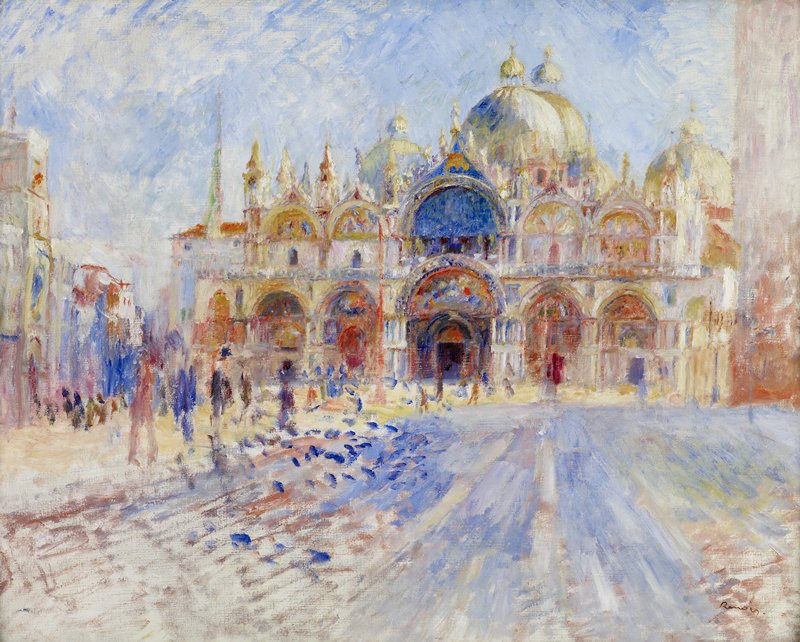
Famous locations in art: Pierre-Auguste Renoir, The Piazza San Marco in Venice, 1881, Minneapolis Institute of Art, Minneapolis, MN, USA.
Pierre-Auguste Renoir, a key figure in the Impressionist movement, was captivated by Venice during his tour of Italy in late October 1881. Like many artists of his time, Renoir was drawn to Venice as its charm and popularity were flourishing among travelers and painters alike. One of the city’s most iconic locations, Piazza San Marco (St. Mark’s Square), became the focus of his artistic attention. This grand public square, home to St. Mark’s Basilica and the Doge’s Palace, had earned a reputation as the heart of Venice. Though it remains unproven, it is said that Napoleon once referred to it as “the world’s most beautiful drawing room.”
Renoir, like a swarm of other artists, positioned himself before the piazza’s sunlit façade, capturing the delicate pinks and creams of its buildings bathed in the midday light. His interpretation of the scene is rendered in the typical Impressionist style, with bright yet sparingly used colors and an almost sketch-like finish. Simple brushstrokes and dabs of paint bring to life the figures and birds scattered across the square, with Renoir’s use of negative space adding depth and airiness to the composition. The result is a vibrant yet serene depiction of Venice’s premier piazza.
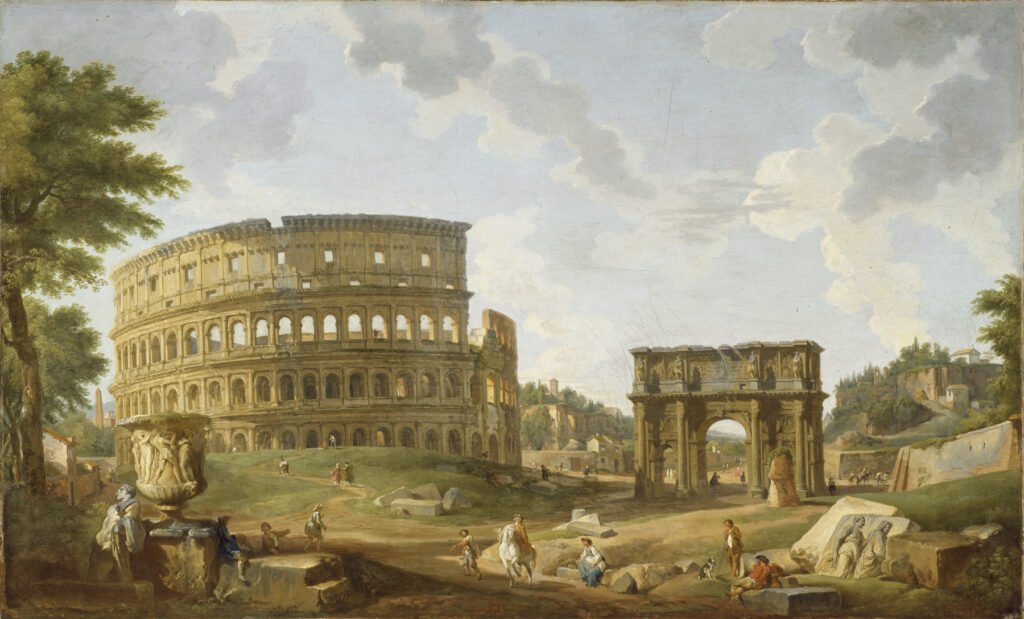
Famous locations in art: Giovanni Paolo Panini, View of the Colosseum, 1747, Walters Art Museum, Baltimore, MD, United States.
Giovanni Paolo Panini was an Italian Baroque painter and architect active mainly in Rome. He is best known for his imaginative vistas of Rome and took a particular interest in the city’s antiquities. His works frequently depict romanticized views of the city’s ancient architecture. Driven by a growing interest in archaeology, Roman ruins regained popularity as subjects by the 1700s, and his works frequently served as souvenir paintings.
In this composition, Panini positions the ruins of the Colosseum alongside the nearby Arch of Constantine. He populates the foreground with various figures in a fanciful reconstruction that also includes the famous Borghese vase.
Completed in 80 CE under Emperor Titus, the Colosseum stands as a grand architectural symbol of the Roman Empire‘s engineering might and rich cultural history. Originally intended to host gladiatorial combats, this massive stone amphitheater is now a popular Roman ruin.
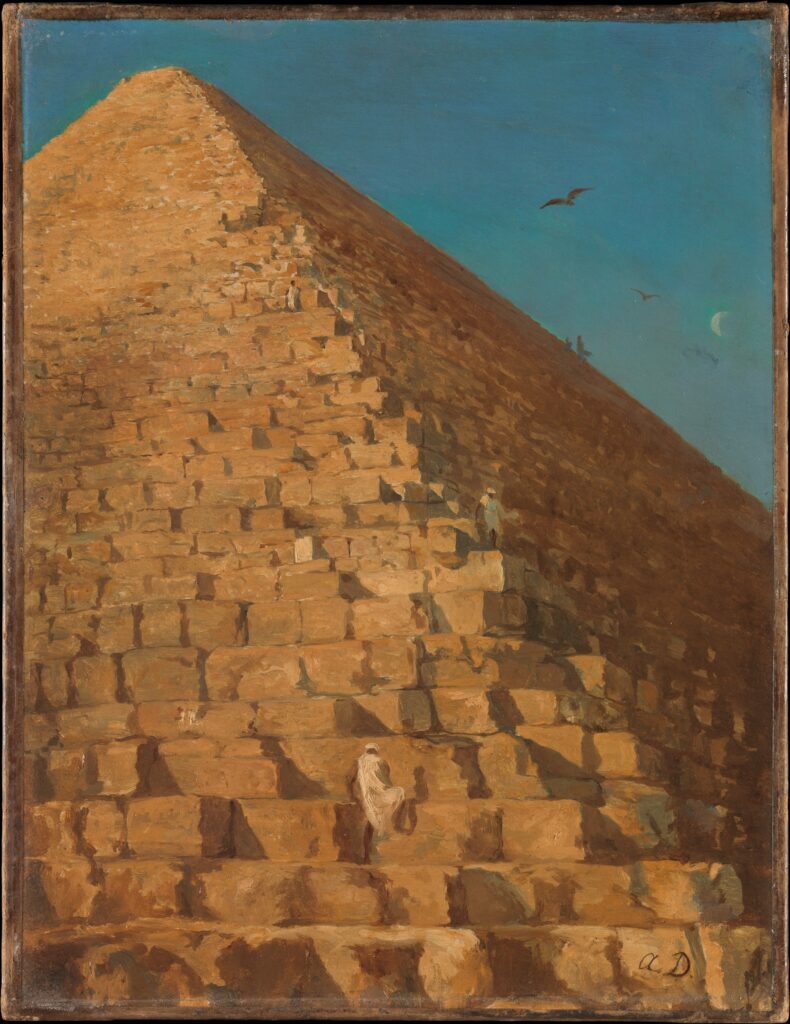
Famous locations in art: Adrien Dauzats, The Great Pyramid, Giza, ca. 1830, Metropolitan Museum of Art, New York City, NY, USA.
The French landscape, genre, and Orientalist painter Adrien Dauzats traveled extensively and frequently illustrated travel literature, which eventually led him to join a diplomatic and cultural mission to Egypt in 1830. This journey coincided with a peak in 19th-century European fascination with Egypt, sparking a wave of Orientalist works by artists eager to document the region’s grand history.
Upon his arrival, Dauzats was profoundly struck by the physical scale of the local monuments, much like any other tourist. Soon after returning to Paris, he painted a striking view of the Great Pyramid of Giza. This structure is the oldest and largest of the pyramids in the Giza complex, originally built as a monumental tomb for the Fourth Dynasty Pharaoh Khufu, and has stood for over 4,500 years. It continues to awe travelers today as one of the Seven Wonders of the Ancient World.
Instead of relying on the usual depictions of these pyramids, Dauzats chose an angle that emphasizes the grand scale, yet the structure remains immediately recognizable. Within the composition, he included small figures that contrast with the massive structures, providing clear context to the grand blocks.
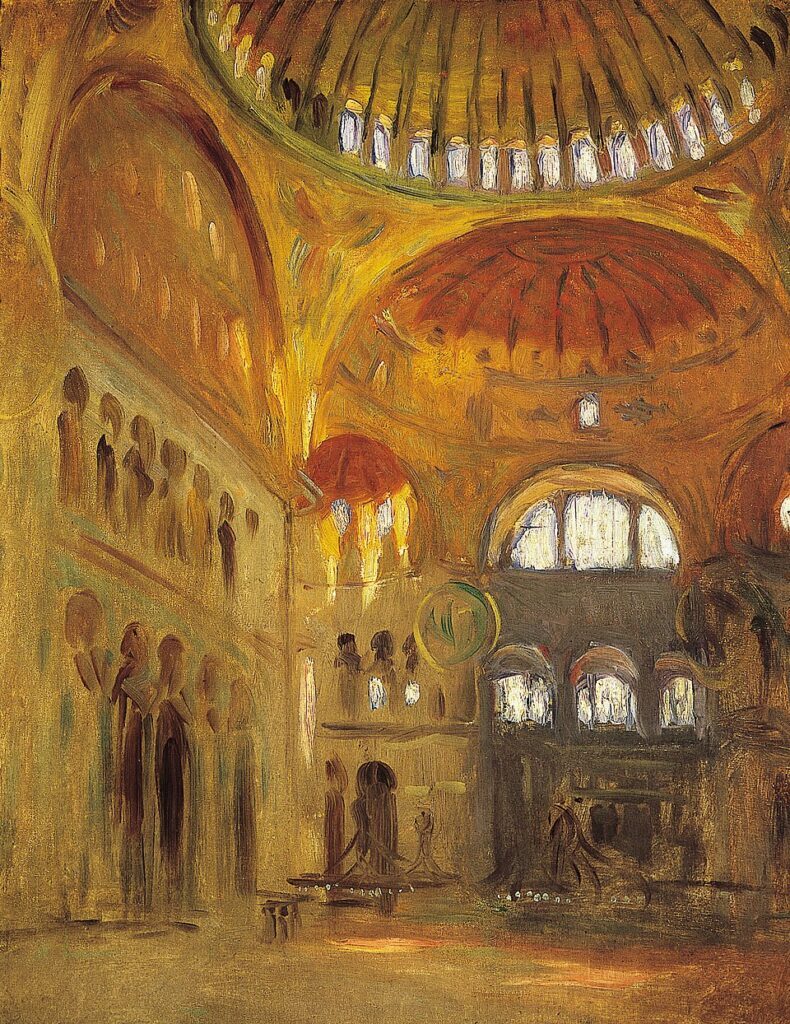
Famous locations in art: John Singer Sargent, Interior of Santa Sophia, Constantinople, 1891, Speed Art Museum, Louisville, KY, USA.
John Singer Sargent, a celebrated American expatriate painter and an icon of the Edwardian era, was widely regarded as the preeminent portraitist of his generation. Known for his exceptional technique, he later transitioned away from formal society commissions to find greater artistic freedom in creating inspiring watercolors and landscape sketches during his extensive travels.
Among his travel subjects was the Hagia Sophia, which he painted during a 1891 visit to Constantinople to study Byzantine mosaics. The current structure of the monument was built by the Byzantine emperor Justinian I as the Christian basilica of Constantinople between 532–537 CE. It was considered the epitome of Byzantine architecture. Following the fall of Constantinople in 1453, it served as a mosque until 1935, when it became a museum. It remained a museum until it was reinstated as a mosque in 2020, and it is now officially the Hagia Sophia Grand Mosque, which remains partially accessible as a tourist center.
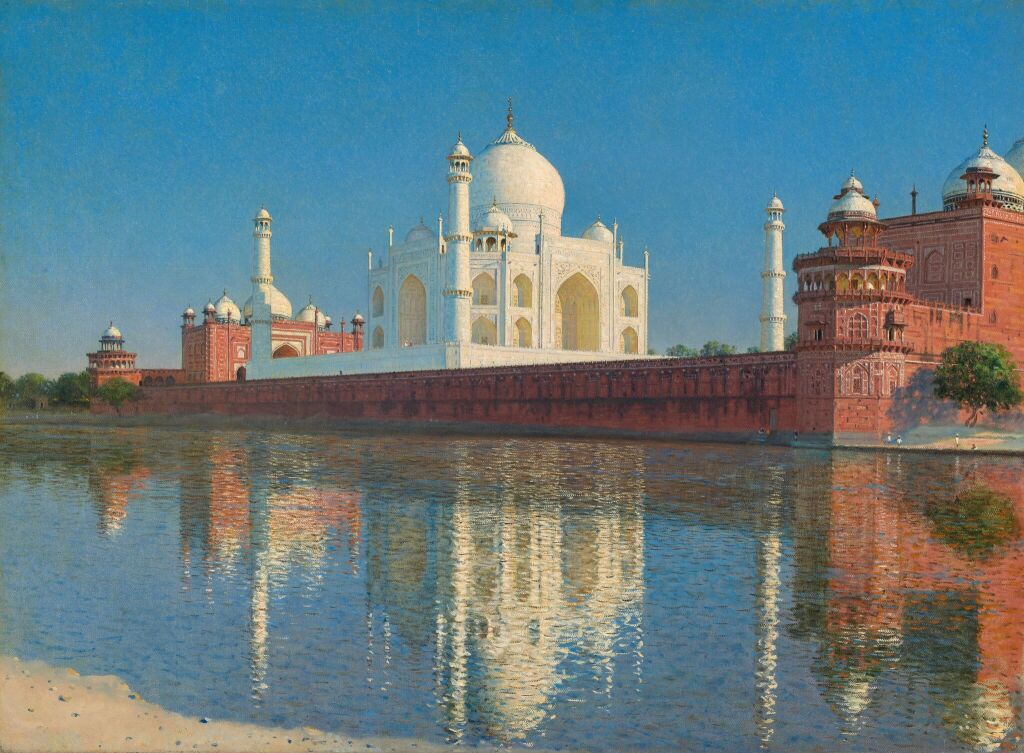
Famous locations in art: Vasily Vereshchagin, Taj Mahal Mausoleum in Agra, 1874–1876, Tretyakov Gallery, Moscow, Russia.
Vasily Vasilyevich Vereshchagin was a Russian painter, war artist, writer, and traveler celebrated for his breathtaking and realistic depictions of war and conflict, which explicitly highlighted the horrors of battle, death, suffering, and destruction. Contrastingly, he also provided breathtaking chronicles of life across Central Asia, India, and the Middle East during the 19th century, capturing a world that no longer exists.
Among the sights he documented was the Taj Mahal, which stands on the southern bank of the Yamuna River in Agra, India. Commissioned in 1632 by the Mughal Emperor Shah Jahan as a mausoleum for his favorite wife, Mumtaz Mahal, the structure is strongly tied to many myths. Celebrated globally as a supreme masterpiece of Indo-Islamic architecture, its pristine white marble, flawless symmetry, and intricate gemstone inlays have captivated travelers for centuries.
DailyArt Magazine needs your support. Every contribution, however big or small, is very valuable for our future. Thanks to it, we will be able to sustain and grow the Magazine. Thank you for your help!

Maya Tola is a Dallas-based attorney, with a zest for art history. A time traveler at heart, Maya often finds herself consumed in the contemplation of life in antiquity. She has been sharing her infectious enthusiasm for art and history since 2018 through her posts and articles for the DailyArt App and DailyArt Magazine. When she's not working or writing, you'll find Maya obsessing over plants, animals, and food (in no particular order).

Univ. of New Orleans, Fine Arts and History; Fine Artist, Professional Graphic Designer, Art Historian, Historian, Musician, worked at the New Orleans Museum of Art and MS Museum of Art; learning enthusiast!
Upper Silesia in Poland is a beautiful and extremely interesting off-the-beaten-track region to visit for its historic, natural, and cultural values.
Kate Wojtczak 9 July 2026
From Titian to Monet, London is packed with art by the world’s most beloved artists. If your goal is to see famous artworks, you probably have...
Sandra Juszczyk 2 September 2025
If you are planning to visit the International Art Exhibition or the Biennale of Architecture in Venice, this is a must-see. Built in 1932, the...
Zacheta 7 August 2025
The Dutch graphic artist M.C. Escher is well known for his mathematically inspired art. For nearly 30 years, he lived in the small town of Baarn, in...
Guest Author 26 May 2025