




10 Autumn Activities Inspired by Impressionist Paintings
Autumn is such a colorful season! Here are 10 activities inspired by Impressionist autumn paintings to enjoy during this time of year.
Andra Patricia Ritisan 25 September 2026
9 July 2026 min Read
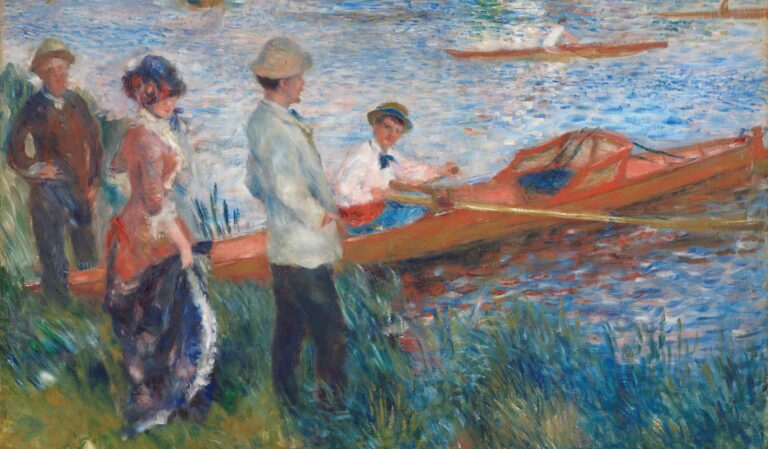
Pierre-Auguste Renoir, Oarsmen at Chatou, 1879, National Gallery of Art, Washington, DC, USA. Detail.
Light-filled moments in nature—Pierre-Auguste Renoir’s Impressionist paintings are a reminder of how simple and beautiful summer can feel. Here are 10 artworks that feel like dreamy, warm days: relaxed, bright, and full of ease.
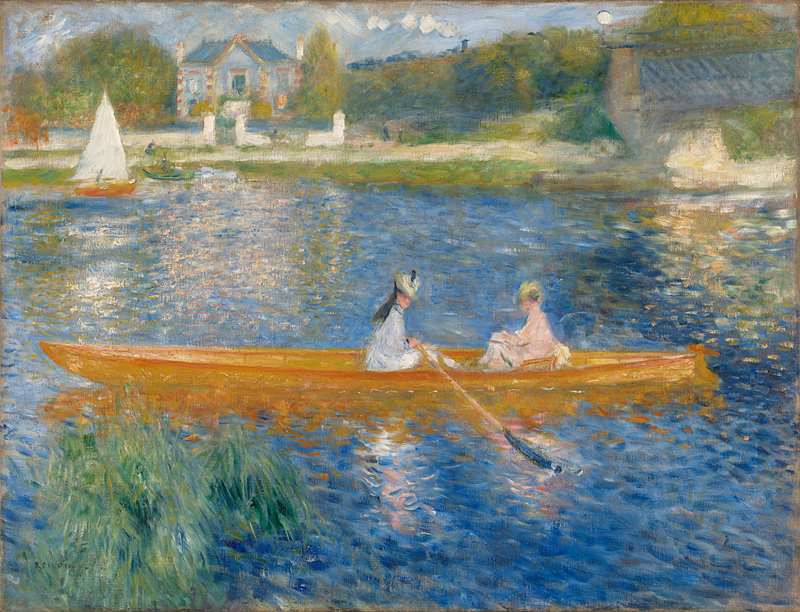
Pierre-Auguste Renoir, The Skiff (La Yole), 1875, National Gallery, London, UK. Museum’s website.
Pierre-Auguste Renoir (1841–1919) was a French Impressionist painter who spent most of his life in Paris and worked alongside artists such as Claude Monet and Edgar Degas. In the early and later years of his career, Renoir leaned toward a more traditional style inspired by classicism, but in the 1870s and early 1880s, Renoir fully focused on Impressionism. During this period, he painted scenes filled with vivid colors and a bright, light tone, capturing people in and around Paris—by the water, in the meadows, or gathering in cafés and restaurants. The visible brushstrokes, characteristic of the Impressionist movement, give these scenes an almost idealized serenity—moments one could easily wish to be part of.
The Skiff, painted in 1875, features motifs often seen in Renoir’s work—elegant women, straw hats, and boats on the Seine River. The saturated colors used in this piece—especially the strong blue and orange—enhance the sense of how hot the day might have felt.
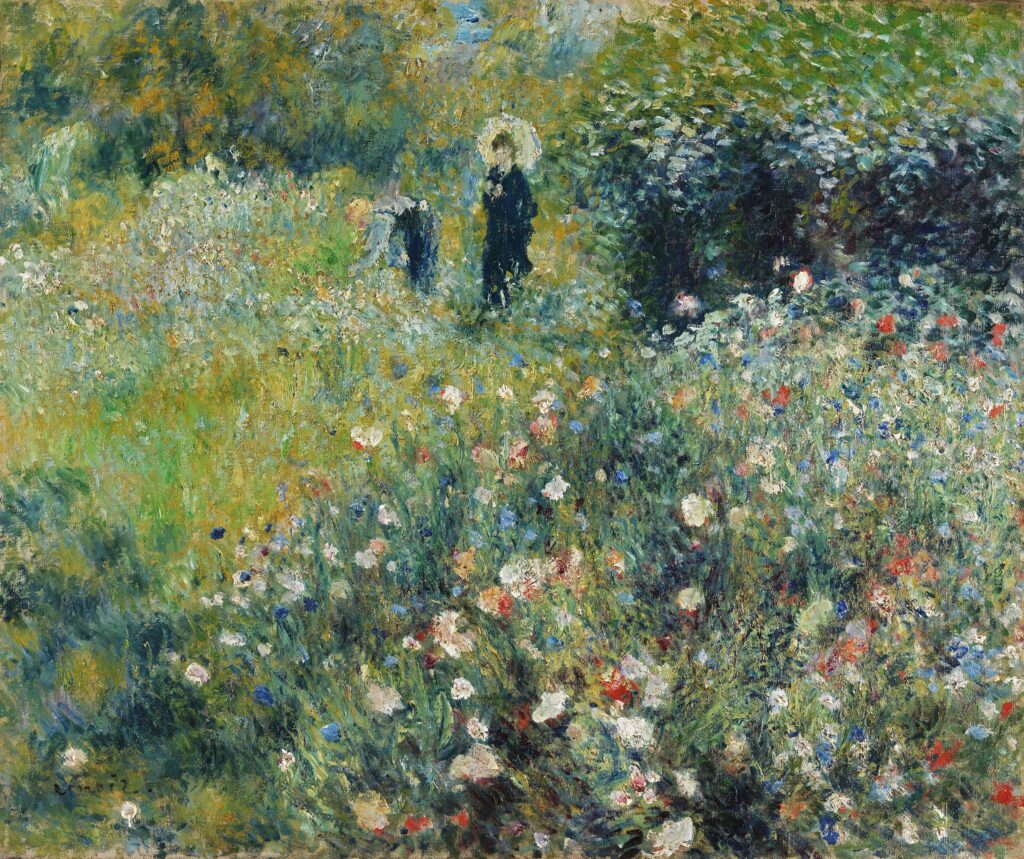
Pierre-Auguste Renoir, Woman with a Parasol in a Garden, 1875, Thyssen-Bornemisza Museum, Madrid, Spain. Museum’s website.
In the same year, Renoir painted Woman with a Parasol in a Garden. Between 1875 and 1877, he lived in the Montmartre district of Paris, in a small studio with a garden that looked more like a park with tall grass, wildflowers, and overgrown bushes.
Against this lush backdrop, Renoir painted two figures: a woman with a parasol and a man leaning down, most likely to pick a flower. The composition has no visible horizon, and the scattered touches of color make the whole garden feel like a small oasis. At that time, Montmartre still had a semi-rural character, and as more artists moved there, the area slowly became a center of art.
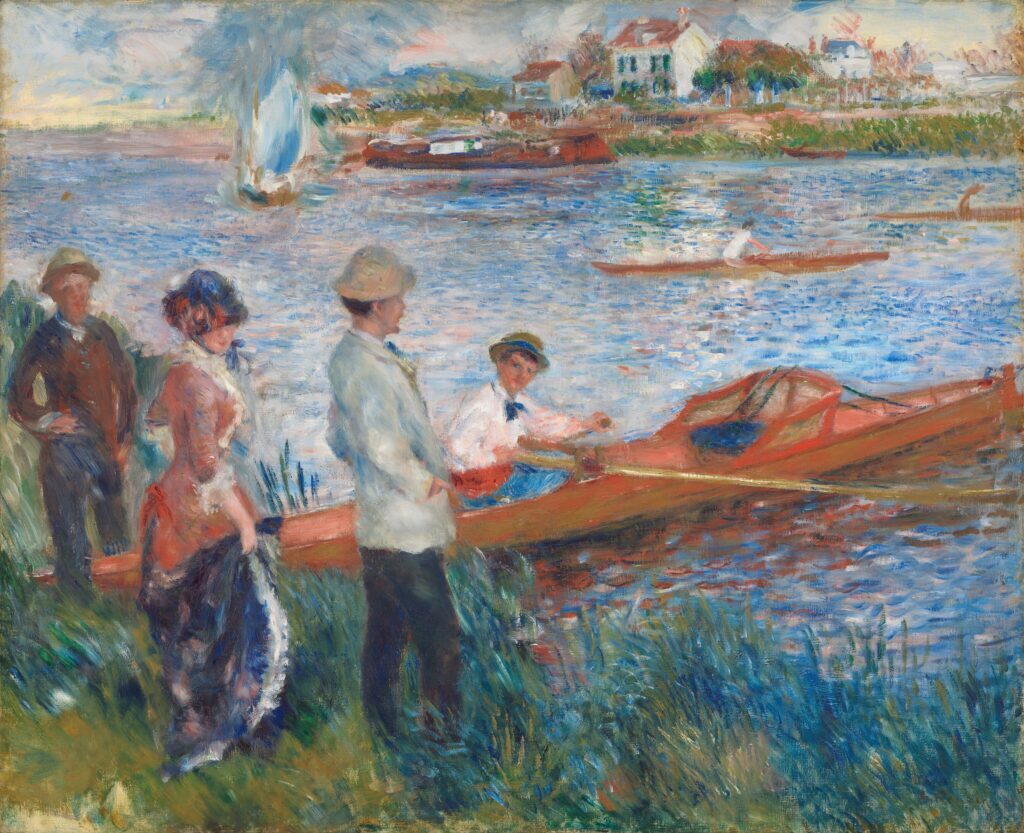
Pierre-Auguste Renoir, Oarsmen at Chatou, 1879, National Gallery of Art, Washington, DC, USA. Museum’s website.
In Chatou, a small town just outside Paris, rowing was one of the favorite summer activities. In Oarsmen at Chatou, Renoir captures a small group of his friends standing on the riverbank. The river looks busy, with several boats drifting on the water. On the opposite shore, there are restaurants and cafés where people often ended their afternoons. The woman in the group is Aline Charigot, who would become Renoir’s wife in 1890. Before that, she was his close friend and model, and she continued to appear in his portraits throughout his life.
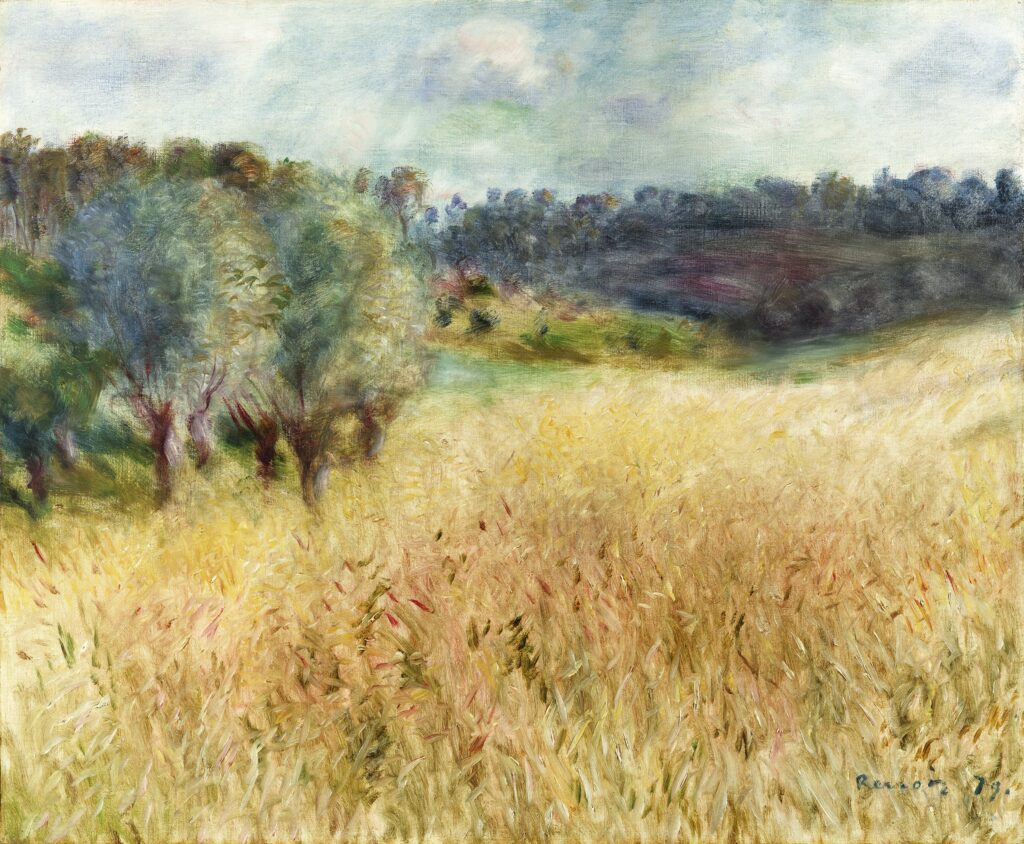
Pierre-Auguste Renoir, Wheatfield, 1879, Thyssen-Bornemisza Museum, Madrid, Spain. Museum’s website.
Renoir spent many summers in Wargemont, Normandy, where he visited his friend Paul Bérard, a banker and a patron of the artist. By then, Renoir was working on many portraits, which were bringing him considerable success. Wheatfield, however, shows a still moment in the landscape—an open field under a slightly cloudy sky. It feels like a storm is approaching at the end of a hot day: the air is heavy, and the trees seem to move in the wind.
In addition to this work, the artist painted the coastal area of Normandy, a region that attracted many painters, including Claude Monet.
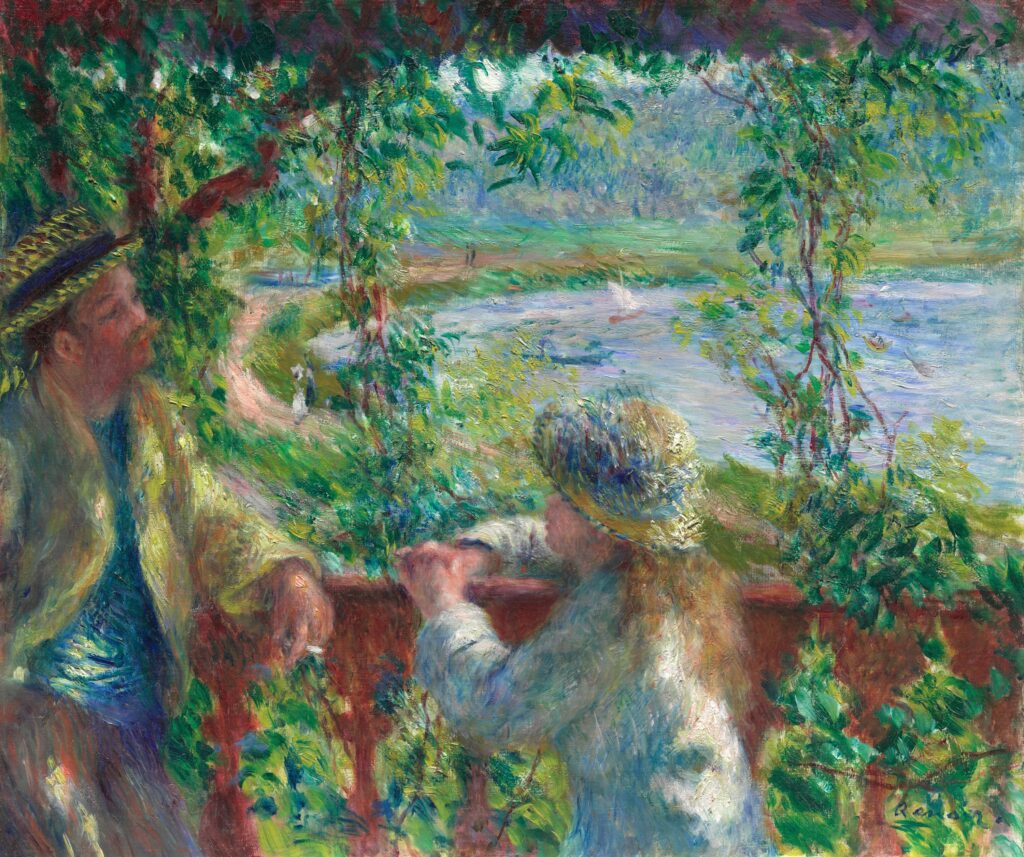
Pierre-Auguste Renoir, Near the Lake, 1879–1880, Art Institute of Chicago, Chicago, IL, USA. Museum’s website.
Looking at Renoir’s summer paintings, one thing is sure—a boat is almost always part of the scene. In Near the Lake, a small one appears in the background, and the figures on the porch take over the foreground. Here, the vibrant use of color makes clear just how vivid his approach really was, confirming he had one of the most striking color palettes among the Impressionists. The whole composition glows with intense greens, from deep emerald shades to warm olive tones.
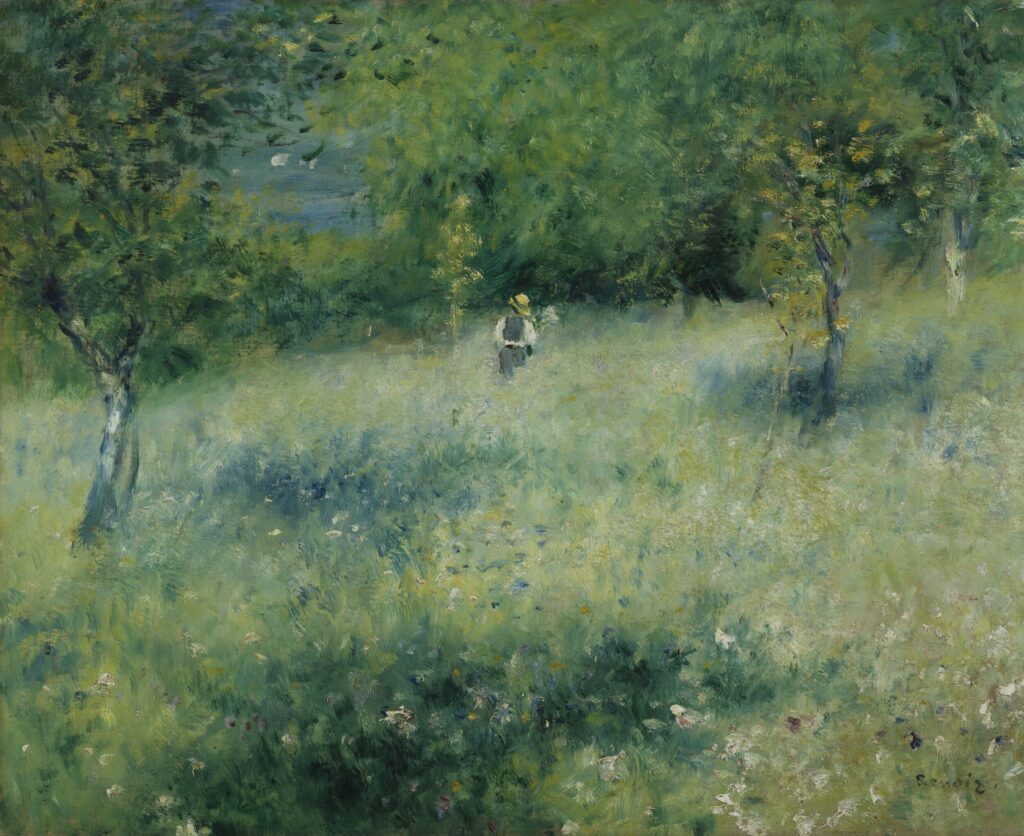
Pierre-Auguste Renoir, Spring, Chatou, c. 1873, Courtauld Gallery, London, UK. Gallery’s website.
Stepping away from the season for a moment and returning to Spring, Renoir created this idyllic scene in 1873. The yellow shades blending with green suggest it could be the end of spring, with the days getting longer. At first glance, the landscape seems to be just a meadow, but on closer inspection, a small patch of water emerges between the trees in the upper left corner. The tiny white dot against the blue—knowing Renoir—could be a boat.
Back then, Renoir spent long days in Chatou and in small towns along the Seine near Paris. He often painted outdoors, side by side with Monet as they prepared for the very first Impressionist exhibition, held in 1874 at Nadar’s photographic studio.
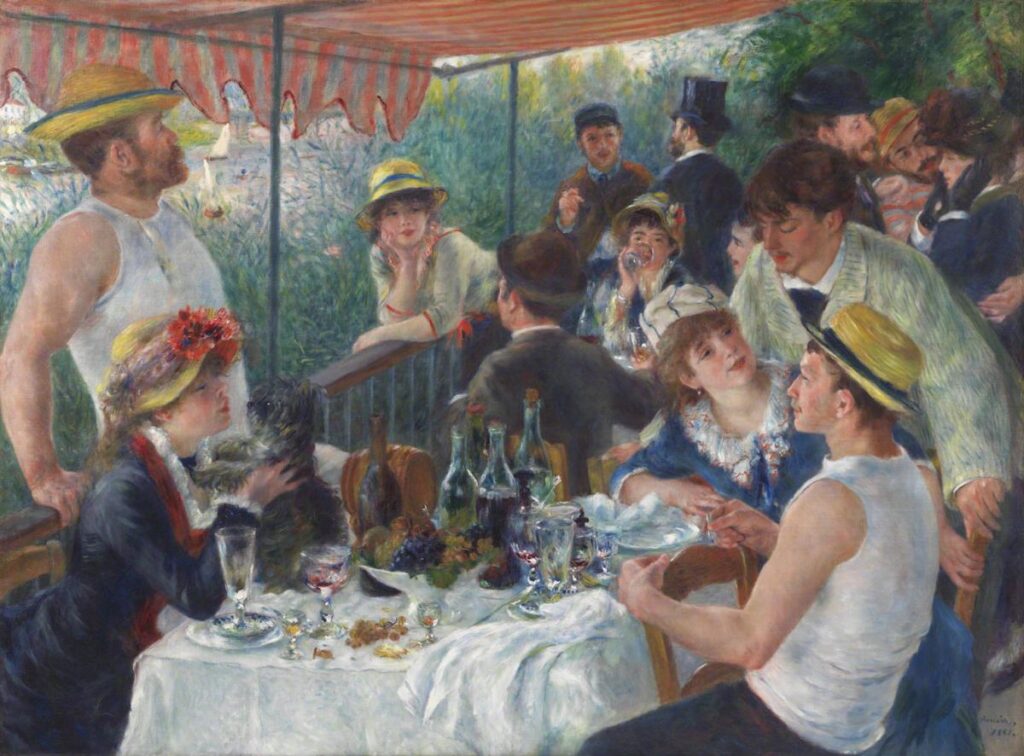
Pierre-Auguste Renoir, Luncheon of the Boating Party, 1880–1881, The Phillips Collection, Washington, DC, USA. Collection’s website.
Luncheon of the Boating Party is one of the greatest masterpieces of Impressionist paintings. Renoir captured a group of friends gathering at the Maison Fournaise restaurant—a place many artists loved to visit. In this group, a few people can be recognized. The woman on the left playing with a dog is Aline Charigot, Renoir’s partner. Across from her is the man in a straw hat, Gustave Caillebotte, an Impressionist painter.
Early signs of Renoir’s gradual departure from classic Impressionism are visible here. While the background and still life remain painterly, he gave the figures more three-dimensional form and clearer contours.
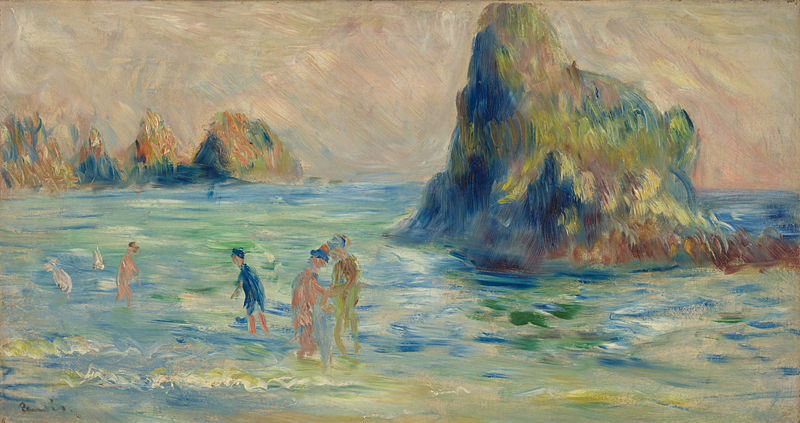
Pierre-Auguste Renoir, Moulin Huet Bay, Guernsey, 1883, National Gallery, London, UK. Museum’s website.
In 1883, Renoir spent over a month on the small, enchanting island of Guernsey, where he created 15 paintings, including Moulin Huet Bay, Guernsey—a bay with cliffs and luminous turquoise water. During this stay, he changed the way he worked: he began with oil sketches made directly on site and completed them later in the studio.
The island clearly captivated him with the dramatic cliffs, clear water, paths with breathtaking views over the shore. It’s understandable why he stayed there for about six weeks.
Today, on the island, there is a path called Renoir Walk, where art-loving hikers can find empty frames placed exactly where Renoir once stood, perfectly recreating the views he painted. It is an unforgettable activity for Renoir fans, allowing them to experience the island through the artist’s eyes.
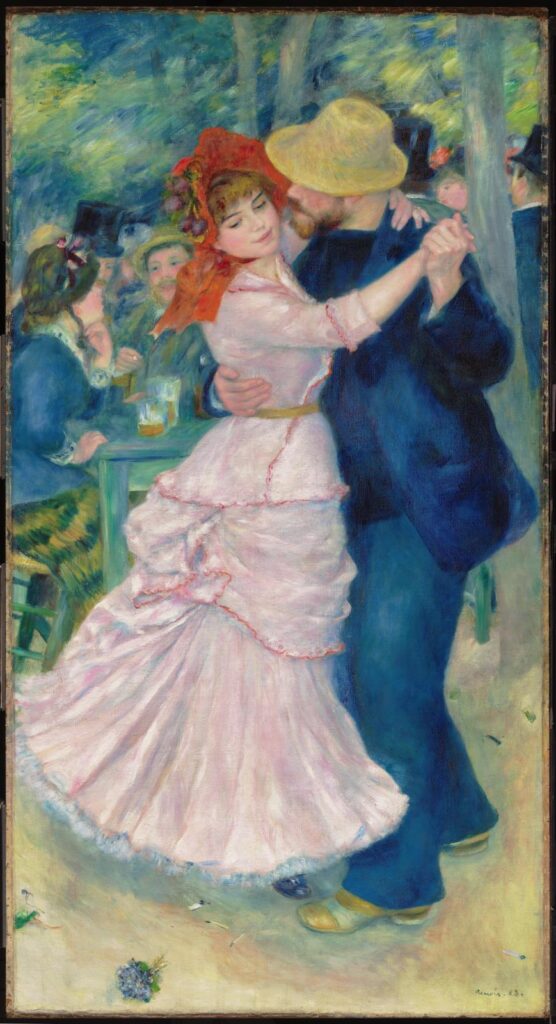
Pierre-Auguste Renoir, Dance at Bougival, 1883, Museum of Fine Arts, Boston, MA, USA. Museum’s website.
Dance at Bougival is part of Renoir’s “dance trilogy,” a series of paintings showing couples dancing in different surroundings—two in the countryside and one in the city—all painted in 1883. This one is the most dynamic, with his close friends caught mid-spin. People in the background are chatting, drinking, smoking, and probably raising their voices over the loud music. The vivid colors and the movement of the figures make the composition feel lively.
Currently, this painting is on display in the temporary exhibition Renoir and Love at the Musée d’Orsay, on view until July 19, 2026, giving visitors a chance to see the trilogy in one place.
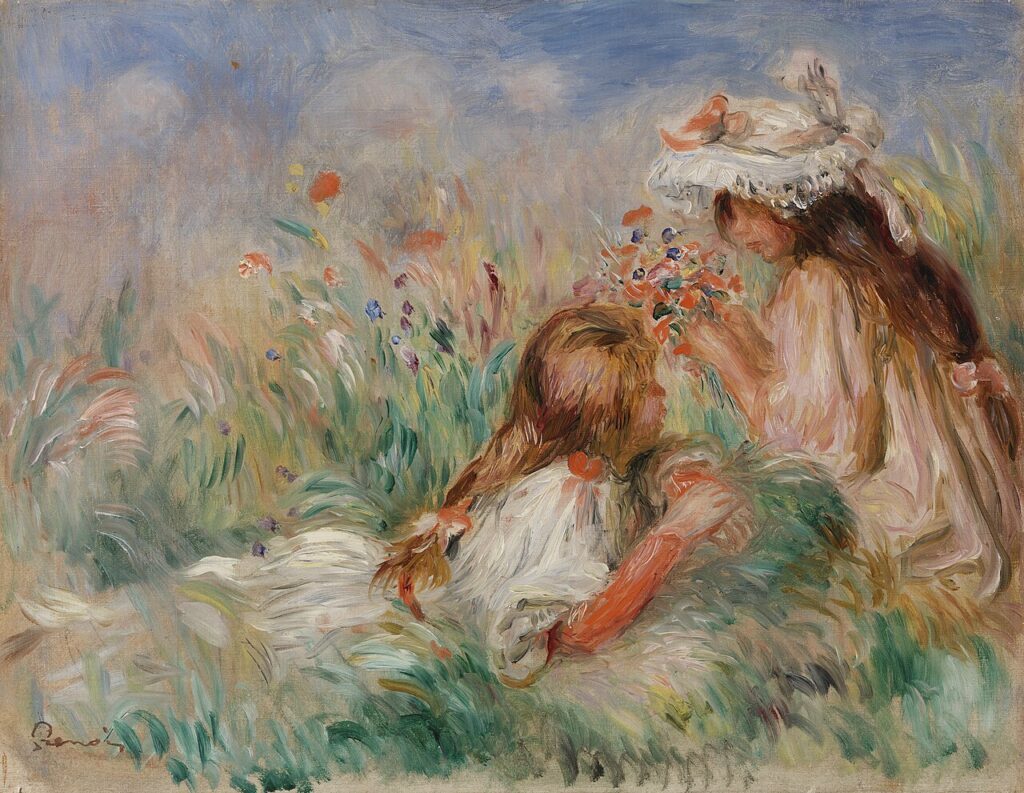
Pierre-Auguste Renoir, Girls in the Grass Arranging a Bouquet, c. 1890, Barnes Foundation, Philadelphia, PA, USA. Foundation’s website.
In 1890, Renoir started a new chapter in his life—he married, his paintings gained more recognition, and his style changed slightly, influenced by his trip to Italy a couple of years earlier. From this year on, he often painted women, his friends, and his family outdoors, adding more grace and harmony to the figures.
This change is clearly visible in Girls in the Grass Arranging a Bouquet, where he captured two girls lying in a pastoral meadow, picking flowers. The whole scene evokes memories of carefree summers.
DailyArt Magazine needs your support. Every contribution, however big or small, is very valuable for our future. Thanks to it, we will be able to sustain and grow the Magazine. Thank you for your help!

Kinga is an art enthusiast, mainly interested in 19th-century art, especially Impressionism and Romanticism. She also appreciates classical art and architecture.

Coffee-fueled writer, artist, and daydreamer.
Autumn is such a colorful season! Here are 10 activities inspired by Impressionist autumn paintings to enjoy during this time of year.
Andra Patricia Ritisan 25 September 2026
Summer has arrived! It is time to enjoy some deserved vacations, rest, go to the beach, enjoy the sunshine, and have fun. Here are 10 Impressionist...
Jimena Escoto 28 August 2025
The sun is shining, the flowers are blooming. It is officially spring! And what style captures spring’s delicate essence better than Impressionism?...
Sandra Juszczyk 20 March 2026
The Spanish master Joaquín Sorolla (1863-1923) had a magical way of capturing light, whether it is sun-drenched beaches, shimmering water, or scenes...
Joanna Kaszubowska 30 December 2025


