
How Did Paris Fall in Love with Ballets Russes?
Ballets Russes was a ballet company founded by the famous impresario Sergei Diaghilev. No doubt, Ballets Russes made Russian ballet famous all around...
Guest Author 21 May 2025
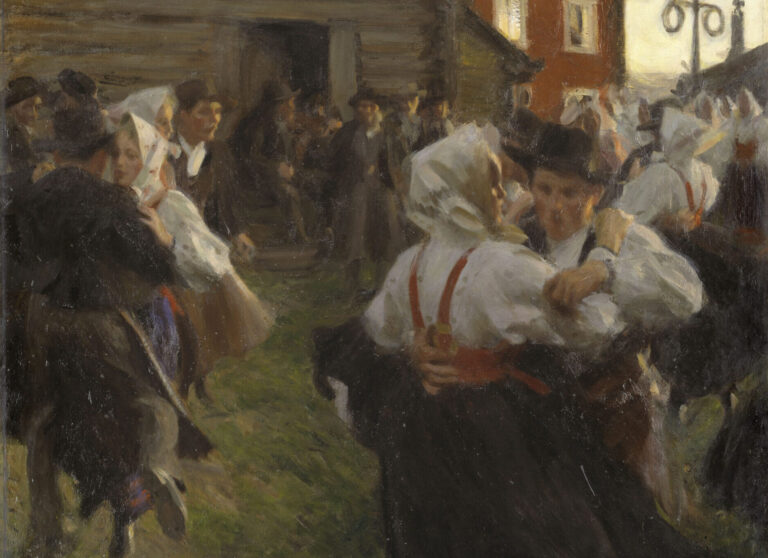
Anders Zorn, Midsummer Dance, 1897, Nationalmuseum, Stockholm, Sweden. Detail.
Dance has appeared in art since humans began creating artworks, reflecting it’s importance in people’s lives. Artists have captured the feeling, beauty, and movement of entire choreographies in a single frame. Discover some of the best depictions of dance in art history. Several of these artists had close connections to performers and theaters, collaborating as costume and scenography designers. As you will see, they transmitted their love for this art form on canvases.

Pierre-Auguste Renoir, Dance at Moulin de la Galette, 1876, Musée d’Orsay, Paris, France.
Pierre-Auguste Renoir (1841–1919) sought to capture the daily life of common people, so he would visit places like the Moulin de la Galette to have fun, observe, and paint. The piece shows Parisian society enjoying a day of leisure with friends. Six dancing couples appear on the left side of the painting, holding each other intimately. Renoir presented this work at the Impressionist Exhibition of 1877. Although it received harsh criticism at the time, it became one of his most famous masterpieces and a staple of Impressionism.
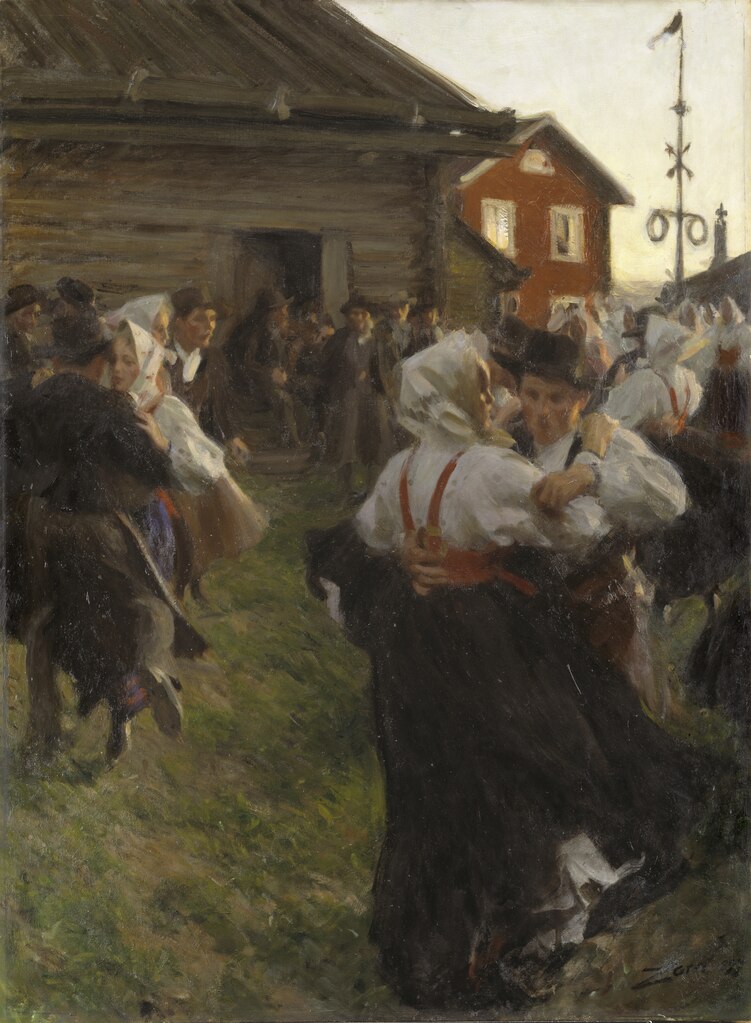
Anders Zorn, Midsummer Dance, 1897, Nationalmuseum, Stockholm, Sweden.
In the countryside, people also enjoyed lively afternoons of twirling and jumping with the community. The Swedish painter Anders Zorn (1860–1920) represented a midsummer celebration in the town of Morkarlby, Sweden. Zorn decided to place the maypole in the background and focused on the couples dancing around it. The soft orange light bathing the canvas suggests the scene occurs at sunrise.
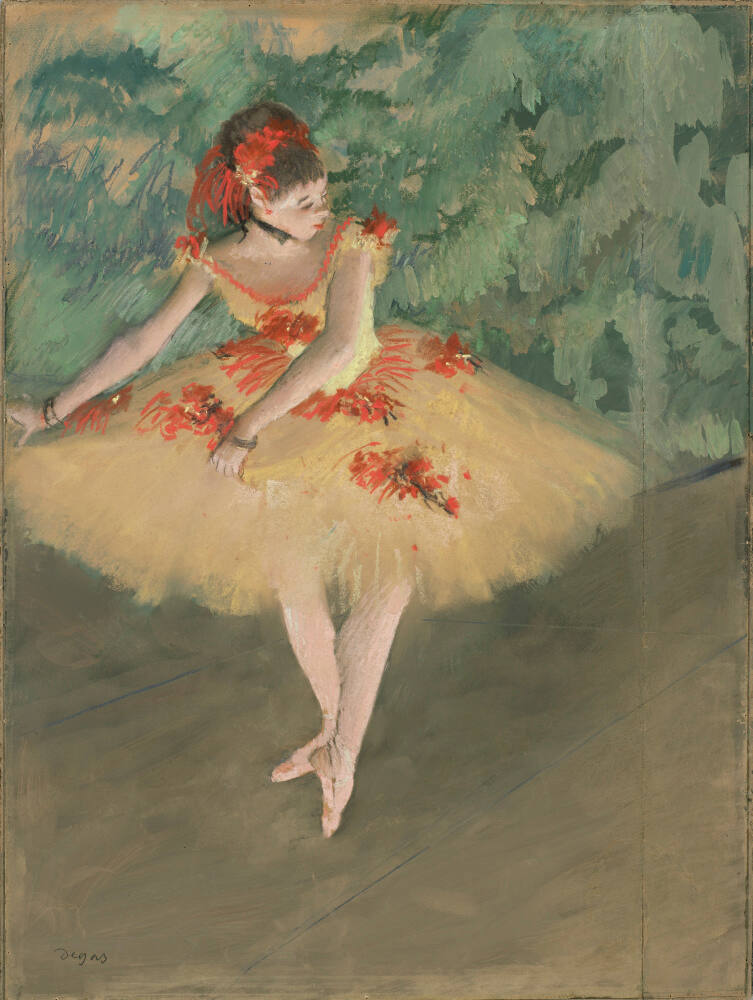
Edgar Degas, Dancer Making Points, ca. 1874–1876, Nelson-Atkins Museum of Art, Kansas City, MO, USA.
This article would not be complete without Edgar Degas’ ballerinas. His works depicting dancers, both on and off stage, are among the most famous depictions of dance in art history. Dancer Making Points shows a ballerina in a yellow tutu decorated with red flowers. There is some debate about the exact step the ballerina is performing. An alternative title, Le Commencement des “Pirouettes sur la Pointe en Dedans” (The Beginning of “Pirouettes en Dedans“), indicates that the girl is about to spin inward toward her standing leg, in this case, the left one.
Valentine Hugo (1887–1968) was a French Surrealist artist from the 20th century. When she moved to Paris to study art, she found Serge Diaghilev’s Ballets Russes at the Thèâtre du Châtelet.
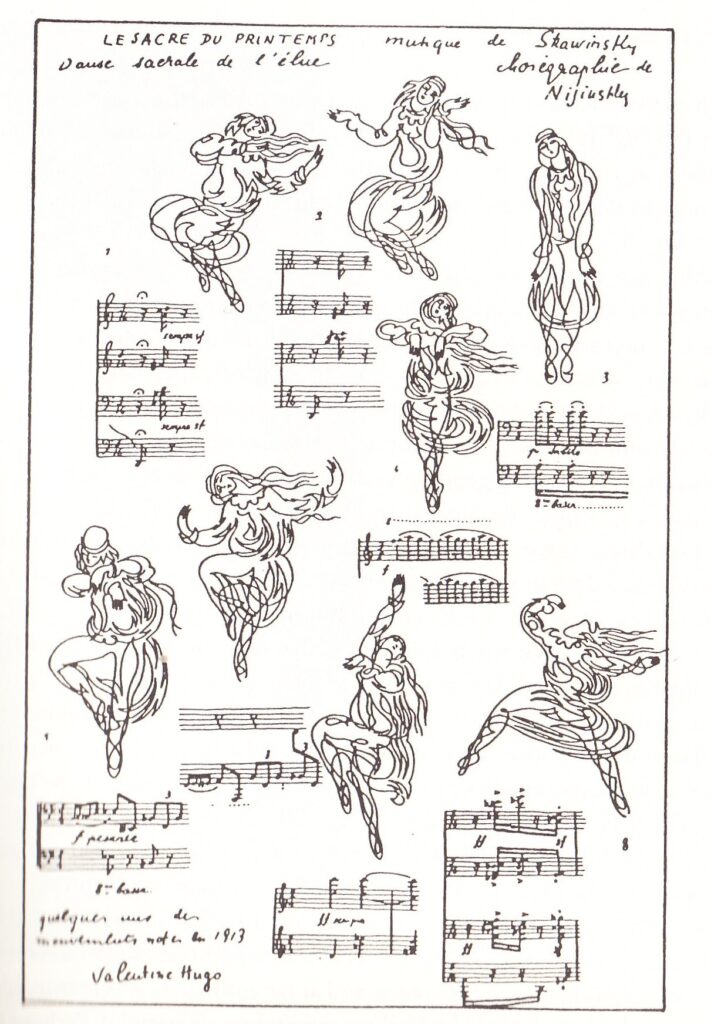
Valentine Hugo, Marie Piltz in the Sacrificial Dance from The Rite of Spring, illustration from Montjoie!, June 1913. Wikimedia Commons (public domain).
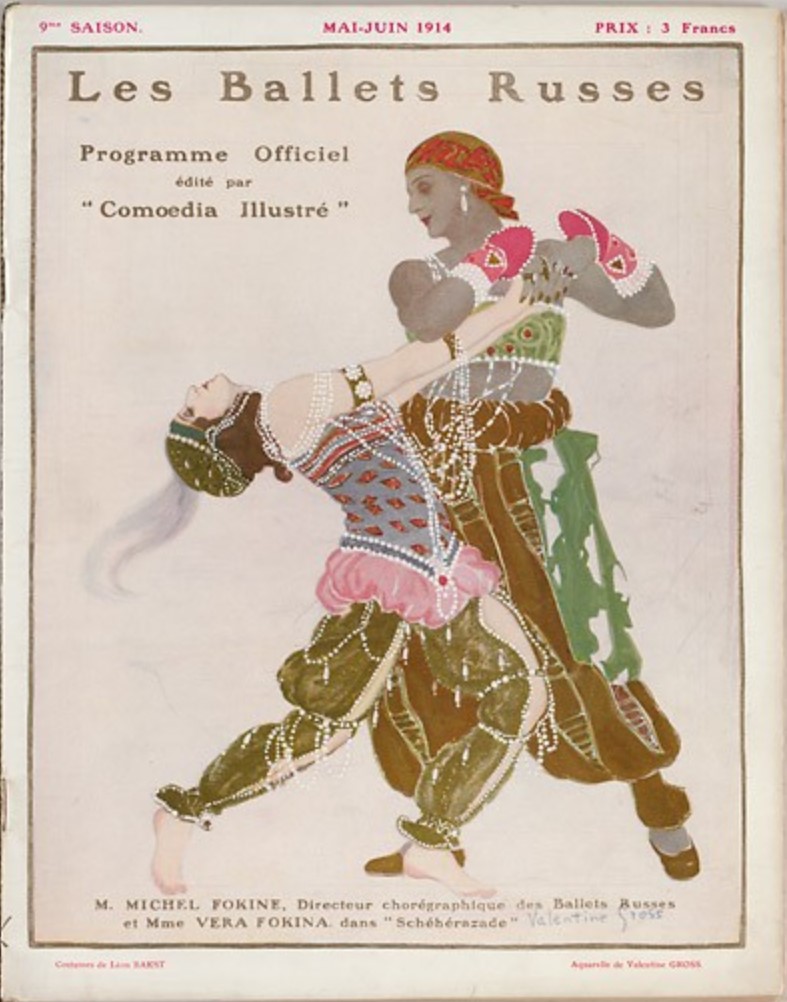
Valentine Hugo, Scheherazade, 1914, Houghton Library, Harvard University, MA, USA.
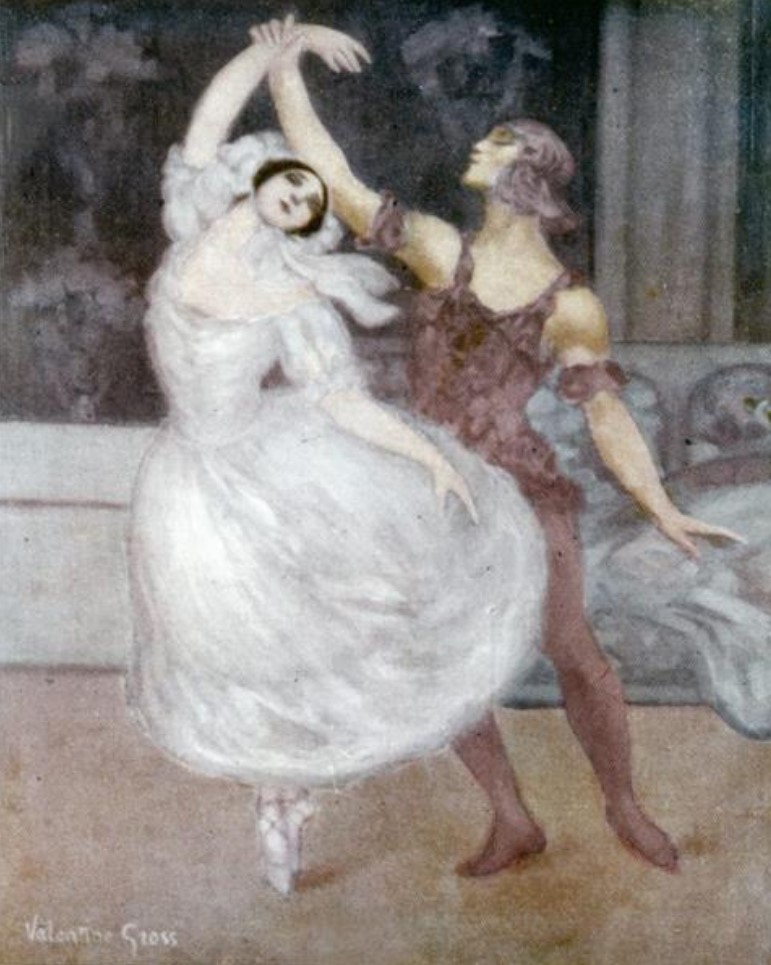
Valentine Gross, Vaslav Nijinsky and Tamara Karsavina in “Spectre De La Rose,” c. 1913. WikiArt.


Le Sacre du Printemps (The Rite of Spring) was a turning point in ballet history. Igor Stravinsky broke every rule of classical ballet he could, from the story to the music, costumes, and choreography.
Hugo witnessed the riot that the premiere of the ballet caused in 1913. These incredible sketches reveal the vision of the Sacrificial Dance, the only solo of the entire show, in which a young woman dances to her death. She sketched different moments of the choreography around the musical notes.
Without hearing the music, nor seeing the movement, the viewer gets an idea of the dramatic, vivid, and intense nature of the performance thanks to the flowy lines Hugo employed.
Hugo not only drew the Ballets Russes, but she also played a key role in shaping their reception. She collaborated with the journal Art Decoration and other similar publications, where she showed her artworks and writings.
Art critic Raymond Bouyer complimented her artworks in an edition of Art Decoration from 1913, stating that, “[they] transpose the violence into delicacy, and for these dazzling minutes . . . give us not a pictorial equivalent, but a kind of translation, in a different tone.”
In this cover, Hugo represented a moment in the ballet Sheherazade, choreographed by Michel Fokine.
Vaslav Nijinsky (1889–1950) and Tamara Karsavina (1885–1978) were the lead dancers of the Ballet Russes. Le Spectre de la Rose, a short ballet of less than ten minutes, tells the story of a young girl returning from a ball. She holds a rose, and when she falls asleep, she dreams the rose comes to life.
Hugo represented the pas de deux with Karsavina as the young girl and Nijinsky as the rose. This is one of the multiple pieces she made of this ballet.

Diego Rivera, Dance of Tehuantepec, 1928, MALBA, Buenos Aires, Argentina.
Diego Rivera (1886–1957) is most famous for his impressive murals, but he also painted in oil on canvas, such as Dance of Tehuantepec. This monumental painting of 79 x 64.5 in (199 x 162 cm) represents the zandunga, a traditional dance from the state of Oaxaca, in southern Mexico. The predominance of orange tones contrasts with the green background, formed by banana trees. For Rivera, as for other muralists, it was important to capture and exalt Mexican identity in his works. The dancers wear traditional attire, embroidered huipiles for the women and straw hats and white cotton clothes for the men. While the poses allude to movement, rigidity reigns in this piece, as if the dancers are frozen on the spot.
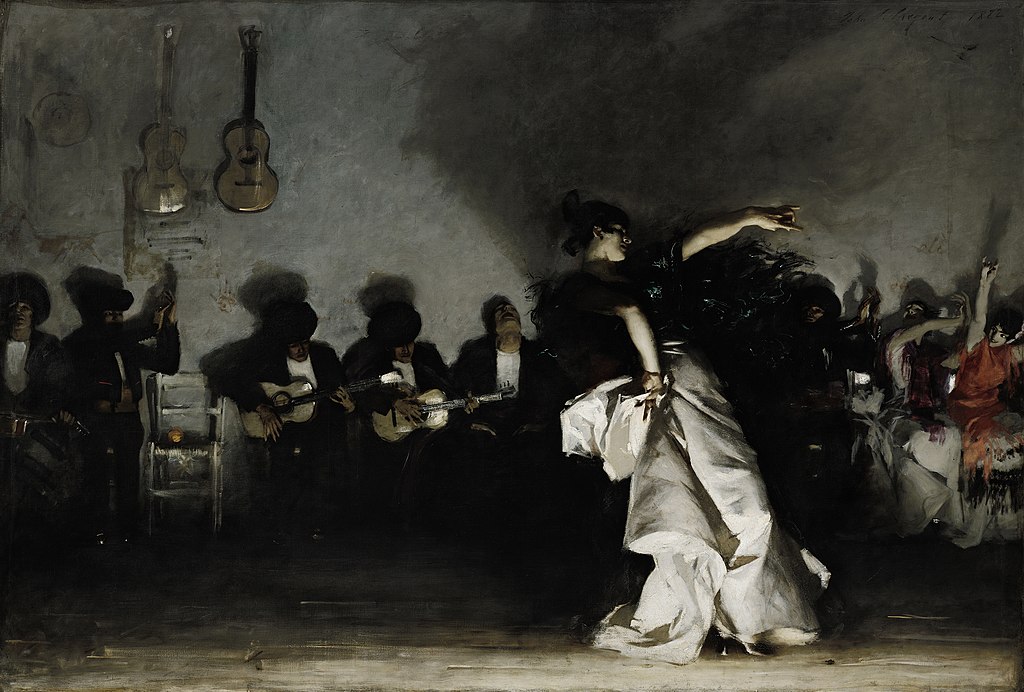
John Singer Sargent, El Jaleo, 1882, Isabella Stewart Gardner Museum, Boston, MA, USA.
Spanish dances have been favorites among European artists for their dramatic and somewhat exotic nature. For example, El Jaleo (the ruckus) by John Singer Sargent (1856–1925) depicts a Romani dancer in the middle of a routine. The artist took inspiration from a trip to southern Spain in 1879. The scene is mostly dark, but Sargent strategically lit the dancer’s white skirt from the bottom, casting shadows that fill up the gray wall in the background, adding intensity to the performance. The harsh and wide brushstrokes emphasize the quick movement of the fabric as she jerks it up. Musicians and other spectators play their instruments and cheer avidly, immersing the viewer in the scene.
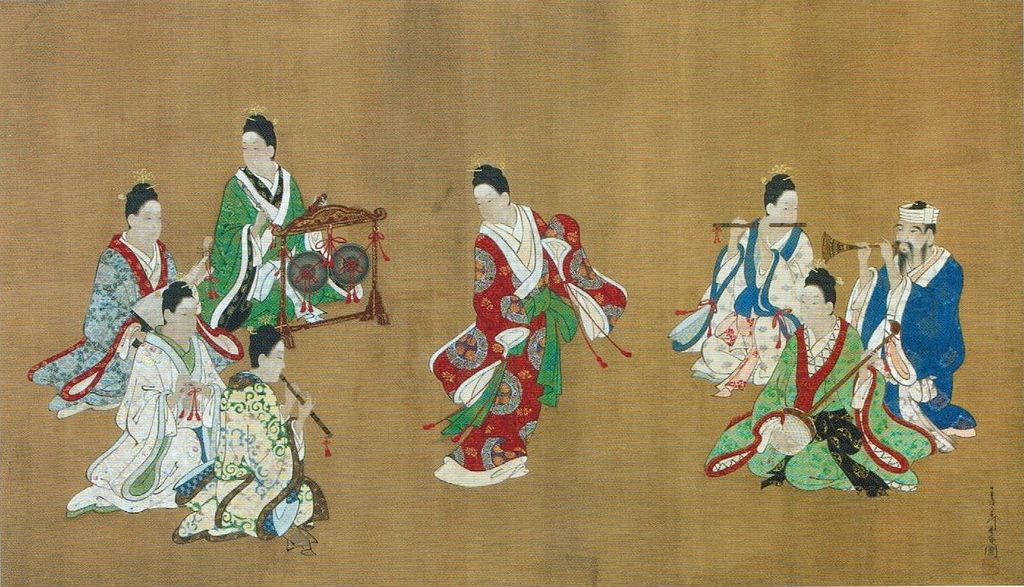
Miyagawa Chōshun, Ryukyuan People Dancing and Playing Musical Instruments, c. 1710–1718, Weston Collection, Chicago, IL, USA.
Dancing appears often in ukiyo-e works, a style focused on the representation of leisure and pleasures in life. Miyagawa Chōshun (1683–1753) focused on paintings rather than woodprints, using silk as support. Possibly, this painting illustrates a performance during a delegate’s visit from the Ryukyu Islands to Edo.
Chōshun omitted any trace of a physical setting, giving the impression of floating figures. The ochre background’s flatness, typical of Japanese works, reflects a subtle fear of fullness, contrasting with the Western fear of emptiness. If we compare it with Sargent’s painting above, we find considerable stylistic differences. It lacks the dramatic atmosphere of El Jaleo; instead, it suggests elegance and serenity. Moreover, the brushstrokes are delicate, the colors vibrant, and the drawing perfectly traced.

Dance of Love (Rasa Lila), c. 1840, Art Gallery of New South Wales, Sydney, Australia.
This Indian miniature painting from the 19th century depicts the Raslila—“the Dance of Divine Love.” The blue-skinned figure at the center represents the god Krishna dancing with his partner Radha. According to Hindu scriptures, she was the deity’s favorite gopi (milkmaid). The women in traditional orange dresses surrounding them are other gopis who, upon hearing him play the flute, followed the music to reach him. It may not be apparent, but this dance takes place in the night, a night that has stretched on for billions of years. This painting is an excellent representation of the relationship between dance and religion.
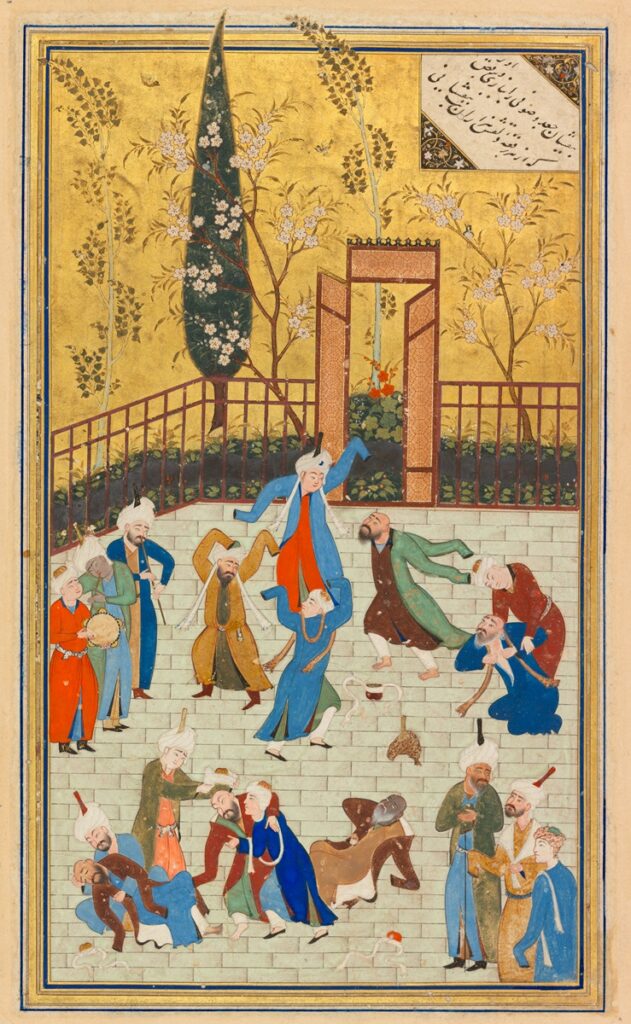
Shaykhzada, Sufi Dance, folio from a Divan (collected poems) by Hafiz, 1523–1524, National Museum of Asian Art, Washington, DC, USA.
This folio of a manuscript illustrates whirling dervishes, members of the Sufi branch of Islam. The artist Shaykhzada (16th century) depicts them performing the sama, a mystical dance that allowed the participants to connect on a spiritual level with the divine. At the center, four male figures dance in circles, waving their arms in different directions. In the lower part, other members have achieved their goal; they have entered into a deep level of abandon. The figure to the right of the circle kneels as he looks up and opens his clothes. At the bottom, a dark-skinned man lies with his eyes open, and another dervish cannot stand any longer and is aided by a friend. To the far corner, a dancer has lost consciousness. Three musicians hold joyful expressions as they play flutes and a tambourine. The work belongs to the city of Herat in modern-day Afghanistan.
So, here they are, outstanding depictions of dance in art history. Every region has its own way of dancing and its own way of representing it in the visual arts. It is a challenge to take an intangible practice and transform it into a tangible object, and these artists have achieved it masterfully.
Japanese Prints and Paintings of the Eighteenth Century, Sebastian Izzard Asian Art, 2012. Accessed: Oct 2, 2025.
Valentine Hugo: An Inventory of Her Papers in the Carlton Lake Collection at the Harry Ransom Center, Harry Ransom Center. Accessed: Oct 2, 2025.
Marylaura Papalas: Valentine Gross Hugo: Fashion & Performance in Early Twentieth-Century French Magazines, Journal of Modern Periodical Studies 11, no. 2, Jstor, 2020. Accessed: Oct 2, 2025.
Get your daily dose of art
Click and follow us on Google News to stay updated all the time

DailyArt Magazine needs your support. Every contribution, however big or small, is very valuable for our future. Thanks to it, we will be able to sustain and grow the Magazine. Thank you for your help!

An International Relations graduate and an art lover. I prefer art prior to the 20th century, in general. I'm interested in art from Mexico and by female artists.
Ballets Russes was a ballet company founded by the famous impresario Sergei Diaghilev. No doubt, Ballets Russes made Russian ballet famous all around...
Guest Author 21 May 2025
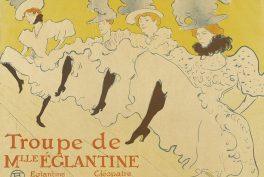
Can-can paintings depict the most famous dance of the Belle Époque era. Originating in France, the Can-can, associated with skirts, petticoats, high...
Charlotte Stace 6 November 2025
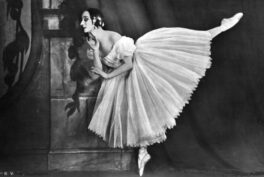
Anna Pavlova, a Russian ballerina, was highly independent for her times. She formed her own company and choreographed her own performances. She toured the world for twenty years and introduced ballet to other parts of the world. Pavlova was so famous that she was honored with a dessert named after her, it is called the Pavlova cake!
Anuradha Sroha 21 May 2025
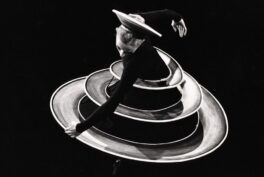
Bauhaus is widely known for its iconic designs and contributions to the art world. What is less known is that their concepts could be applied to...
Nadine Waldmann 20 June 2025