Summary
- Largely self-taught, Frida Kahlo turned personal trauma into fierce self-portraits that confront pain, identity, and womanhood.
- Starting in her late seventies, Grandma Moses painted warm, detailed scenes of rural American life that made her a defining figure of folk art.
- Henri Rousseau, a former customs officer, painted imaginative jungles from books and greenhouses, creating dreamlike, unconventional scenes.
- Anna Boberg spent decades in Norway’s Lofoten Islands, painting mountains, sea, and skies with a patient, experiential approach and by repeated observation.
- After a war injury weakened his arm, Horace Pippin slowly relearned to paint, creating intimate scenes of war, home, and Black history.
- Séraphine Louis, a housemaid in northern France, painted by candlelight in her spare hours, creating vibrant, patterned works filled with leaves and flowers.
- Suzanne Valadon, who modeled for artists like Renoir and Toulouse-Lautrec, taught herself to paint, creating women and interiors with a directness and presence that defied conventional ideals.
- Clementine Hunter began painting in her fifties, capturing Black Southern life with intimate detail born from decades of lived experience on a plantation.
- Dorothea Tanning, largely self-taught, built a decades-long career exploring painting, sculpture, and installations, continually evolving her style.
- Jean-Michel Basquiat moved from street graffiti to museums, layering words and symbols of Black history into raw, improvisational paintings.
We didn’t include Van Gogh, and here’s why: as much as we adore him (and we do!), his self-taught status is a little blurry. So this list highlights 10 other visionaries who were truly, sometimes even defiantly, self-taught. Seven of them are women, not by design. Talent doesn’t wait for permission, and history hasn’t always remembered them. These artists found their own ways to be seen.
1. Frida Kahlo
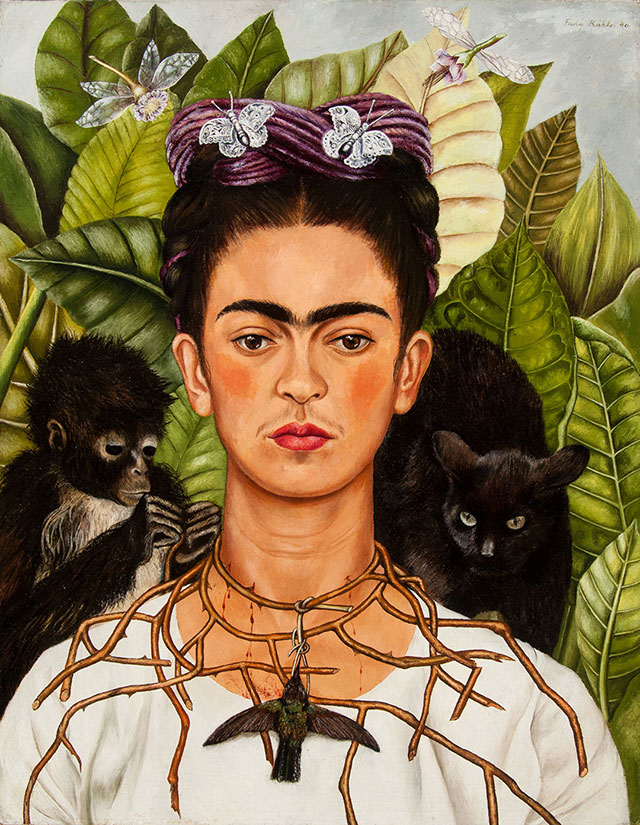
10 Famous Self-Taught Artists: Frida Kahlo, Self-Portrait with Thorn Necklace and Hummingbird, 1940, Harry Ransom Center, Austin, TX, USA. Museum’s website.
Known for her piercing gaze and uncompromising self-portraits, Frida Kahlo (1907–1954) was a Mexican painter who turned lived experience into a deeply personal visual language. Long before she became a global icon, Kahlo was already immersed in drawing, filling notebooks with sketches, and receiving early instruction from the printmaker Fernando Fernández, a close friend of her father. Art mattered deeply to Kahlo from the start, even if she had not yet imagined it as a career.
I paint self-portraits because I am so often alone, because I am the person I know best.
Everything shifted after a severe bus accident at the age of 18, which left her in lifelong pain. Confined to bed for months, Kahlo began to paint with the help of a specially made easel and a mirror placed above it. She returned to her own image again and again, once explaining that she painted herself because she was often alone and knew her subject best. Largely self-taught, she built a body of work that confronts pain, identity, and desire with remarkable directness. In paintings such as The Two Fridas and the self-portrait presented above, Kahlo presents a vision of womanhood that is fierce, self-aware, and unapologetic.
2. Grandma Moses
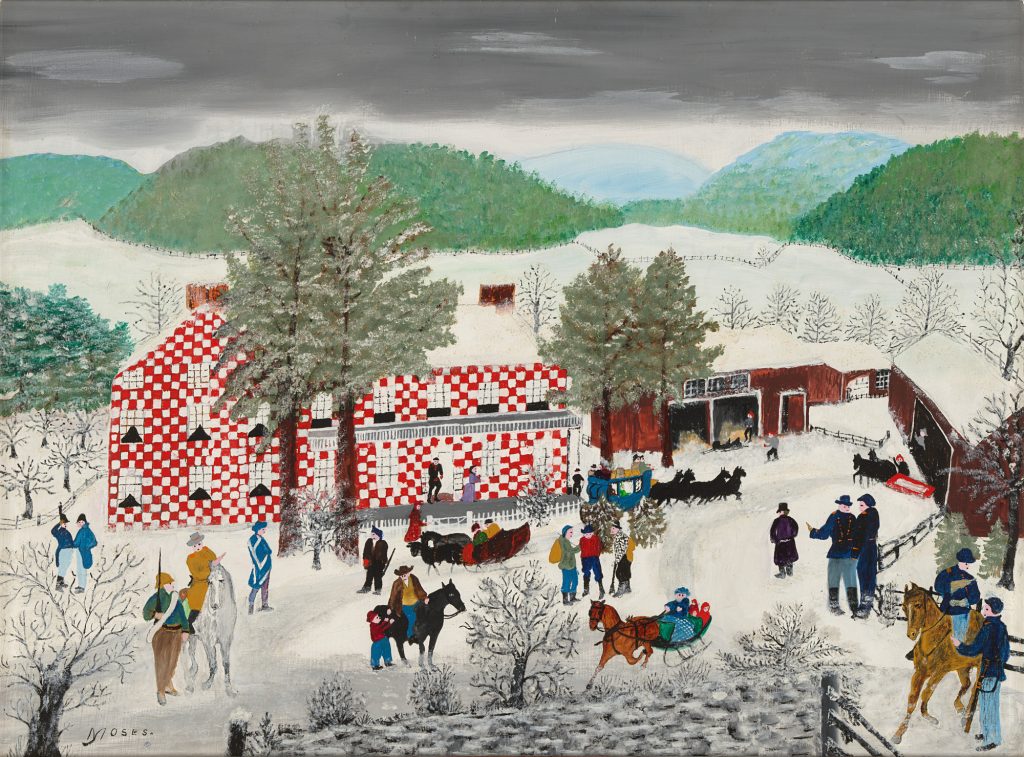
10 Famous Self-Taught Artists: Grandma Moses, Checkered House, 1955, Smithsonian American Art Museum, Washington, DC, USA. Museum’s website.
Anna Mary Robertson Moses (1860–1961), better known as Grandma Moses, didn’t set out to be an artist at all. For most of her life, Moses was simply busy living: working, keeping a household going, and experiencing the rhythms of rural America. Then, in her late seventies, arthritis made embroidery painful to continue. So Moses tried something else. She picked up paint.
Life is what we make it, always has been, always will be.
With no formal training and no “right” materials, Moses taught herself as she went, painting with whatever was practical and close at hand, like leftover canvas or fireboard. What emerged weren’t grand manifestos or fashionable experiments, but scenes that feel like warm memories: winter roads, seasonal chores, small-town gatherings, and the everyday dramas of country life—observed with affection and a wonderfully steady eye. Works such as Sugaring Off and Checkered House show how her straightforward approach could be quietly powerful: detailed, narrative, and instantly readable, like a story that feels easy to enter.
Discovered late in life and celebrated worldwide, Grandma Moses became a defining figure of American folk art, reminding us that artistic vision does not depend on formal training and that creativity can arrive quietly, long after society expects it to have ended.
3. Henri Rousseau
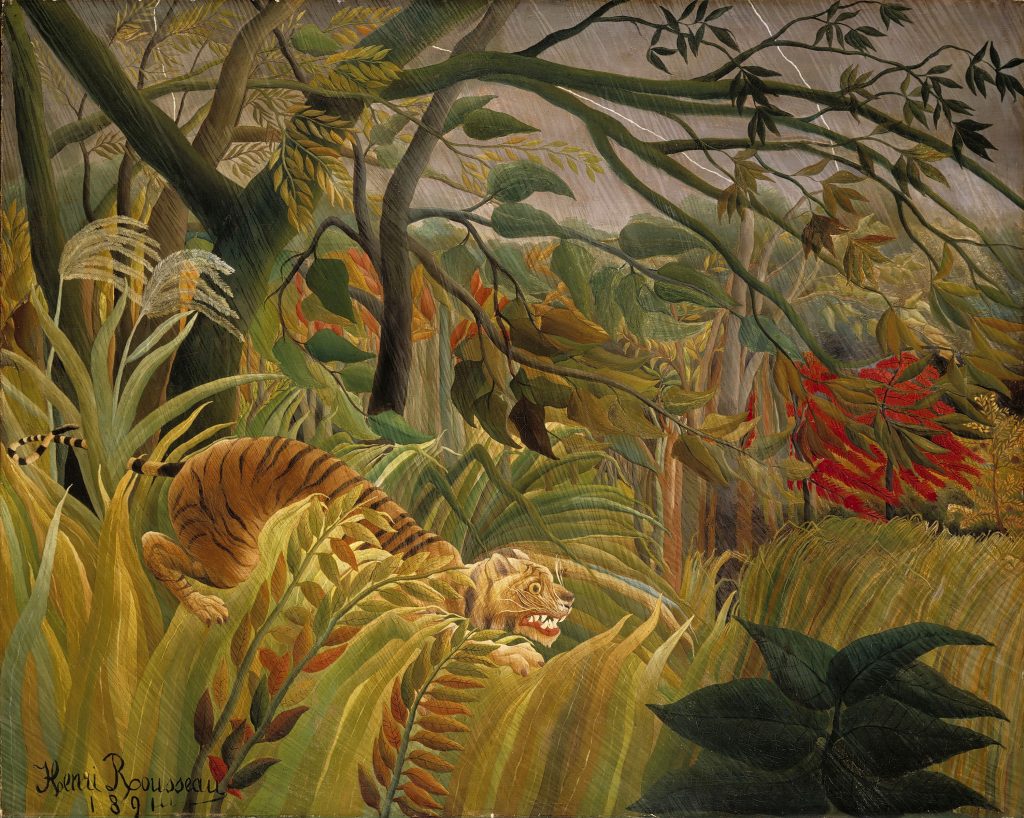
10 Famous Self-Taught Artists: Henri Rousseau, Surprised!, 1891, National Gallery, London, UK. Museum’s website.
Henri Rousseau (1844–1910) is now remembered as a French post-Impressionist painter working in a so-called naïve manner, though nothing about his path into art followed the usual road. Rousseau never trained at an academy, never learned perspective or anatomy in a classroom, and for most of his life worked as a Paris customs officer. Painting was something he came to on his own, slowly, by looking hard and trying again, until he took an early retirement in his late forties and finally gave himself time to paint as if it were the main thing.
What Rousseau taught himself was a way of inventing a world from secondhand sight. His famous jungles were not painted from the wild but from Paris—the greenhouses of the Jardin des Plantes, museum displays, illustrated books, and printed images that he absorbed and rearranged. That self-made education explains why his paintings don’t behave like academic ones. Space stays flat, leaves stack like cutouts, figures feel oddly still, and the whole scene reads like a dream you can’t quite step into. In works like Surprised! and The Dream, the “wrongness” is the point: Rousseau paints the jungle the way it lives in the mind, not the way a school would teach you to build it.
4. Anna Boberg
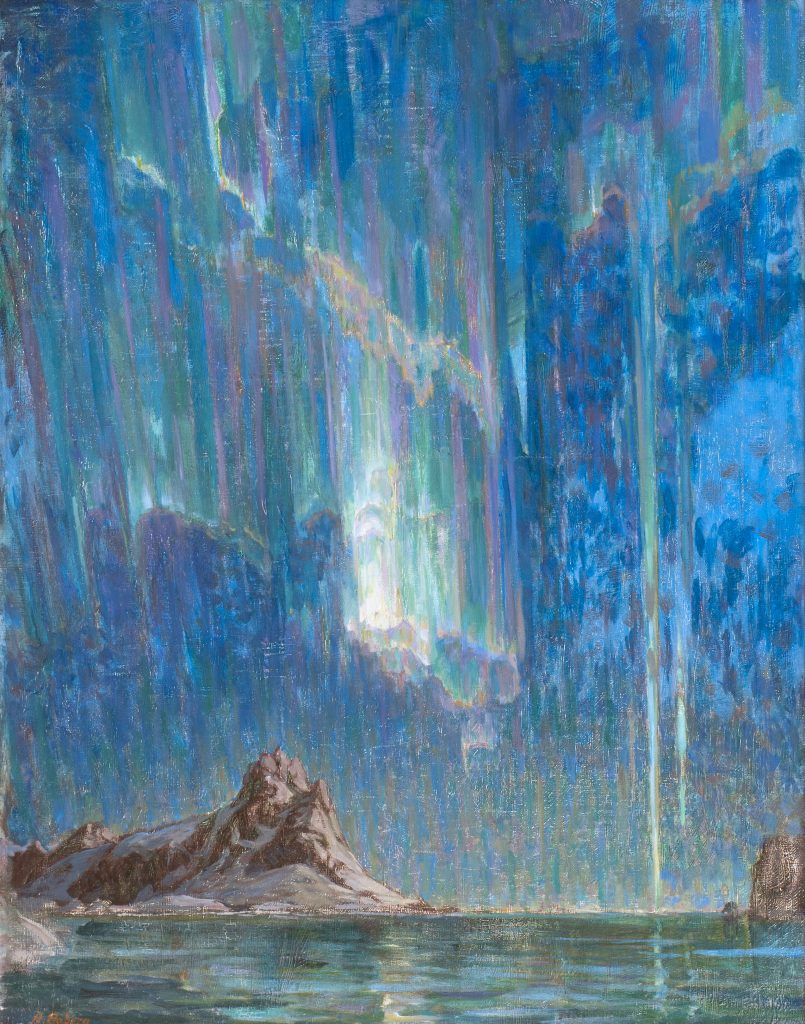
10 Famous Self-Taught Artists: Anna Boberg, Northern Lights. Study from North Norway, Nationalmuseum, Stockholm, Sweden. Museum’s website.
Anna Boberg (1864–1935) was a Swedish painter who did not come up through studios and classrooms. Apart from a very brief stay at the Académie Julian in Paris, she learned mostly by moving through the world with her eyes open, painting what caught her attention, and returning to it again and again. She once called herself a “polar researcher,” and in many ways she lived like one, searching for places that could teach her what schools had never given her.
After first visiting the Lofoten Islands in northern Norway in 1901, Boberg kept going back for more than 30 years, often traveling alone and staying for long stretches just to paint. She worked outdoors whenever she could, facing wind, cold, and sudden shifts of light, sometimes using a special easel strapped to her body so she could paint while standing in harsh conditions.
Mountains, sea, storms, and long northern skies slowly shaped Boberg’s way of seeing. Her paintings grew slowly, formed by doing the same things over and over. Boberg’s art feels shaped by experience rather than by schooling, as if it had been developed by walking the same paths, watching the same weather, and refusing to look away.
5. Horace Pippin
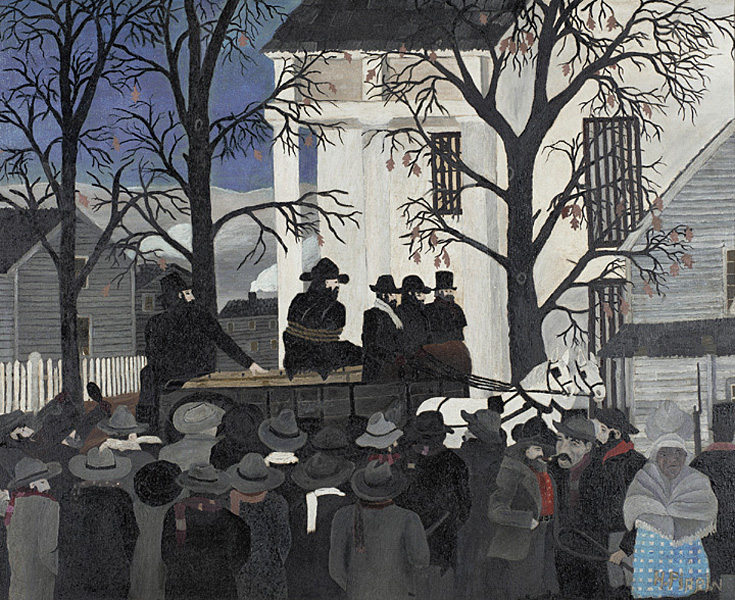
10 Famous Self-Taught Artists: Horace Pippin, John Brown Going to His Hanging, Pennsylvania Academy of the Fine Arts, Philadelphia, PA, USA. Museum’s website.
Horace Pippin (1888–1946) was an African American painter whose art grew out of the life he lived. He loved to draw as a child but never received formal training. Everything changed when he served in World War I and was shot in the right shoulder, leaving his arm badly weakened. For a long time, making art felt far away, like something he had lost.
Pictures just come to my mind and I tell my heart to go ahead.
Pippin did not let his artistic practice disappear. He began by burning images into wood, guiding his injured hand with the other, slowly teaching himself how to use his hands again. Little by little, painting returned, in small steps, as his hands slowly came back to him. Pippin painted scenes of war, home, faith, and Black history, paying attention to small moments that might otherwise fade. Works like John Brown Going to His Hanging feel quiet at first, then grow heavier the longer you stay with them. His paintings were shaped through effort, memory, and care, built not by lessons, but by the steady need to remember and to tell his own story.
6. Séraphine Louis
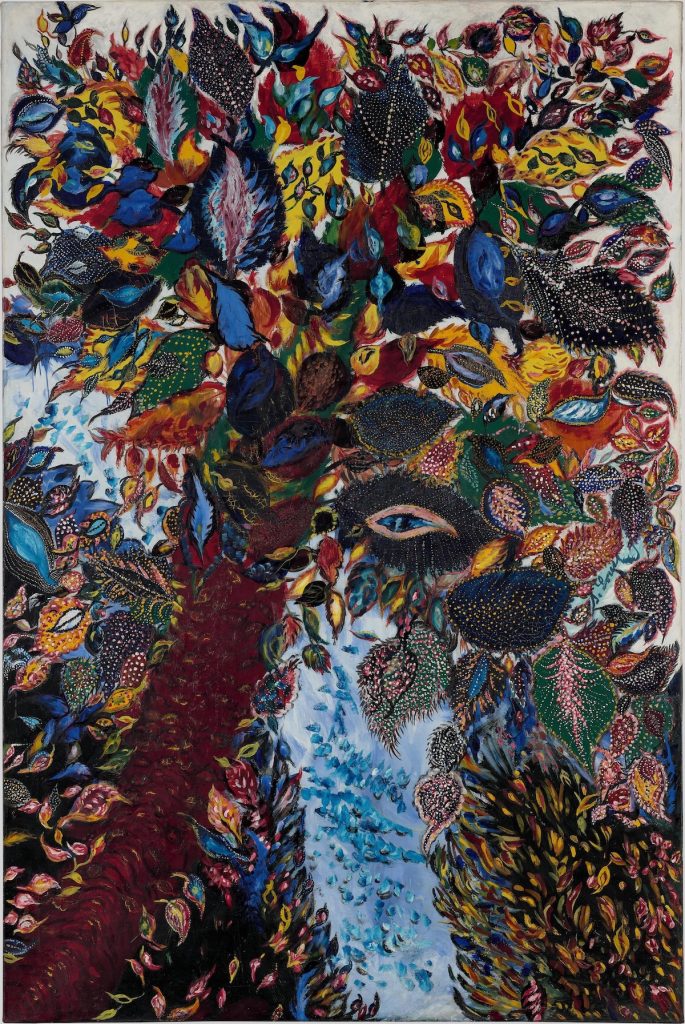
10 Famous Self-Taught Artists: Séraphine Louis, Tree of Paradise, c. 1929, Musée National d’Art Moderne, Centre Pompidou, Paris, France. Museum’s website.
Séraphine Louis (1864–1942), often called Séraphine de Senlis, spent much of her life working as a housemaid in northern France. She had no formal art training and little time of her own. After long days of cleaning and cooking, Louis painted late at night, usually in secret. Her images grew out of faith and daily looking, shaped by church windows, religious images, and the quiet rhythms of her own inner life.
Louis taught herself everything, including how to mix her own paints from wax, plants, and other materials she never fully explained. Her paintings fill the surface with leaves, flowers, and repeating forms that seem to expand in every direction. Works such as Tree of Paradise (c. 1929) glow with dense color and careful pattern, shaped through devotion and repetition.
In 1912, the German collector Wilhelm Uhde came across her paintings and slowly realized that the glowing, patterned images he admired belonged to the woman who cleaned his house. A self-taught maid, painting by candlelight in her spare hours, had created what the art world would later call naïve painting—outside schools, outside rules, and entirely her own.
7. Suzanne Valadon
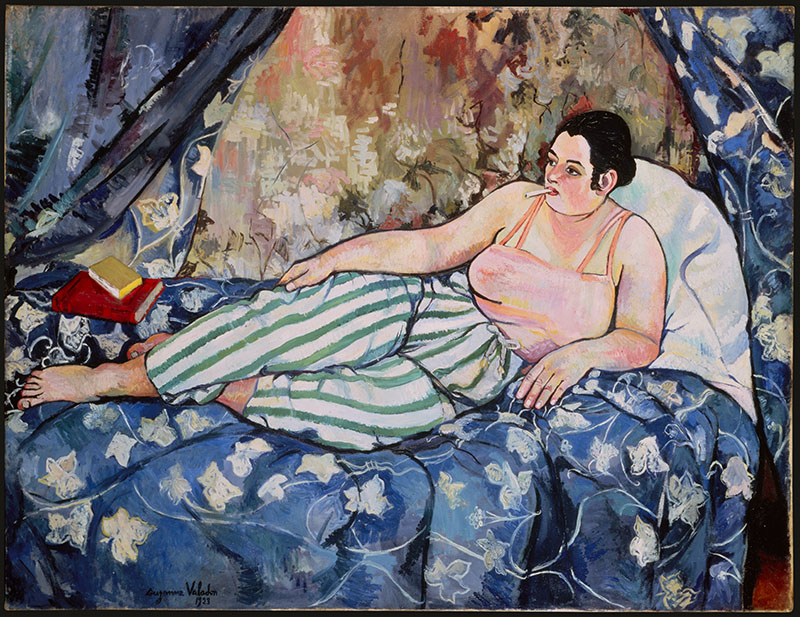
10 Famous Self-Taught Artists: Suzanne Valadon, The Blue Room, 1923, Musée National d’Art Moderne, Centre Pompidou, Paris, France. Museum’s website.
Suzanne Valadon (1865–1938) grew up in Montmartre and began working very young, taking whatever jobs she could find. After a short and dangerous life as a circus acrobat ended with an injury, she started posing as a model for painters in Paris. From 1880 to the early 1890s, Valadon sat for artists like Renoir and Toulouse-Lautrec. While they painted, she watched closely: how they drew bodies, how they handled color, how a figure took shape on canvas. She could not afford formal lessons, so she learned by looking, asking, and trying on her own.
I had great masters. I took the best of them of their teachings, of their examples. I found myself, I made myself, and I said what I had to say.
Thérèse Diamand Rosinsky, Suzanne Valadon, New York: Universe, 1994.
Valadon soon began drawing and painting herself. Edgar Degas admired her work, bought her drawings, and showed her some technical methods, but she never entered an academy or followed a set school. Valadon practiced by copying paintings at the Louvre and by working from people around her. Her art focuses on women, interiors, still lifes, and especially nudes. Unlike the soft, ideal figures common at the time, her women feel solid, direct, and fully present. Paintings like The Blue Room show bodies that rest, think, and exist without trying to please. Valadon learned her craft through watching, working, and trusting her eye—growing outside classrooms long before institutions began to recognize her.
8. Clementine Hunter
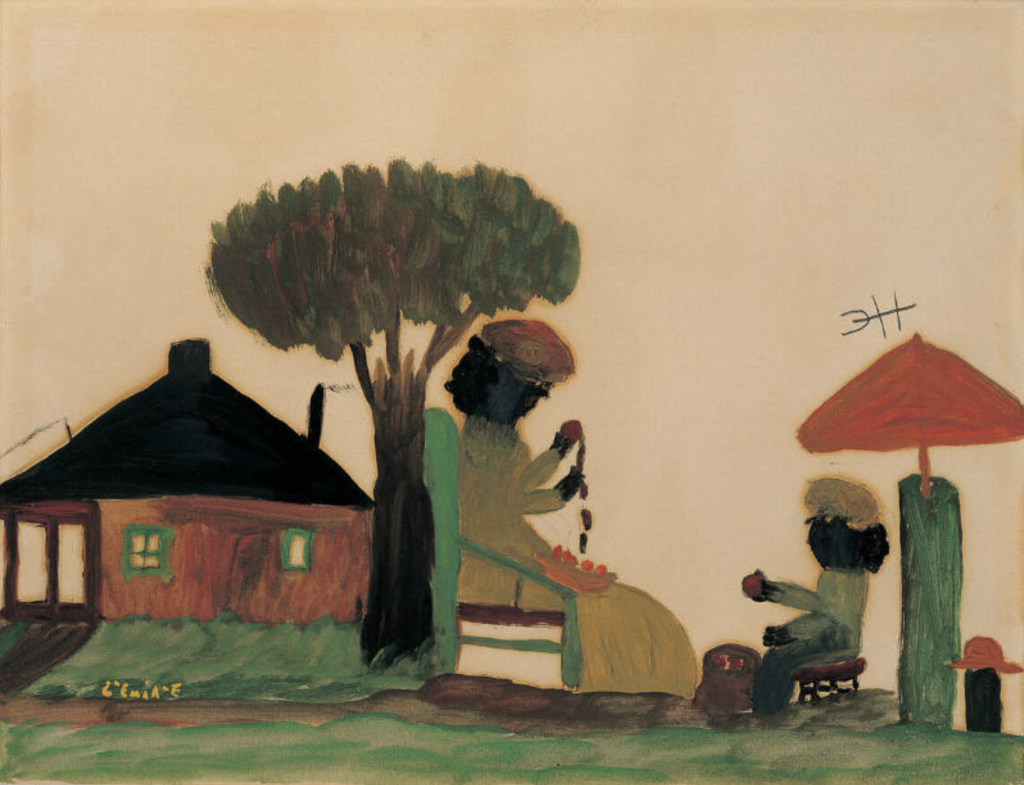
10 Famous Self-Taught Artists: Clementine Hunter, The Apple Paring, c. 1945, American Folk Art Museum, New York, NY, USA. Museum’s website.
Clementine Hunter (1886–1988) was a self-taught Black folk artist from Louisiana in the American South. Hunter spent most of her life living and working on Melrose Plantation in the Cane River region. She began working in the fields as a child and never learned to read or write. For decades, her days were filled with cotton picking, cooking, cleaning, and raising children. Painting came much later, in her fifties, after a lifetime of labor. Hunter did not enter art through schools or studios. She came to it through a life so closely observed that it had already taken root inside her.
Hunter painted Black life in the rural South as she had lived it. Her pictures show baptisms, funerals, weddings, cotton fields, kitchens, church days, dancing, and long working afternoons. She did not rely on models or photographs; she worked from what had become second nature to her. Hunter once said she didn’t look at things to paint them; she carried them in her head and put them down from there.
Painting is a lot harder than pickin’ cotton. Cotton’s right there for you to pull off the stalk, but to paint, you got to sweat your mind.
At first, she sold her paintings for a few cents outside her cabin, sometimes charging people just to look. Slowly, others began to notice what she was doing. By the end of her life, museums were collecting her work, and her paintings were selling for thousands of dollars. Hunter made thousands of images, building one of the richest visual records of Black Southern life in the early 20th century—without school, without rules, and without ever leaving the world she painted.
9. Dorothea Tanning
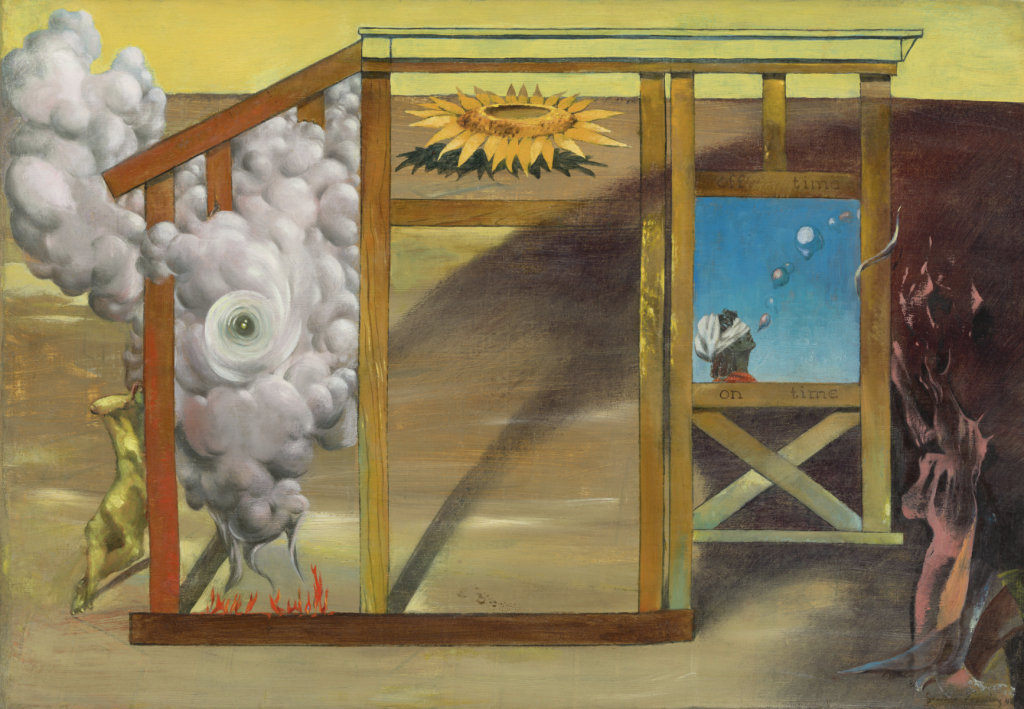
10 Famous Self-Taught Artists: Dorothea Tanning, On Time Off Time, 1948, Museum of Modern Art, New York, NY, USA. Museum’s website.
Dorothea Tanning (1910–2012) grew up in Galesburg, Illinois, and paved her own way as an artist with almost no formal schooling. She spent time as a library assistant during her teenage years, then tried the Chicago Academy of Art for only a few weeks before deciding she’d learn by doing. By the mid-1930s, Tanning was in New York, earning a living as a freelance illustrator and quietly building her career in the studio, learning by looking and letting museums and galleries replace classrooms.
In 1936, Tanning visited MoMA’s landmark exhibition Fantastic Art, Dada, Surrealism, and the dream-logic of Surrealism stayed with her. A few years later, her self-portrait Birthday caught the eye of gallerist Julien Levy, who gave her solo shows and introduced her to the Surrealist circle. Later, Tanning lived and worked in France for many years, where her work continued to change and open into new forms: from sharply rendered, uncanny interiors in the 1940s to more fragmented, freer paintings after the mid-1950s, and then into soft sculptures and immersive installations such as Hôtel du Pavot, Chambre 202.
What makes her self-taught story stand out is the scale of that evolution. Tanning didn’t “arrive” at a single style and stay there; she treated every new medium and turn as something she could simply teach herself next.
Am I Surrealist? Am I a sophist, a Buddhist, a Zoroastrian? Am I an extremist, an alchemist, a contortionist, a mythologist, a fantasist, a humorist? Must we artists bow our heads and accept a label, without which we do not exist? The underlying ideas of Surrealism are still very much with me. They are in the backs of a lot of other minds too, even those so young as to have known only the records of the hearsay, the debris. But I have no label except artist.
10. Jean-Michel Basquiat
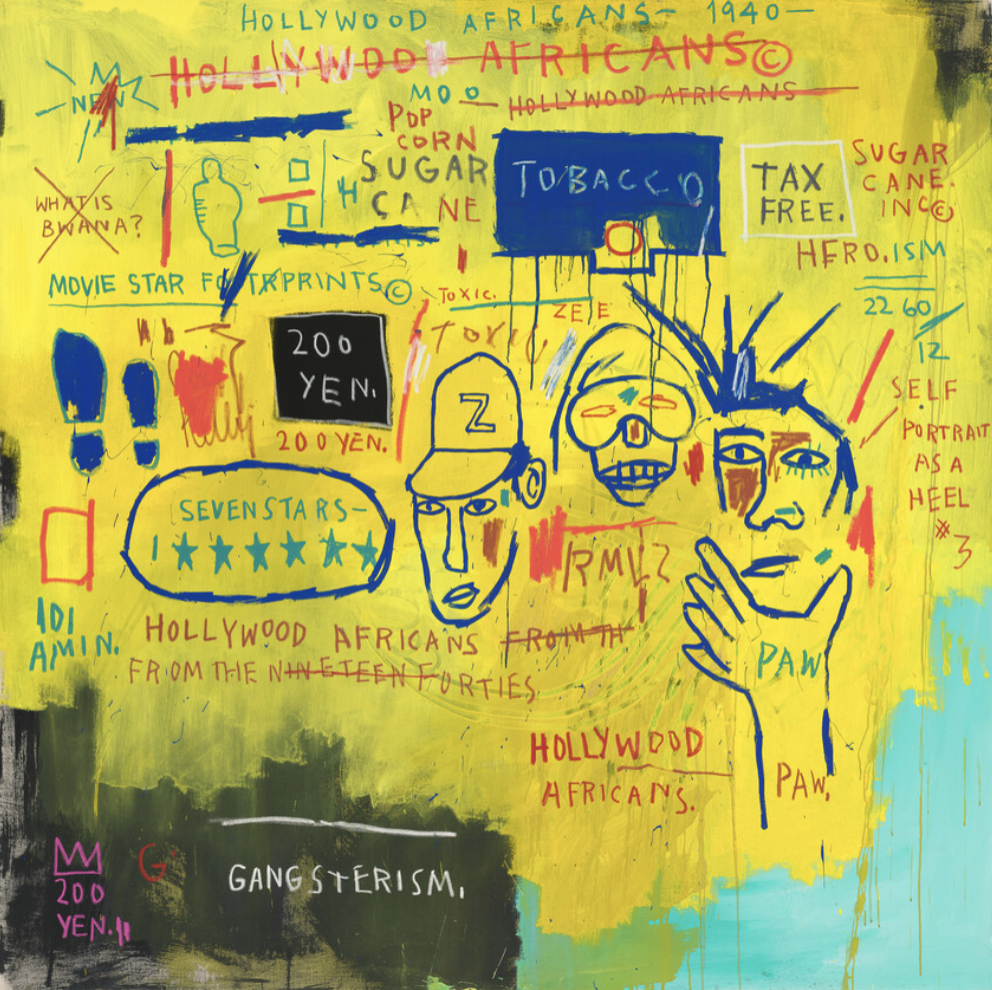
10 Famous Self-Taught Artists: Jean-Michel Basquiat, Hollywood Africans, 1983, Whitney Museum of American Art, New York City, NY, USA. Museum’s website.
Jean-Michel Basquiat (1960–1988) was a self-taught artist who transitioned from street language to museum walls without softening the edges. In the late 1970s, he and Al Diaz began signing cryptic one-liners across Lower Manhattan as SAMO. These were short, sharp texts that sounded like ads, jokes, and warnings at the same time.
Following the 1980 Times Square Show, the art world began to take notice. A year later, critic René Ricard’s “The Radiant Child” pushed Basquiat into full view, just as the art world began treating artists like products. Basquiat quickly understood how race shaped the way people looked at him, often in racist and contradictory ways, and he turned that tension back into his work.
I wanted to be a star, not a gallery mascot.
Basquiat didn’t learn by copying schools; he learned by absorbing the street. He treated the canvas like a wall and a notebook at once—stacking symbols, words, lists, and fragments of Black history until meaning started to pulse through the noise. His paintings move like jazz improvisation: themes return, interrupt each other, then hit harder the second time around. Instead of polishing one clean style, Basquiat kept feeding the surface with more language and more pressure, turning the chaos of the 1980s into a visual system that could hold identity, racism, ambition, and rage in one breath.
When Experience Becomes Education
After these ten lives, training stops being the headline. What stays is how each artist learned by working with what was in front of them, day after day. Different places, different limits, different risks, yet the same result: artists made their own way into art. They did not wait to be chosen. They worked, they looked, and they kept going.
In the end, the world did not shape artists. Artists shaped the world that learned to see them.