Does My Bum Look Big in This? The Female Body in Art
Explore the representation of the female body and buttocks in art, celebrating diversity and beauty across history and modern culture.
Candy Bedworth 29 January 2026
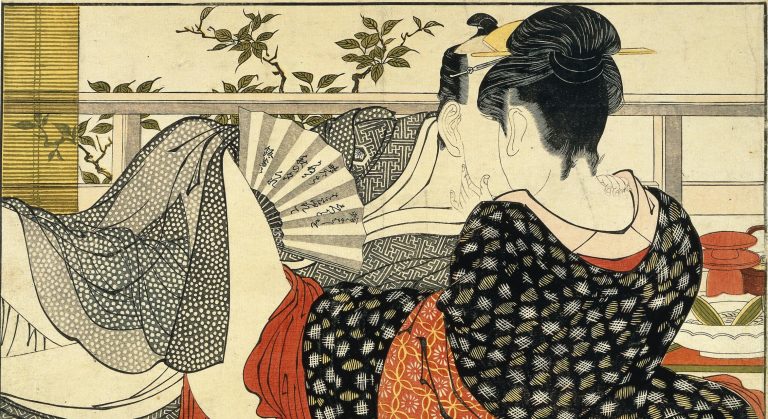
Utamaro, Utamakura (Poem of the Pillow), 1788, British Museum, London, UK. Museum’s website. Detail.
Erotic, playful, and unexpectedly sophisticated, shunga holds a unique place in Japanese visual culture. But there is often far more than mere provocation in these artworks, which combine explicit sexuality with humor, storytelling, and exceptional craftsmanship. Shunga provides a revealing insight into how intimacy, desire, and human relationships were understood in early modern Japan. Keep reading to explore this fascinating genre through 10 Japanese shunga that will shock you!
Shunga was a popular genre of Japanese erotic art produced in large quantities between the 17th and 19th centuries. The term “shunga” literally means “picture of spring,” and “spring” here is a euphemism for sex. Shunga came in various formats such as painted handscrolls, illustrated books, and woodblock prints in the ukiyo-e style.
Despite its explicit content, shunga requires as much technical skill and aesthetic refinement as non-erotic art and was normalized across artistic practices of multiple schools.
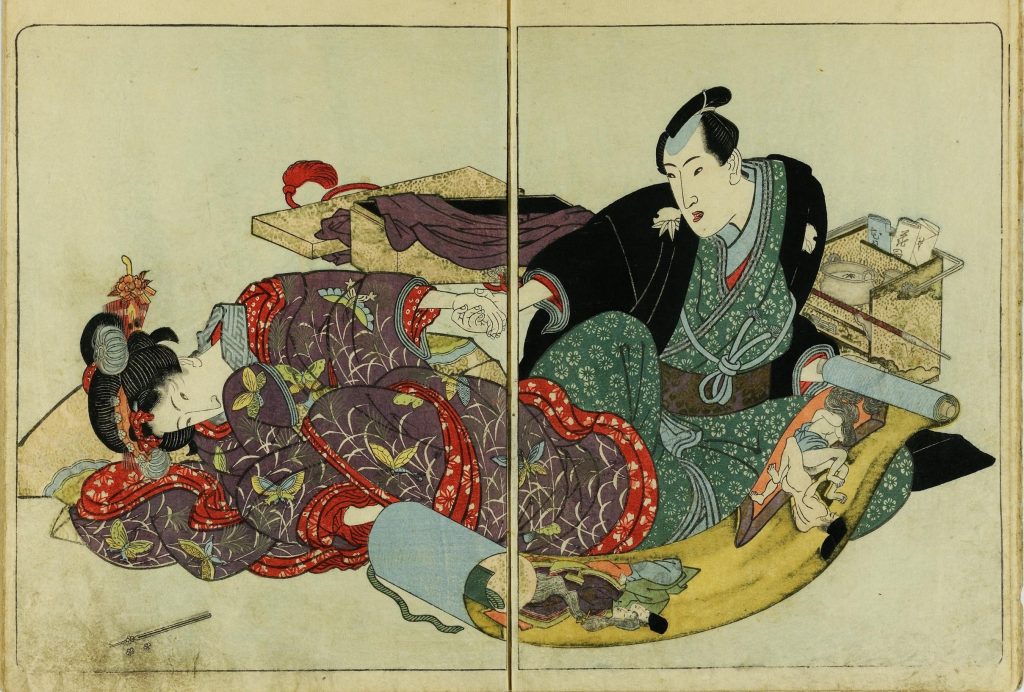
Kunisada, Shunka shuto, Shiki no nagame (In Praise of Love, in the Four Seasons), 1827–1829, British Museum, London, UK. Museum’s website.
Shunga appealed to a broad audience, from wealthy merchants to lower-ranking samurai. Although officially banned after 1722, the ban was inconsistent, and production continued.
Historical records suggest that shunga often played an intricate role in private life, appearing in bridal trousseaux and functioning as visual guides to romance and lovemaking. In this way, shunga served not only as entertainment, but also facilitated education and personal reflection.
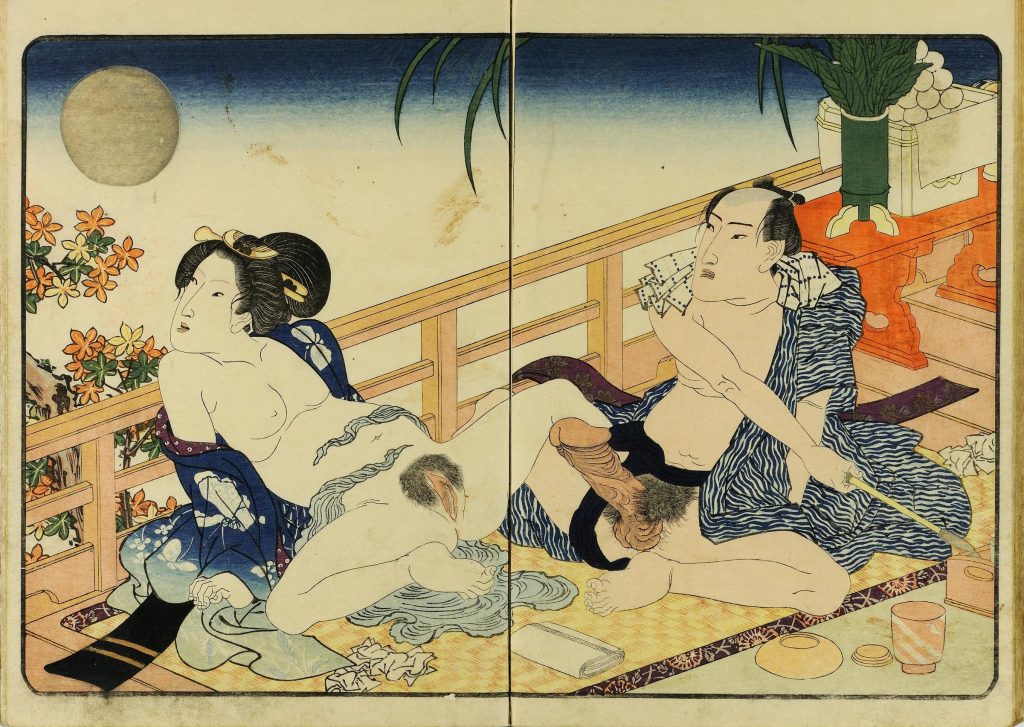
Kunisada, (Shunka shuto) Shiki no nagame (In Praise of Love (in the Four Seasons)), 1827–1829, British Museum, London, UK. Museum’s website.
This print comes from a luxurious book by Utagawa Kunisada, likely intended for an affluent audience. Set on a moonlit terrace, the scene is enriched with everyday domestic details that heighten a sense of intimacy and romance. Unlike many shunga works in which lovers remain partially clothed, this image presents the couple with most of their garments stripped off, exposing their bodies and emphasizing their oversized genitalia.
The sexually explicit nature of shunga works is shocking, but they are also extremely beautiful, humorous, and tender.
Shunga: Sex and Pleasure in Japanese Art, British Museum Press, London, 2013.
Exaggeration was a characteristic of shunga’s visual language. Artists used these techniques to create clear, dynamic compositions that conveyed emotional and physical connection between the figures, while bringing the viewer’s attention to some focal points. These playful distortions were but a means to communicate desire, considering that nudity alone was not necessarily considered erotic in Edo Japan.
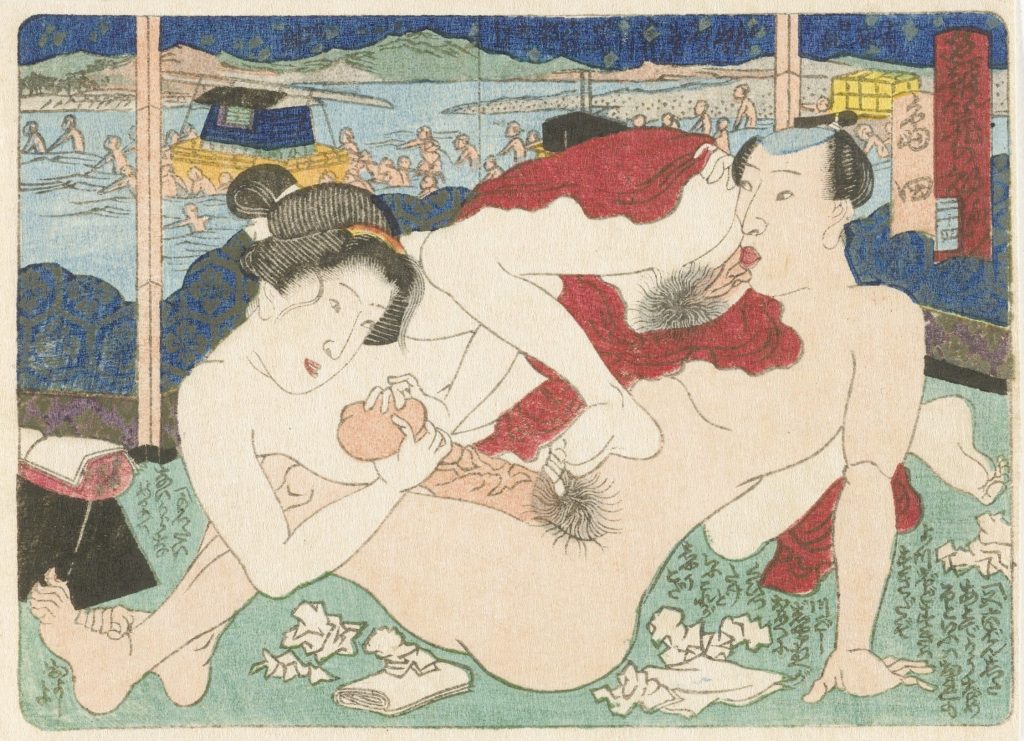
Kunisada, The Shimada Rest Stop, 1835–1845, Rijksmuseum, Amsterdam, Netherlands. Museum’s website.
Another characteristic of shunga is the portrayal of improbable sexual positions. In many works, like The Shimada Rest Stop, the poses are not only unconventional but also composed so that the figures’ bodies become intertwined, making it difficult to distinguish one figure from another.
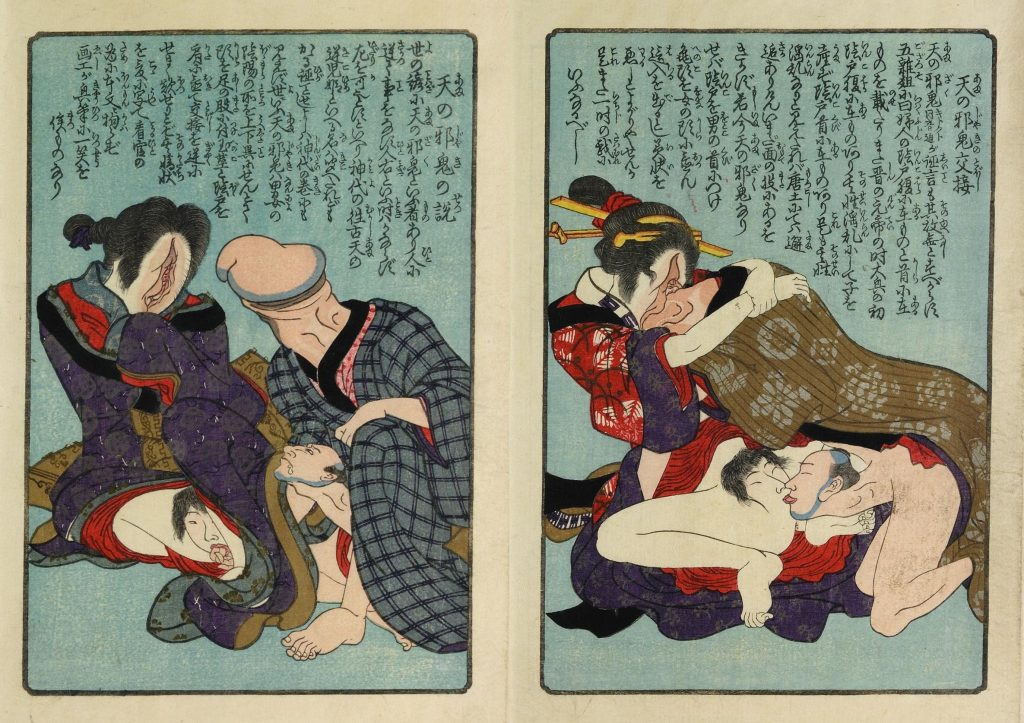
Kunisada, Shunshoku hatsune no ume (Spring Colours: First Cry of the Warbler on the Plum), 1842, British Museum, London, UK. Museum’s website.
In some works, genitals even replace faces, as seen in this striking piece by Kunisada. By presenting the sexual organs as a “second face,” the artist gives visual form to primal desire, suggesting how passion can momentarily eclipse social identity and emotional restraint. This bold visual strategy reflects shunga’s blend of humor, symbolism, and exaggeration. Rather than serving shock value alone, the image invites viewers to reflect on the tension between social decorum and private desire in Edo society.
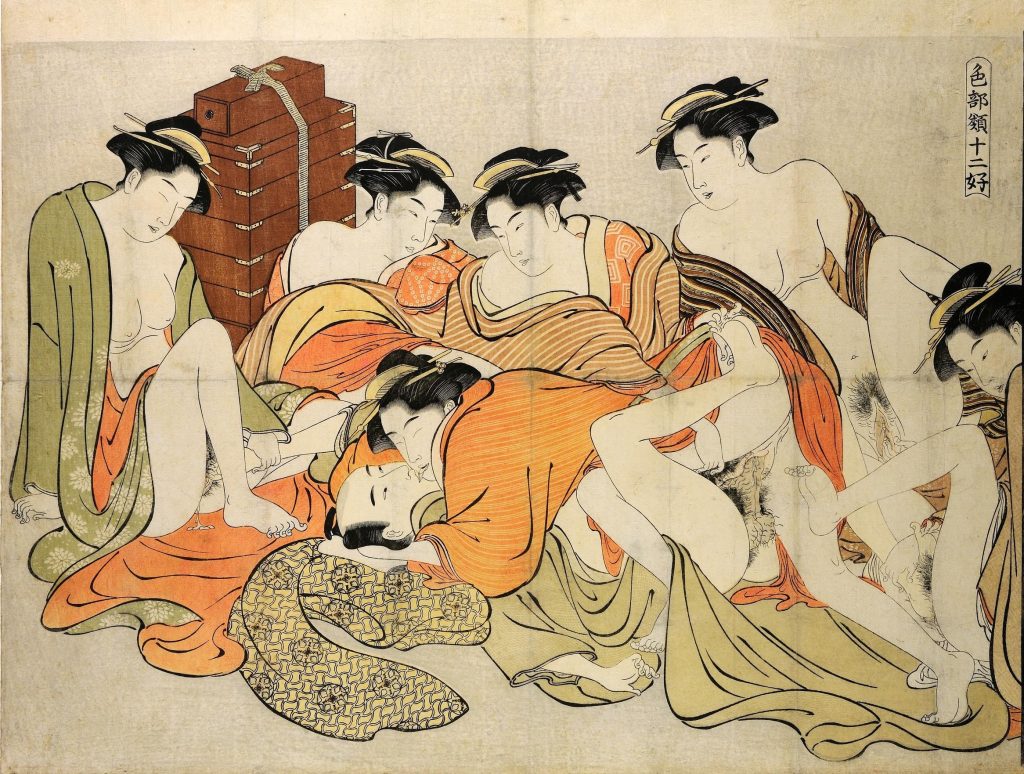
Katsukawa Shunchō, Shiki burui juni-ko (Twelve Tastes in the Classification of Passion), c. 1785, British Museum, London, UK. Museum’s website.
This same blend of bold symbolism and playful exaggeration appears in shunga’s frequent depictions of group encounters, as seen in this striking print. It portrays a handsome salesman approached by six eager young women, who surround him as he lies on his back, each seeking pleasure in her own way.
The scene’s comic excess may be read as an inversion of the traditional Seven Lucky Gods, only one of whom, Benzaiten, is female, turning a familiar cultural motif into erotic satire.
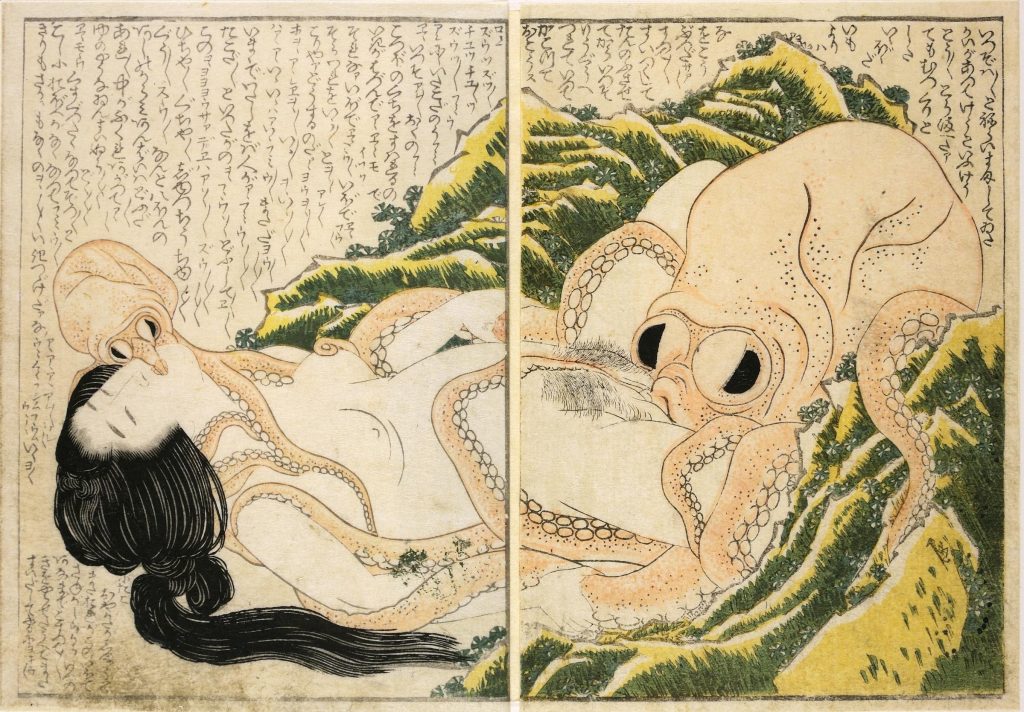
Hokusai, Kinoe no komatsu (The Dream of the Fisherman’s Wife), 1814, British Museum, London, UK. Museum’s website.
While most shunga portray human lovers, a small number feature animals in fantastical or symbolic encounters. The most famous example appears in Hokusai‘s work The Dream of the Fisherman’s Wife.
In the artwork, a large octopus pulls a diving woman into a crevice between two rocks, using its eight legs to entwine and play with her body, while a smaller octopus kisses her mouth. Although she appears lifeless, her arched back suggests pleasure, which is confirmed by the accompanying dialogue.
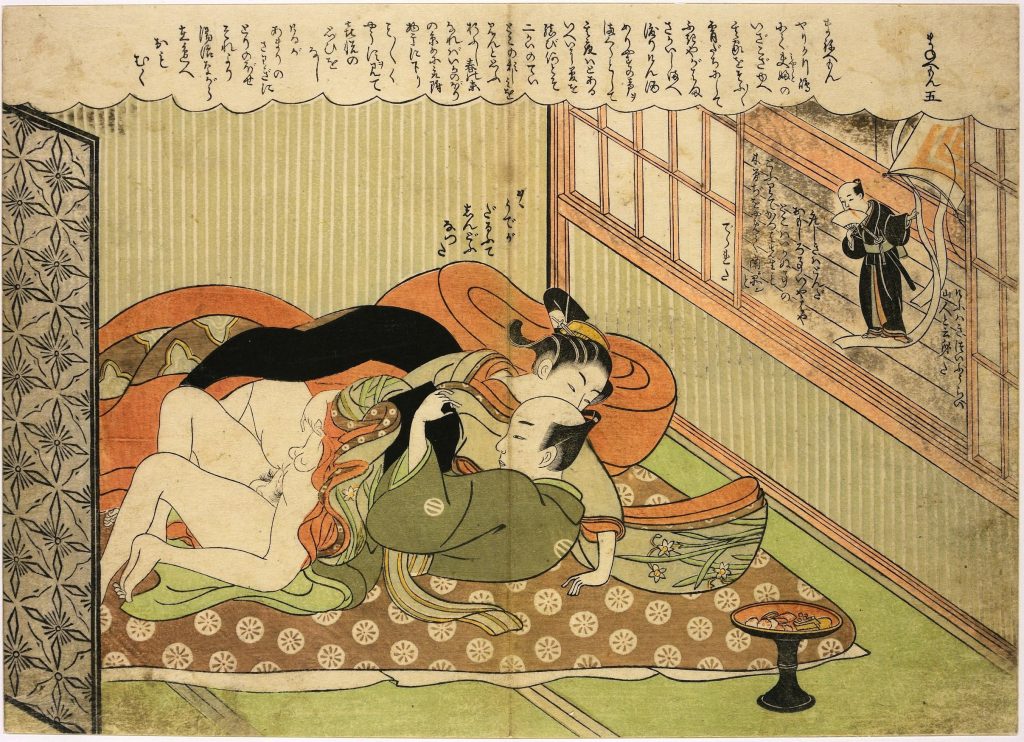
Suzuki Harunobu, Mane’emon no. 5 from Furyu enshoku Mane’emon (Elegant Amorous Mane’emon) series, 1770, British Museum, London, UK. Museum’s website.
Although most shunga depict heterosexual couples, same-sex relationships appear frequently, especially in works addressing male audiences. This full-color, nishiki-e print belongs to Harunobu’s celebrated series about Mane’emon, a man who gains immortality and the ability to observe private sexual customs.
Shunga were not regarded simply as pornography; rather they were appreciated as works of art and as auspicious objects connected with marriage and prosperity.
Shunga: The Erotic Art of Japan, Kodansha International, Tokyo, 1973.
Here, Mane’emon watches two men engaged in intercourse. Symbolic narcissus flowers on the youth’s robe signal homosexuality. The scene reflects Edo-period acceptance of same-sex relationships, particularly within urban and samurai culture, and demonstrates how shunga documented diverse forms of desire.
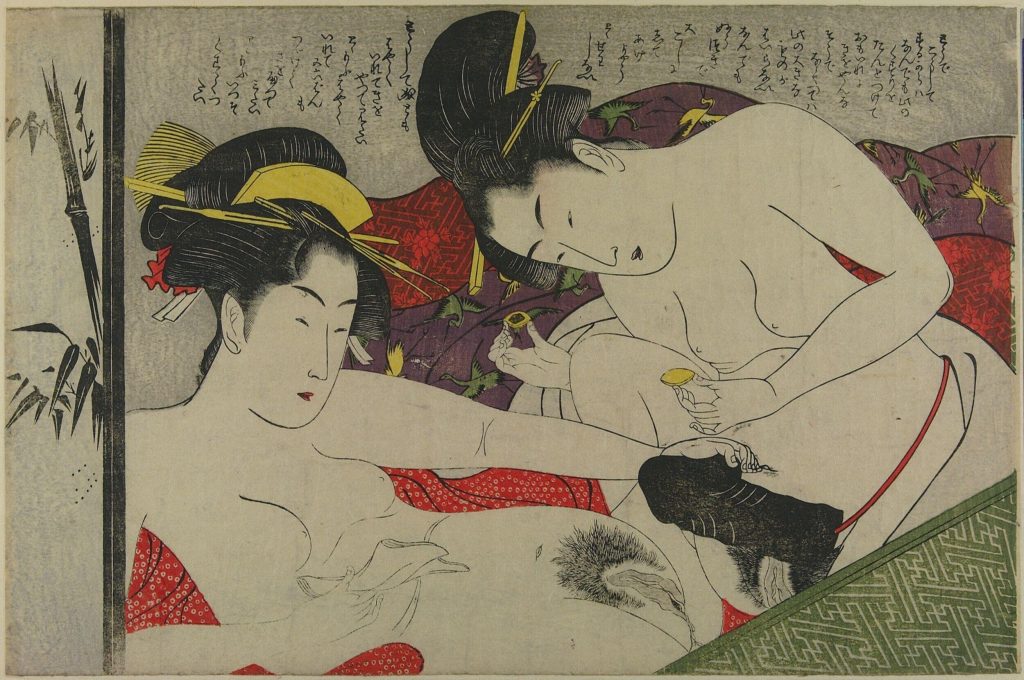
Lesbian love and sex appear less frequently in shunga but are nonetheless documented. This print shows two women preparing to use a strap-on dildo, with one holding lubricant. Such scenes reveal the practical and educational dimension of shunga as sexual manuals.
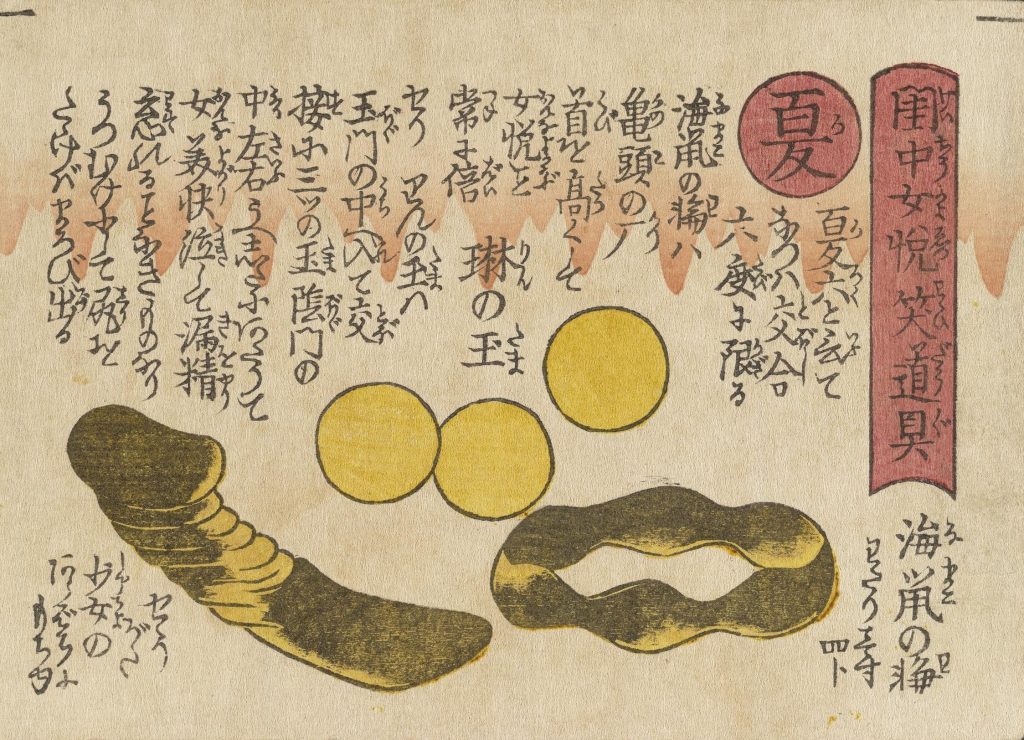
Keisai Eisen, Namako no wa, rin no tama, shō-gata (Summer: Sea-cucumber Ring, Jewel Balls, Small Dildo) from Keichū nyo’etsu warai-dōgu (Sex Toys for Women’s Pleasure in the Bedroom), 1822–1824, British Museum, London, UK. Museum’s website.
Sex toys were common during the Edo period and appear in many shunga prints. Accompanying comic texts often provided advice and pseudo-medical recommendations, blending instructions with entertainment.
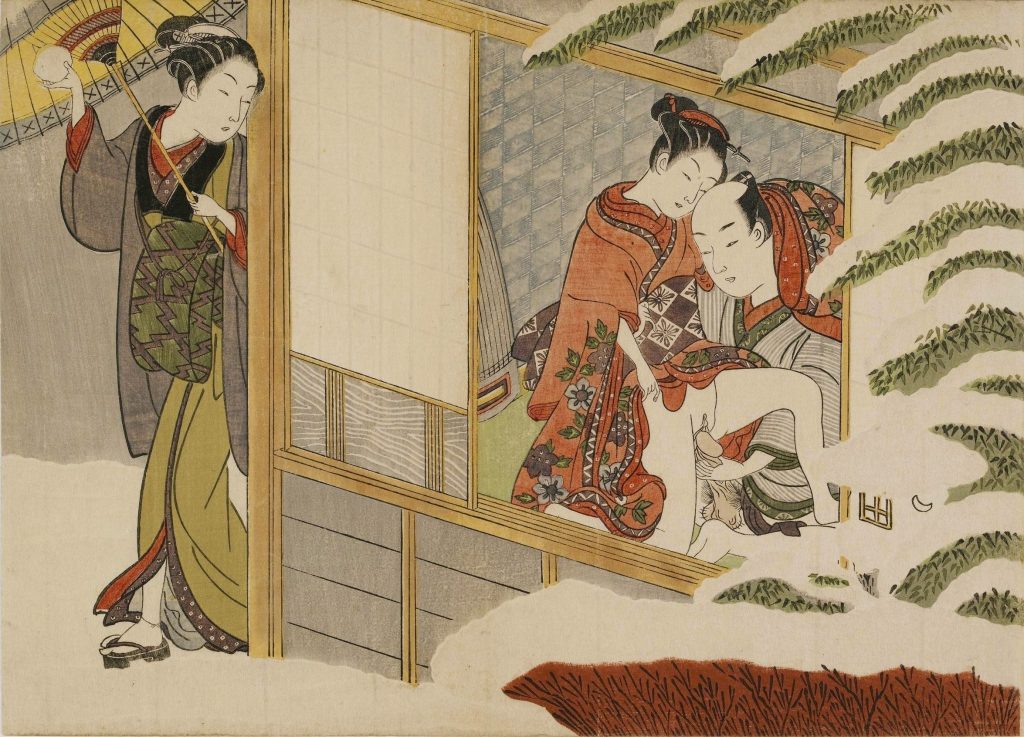
Suzuki Harunobu, Print with erotic scene, 1765–1770, British Museum, London, UK. Museum’s website.
Masturbation, voyeurism, and jealousy are recurring themes in shunga. In this snowy scene, a man makes love with a woman beside an open window while the man’s wife watches from outside, preparing to throw a snowball in anger. The contrast between private pleasure and public exposure creates dramatic tension and humor. The well-preserved shunga print by Suzuki Harunobu features vibrant colors and embossing, as well as the detailing of snow on bamboo leaves. It’s considered one of Harunobu’s finest erotic designs, created for wealthy patrons.
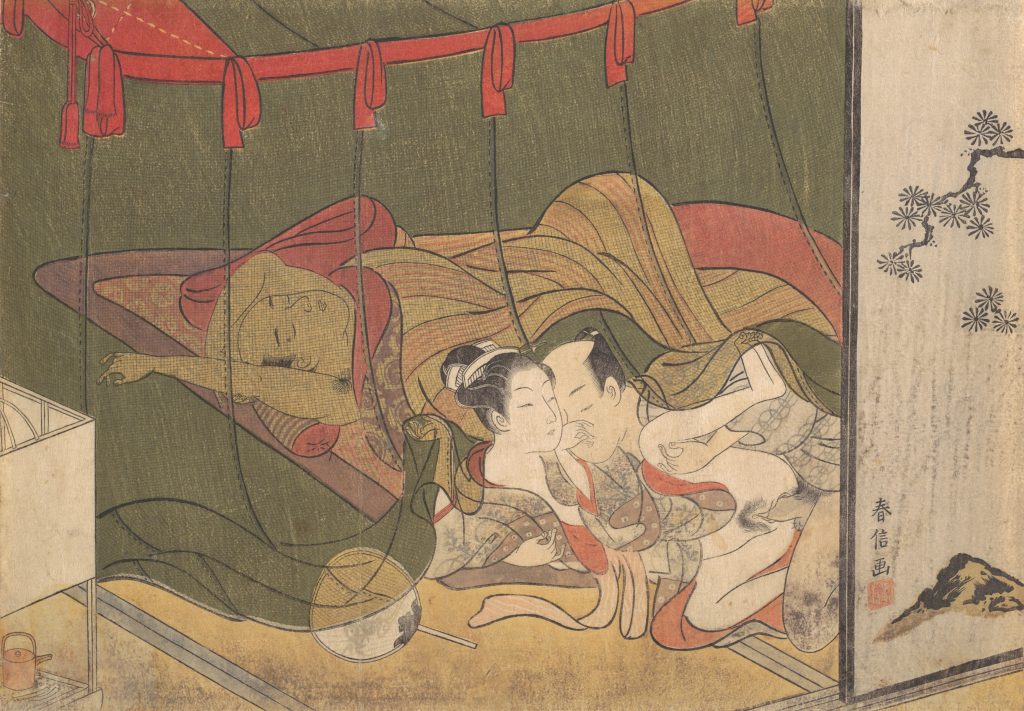
Suzuki Harunobu, Lovers Beneath a Mosquito Net, 18th century, Metropolitan Museum of Art, New York City, NY, USA, Museum’s website.
Similarly, other shunga artworks, such as this one, explore sexual intercourse in the presence of a third person. Two lovers make love under a patterned mosquito net, while another man sleeps nearby. The delicate details and soft coloring create an atmosphere of quiet sensuality. Rather than presenting sex as taboo, the scene reflects Edo-period views of desire as a natural part of everyday life enmeshed within shared living spaces and social relationships.
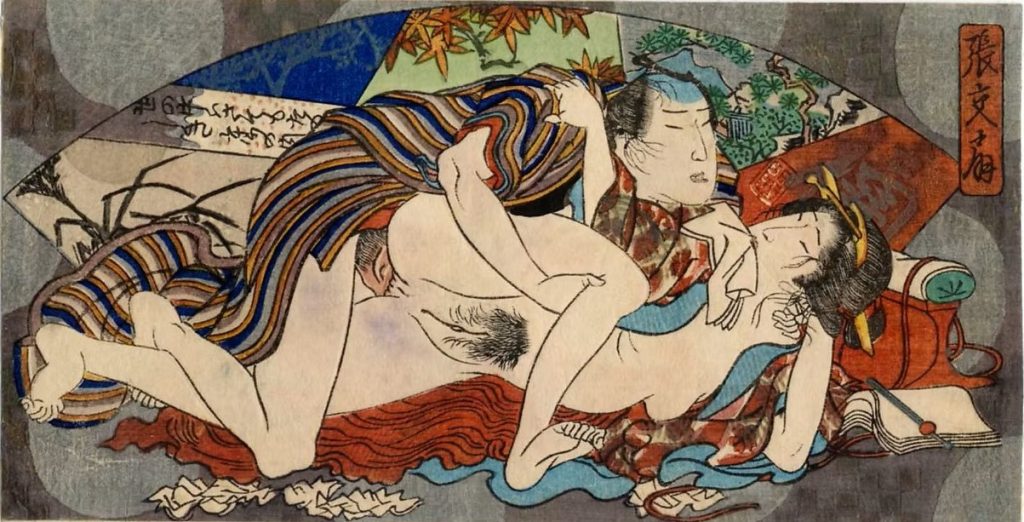
Harimaze Ôgi (The Decorated Fan), 1850–1860, Rijksmuseum, Amsterdam, Netherlands. Museum’s website. Detail.
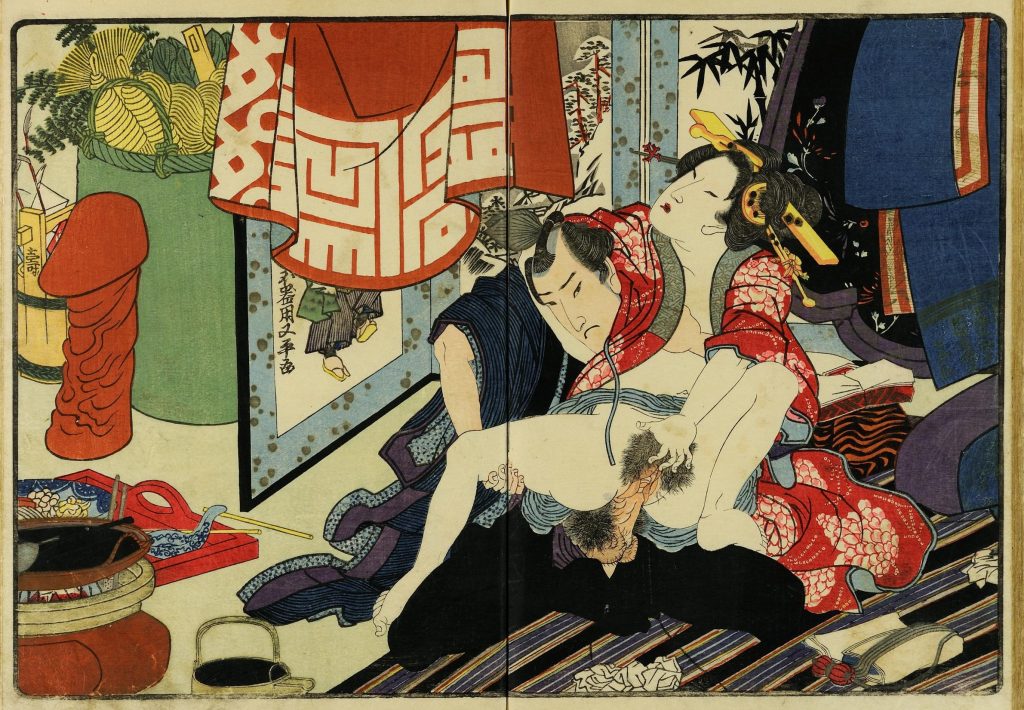
Kunisada, (Shunka shuto) Shiki no nagame (In Praise of Love (in the Four Seasons)), 1827–1829, British Museum, London, UK. Museum’s website.


The rich colors and detailed fabrics stand out beautifully. The bold sensuality and fan-shaped background give the print a unique charm.
In a lavish brothel, a client and a courtesan share an intimate moment. The woman, with her hair elegantly styled, wears a stunning kimono and is surrounded by luxury interiors and erotic toys while the man appreciates her exceptional services.
Courtesans and brothel culture were also important themes in many shunga prints. The woman’s elaborate hairstyle and luxurious clothing suggest the elegance of the pleasure quarters rather than an ordinary home. The richly decorated interior further indicates that this is not a domestic space.
Rather than emphasizing private intimacy, this composition focuses on spectacle, status, and the dynamics of commercialized desire. Captions or dialogue often add humor or erotic innuendo, enhancing the narrativity of the work.
Shunga presents sexuality and sexual pleasure as natural and essential to the human condition.
Shunga: Sex and Pleasure in Japanese Art, British Museum Press, London, 2013.
These 10 works demonstrate that shunga is far more than mere provocative imagery. They showcase remarkable technical skill, playful humor, layered symbolism, and subtle social commentary, offering a vivid reflection of sex, intimacy, and pleasure during the Edo period. Beyond their erotic appeal, they provide valuable cultural and historical insights into their times and have a lasting influence on later artists and visual traditions. What are your thoughts on these works, and how do you view shunga as an artistic genre?
If, like us, you love Japanese art, be sure to check out our Japanese Art postcards, featuring some of the most remarkable Japanese prints!
Chris Uhlenbeck and Margarita Winkel, Japanese Erotic Fantasies—Sexual Imagery of The Edo Period, Hotei Publishing, Amsterdam, 2005.
Timothy Clark, et al, Shunga: Sex and Pleasure in Japanese Art, British Museum Press, London, 2013.
Tom Evans, Mary Anne Evans, Shunga: The Art of Love in Japan, Paddington Press, New York, 1970.
Get your daily dose of art
Click and follow us on Google News to stay updated all the time

DailyArt Magazine needs your support. Every contribution, however big or small, is very valuable for our future. Thanks to it, we will be able to sustain and grow the Magazine. Thank you for your help!

Katerina is an art enthusiast and lover of masterpieces. She holds a Bachelor’s degree with specialization in Archaeology and Art History from Aristotle University of Thessaloniki, Greece. She plans to continue her studies in Art History and enjoys exploring the world of art infinitely and beyond.

Explore the representation of the female body and buttocks in art, celebrating diversity and beauty across history and modern culture.
Candy Bedworth 29 January 2026
Nudity started being an important subject in art in ancient Greece. The male body was celebrated at sports competitions or religious festivals, it...
Anuradha Sroha 19 November 2025
Hidden underground for hundreds of years, depictions of sex, love, and erotica in Andean pre-Columbian art are now proudly displayed in the Erotic...
Bruno Guerra 13 June 2025
One simply cannot praise Homer’s peerless oeuvre enough. We all read Iliad and Odyssey several times, and surely, a considerable amount of us has...
Erol Degirmenci 4 November 2021