

The Light Beyond Stone: The Hidden Meaning of Gothic Stained Glass
Imagine living in medieval Europe. Disease, famine, and war are constant companions, and life is fragile and uncertain. Your faith shapes every...
Guest Author 21 September 2026
3 September 2026 min Read
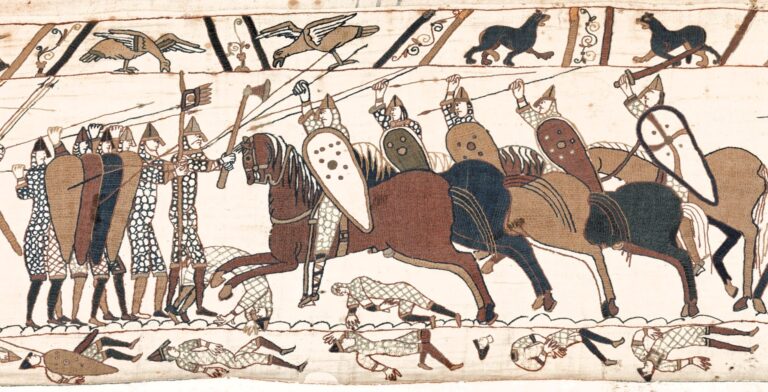
Bayeux Tapestry (scene 52), 11th century, Musée de la Tapisserie de Bayeux, Bayeux, France. Detail.
The Bayeux Tapestry is one of the most remarkable artistic achievements of the Middle Ages. Filled with knights, warships, mythical beasts, and royal intrigue, it is both a 11th-century film strip of medieval life and a powerful piece of political storytelling. Nearly a millennium after its creation, this masterpiece returns to England for a once-in-a-lifetime presentation at the British Museum. But what exactly is the Bayeux Tapestry, and why does it still matter?
The Bayeux Tapestry is often considered the world’s earliest surviving monumental secular embroidery. Through words and images, the tapestry tells the events between 1064 and 1066, which culminated in the Battle of Hastings in 1066 and William, Duke of Normandy’s conquest of England. Considered as one of the most significant turning points in British history, as England was never successfully conquered again!
Over the centuries, the Bayeux Tapestry has been known by different names: “Telle du Conquest” (Cloth of the Conquest) in the Middle Ages, “William’s Little Cloth” in the 18th century, and “Queen Matilda’s Tapestry” in the 19th century.
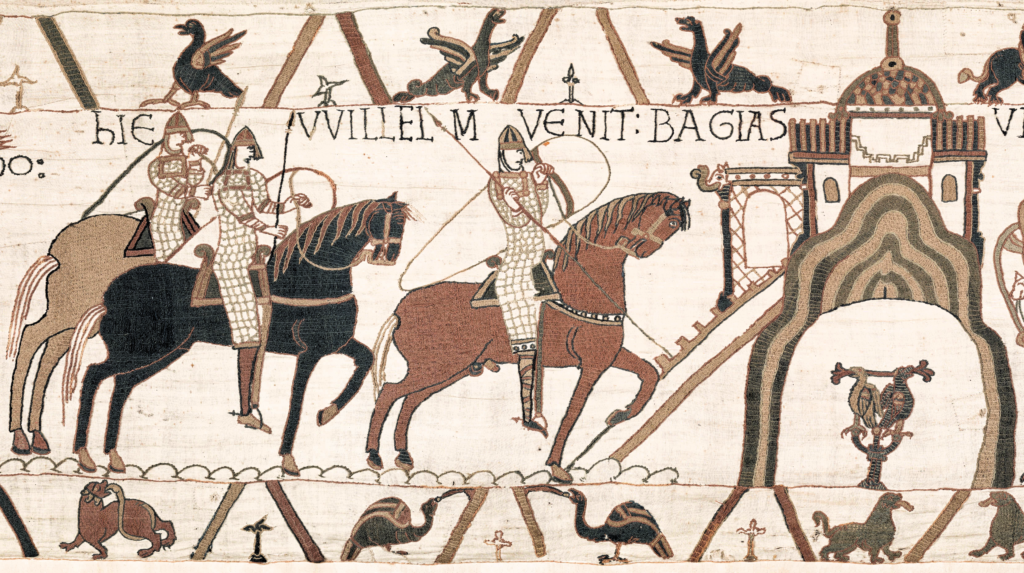
Bayeux Tapestry (scene 22), 11th century, Musée de la Tapisserie de Bayeux, Bayeux, France. Detail.
Despite its traditional name, the Bayeux Tapestry is not a tapestry at all. A true tapestry is woven, whereas the Bayeux masterpiece consists of vegetable-dyed wool threads embroidered onto a woven linen ground. The piece consists of nine individual panels of woven linen, stitched together to form a seamless banner measuring approximately 68.38 m (almost 224 ft.) in surviving length and about 50 cm (19 3/4 in) high.
The artisans used techniques including stem stitch for outlines, contours, and details while laid-and-couched stitching, known as Bayeux Stitch, for larger areas of color. Its restricted palette of terracotta, ocher, blue-green, gold, and dark blue gives the work its distinctive visual character.
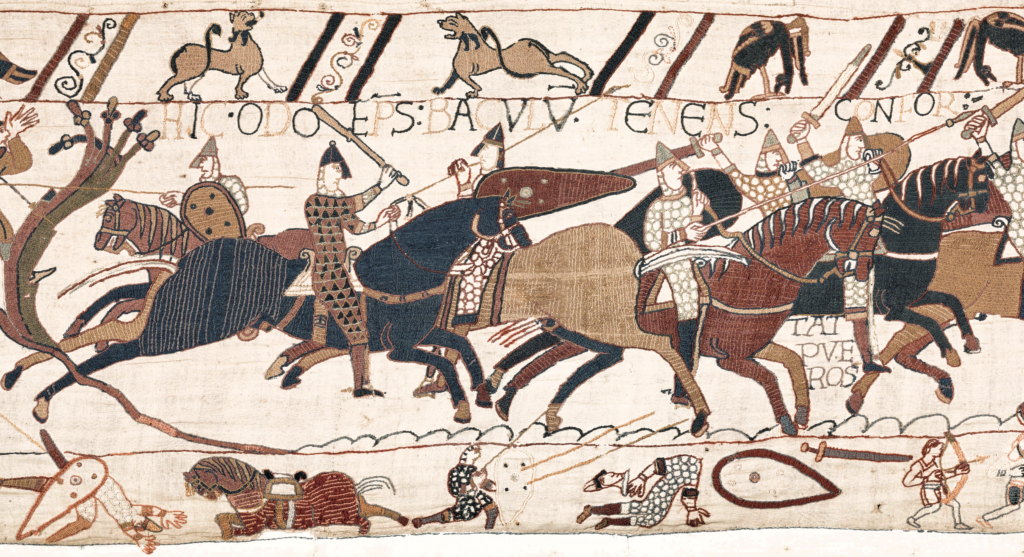
Bayeux Tapestry (scene 54), 11th century, Musée de la Tapisserie de Bayeux, Bayeux, France. Detail.
For centuries, romantic belief attributed the embroidery to Queen Matilda, wife of William the Conqueror, and her ladies-in-waiting. Modern historians have largely rejected this story. Odo, Bishop of Bayeux, William’s half-brother, is often considered the likely commissioner. His prominent appearance in embroidery further suggests his close involvement. The work was probably intended to decorate the nave of the newly dedicated Bayeux Cathedral on July 14, 1077.
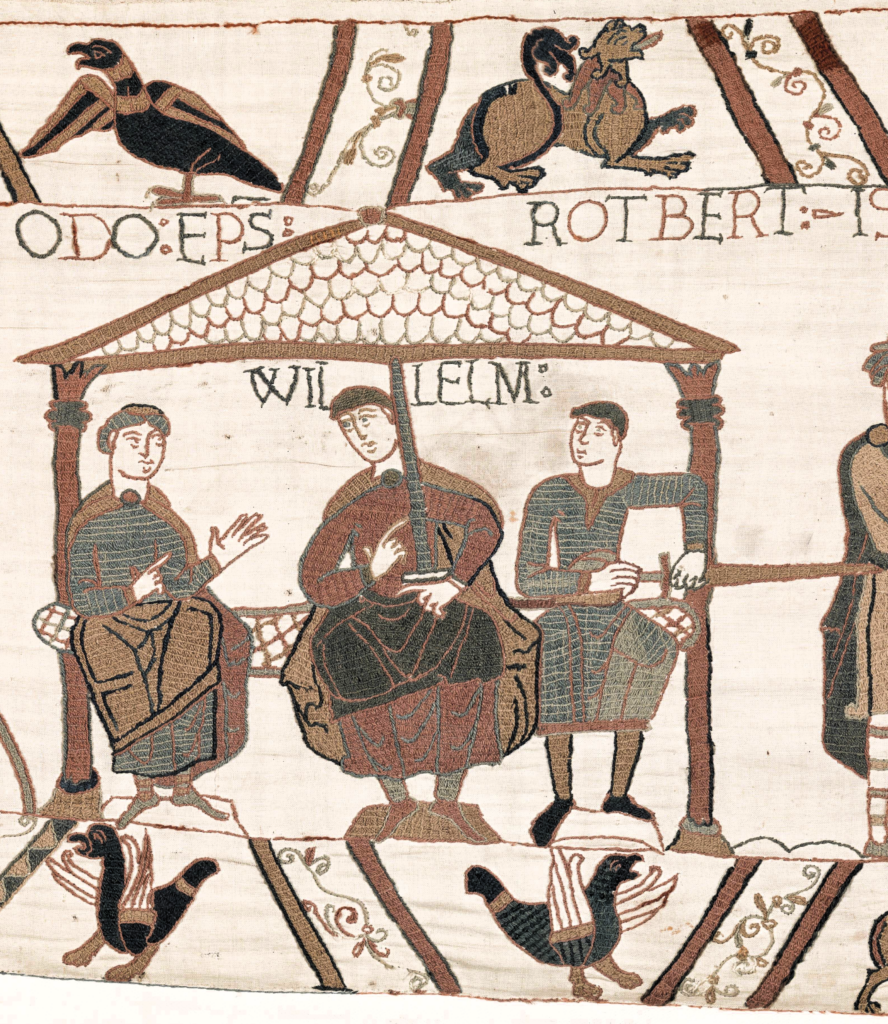
Bayeux Tapestry (scene 44), 11th century, Musée de la Tapisserie de Bayeux, Bayeux, France. Detail.
The precise crafters of the Bayeux Tapestry remain a mystery. However, historians generally believe that it was created in England, possibly in Canterbury, where Anglo-Saxon workshops were renowned for their embroidery throughout Europe. Some scholars have suggested that its designs may have been prepared in a Canterbury scriptorium before being executed by skilled English embroiderers—presumably English women. If this interpretation is correct, the Bayeux Tapestry embodies history’s greatest paradoxes. The conquered may have created one of the most celebrated visual accounts of their conquerors’ victory!
It begins with Edward the Confessor, King of England, who died childless in January 1066. His death triggered a succession crisis involving three claimants: Harold Godwinson, England’s most powerful nobleman; William, Duke of Normandy; and Harald Hardrada, King of Norway.
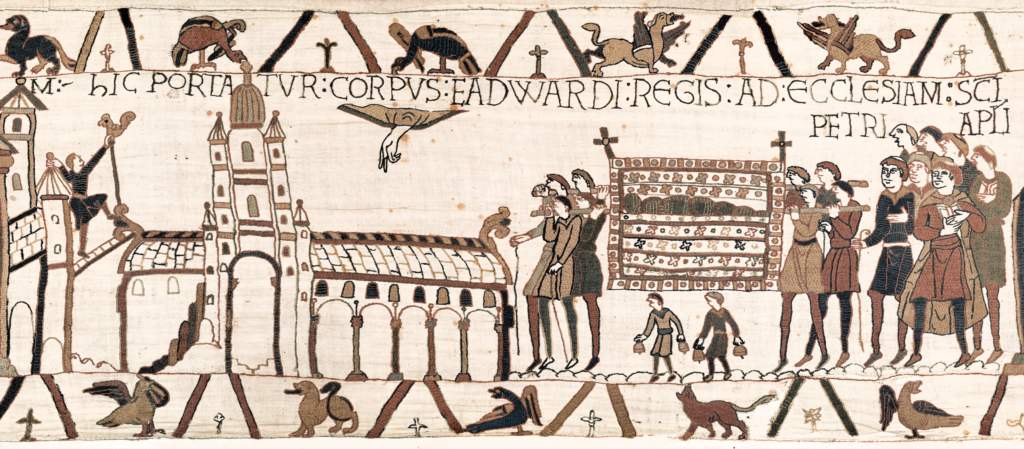
Bayeux Tapestry (scene 26), 11th century, Musée de la Tapisserie de Bayeux, Bayeux, France. Detail.
The tapestry tells this story firmly from the Norman perspective. According to its narrative, Edward had promised the English throne to William. During a diplomatic mission to Normandy, Harold was captured before being released by William. In return, Harold supposedly swore a solemn oath recognising William as England’s rightful future king.
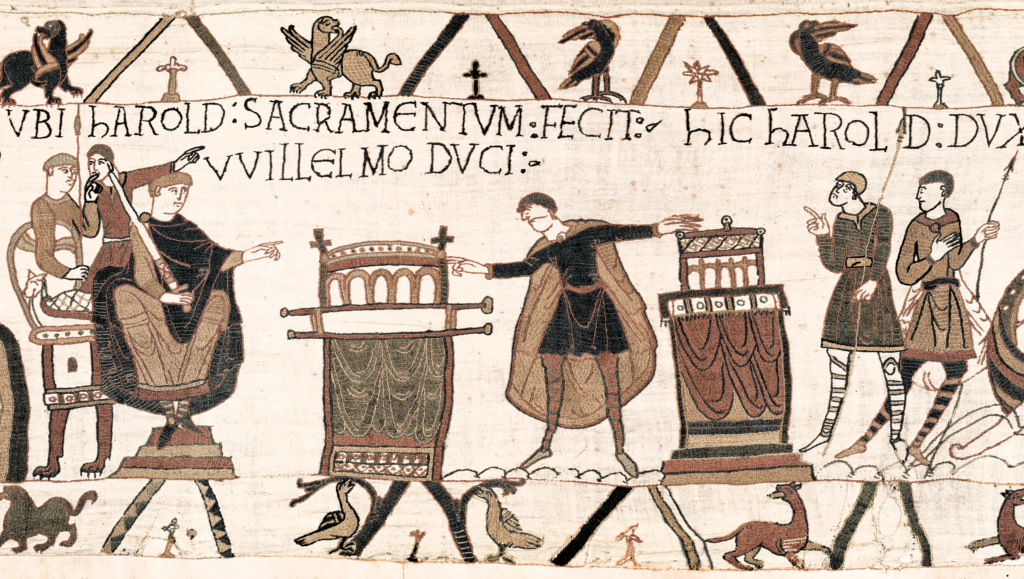
Bayeux Tapestry (scene 23), 11th century, Musée de la Tapisserie de Bayeux, Bayeux, France. Detail.
This significant scene depicts Harold placing his hands upon sacred relics. Beneath, the inscription carried profound religious and legal significance: “UBI HAROLD SACRAMENTUM FECIT WILLELMO DUCI” (“Where Harold made an oath to Duke William”).
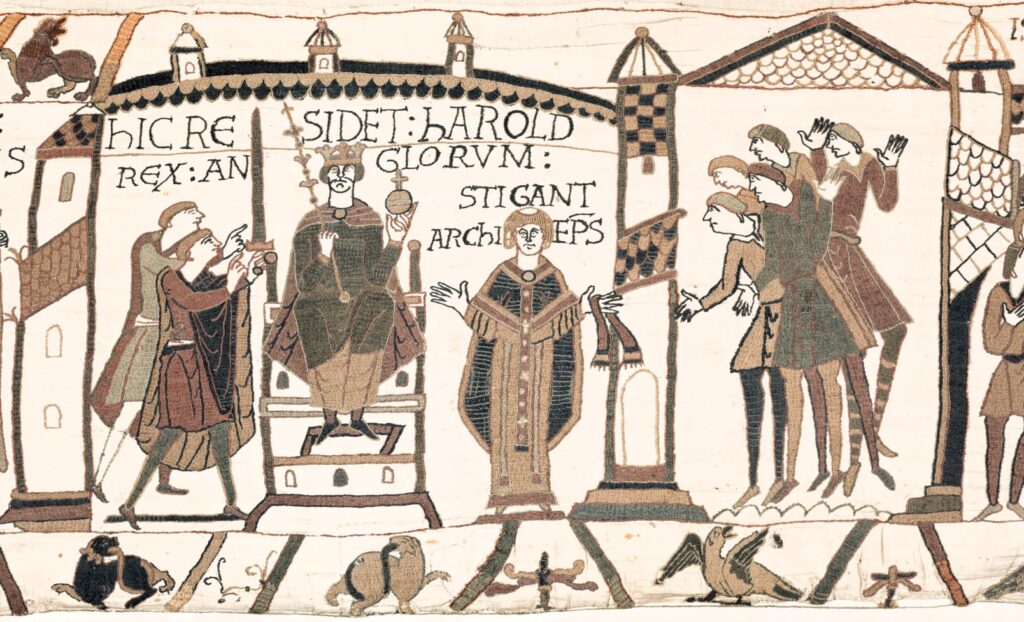
Bayeux Tapestry (scene 30-31), 11th century, Musée de la Tapisserie de Bayeux, Bayeux, France. Detail.
By portraying Harold as having broken this oath after he accepted the English crown, the tapestry offers William a moral and political justification for his invasion. Whether Harold truly intended to betray William remains debated. English chroniclers provide different versions of the story, while some later historians suggest Harold may have sworn under duress. Nevertheless, the embroidery leaves viewers in little doubt about where its sympathies lie.
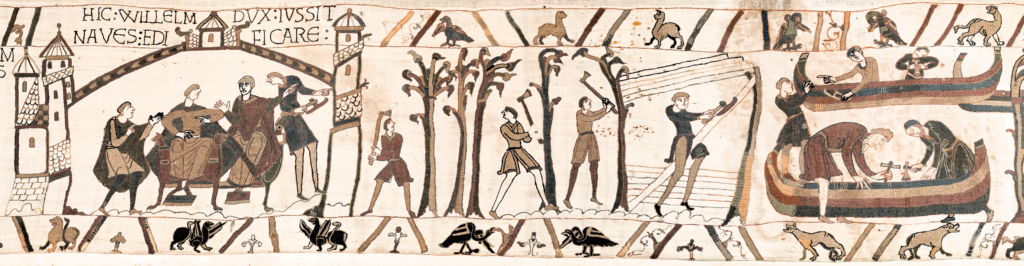
Bayeux Tapestry (scene 35), 11th century, Musée de la Tapisserie de Bayeux, Bayeux, France. Detail.
The tapestry is organized into three horizontal registers. The central one carries the principal narrative that unfolds across 58 scenes, accompanied by Medieval Latin tituli (inscriptions) identifying people, places, and events. The upper and lower borders contain a rich assortment of secondary imagery, containing animals, mythical creatures, moral stories, as well as social activities such as hunting and farming.
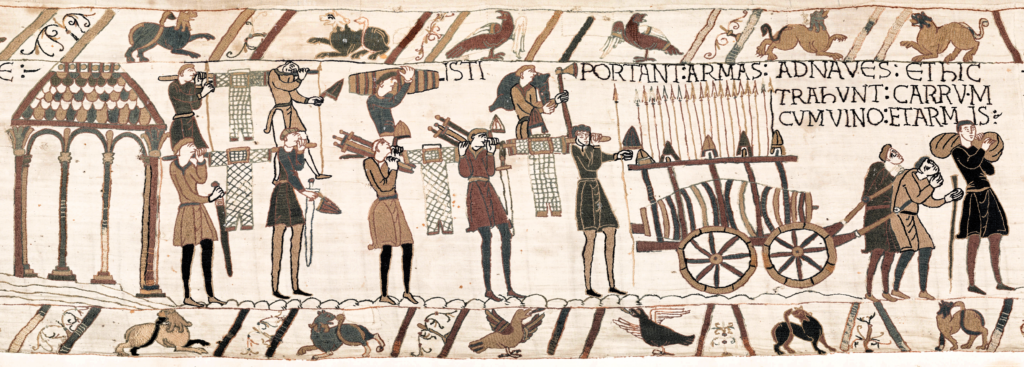
Bayeux Tapestry (scene 37), 11th century, Musée de la Tapisserie de Bayeux, Bayeux, France. Detail.
Rather than focusing only on warfare, the tapestry highlights the preparation and logistics of conquest. It shows workers felling trees and building ships, armourers preparing weapons, soldiers carrying spears, swords, shields, and chain mail, and men transporting barrels of wine to the fleet. These scenes portray William’s campaign as a carefully coordinated military enterprise, supported by loyal followers and divine favor.
The story unravels as a continuous sequence of images rather than separate framed scenes. Trees, buildings, ships, and other vertical elements help divide episodes, while gestures, recurrent figures, horses, and inscriptions guide the viewer across the long linen surface.
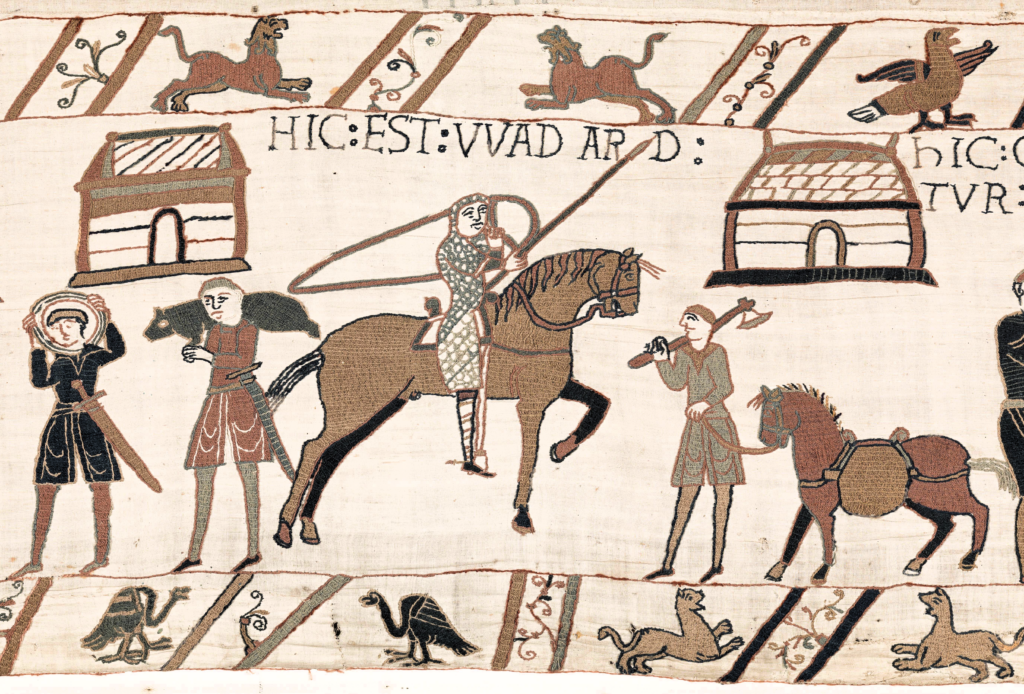
Bayeux Tapestry (scene 41), 11th century, Musée de la Tapisserie de Bayeux, Bayeux, France. Detail.
The tapestry offers a vivid record of life and material culture in the 11th-century. Unlike many surviving medieval artworks that focus primarily on biblical narratives or saints, the Bayeux Tapestry presents historical events through a diverse cast of people. Kings and bishops appear alongside sailors, carpenters, cooks, messengers, blacksmiths, and servants.
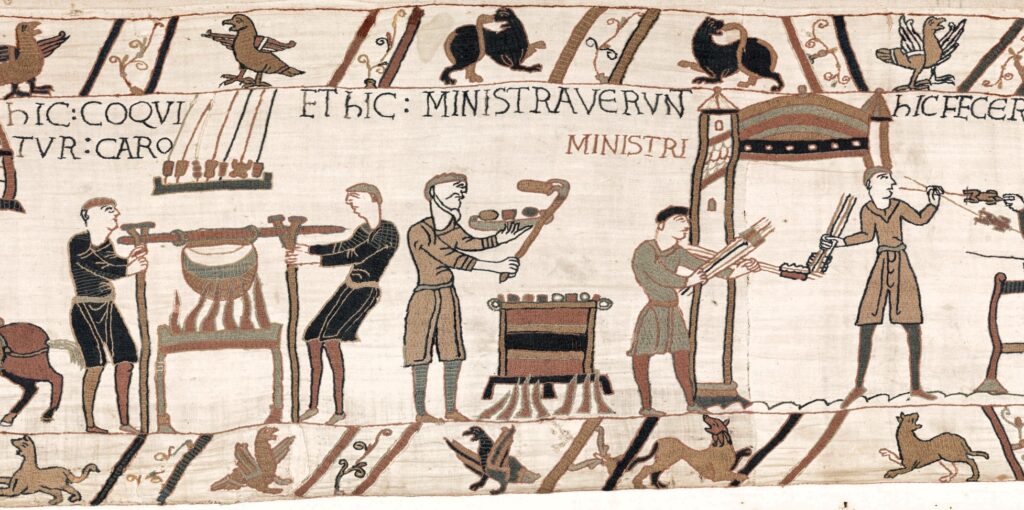
Bayeux Tapestry (scene 42), 11th century, Musée de la Tapisserie de Bayeux, Bayeux, France. Detail.
Expressions of fear, triumph, grief, and determination animate the figures, while details of food, clothing, hairstyles, helmets, saddles, tools, furniture, architecture, ships, and weapons provide an unparalleled glimpse into the world of the 11th century. In this way, the tapestry transforms contemporary history into monumental public art, preserving not only the events of 1066 but also a detailed record of the society and culture surrounding them.
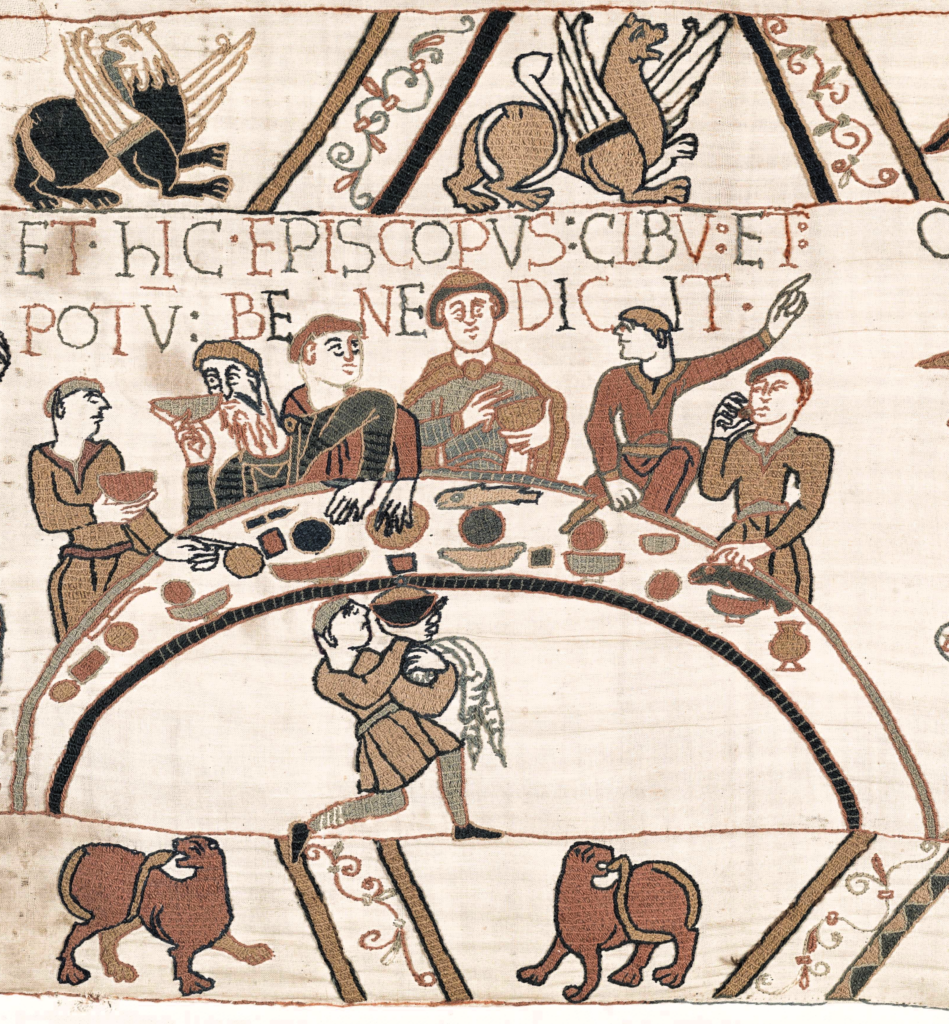
Bayeux Tapestry (scene 43), 11th century, Musée de la Tapisserie de Bayeux, Bayeux, France. Detail.
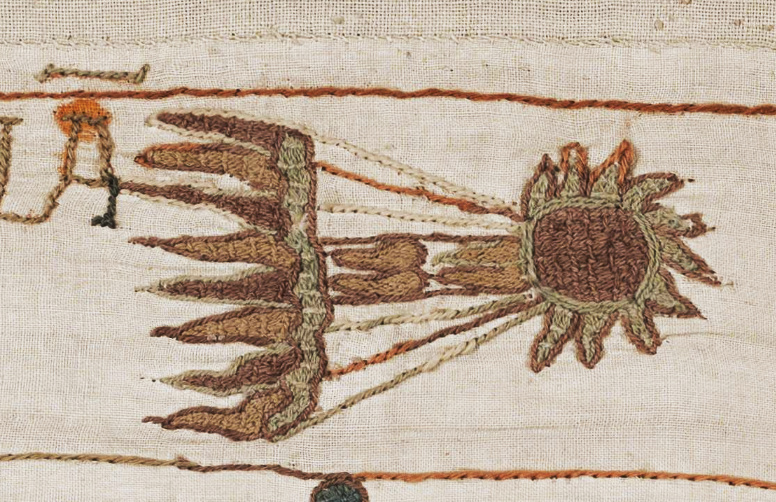
Bayeux Tapestry (scene 33), 11th century, Musée de la Tapisserie de Bayeux, Bayeux, France. Detail.
One of the most surprising elements of the tapestry is the Halley’s Comet. To medieval audiences, comets were often understood as divine signs rather than astronomical phenomena. Appearing shortly before William’s invasion, Halley’s comet was widely interpreted as an omen of political change. The tapestry cleverly incorporates this belief into its narrative, connecting the earthly events with the heavens and reinforcing the idea that the Norman Conquest was part of a larger and potentially divinely ordained order.
Modern astronomers identify the scene as the comet’s 1066 return, and this depiction is considered its earliest surviving visual representation.
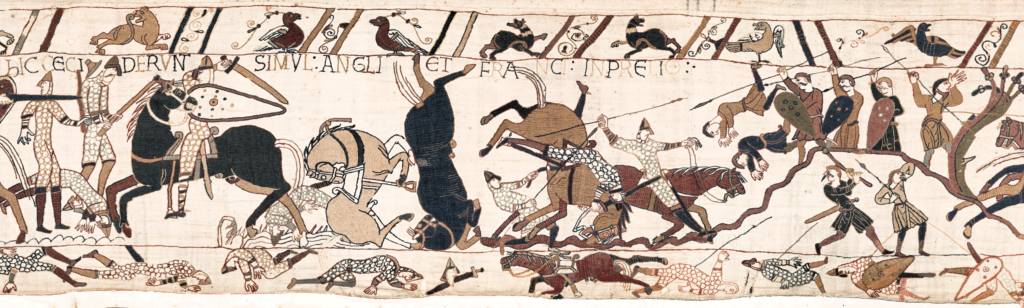
Bayeux Tapestry (scene 53), 11th century, Musée de la Tapisserie de Bayeux, Bayeux, France. Detail.
The Battle of Hastings, fought on October 14, 1066, forms the dramatic climax of the embroidery. In the form of a vivid visual drama, Norman cavalry charges repeatedly against the English shield wall, while archers, infantry, and mounted knights fill the composition with movement and violence. Rearing horses, shattered spears, flashing swords, and fallen warriors accumulate in the lower border. Although highly stylized, the scenes possess remarkable energy, making the viewer feel the momentum toward a successful Norman conquest.
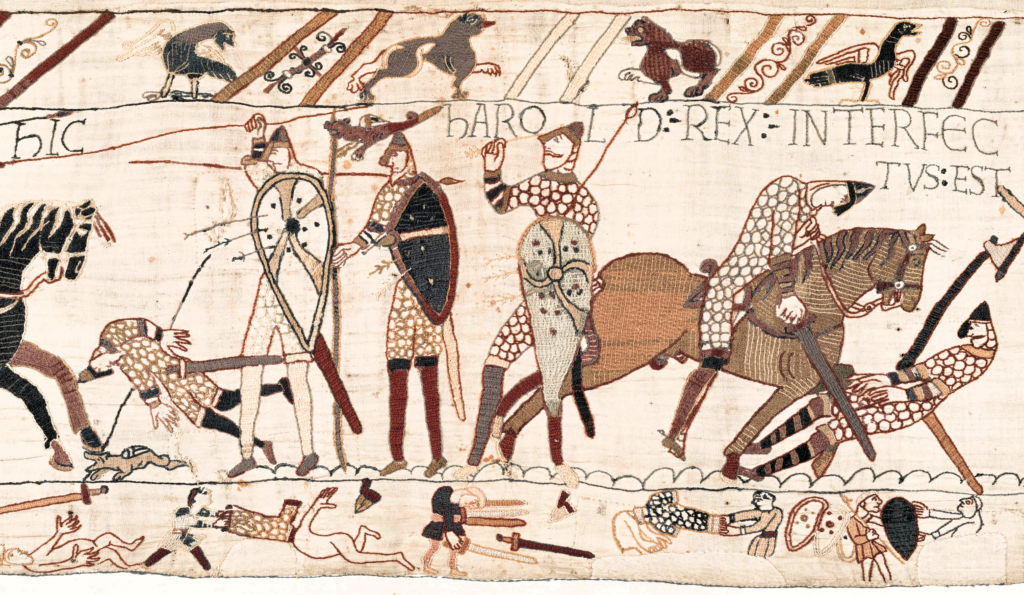
Bayeux Tapestry (scene 57), 11th century, Musée de la Tapisserie de Bayeux, Bayeux, France. Detail.
The inscription HIC HAROLD REX INTERFECTUS EST (“Here King Harold is killed”) identifies the moment of Harold’s death. Traditionally, the king is shown being struck in the eye by an arrow before being killed by a Norman knight. However, the scene has been debated by scholars, particularly over whether the arrow was original or altered during later restoration and whether the figure struck by it can be identified with certainty as Harold.

Bayeux Tapestry (scene 38), 11th century, Musée de la Tapisserie de Bayeux, Bayeux, France. Detail.
The embroidery presents the Norman version of the events of 1066 and strongly supports William’s claim to the English throne. Harold’s oath, the appearance of Halley’s Comet, and William’s military success all contribute to a narrative in which the conquest appears justified and even divinely sanctioned. For this reason, the Bayeux Tapestry is often described as an early example of political propaganda. Yet its political purpose does not diminish its historical value. Instead, it reminds us that history can be constructed through images as powerfully as through written texts.
Despite featuring over 600 human figures, only three women appear in the primary central register, alongside three anonymous figures in the margins. These include Queen Edith (sister of Harold and wife of Edward the Confessor), a woman named Ælfgyva involved in a mysterious clergy scandal, and an unnamed mother fleeing with her child as Norman soldiers set fire to her house—a rare depiction of civilian suffering.
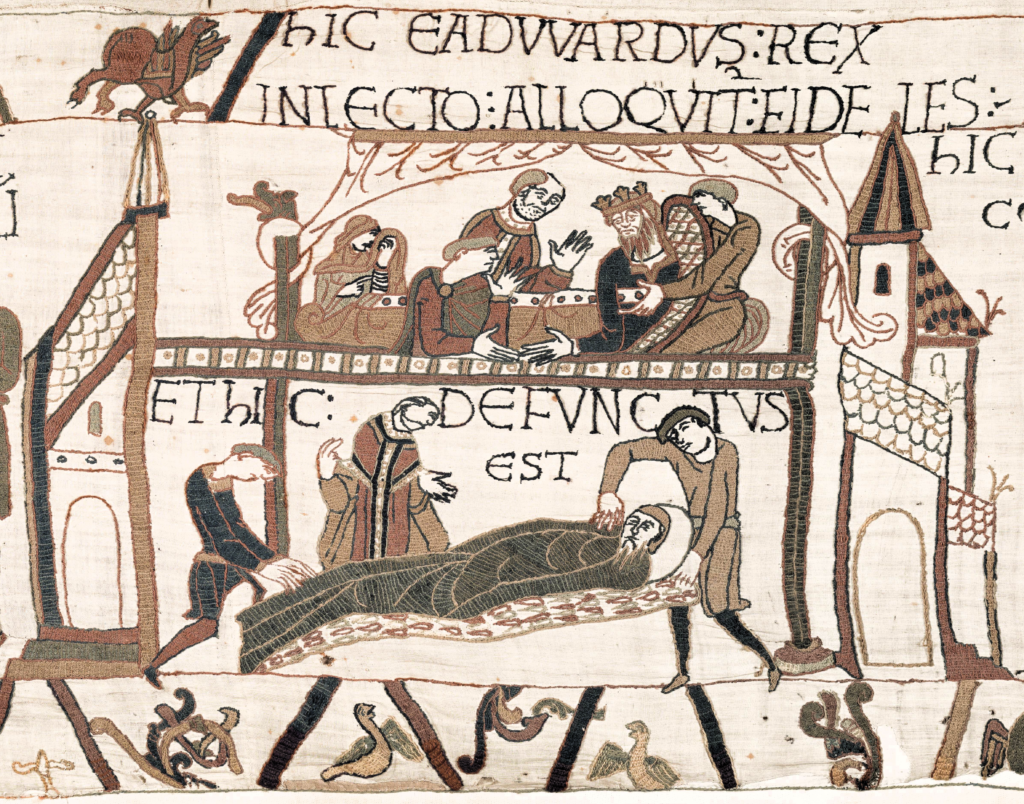
Bayeux Tapestry (scene 27-28), 11th century, Musée de la Tapisserie de Bayeux, Bayeux, France. Detail.
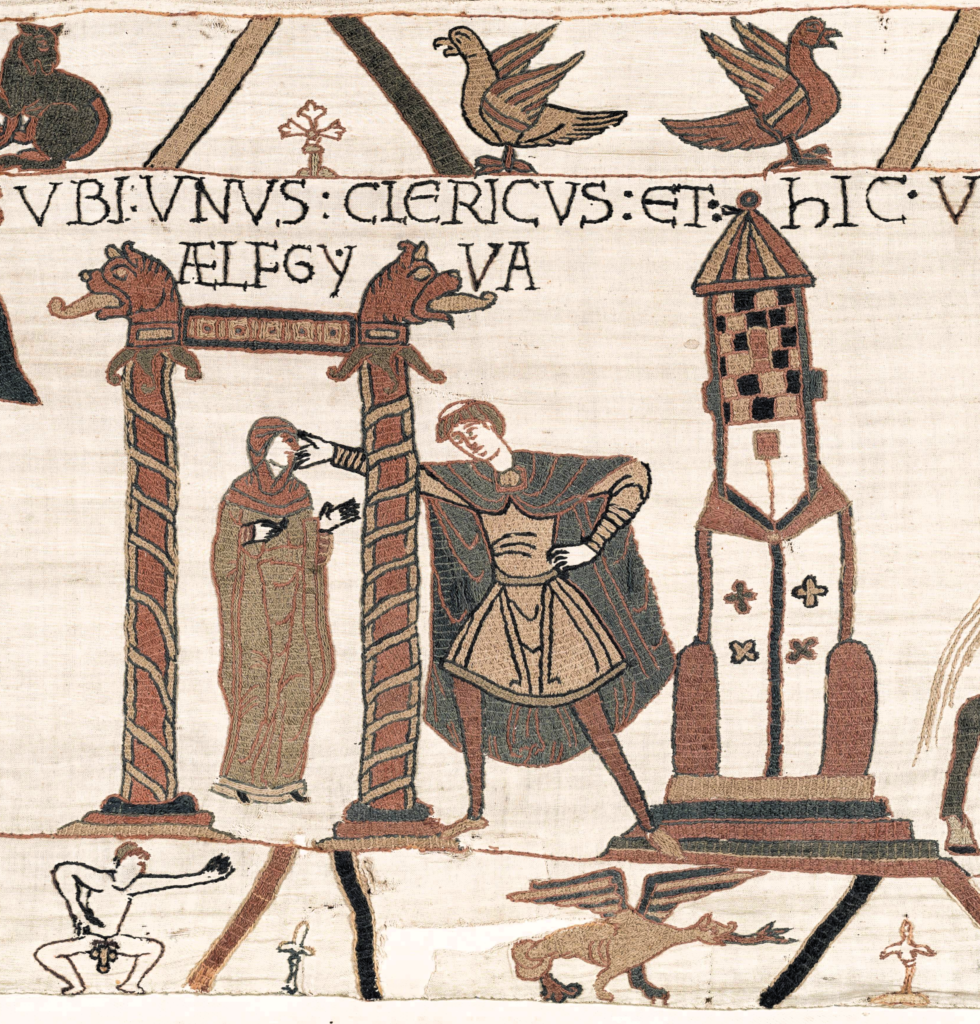
Bayeux Tapestry (scene 15), 11th century, Musée de la Tapisserie de Bayeux, Bayeux, France. Detail.
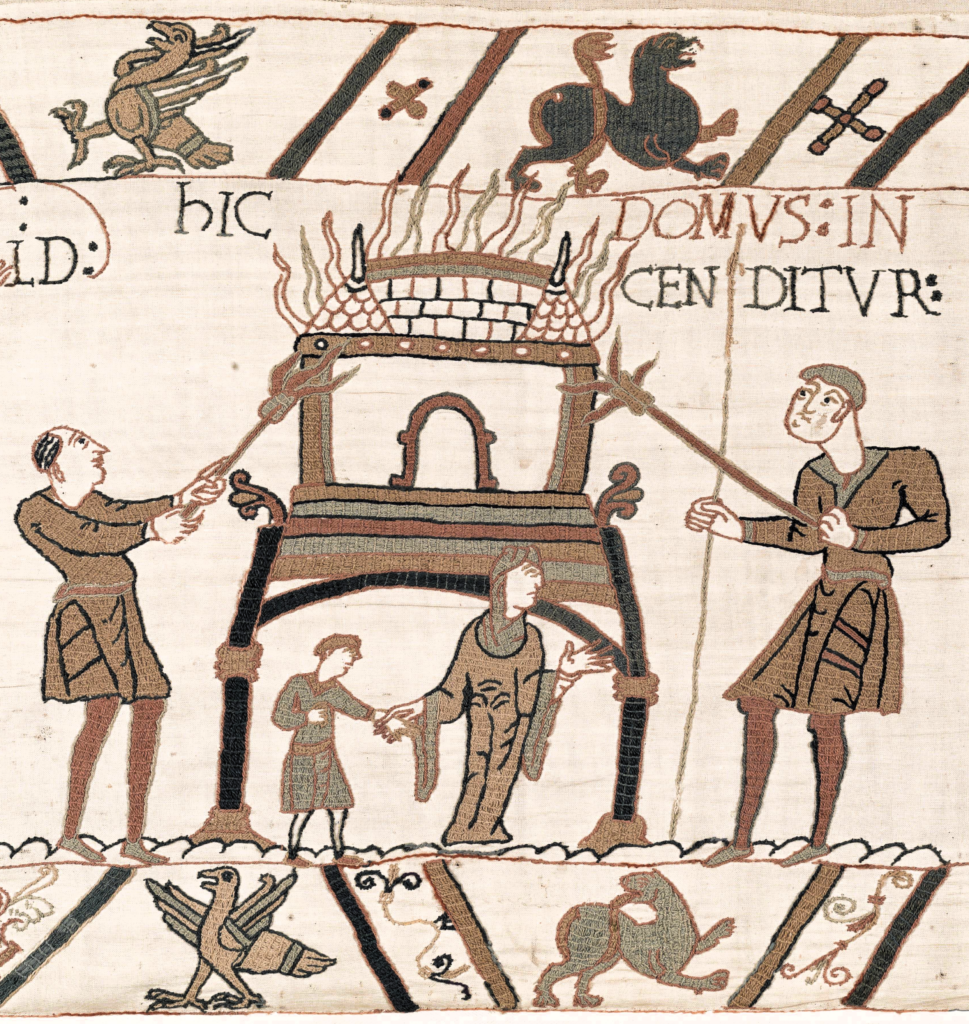
The Bayeux Tapestry (scene 47), The Bayeux Museum, Normandy, France, 11th century. Detail
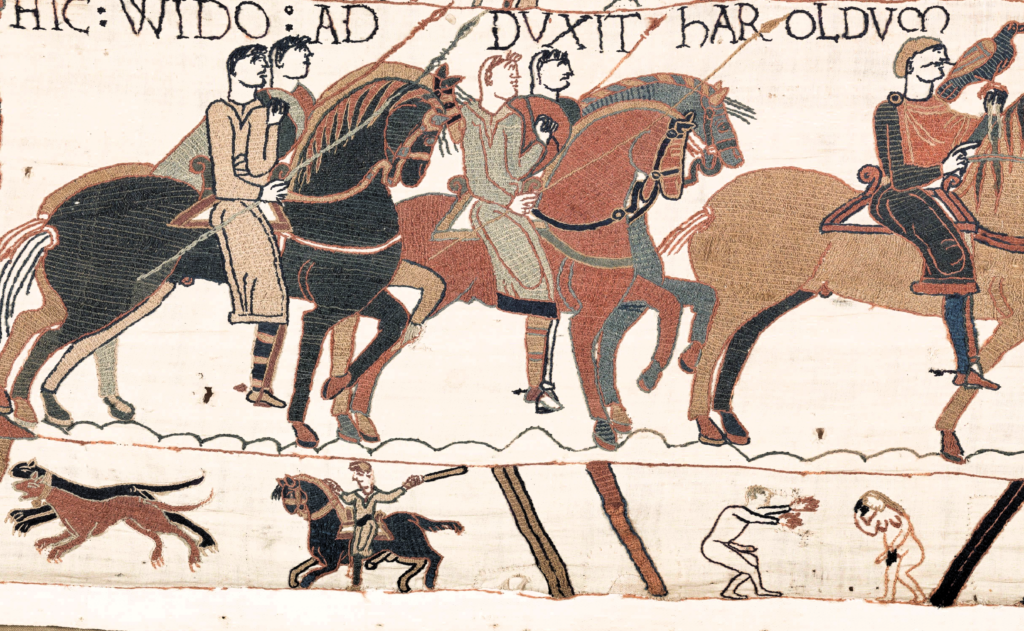
Bayeux Tapestry (scene 13), 11th century, Musée de la Tapisserie de Bayeux, Bayeux, France. Detail.


A woman presumed to be Queen Edith, wife of Edward the Confessor and sister of Harold Godwinson, weeps at her husband’s deathbed. She is the figure at the far left of the group.
This scene depicts Ælfgyva standing within an arched frame as a male cleric reaches towards her face. The mysterious scene, accompanied by the inscription “Where Ælfgyva and the cleric,” has often been interpreted as referring to a scandal known to contemporary viewers.
This scene depicts a woman fleeing a burning building set alight by Norman soldiers while holding the hand of a child.
A nude female figure appears in the lower border of the Bayeux Tapestry, recoiling from another nude figure. The meaning of this unusual and provocative scene remains uncertain.
Though sparse, their inclusion provides crucial clues about noble lineage, social scandal, and the human consequences of war, extending the tapestry’s narrative beyond kings and soldiers.

Bayeux Tapestry (scene 10), 11th century, Musée de la Tapisserie de Bayeux, Bayeux, France. Detail.
Running continuously above and below the main narrative are decorative borders filled with animals: birds, lions, dragons, and mythical creatures. There are also genre scenes, like agricultural scenes and hunting activities, evangelist symbols, and episodes associated with medieval fables. During battle scenes, the imagery becomes more graphic, with decapitated bodies, severed limbs, and fallen soldiers being stripped of armor.
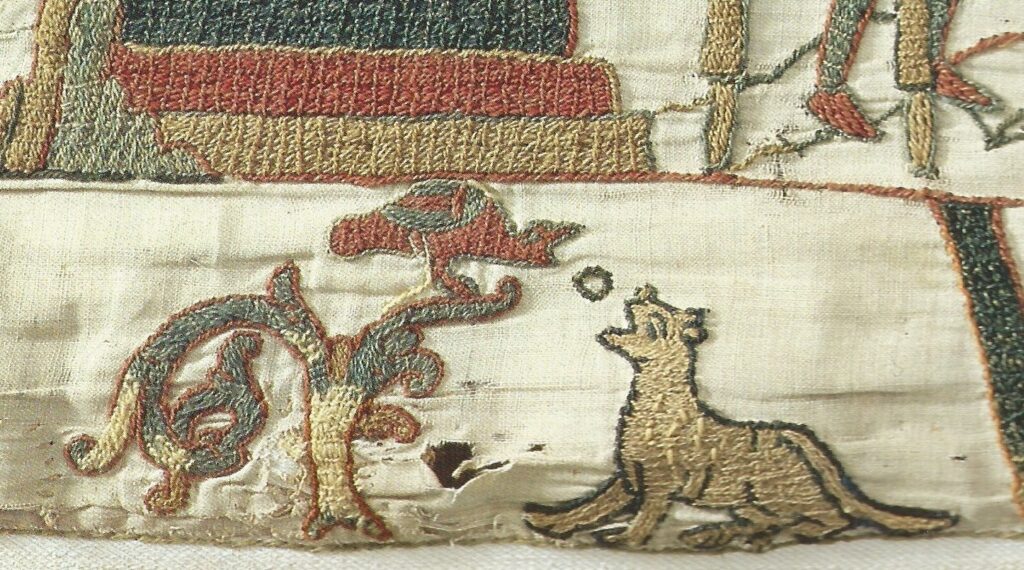
Bayeux Tapestry (scene 4), 11th century, Musée de la Tapisserie de Bayeux, Bayeux, France. Detail.
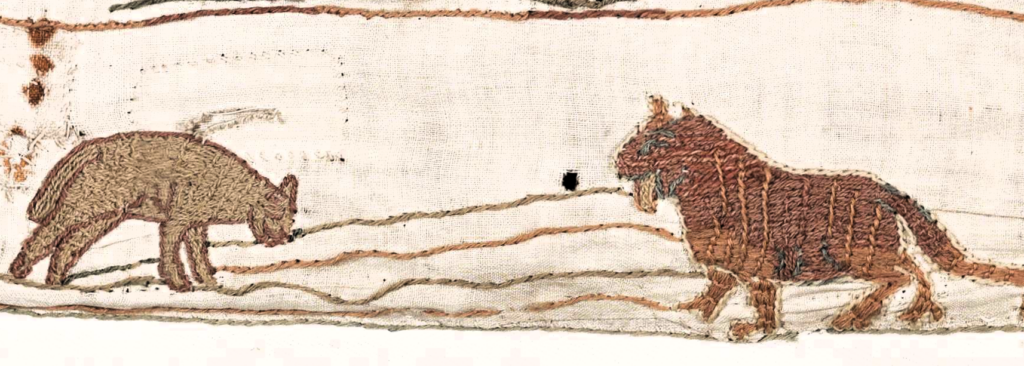
Bayeux Tapestry (scene 4), 11th century, Musée de la Tapisserie de Bayeux, Bayeux, France. Detail.
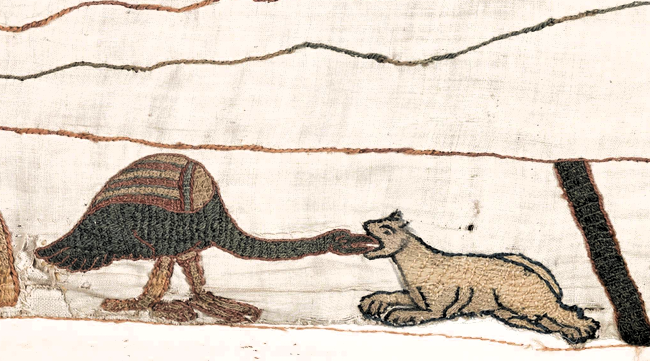
Bayeux Tapestry (scene 5), 11th century, Musée de la Tapisserie de Bayeux, Bayeux, France. Detail.
This scene depicts Aesop’s The Fox and the Crow, in which a cunning fox uses flattery to trick a crow into giving up its cheese. The moral of the fable – “Flatterers are not to be trusted”
This scene depicts Aesop’s The Wolf and the Lamb, in which a powerful wolf invents excuses to justify attacking a helpless lamb. The fable warns that the powerful may use false accusations to justify harming the innocent.
This scene depicts Aesop’s The Wolf and the Crane, in which a crane helps a wolf by removing a bone from its throat. The moral of the fable is that the wicked are unlikely to reward those who help them.
The exact meaning of the borders remains uncertain. Some scholars interpret them as moral or symbolic commentary, while others connect them to popular medieval stories and visual traditions, including Aesop’s fables. Their placement alongside scenes of warfare possibly reflects the perspective of the Anglo-Saxon embroiderers, who registered silent dissent beneath the eyes of their Norman patrons. Although the idea of deliberate dissent cannot be established with certainty, the marginal imagery add a complex visual layer to the tapestry’s main political narrative.
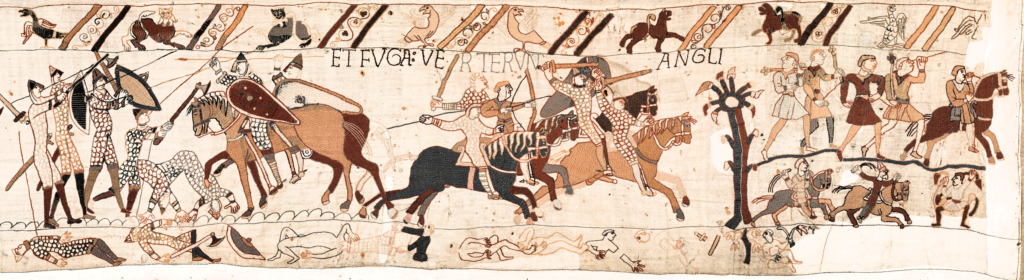
Bayeux Tapestry (scene 58), 11th century, Musée de la Tapisserie de Bayeux, Bayeux, France. Detail.
The Bayeux Tapestry survives in an incomplete state, with its final section lost. Scholars have suggested that the missing portion may originally have depicted William’s coronation as King of England at Westminster Abbey on Christmas Day 1066, perhaps followed by scenes celebrating the establishment of Norman rule. Although the exact ending remains unknown, this leaves the tapestry with an intriguing sense of incompleteness, inviting viewers to imagine its final chapter.

The survival of the Bayeux Tapestry is almost as remarkable as the story it depicts. Probably completed in the decades after the Norman Conquest, it was associated with Bayeux Cathedral and is documented in a cathedral inventory from 1476. Over its 1,000 year of existence, it has survived catastrophic fires, religious wars, the French Revolution (when it was nearly used as a canvas cover for military wagons), and Nazi occupation during World War II.
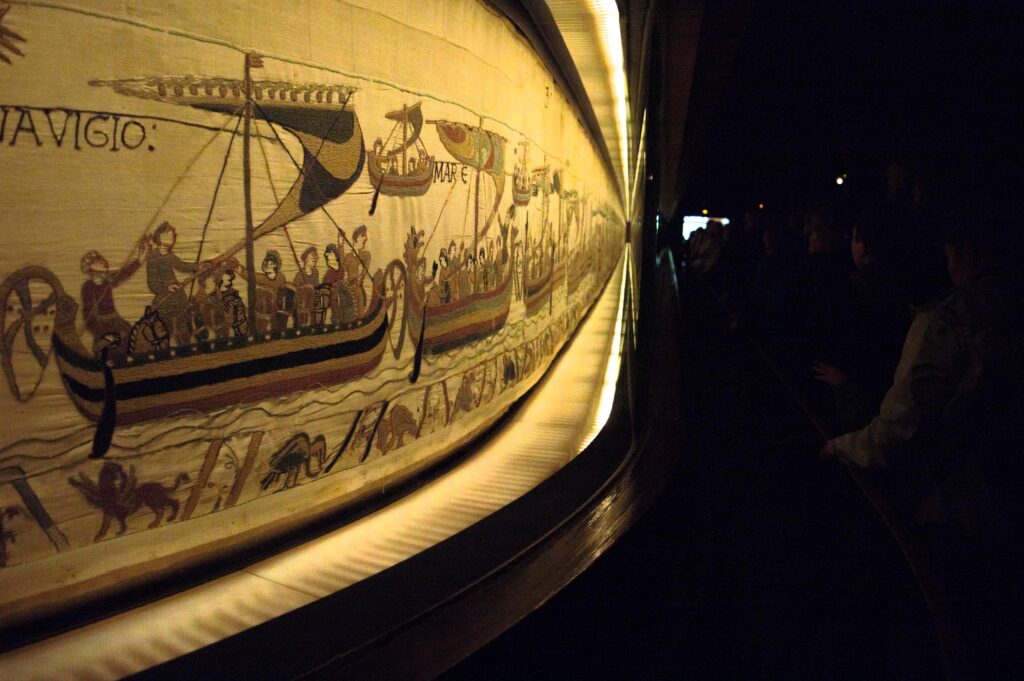
Exhibition view of the Bayeux Tapestry, Musée de la Tapisserie de Bayeux, Bayeux, France. Photograph by Supercarwaar via Wikimedia Commons (CC BY-SA 4.0).
Following a landmark Anglo-French cultural agreement, and with the Bayeux Museum undergoing renovation, this year the tapestry makes a historic return to England. It will be exhibited at the British Museum, offering visitors a rare opportunity to encounter one of the world’s greatest medieval treasures in the very country whose history, culture, and language were forever transformed by the Norman Conquest.
The Bayeux Tapestry is on view at the British Museum, London, UK, from September 10, 2026 till July 11, 2027.
Carola Hicks, The Bayeux Tapestry: The Life Story of a Masterpiece, London: Chatto & Windus, 2006.
Rose-Marie Hagen and Rainer Hagen, What Great Paintings Say, Vol. 1. Cologne: Taschen, 2003.
Andrew Bridgeford, 1066: The Hidden History in the Bayeux Tapestry, New York: Walker & Company, 2005.
DailyArt Magazine needs your support. Every contribution, however big or small, is very valuable for our future. Thanks to it, we will be able to sustain and grow the Magazine. Thank you for your help!

Shivani is fascinated by art narratives and history. She likes spending her time in historic neighborhoods, sketching, and collecting textures from nature. This process inspires her writing and her view on life. She studied Art History and Aesthetics at the Maharaja Sayajirao University of Baroda, Gujarat, India.

Imagine living in medieval Europe. Disease, famine, and war are constant companions, and life is fragile and uncertain. Your faith shapes every...
Guest Author 21 September 2026
The Middle Ages were an exciting time in art history—a revival of imaginative, vivid art, both religious and secular, was spreading across Europe.
Justin Fenech 28 May 2026
While her gleaming gold body might remind you of a Star Wars droid, this masterpiece is something far more mysterious and sacred. Beneath layers of...
Jimena Aullet 5 December 2025
Barcelona = Gaudí, we all know that. For football fans, it is also the famous Barça, the team with the motto: “More than a club”. And so it is...
Joanna Kaszubowska 11 August 2026