


Georges Papazoff: The Surrealist Who Refused to Behave
Too wild for the canon, too slippery for nationalism, and too early to be officially celebrated: that’s Georges Papazoff—a 20th-century Bulgarian...
Katie Mikova 2 April 2026

Tamara de Lempicka, The Sleeping Girl (Kizette) I, 1933, private collection. Facebook.
Tamara de Lempicka was an Art Deco artist best known for her glamorous portraits from the 1920s and 1930s. Discover ten of Tamara de Lempicka’s paintings that showcase her iconic style and its evolution over the course of her career.
This year marks the 100th anniversary of the Exposition internationale des arts décoratifs et industriels modernes (International Exhibition of Modern Decorative and Industrial Arts). The exposition, held in Paris in 1925, introduced the modern style that would come to be known and recognized internationally as Art Deco. Tamara de Lempicka (1894–1980) is, to this day, the most famous Art Deco artist. She was discovered at the Exhibition in Paris, where two of her paintings were presented. Tamara de Lempicka’s paintings were uniquely modernist and a combination of multiple styles (including Cubism, Neoclassicism, and Mannerism). While most of her subjects were women, she also painted portraits of affluent figures, studies of New York skyscrapers, and still lifes.
As Art Deco grew out of favor during and after WWII, she began to experiment and evolve her style, even shifting to painting abstract pieces. These later works never reached the popularity of her art in the 1920s and 1930s. After Art Deco was officially coined in the 1960s with a resurgent interest in the style, De Lempicka’s artwork was also revived. Tamara de Lempicka’s paintings and name have since been fittingly associated with the glamour and grandiloquence that is Art Deco.

Tamara de Lempicka, Autoportrait (Tamara in a Green Bugatti), 1929, private collection. Wikimedia Commons (PD-US).
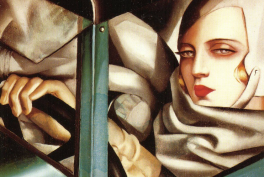
Autoportrait is one of Tamara de Lempicka’s most famous paintings. Commissioned in 1929 by Die Dame, a German fashion magazine, it is undoubtedly one of the coolest self-portraits ever painted. De Lempicka depicts herself in a scarf in the driver’s seat of a green Bugatti, a racing car she did not own. Like her portraits of aristocrats, she paints herself with a cool elegance and sophistication. And like the magazine she made it for, the work celebrates the independence of the modern woman.
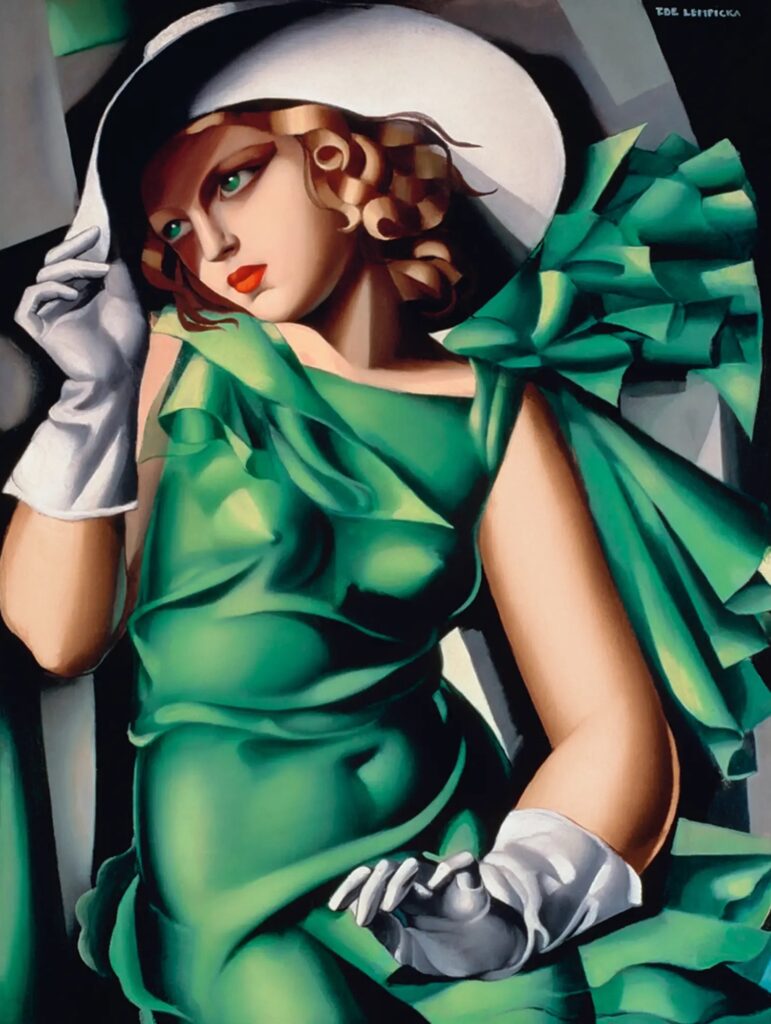
Tamara de Lempicka, Young Girl in Green, 1929, Musée National d’Art Moderne, Paris, France. Boszart.
Another popular painting by De Lempicka, Young Girl in Green (or Young Girl with Gloves), is a quintessential piece of De Lempicka’s artwork. What’s remarkable about this piece is the still dynamism in which the artist captures a sensuality of the female subject despite the restraints of geometrical forms and angles. This painting, in particular, is the perfect example of De Lempicka’s skill in fusing classicism with the modernism of Art Deco.
The woman, pale in the flesh, is holding the brim of her hat, tilting her head to protect it from a gust of wind. Meanwhile, her dress moves in the breeze and hugs her skin with striking clarity and texture, revealing her belly and breasts. The green of the dress emphasizes the girl’s liveliness, individuality, and poise, while the white gloves indicate a chic woman of the Jazz Age.
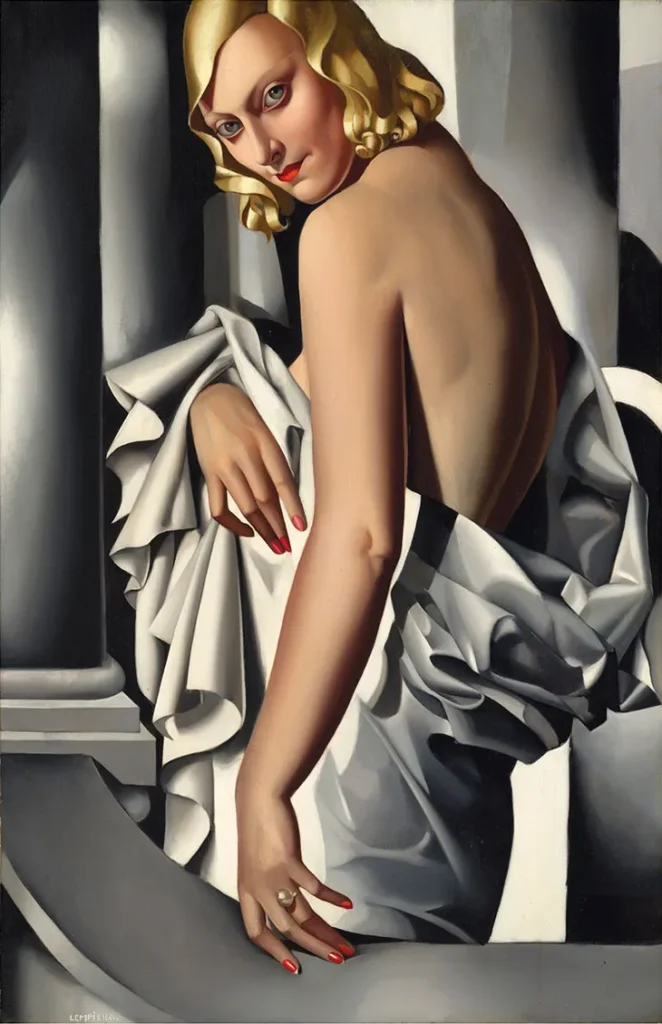
Tamara de Lempicka, Portrait of Marjorie Ferry, 1932, private collection. Apollo Magazine.
Marjorie Ferry was a cabaret singer in Paris in the 1930s. Here she is portrayed in De Lempicka’s sleek, sensual style. Her slight grin is reminiscent of Leonardo da Vinci‘s Mona Lisa. The circumstances of the scene are a mystery, heightened by the bedsheets around her nude body, her back exposed, and the ring on her finger. Ferry’s hand sits seductively on what appears to be a curved sofa while the background is filled with modernist marble pillars. The composition, dominated by shades of white and silver, emphasizes the glitz and glamour of the continental Marjorie Ferry. This painting wouldn’t look out of place in a collection of MGM publicity pictures of Jean Harlow.
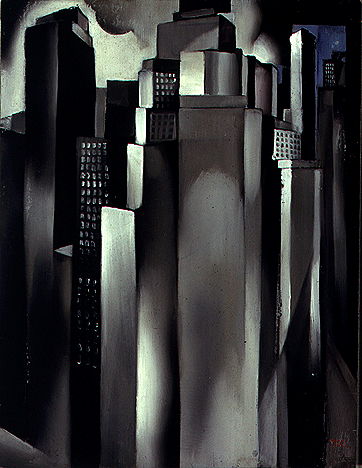
Tamara de Lempicka, Skyscrapers, 1929, private collection. Artist’s website.
Though not nearly as discussed as De Lempicka’s portraits, her studies of New York City are well worth examining. During her first visit to the United States in 1929, De Lempicka painted several studies of New York City skyscrapers like the one above. Her Cubist influence is most apparent in these renderings of the tall buildings in an apparent nighttime scene, taking the nickname “concrete jungle” literally.
Some of the buildings, including the one in the forefront, feature no windows. They are simply covered in shades of gray and darkness. It is a striking composition, nearly black-and-white and reminiscent of the miniature urban sets used by film studios at the time. The way the skyscrapers extend to the sky like smooth, streamlined blocks is very Art Deco.
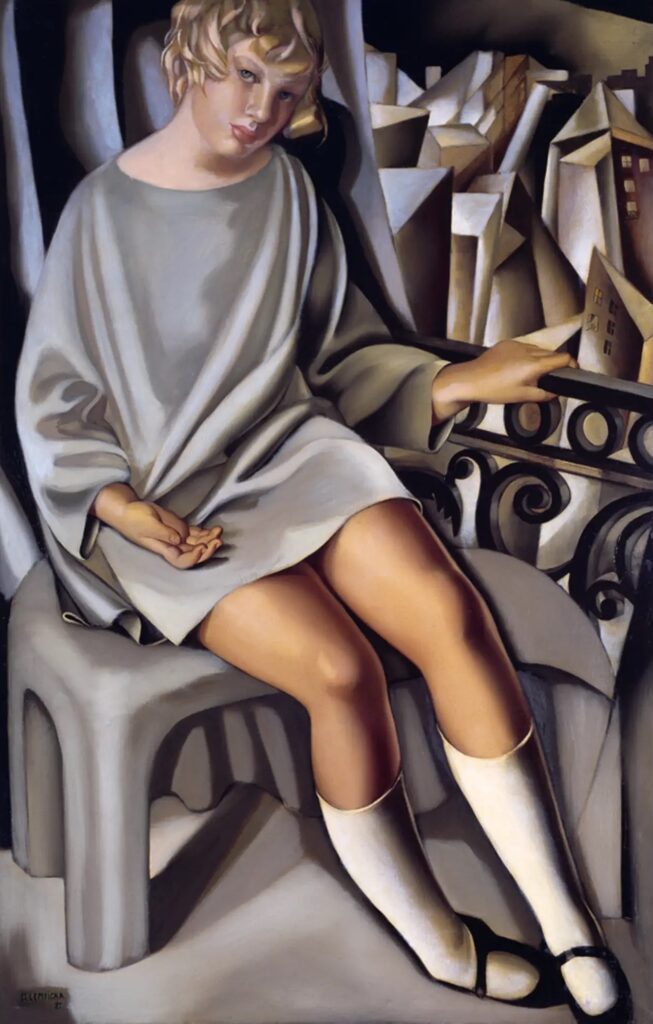
Tamara de Lempicka, Kizette on the Balcony, 1927, Musée National d’Art Moderne, Paris, France. Boszart.
Kizette on the Balcony is one of five portraits De Lempicka painted of her daughter. Though De Lempicka and Kizette were not close, this hardly shows in the painting. Kizette is shown sitting on a balcony in front of what appears to be a blue curtain with clustered city buildings lit up in the background to the right. Her dress is a loose, silvery white. She has one hand on the rail and her other hand is open as if holding something. Her expression is neutral as she slouches on the curved chair and leans her head to the side. It is a lovely portrait and suggests that by painting Kizette in her signature style, De Lempicka was willing, as a workaholic artist, to affectionately give her daughter the same time and effort she bestowed on her wealthy clients.
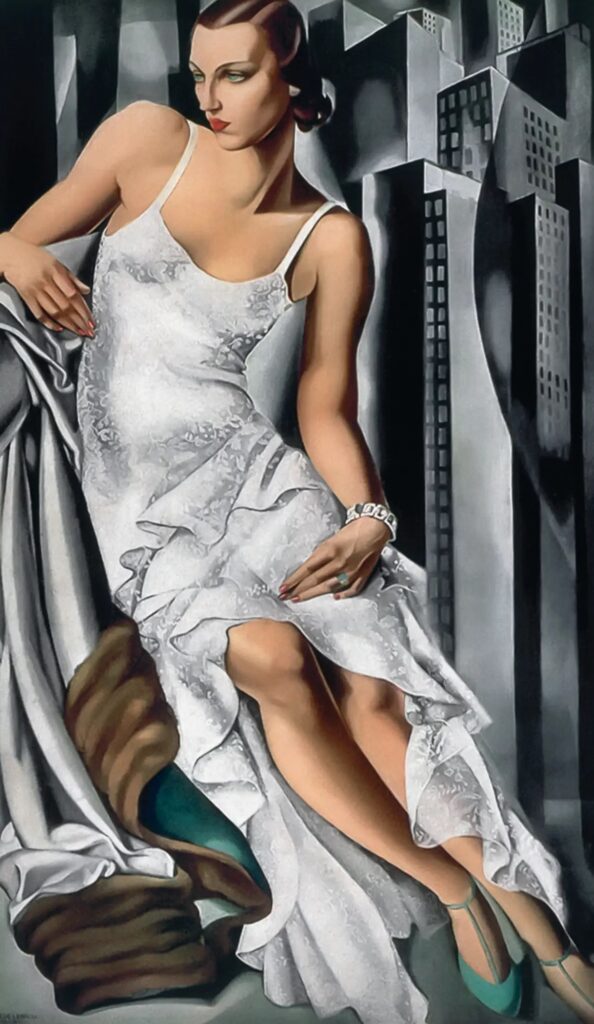
Tamara de Lempicka, Portrait of Mrs. Allan Bott, 1930, private collection. Boszart.
In this stunning portrait, De Lempicka’s background skyscrapers are matched in size by the painting’s feminine subject in the foreground. De Lempicka’s blend of sensuality and refinement collides with a subtle statement on the contemporary apex of American capitalism. A modern woman of high society, dressed in white and sculpture-like, elegantly leans against a backdrop of the buildings that emphasize her emphasizes her status and stature, rather than minimizes her presence. It is the future promised by the modern aesthetic of Art Deco, fully arrived in America.
Perhaps it is no coincidence that in the same year this work was completed, two famous New York City Art Deco skyscrapers were under construction and soon to open (the Chrysler Building and the Empire State Building).
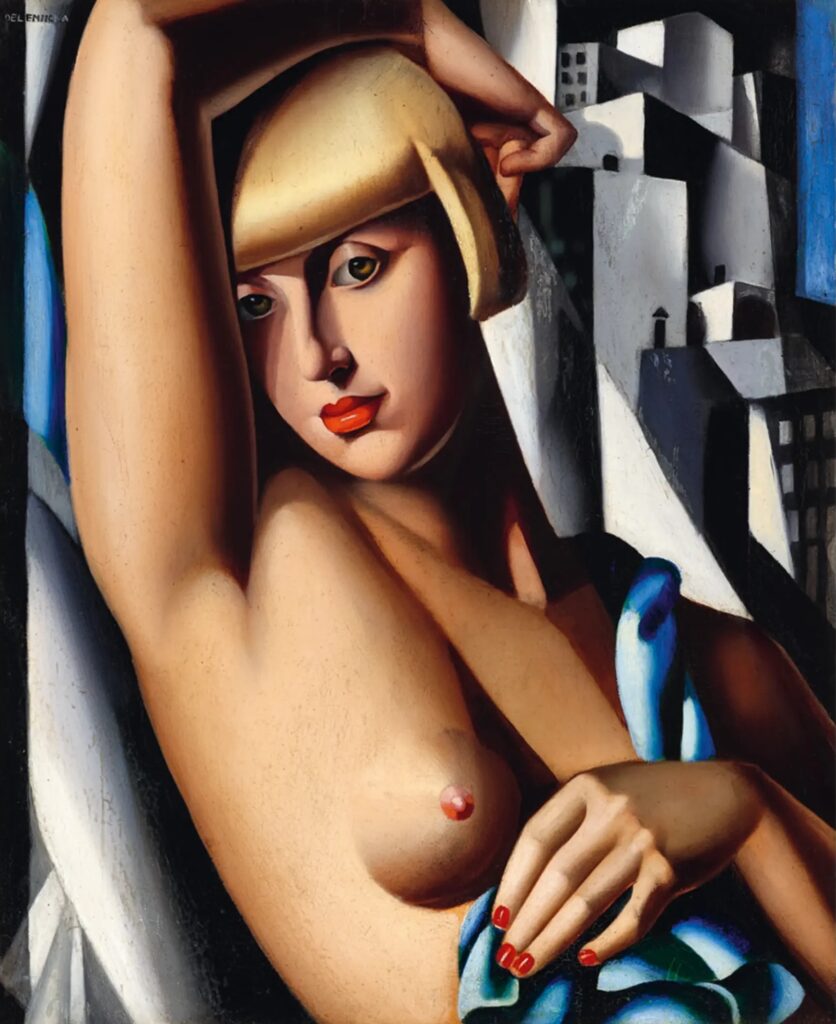
Tamara de Lempicka, Portrait of Suzy Solidor, 1933, Château Grimaldi, Cagnes-sur-Mer, France. Boszart.
Suzy Solidor, a cabaret singer, actress, and Paris nightclub owner, shines in this partially nude portrait. Though she posed for many artists, including the photographer Man Ray, De Lempicka’s painting best captures the charm and beauty of Solidor. Her modern style and geometric forms of the feminine figure truly represent Solidor’s reputation as a fearless, independent queer woman.
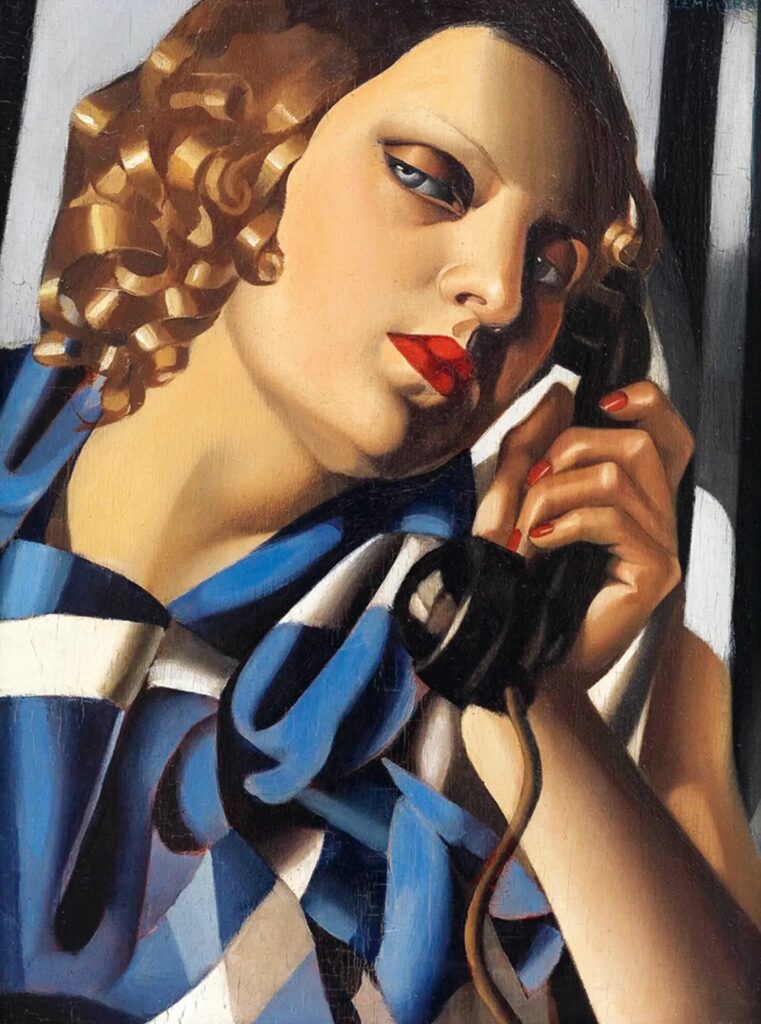
Tamara de Lempicka, The Telephone II, 1930, private collection. Boszart.
This portrait of a woman on the telephone is reminiscent of a close-up on a character in a movie scene. Like classical Hollywood film directors, De Lempicka understood the pictorial possibilities of a person talking on the phone. A woman, wearing what looks to be a chic blue and white dress, angles her head towards the phone as if listening to someone or waiting while the line is held. Her gaze is straight ahead as if looking at us or a camera. It is almost if we, the viewer, are intruding on a private conversation. Like most of De Lempicka’s works, it is a transfixing portrait, both intriguing and impressive.

Tamara de Lempicka, Suzanne Bathing, 1938, private collection. Boszart.
Suzanne Bathing is an evolved nude portrait from De Lempicka and is a stark contrast to her previous nude paintings. In De Lempicka’s 1930 painting, Nude with Buildings, a woman holds an olive branch in front of a background of tall buildings, portraying the mass distance between the industrialized world and the natural world. Suzanne Bathing was inspired by Renaissance painters and based on an Old Testament story. The work may have come out of De Lempicka’s recovery from a severe depression.
Here, a woman, Suzanne, is in a natural setting. She sits uneasily in front of trees, avoiding eye contact with the viewer and clutching her white clothing. She exudes modesty and innocence rather than a powerful and seductive sexuality. Her look is more uncertain and uncomfortable than the modern women glamorized in front of skyscrapers in De Lempicka’s early 1930s portraits. This was the beginning of De Lempicka’s later style that would, along with Art Deco, fall out of favor.

Tamara de Lempicka, Amethyst, 1946, private collection. Artist’s website.
Last but not least is a work symbolizing the further stylistic development of De Lempicka. By the 1940s, she had moved on from the Art Deco geometric forms of her famous works, focusing on still lifes and portraits of young women with more classical, rounded faces. Amethyst is also an example of her experiment with color during this time.
A partially nude woman plays a guitar against the backdrop of a sky with different shades of purple and a still body of water. Though it is a peaceful and serene scene, the colors leave a sense of coldness and the appearance of a brisk morning. De Lempicka was living in her country home in Connecticut at this time, a world away from her past popularity. Perhaps this was a familiar scene to her. Nevertheless, it is wonderfully captured.
Get your daily dose of art
Click and follow us on Google News to stay updated all the time

DailyArt Magazine needs your support. Every contribution, however big or small, is very valuable for our future. Thanks to it, we will be able to sustain and grow the Magazine. Thank you for your help!

A writer devoted to the arts with a Master's degree in English and a specialization in film studies/history. Ars longa, vita brevis.

Leigh is a writer, reader, art lover, radio nerd and herbalist based in Nashville, TN.
Too wild for the canon, too slippery for nationalism, and too early to be officially celebrated: that’s Georges Papazoff—a 20th-century Bulgarian...
Katie Mikova 2 April 2026
Throughout the centuries, women’s bodies have consistently been staged for display rather than simply allowed to exist. John Berger’s...
Guest Author 12 March 2026
As we are in the middle of the season of Great Lent, sacred imagery becomes a bridge between the material world and spiritual reflection. Even today,...
Guest Author 12 March 2026
Picasso is usually thought of as a genius who by a divine miracle possessed inexplicable artistic talent. This would probably annoy Picasso, because...
Alvaro Alonso Pardal 26 March 2026



.jpeg#/media/File:Tamara_de_Lempicka,_Autoportrait_(Tamara_in_a_Green_Bugatti).jpeg)