The Flower Alphabet
Flower symbolism in art did not emerge in a vacuum. It grew from two overlapping traditions: the ancient and medieval herbals (Herbarius moguntinus, De materia medica, Hortus Sanitatis) and the rich body of Christian iconography that assigned moral and spiritual meanings to flowers. By the Renaissance, educated viewers read this botanical alphabet fluently. A painter who placed white lilies in Archangel Gabriel’s hands was not making a decorative choice. He was citing a centuries-old theological text. A Flemish still-life artist who tucked a skull between roses and a half-peeled lemon was composing a homily on mortality, petal by petal.
What makes the Old Masters so extraordinary is how this hidden symbolism in paintings extended beyond the sacred and devotional. It reached into the realm of the dangerous and the occult.
White Lilies: The Immaculate Messenger
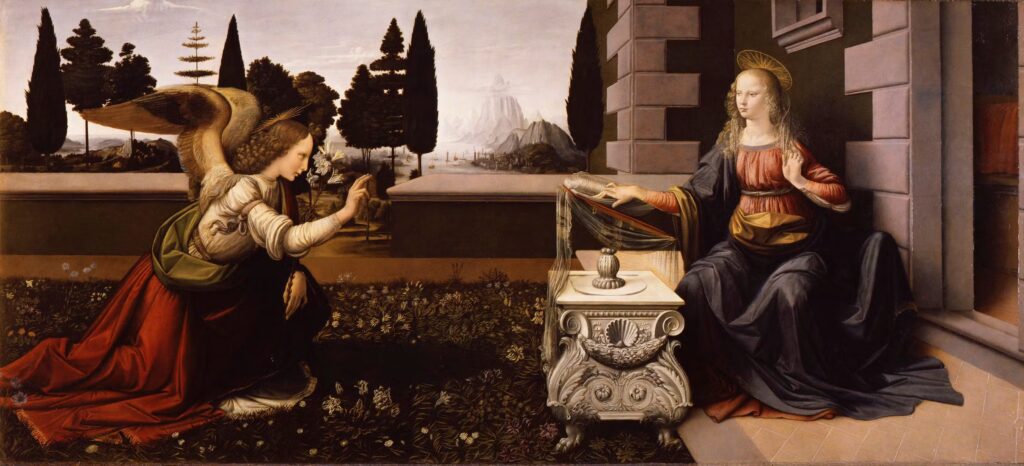
Few plants carry as much symbolic freight in Western painting as the white lily, and few images are as legible as Gabriel’s lily in Leonardo da Vinci‘s Annunciation. Held with the precision of a formal attribute, the lily announces not just the Archangel’s identity but the entire theological argument of the painting: purity, divinity, the immaculate vessel that Mary is about to become. Leonardo, whose botanical notebooks reveal an almost obsessive accuracy in plant morphology, renders the petals with a scientist’s care and a theologian’s intent.
Yet the lily’s symbolic reach extended further than pure Marian iconography suggests. In the classical tradition, it also belonged to Hera, to Juno, to the goddesses of sovereignty and power. To place it in a painting was to invoke not only the Virgin but an older, more potent feminine authority. Painters of female subjects, from Botticelli to the Pre-Raphaelites, exploited this ambiguity with quiet consistency.
Red Poppies: The Sleep That Does Not End
If the lily signals grace, the red poppy signals something far more troubling. That is the boundary between sleep and death, between forgetting and oblivion. In Greek mythology, poppies belonged to Hypnos, god of sleep, and to his twin brother Thanatos, god of death. Demeter wore a poppy crown in her grief for Persephone, the plant a cipher for the stupor of sorrow, the numbness of loss.
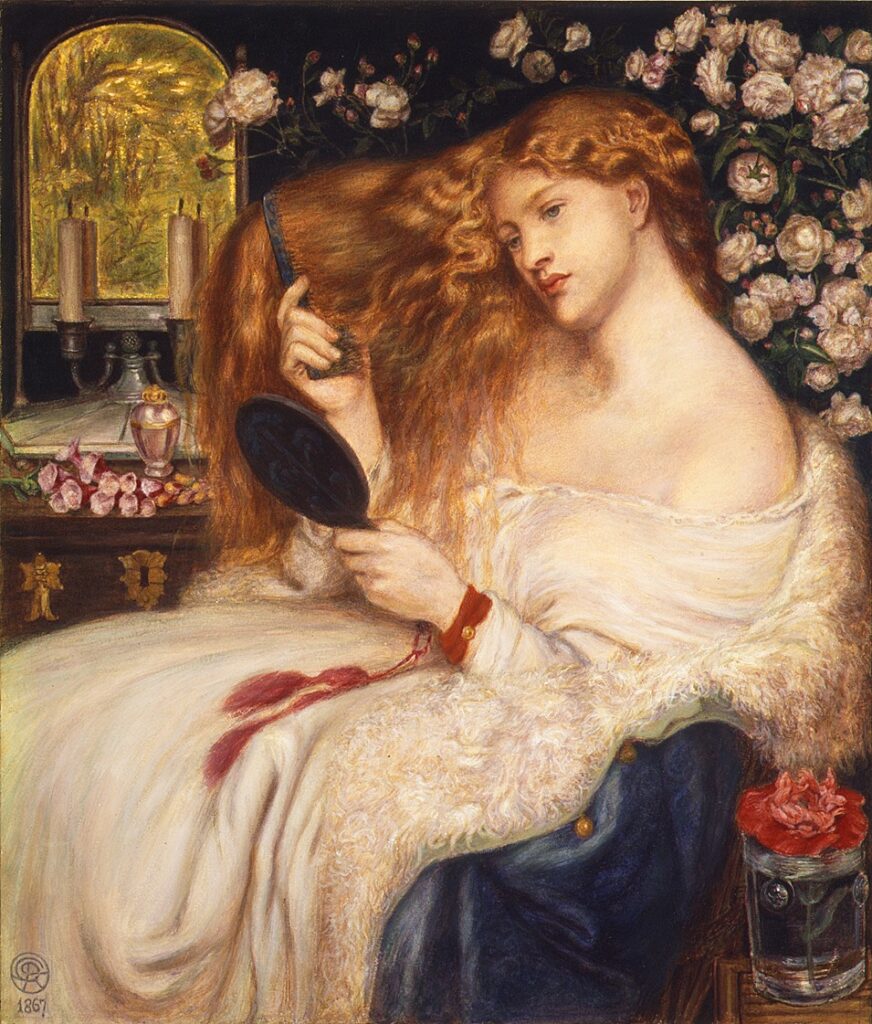
The poppy had accumulated centuries of this dark freight, when the Pre-Raphaelites deployed it with deliberate precision. Dante Gabriel Rossetti scattered poppies through several of his languid, heavy-lidded female figures: women who seem perpetually suspended between this world and another, between desire and dissolution. The poppy in these paintings does not merely decorate the foreground. It explains the subject. These women are not just beautiful. They carry the flower symbolism in art of enchantment, drugged by longing, marked for tragedy.
Ophelia’s Bouquet: A Forensic Reading
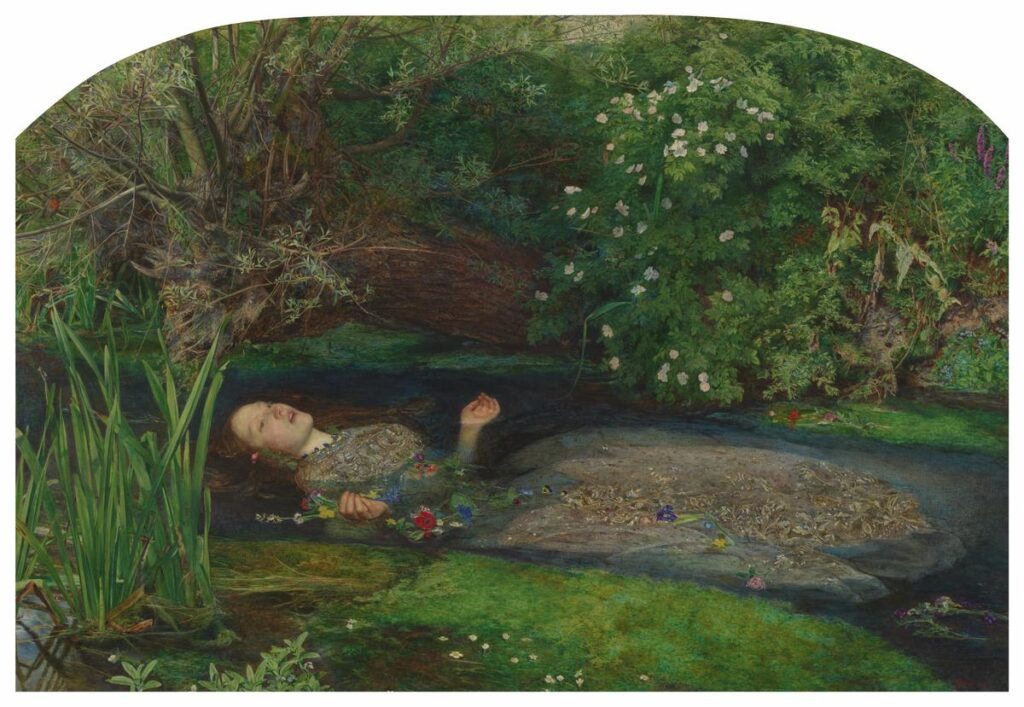
No painting in the Western canon deploys botanical symbolism more systematically than John Everett Millais‘s Ophelia. Famously rigorous in his research, he painted Elizabeth Siddal floating in a bath of water over months. Furthermore, he spent weeks in the Surrey countryside rendering every plant in obsessive detail.
Ophelia carries pansies, whose name derives from the French pensée—thought, remembrance. She wears a garland of daisies, emblems of innocence deceived. Beside her float violets (faithfulness, but also the flowers Hamlet told her would wither with his father’s death) and nettles, denoting pain. Most importantly, there is rue—the herb of bitter regret, the plant Ophelia herself distributes in Act IV with the words “there’s rue for you, and here’s some for me.”
The willow trailing its branches overhead seals the argument. In Elizabethan and Jacobean culture, the willow signified forsaken love, sung by Desdemona in Othello and carried as a symbol by jilted or abandoned women. Ophelia finds herself surrounded, on all sides, by plants that explain exactly what has happened to her and what is about to. The hidden symbolism in paintings rarely speaks this loudly, or this precisely.
Mandrake and Belladonna: The Garden of the Sorceress
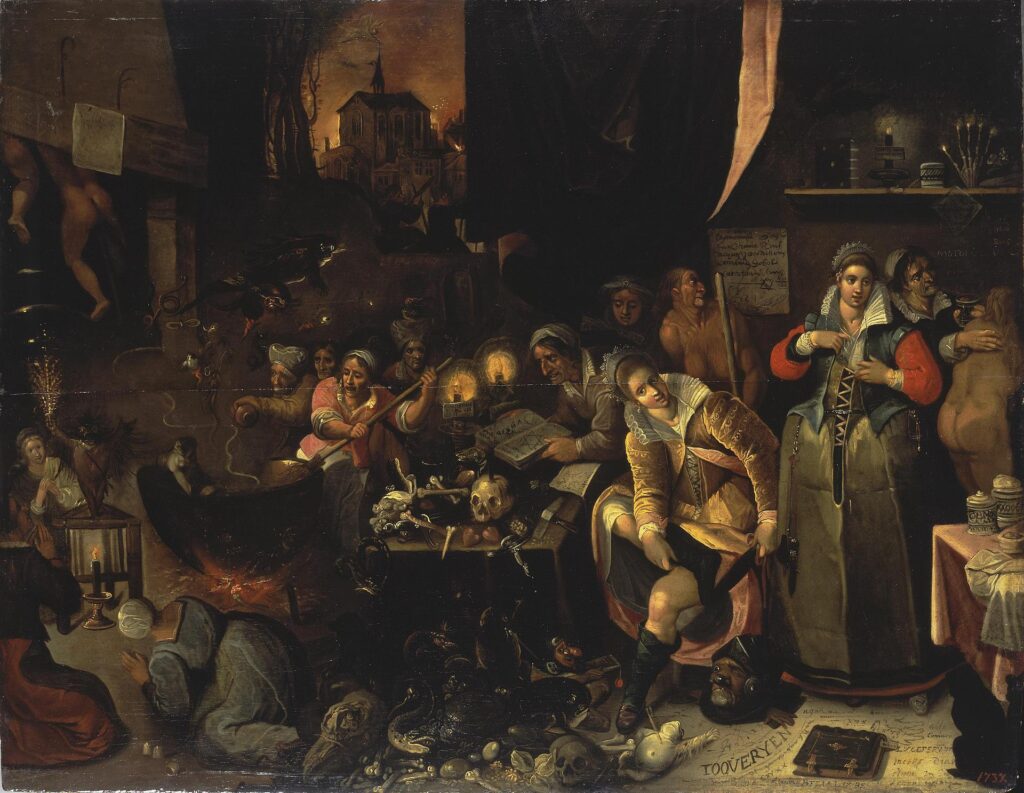
At the darker edge of the botanical lexicon lived the plants of magic, poison, and transformation. Renaissance and Romantic painters turned to them irresistibly when depicting witches, sorceresses, and femmes fatales.
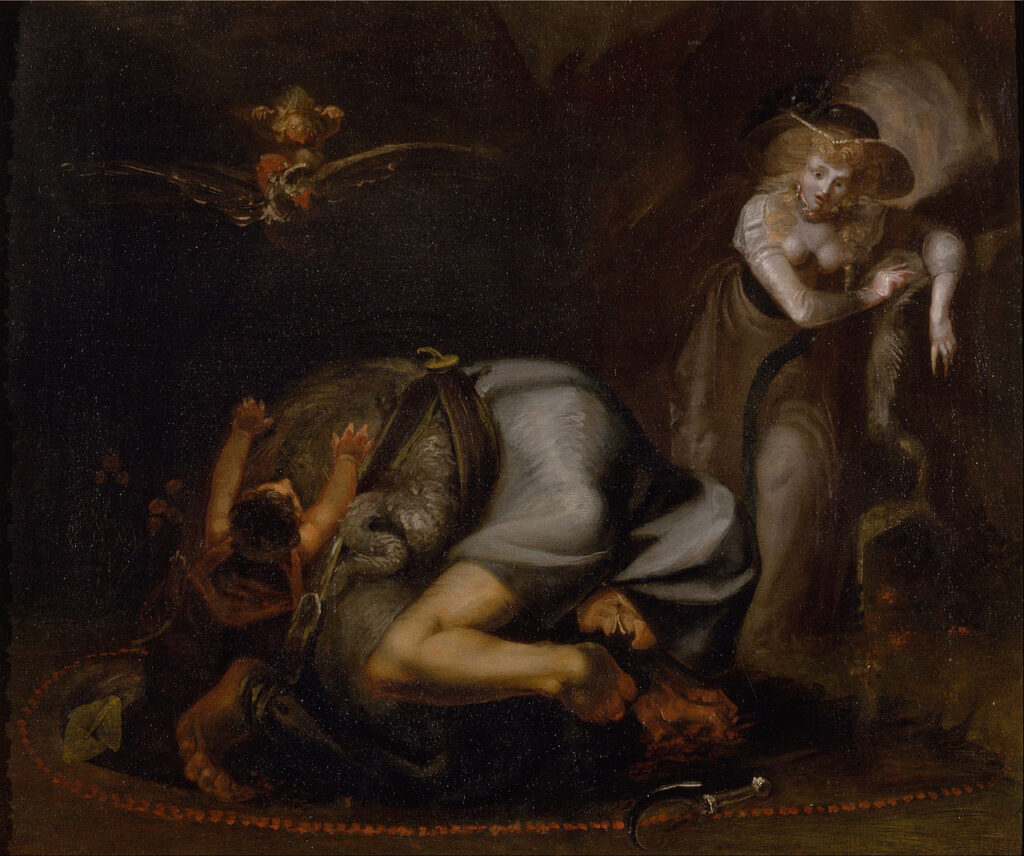
The mandrake stood as perhaps the most mythologically loaded plant in the European imagination. Its forked root, resembling a human body, placed it at the centre of an enormous body of folk magic. Legend said it shrieked when pulled from the earth, caused madness in those who heard its cry. Moreover, it served as the essential ingredient in love potions and flying ointments. When painters depicted Circe, Hecate, or the witches of Macbeth, mandrake filled the apothecary’s array before them as a visual shorthand for supernatural transgression.
Belladonna carried its danger in its very name. Atropa belladonna, its scientific name, derives from Atropos, the Fate who cuts the thread of life. Bella donna, that is beautiful woman, records the Renaissance practice of using the plant’s alkaloids to dilate the pupils, which painters of the period considered seductive and alluring. It served simultaneously as a cosmetic and a poison, a tool of beauty and of murder.
In portraits of enigmatic or threatening women, the belladonna berry (glossy, dark, deceptively appealing) functions as a knowing signal to the viewer: this woman conceals something. The flower symbolism in art of the sorceress tradition told the viewer what the face refused to show.
Dutch Golden Age: The Vanitas Cabinet
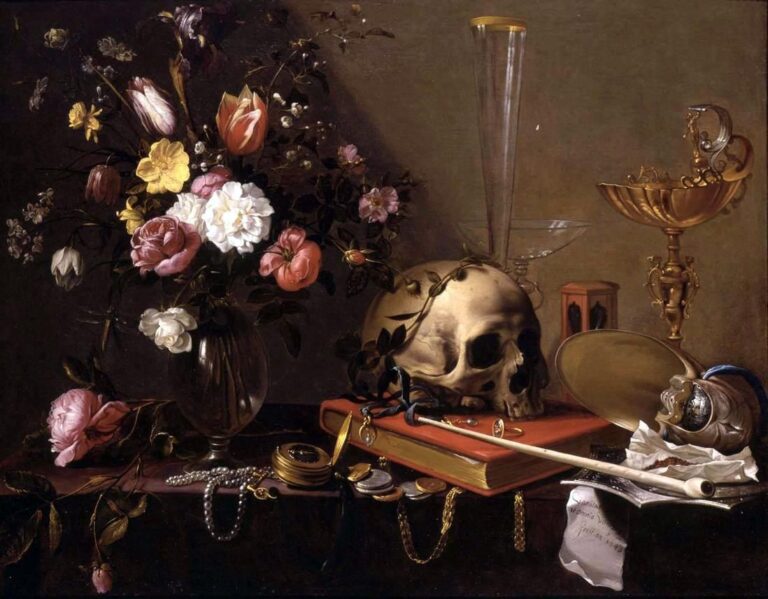
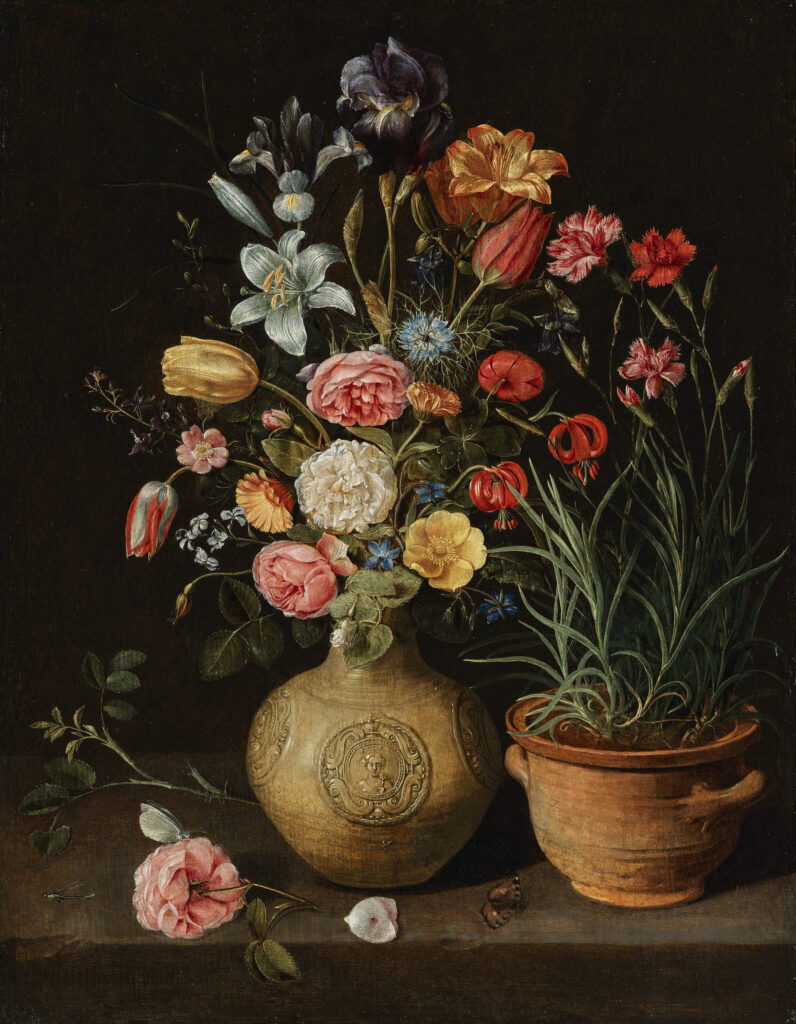
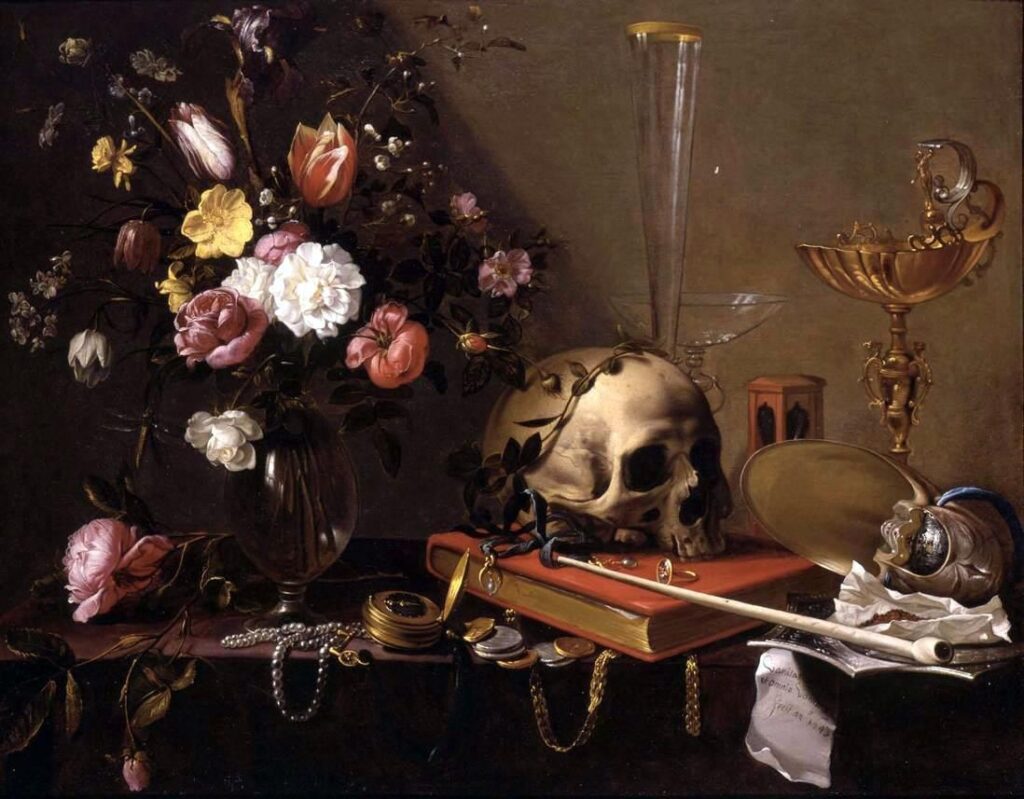
In the vanitas still life paintings of the Dutch Golden Age, the entire canvas becomes a cabinet of botanical mortality symbols, arranged with the care of a sermon. Roses stand in for the transience of earthly beauty. Tulips, still exorbitant in price during the tulip mania of the 1630s, embodied financial vanity and folly. Wheat suggested the harvest of life reaching its end. Morning glories, which open at dawn and close by afternoon, spelled out in flower-time the shortness of a human day.
The most consistent presence, however, is the iris: associated with both the Greek messenger goddess, Iris, and with the Virgin Mary, the iris in Dutch still life occupies the threshold between heaven and earth. It announces that the beauty before the viewer is already passing out of it. The hidden symbolism in paintings of the Dutch Golden Age operates less as a code than as a continuous meditation: a vanitas in miniature, built one petal at a time.
Reading the Hidden Flower Symbolism in Art
What emerges from this survey is not merely a curiosity, a parlor game of botanical symbol-spotting. It amounts to a fundamentally different way of looking at paintings. When we learn to read the flora, we understand that Old Master paintings rarely say only one thing at a time. The surface image (a saint, a drowning girl, a vase of flowers) offers the first text. The plants offer the second, and often the more honest.
The artists who deployed flower symbolism in art most deliberately extended trust to a viewer capable of reading what they hid in plain sight. To notice such subtle details means accepting an invitation into a deeper conversation. That conversation unfolds not in words, but in roots and petals, in poisoned berries and crushed poppies, in the silent and persistent language of the garden.
P.S. You’ll find many amazing floral paintings in our Flowers in Art postcard set! Be sure to check it out.