Summary
- Donatello, a leading Renaissance sculptor, created Saint George for Florence’s Armorers’ Guild after studying classical sculpture in Rome with Filippo Brunelleschi.
- Pazzi Madonna showcases the artist’s pioneering use of ultra-low relief and one-point perspective to create a realistic sense of space
- In St. John the Baptist and the Penitent Magdalene, Donatello explored wood as a sculptural medium.
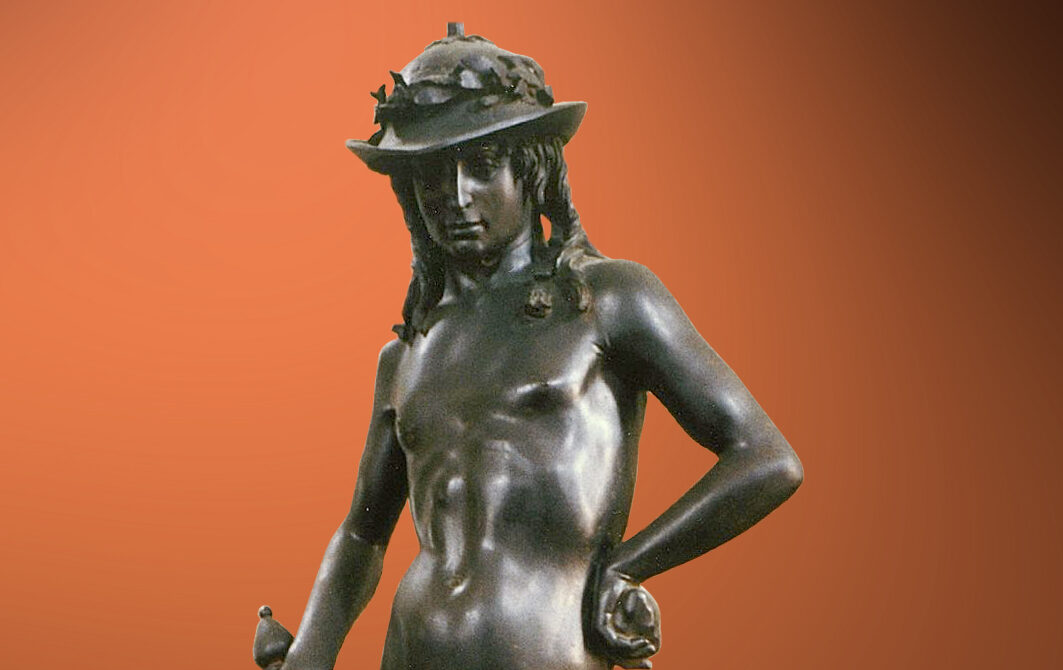
- Donatello’s bronze David was the first freestanding male nude since antiquity.
- Gattamelata combines a powerful sense of authority strikingly with naturalistic details. Its innovative bronze construction and dynamic composition influenced equestrian monuments for centuries.
- In The Miracle of the Penitent Son, Donatello fills a foreshortened architectural setting with crowded figures, using extremely low relief, incised lines, and gilded highlights to create a sense of depth.
- Judith and Holofernes depicts Judith with unprecedented determination while avoiding the sexualized portrayal common in later images of her.
- Amor-Attis is a playful mythological figure combining Attis with the wings of Eros, enriched with symbols of fertility and rebirth.
- Donatello’s Zuccone is a striking study of old age, with rough surfaces and crumpled drapery emphasizing the prophet’s worn appearance. Its expressive realism anticipates Rodin’s later sculptural style.
- Lamentation over the Body of Christ is a small bronze relief that conveys intense grief through rough surfaces and expressive poses, showcasing Donatello’s mastery of emotion and naturalism.
1. Early Marbles
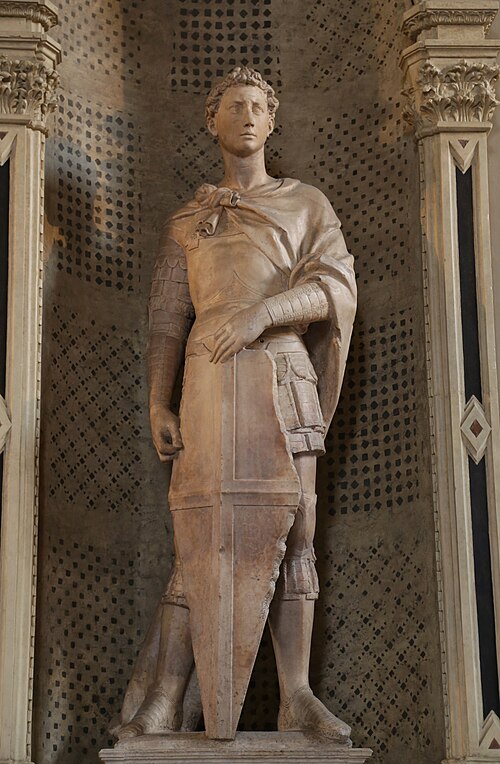
Donatello, Saint George, 1416–1417, Bargello, Florence, Italy. Photograph by Rufus46 via Wikimedia Commons (CC BY-SA 3.0).
Donatello (c.1386-1466), born Donato di Niccolò di Betto Bardi, was born in Florence and spent most of his career there, at a time when the city was a center of artistic patronage and Renaissance learning. His early work, like that of his contemporary and rival Lorenzo Ghiberti, was driven by public commissions for statuary in the Duomo complex and on Orsanmichele, the former grain market, which was being converted into a church. Here the town’s merchant guilds competed with a series of sculptures of their respective saints, placed in niches around the outside of the building. Donatello’s Saint George was his second Orsanmichele commission, after Saint Mark, and was produced for the Armorers’ Guild. Both were carved in marble and showed the influence of the year or so that Donatello had spent in Rome studying classical sculpture, with his mentor Filippo Brunelleschi (1377–1446).
The deceptive simplicity of Saint George makes it easy to overlook Donatello’s skill. The saint is positioned on a slight twist, one shoulder projecting to make him seem poised for action, ready almost to escape the shallow niche in which he stands. That sense of what Giorgio Vasari called “a marvellous sense of movement within the stone” is emphasized by the weight on his left leg and the strong diagonal created by the shadow of his cloak and the line of the shield.
Military hero St. George would once have held a weapon in his right hand and worn a bronze helmet, but even without these, his athletic youthfulness is paramount. He looks ahead, perhaps contemplating his meeting with the dragon and his symbolic battle with evil, but ready to face it unafraid. This complex humanity, an ability to create believable, almost breathing figures, defined all of Donatello’s work.
2. Perspective and Relief
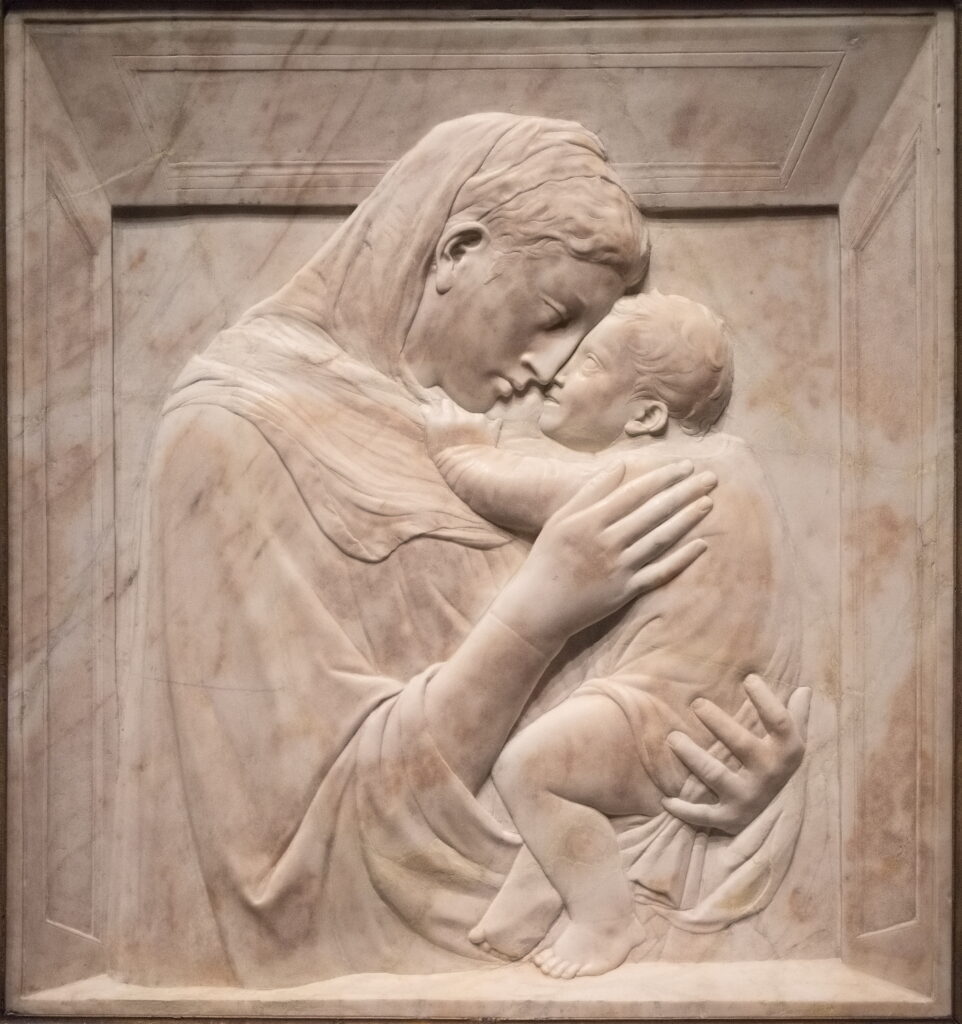
Donatello, The Pazzi Madonna, c. 1422, Bode Museum, Berlin, Germany. Photograph by Armin Kleiner via Wikimedia Commons (CC BY-SA 4.0).
Produced as a private devotional object for the Florentine family of the same name, the Pazzi Madonna is the earliest of several reliefs depicting the Madonna and Child, which Donatello and his workshop produced in various media. Its use of schiacciatio, an ultra-low relief technique pioneered by Donatello, is striking. At a time when polychrome reliefs were popular, it was also unusual for its lack of color, and subsequent painted copies followed.
More importantly, Donatello employed one-point perspective in the work. This technique was in early development by artists like Masaccio. It allowed him to create an illusionistic frame for his figures, which roots them in physical space and, when viewed from a kneeling position, made them seem all the more realistic.
To modern viewers, however, the intense bond between mother and child is particularly striking. The touching noses, mutual stare, and the tiny hand reaching across are deeply emotional. With the lack of haloes or any religious symbolism, these become very human figures, an everywoman and her child.
3. Carving in Wood
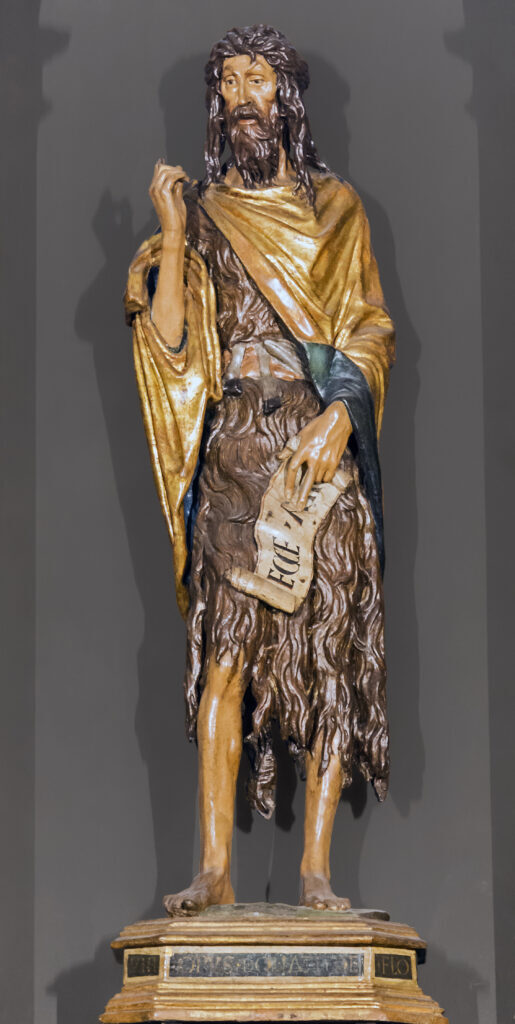
Donatello, St John the Baptist, 1438, Santa Maria Gloriosa dei Frari, Venice, Italy. Photograph by Didier Descouens via Wikimedia Commons (CC BY-SA 4.0).
Wood was associated with Medieval carving, for instance the Volterra Deposition, but not widely used in 15th-century Florence, other than for crucifixes. As a cheap material, it lacked intrinsic value, and it had limitations of scale. In St. John the Baptist and the Penitent Magdalene, Donatello not only tested the possibilities of wood carving but used the qualities of the medium to his advantage. Both figures are attenuated and emaciated, exploiting the thin verticality of the original trunk. Both were dwellers in the wilderness who seem to have almost become part of nature.
Arguably these are old-fashioned figures with painted and gilded surfaces, but Donatello is deliberately reworking tradition. The gesso (plaster) that was applied as underpainting becomes an extra layer of modelling; the paint itself is limited so that one never forgets the material beneath, and the gilding acts as a highlight only. St. John stands with a subtle contrapposto (weight on one leg), his mouth open and his features animated in speech. The naturalism and the natural material bring him closer to the viewer.
4. David
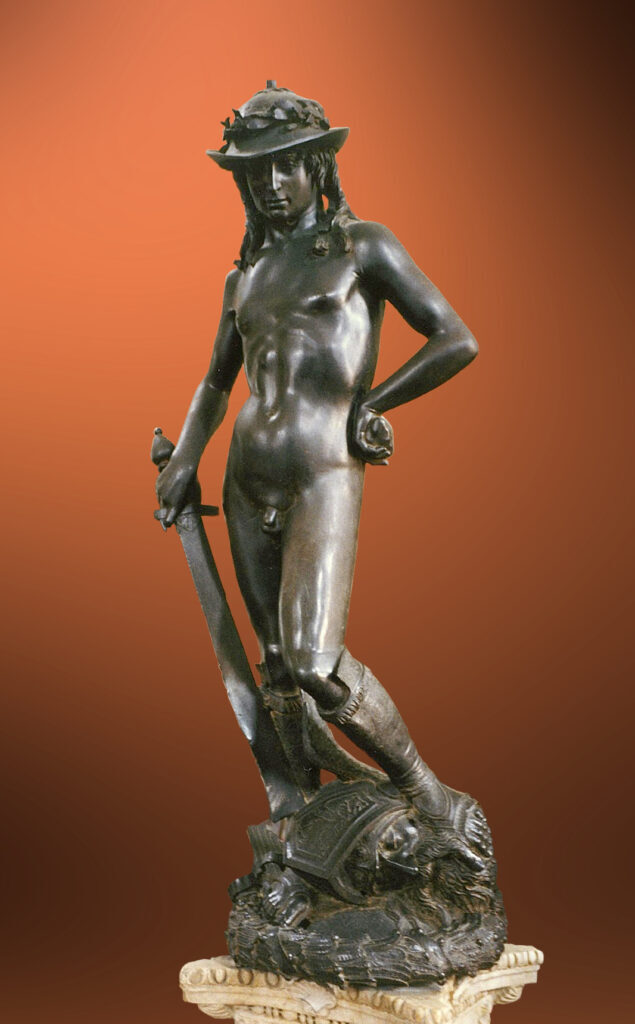
Donatello, David, c. 1440, Bargello National Museum, Florence, Italy. Photograph by Tetraktys via Wikimedia Commons (CC BY-SA 2.0).
Donatello’s bronze David was the first freestanding male nude produced since classical times. That alone makes it a significant work. However, in many ways, it is the least interesting thing about it. Although Donatello takes the concept of the idealized nude from the ancient world, he does not, as Michelangelo did with his version 80 years later, adopt a heroic classical style. Instead, he takes a unique hybrid approach that exemplifies the subject matter.
The Medici family likely commissioned David, intending to display it in the courtyard of their palazzo as a sign of their—and their city’s—status. It was, in fact, the second version of the subject that Donatello had produced. His earlier David, in marble, is more in the style of Saint George. In the bronze version, the sleek metallic surface is exploited to emphasize the shepherd’s youthfulness, alongside the slender curving pose and long curled hair. Its Gothic elegance is unusual in Donatello’s work, and would have been further exaggerated by the partial gilding that the sculpture originally bore.
David seems weighed down by the helmet he wears and the sword he has just wielded. The contrast of these, and his boots, with the naked flesh above, stresses his innocence and weakness, further contrasted with the complex modelled mass of Goliath’s head. David has not triumphed out of might but through goodness and purity, by the grace of God. His gaze, almost hidden as he looks down on the head of the giant he has killed, is ambiguous. There seems to be a trace of a smile on his lips.
5. Gattamelata
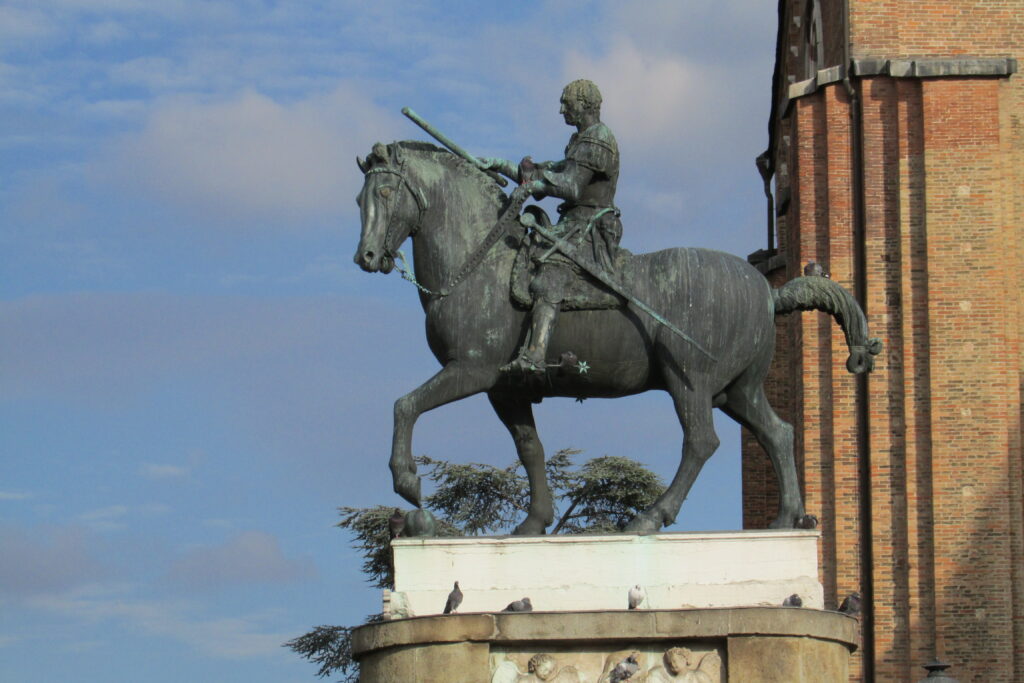
Donatello, The Equestrian Statue of Gattamelata, c. 1453, Piazza del Santo, Padua, Italy. Photograph by Chris Light via Wikimedia Commons (CC BY-SA 4.0).
In a career of firsts, this ranks as one of the most impressive: Gattamelata is the first full-size equestrian statue since antiquity and a deliberate homage to the most famous surviving Roman example of Marcus Aurelius. The technical skill required to produce a bronze of this scale cannot be underestimated. The ball on which the horse’s raised front hoof rests exemplifies how the sculptor worked within limitations, balancing the desire to create dynamism (and mimic Marcus Aurelius) with the fragility of the bronze limb. Donatello’s work became the model for equestrian portraits for centuries to come.
Gattamelata was the nickname of Erasmo of Narni, the mercenary being honored by his family for helping secure the Venetian Republic. The horse and rider are both individualized and naturalistically portrayed. The animal’s solid anatomy and the figure’s stocky strength work together to create a sense of authority and power. They mirror each other in character, with the curve of the animal’s head following the slight twist of the soldier’s neck, both alert and wide-eyed. Despite the fact that this is a symbolic public monument, Donatello has created a believable human being.
6. Drawing in Bronze
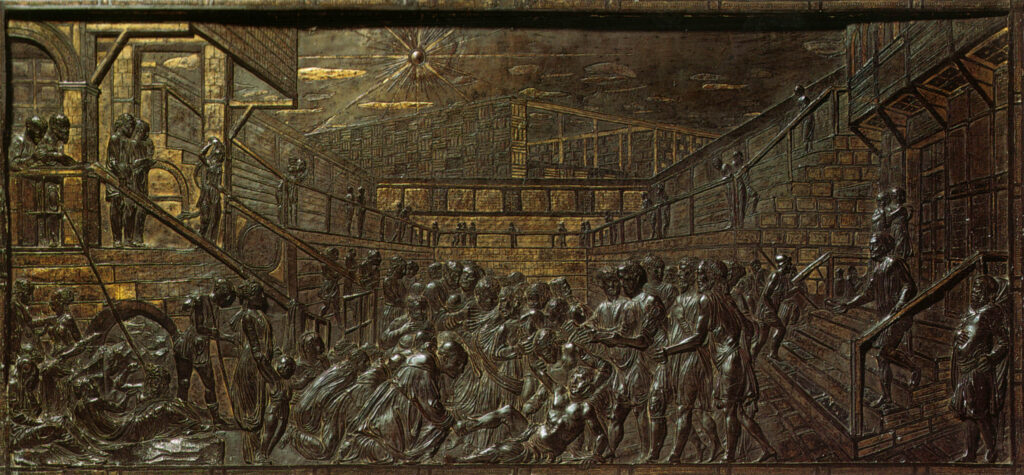
Donatello, The Miracle of the Penitent Son, c. 1447–1450, Basilica of St Anthony, Padua, Italy. Photograph by Sailko via Wikimedia Commons (public domain).
Gattamelata was produced during an extended stay in Padua, when Donatello also worked on several commissions for the Basilica of Saint Anthony. In four panels for the high altar, he produced some of the period’s most complex reliefs, showing scenes from the life of the saint to whom the cathedral was dedicated. The Miracle of the Penitent Son is typical in the way it sets a crowd of figures against a heavily foreshortened architectural setting.
One might accuse Donatello of overload, and he is clearly determined to showcase his skills. The structures rendered have multiple layers, depths, arches, steps, brickwork—all incidental details that create a stage set (literally, look at the watching figures) for the action, but ultimately also distract from it. Above all, however, in a clear sky, dotted with sparse clouds, the light of God shines through. All these details are almost “drawn” onto the bronze, with Donatello working in a combination of extremely low relief and incised lines, emphasized by gilded highlights.
Even the foreground figures are in low relief, the two protagonists given little prominence beyond their poses and central position. The mass of bodies crowded into so little space forces them out of the relief and into the viewer’s world. Previous sculptors like Ghiberti had used rounded high relief and back views to do this: Donatello is pushing the boundaries again.
7. Judith
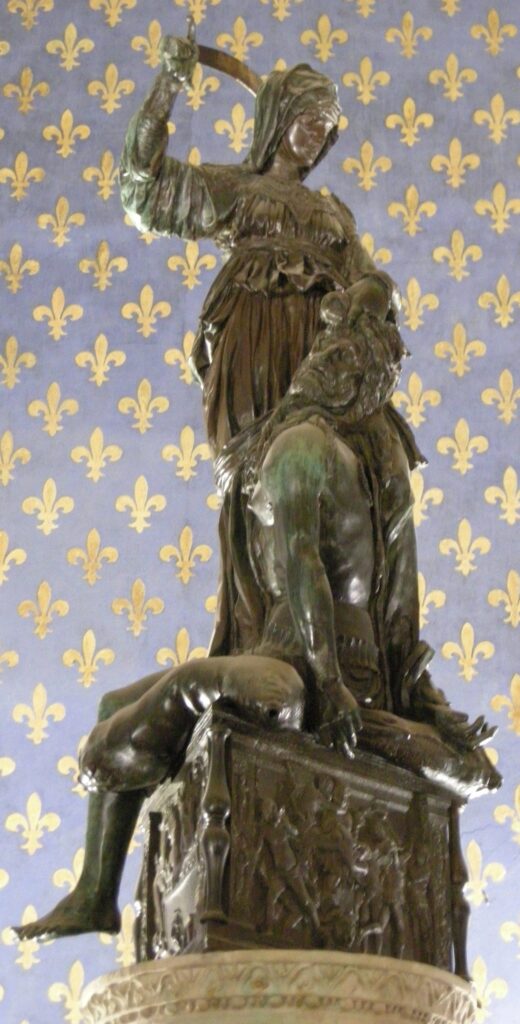
Donatello, Judith and Holofernes, 1457–1464, Palazzo Vecchio, Florence, Italy. Photograph by Sailko via Wikimedia Commons (CC BY-SA 3.0).
Like David, Judith and Holofernes was a Medici commission, originally gilded in part, designed to decorate their private palace. After the family fell from power, the sculpture was moved to the Palazzo della Signoria and took on new significance as a symbol of the defeat of tyranny. Although images of Judith became common from the Renaissance onwards, this was the first time that an artist represented her in the act of killing Holofernes, with her sword arm raised and a look of determination on her face.
Unlike many images of Judith, Donatello does not sexualize the female figure. Rather, her heavy draperies contrast with the slumped flesh of Holofernes at her feet, creating a spiral of active movement from the tip of the sword downwards. By seating the male figure on a “soft” cushion with his legs dangling over the plinth, Donatello breaks the barrier between sculpture and reality: Holofernes is in our space. Despite its columnar appearance, the sculpture is intended to be seen in the round, from different perspectives, emphasized by the three reliefs on the triangular plinth.
8. Youth
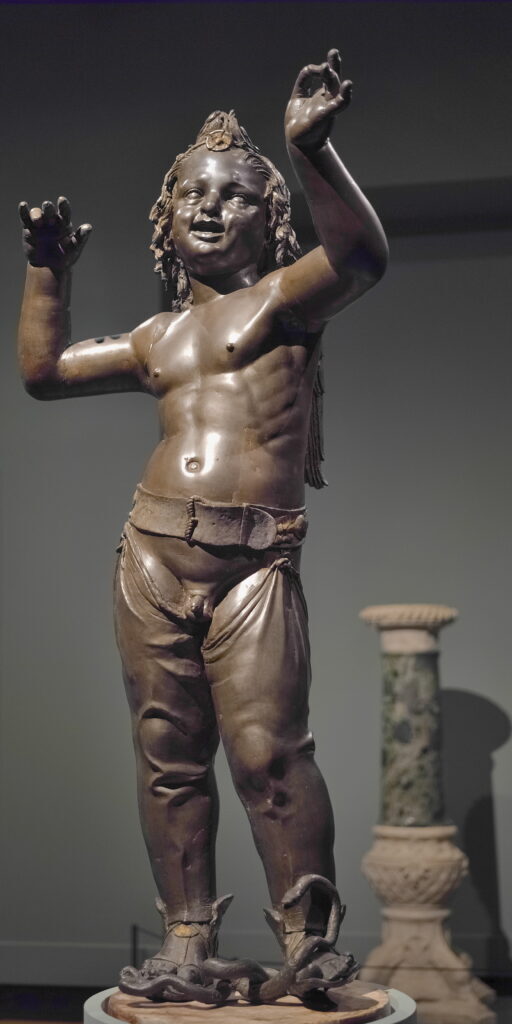
Donatello, Amor-Attis, c. 1440–1443, Bargello National Museum, Florence, Italy. Photograph by Bautsch via Wikimedia Commons (CC0 1.0).
The serious religious and civil messages conveyed by many of Donatello’s works are far from the whole story. Amor-Attis is a playful, humorous work, probably a private commission for the Doni family. The figure is a combination of classical gods: The Greco-Roman Attis, who represented vegetation and fertility, is here given the wings of Eros/Cupid, god of love and desire. Donatello has paid attention to classical precedents, copying the odd breeches from ancient sculpture and using symbolism. The snake at the boy’s feet represents rebirth, and poppy heads on his belt symbolize fruitfulness.
However, the sculptor wears his learning lightly, focusing instead on the boyish exuberance of the figure with his laughing mouth and hands raised almost as if he is conducting an invisible orchestra. There are other examples of Donatello reveling in this type of decorative piece and youthful putti figures, even in sacred settings.
9. Age
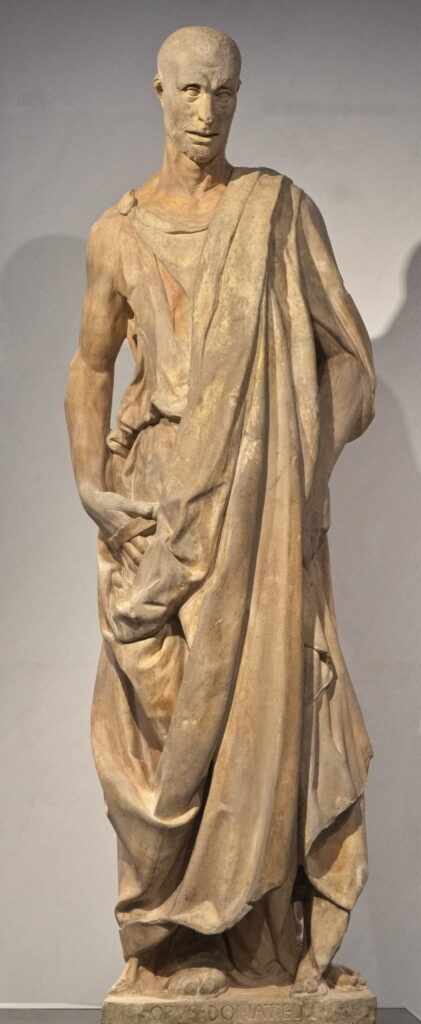
Donatello, Zuccone, c. 1423–1425, Museo dell’Opera del Duomo, Florence, Italy. Photograph by Armin Kleiner via Wikimedia Commons (CC BY-SA 4.0).
In complete contrast to Amor-Attis, one of Donatello’s earliest works is one of the great studies of old age. Zuccone, a nickname referring to the bald head of the unnamed prophet (likely Habakkuk), was carved as part of the decoration of the Campanile (bell-tower) of Florence’s Duomo. The features seem so specific that Vasari suggested it was a portrait, but it seems more likely that Donatello has reached into his imagination to present a care-worn but philosophical figure. He looks down at us, his mouth slightly open, his elongated bald head suggesting his intelligence, with enough of a twist in his stance to suggest a captured moment of life.
Compared with the refined carving of Saint George, Donatello has deliberately kept the surface rough, suggesting creases round the eyes, stubble on the chin, and an uneven skull. The toga-like draperies are barely modelled, their crumpled folds adding to the figure’s aged appearance and suggesting the sagging frame beneath. The looseness is comparable to Auguste Rodin‘s work four and a half centuries later.
10. Lamentation
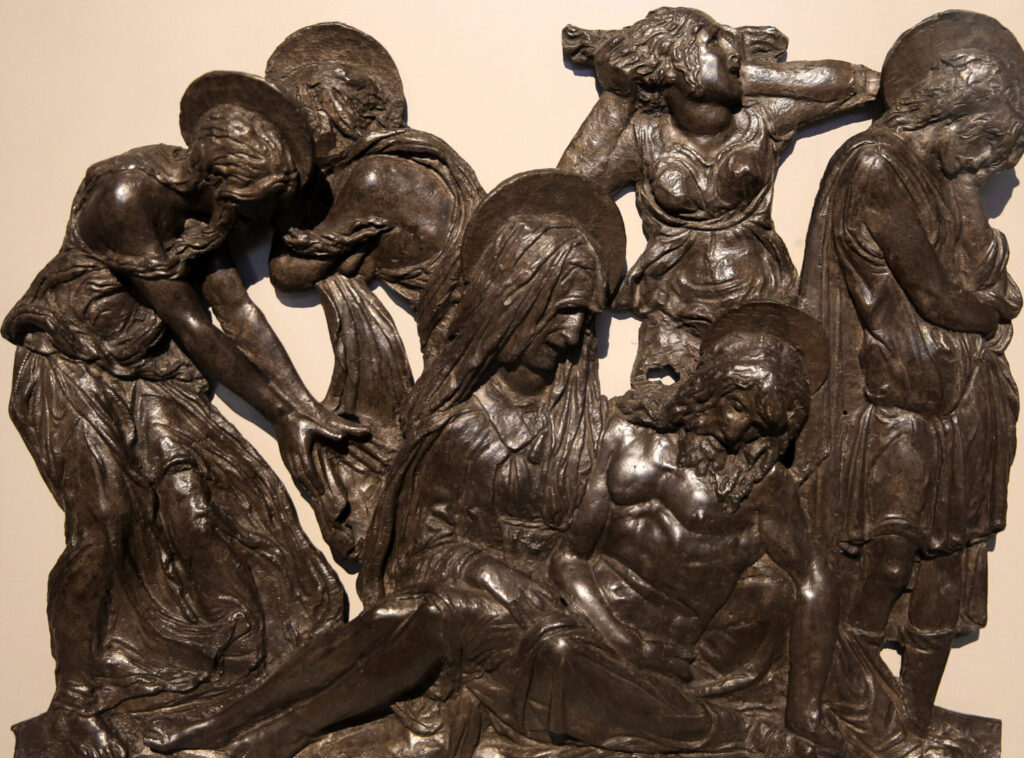
Donatello, Lamentation over the Dead Christ, 1455–1460, Victoria and Albert Museum, London, UK. Photograph by Francesco Bini via Wikimedia Commons (CC BY-SA 4.0).
One of the artist’s most experimental late pieces, the Lamentation over the Body of Christ is just 32 centimeters high, yet it packs a huge emotional punch. Mary cradles the body of her son while four other figures, including Mary Magdalene and St. John the Evangelist, variously express their grief. The bronze between the figures is cut away, emphasizing the poses and the interlocking bonding of a group joined by their shared love of the central figure.
Although Donatello is working in low relief, the roughness of the surface seems to mimic the rawness of the emotion on show. Notice, for instance, how the fingers of the figure on the left are exaggerated by folds of drapery, to suggest their thrusting movement towards Christ. Two of the figures are open-mouthed, and one can almost hear their cries. One is literally tearing her hair. We have no certainty why, or even exactly when, this work was made, but it remains one of the most brutal representations of grief, on a par with later Expressionist work by artists like Käthe Kollwitz.
For technical innovation, Renaissance ideas, and a range of styles and materials, Donatello was unmatched during the 15th century. However, it is his ability to convey naturalism and emotion—both quiet and extreme—that makes his work so compelling today. He draws you in, makes you believe, and asks you to feel. That is what makes him a supreme sculptor.