

Donatello in 10 Sculptures: Innovation and Emotion
If you ask people to name the greatest sculptor, the 15th-century Florentine, Donatello, will not be near the top of the list. Yet throughout a long...
Catriona Miller 28 September 2026
20 April 2026 min Read
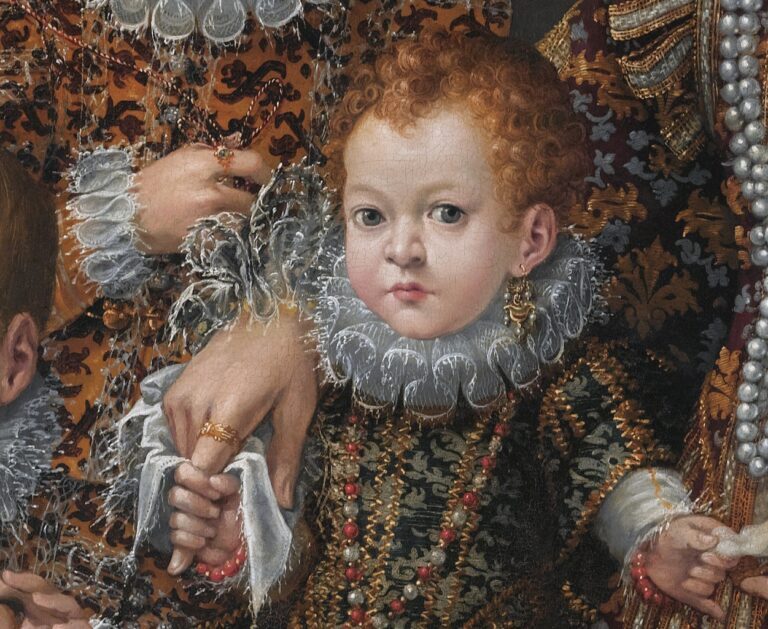
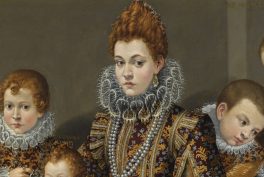
Lavinia Fontana, Portrait of Bianca degli Utili Maselli and Her Children, ca. 1604–1605, Fine Arts Museums of San Francisco, San Francisco, CA, USA. Detail.
While researching 17th-century portraiture, especially those by Lavinia Fontana, I started noticing the children bedecked in jewelry like miniature adults. But the more I looked, the more it became clear that these accessories were far from superficial. They carried meaning. They spoke. What can a child’s jewelry tell us about the past? Perhaps more than we expect—it speaks to family, faith, and the roles children were expected to embody in early modern society.
I stumbled into this subject almost by accident; while researching 17th-century portraiture, I found myself pausing at the children, those miniature adults in silks and brocades, their small bodies framed with the same embroidery, lace, and jewels as their parents.
Today, we tend to think of children’s jewelry as light, inexpensive, even sentimental. Perhaps a baptism bracelet, a silver locket, or necklace of plastic beads come to mind—a “friendship” bracelet. But in early modern Europe, these objects were far from neutral. Children’s portraits show that clothes and jewels functioned as markers of identity and place, carrying dynastic, devotional, and protective significance. These were costly, meaningful objects that visibly bound children into the fabric of family, faith, and social expectation.
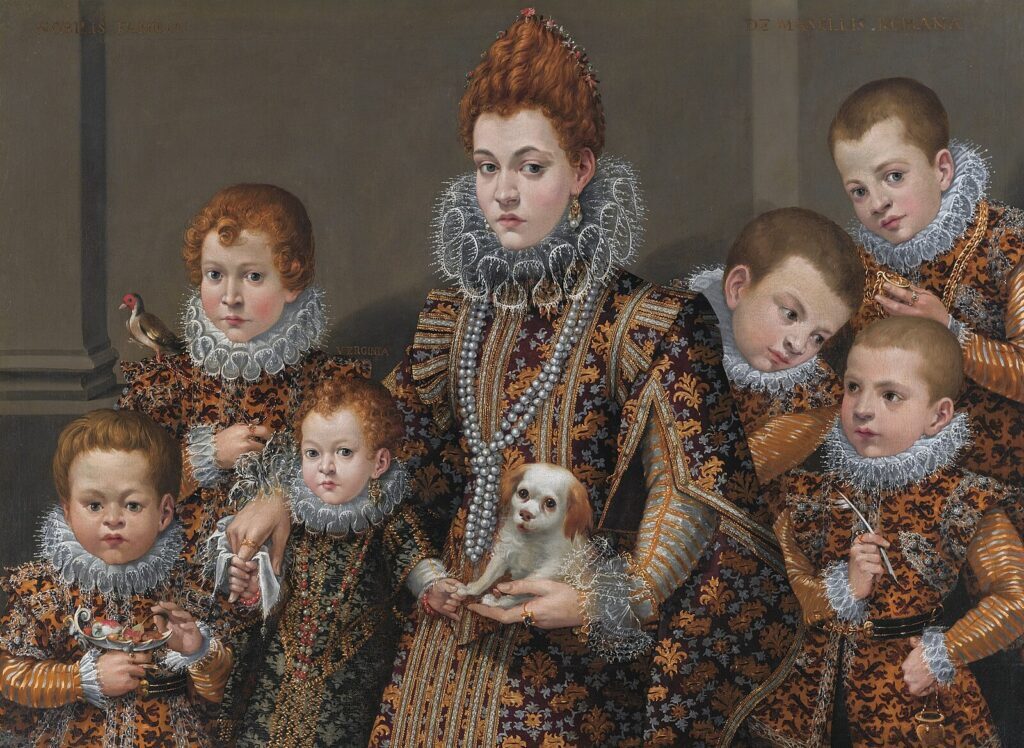
Lavinia Fontana, Portrait of Bianca degli Utili Maselli and Her Children, ca. 1604–1605, Fine Arts Museums of San Francisco, San Francisco, CA, USA. Museum’s website.
In Lavinia Fontana’s Portrait of Bianca degli Utili Maselli and Her Children, jewelry serves as a powerful visual language, rich with layered meanings that go beyond simple decoration. Jewelry is used to distinguish individuals. Bianca degli Utili Maselli, a Roman noblewoman, is shown with five sons; particular attention is drawn to her daughter, Verginia. She is the only child her mother embraces, and the only one whose name is inscribed above her head.
Verginia is bedecked with jewelry: coral bracelets around her wrists, an alternating strand of coral and pearls at her neck, and five-drop earrings—which echo her mother’s—marking her as both cherished and significant within the family. These elements position her within a carefully constructed visual language of meaning. While her brothers wear gold chains or hold signs of inheritance, Verginia’s jewelry signals something more intimate, the merging of protection, purity, and projected virtue. It quietly marks her out, not only as a cherished daughter, but possibly as the figure through whom family hopes and dynastic continuity were to be carried forward.
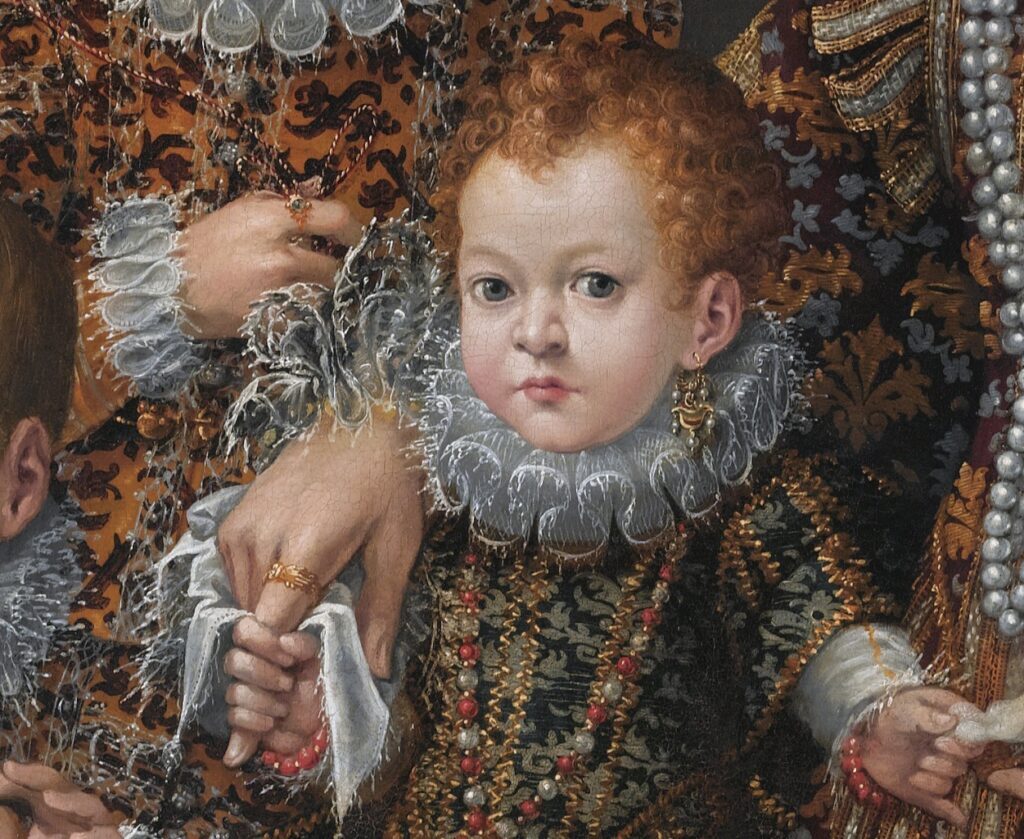
Lavinia Fontana, Portrait of Bianca degli Utili Maselli and Her Children, ca. 1604–1605, Fine Arts Museums of San Francisco, San Francisco, CA, USA. Detail.
During the Renaissance, red coral was highly valued for its beauty and apotropaic qualities. It was considered to have power to ward off evil and illness. The pearls around her neck and on her earrings symbolize purity and connect her to religious traditions such as water baptism, while also reflecting adult fashion and possibly signaling her impending transition into adulthood and marriage.
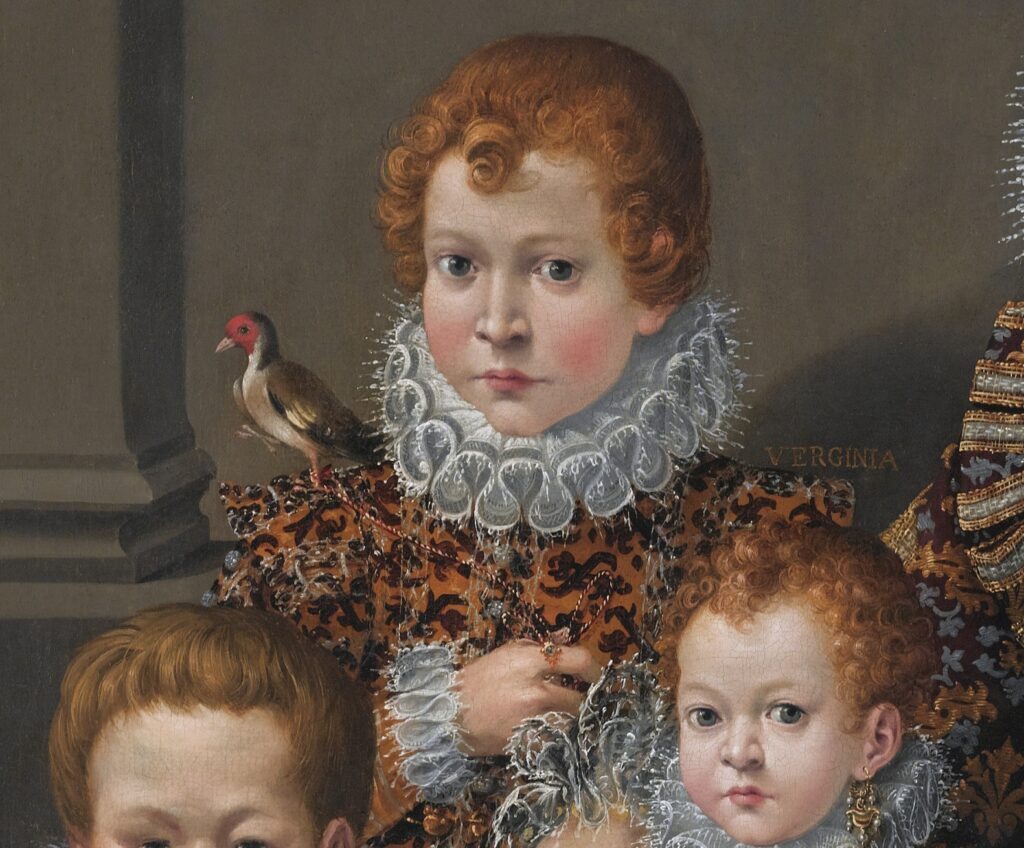
Lavinia Fontana, Portrait of Bianca degli Utili Maselli and Her Children, ca. 1604–1605, Fine Arts Museums of San Francisco, San Francisco, CA, USA. Detail.
Although Verginia’s jewelry is the most visually elaborate and symbolically prominent in the artwork, the other figures are adorned with items contributing to the portrait’s broader meaning. Several of the boys wear modest rings or gold chains, and one, notably, holds a gold medallion suspended from a chain.
Fontana deliberately uses these symbolic accessories to convey a sense of both individuality and familial cohesion. Each figure is associated with an object that gestures toward a particular virtue or quality: a quill and inkwell for learning, a songbird perhaps for innocence or sociability, and a silver cup of figs that may allude to fertility or abundance. The gold medallion, although its specific meaning remains ambiguous, clearly belongs within this system of carefully chosen emblems.
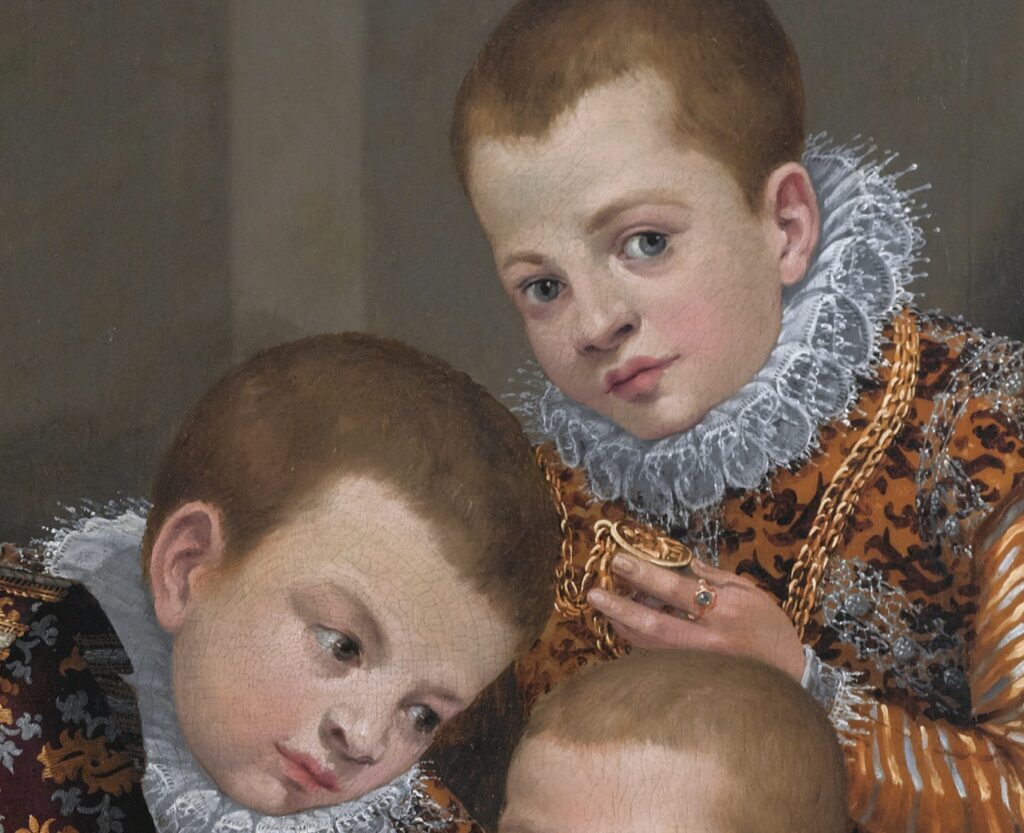
Lavinia Fontana, Portrait of Bianca degli Utili Maselli and Her Children, ca. 1604–1605, Fine Arts Museums of San Francisco, San Francisco, CA, USA. Detail.
In 17th-century European portraiture, jewelry signaled wealth, reinforced family networks, marked stages of life and encoded morality, virtue, and protection. Whether pearls, coral, or gold, whether worn by infants, young girls, or adults, these adornments told stories about the sitter’s identity, their place in the family, and the hopes their families invested in them. Portraits of children reveal that even the youngest sitters bore visible signs of care, devotion and social position, proof that jewelry was, above all, a language of meaning.
Coral beads, crosses, and pearls gleam across their small bodies, shining symbols of identity and expectation. These were never just accessories. In the hands of Fontana, jewelry became a language, a way to express inheritance, care, faith, and the futures families imagined.
DailyArt Magazine needs your support. Every contribution, however big or small, is very valuable for our future. Thanks to it, we will be able to sustain and grow the Magazine. Thank you for your help!
If you ask people to name the greatest sculptor, the 15th-century Florentine, Donatello, will not be near the top of the list. Yet throughout a long...
Catriona Miller 28 September 2026
Venetian color often feels immediate: a blue robe, a crimson sleeve, a flash of yellow, a shadow beneath living skin. Yet before these colors became...
Wen Gu 3 September 2026
Few artists have shaped the history of Western art as profoundly as Michelangelo Buonarroti (1475–1564). Sculptor, painter, architect, and poet, he...
Catherine Razafindralambo 29 June 2026
The complex of the Santi Apostoli basilica in Rome, located just steps away from the bustling Piazza Venezia, is a place steeped in history. If you...
Javier Abel Miguel 18 February 2026