Summary
- Michelangelo’s Pietà established his reputation in Rome through its depiction of Mary and Christ, combining naturalism, idealized beauty, and themes of suffering and redemption.
- The Artist’s unfinished Entombment emphasizes the human experience of loss and mourning, focusing on the physical and emotional burden of carrying Christ’s body.
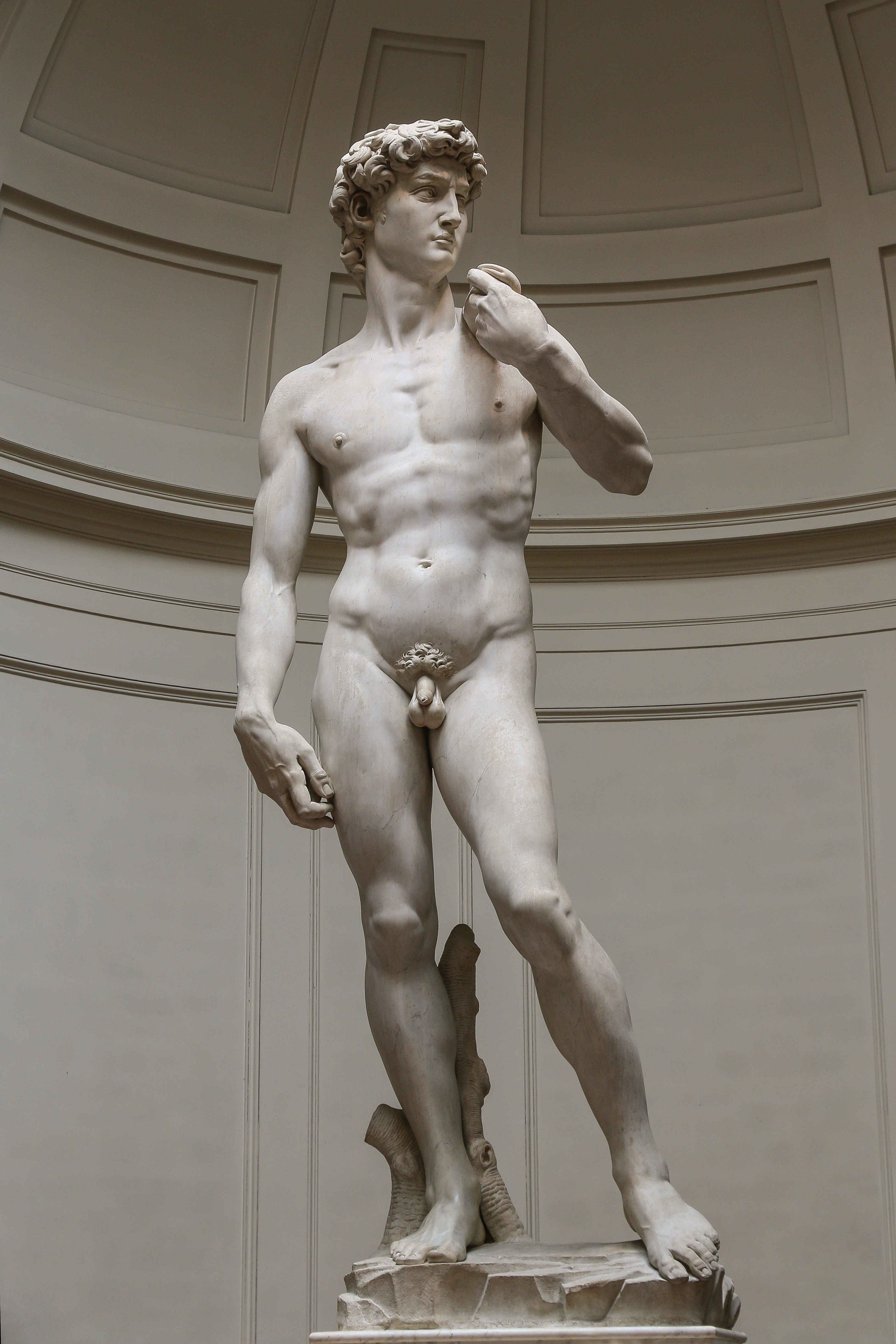
- David, carved from a long-abandoned marble block, was installed as a symbol of the Florentine Republic, depicting the biblical hero in a tense moment before battle.
- The Doni Tondo, Michelangelo’s only surviving panel painting, conveys religious meaning through dynamic figures and a complex composition contrasting Christian and pagan worlds.
- The Sistine Chapel ceiling, commissioned by Pope Julius II, presents a vast Genesis cycle which includes the iconic Creation of Adam.
- The Tomb of Julius II occupied Michelangelo for nearly four decades and produced the monumental Moses, yet it remained one of his greatest artistic disappointments.
- Michelangelo’s Last Judgement, painted for the Sistine Chapel altar wall during a time of religious crisis, presents a densely populated vision of salvation and damnation centered on a powerful Christ.
- The Florentine Pietà (Deposition), intended for the artist’s tomb, depicts Christ’s body in a deeply emotional scene of grief and vulnerability, possibly including a self-portrait of the artist.
- Major commissions such as St Peter’s Basilica demonstrate Michelangelo’s architectural mastery, as he designed the centralized plan and monumental dome that define Rome’s skyline.
- Michelangelo’s Rondanini Pietà, left unfinished at his death, reduces forms to essentials, replacing anatomical perfection with fragility and intimacy.
The 10 masterpieces presented here trace that remarkable journey, from the youthful Vatican Pietà to the unfinished Rondanini Pietà that occupied Michelangelo in the final days of his life.
1. Pietà (1498–1499)
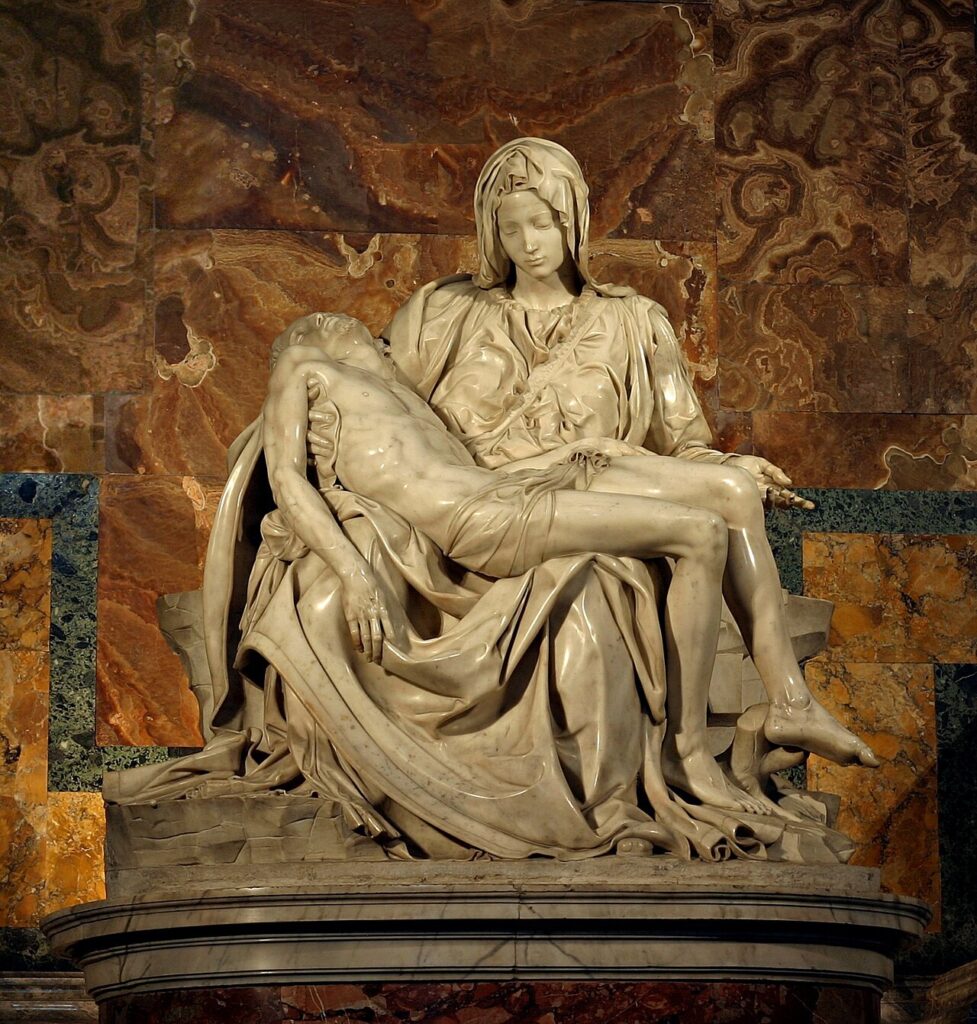
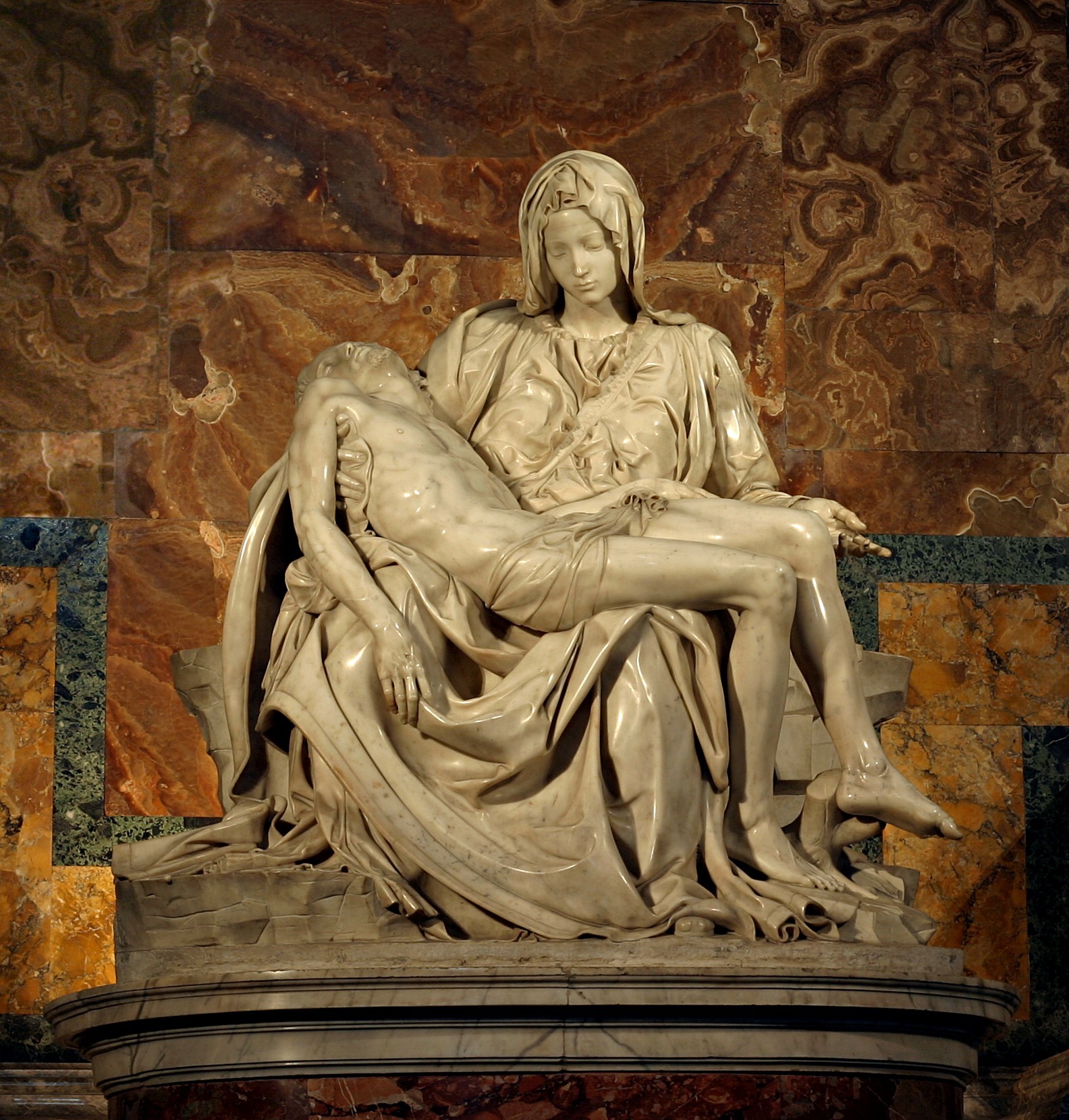
Michelangelo, Pietà, 1498–1499, St Peter’s Basilica, Vatican City. Photograph by Stanislav Traykov.
Michelangelo arrived in Rome in 1496 at the age of 21, largely unknown outside Florence. The Pietà was his first major Roman commission, created for the French cardinal Jean de Bilhères-Lagraulas and intended for his funerary chapel in St. Peter’s Basilica.
Carved from a single block of marble, the sculpture depicts the Virgin Mary cradling the dead Christ after the Crucifixion. Despite the tragedy of the scene, neither figure displays dramatic emotion: Mary appears calm and contemplative, while Christ’s body rests peacefully across her lap. One of the work’s most striking features is the Virgin’s youthful appearance: rather than portraying her as a grieving middle-aged mother, Michelangelo gave her an idealized beauty that many scholars have linked to contemporary theological ideas about Mary’s purity and to Renaissance concepts of beauty as a reflection of divine perfection.
The sculpture is remarkable for its balance between naturalism and idealization: Christ bears the marks of the Passion, yet his body remains serene and unmarred by physical decay. The composition invites viewers to contemplate not only death and suffering but also the promise of redemption that lies at the heart of the Christian story.
The Pietà established Michelangelo’s reputation in Rome almost immediately, and he was fiercely protective of the work. According to Giorgio Vasari, after overhearing visitors attribute the sculpture to another artist, Michelangelo returned to St. Peter’s and carved his name across the sash running over the Virgin’s chest. It was the first and only work he ever signed.
2. The Entombment (c. 1500–1501)
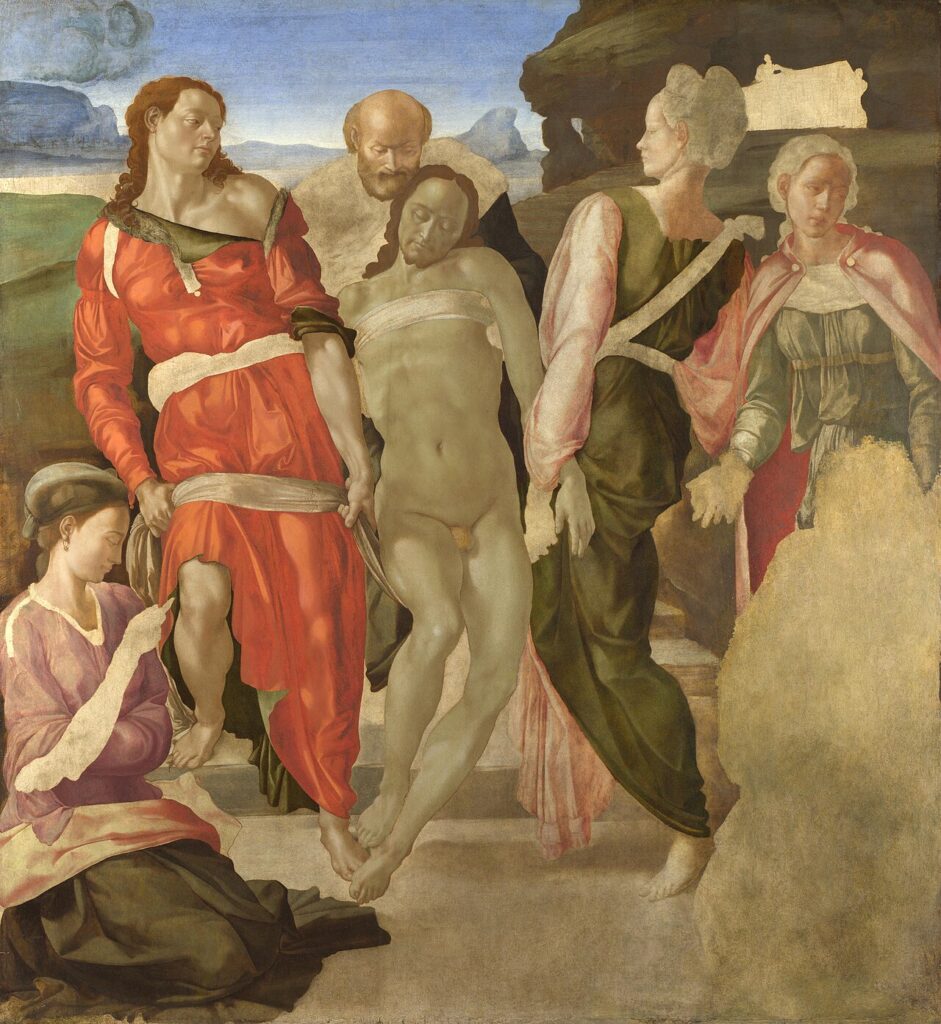
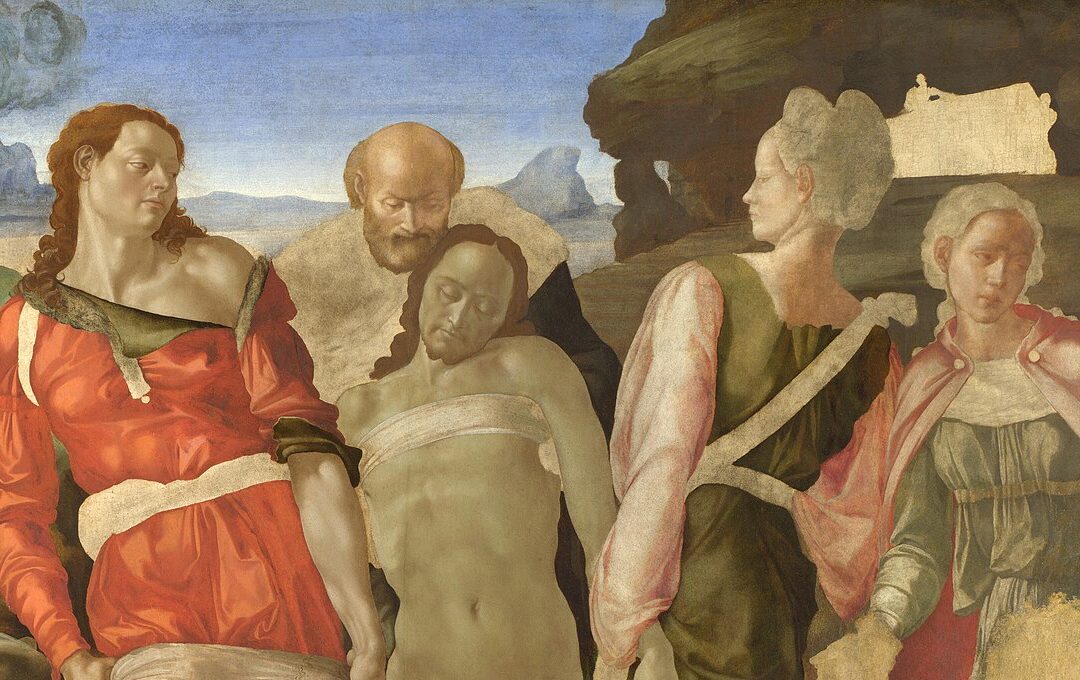
Michelangelo, The Entombment, 1500–1501, National Gallery, London, UK.
Shortly after completing the Pietà, Michelangelo accepted a commission for an altarpiece intended for the funerary chapel of a bishop in the Roman church of Sant’Agostino. The resulting painting, known as the Entombment, was never finished. In 1501, Michelangelo left Rome after securing a commission for a colossal marble statue in Florence (the project that would become the David) and never returned to complete the work.
The painting depicts Christ’s body being carried to the tomb by a group of mourners. Several areas remain unfinished: some figures are only broadly sketched, while a large section in the lower right was left entirely blank. Even in its incomplete state, the composition reveals Michelangelo’s interest in the expressive potential of the human body. The figures twist and strain beneath Christ’s weight, creating a sense of physical effort that contrasts with the calm stillness of the Pietà.
Whereas the Pietà presents Christ’s death through an idealized vision of beauty and serenity, the Entombment focuses more directly on the human experience of loss and mourning, as the emotional and physical burden of carrying Christ’s body is central to the scene. Although unfinished, the painting offers a glimpse into Michelangelo’s early exploration of a subject that would occupy him throughout his career as he would return repeatedly to the theme of the Entombment, approaching it from different artistic and spiritual perspectives.
3. David (1501–1504)
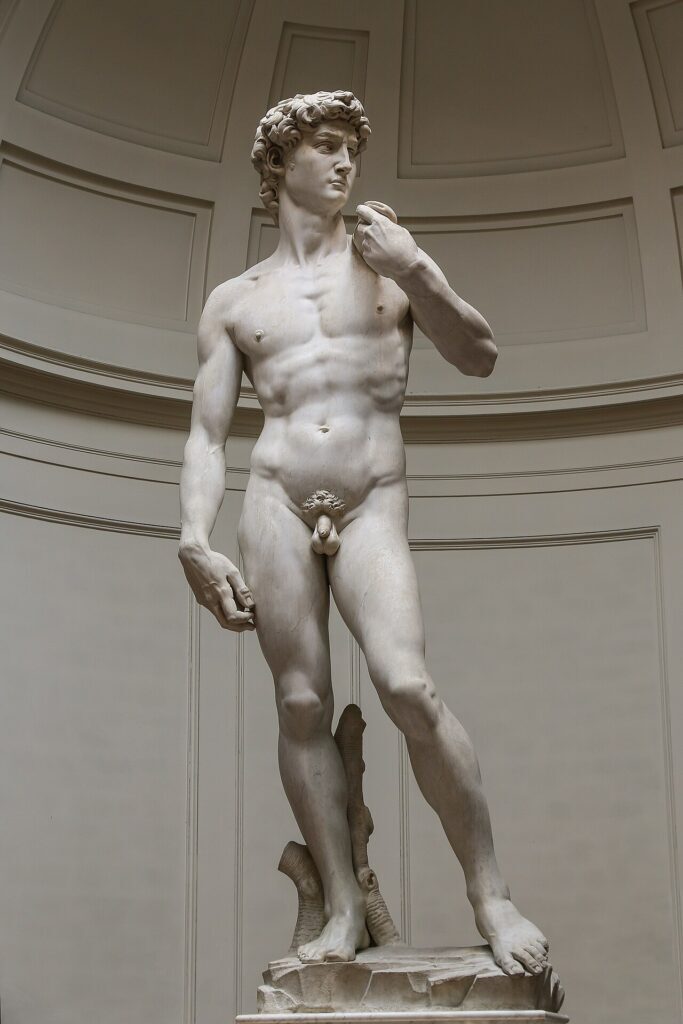
Michelangelo, David, 1501–1504, Galleria dell’Accademia, Florence, Italy. Photograph by Jörg Bittner Unna.
In 1501, Michelangelo accepted a commission that had defeated every sculptor before him: a massive block of marble that had lain abandoned in the workshops of Florence Cathedral for more than 25 years, as it was considered too narrow and flawed to be used successfully. Three years later, Michelangelo unveiled the David.
The sculpture was installed outside the Palazzo della Signoria, the seat of Florence’s civic government. This choice of location was significant as Florence had recently expelled the Medici family and was very protective of its republican identity. David, the young shepherd who defeated the giant Goliath against overwhelming odds, became a powerful symbol of the city itself. Michelangelo reinforced this association by depicting David before the battle rather than after it. Instead of celebrating victory, the sculpture captures a moment of tense anticipation: the sling rests over one shoulder, the muscles tighten, and the young hero fixes his gaze on an opponent the viewer cannot see.
The statue draws heavily on the legacy of classical antiquity: its monumental scale, nude form, and idealized anatomy recall the heroic figures of ancient Greece and Rome. Yet Michelangelo also departed from classical models: David’s hands are unusually large, the veins of his right wrist are visible beneath the skin, and his expression conveys an extraordinary psychological intensity. The result is a figure that feels both ideal and deeply human.
For Renaissance viewers, David carried political and religious meanings alike. He was not only the defender of Israel but also the future king traditionally associated with the Book of Psalms. Michelangelo’s sculpture holds these different identities in balance. It is at once a civic monument, a revival of the classical heroic nude, and a biblical figure whose strength ultimately derives from faith rather than physical power.
4. The Doni Tondo (c. 1506–1507)
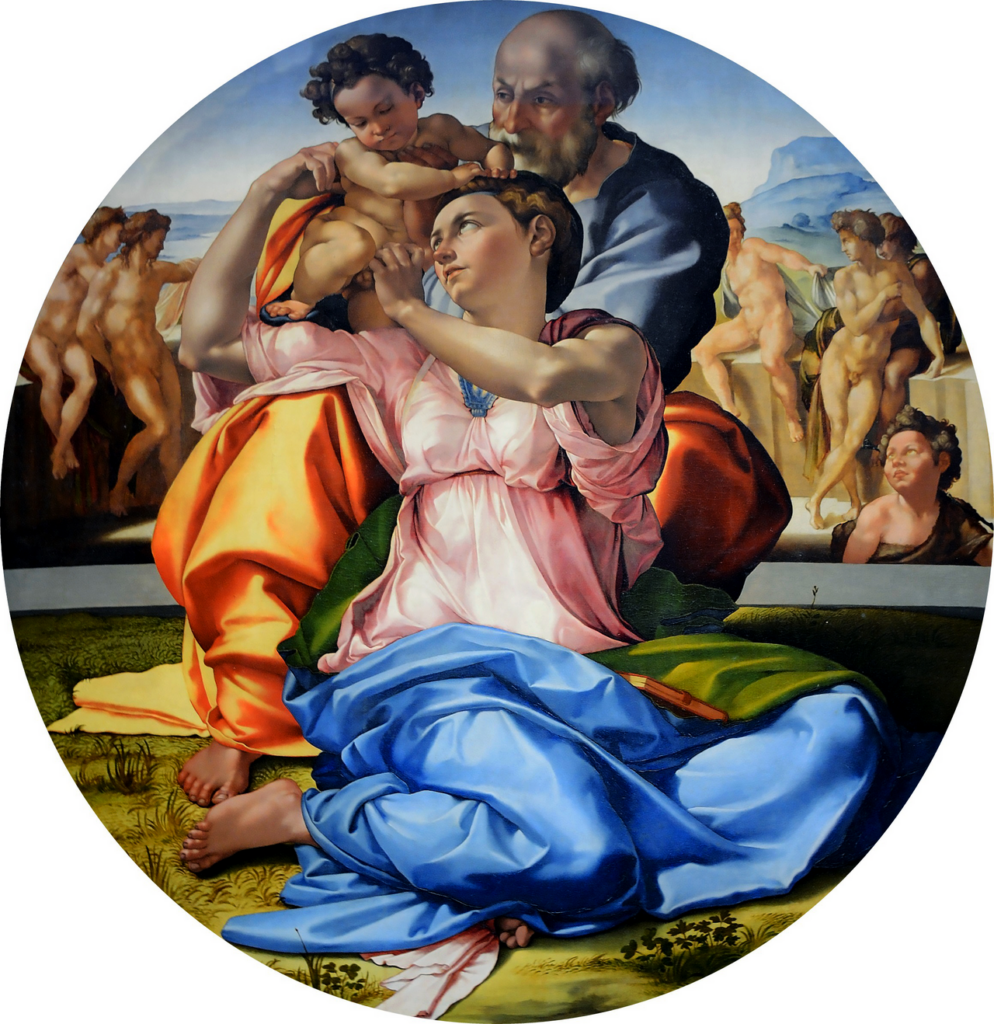
Michelangelo, Doni Tondo, 1506–1507, Uffizi, Florence, Italy.
While still in Florence, Michelangelo received a commission from the wealthy cloth merchant Agnolo Doni to celebrate his marriage to Maddalena Strozzi. The resulting painting is the artist’s only surviving finished panel painting.
At the center of the painting, the Virgin twists sharply backward to receive the Christ Child from Joseph, her body arranged in a complex pose that seems almost to press against the circular frame. In the middle stands the young John the Baptist, while behind a low stone wall, a group of nude youths reclines in apparent indifference to the sacred scene. The meaning of these figures has long been debated: they are often interpreted as representing humanity before the coming of Christ, a pagan world awaiting redemption. At the same time, the Holy Family embodies the New Covenant. In this reading, the wall separating the two groups becomes a symbol of the boundary between the old order and the promise of salvation.
The Doni Tondo also demonstrates Michelangelo’s distinctive approach to religious art: theology is expressed not only through symbols but through the bodies themselves: their movement, weight, and interaction in space. In this respect, the painting anticipates many of the aspects that would later find monumental expression on the ceiling of the Sistine Chapel.
5. The Sistine Chapel Ceiling (1508–1512)
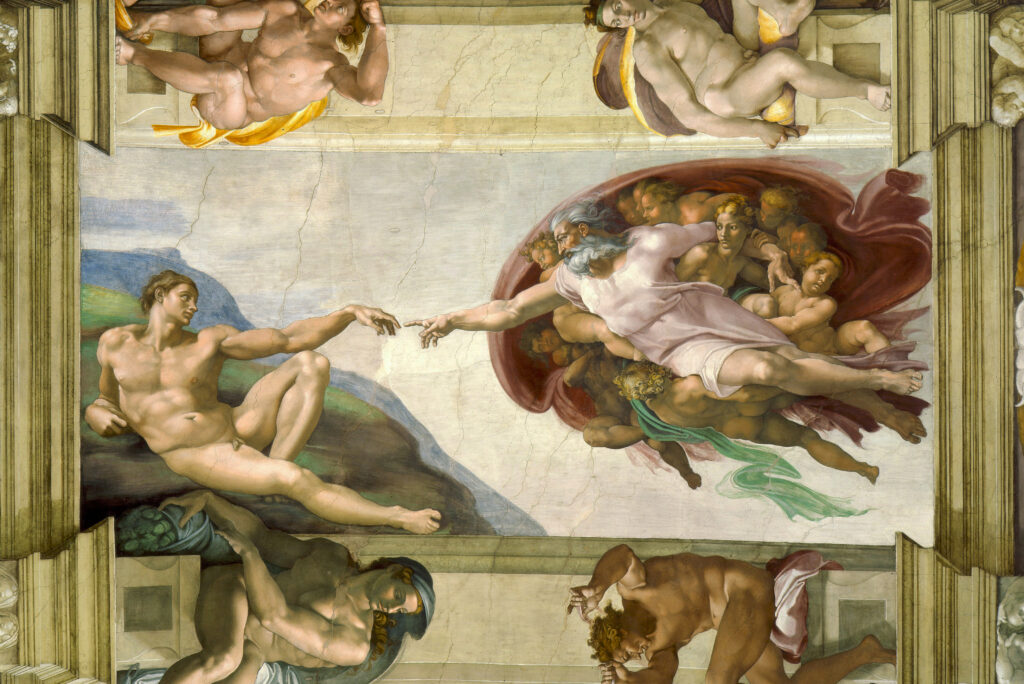
Michelangelo, Creation of Adam from the Sistine Chapel, 1508–1512, Apostolic Palace, Vatican City.
In 1508, Pope Julius II summoned Michelangelo back to Rome with a daunting new commission: the ceiling of the Sistine Chapel. Michelangelo resisted at first, insisting that he was a sculptor rather than a painter, but Julius was unmoved, and work began that same year. For the next four years, Michelangelo worked high above the chapel floor on scaffolding of his own design, painting much of the ceiling himself. In letters that he sent back home, he complained about the physical strain of the project and the toll it took on his body.
Covering more than 500 square meters, the ceiling presents one of the most ambitious visual interpretations of Christian theology. At its center are nine scenes from the Book of Genesis. Surrounding them are prophets, sibyls, and the ancestors of Christ, creating a vast narrative that links the creation of the world to the promise of salvation. Although theologians helped shape the programme, Michelangelo played a major role in its development, which was an extraordinary achievement for an artist undertaking his first large-scale fresco cycle.
At the heart of the ceiling is the Creation of Adam, the image that has become synonymous with the Sistine Chapel itself. God and Adam reach toward one another across a narrow gap, their fingers separated by only a few centimeters. God surges forward with dynamic energy, while Adam reclines on the earth, awakening to life. The scene transforms a brief biblical passage into a powerful meditation on humanity’s relationship with the divine as the tiny space between the two hands seems to suggest both God’s nearness to humanity and the distance that still separates Creator and creation.
6. The Tomb of Pope Julius II (1505–1545)
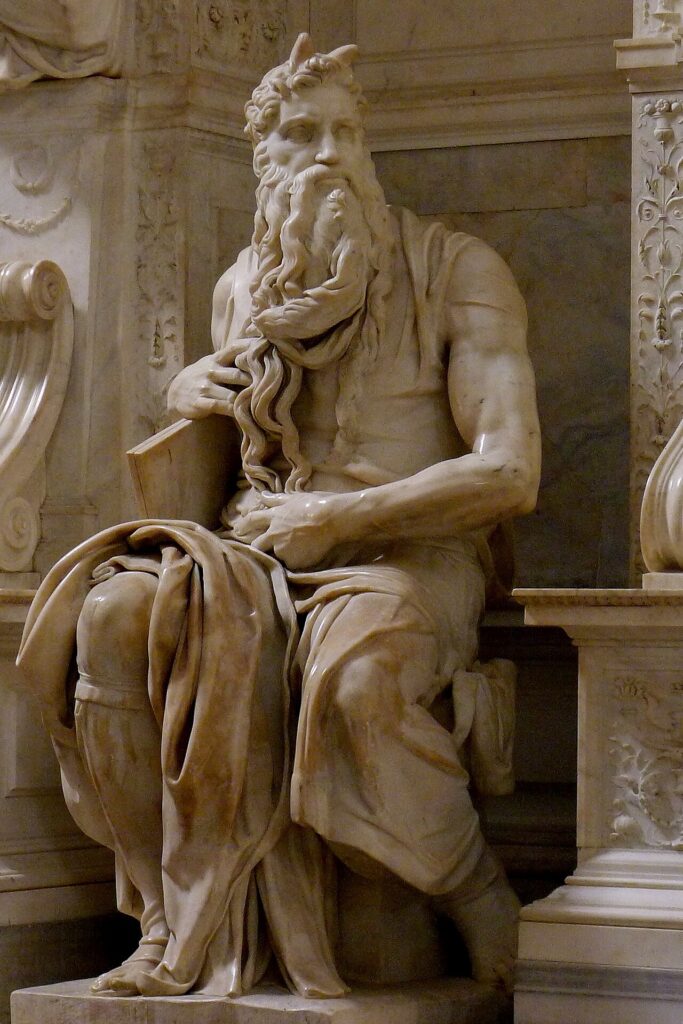
Michelangelo, Moses, detail of the tomb of Pope Julius II, 1505–1545, San Pietro in Vincoli, Rome, Italy. Photograph by Jörg Bittner Unna.
Pope Julius II commissioned his tomb in 1505, envisioning a freestanding monument populated by more than 40 sculptures, a project of a scale not seen since antiquity. Michelangelo accepted the commission and travelled to the marble quarries of Carrara to select the stone himself. Yet before work could progress further, Julius redirected both his attention and his resources toward the rebuilding of St. Peter’s Basilica. What followed was nearly four decades of interruptions, revised contracts, and increasingly reduced ambitions.
Over time, the project was repeatedly scaled back. The vast freestanding monument gave way to a much smaller wall tomb, while successive popes diverted Michelangelo to other commissions. When the tomb was finally installed in San Pietro in Vincoli in 1545, it bore little resemblance to the grand scheme originally envisioned. Michelangelo regarded the project as the great disappointment of his career, referring to it as the “tragedy of the tomb.”
The statue of Moses, carved between 1513 and 1515, offers a glimpse of what the original monument might have achieved. Seated and powerfully built, Moses turns sharply to one side, clutching the tablets of the Law beneath his arm. Everything about the figure suggests contained energy: the twisting torso, the flowing beard, and the intense gaze. According to Michelangelo’s biographer, Ascanio Condivi, the artist was so impressed by the statue’s lifelike presence that, upon completing it, he struck its knee with a hammer and commanded it to speak. Whether this anecdote is true or not, few sculptures better demonstrate Michelangelo’s ability to transform marble into such a realistic figure.
7. The Last Judgement (1536–1541)
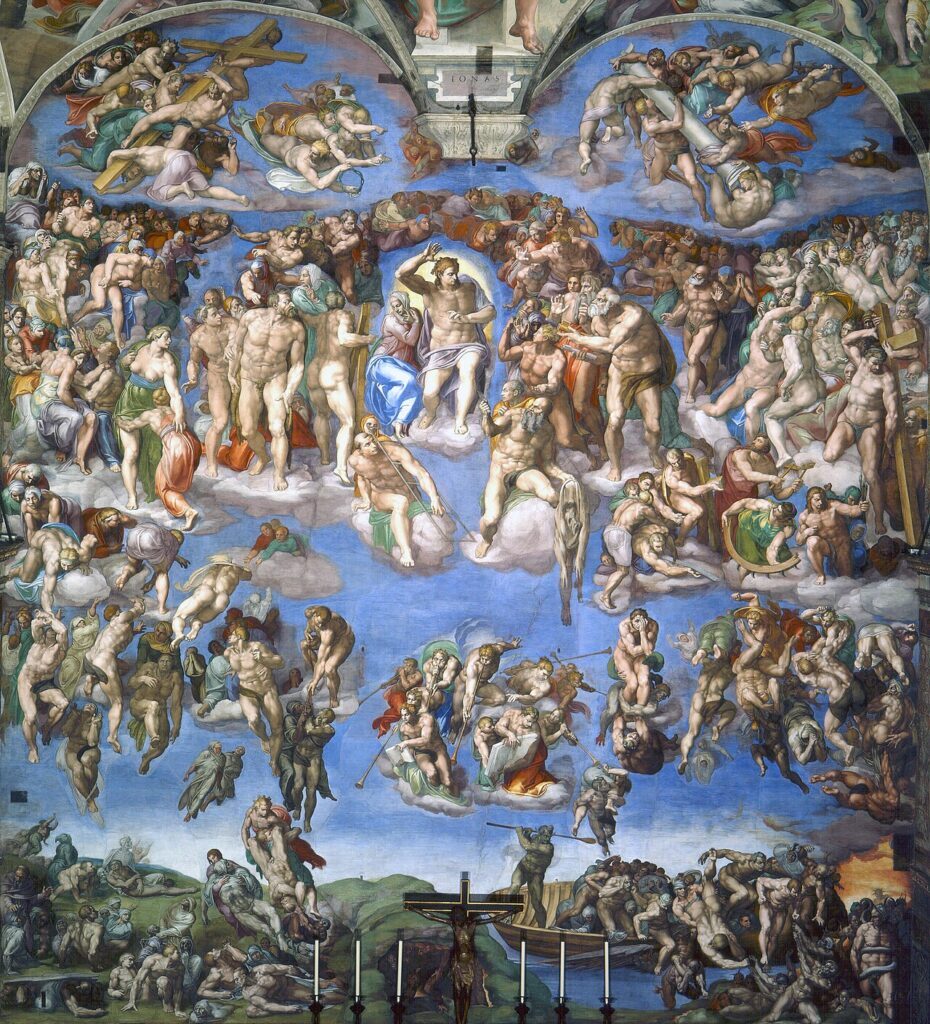
Michelangelo, The Last Judgement, 1536–1541, Sistine Chapel, Apostolic Palace, Vatican City.
When Michelangelo returned to the Sistine Chapel in 1536 to paint the altar wall, both Rome and the Church had changed dramatically. Nine years earlier, the city had been devastated by the Sack of Rome, when troops of the Holy Roman Emperor looted the city for weeks and killed thousands. Meanwhile, the Protestant Reformation had raised serious questions about salvation, faith, and the authority of the Church. Michelangelo himself had become close to Vittoria Colonna, the poet and noblewoman whose circle of reform-minded Catholics emphasized personal devotion and an inner relationship with God. Their friendship would become one of the most important of his later years.
The Last Judgement emerged from this atmosphere of uncertainty and religious debate. Covering the entire altar wall of the Sistine Chapel, the fresco contains nearly 300 figures revolving around a commanding figure of Christ, whose raised arm dominates the scene. Unlike many earlier depictions of the subject, Michelangelo abandons clear divisions between heaven and hell. The blessed and the condemned occupy the same space, rising and falling through a densely crowded composition.
Traditional elements of Christian iconography are often transformed or omitted: Christ appears less as a distant judge enthroned in heaven than as a powerful, athletic figure whose image recalls classical sculpture; the angels are wingless; and the familiar architectural framework of earlier Last Judgements has disappeared.
Among the many figures is what is often identified as Michelangelo’s own self-portrait, appearing not as a triumphant artist but as the flayed skin held by St. Bartholomew. Whether intended as a confession of spiritual anxiety, a meditation on mortality, or something else entirely, it introduces an unusually personal note into the fresco. It stands in marked contrast to the artist’s youthful confidence associated with the Pietà.
8. The Florentine Pietà (c. 1547–1555)
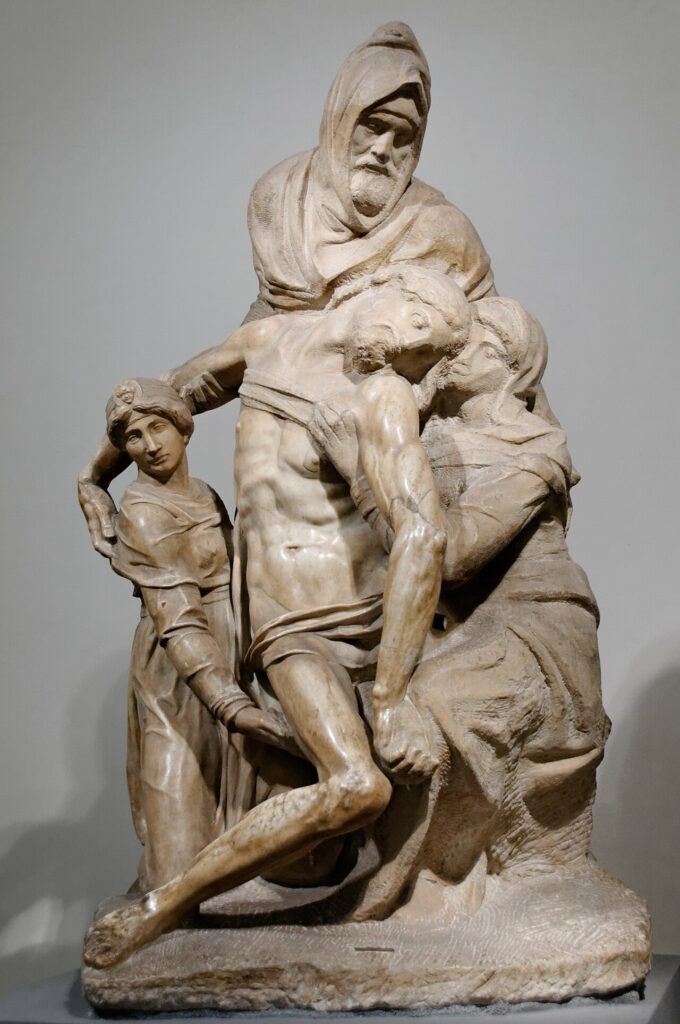
Michelangelo, Florentine Pietà, c. 1547–1555, Museo dell’Opera del Duomo, Florence, Italy. Photograph by Marie-Lan Nguyen.
Vittoria Colonna died in 1547 with Michelangelo at her bedside. By then, the artist was in his 70s, and the losses of friends and contemporaries were becoming an increasingly familiar part of his life. Around this time, he began working on the Florentine Pietà, also known as the Deposition, a sculpture intended for his own tomb.
The group brings together three figures around the dead body of Christ: the Virgin Mary, Mary Magdalene, and a hooded older man supporting Christ from behind. This figure is traditionally identified either as Nicodemus or Joseph of Arimathea, both associated with Christ’s burial in the Gospels. It is also widely believed to be a self-portrait of Michelangelo. Significantly, neither Nicodemus nor Joseph occupies a central role in the biblical narrative. They are witnesses rather than protagonists, and Michelangelo appears to have chosen to place himself within the scene in precisely that capacity.
In the sculpture, Christ’s body seems heavy and difficult to support, while the figures cluster together in a compact, almost unstable arrangement. Rather than emphasizing ideal beauty, Michelangelo focuses on grief, compassion, and physical vulnerability. The result is one of the most intimate and emotionally complex works of his later years.
In 1555, Michelangelo attacked the sculpture with a hammer, breaking parts of Christ’s arm and leg. The reason remains uncertain: some accounts suggest frustration with flaws in the marble, while others point to dissatisfaction with the work itself. His assistant, Tiberio Calcagni, later repaired the damaged sections and completed parts of the group. Whatever prompted the destruction, the sculpture’s fractured and unfinished appearance has become inseparable from its meaning, reinforcing its sense of struggle, incompletion, and personal reflection.
9. St Peter’s Basilica (1546–1564)
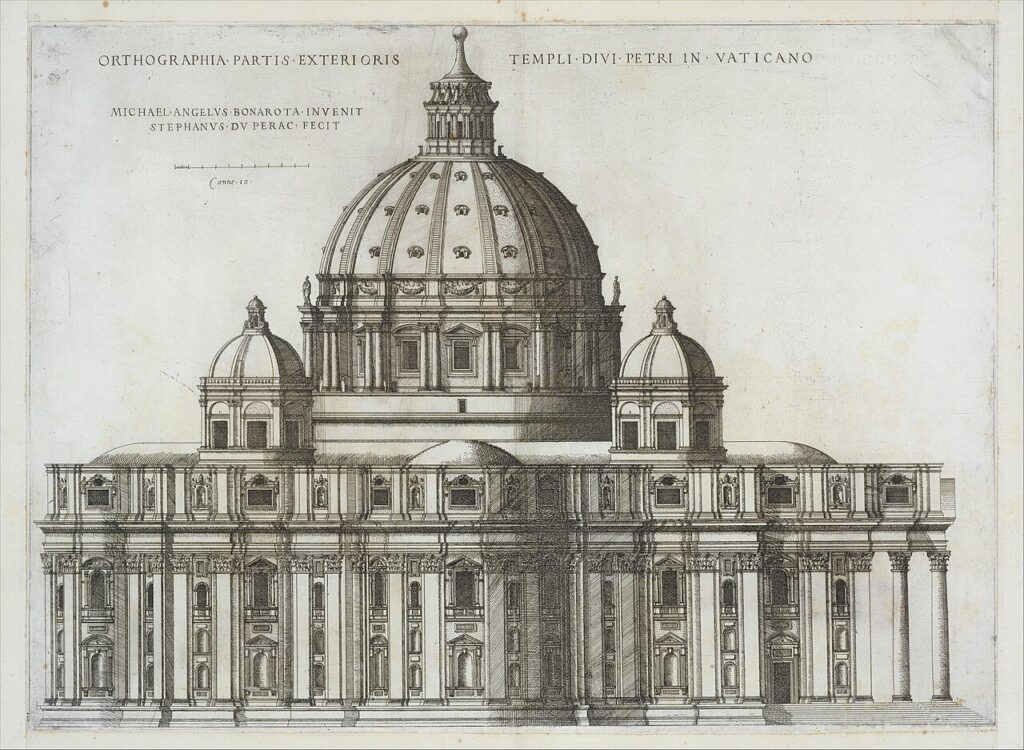
Stefan du Pérac, engraving based on Michelangelo’s designs for St Peter’s Basilica, 1569, Metropolitan Museum of Art, New York City, NY, USA.
Before his death, Michelangelo devoted the final years of his life to the construction of St. Peter’s Basilica in Rome. Appointed chief architect in 1546 at the age of 71, he accepted the commission, considering it a service to God. The project had already been underway for decades and had passed through the hands of several architects, whose additions had complicated the original design. Michelangelo simplified the plan, returning to Donato Bramante’s vision of a centralized church based on a Greek cross, with four arms of equal length extending from a vast domed center. For Michelangelo, this was more than an architectural decision: the harmonious geometry of the circle and the cross reflected Renaissance ideas about divine order and perfection.
Above the crossing, he designed the monumental dome that still dominates Rome’s skyline today. Although he died in 1564 before its completion, his design largely guided the final construction, which was completed by Giacomo della Porta in 1590.
If Michelangelo’s sculptures and paintings explored the relationship between the human body and the divine, St. Peter’s Basilica demonstrates how he could express the same spiritual ideals through architecture on a monumental scale.
10. The Rondanini Pietà (1552–1564)
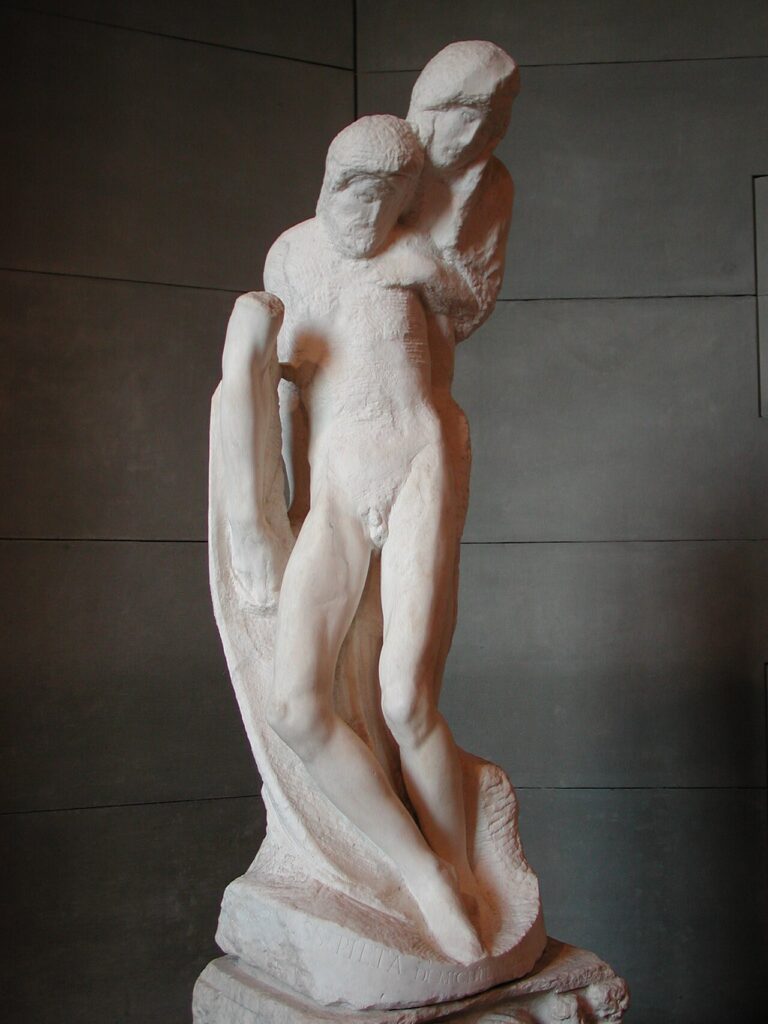
Michelangelo, Rondanini Pietà, 1552–1564, Sforza Castle, Milan, Italy. Photograph by Paolo da Reggio.
Michelangelo was still working on the Rondanini Pietà six days before his death on February 18, 1564. The marble bears the traces of repeated revisions. Part of an earlier and more finished version of Christ’s head and arm remains visible to one side, evidence that Michelangelo repeatedly reworked the composition, cutting deeper into the stone and abandoning forms he had already completed. What survives is a remarkable group: the Virgin stands behind Christ, supporting him in an embrace that blurs the boundary between the two bodies. The figures are elongated and simplified, their forms reduced to essentials. Little remains of the muscular ideal that had defined so much of Michelangelo’s earlier work. Instead, the sculpture conveys a sense of fragility, intimacy, and quiet restraint.
The contrast with the first Pietà is striking. Created more than six decades apart, the two sculptures approach the same subject in radically different ways: the youthful work astonishes with its polished surfaces, anatomical perfection, and compositional balance; the Rondanini Pietà seems to move in the opposite direction, toward simplification and abstraction. Art historians have long debated what this transformation means. Whether it reflects changing artistic priorities or personal devotion, the sculpture remains one of the most moving and enigmatic creations of his final years. Unfinished at his death, it offers no clear conclusion, only the image of an artist still searching, still refining, and still at work until the very end.
By the time of his death in 1564, Michelangelo had become one of the most celebrated artists in Europe. More than four centuries later, Michelangelo’s masterpieces continue to inspire, challenge, and provoke debate. Their enduring power lies not only in their technical achievement but also in their ability to give visual form to questions that remain fundamentally human and that extend beyond the visible world.