Angelica Kauffman (1741–1807) may have been born in Austrian Switzerland, but she was the ultimate cosmopolitan. Her family had moved to Italy by the time she was a year old, and her father traveled widely throughout the expansive Austrian Empire, working as a muralist. Kauffman was famously fluent in four languages and was clearly something of a prodigy. Trained as her father’s assistant, by the age of 12, she was already painting portraits, and at 21, she became a member of the Accademia delle Arti del Disegno in Florence.
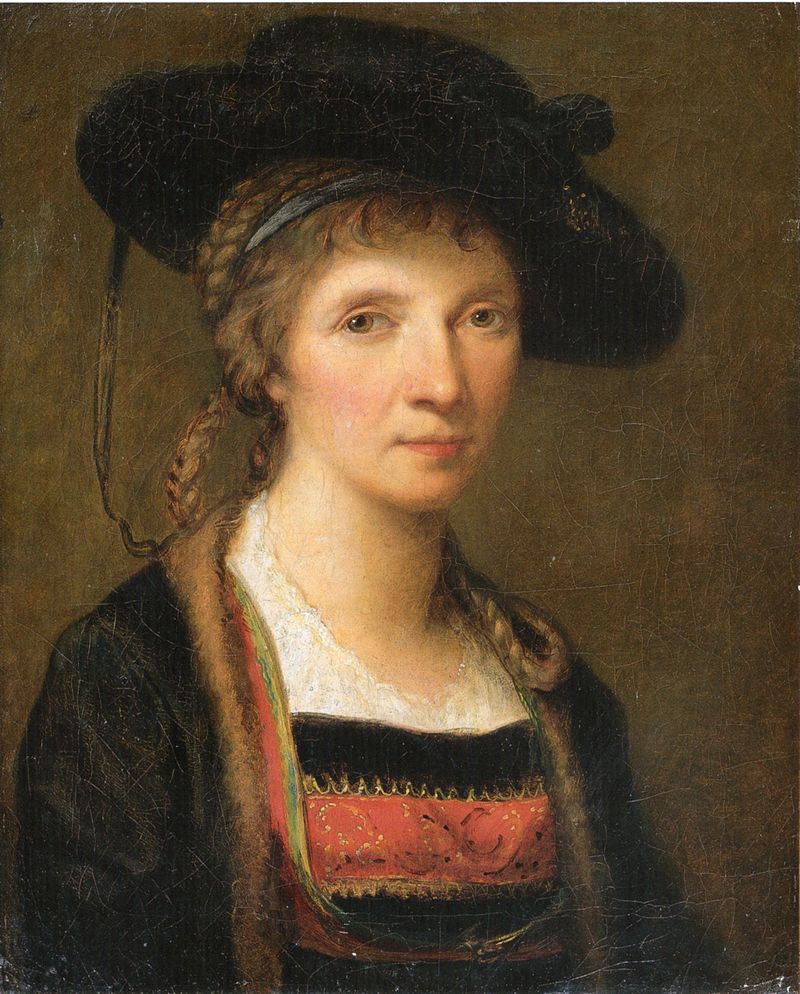
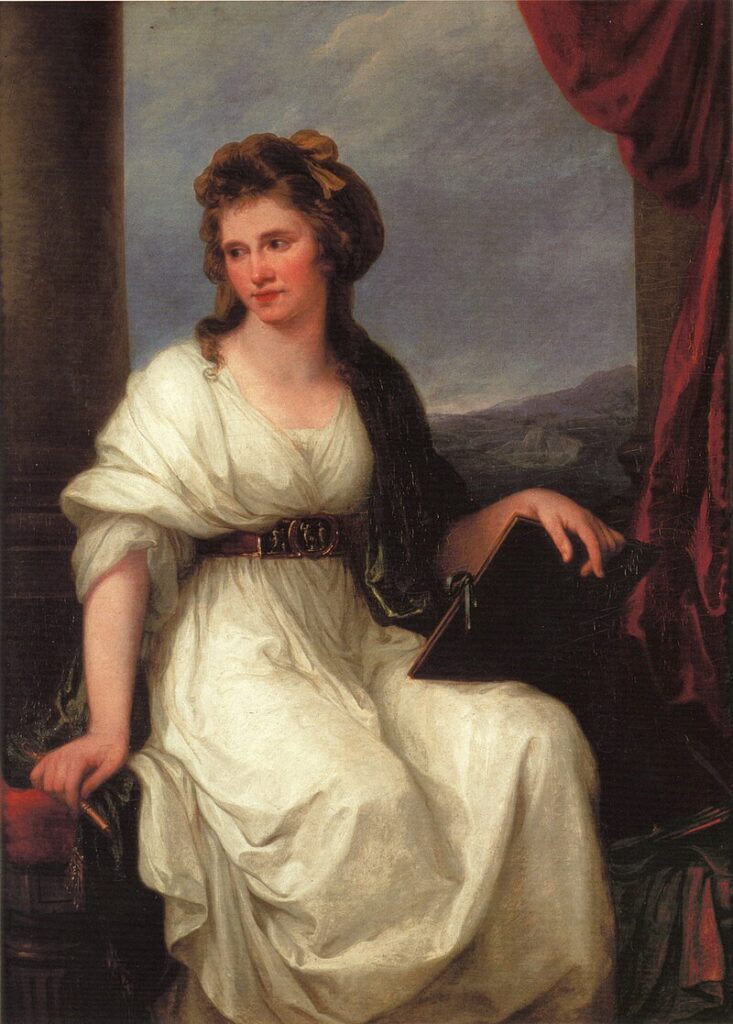
She was not, however, averse to representing herself as a simple country girl. The self-portrait above, completed at the relatively youthful age of 40, depicts her in traditional local dress from the region in which she was born. By 1781, she was successful enough to be able to play down her cosmopolitan professionalism. She knew that virtue was important if a woman was to be taken seriously, and her costume implied innocence and tradition. Additionally, simplicity was in fashion, exemplified by Marie Antoinette playacting as a milkmaid and Jean-Jacques Rousseau’s writings about nature. It was just one of Kauffman’s many faces.
The Multi-Talented Musician
Kauffman was not just a child prodigy in art; she was also a skilled musician and singer who could have chosen to make that her profession. Apparently, a Catholic priest warned her against becoming an opera singer because it was considered a disreputable profession. Art, certainly portraiture and history painting, had a much more serious and intellectual reputation.
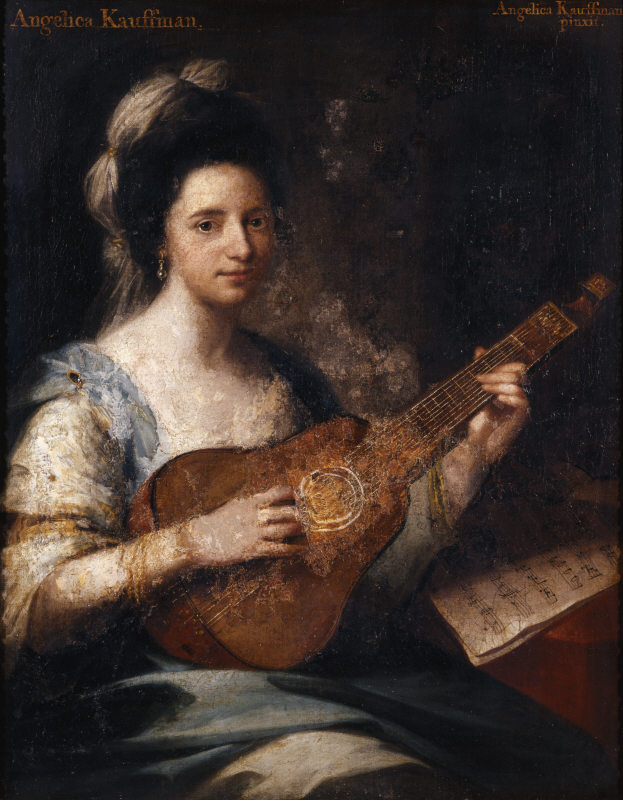
Women, however, were expected to be accomplished amateur musicians, able to sing and play to amuse themselves and entertain family and friends. Kauffman, therefore, had two good reasons to represent herself this way. She was emphasizing that she was still a lady, even though she was engaged in a profession, while proving she was well-rounded. An early (and unfortunately badly damaged) self-portrait shows her playing for pleasure with a guitar and sheet music.
The Professional Artist
One of the most common ways for artists to represent themselves was in the act of painting or drawing. The earliest known self-portrait by a woman was Catharina van Hemessen‘s 1548 painting of herself sitting at her easel, holding a palette and brushes, and looking confidently out at the viewer. A Latin inscription on the canvas translates to “I painted this, aged twenty.” There is pride there – bravado from a young woman determined to make her name in a man’s world.
When van Hemessen painted herself, it was unusual even for male artists to show themselves at work. Other women practitioners like Judith Leyster followed suit, proving that they were actually capable of wielding a brush, and increasingly so did men like Rembrandt van Rijn. Perhaps most famously, Diego Velázquez painted himself painting the Spanish court in Las Meninas.
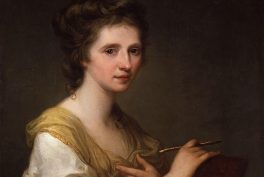
There was, however, a way of going further: Artemisia Gentileschi did not just portray herself as a painter, but as the allegory of painting. Similarly, Kauffman represents herself as a muse, serenely sitting in a white robe with an antique belt in a classical setting. She gazes off to the side, almost as if she is looking down from an exalted position on ordinary mortals, pencil and sketch book in her hands.
History Painting
By painting herself as a mythological figure, Kauffman was also underlining that she was a recognized history painter. The most highly regarded genre, history painting, encompassed large-scale canvases of religious, classical, and historical subjects. Kauffman, like Gentileschi before her, had managed to overcome the prejudice that women simply did not have the intellectual capabilities to paint such serious subjects or the physical stamina to work on a large scale.
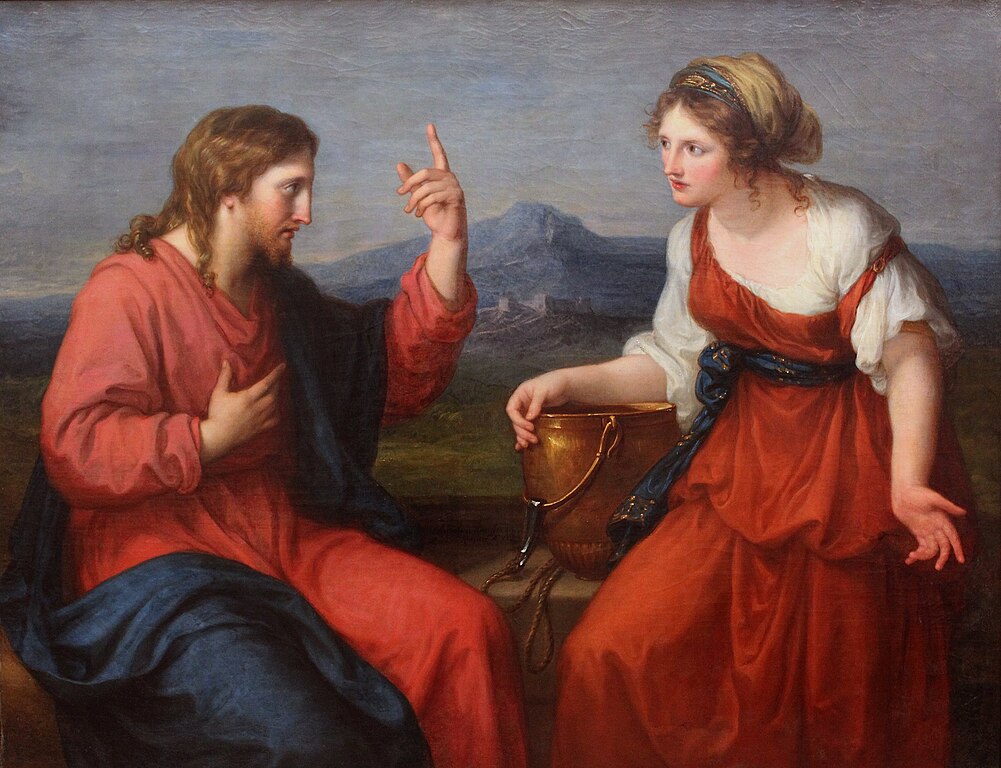
In Christ and the Samaritan Woman at the Well, Kauffman represents a Biblical subject—when Jesus reveals himself to a lone woman getting water at a well—on a large canvas, approximately a meter and a half across. The close-cropped composition puts the viewer very near the figures; the bold color blocks and lack of background detail make them stand out even more. With clear gestures, Kauffman illustrates the narrative but also gives it a very personal twist. The two figures are balanced around the central V between their knees. This woman sees herself as an equal, happy to debate with a man.
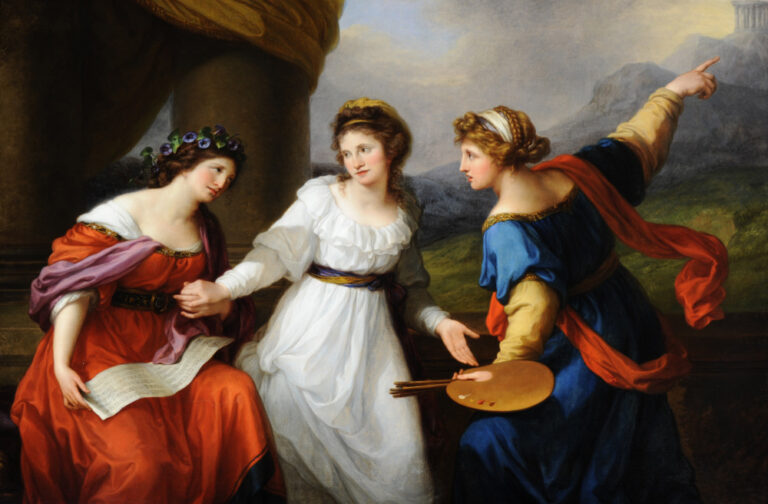
Self-Portrait of the Artist Hesitating Between the Arts of Music and Painting
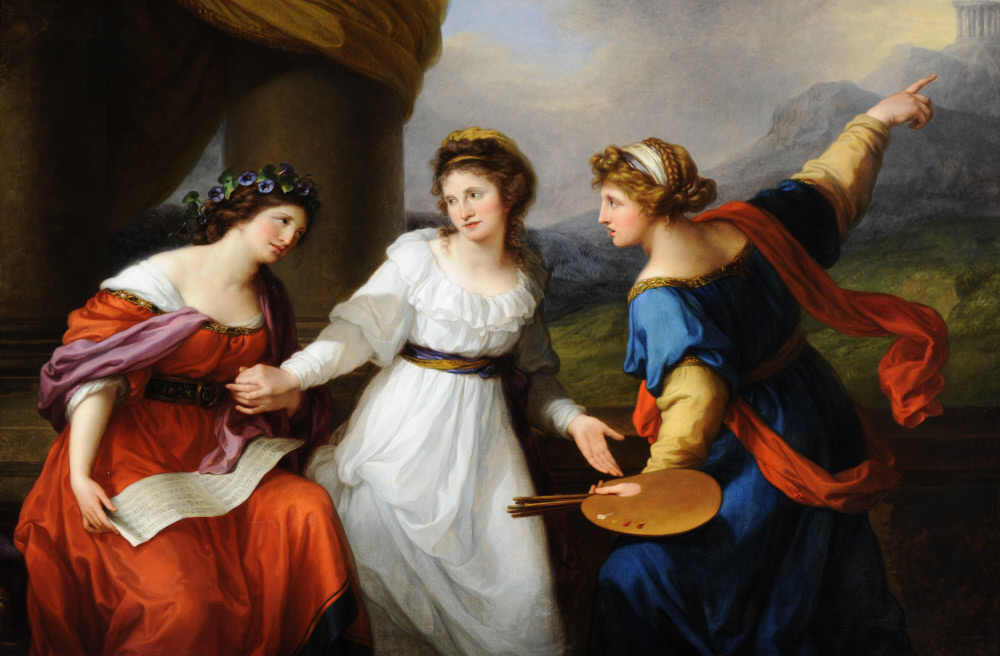
If you put all these pieces together—music, art, innocence, history—then the large, allegorical Self-Portrait of the Artist Hesitating Between the Arts of Music and Painting begins to make sense. Here, a young Kauffman, dressed in white, stands center-picture, deciding on her future career. The position stresses her importance; the glowing white, representing innocence, also draws the viewer’s attention.
On her right, Music, holding a score, looks slightly desperate as she grips Kauffman’s hand. It is as if she knows the argument is already lost. On the left, Painting with a palette and brushes points to future glories, represented by a temple on a hill.
Music wears a low-cut red dress, perhaps to symbolize feminine emotion. Painting is dressed predominantly in blue, the color of rational thought and also one associated with holiness, but the figure also wears yellow sleeves and a sash of red. She therefore represents the primary colors, which are the basis of all art.
The vaguely delineated background is a combination of the Alpine scenery of Kauffman’s homeland and classical architecture, which situates this as a history painting. Finally, Kauffman employs the same cropped composition and clear gestures that she would go on to use in Christ and the Samaritan Woman at the Well to create big, bold, foregrounded storytelling.
The Choice of Hercules
Kauffman did not pick the idea of her Self-Portrait of the Artist Hesitating out of the blue. An ancient Greek parable presented The Choice of Hercules in which the young hero had to choose between Vice, with its life of easy pleasure, and Virtue, the more demanding but moral path. It was a theme that several Renaissance artists had painted, most famously Annibale Carracci.
Hercules, like the young Kauffman, is center-stage: just as she is dressed in white to symbolize innocence, he is identified by his heroic, idealized nudity and the club he always carried. Unlike her, he is not actively engaging with the figures, but instead is sitting in contemplation as he makes this crucial life choice. The figure of Vice, inevitably, is scantily clad and alluring, her diaphanous draperies swirling almost as if she were dancing. She stands in a verdant green landscape, and at her feet are musical instruments and theatrical masks, associated with pleasure and leisure.
Virtue stands on Hercules’ right, wearing blue and red. She points upward toward a mountain peak where, at the end of a rocky and winding path, Pegasus, the hero’s reward, is waiting.
A Young Woman’s Choice
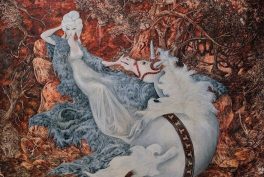
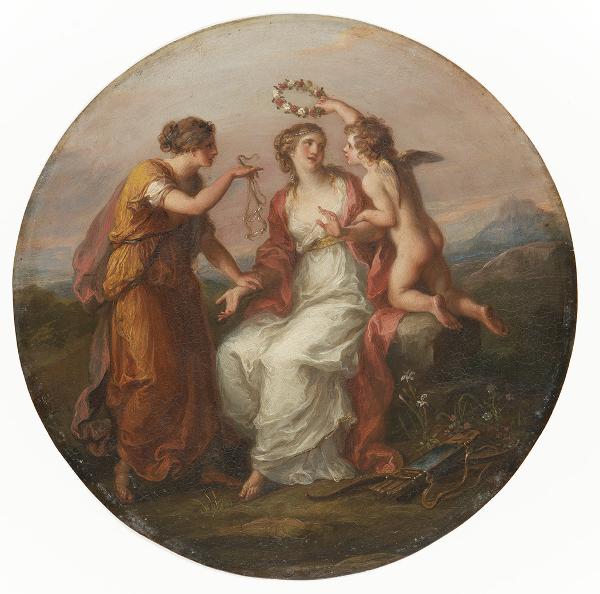
Kauffman tackled a similar subject earlier in her career, in a pair of small works on copper. In the first Beauty Seduced by Love and Guided by Wisdom, the white-clad, central figure—Beauty—finds herself torn between Love, represented by Cupid, and Wisdom, a more soberly dressed, sensible woman. Here, the young woman seems far less in control: Cupid is looming above her, tempting her with a garland of flowers, and she appears almost unaware of the other woman. Nevertheless, Wisdom’s guiding hand is on her arm.
The second roundel represents a cautionary tale of what will happen if Beauty does not heed Wisdom’s guidance. In Beauty Bound by Love Abandoned by Wisdom, a disheveled-looking Beauty has given herself up to Cupid, who now occupies the center. Remembering the priest’s warning about the dangers of a musical career, it is easy to see the parallels between these panels and the self-portrait. Kauffman has taken the wise and morally responsible path.
Joshua Reynolds
An obvious difference between Kauffman’s self-portrait and Carracci’s The Choice of Hercules is the reversal of positions: the latter has the right choice, Virtue, on the figure’s right, Kauffman has her on the left. Likely, Kauffman had only seen prints of Carracci’s work, which would have reversed the original image. A similar arrangement of the figures is seen in a painting by Joshua Reynolds, which also takes Carracci, in reversed print form, as inspiration.
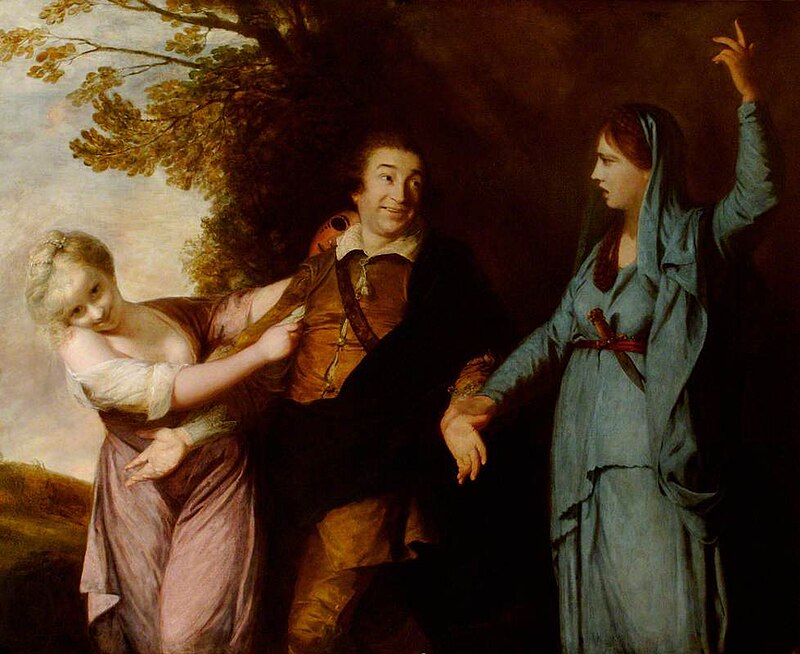
David Garrick Between Tragedy and Comedy shows the most famous actor of the day, who was also a patron of Kauffman, deciding whether to take crowd-pleasing, less demanding comedic roles or play more difficult but noble tragic parts. Comedy is feminine and flirtatious, trying to pull him toward the sunlight. Blue-dressed Tragedy solemnly points heavenward. Reynolds turns a serious history subject into a light-weight genre painting, but his viewers would have understood the classical reference to Hercules.
Kauffman and Reynolds were good friends during the period she was in London (1766–1782)—there were even scurrilous rumors that they were closer than that. It seems very likely that Kauffman would have known of the Garrick picture.
Self-Portraits and Self-Promotion
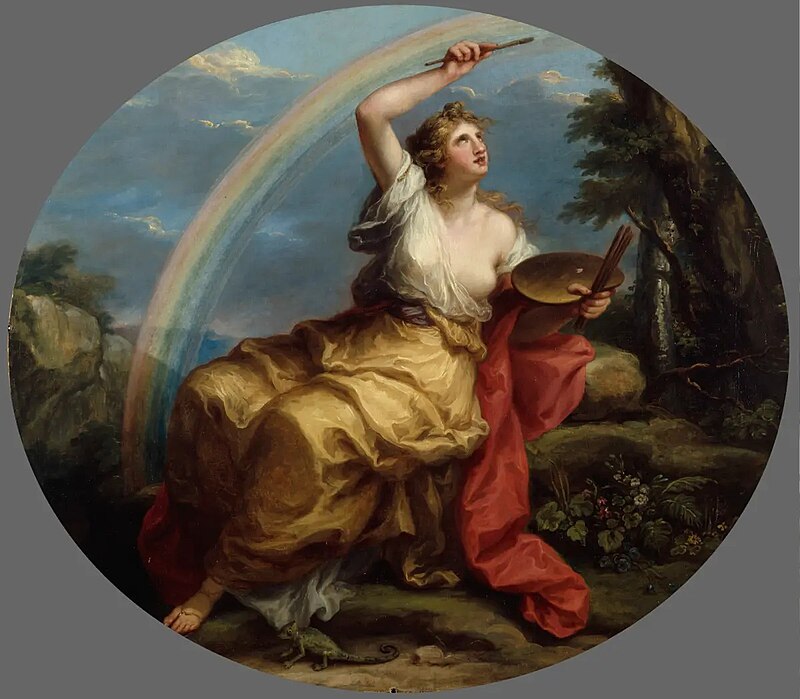
Kauffman was one of only two women founding members of the Royal Academy and, in 1778, was commissioned by the new institution to produce four works illustrating the Elements of Art: design, color, invention, and composition. These were not self-portraits, but they were all women, elevated to a mythical status by their painting abilities. Coloring shows a woman, in one of Kauffman’s characteristic strong profiles, literally sweeping the rainbow out of the sky and onto her empty palette. Her eyes shine brightly, and her whole body is dynamic and decisive.
Angelica Kauffman was a genius at self-promotion. More than that, she was determined to elevate her status, and by extension that of women in general. Strong, independent, intellectual, and professional, she was the equal of Hercules himself. She strides across the huge canvas of Self-Portrait of the Artist Hesitating Between the Arts of Music and Painting, and steps boldly into history.