

Immigrants and Refugees in Rembrandt’s World
A remarkable exhibition opened last week at the Morgan Library & Museum, New York, bringing together for the first time a group of works on paper...
Nicole Ganbold 2 November 2026
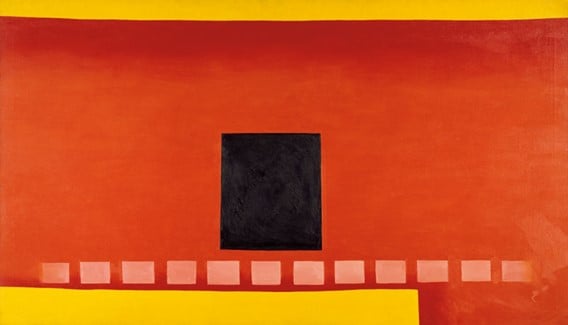
Georgia O’Keeffe, Black Door with Red, 1954. Chrysler Museum of Art, Norfolk, VA, USA. Bequest of Walter P. Chrysler, Jr. © 2026 The Georgia O’Keeffe Foundation/Artists Rights Society (ARS), New York.
At the Detroit Institute of Arts, a landmark exhibition reveals a less familiar side of one of America’s most celebrated modern artists: her lifelong fascination with the structures, spaces, and architectural forms that shaped her world.
Georgia O’Keeffe’s monumental flowers, bleached animal skulls, and sweeping New Mexico landscapes have become defining images of American modernism. Yet, behind these familiar subjects lies another, less explored fascination: the architecture of the places she inhabited, from the soaring skyscrapers of Manhattan to weathered rural barns and the sunlit adobe walls of the American Southwest.
With Georgia O’Keeffe: Architecture, the Detroit Institute of Arts invites visitors to reconsider the artist through nearly 40 paintings created between the 1920s and the 1960s. On view through January 3, 2027, this exhibition is the first to trace her interest in architecture during this period of time.
I often painted fragments of things because it seemed to make my statement as well as, or better than, the whole could.
Georgia O’Keeffe: Architecture, Detroit Institute of Arts.
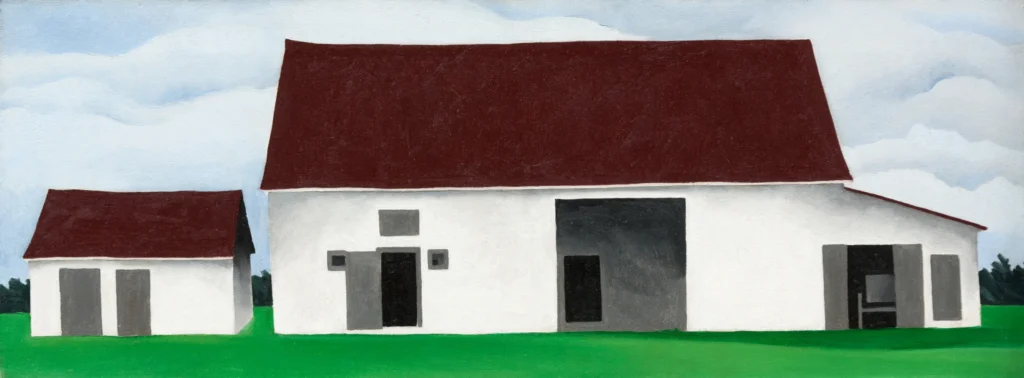
Georgia O’Keeffe, Stables, 1932, Detroit Institute of Arts, Detroit, MI, USA. Gift of Robert Tannahill, 45.454 © 2026 The Georgia O’Keeffe Foundation/Artists Rights Society (ARS), New York.
The origins of this exhibition can be traced to a single painting that already called Detroit its home: Stables (1932), part of the DIA’s permanent collection since 1945. When Ben Colman joined the museum as curator of American art in 2015, he became fascinated by this quietly powerful work. Painted by O’Keeffe following a road trip through Quebec with her niece in the summer of 1932, Stables presents a rural building with extraordinary economy. Its appeal lies not in elaborate details or picturesque storytelling, but in the essential character of the structure itself. O’Keeffe pares the scene down, allowing the building’s proportions, surfaces, and carefully considered forms to carry the composition.
What began as a curatorial inquiry into one painting gradually expanded into a much larger investigation. What had drawn O’Keeffe to this particular stable? How did she look at buildings, and what could her other architectural paintings reveal about the places where she lived, worked, and developed her distinctive visual language? The answers led Colman beyond the museum’s own collection, into decades of paintings and the artist’s personal writings and correspondence.
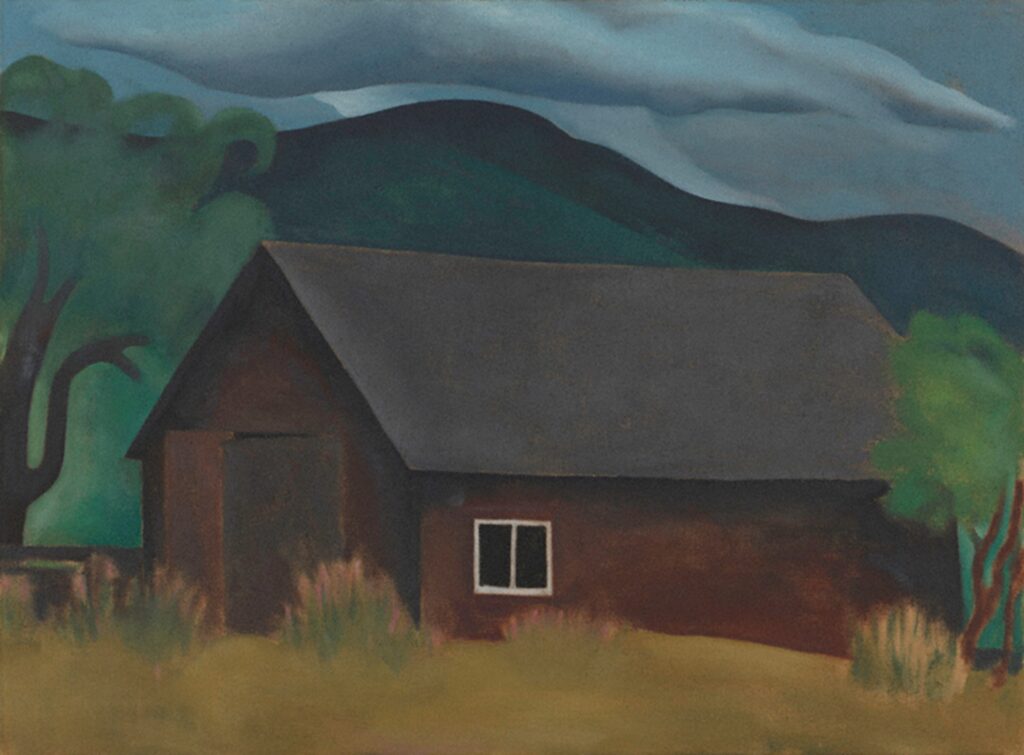
Georgia O’Keeffe, My Shanty, Lake George, 1922, The Phillips Collection, Washington, DC, USA. Acquired 1926. © 2026 The Georgia O’Keeffe Foundation/Artists Rights Society (ARS), New York.
Long before the adobe houses of New Mexico became inseparable from her public image, O’Keeffe had developed a profound sensitivity to rural architecture. Her childhood on a Wisconsin dairy farm gave her an intimate familiarity with agricultural buildings. Barns, sheds, farmhouses, and stables belonged to the visual vocabulary of her earliest experiences. Later, during summers spent at Lake George in upstate New York, she returned to these forms with renewed intensity.
The barn is a very healthy part of me…It is my childhood.
Georgia O’Keeffe: Architecture, Detroit Institute of Arts.
There is something particularly revealing about her decision to devote such sustained attention to working buildings. They were not grand monuments designed to impress, but humble structures shaped by everyday life. O’Keeffe discovered in them a formal beauty that conventional distinctions between high art and ordinary surroundings might overlook. The rural paintings in this exhibition establish a visual language that persists throughout her career: the simplification of forms, the sensitivity to surface, and the ability to turn an apparently unremarkable subject into a powerful image.
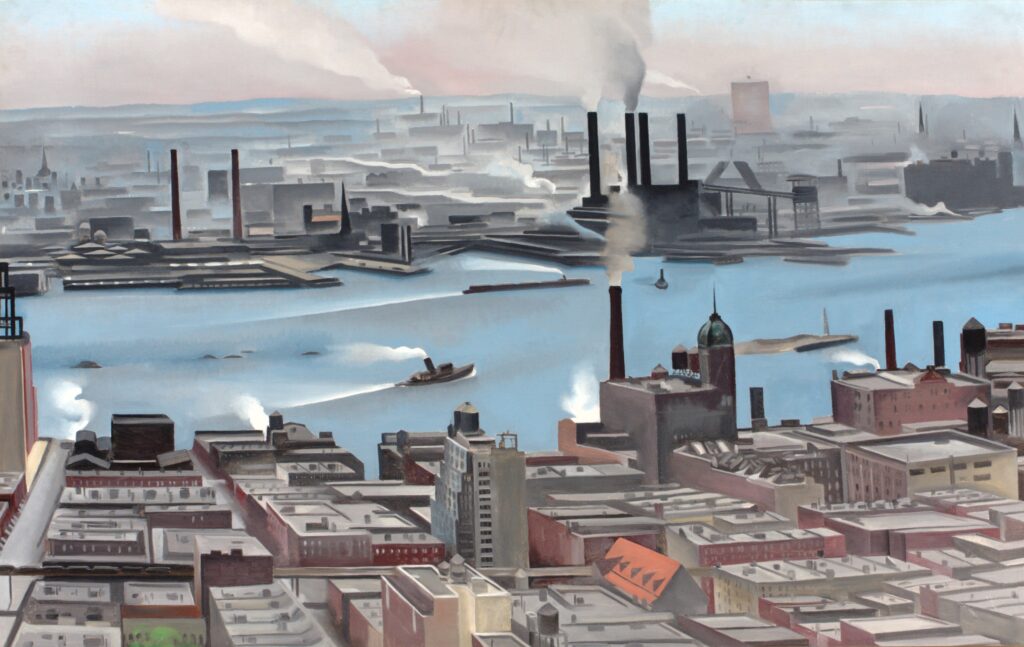
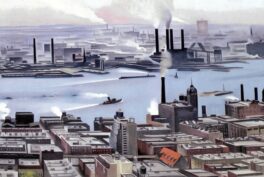
Georgia O’Keeffe, East River from the 30th Story of the Shelton Hotel, 1928, New Britain Museum of American Art, New Britain, CT, USA. Stephen B. Lawrence Fund © 2026 The Georgia O’Keeffe Foundation/Artists Rights Society (ARS), New York.
The rural world was only one side of O’Keeffe’s architectural imagination. From 1918 until 1949, she lived and worked in New York for part of each year, sharing an extraordinary vantage point over the city with her husband, photographer and gallerist Alfred Stieglitz. Their home at the Shelton Hotel, a pioneering residential skyscraper in Manhattan, placed O’Keeffe high above the streets that were being transformed by an unprecedented architectural expansion.
I began talking about trying to paint New York. Of course, I was told that it was an impossible idea—even the men hadn’t done too well with it.
Georgia O’Keeffe: Architecture, Detroit Institute of Arts.
The paintings that emerged from this environment are among her most striking architectural works. In East River from the 30th Story of the Shelton Hotel, the artist transforms the view from her high-rise apartment into a compelling study of urban space, geometric form, and perspective. The river, bridges, and surrounding buildings are rendered through simplified shapes and strong vertical and horizontal lines, emphasizing the city’s monumental scale. By combining the precision of modern architecture with subtle shifts in color and light, O’Keeffe captures both the dynamism of New York City and the sense of distance created by viewing it from above. The painting reflects her fascination with the modern metropolis, presenting the urban landscape not merely as a setting but as an abstract arrangement of forms and structures.
The Shelton Hotel offered her a subject she could return to repeatedly, just as she returned to barns and later, the patio of her New Mexico home. Architecture provided both a stable point of observation and an ever-changing spectacle of light and atmosphere.
One of the exhibition’s most poignant works is Brooklyn Bridge (1949), painted in the year she moved permanently to New Mexico. Seen from beneath its monumental arches, the bridge becomes more than an emblem of New York: It suggests a moment of transition, a threshold between the city that had shaped much of her adult life and the landscape that would define her later years.
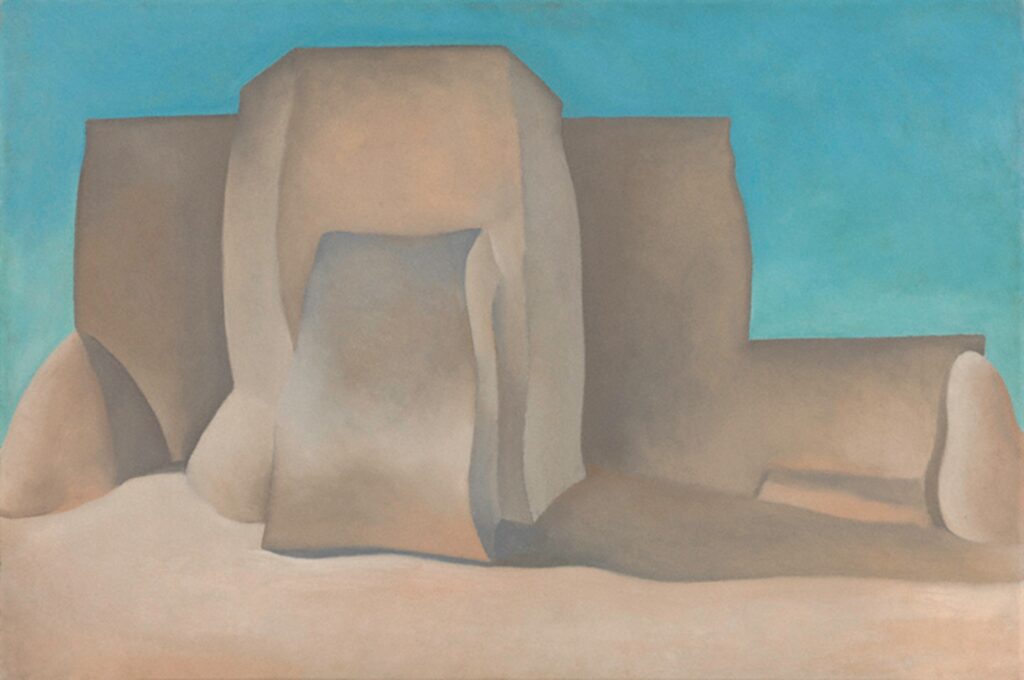
Georgia O’Keeffe, Ranchos Church, No. II, NM, 1929, The Phillips Collection, Washington, DC, USA. Acquired 1930 © 2026 The Georgia O’Keeffe Foundation/Artists Rights Society (ARS), New York.
While New York exposed O’Keeffe to the dramatic verticality of urban architecture, New Mexico offered a profoundly different interplay between buildings, landscape, and light.
The artist first visited the region in the 1920s, drawn by its expansive horizons and distinctive visual character. Over time, the Southwest became much more than a source of artistic inspiration. In 1949, she moved there permanently, settling into a landscape whose architecture offered new possibilities for her exploration of form and space. In paintings of Taos Pueblo, historic churches, and adobe houses, O’Keeffe investigated how architectural forms could communicate the character of a particular place.
Perhaps the most intimate expression of this fascination appears in her paintings of the patio door at her home in Abiquiú, a village in northern New Mexico. This became a subject to which she returned again and again. In some paintings, it appears as a dark rectangle set against a pale wall; in others, the surrounding surfaces and shifting light change the balance of the composition. O’Keeffe’s repeated observations reveal the wealth of visual detail contained within even the simplest forms. O’Keeffe’s patio door paintings anticipate the visual language of Color Field painting, with their expansive areas of flat, luminous color and pared-down geometric forms, creating a striking interplay between color, shape, and negative space. O’Keeffe transforms a familiar architectural detail into an almost meditative experience.
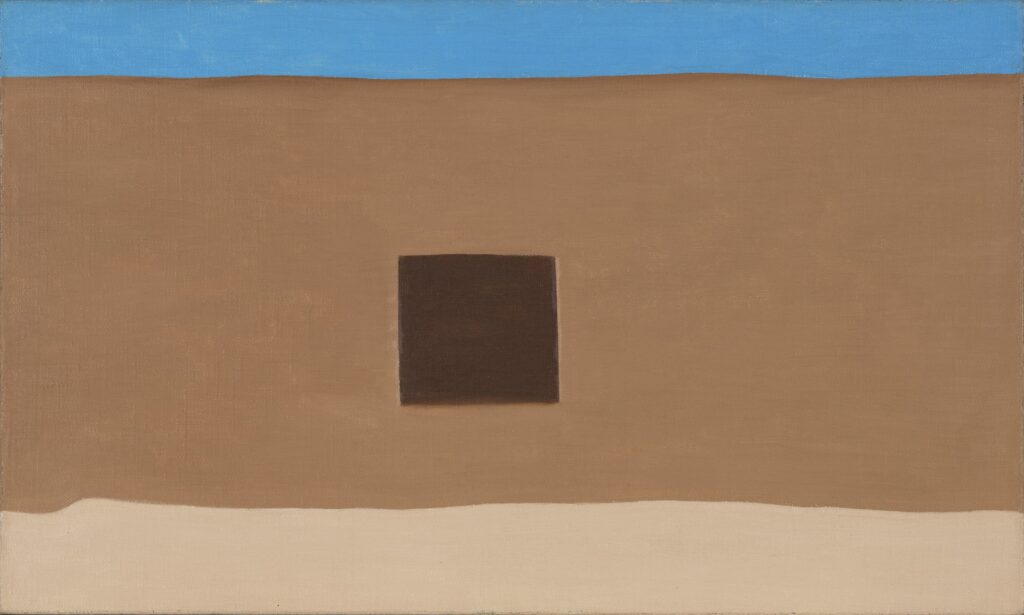
Georgia O’Keeffe, In the Patio III, 1948, Georgia O’Keeffe Museum, Santa Fe, NM, USA. Gift of The Georgia O’Keeffe Foundation © 2026 The Georgia O’Keeffe Foundation/Artists Rights Society (ARS), New York.
A rural stable in Quebec, a Manhattan skyscraper, and an adobe doorway in New Mexico might appear to belong to separate artistic worlds. Yet, this illuminating exhibition reveals the consistency of O’Keeffe’s approach. Her relationship with architecture offers a compelling way to understand what made her art so distinctly American. At a time when many artists travelled to Europe to study the latest developments in modernism, she built her visual language through sustained observation of the landscapes, buildings, and cities of her own country. She made abstraction her own by applying it to subjects belonging to her experience: the agricultural buildings of Wisconsin and upstate New York, the rapidly expanding Manhattan skyline, and the vernacular architecture of the Southwest. These environments became her laboratories for exploring form, color, texture, light, and composition.
“Georgia O’Keeffe spent her career looking closely at the world around her and finding new meaning in it,” said Ben Colman, DIA Curator of American Art. “When you step back and consider all her architectural paintings together—the New York cityscapes, the rural barns, the adobe walls of New Mexico—you realize she was asking remarkably consistent questions about place and identity across decades. This exhibition is an invitation to discover that vision with a fresh perspective, and I think visitors will come away seeing both O’Keeffe and the built world around them a little differently.”
If I could say it in words, there would be no reason to paint.
Georgia O’Keeffe: Architecture, Detroit Institute of Arts.
DailyArt Magazine needs your support. Every contribution, however big or small, is very valuable for our future. Thanks to it, we will be able to sustain and grow the Magazine. Thank you for your help!

Natalia is an author and Italian language translator of art history, theory, and criticism. She works with museums and galleries across Europe to bring exhibitions to anglophone audiences. She has translated for the International Venice Biennale and the Uffizi Gallery in Florence, Italy.

Melanie is a freelance editor, proofreader, and writer within humanities fields. Follow her on Twitter @melaniesdemmer.
A remarkable exhibition opened last week at the Morgan Library & Museum, New York, bringing together for the first time a group of works on paper...
Nicole Ganbold 2 November 2026
A new exhibition at Tate Britain, London, aims to show the transformative change that the UK underwent in the 1990s. With a strong focus on...
Edoardo Cesarino 26 October 2026
The story of Vincent van Gogh’s turbulent and tragically short life has been told and mythologized many times, in exhibitions, books, and on...
Catriona Miller 29 October 2026
A golden figure and a dance of the dead haunt rooms of the Benaki Museum in Athens, Greece. There, Polish painter Aleksandra Waliszewska stages a...
Errika Gerakiti 23 September 2026