Summary
- Primaticcio depicts Odysseus leading his men in the brutal attack on the Cicones, before their defeat forces them back to sea.
- Robinson presents the lotus-eaters’ island as beautiful yet disorienting, reflecting the men’s loss of direction and self.
- Tibaldi’s idealized Polyphemus shifts the focus from the Cyclops’ horror to Odysseus’ brutality as he blinds the giant and escapes.
- Artists portrayed Circe variously as an innocent sorceress, a femme fatale, or the center of an exotic magical world.
- Fuseli shows Odysseus recoiling as his dead mother appears among the ghostly souls of the Underworld.
- Artists often depicted the Sirens as seductive women or mermaids, while Waterhouse portrays them as threatening half-bird creatures, giving the scene a darker sense of danger.
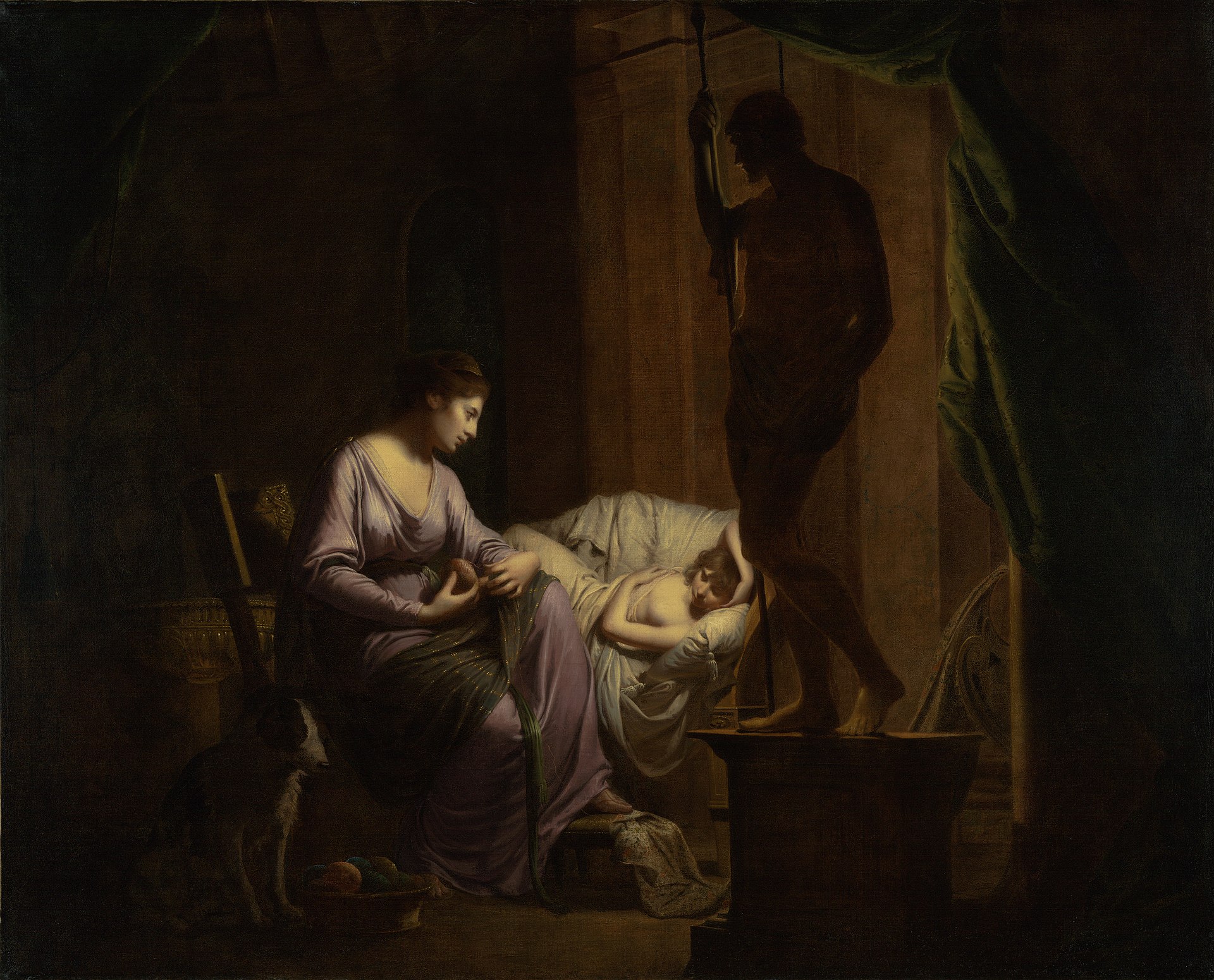
- Kauffman portrays Penelope’s lonely wait for Odysseus, while Wright shows her secretly unravelling the shroud to delay the suitors.
- Böcklin presents Calypso’s island as an uneasy place, in contrast to the idealized paradise favored by other artists.
- Artists depicted Athena’s magical intervention and Odysseus’ emotional reunions in Ithaca.
- Alaux presents Odysseus as an idealized, powerful hero reclaiming his throne.
- Turner transforms the Odyssey into a vast, poetic landscape, with Odysseus dwarfed by the sea and the forces surrounding him.
1. The Start of the Story
Homer’s epic poem, the Odyssey (8–7 BCE), is really a sequel to his Iliad, which tells of events during the 10-year-long Greek siege of Troy. Odysseus, King of Ithaca, is part of the Greek forces and will go on to play a crucial role in the design of the wooden horse, which will eventually trick the Trojans. The Odyssey tells the story of what happens next, as Odysseus (also called Ulysses) and his men try to make their way back home to Ithaca. It is far from plain sailing: this journey will also last 10 years.
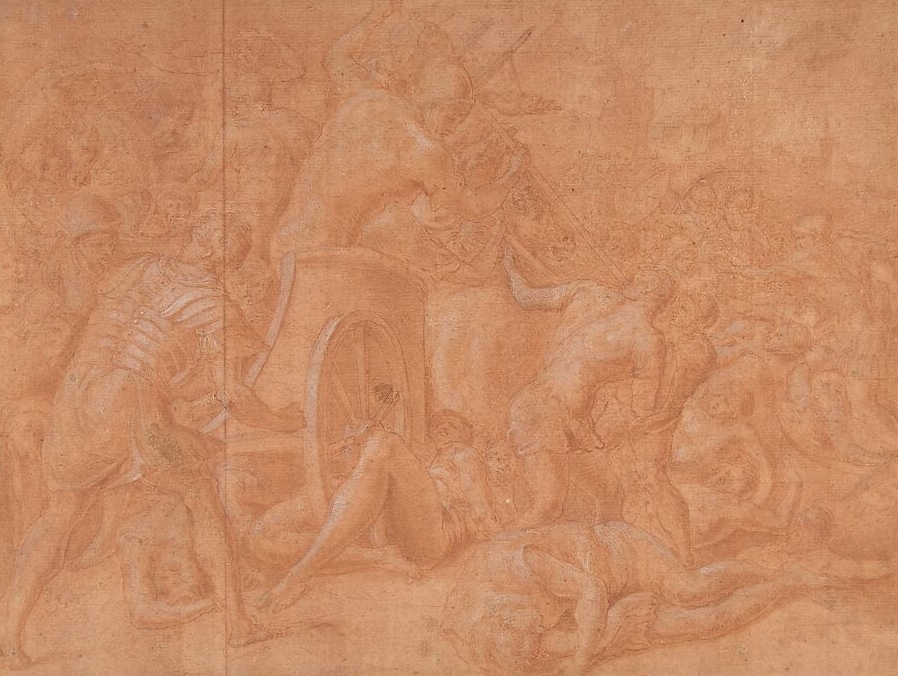
Francesco Primaticcio, Ulysses and His Companions Fighting the Cicones Before the City of Ismaros, study for a destroyed fresco, 1555–1560, Metropolitan Museum of Art, New York City, NY, USA.
Odysseus and his men begin as triumphant warriors who attack and pillage the island of Cicones in much the same way as they had laid waste to Troy. Primaticcio depicts the carnage with Odysseus as an authority figure, higher than the rest and leading from his chariot. However, unlike at Troy, they are defeated and forced back to sea.
The Odyssey is not about a warrior king. It is about the trials of a single man, who has to lose everything—his ships, his men, his status—before he can rediscover who he is and find his way home. Neither is it about wars between men, as much as a battle between mankind and magic, between men and the gods, and between a man and himself.
2. The Island of the Lotus Eaters
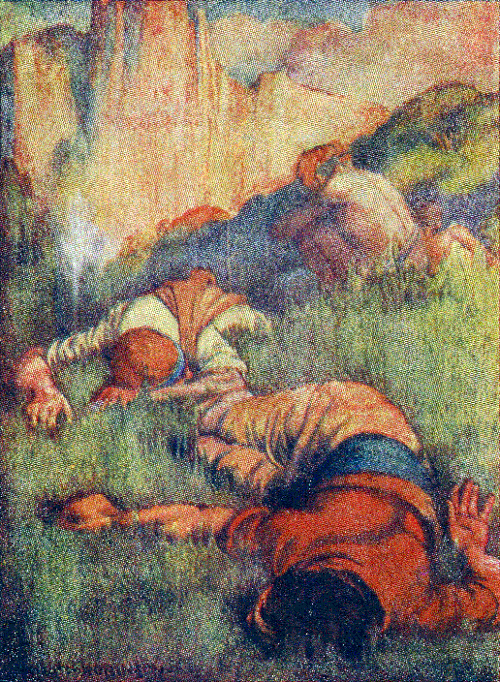
W. Heath Robinson, And Dream Idle, Happy Day-Dreams That Never Ended, illustration from Jeanie Lang, Stories from the Odyssey Told to the Children, 1906.
Odysseus and his men next arrive at a beautiful island, where the inhabitants eat the flowers of the lotus tree, “as sweet as honey,” which cause forgetfulness and lethargy. Three of the crew foolishly eat and collapse in a stupor amidst the luxuriant landscape. Odysseus forces them, weeping, back to the ships. The episode reinforces the narrative of loss—loss of direction, judgement, and self.
Robinson’s shimmering softness and disorienting scale give a sense of the hallucinatory effects of the lotus flowers. Other artists like Robert S. Duncanson focused on the island’s Edenic landscape. However, in the Odyssey, beauty is usually deceptive, hiding danger or death. Deception is another major part of the storyline.
3. Polyphemus the Cyclops
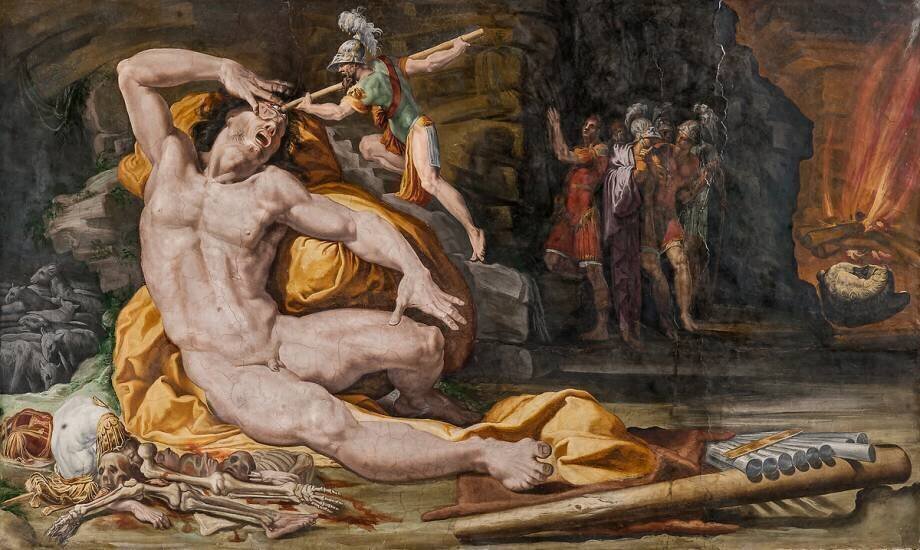
Pellegrino Tibaldi, Ulysses Blinding Polyphemus, c. 1549–1551, Palazzo Poggi, Bologna, Italy.
Odysseus and his men get themselves trapped inside the cave in which the one-eyed giant Polyphemus keeps his flock of sheep. By stabbing the giant in the eye, they blind him and then escape by tying themselves to the underbellies of the sheep. A furious Polyphemus chases them to the sea.
Although we might imagine the Cyclops as a misshapen ogre, artists tended to represent him as an oversized but idealized man. Tibaldi even deliberately poses him in an echo of Michelangelo‘s Adam. It makes for an oddly ambiguous image which emphasises Odysseus’ brutality, rather than the horror of a creature who has eaten four crew members.
Odilon Redon‘s symbolist interpretation of the Cyclops (albeit in a different context) represents him as an ogre but also elicits the viewer’s sympathy with a bright palette and huge, penetrating eye.
4. Circe
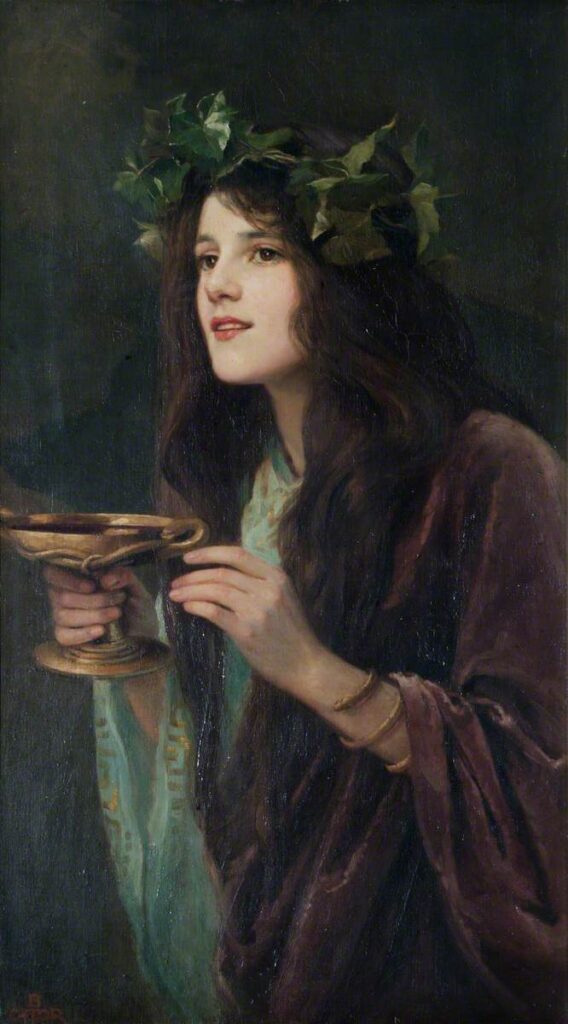
Beatrice Offor, Circe, 1911, Bruce Castle, London, UK.
Living alone on the island of Aeaea, Circe is a sorceress who can transform men into animals. She changes Odysseus’ crew into pigs, but, warned by the one man who escapes and helped by the god Hermes, Odysseus refuses to drink her magic potion and saves his men.
Beatrice Offor shows Circe offering the potion but looking surprisingly wholesome and innocent. Most male artists, however, represented her as the ultimate femme fatale, tempting and trapping innocent men. Earlier depictions have her scantily clad and often entangled with Odysseus, but by the Victorian era, the hero is usually absent. Instead, Circe offers the cup forward, allowing Odysseus’ role to be taken by the (supposed male) viewer.
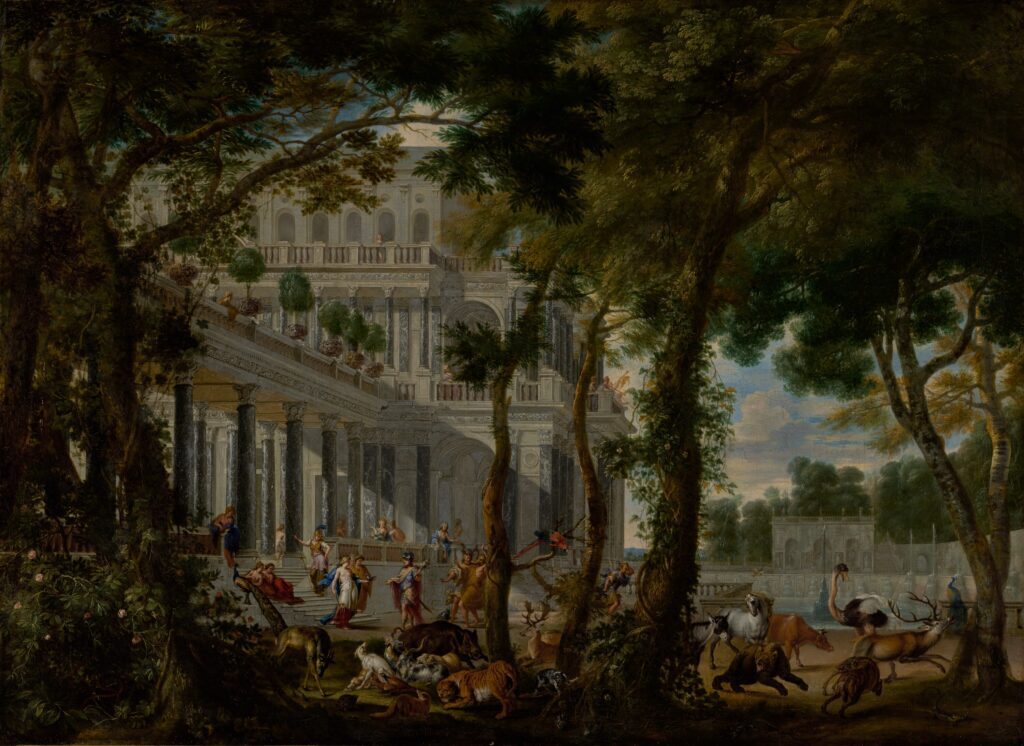
Wilhelm Schubert van Ehrenberg and Carl Borromäus Andreas Ruthart, Ulysses at the Palace of Circe, 1667, Getty Center, Los Angeles, CA, USA.
For many earlier artists, it was not Circe’s sexuality which appealed but her sorcery. It offered the opportunity to represent exotic animals and let imaginations run wild in their representation of her magical palace.
Few went to such lengths as Wilhelm Schubert van Ehrenberg, who created an elaborate classical villa in the woods and utilized the specialist skills of animal painter Carl Borromäus Andreas Ruthart to visualize a menagerie including a tiger, ostrich, and bear. The figures of Circe, offering her potion, and Odysseus are small and insignificantly placed in the middle ground, alongside horrified crew members in the process of being transformed. The story is there, but you really have to look for it.
5. The Underworld
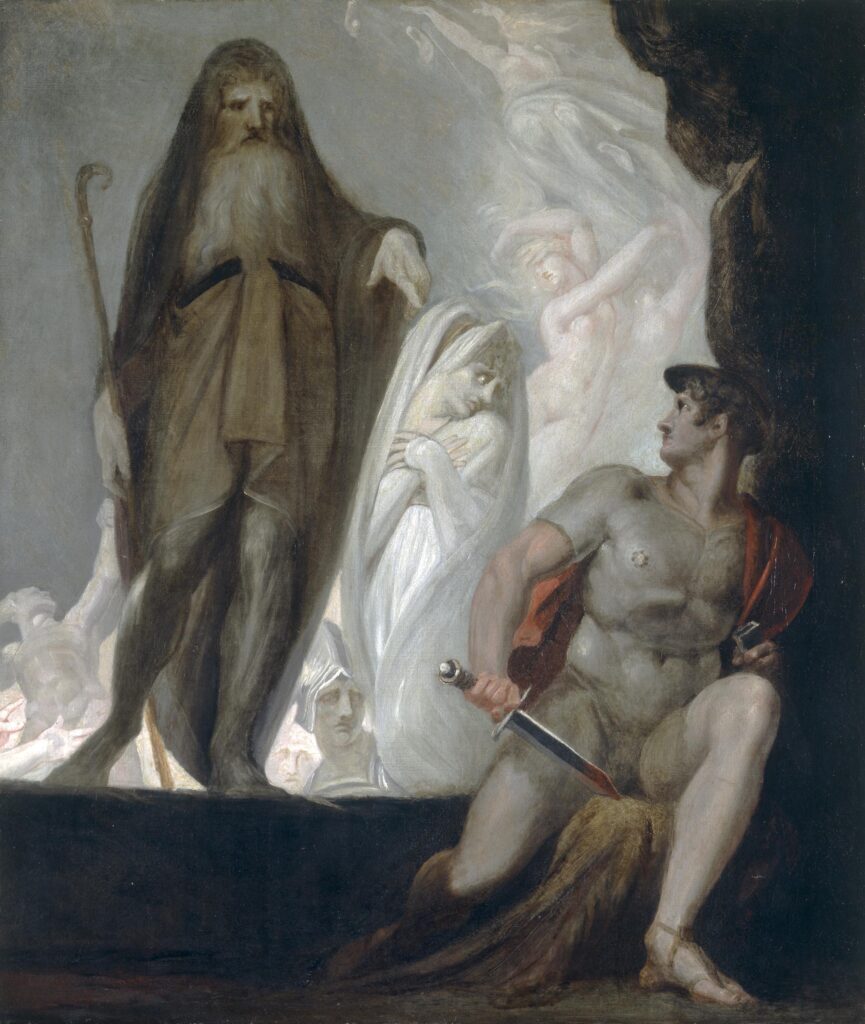
Henry Fuseli, Tiresias Foretells the Future to Odysseus, c. 1800, National Museum Cardiff, Cardiff, UK.
After staying with Circe for a year, Odysseus and his men voyage to the very edge of the Underworld to listen to the prophecy of the blind Tiresias. He warns Odysseus that he and the crew must not eat the cattle of the god Helios and tells him how to successfully sail past the sea monsters Scylla and Charybdis. Odysseus also comes face to face with his dead mother, who has died of grief in his long absence.
Henry Fuseli, who loved a bit of gothic horror, relishes this episode, creating an almost monochrome gloom against which the souls of the dead float like luminous ghosts. Odysseus seems to recoil as his mother is revealed to him, suddenly realising the price of his years away from home.
6. The Sirens

John William Waterhouse, Ulysses and the Sirens, 1891, National Gallery of Victoria, Melbourne, Australia.
The song of the Sirens was enough to drive men to destruction. Odysseus gets his crew to block up their ears with wax whilst he is tied to the mast so he can listen. Tortured by the song, he pleads to be released, but his men simply tie him tighter.
The Sirens were usually depicted as beautiful naked women, or even mermaids. But John William Waterhouse, following some ancient Greek examples, shows them half-bird, half-human, swooping threateningly down around the boat. One is even perched on the side. An episode which is often reduced to mere titillation now has real menace, with the preponderance of black, grey and chilly blue, and Odysseus visibly straining against his bonds.
7. Penelope
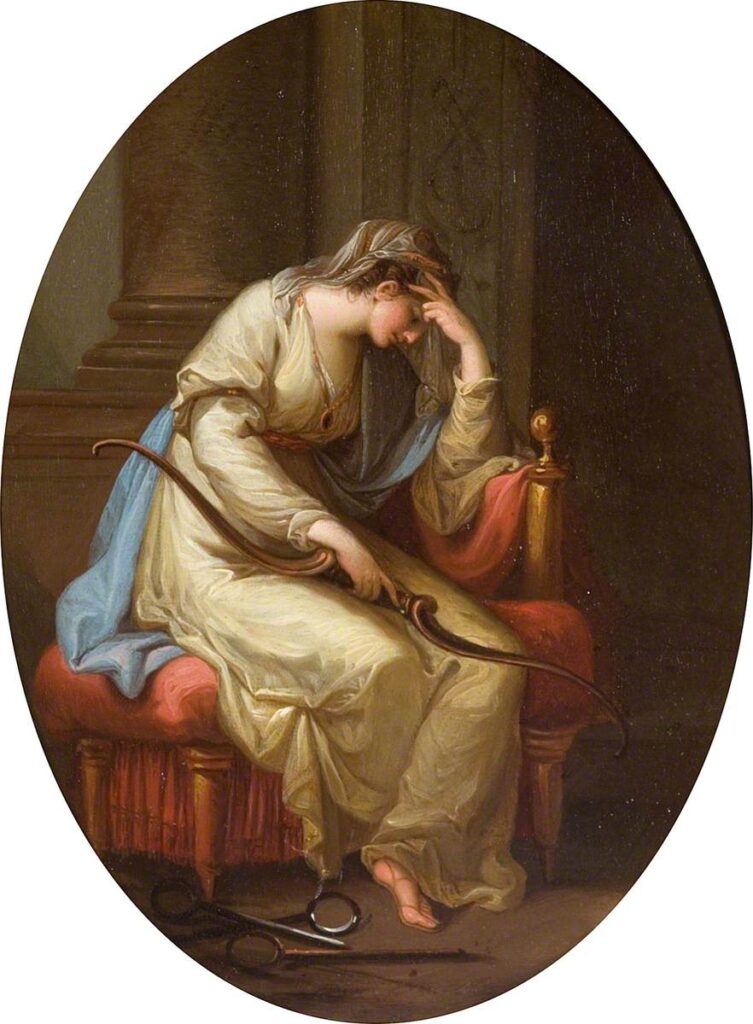
Angelica Kauffmann, Penelope Weeping over the Bow of Ulysses, 1779, Wolverhampton Art Gallery, Wolverhampton, UK.
Waiting back in Ithaca was Odysseus’ wife, Penelope. She was in a perilous position, with a son not yet old enough to claim the throne, and besieged by suitors who claimed her husband must be dead and that she should remarry.
Angelica Kauffman painted a series of works that focused on the Queen of Ithaca. Here, Penelope is shown in isolated loneliness. She holds her husband’s bow, which, famously, only he was strong enough to string. On the floor lie the hoops through which Odysseus used to shoot an arrow as a demonstration of his skill. Both items feature prominently at the end of the Odyssey, as anyone looking at the picture would have known. They give the viewer an optimism that Penelope herself does not have.
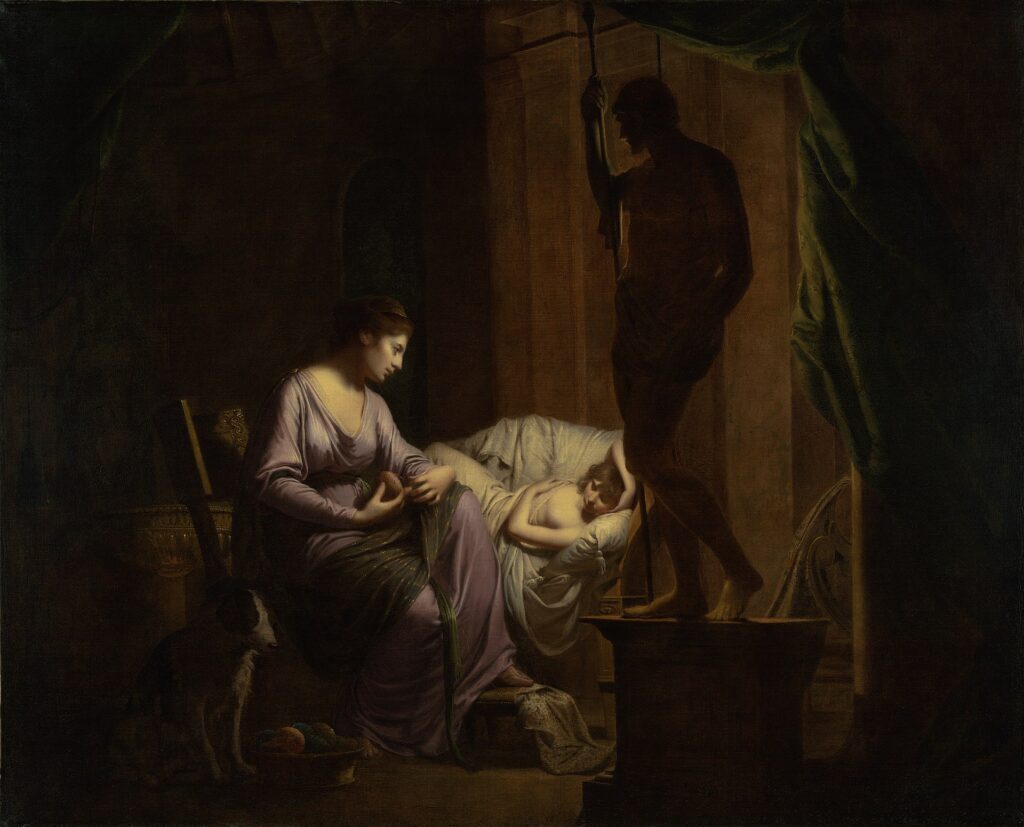
Joseph Wright of Derby, Penelope Unravelling Her Web, 1783–1784, J. Paul Getty Museum, Los Angeles, CA, USA.
Penelope is far from being a passive victim, however. She has vowed to remarry only when she finishes weaving a shroud for her father, and questions every traveller in the hope of news of her husband. Every night she sits up unravelling the work she has done that day, delaying the suitors as she waits for Odysseus’ return.
Penelope was often shown at her loom. Joseph Wright, however, uses his characteristic love of chiaroscuro to show Penelope winding the wool back into a ball. Her son sleeps in the moonlight. A statue of Odysseus looms above her, and her husband’s dog sits by her side. Darkness threatens on all sides, but she is focused on her task.
8. Calypso
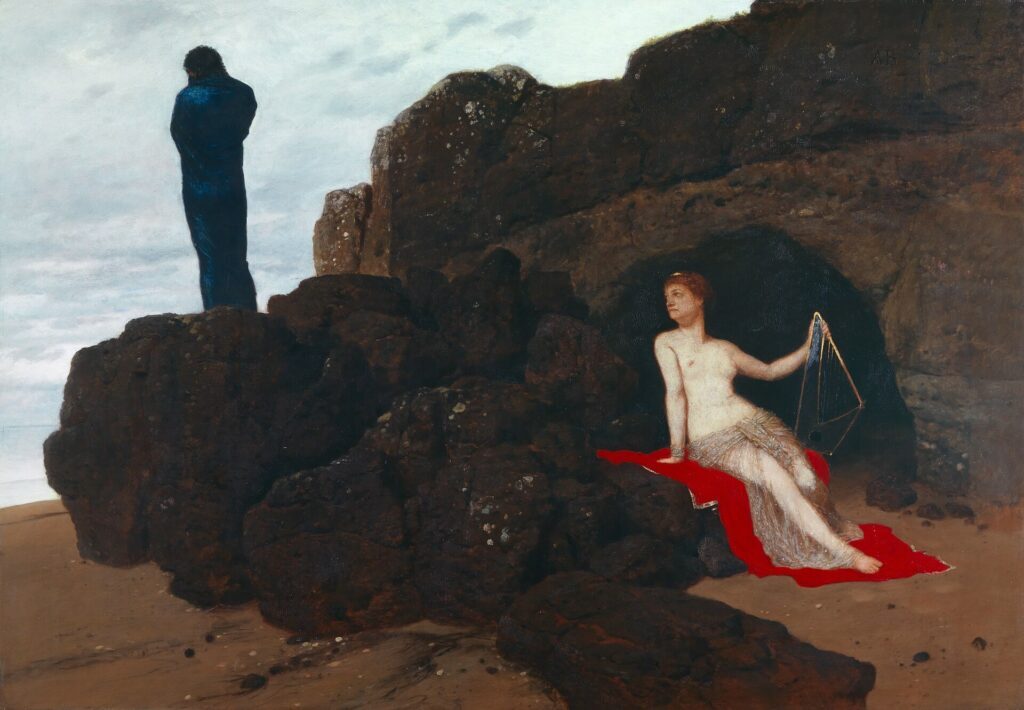
Arnold Böcklin, Ulysses and Calypso, 1882, Kunstmuseum Basel, Basel, Switzerland.
As Tiresias predicts, Odysseus loses his crew first to Scylla and then to a storm caused by the gods as a punishment for killing their sacred cattle. He is rescued by Calypso, who keeps him captive for seven years, enchanting him with her music and promising him immortality, despite his weeping to return home. In the end, it is the gods who intervene and tell Calypso to release him.
Most artists see Calypso as another attractive siren and her island as a kind of idealized pleasure palace, but Arnold Böcklin creates an uneasy atmosphere. A silhouetted Odysseus stands longingly on the cliff looking towards the horizon, his form so simplified that he seems to have become partly dehumanized by what is happening to him. Calypso seems fragile, an almost tragic figure clinging to an illusion. The reality is bare rock and emptiness.
9. Odysseus Returns Disguised as a Beggar
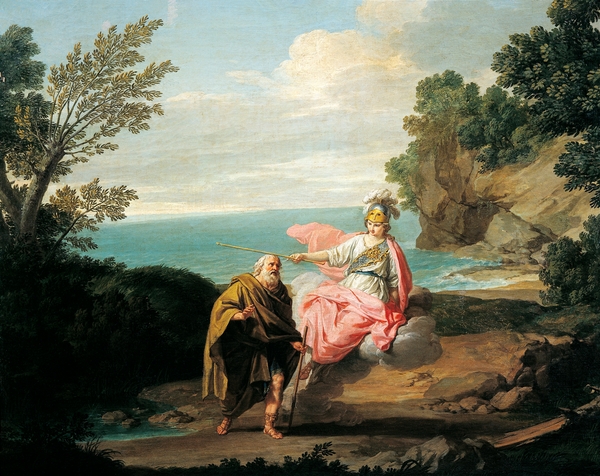
Giuseppe Bottani, Ulysses Transformed by Athena into a Beggar, 1775, Pinacoteca Malaspina, Visconti Castle, Pavia, Italy.
The role of the gods is crucial throughout the Odyssey, especially during the hero’s return to Ithaca. Athena ensures that he can get to his palace unnoticed by disguising him as a beggar. The ruse allows for a series of poignant reunions as one by one people recognize him. Athena reveals him to Telemachus, his son, quite literally in a puff of magic smoke as Johann August Nahl depicts it. Eurycleia, his old nurse, recognizes him as he bathes his feet and sees an old wound on his ankle. Most poignantly of all, Argus, the faithful dog who has waited 20 years for his master, knows Odysseus despite the disguise.
10. Odysseus Kills the Suitors
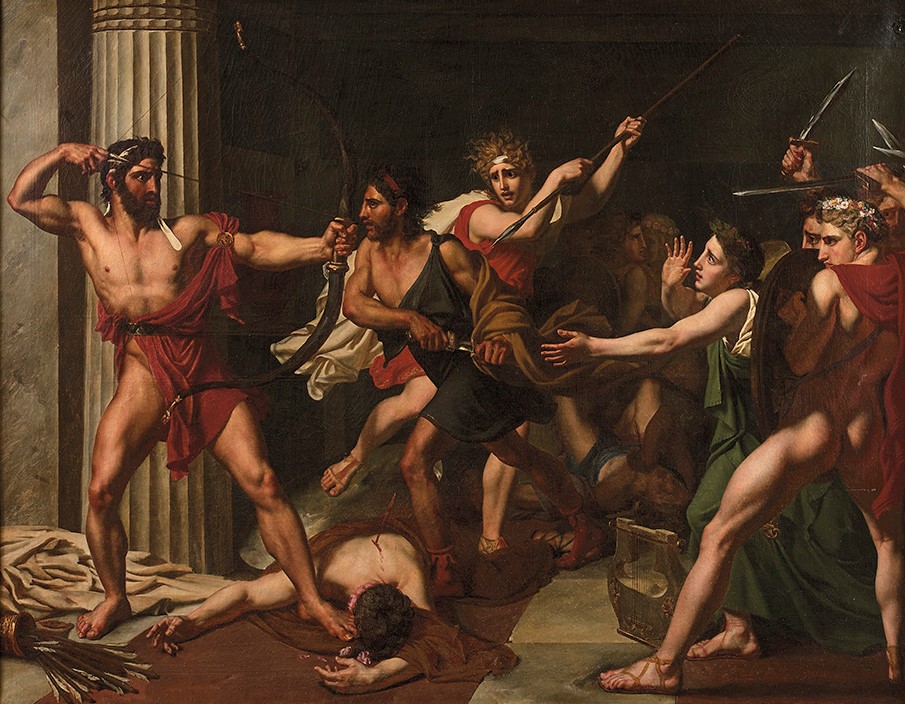
Jean Alaux (attributed), Ulysses and Telemachus Massacring the Suitors, 1812, private collection. Wikimedia Commons (public domain).
The bloody climax of the Odyssey sees the hero reunited with his bow and reclaiming his throne by massacring the men who have gathered in the hope of securing Penelope’s hand and the crown. Neoclassicist Jean Alaux represents Odysseus as an idealized hero, far removed from the old, travel-worn man that we might expect. His strong pose against the marble column behind him stands in contrast to the tangle of limbs and deep shadows of the rest of the painting.
Other artists, notably Gustave Moreau, focused on the chaos rather than the heroism: he gives center stage to the gods, in the form of Athena, rather than to a mortal hero.
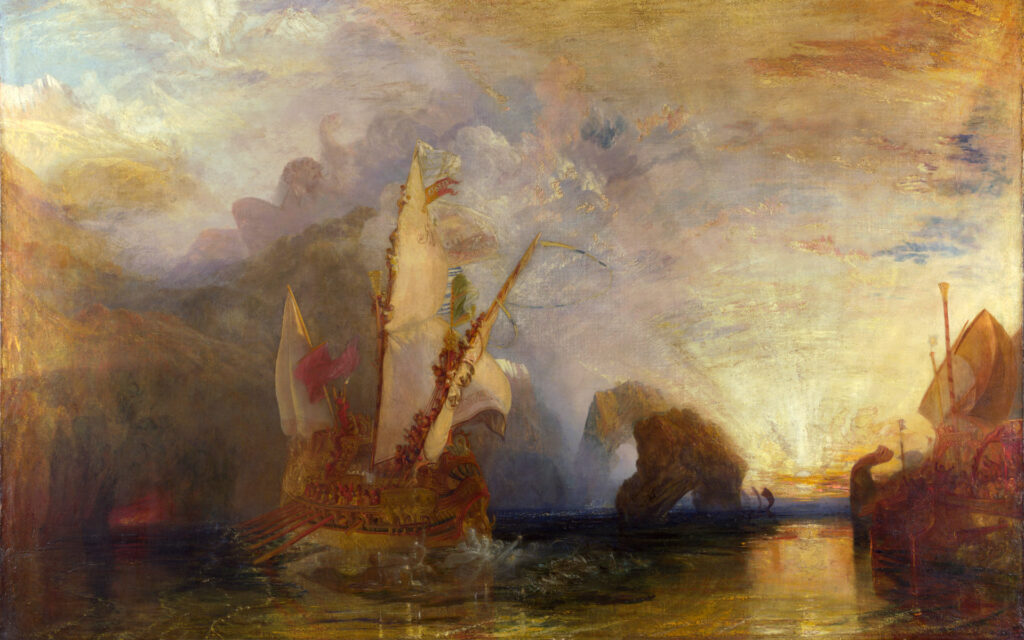
J.M.W. Turner, Ulysses Deriding Polyphemus, 1829, National Gallery, London, UK.
Everyone has their own view of the Odyssey. Christopher Nolan sees an action movie; Margaret Atwood foregrounds Penelope; and, looking at J.M.W. Turner‘s Ulysses Deriding Polyphemus, you might think he sees it just as an excuse for a landscape. The narrative is almost inconsequential: Polyphemus is barely distinguishable from the rocks top left, and Odysseus is almost comically small as he taunts the giant.
However, in the wide sea frothing with mythical creatures and the glorious sun rising on the far, far horizon, Turner captures the grandeur and poetry of Homer’s story. At its heart, the Odyssey is about the insignificance of one man in the face of forces beyond his control, who has to just keep going forward and only wants to get home. That is what makes it such a timeless story.






#/media/File:Statue_of_Odysseus_beneath_the_ram_(Torlonia_MT_438)_01.jpg)

#/media/File:Odilon_Redon_-_The_Cyclops,_c._1914.jpg)


.jpg)