
The Odyssey in Art: Myth, Magic, and Mayhem
Everyone is talking about Christopher Nolan’s The Odyssey, but his version of the narrative is just the latest in a long history. From Ancient...
Catriona Miller 28 September 2026
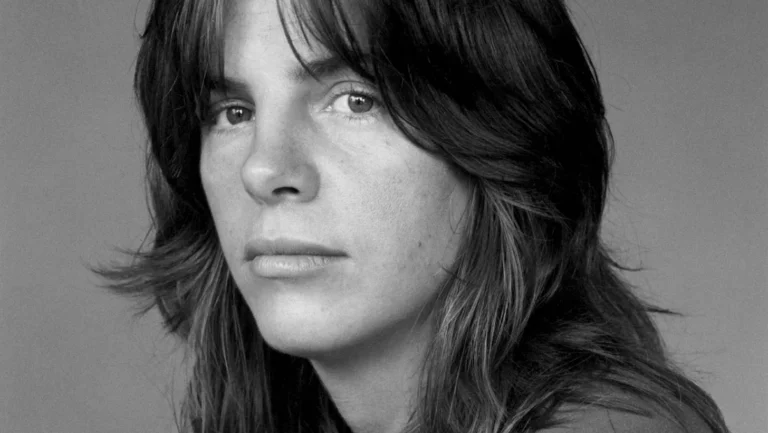
Eileen Myles, 1980. Photograph by Robert Mapplethorpe. SES/SUMS IT UP. Detail.
Eileen Myles, one of the defining voices of American poetry, is a New York writer whose conversational, fearless verse has shaped queer, experimental, and socially engaged writing since the 1970s. Across poems, prose, criticism, and performance, they have turned everyday life into a way of examining class, desire, the body, and power.
There is a mythical aura that surrounds 1970s New York City and its artistic community. With its artists, writers, and performers, New York reshaped the art and cultural world once again, setting examples and precedents for the whole world to follow.
Among the artists and writers in New York at the time, Eileen Myles was finding their own voice, one that would speak for their generation and for those to come. Looking back across their poems, from a first book in 1978 to more recent work, you can hear one restless, funny, unguarded mind, merging and challenging the boundaries between poetry, autobiography, and critical engagement with the world around us. Myles has written fiction, essays, plays, opera libretti, and performance pieces too, but poetry is the thread running through all of it. An affectionate and critical observer of American society, with its flaws and everyday beauty, Myles has made American life, its class lines, its dreams and its small humiliations, their lifelong subject.
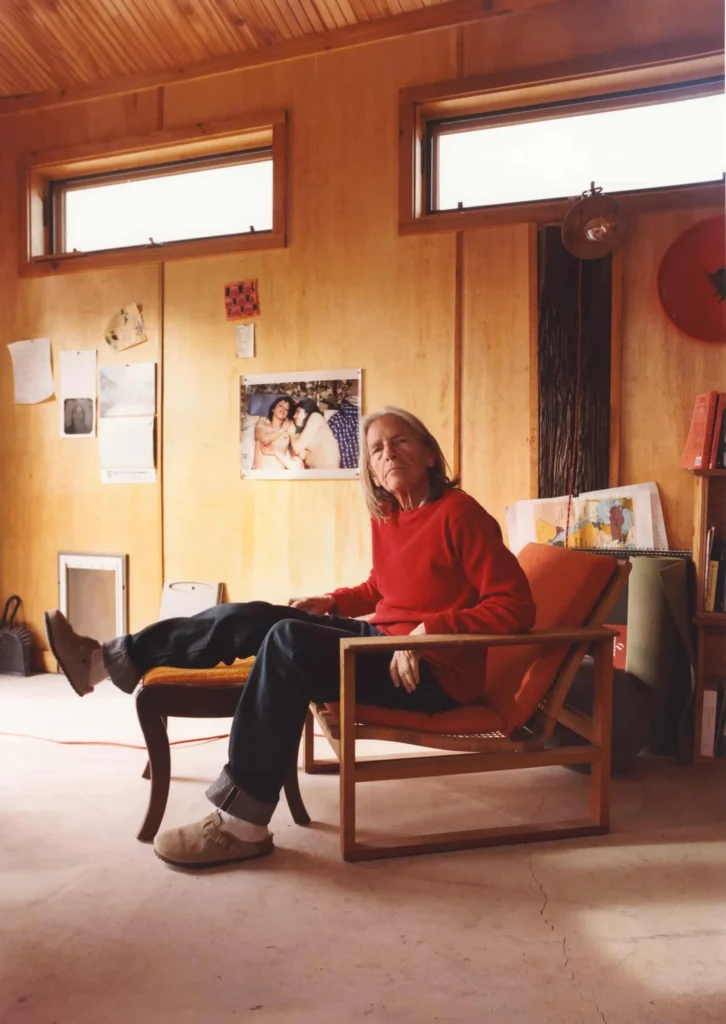
Eileen Myles. Photograph by Cole Barash/Apartamento.
Myles was born on December 9, 1949, in Cambridge, Massachusetts, into a working-class family, and attended Catholic schools in Arlington. After graduating from UMass Boston in 1971, they moved to New York in 1974 with one aim: to be a poet. They found their people at the St. Mark’s Poetry Project, studying with Alice Notley, Ted Berrigan, Paul Violi, and Bill Zavatsky, and meeting Allen Ginsberg. In 1979 they worked as an assistant to the poet James Schuyler, an experience that later became the title story of Chelsea Girls.
From 1984 to 1986 Myles was the Poetry Project’s artistic director, steering it through the Reagan-era arts cuts. In 1991 and 1992, they ran an “openly female” write-in campaign for president from the East Village, half protest and half performance, which inspired Zoe Leonard’s poem “I want a president.” Myles has also taught widely, holding a professorship at UC San Diego from 2002 to 2007 and visiting positions at Bard College, Columbia University, and NYU, among others. In 2016, they publicly endorsed Hillary Clinton in a BuzzFeed essay and wrote the poem “MOMENTUM 2016” as part of the “Artists for Hillary” campaign. Today, they divide their time between New York and Marfa, Texas.
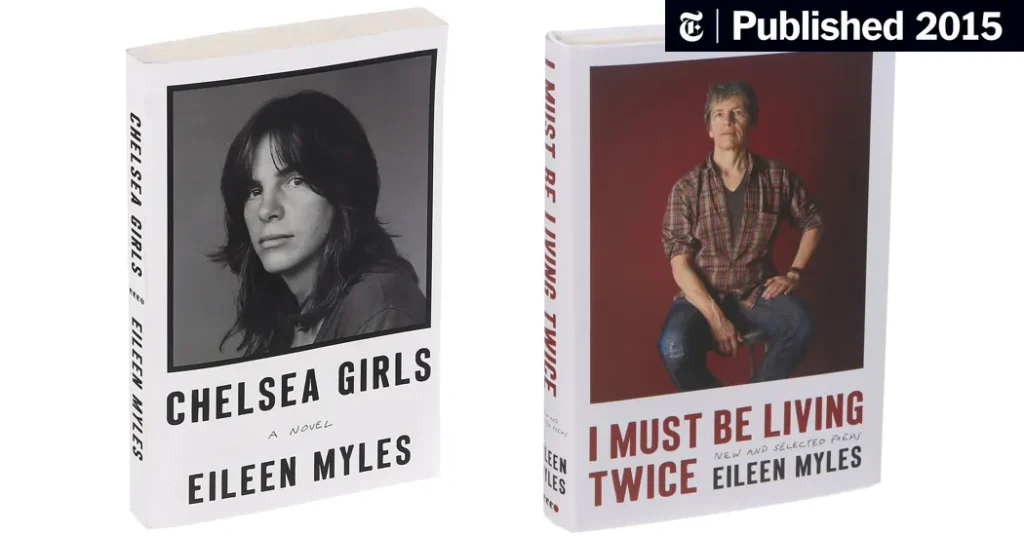
Front covers of Chelsea Girls and I Must Be Living Twice, 2015. The New York Times.
What is immediately striking in Myles’s work is how easy, almost colloquial, it sounds. The language follows the rhythms of everyday speech, in the first-person vernacular they have become known for, and it is a voice you feel you could overhear on a street corner. The ease is deceptive, though, because the lines are built with real precision, and Myles balances a voice that seems spontaneous with a finely mastered craft.
Myles became famous for writing about class, queer desire, the body, gender, and the city, and for treating personal experience as something never merely personal. In their work, the private moment becomes a place to observe how people live, work, and love, and how structures of power shape all of it. Not Me (1991), home to “An American Poem,” in which Myles playfully claims to be a Kennedy, is one of their best-known collections of poems. I Must Be Living Twice: New and Selected Poems 1975–2014 (2015) gathers decades of work into a single volume. Both move easily between the personal journal, cultural commentary, and a wider inquiry into how we live together.
The same sensibility carries into prose. Chelsea Girls (1994), which won France’s Inrockuptibles Prize for best foreign novel, reads like a poet’s book and a memoir of the Lower East Side’s artistic milieu. Beyond fiction, Myles has written art criticism and travel essays, collected in The Importance of Being Iceland: Travel Essays in Art (2009), as well as works for the stage and for performance.
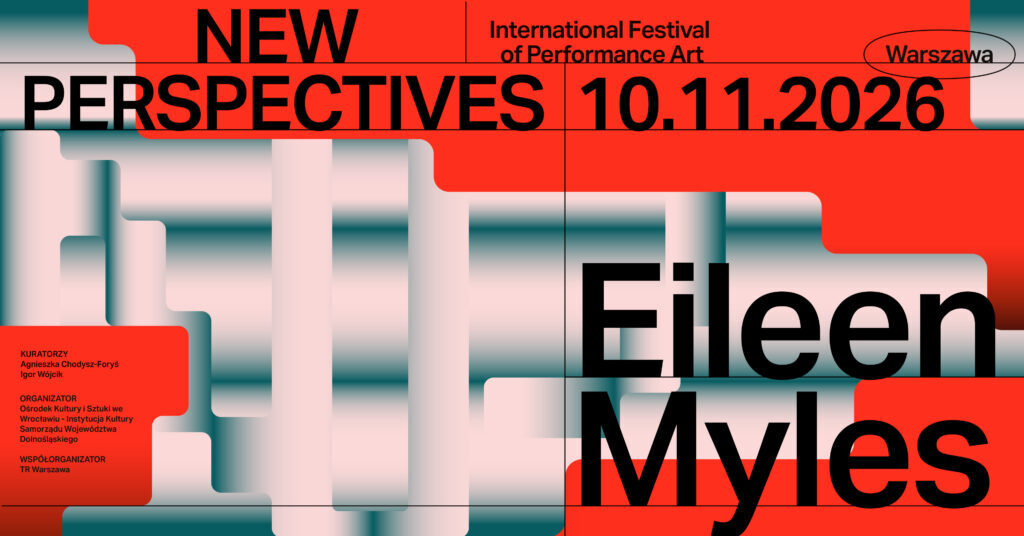
New Perspectives International Performance Festival poster promoting artist talk with Eileen Myles, 2026. Press materials.
Critics have long recognized Myles’s craft. Dennis Cooper called them one of the most restless intellects in contemporary writing, and the Boston Globe described them as a rock star of poetry. Their honors include three Lambda Literary Awards, a Guggenheim Fellowship (2012), the Clark Prize for Excellence in Arts Writing (2015), and a Creative Capital award (2016). The 2015 reissue of Chelsea Girls alongside I Must Be Living Twice brought their work to a much wider readership, and that readership is now international.
A recent Polish-language selection, A day, several bright days, published by the Culture and Art Centre in Wrocław, gathers about 60 poems from across Myles’s career, translated by Maciej Topolski, Joanna Mąkowska, and Karol Poręba. Before it, only one Myles poem, “Broken Cindy,” had ever appeared in Polish. That a poet so rooted in the East Village and the New York of the 1970s now speaks to readers in Wrocław says something about how far their work reaches.
This fall, that work will also be seen and heard on stage. On November 7, the New Perspectives International Performance Festival in Wrocław offers a chance to meet Myles in person, with a presentation of the Polish edition of their poetry, moderated by Małgorzata Myk. The same day, two performances inspired by their work follow. Choreographer Alka Nauman presents Dog is travelling through you—an experimental, absurd and tender piece drawn from Chelsea Girls, and Afterglow (a dog memoir), in which a dog lives inside the body of a Polish lesbian. Liliana Zeic brings That moment when you realised that there was something wrong with the world (2026), a performance that begins from the uneasy sense that something is amiss.
Two additional artist talks with Eileen Myles will take place in Warsaw (November 10) and Łódź (November 12). Together, the events make a fitting introduction to a poet whose work has always been, above all, a voice, and whose poems are the life itself, in all its jokes, grudges, tenderness, and weather.
DailyArt Magazine needs your support. Every contribution, however big or small, is very valuable for our future. Thanks to it, we will be able to sustain and grow the Magazine. Thank you for your help!

Carlotta Mazzoli is an independent curator and art advisor, currently based in Europe. Over the past ten years, she has collaborated with private and public institutions and art galleries in Italy, London, New York, and Shanghai. She specializes in public art, environmental and social issues, and the importance of art as a relational medium. In her free time she likes to write about art and travels on Artsy Travels.

Univ. of New Orleans, Fine Arts and History; Fine Artist, Professional Graphic Designer, Art Historian, Historian, Musician, worked at the New Orleans Museum of Art and MS Museum of Art; learning enthusiast!
Everyone is talking about Christopher Nolan’s The Odyssey, but his version of the narrative is just the latest in a long history. From Ancient...
Catriona Miller 28 September 2026
From groundbreaking painters to innovative sculptors and visionary illustrators, women artists have shaped the way we see the world. Yet many of...
Natalia Iacobelli 7 July 2026
Suppose you are not satisfied with any of the historical or fantasy dramas out there lately where all kinds of slander, deception, and politicking...
Orion Grace 2 March 2023
It is most common to talk about paintings or sculptures inspired by a piece of literature. Yet, this relationship between arts is not unidirectional.
Jimena Escoto 23 April 2024