Summary
The story of the late David Hockney, one of the most iconic contemporary painters, told through 10 artworks:
- We Two Boys Together Clinging uses a Walt Whitman cipher to cloak gay intimacy at a time when homosexuality was illegal in Britain.
- A Bigger Splash fixed the image of Southern California, and the pool that became Hockney’s signature.
- Mr and Mrs Clark and Percy—subverts traditional marriage conventions within this series of double portraits.
- Portrait of an Artist (Pool with Two Figures)—reworked from found photographs and later sold for a record $90.3 million.
- The Rake’s Progress set design, drawing on William Hogarth—the opera side gig that turned into a second career.
- David Hockney explored multi-viewpoint imagery with his Cubism-inspired photocollages, culminating in Pearblossom Hwy., 11–18th April 1986, #2.
- A Bigger Grand Canyon—a monumental grid of 60 canvases that pull the viewer inside.
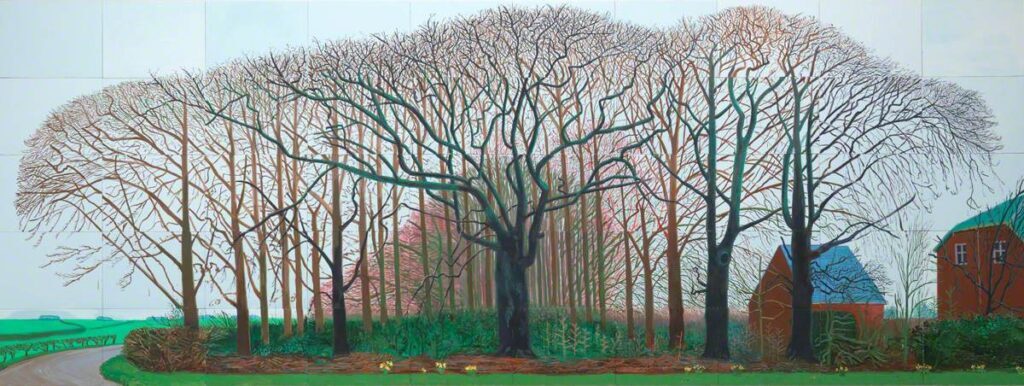
- Bigger Trees Near Warter combines en plein air panels, multiple viewpoints, and digital tools to depict a Yorkshire woodland.
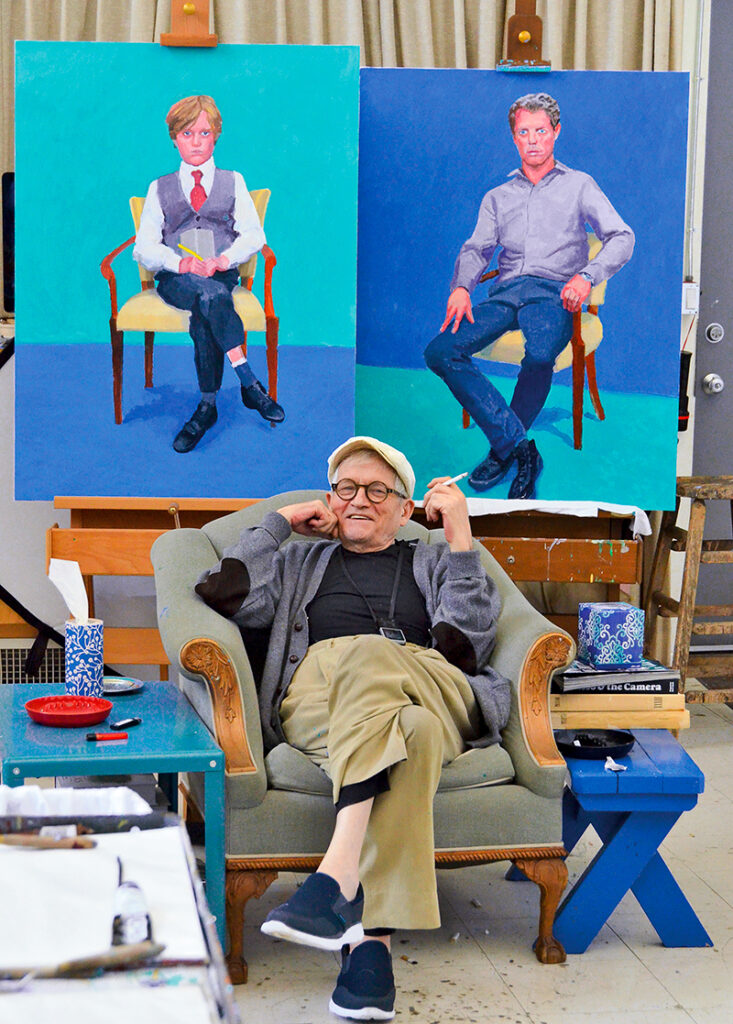
- 82 Portraits and 1 Still-life—series using the same chair and format, depicting Hockney’s friends and family.
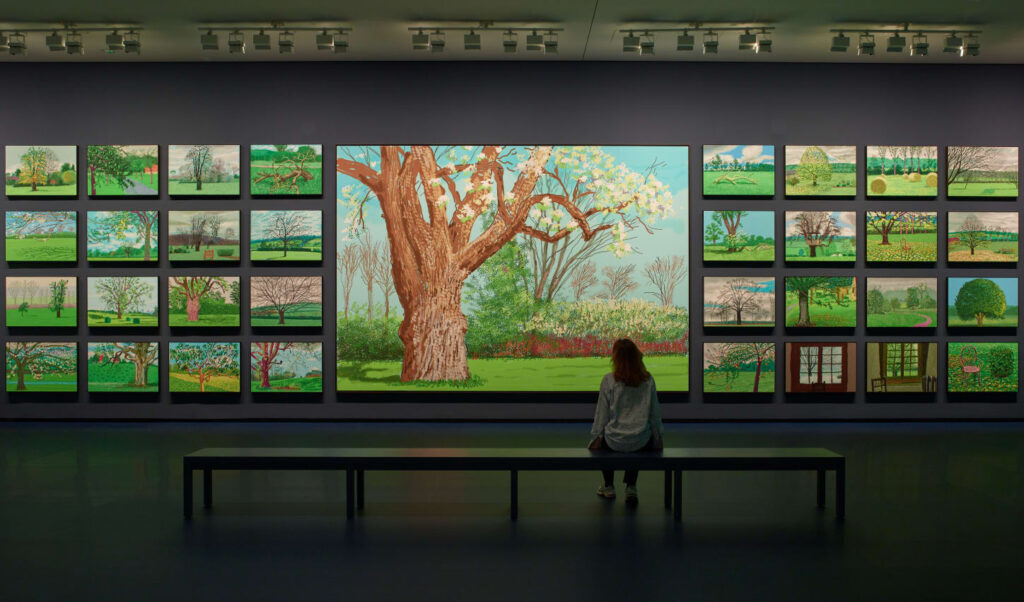
- Arrival of Spring, Normandy, 2020—a lifetime of gadget-tinkering ending on an iPad, painting taken as seriously on a screen as on canvas.
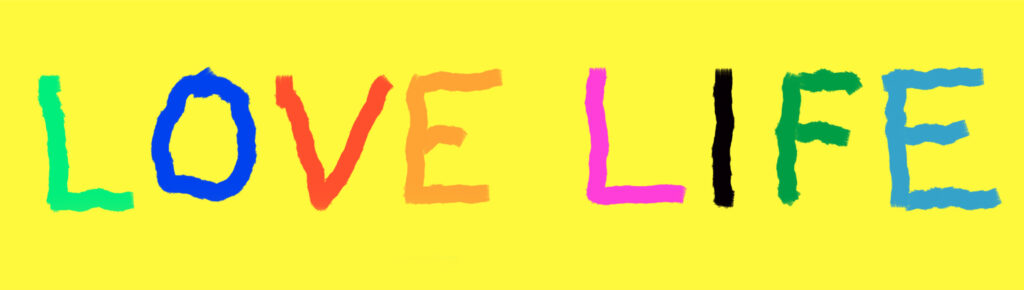
After the artist’s passing on June 11, 2026, the message “LOVE LIFE” from the immersive exhibition David Hockney: Bigger & Closer (not smaller & further away) became the cover image of his official website.
Sporting his signature glasses and ever-present cigarette, David Hockney had a seven-decade fascination with the many ways in which reality can be observed and represented. Working across painting, drawing, printmaking, photography, collage, video, stage design, digital paintings, and even iPad images that lifted spirits during the COVID-19 pandemic, Hockney challenged us to celebrate the world around us, insisting that “the very process of looking can make a thing beautiful.”
1. We Two Boys Together Clinging, 1961
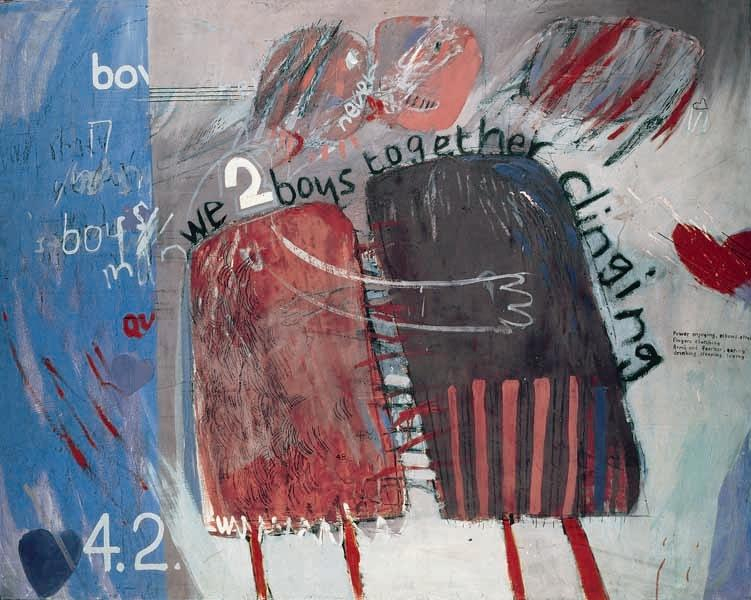
David Hockney in 10 Artworks: David Hockney, We Two Boys Together Clinging, 1961, Art Council Collection, Southbank Centre, London, UK. © David Hockney.
Both romantic and defiant, We Two Boys Together Clinging depicts two gay men in an embrace as a display of queer intimacy and tenderness. Hockney created the work while still a student at the Royal College of Art, six years before Britain’s 1967 Sexual Offences Act partially decriminalized same-sex relationships between men. The title comes from a Walt Whitman poem, making same-sex desire and coded queer expression visible at a time when showing gay love openly was not only dangerous, but also illegal. By the 1960s, artists were starting to address queer identities more openly, inspired by the sexual revolution and the gay rights movement.
Hockney included a quote from Whitman’s 1855 collection of poems, Leaves of Grass, but left out the title verse: “We two boys together clinging, / One the other never leaving.” By employing Whitman’s initials-as-numbers cipher in his early work (1 for A, 2 for B, etc.), the artist partly cloaked homoerotic desire in his paintings; he used the number 4.8 for David Hockney (4 for D, 8 for H) and 4.2 for “Doll Boy” Cliff Richard, the British pop idol he had a schoolboy crush on. The words “Never” and “Yes” can be seen between the scribbled young men’s lips. Hockney’s crude handling of paint and the unsophisticated figures were influenced by the naive style of French artist Jean Dubuffet.
2. A Bigger Splash, 1967
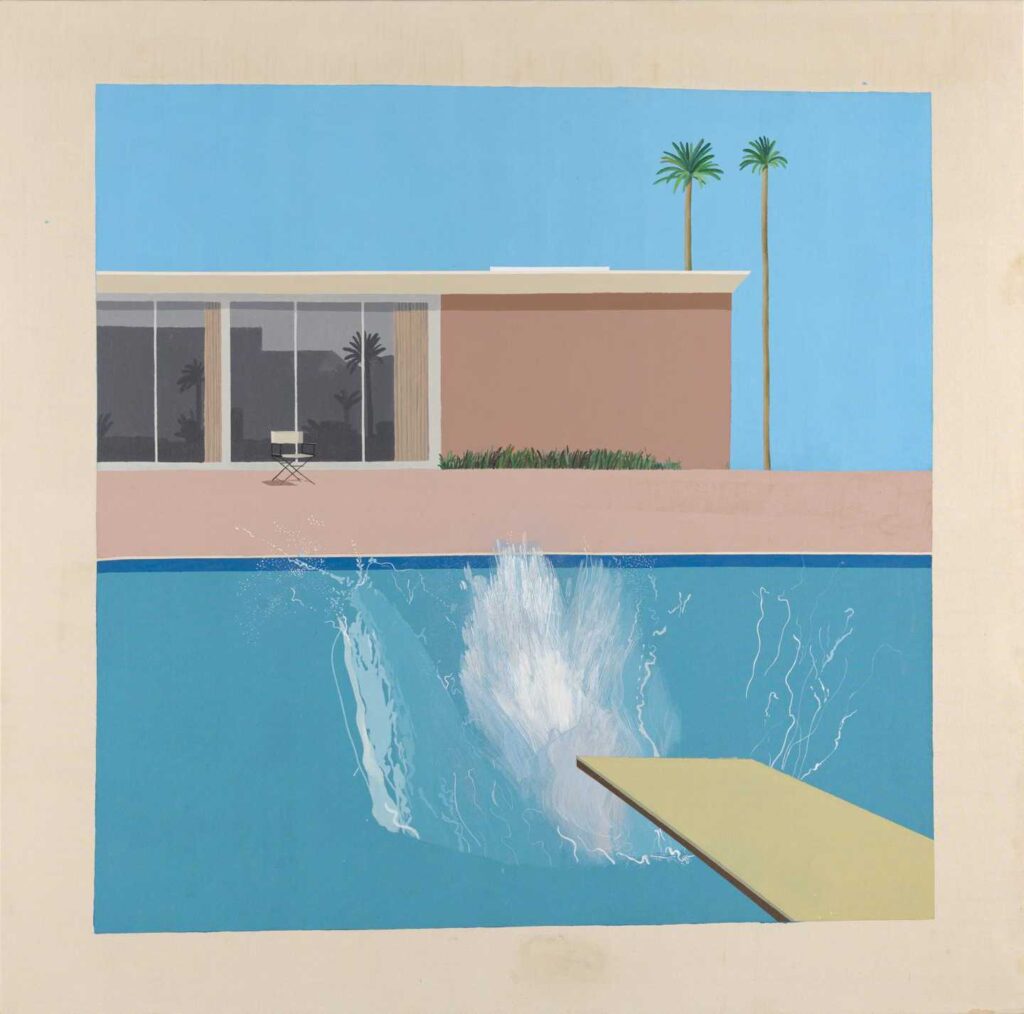
David Hockney in 10 Artworks: David Hockney, A Bigger Splash, 1967, Tate Britain, London, UK.
Hockney did not invent the Southern California cool aesthetic, but A Bigger Splash fixed the world’s image of it. He moved to Los Angeles in 1964 and, by his own admission, fell hard for it. Hockney lived in the city, on and off, for the next six decades; the ubiquitous L.A. swimming pools became a recurring motif. It is the last and largest of Hockney’s three “Splash” canvases, each one stripped further down. The final pared-down image, painted while Hockney was teaching at the University of California at Berkeley, reads as pure Golden State: a one-level pink house, a diving board, two skyduster palm trees, and a flat blue pool under a cloudless sky.
The scene was not painted from life. The pool derives from a photograph in a manual, the house from one of Hockney’s own earlier drawings. Everything but the splash is laid down flat and smooth with a paint roller, the lines sharp, the color uniform. The splash is the exception—worked bit by bit with small strokes—the one place in the painting where you can see the artist’s hand. Ironically, Hockney spent two weeks on the most ephemeral thing in the frame, a burst of water gone in a second. His cool graphic California pictures led straight onto the great naturalistic portraits that made him one of the most influential contemporary British artists.
3. Mr and Mrs Clark and Percy, 1970–1971
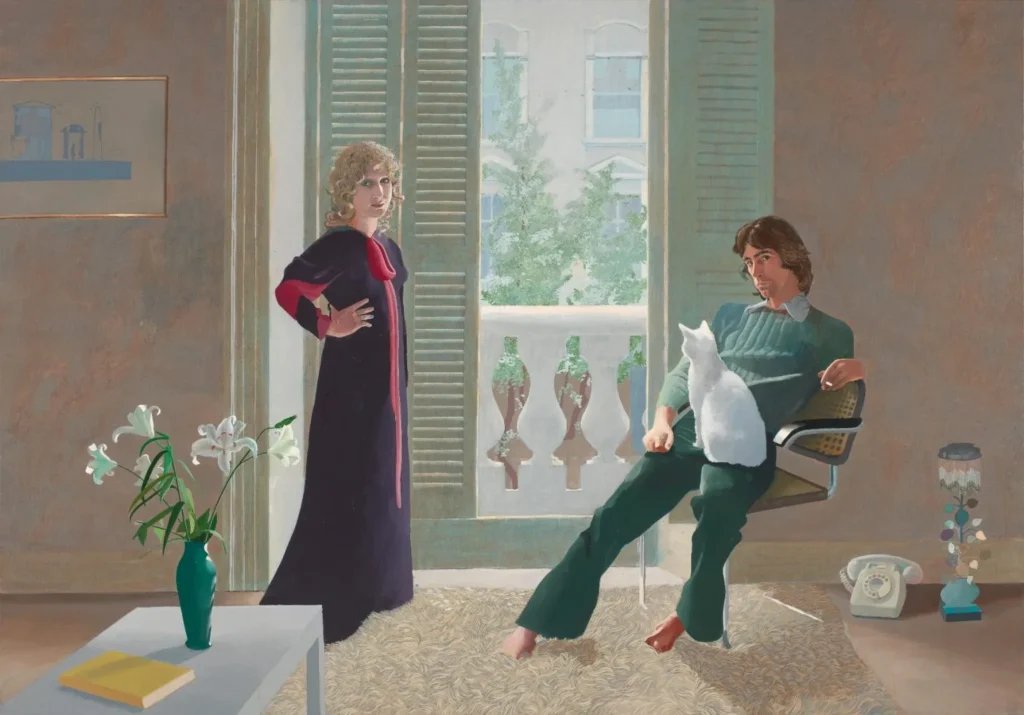
David Hockney in 10 Artworks: David Hockney, Mr and Mrs Clark and Percy, 1970–1971, Tate Britain, London, UK.
Mr and Mrs Clark and Percy is considered a masterpiece of modern British portraiture. The large acrylic canvas depicts longtime Hockney muse, textile designer Celia Birtwell, and her then-husband, fashion designer Ossie Clark. Hockney subverts traditional marriage portrait conventions by having Birtwell stand while her husband sits. The lightest part of the painting is in the center, creating a tonal challenge that allows Hockney to show off his handling of soft, natural light. It also helps create a charged atmosphere due to the stark contrast with the dark foreground figures. (Fun fact: the cat was actually named Blanche, and Hockney chose to use the name of a different household cat named Percy for the title!)
This canvas belongs to a run of seven impressive double portraits painted between 1968 and 1975, with the figures posed life-size in their own homes. Two touchstones of the series are American Collectors (Fred and Marcia Weisman) and Christopher Isherwood and Don Bachardy, the novelist and his artist partner at home in Santa Monica. The series ends on a painting Hockney never finished, George Lawson and Wayne Sleep. Hockney attempted to rework the picture for years, chasing the spatial precision he admired in the old master Piero della Francesca. Unable to achieve his goal, the artist renounced naturalism. He gave the unfinished canvas to Tate in 2014.
4. Portrait of an Artist (Pool with Two Figures), 1972
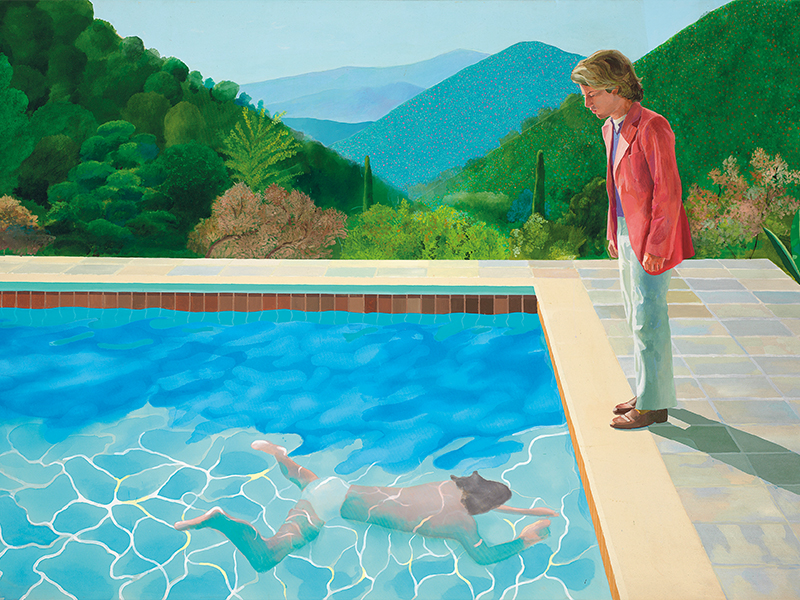
David Hockney in 10 Artworks: David Hockney, Portrait of an Artist (Pool with Two Figures), 1972, private collection. © David Hockney. Christie’s.
Before it sold at Christie’s for a record $90.3 million, Portrait of an Artist (Pool with Two Figures) began as a fortuitous accident. Hockney found two photographs lying together on the floor of his top-floor flat at 17 Powis Terrace, the Notting Hill home and studio he had kept since 1962. One picture was of a figure swimming underwater, the other a young man contemplating something down in front of him. Hockney liked the juxtaposition and started the painting, fusing the two motifs he had been working on for a while—the swimming pool and the double portrait. But months of reworking went nowhere, and he destroyed the canvas. In 1972, with a New York show looming, he decided to revisit the composition.
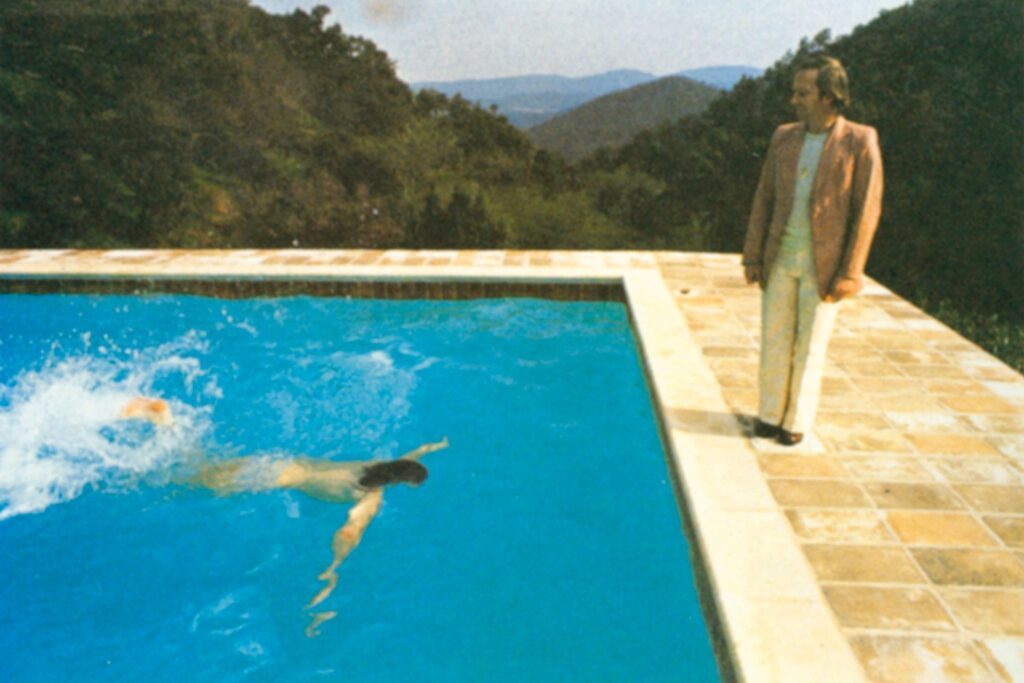
David Hockney in 10 Artworks: Preparatory photograph for Portrait of an Artist (Pool with Two Figures) taken in 1972 at Le Nid du Duc, a villa near Saint-Tropez in the south of France. © David Hockney. Christie’s.
Hockney took a camera to a villa near Saint-Tropez and staged hundreds of poolside shots with friends, then pinned the results across his studio wall back in London. He added photographs of Peter Schlesinger in a pink jacket, the American artist who had been his lover and muse until their breakup the year before. Hockney created the painting from that wall of images—working long days for two weeks straight—and finished the night before the canvas shipped. In 2018, the painting set a new record for the most expensive artwork by a living artist sold at auction; Jeff Koons‘ Rabbit took over the top spot in 2019 at $91.1 million.
5. The Rake’s Progress Set and Costume Designs, 1975–1979
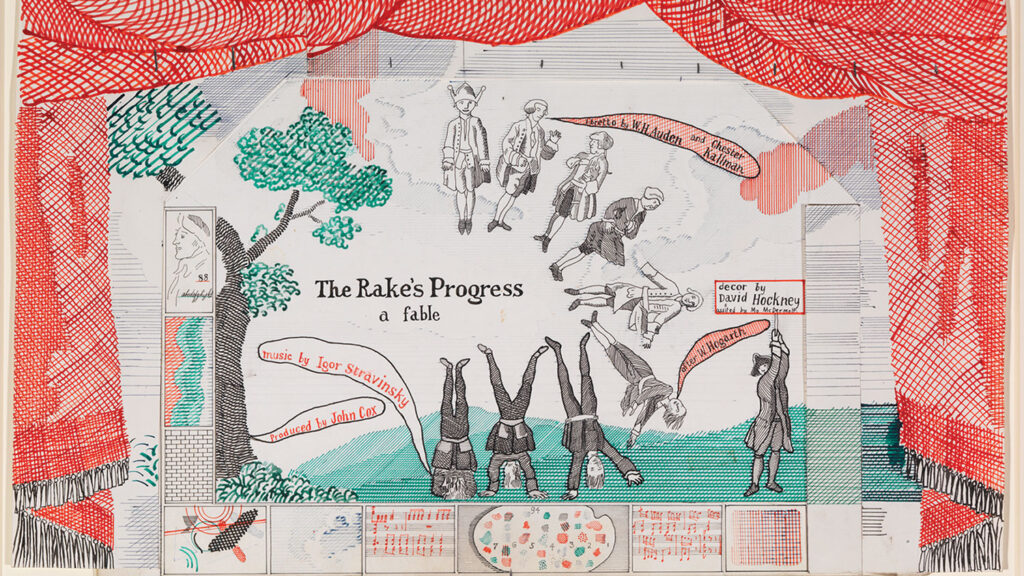
David Hockney in 10 Artworks: David Hockney, Drop curtain for The Rake’s Progress, 1975–1979, collection of the David Hockney Foundation. © David Hockney. Portland Art Museum.
Hockney was not only a great painter but also one who pulled off a lasting career in set and costume design. From 1975 to 1992, he designed for opera houses—including the Royal Opera and New York’s Met Opera—ending due to his failing hearing. Stravinsky’s The Rake’s Progress at the 1975 Glyndebourne Festival Opera was his first commission. The opera was inspired by the 18th-century print series A Rake’s Progress by William Hogarth, the great satirist who invented the “modern moral subject” in British art.
The series follows Tom Rakewell, a young heir who squanders his fortune and ends up in London’s notorious Bedlam asylum. Earlier in his career, Hockney had drawn inspiration from Hogarth as he cast himself as the rake, a young gay artist finding his way in New York City, in 16 etchings made in 1961–1963.
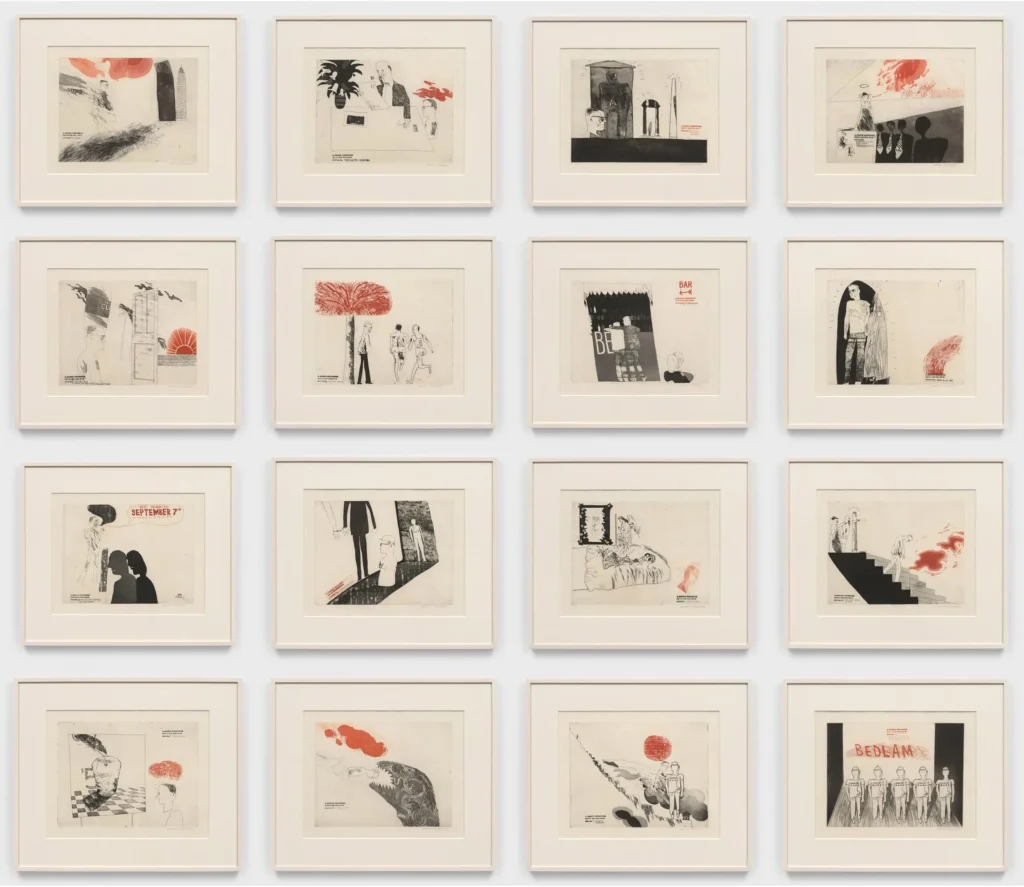
David Hockney in 10 Artworks: David Hockney, A Rake’s Progress (set of 16 etchings), 1961–1963, multiple versions in various collections. Susan Sheehan Gallery.
The designs for Stravinsky’s opera were based on crosshatching, the tight parallel lines used in prints to create shading. Hockney limited the palette to red, blue, and green, the ink colors available in Hogarth’s time. He worked intently on all practical details, making extensive watercolor and ink costume studies and building scale models. His designs emerged like old prints brought to life, but with a playful Hockney edge. A multimedia installation of Hockney’s many celebrated designs is programmed for the Turbine Hall of Tate Modern to coincide with what would have been his 90th birthday in 2027.
6. Pearblossom Hwy., 11–18th April 1986, #2
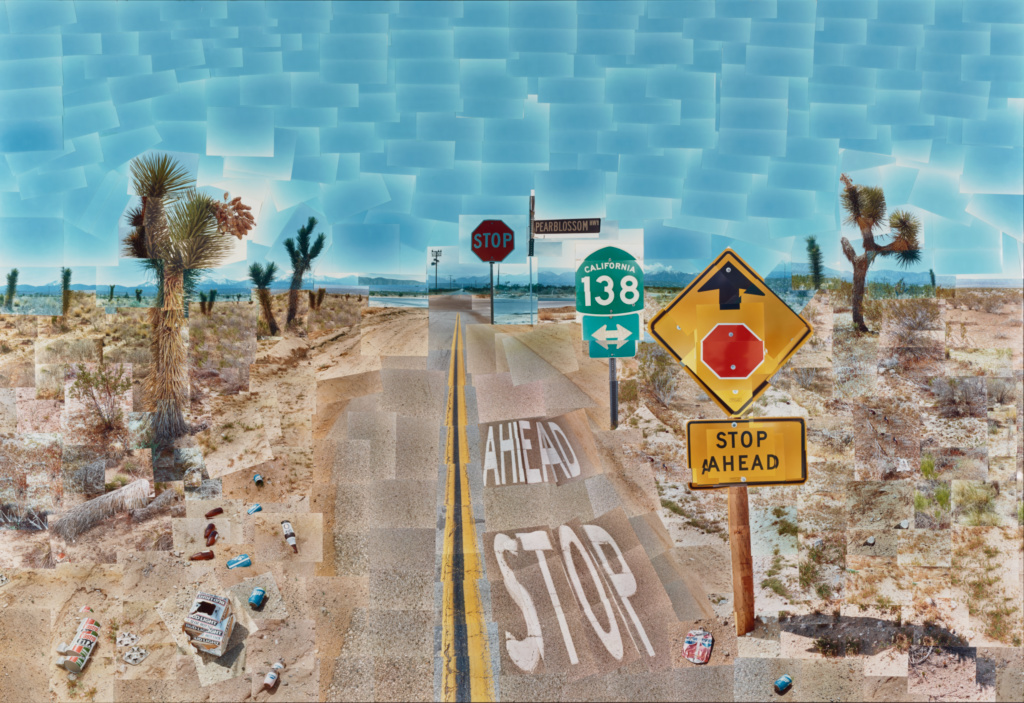
David Hockney in 10 Artworks: David Hockney, Pearblossom Hwy., 11–18th April 1986, #2, 1986, J. Paul Getty Museum, Los Angeles, CA, USA. © 1986 David Hockney.
The closest encounter Hockney had with Cubism and the modern artist he revered most, Pablo Picasso, was when he devised the complex photocollages he called “joiners.” By 1982, Hockney had begun building images from multiple small photographs, taken from different angles and positions, like a jigsaw puzzle. The joiners allowed Hockney to show different viewpoints and moments within a single work. He made around 150 joiners in a few months, starting with his own house and garden before turning to friends, family, and the American West. Pearblossom Hwy., 11–18th April 1986, #2 is the ultimate culmination of that approach.
Hockney photographed a road junction in the Mojave Desert over the course of a week. The first version of the work was commissioned for a Vanity Fair story, but it was never published. This second version was built from larger prints, making the finished collage bigger too, at about 6 x 9 ft (1.8 x 2.7 m). Both versions are now at the Getty. Hockney called the compound images “a panoramic assault on Renaissance one-point perspective.” Other famous examples include a 1982 portrait of Hockney’s mother built from dozens of separate frames, and his attempt to hold the vast landscape of the Grand Canyon in a single photocollage.
7. A Bigger Grand Canyon, 1998
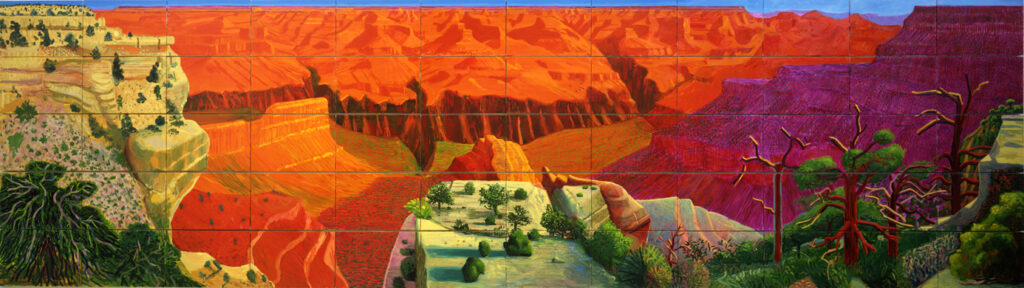
David Hockney in 10 Artworks: David Hockney, A Bigger Grand Canyon, 1998, National Gallery of Australia, Canberra, Australia. © David Hockney. The David Hockney Foundation.
Hockney’s visual experimentation with one of the great wonders of the natural world came out of a fascination with its vastness and noticing the movement of light and color across the layered rock formations when he first visited the site in the 1960s. This monumental oil landscape was painted from memory in Hockney’s hangar-sized Hollywood Hills studio, inspired by Grand Canyon photocollages he made in the 1980s and Thomas Moran’s 19th-century panoramic version. It consists of 60 separate canvases arranged in a grid of about 7 by 24 ft (2 x 7 m). An exploration of Hockney’s concept of reversing perspective, each section has its own vantage point, creating the effect of pulling the viewer inside the space.
The same obsession with how we process visual information carried Hockney into his next project. He adopted the unorthodox belief that certain Old Master images were too optically precise to have been drawn by eye alone. In 2001, he published the controversial book Secret Knowledge, arguing that painters had used mirrors and lenses for centuries to achieve that realism. Art historians were not charmed by a 600-year theory with little documentary evidence, and the dispute made for entertaining sparring for the rest of his life.
8. Bigger Trees Near Warter, 2007
David Hockney in 10 Artworks: David Hockney, Bigger Trees Near Warter or/ou Peinture Sur Le Motif Pour Le Nouvel Age Post-Photographique, 2007, Tate, London, UK. © Estate of David Hockney. Image credit: Richard Schmidt. ArtUK.
After becoming a star in reliably sunny Los Angeles—Hollywood Hills home and all—Hockney started returning to Yorkshire regularly in the 1990s to visit his aging mother. She died in 1999. He eventually relocated to the coastal town of Bridlington and spent the better part of a decade focused on landscape painting, swapping the sunshine and palm trees for the changing seasons and rolling hills of his native northern England. The spring arrival of the hawthorn blossoms, the beautifully dense white blooms of the “May” tree, became a yearly fascination.
Hockney was endlessly inspired by the English landscape. He took the technique of composing large images from multiple smaller frames that he explored with his joiners to its maximum expression in the painting-turned-mural Bigger Trees Near Warter. Over 40 ft (12 m) wide and comprised of 50 canvases painted from different perspectives, it depicts a Yorkshire sycamore grove just before spring in astonishing detail. Each canvas was painted en plein air, then scanned and assembled using photomosaic digital tools. The final work was produced with the help of Hockney’s team and painstakingly documented by thousands of photographs. It was donated to Tate in 2008.
9. 82 Portraits and 1 Still-life, 2013–2016
David Hockney in 10 Artworks: David Hockney in his Los Angeles studio, 2016. © David Hockney Photo: Jean-Pierre Goncalves de Lima. Artsy.
Hockney returned to portraiture slowly. He had stopped painting and left Yorkshire for Los Angeles, then eased back in with a single portrait of his longtime assistant and partner, JP Gonçalves de Lima. The sittings became a series. Between 2013 and 2016, he sat 82 family members, friends, and figures from his artistic circle in the same yellow chair. Against the same blue-green ground, on identical 48-by-36-inch canvases, he painted each from life over two or three days in what he called a “20-hour exposure.” For this series, he only painted people he knew, convinced that the better he knew the model, the truer the portrait.
Working in the British portrait tradition, Hockney measured himself against those Old Masters whom he repeatedly argued leaned on optics. He considered the 82 paintings, plus a lone still life of fruit on a bench, a single body of work rather than separate portraits. Art dealer Larry Gagosian, architect Frank Gehry, and conceptual artist John Baldessari appear, but so do friends, helpers, and his sister Margaret, each given the same scale and attention. Birtwell also returns, the muse and close friend he famously painted four decades earlier, along with her cat Percy.
10. iPad Paintings, Arrival of Spring, Normandy, 2020
David Hockney in 10 Artworks: David Hockney, Arrival of Spring, Normandy, 2020 series, 2020, exhibition view of David Hockney 25, 2025, Louis Vuitton Foundation, Paris, France. © David Hockney. © Fondation Louis Vuitton. Marc Domage. Contemporary Lynx.
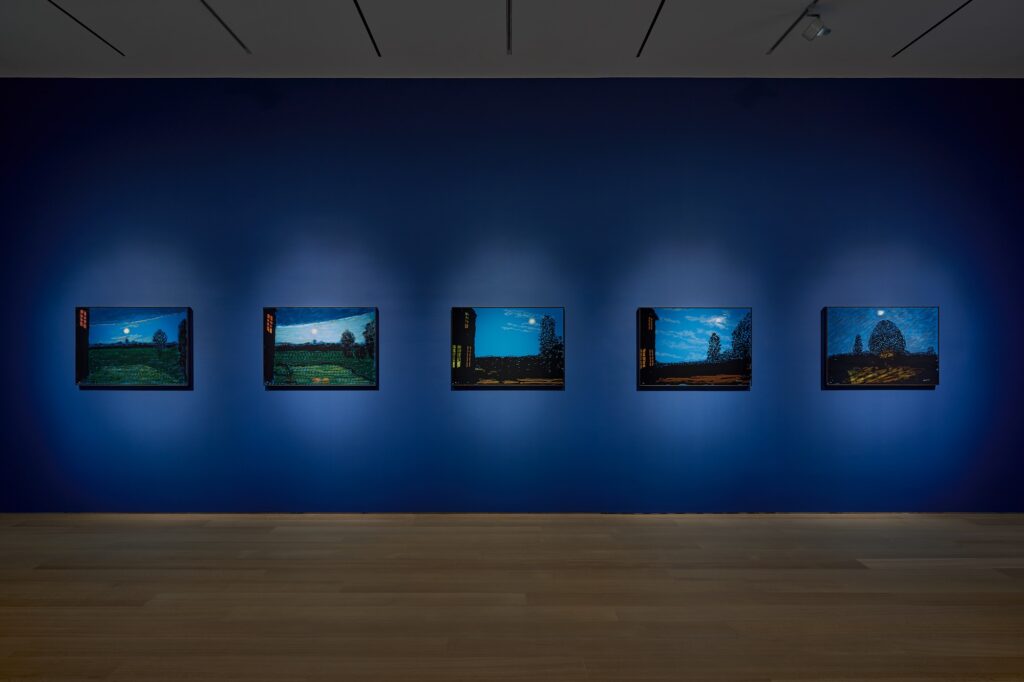
Hockney first used the iPad in 2011 for a series of 51 drawings, The Arrival of Spring in Woldgate, East Yorkshire. This entry notably logs him revisiting the subject after moving to a Normandy farmhouse in 2020. As the world locked down, Hockney shared an iPad image of a patch of daffodils as a message of hope; 220 iPad drawings were later published in the aptly titled book 220 for 2020. For Hockney, the iPad was as much an artistic tool as a brush, with the added benefit of being backlit, allowing him to draw and paint the moon outdoors, at night.
David Hockney in 10 Artworks: David Hockney, Moon Room series, exhibition of David Hockney: The Moon Room, 2026, Pace Gallery, New York City, NY, USA.
A perennial innovator, Hockney’s embrace of cutting-edge digital technology befits the arc of his career. He had been at the forefront of experimentation since the 1980s, incorporating the latest technology of the time—fax machines and office copiers—into his artistic practice. Hockney even took part in the 1989 São Paulo Biennial with an artwork assembled by fax. He was also an early user of Macintosh digital art tools as well as a producer of video art using portable high-definition video cameras.
Hockney’s experimentation was as long as his life, notably becoming one of the first painters to mine the artistic possibilities of digital tools like the iPhone and iPad, all well past “retirement age.” For Hockney, the use of technology was not a gimmick but the culmination of a career dedicated to the relentless pursuit of new ways of looking.