

Edvard Munch and the Chocolate Factory
For over 100 years, 12 large Edvard Munch paintings have graced the walls of the Freia chocolate factory, making the workers’ lunch hall a...
Theodore Carter 6 July 2026
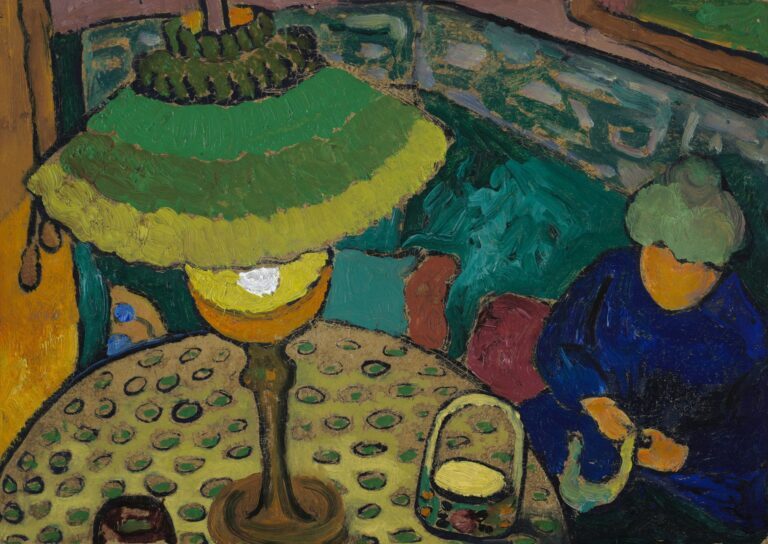
Erma Bossi, Interior with Lamp, 1909, Lenbachhaus, Munich, Germany.
In 1905, four German artists in Dresden formed a group called Die Brücke (The Bridge), which ultimately shaped what we know today as Expressionism. Though Edvard Munch’s expansion of Post-Impressionist ideas prefigured the movement, the artists of Die Brücke provided a clearer understanding of what makes a work of art Expressionist. Just six years later, in 1911, Wassily Kandinsky, Gabriele Münter, and Franz Marc—three artists now associated with Expressionism—further pioneered modern art with their exhibitions and almanac titled Der Blaue Reiter (The Blue Rider).
Expressionism is one of the essential artistic movements of modernism in the 20th century. Expounding upon the modernist notion of radically recreating reality, the Expressionist painters sought to externally impress heightened emotions on canvas and present their worldviews through distortion and disorientation of color. Expressionist artworks revel in a myriad of moods and feelings; they present a new truth in the swiftly modernizing and shifting world of the early 20th century. These 10 paintings are the epitome of expressing the world through a subjective lens.
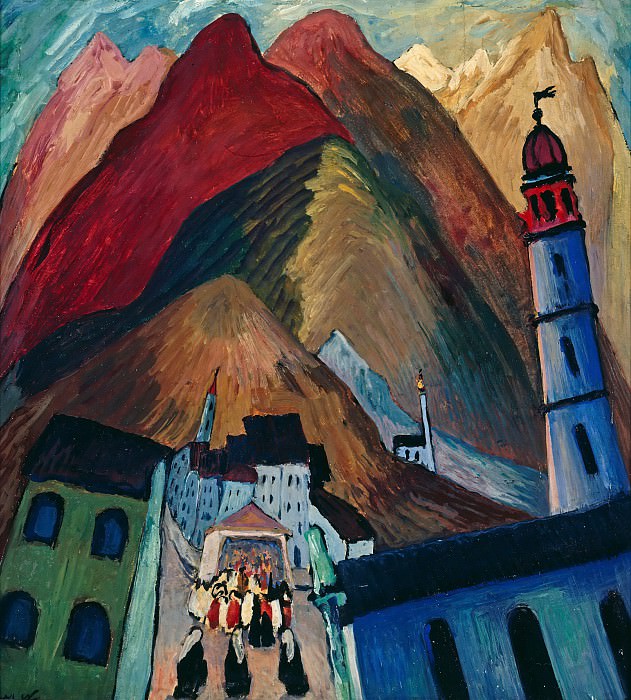
Marianne von Werefkin, Procession in Ascona, 1924, Berggruen Museum, Berlin, Germany.
Marianne von Werefkin was a founder of yet another Expressionist group. This group, Neue Künstlervereinigung München (New Artists’ Association Munich or NKVM), founded in Munich in 1909, was the predecessor to Der Blaue Reiter. Werefkin, a native of Russia, was forced to flee Germany at the outbreak of war in 1914. She emigrated to Ascona, Switzerland, the setting of this Expressionist painting. The titular procession at the bottom center of the composition is dominated by buildings and mountains layered in various colors. Though the surroundings tower over the people in the town, the distorted buildings and canted angles point the viewer’s eye to the figures below.
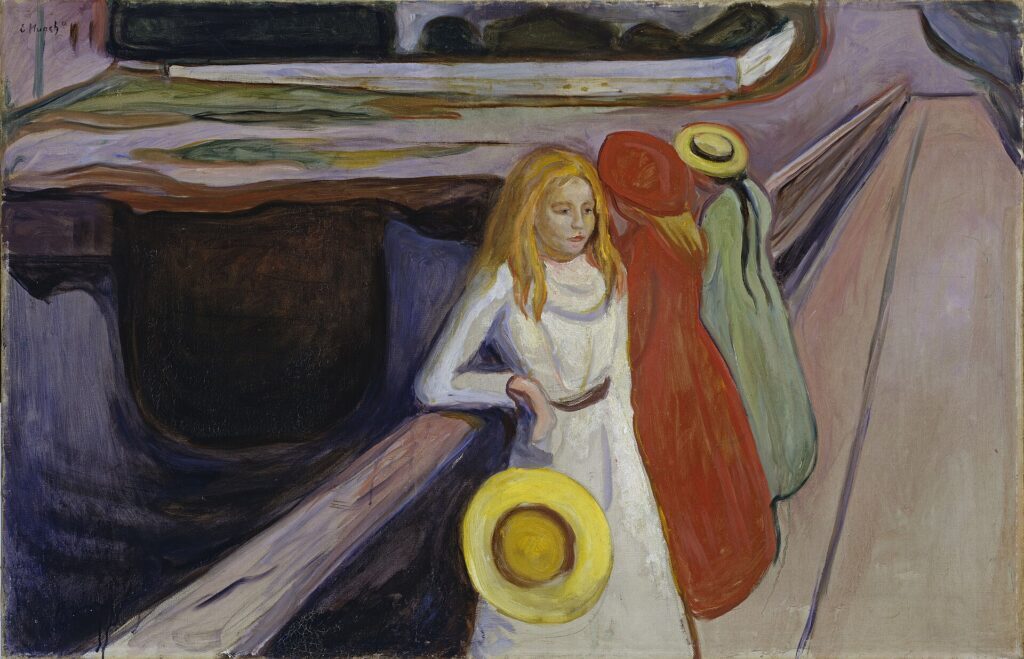
Edvard Munch, Young Girls on a Bridge, 1901, Hamburger Kunsthalle, Hamburg, Germany.
Young Girls on a Bridge is one of a series of 12 similar paintings by Edvard Munch. This piece, from 1901, is the only one that shows the full facial features of the girl in the white dress. The rest of the composition is emblematic of Munch’s atmospheric style. His swirling use of color and lines enhances the work’s fervent emotionalism. Meanwhile, how the girls stand on the bridge, one facing forward while the other two look at the view, offers an ambiguously psychological interpretation. Undoubtedly, Munch’s work was one of the most important precursors of Expressionism.
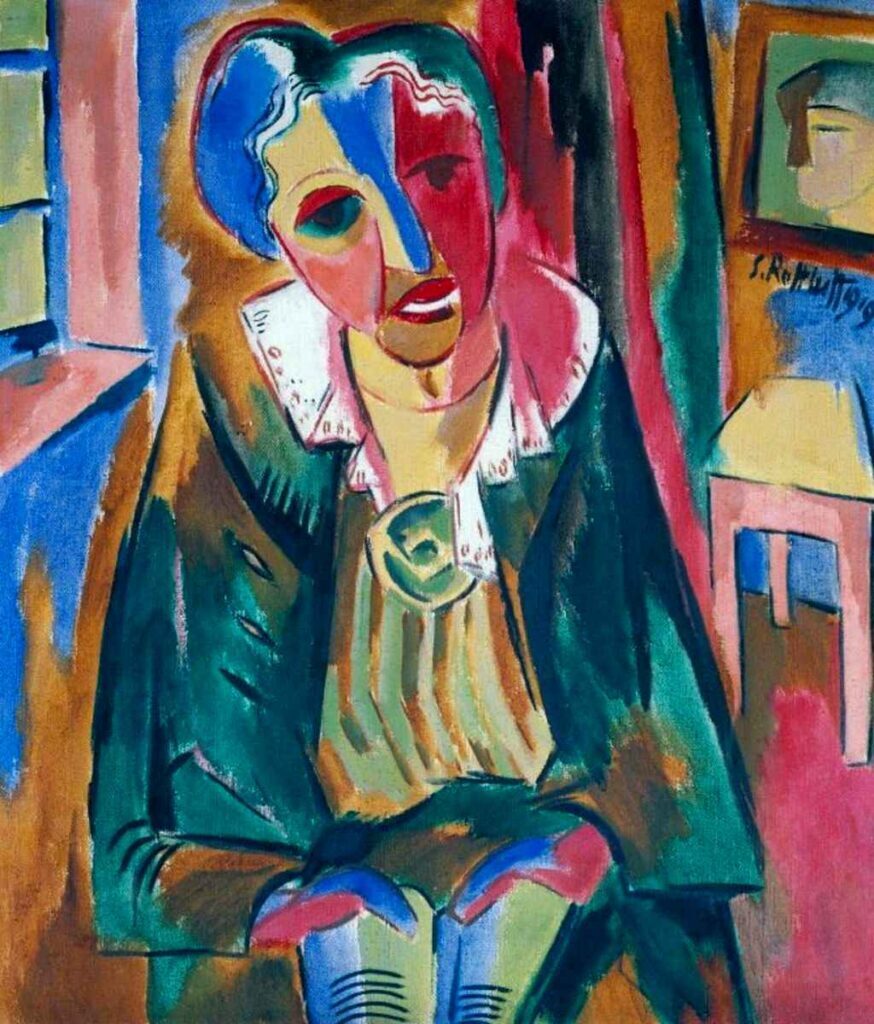
Karl Schmidt-Rottluff, Dr. Rosa Schapire, 1919, Tate, London, UK.
Karl Schmidt-Rottluff painted this portrait of Dr. Rosa Schapire in 1919 and gifted it to her. Dr. Schapire was an art historian and supporter of Schmidt-Rottluff and Die Brücke. This artwork is a great example of an Expressionist portrait. Schmidt-Rottluff presents Dr. Schapire in a wonderful array of angular color formations. One can sense the admiration the artist felt for his subject, especially in eschewing Realism for pure Expressionism. Dr. Schapire hung this artwork in her apartment in Hamburg, Germany. She saved it along with other works of art while escaping Nazi oppression in 1939.
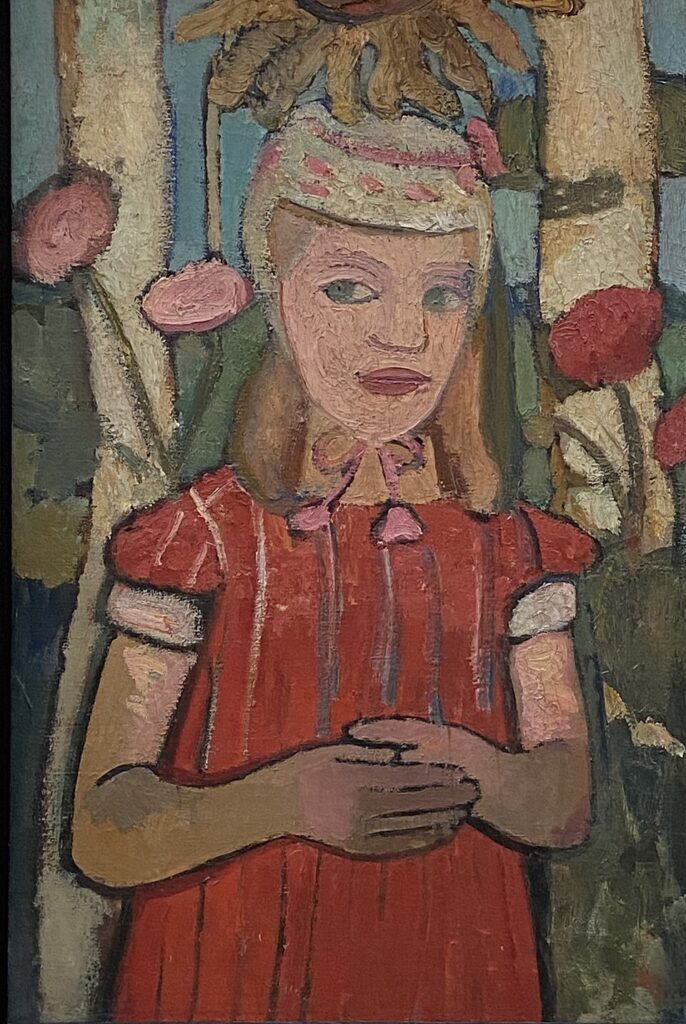
Paula Modersohn-Becker, Girl in a Red Dress Standing Under a Sunflower, 1907, private collection. Photograph by Paradise Chronicle via Wikimedia Commons (CC BY-SA 4.0).
Paula Modersohn-Becker’s fascination with girlhood is best rendered in Girl in a Red Dress Standing Under a Sunflower. Although not a member of Der Blaue Reiter, Modersohn-Becker is widely regarded as an important precursor of German Expressionism. The artist depicted many facets of femininity in both portraits and self-portraits. This piece centers on a young girl in a red dress standing pensively. She wears a pink and white bonnet. A sunflower rises above her head in the background. Two tree branches and other colorful flowers also surround her. The girl’s eyes hold on something to her right while her hands are clasped together, a thumb protruding out.
The color and curiosity of youth are on full display, expressed in Modersohn-Becker’s brilliant style. The artist’s work, along with many other Expressionist painters, was scorned by the Nazis and labeled as “degenerate.” The Paula Modersohn-Becker Museum, opened in 1927, still thrives in Germany today.
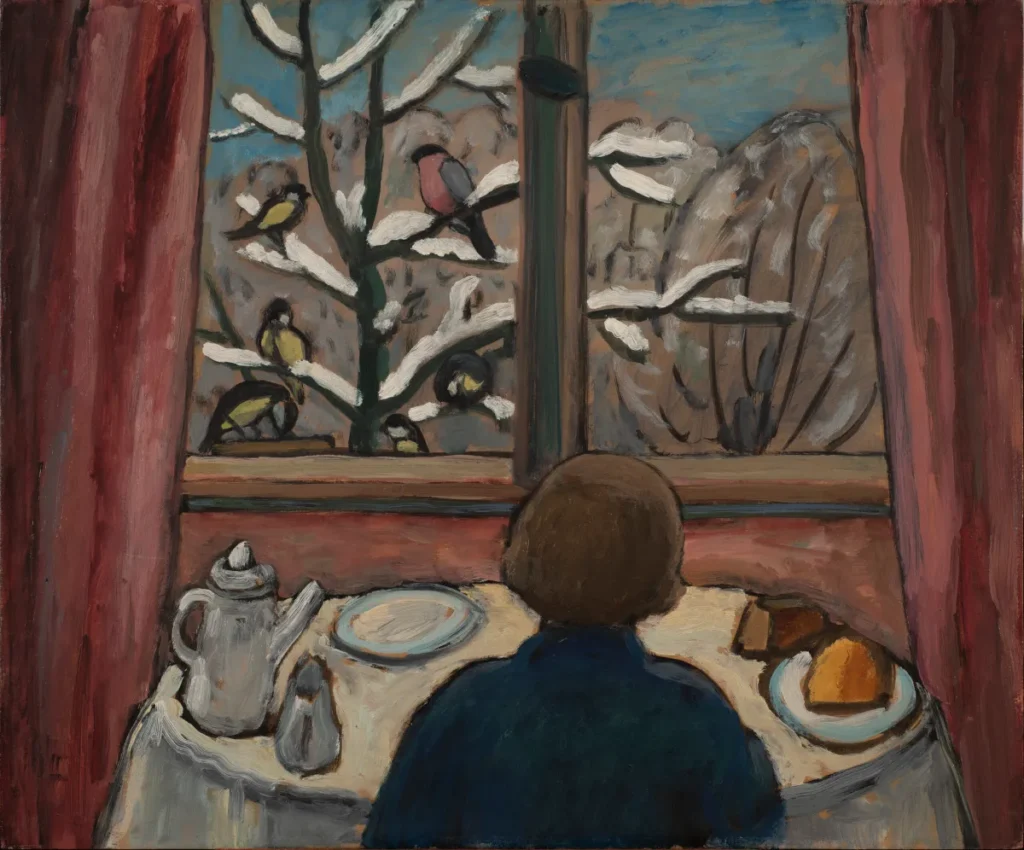
Gabriele Münter, Breakfast of the Birds, 1934, National Museum of Women in the Arts, Washington, DC, USA.
As one of the founders of Der Blaue Reiter, Gabriele Münter focused her early Expressionist paintings on landscapes (some featuring her partner, Wassily Kandinsky), self-portraits, and still lifes. For Breakfast of the Birds, she wrote:
After a short period of agony, I took a great leap forward from copying nature, in a more or less Impressionist style, to feeling the content of things
Indeed, the piece is one of closed-in reflection and isolation. The thick brushstrokes and drab colors convey a sense of both comfort and unease. We see simply formed birds sitting on snow-covered branches through a window. A woman, the back of her head toward us, sits quietly watching them. The “content of things” is made wonderfully and expressively ambiguous.
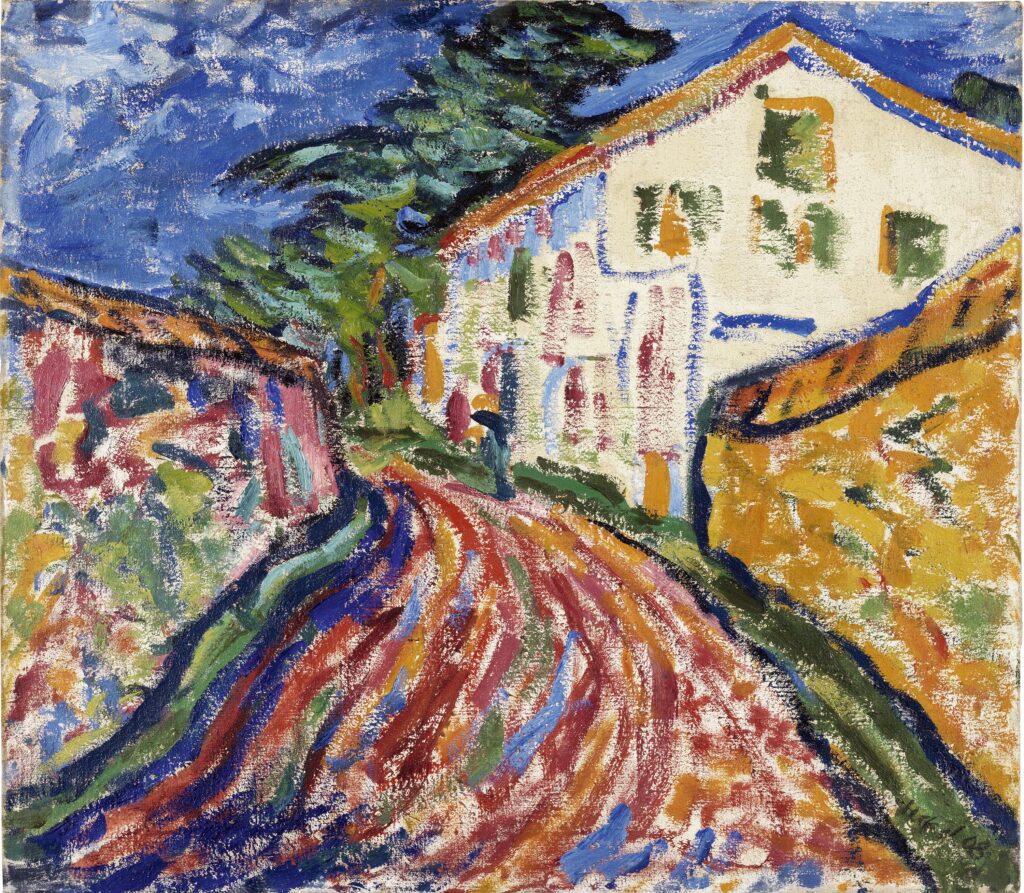
Erich Heckel, House in Dangast (The White House), 1908, Thyssen-Bornemisza Museum, Madrid, Spain.
This painting by Erich Heckel overlaps with Fauvism, another artistic movement beginning around the same time that Heckel, along with Karl Schmidt-Rottluff, Ernst Ludwig Kirchner, and Fritz Bleyl, co-founded Die Brücke. Like Expressionism, Fauvism developed from Post-Impressionism. Both movements collide in their bold use of color and imprecise brushstrokes. Heckel was especially proficient in expressive brushstrokes, designing compositions filled with lively color. Here he depicts a white house (also featured in another Schmidt-Rottluff painting) in the village of Dangast, Germany. This was a popular spot for the artists of Die Brücke. Heckel’s piece is one of the best examples of an Expressionist landscape.
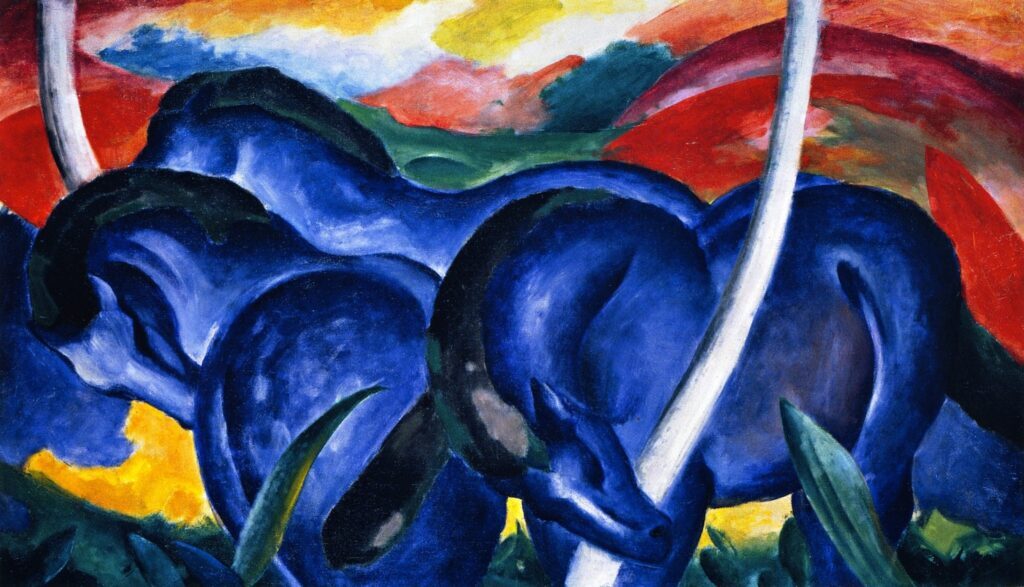
Franz Marc, Large Blue Horses, 1911, Walker Art Center, Minneapolis, MN, USA.
Franz Marc’s Large Blue Horses was shown in Der Blaue Reiter’s first exhibition in 1911. Marc’s signature touchstones of primary colors and transcendent portrayal of animals are on full display. While more geometric than the work other Expressionist painters, signaling a nearly Cubist style, Marc’s paintings fit the Expressionist character simply by their ability to evoke a multitude of strong emotions. The centered blue horses contrast with the red hills and colorful sky in the background, making a balanced and harmonious composition. In fact, Marc’s Expressionist artwork was inspired by another art form: the symphonies of musical compositions.
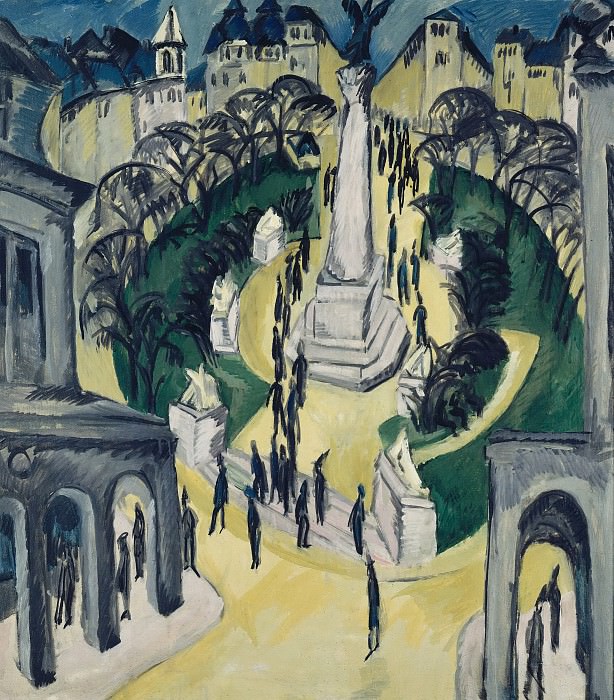
Ernst Ludwig Kirchner, The Belle-Alliance-Platz in Berlin, 1914, Neue Nationalgalerie, Berlin, Germany.
The townsfolk of Belle-Alliance Square (now Mehringplatz) in Berlin are simply shadowy stick figures in this painting by Ernst Ludwig Kirchner. Their presence is highlighted by the composition’s tilted perspective. Kirchner distorts a popular urban location, contrasting the yellow road with the muted tones of the trees and buildings. It’s a striking and expressive depiction of a cityscape, revealing the peculiar alienation of urban life.
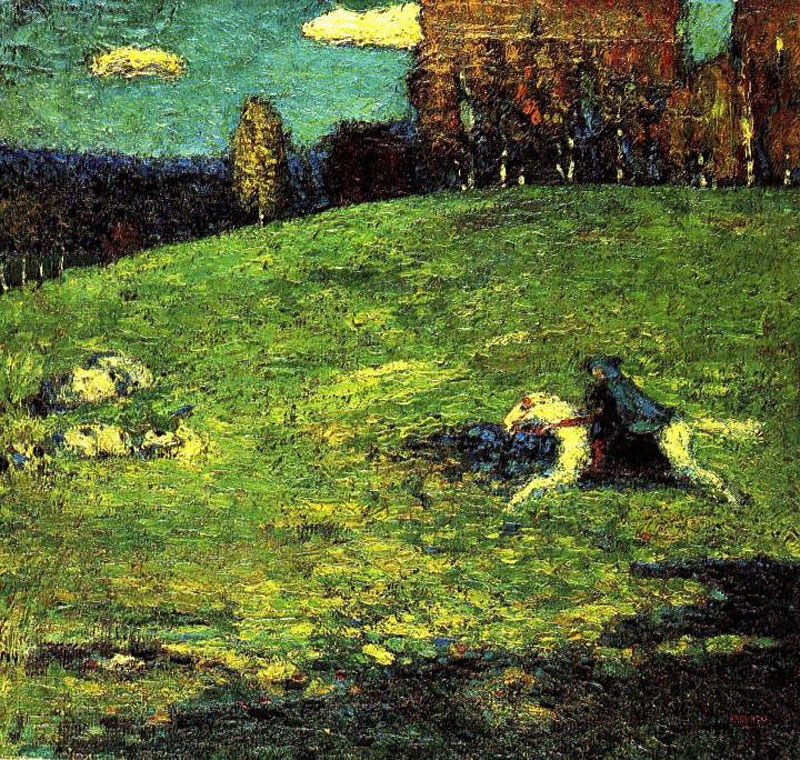
Wassily Kandinsky, The Blue Rider, 1903, private collection. Wikimedia Commons (public domain).
Kandinsky’s The Blue Rider bridges the gap between Impressionism and Expressionism in its technique. However, the heavy use of impasto and eye-catching color in the painting separates it as a true work of early Expressionism. The name Der Blaue Reiter is often associated with this painting, but it also reflects Kandinsky’s and Franz Marc’s shared fascination with the symbolic meaning of the color blue and the motif of the rider. It is a dynamic and forceful piece, wondrous in its titular subject and lively in its dominant shades of green.
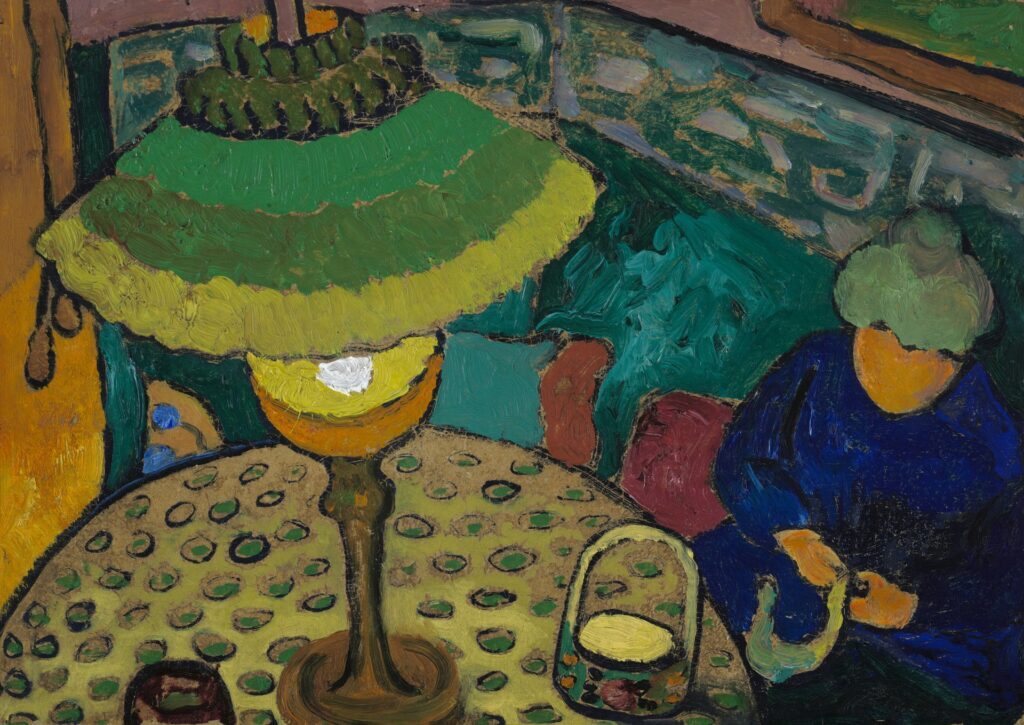
Erma Bossi, Interior with Lamp, 1909, Lenbachhaus, Munich, Germany.
Erma Bossi, a Croatian-born Italian Expressionist painter, was an original member of the Munich New Association of Artists in Germany. This cozy painting by Bossi is another spectacular work of Expressionism. A faceless woman appears to be knitting under the light of a lamp. The heightened colors and simplified forms of Expressionism all appear. However, this piece stands out in its high perspective. The lamp and its colorful shade dominate the composition as we look down on the domestic interior. It is a delight to look at, utilizing expressive distortion for emotional comfort and ease.
DailyArt Magazine needs your support. Every contribution, however big or small, is very valuable for our future. Thanks to it, we will be able to sustain and grow the Magazine. Thank you for your help!

A writer devoted to the arts with a Master's degree in English and a specialization in film studies/history. Ars longa, vita brevis.

Coffee-fueled writer, artist, and daydreamer.
For over 100 years, 12 large Edvard Munch paintings have graced the walls of the Freia chocolate factory, making the workers’ lunch hall a...
Theodore Carter 6 July 2026
Egon Schiele lived for 28 years and painted as though he knew exactly how many years he had. Few bodies of work in modern art carry the biographical...
Errika Gerakiti 1 June 2026
Examining Franz Marc’s most iconic animal paintings reveals how the German Expressionist used color and form to convey the spiritual essence of...
Lisa Scalone 15 May 2025
The purpose of art for a group of avant-garde individuals at the turn of the 20th century was no longer the realistic rendition of the natural world,...
Guest Author 29 February 2024



,_oil_on_canvas,_52.1_x_54.6_cm,_Stiftung_Sammlung_E.G._B%C3%BChrle,_Zurich.jpg)