1. The Fall of Phaethon: Greatly He Dared
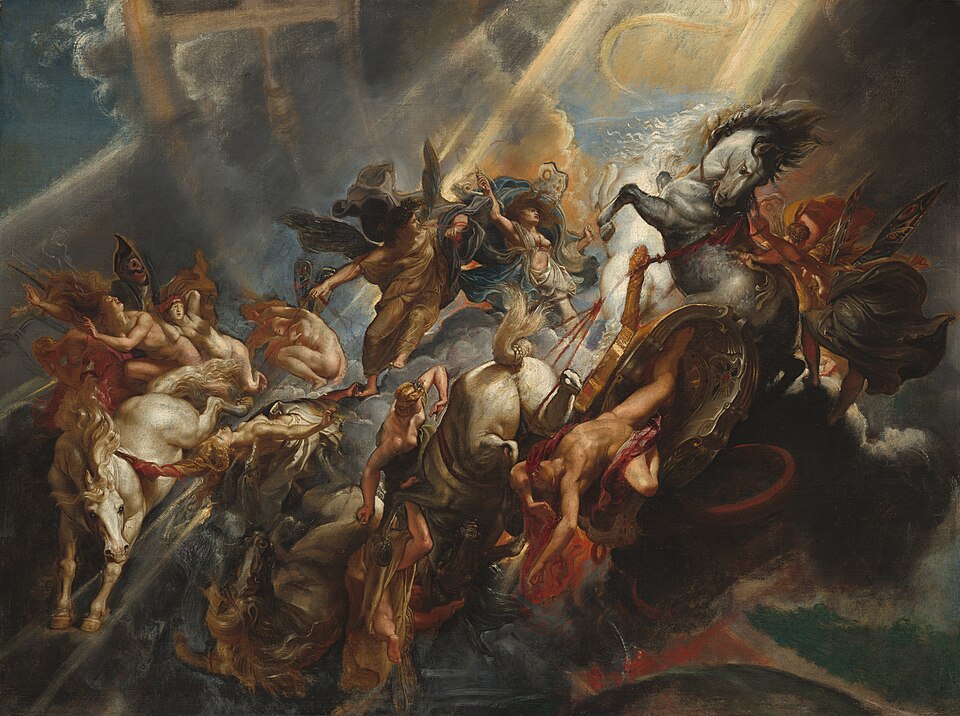
The epitaph of the Phaethon says: “Here Phaethon lies who in the sun-god’s chariot fared. And though he greatly failed, more greatly he dared.”
Phaethon, mortal son of the Greek god Helios, doubted his divine origin. Demanding proof from his father, he went to drive the sun’s chariot for a day. However, his inexperience culminated in absolute chaos that Peter Paul Rubens, supreme master of Flemish Baroque, immortalized with his masterful use of light, color, and movement—Zeus interceded, struck Phaethon with a thunderbolt, and the latter fell mortally from the sky.
The female figures with butterfly wings represent the hours and the seasons. They were so horrified by the scene that the circadian cycle became interrupted. In the background, an astrological arc represents the zodiac, which, in relation to the winged figures, suggests a disruption of the cosmic order.
2. Beckmann and the Gravity of Fall Beyond Freedom
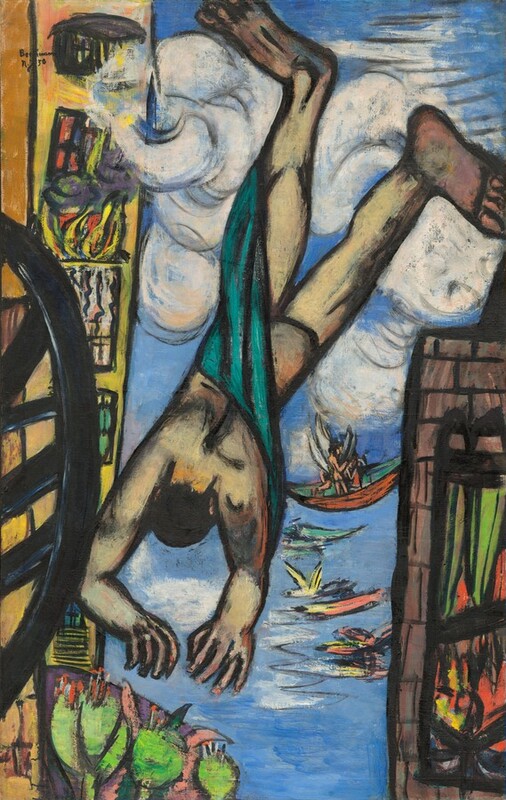
Somewhere between German Expressionism and New Objectivity, Max Beckmann transformed a falling body into a visual testament not only of his turbulent existence but of the entire post-World War II era marked by post-traumatic stress and persecution. The absence of a face and clothing translates vulnerability and universality; the fall of one represents the collapse of all, and the fact that no one is free from war. The distorted forms, strong contours, and vibrant colors convey a sense of inexorable descent. The body does not appear tense but oscillates between two worlds: optimism and pessimism, loss of roots and the search for liberation.
As a regeneration of a once “degenerate” painting, we feel the heart of an artist transforming the imminent collision into a visual scream against brutality. Mathilde “Quappi” Beckmann, the painter’s second wife, preserved it all her life before gifting it to the National Gallery of Art in Washington. Falling Man is about a figure “dropped from the clouds by angels.” And the work may have roots in the author’s illustrations for Goethe’s Faust, depicting the moment when Mephistopheles sends Faust to “the realm of the mothers.”1
3. Harunobu’s Fall: The Jump of Hope
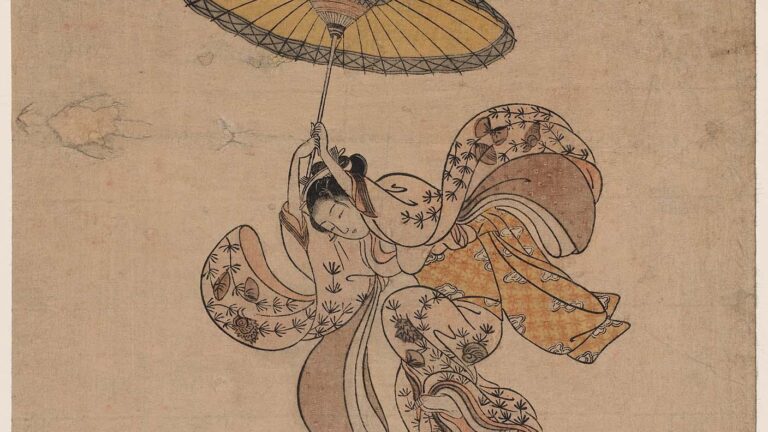
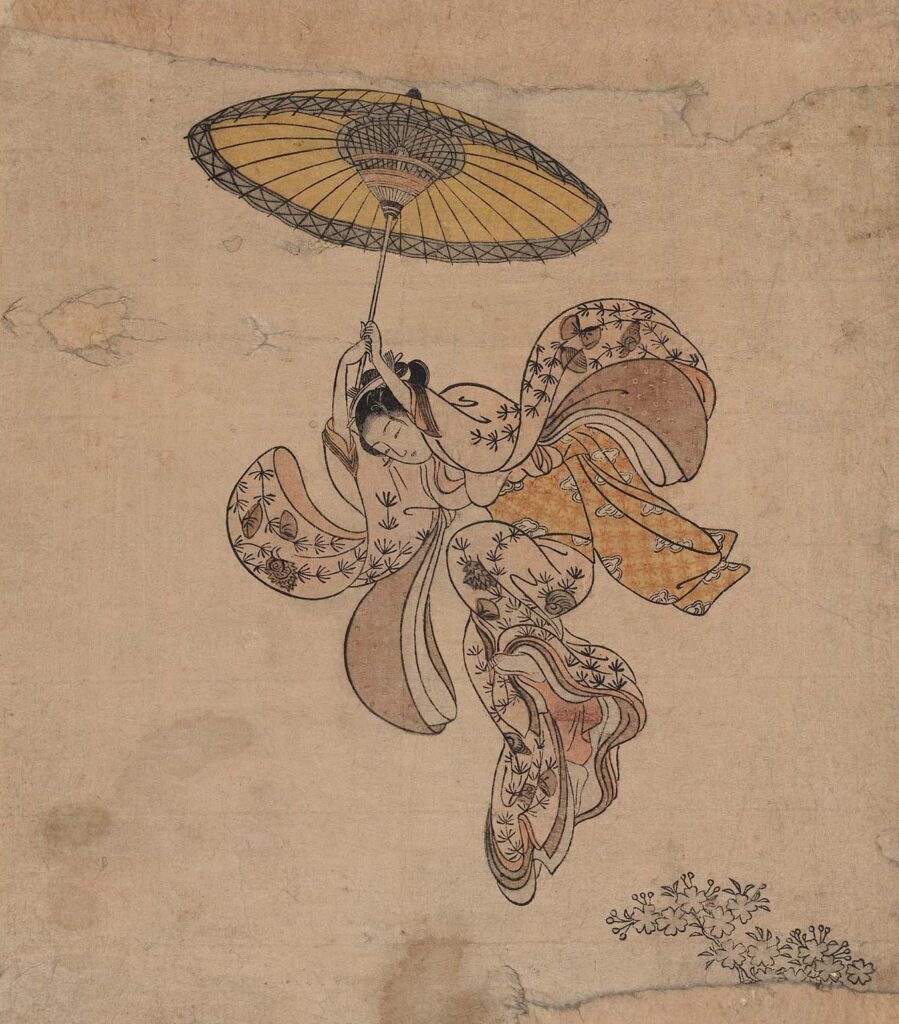
What would it be like to jump in a ukiyo-e world? The absence of shadows and the emphasis on outlines made the figure seem airborne, reinforcing the idea that existence is merely a fleeting moment. Harunobu’s typical fragility glorifies perfectly this moment of poetic lightness, without fear. However, literally, jumping from a balcony of the Kiyomizu-dera temple was a dangerous ritual of faith, practiced during the Edo period (from the 17th to 19th centuries). If people survived, the temple deity (Kannon) would grant their wish. Otherwise, they would achieve immediate enlightenment and enter paradise.2
The umbrella is a poetic symbol as jumpers used no accessories. It was a purely spiritual and physical act. “Jumping from the Kiyomizu platform” has remained as a Japanese expression meaning “to throw oneself headlong.” Between 1694 and 1864, 234 actual jumps were recorded at this temple.
4. Esther: Falling on Stage in the Name of Courage
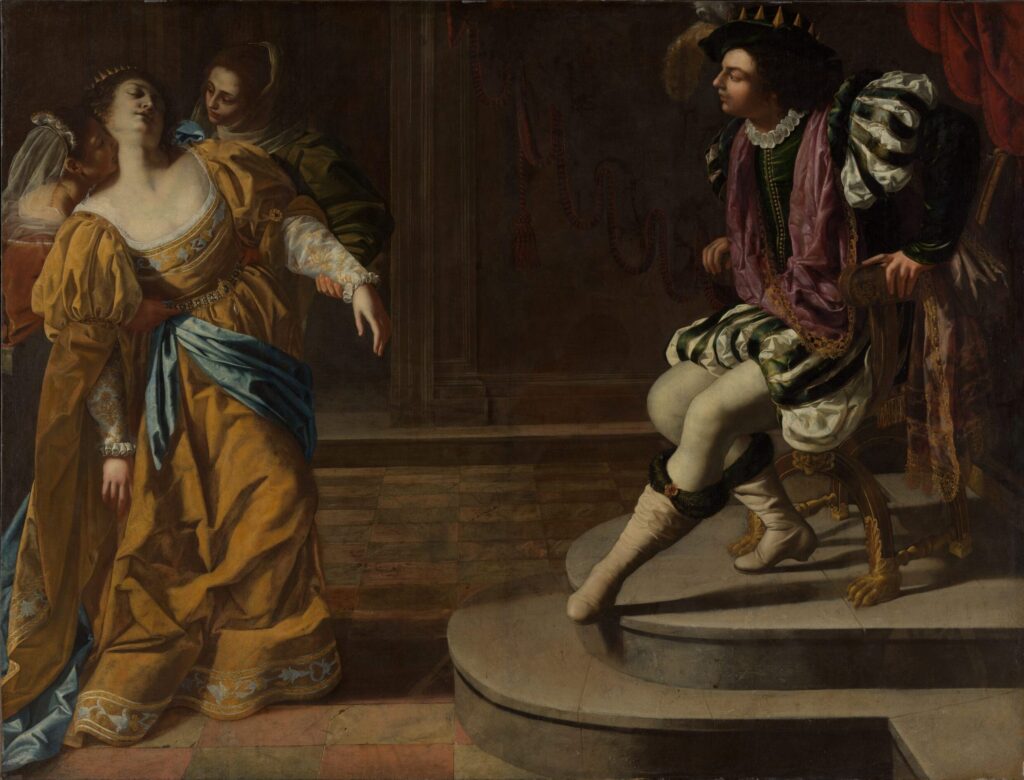
A fainting spell of exhaustion, fear, pure determination, or just hypoglycemia?
An example of how a fall can represent an artistic and even biblical triumph, the painting Esther Before Ahasuerus by Artemisia Gentileschi depicts the dramatic moment when the young Jewish woman, upon becoming queen of Persia, risks her life to save her people from an extermination planned by Haman. Just as the artist rose in an unjust male world, Esther breaks protocol, appearing uninvited, a daring act punishable by death.
The painter’s technical mastery in the use of light and shadow (chiaroscuro) and the meticulous representation of fabric and facial expressions transform a possible feigned fainting spell into an act of courage, victory, and justice.3
5. Icarus Fall and the Gravitational Power of a Dream
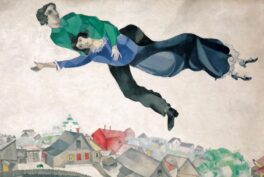
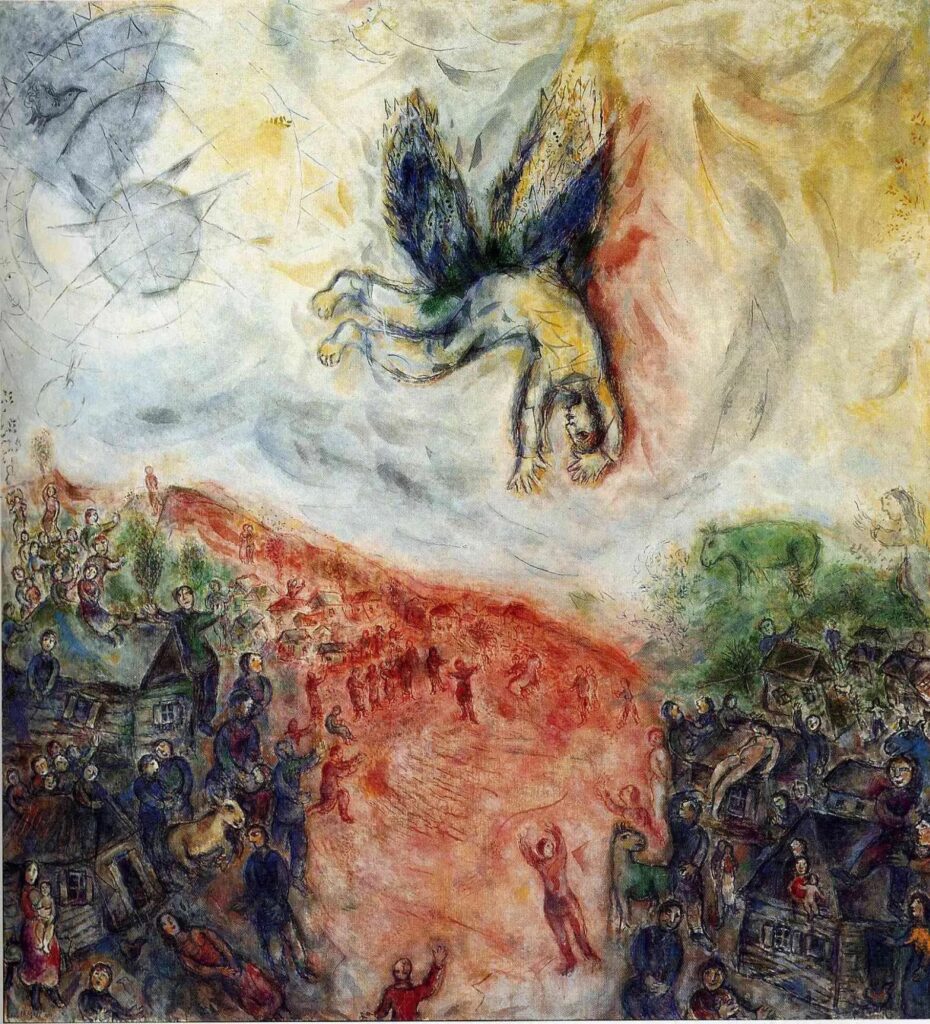
“The poet with the wings of a painter” Marc Chagall chose the most evoked fall in mythological history as a reflection of his life of wars, exile, and passion. His signature approaches of vivid colors, floating figures, and intense nostalgia in The Fall of Icarus subverts the tragic Greek myth. Instead, Chagall painted a celebration of hope and community.
Unlike classical depictions, Chagall’s Icarus doesn’t plummet helplessly into a Aegean Se, nor is he called out for his audacity. Chagall’s Icarus soars above Chagall’s beloved hometown of Vitebsk as townsfolk witness his fall and, potentially, look ahead to his survival in compassion and solidarity. In a graceful arc, his arms reach up towards the sky, maintaining a dreamlike sense of flight. We then see a fallen hero in Chagall’s fantastic ecosystem beyond introspection and hope for a happy ending.
6. Sappho and the Lover Leap into Poetic Eternity
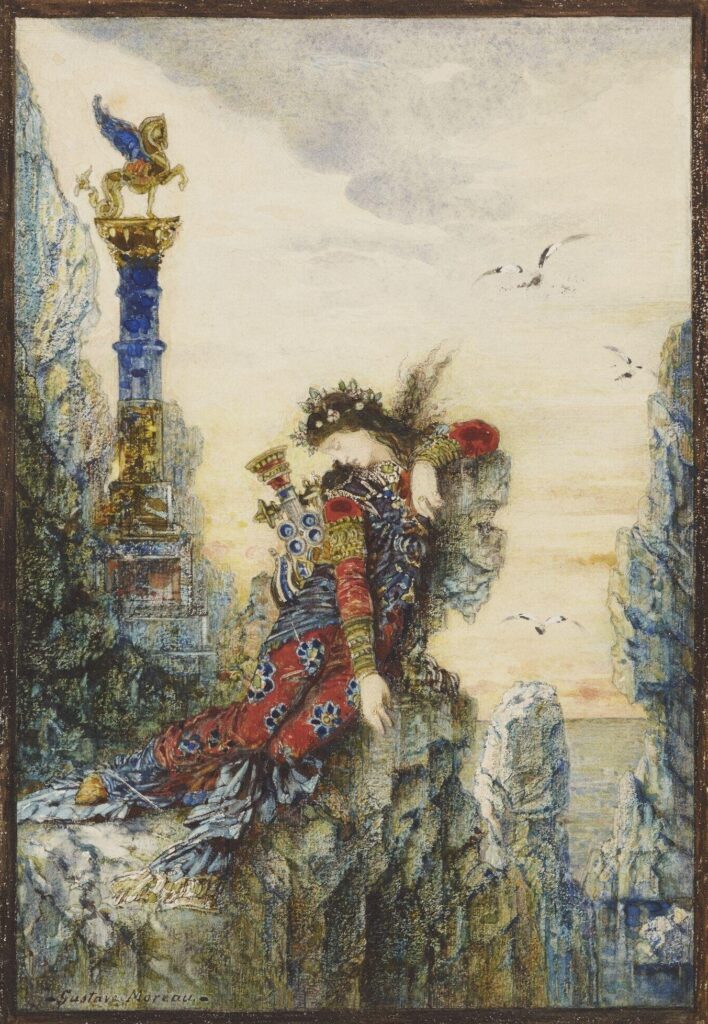
“For my Sappho, I seek the sacred character of a poetic princess. Therefore, I design her dress in a way that evokes in the mind the idea of grace, severity, and above all, that variety which is the greatest quality of the poet: inspiration. I cover this dress with flowers, birds, and all the objects of creation that are reflected in the poet’s mind.”4
Gustave Moreau’s depictions of the poet Sappho’s legendary jump and death from the Leucadian cliffs transcend mere tragedy. Through his signature Symbolist lens, Moreau transformed her despair over Pheon into a poetic exploration of mortal love, divine inspiration, and heavy burden of creative immortality. Even as she plummets into the sea, she clings to her lyre, meaning her art survives the physical body. The seagulls represent the human soul escaping its earthly cage. Her elaborately-decorated clothing and pose were taken from a Japanese woodcut, Genji Taking the Air in Summer on the Sumida by Utagawa Kunisada, which Moreau had bought in Paris.
7. The Plunge of Perseus: A Heroic Rescue
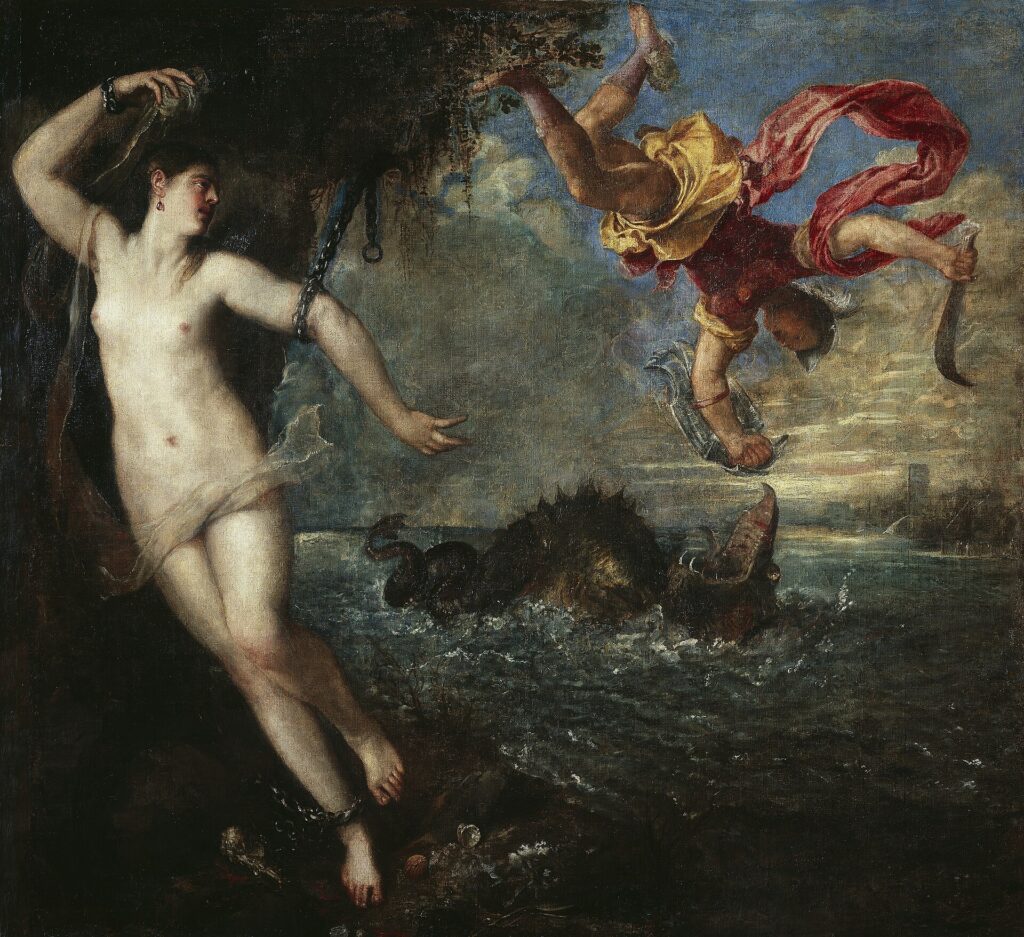
In Perseus and Andromeda, Titian demonstrates that man holds no fixed place in the language of the universe. His plunge, although dizzying, represents an act of free will, and a triumph of love over destiny. Perseus overcomes the fear of death and dives in to attack the monster before unchaining the Ethiopian princess, who was designated to be a sacrifice due to her mother’s vanity.
Infrared reflectography reveals that Andromeda’s position was altered several times, as were Perseus’s limbs, sword, and shield. After all, the descent is a dance with the air and Titian, a master of the Venetian Renaissance and a poet of sensuality, dynamism, and light, portrayed it as such.
8. The Surreal Nature of Inverted Fall
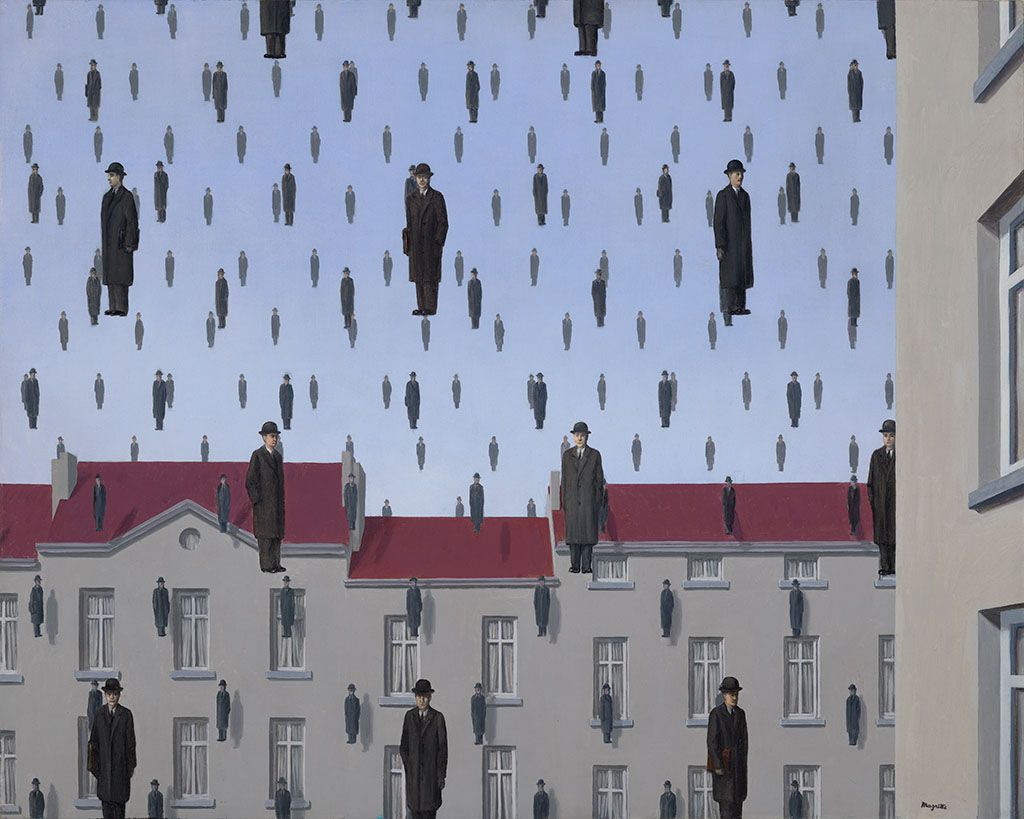
Genius of Surrealism René Magritte shows us that falling can happen in groups, routinely, and orchestrated en masse despite the elements.
The men raining from the sky represent Magritte’s common man in his standardized bowler hat. They float impassively between the sky and gray buildings as they rise into the firmament. Features of the mathematically identical clones are based on himself and his friend Louis Scutenaire, who named the painting. Golconda, refers to an ancient city in India, which once was the world’s main center for diamond trade.
The “frame” remains forever in our subconscious. Are they carrying an umbrella and didn’t open it? How far does the magical reality that Magritte grants us go?
9. The Fall of Remedios Varo: The Illusion of Gravity
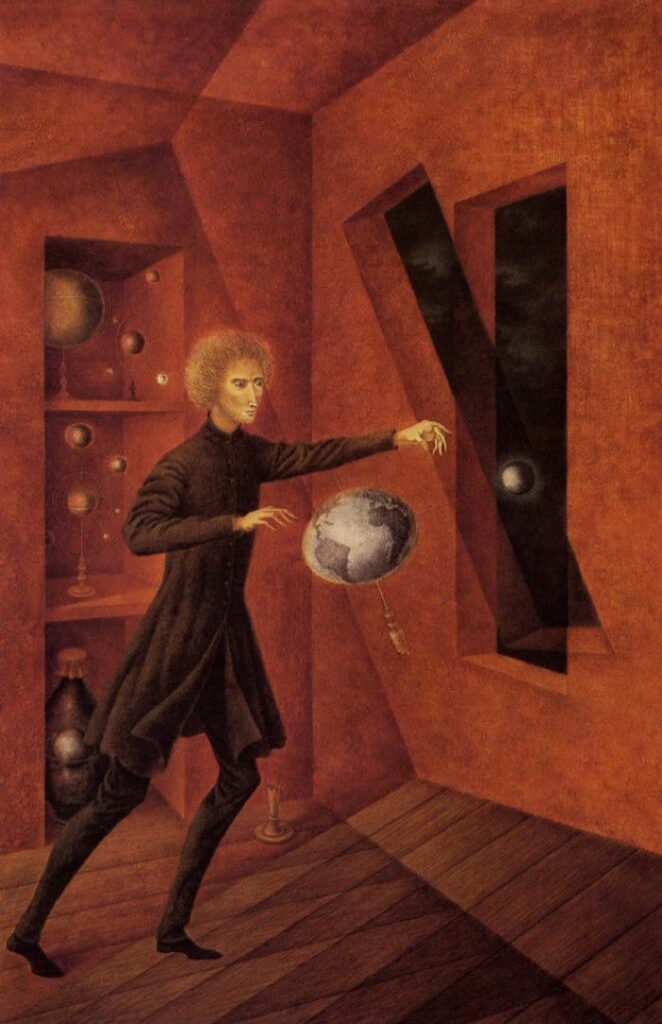
It’s impossible to illustrate gravitational force without underlying Remedios Varo, the artisan of dreams, who architected an esoteric cosmos of turbulent existence.
In Phenomenon of Weightlessness, an astronomer seeks balance in an unstable universe. Windows and walls appear at an impossible angle, dimensional planes are distorted. The scientist loses balance because, in relativity, space and time are not fixed; they change depending on who observes them and the speed. Created in 1963, this painting echoes the collision between Newtonian physics and Einstein’s theory of relativity.5
More than mysticism and alchemy, Remedios Varo believed that art and science are deeply interconnected, and the challenge is to be open to all possibilities.
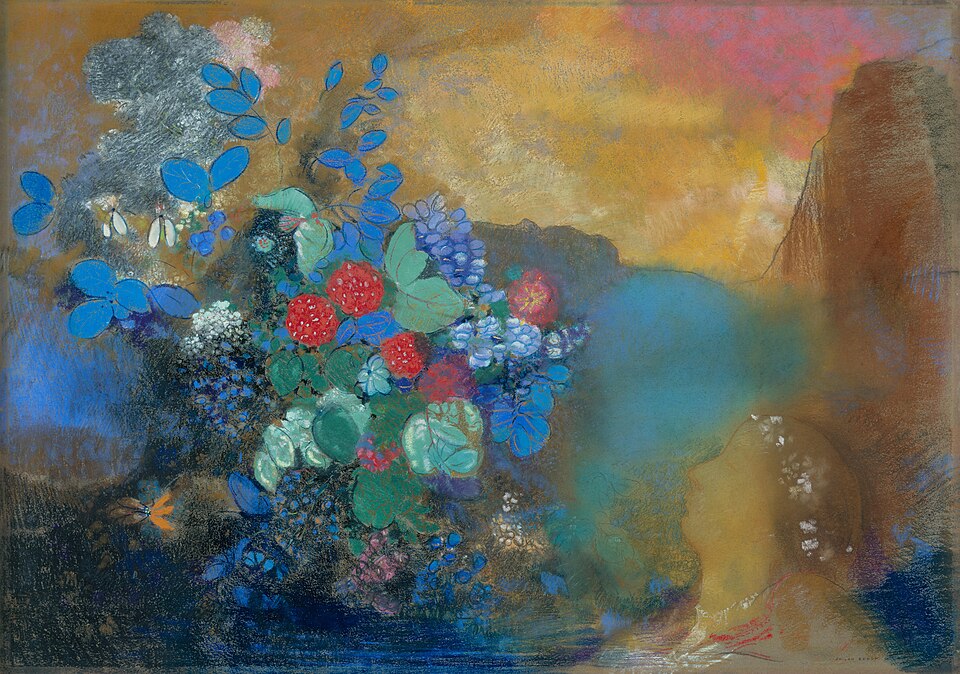
10. Ophelia Dive into a Sea of Flowers
Submerging is a form of falling. Perhaps the most sublime and submissive way to deal with despair. After Hamlet rejects her love and accidentally murders his father, Ophelia plunges into a delirious state, fading into a sea of flowers. She inspired generations of artists, immortalizing herself in the imagination of lost innocence, beauty, and melancholy. What happened before her fall? An envious branch that broke? A courageous intention? In any case, not getting back up is the pessimistic outcome of falling.
In Ofelia Among the Flowers, nature is not a physical setting but an extension of her fragmented mind. Whenever we hear her name, we recall a sea of pure daisies, faithful violets, futile and perfect loves, but, above all, the immortal red of the poppies. And we remember all the artists who, many years before we know them, turned sorrow into unforgettable images.
Odilon Redon‘s friend Émile Hanekin drowned before his eyes. That’s part of the reason he kept revisiting to this theme.
Author’s bio:
Cristina Correia is an internal medicine doctor and art lover from Portugal—an old soul with a special passion for cinema, museums, painting, and music. She is an everyday Fauvist who loves traveling and studying history. Despite being a scientist, she watched Alice in Wonderland endlessly during her childhood and believes that art can show us the best way.