
Józef Chełmoński in 10 Paintings: Capturing the Spirit of Rural Life
Józef Chełmoński masterfully portrayed life in the Polish countryside. His paintings reveal a subtle connection between human and nature,...
Kinga Dobosz 21 August 2025
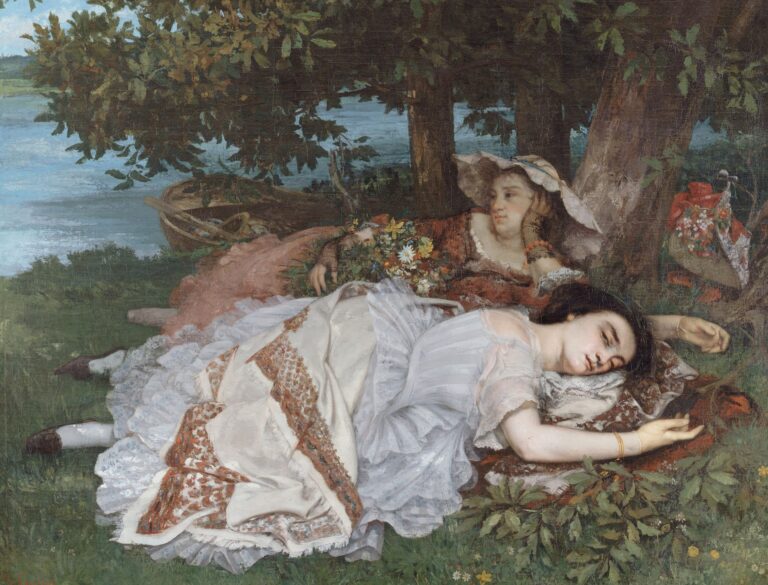
Gustave Courbet, Young Ladies on the Banks of the Seine (Summer), 1857, Petit Palais, Paris, France. Detail.
Gustave Courbet was the bad boy of 19th-century French art. A political and artistic radical, he was imprisoned after the failed 1871 Commune and condemned for painting notorious nudes. Yet he was also an influential bridge between the Romantics and the Impressionists, keenly aware of his own artistic legacy. Here are 10 paintings that prove Courbet was not just out to shock.
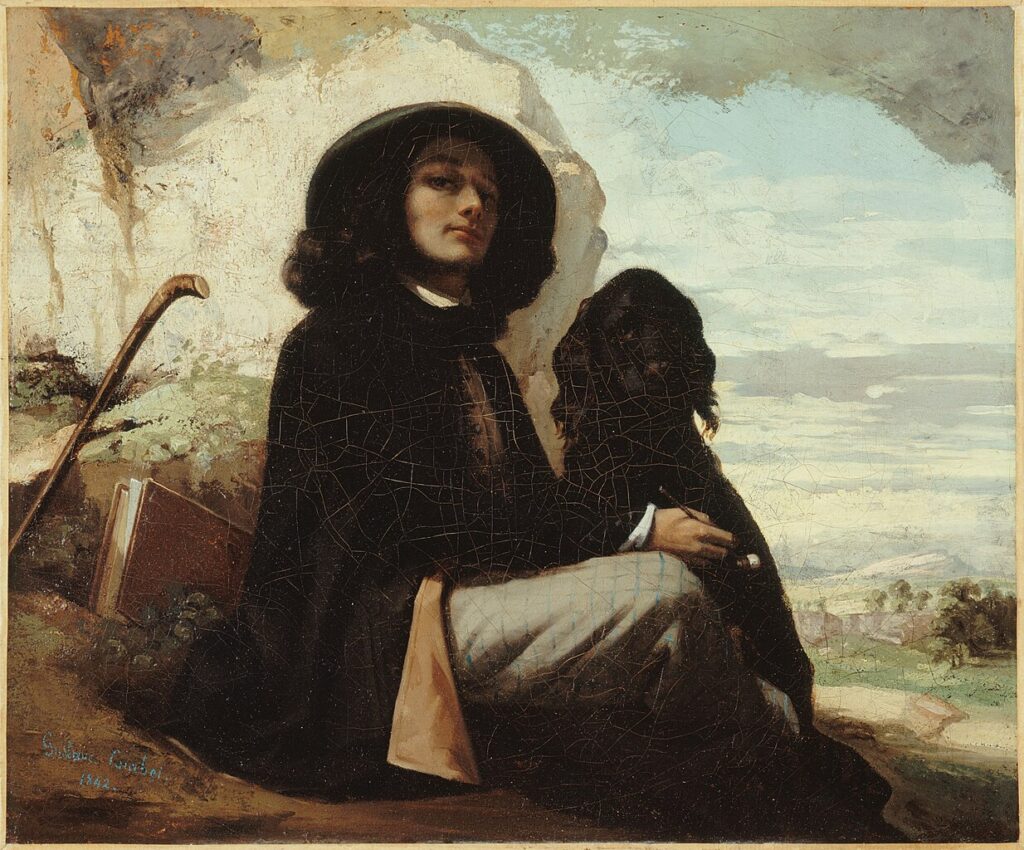
Gustave Courbet, Self-Portrait with Black Dog, 1842–1844, Petit Palais, Paris, France.
Gustave Courbet (1819–1877) painted a huge number of self-portraits, especially during the early part of his career, when he used them to explore different styles and represent himself in different guises and moods. The Desperate Man (1843–1845) shows him wild-eyed, almost tearing his hair out, whereas Self-Portrait with Black Dog portrays a swaggering Romantic artist, taking a rest with a pipe while out sketching in the countryside. The pale, rocky outcrop behind is recognisable as the region around Ornans where Courbet grew up before moving to Paris in 1839. He regularly returned to paint there and it would later feature in many of his works.
The checked trousers show him familiar with the latest fashion, yet the wide-brimmed hat and long dark hair give him a slightly exotic quality. The dog, which actually was his family’s pet, acts as a kind of alter-ego, mirroring the artist’s pose. It is, however, the raised chin and slightly condescending stare, emphasized by the low viewpoint, which really give a sense of Courbet’s self-confident belief in his own creative genius. The limited palette, with its emphasis on black, indicates his artistic influences: Dutch and Spanish painters like Frans Hals and Francisco Goya.
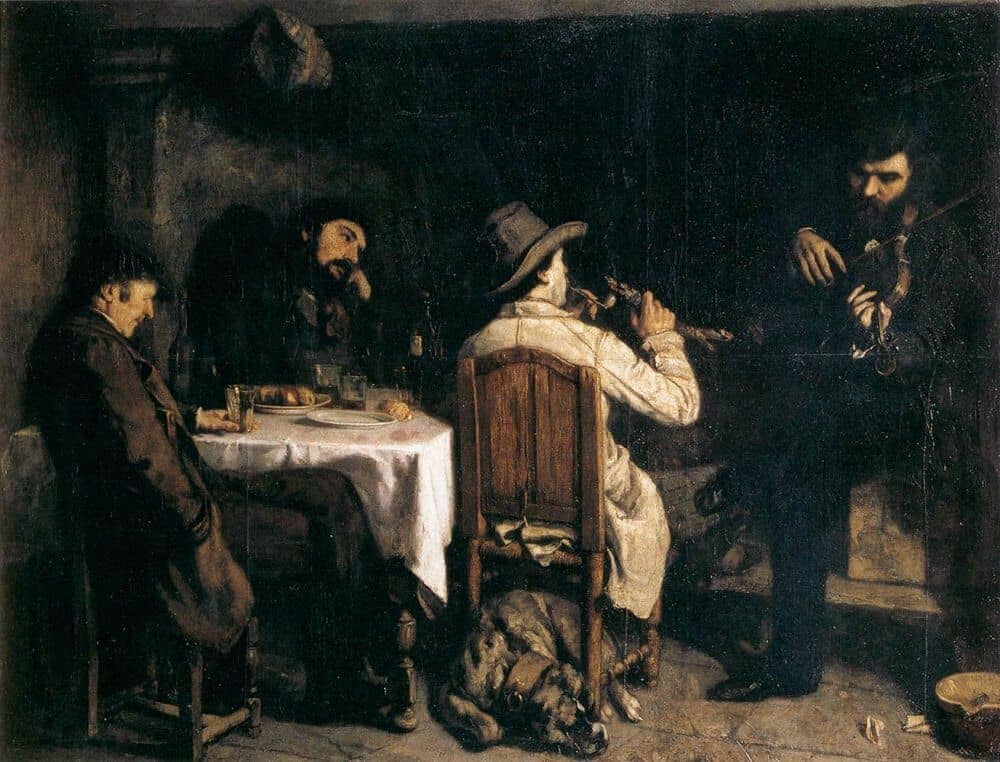
Gustave Courbet, After Dinner at Ornans, 1849, Palais des Beaux-Arts de Lille, Lille, France.
It was Dutch art that Courbet looked back to with his first major success. After Dinner at Ornans, an apparently traditional genre scene featuring the artist’s friends and family, won a gold medal at the 1849 Salon. Courbet’s father sits on the left and, like the other recognizable figures, listens to the violinist. The sombre coloration and carefully angled lighting recall Rembrandt van Rijn and the Le Nain brothers, three 17th-century French artists who had recently seen a revival in popularity.
Crucially, however, Courbet chose to break with tradition in key areas. The painting is huge, 275 cm (108 1/4 in.) across, monumentalizing these ordinary men on a scale which was considered more appropriate to grand subjects. Equally, the group is self-absorbed and turned in on itself, making the viewer feel like an excluded outsider. The figures are not presented for our amusement or sympathy; they simply ignore us.
This was very much in keeping with Courbet’s own personality. He had quickly abandoned a conventional art education and played up his role as the provincial outsider in Paris. He did not seem to care what people thought.

Gustave Courbet, The Stone Breakers, 1849 (destroyed in 1945).
Courbet’s gold medal for After Dinner at Ornans gave him preferential access to the Salon the following year, and he chose the exhibition to thrust his Realism in the faces of wealthy Parisians. Alongside The Stone Breakers, he exhibited The Burial at Ornans and The Peasants of Flagey Returning from the Fair—three works which broke the rules of acceptability in almost every way. These were big canvases with distorted space, harsh lighting, and a lack of compositional focus, showing the contemporary, provincial, lower classes. Paris had witnessed political unrest in 1848, but this was a revolution in art.
Courbet had seen the two figures of The Stone Breakers working by a roadside and invited them to pose in his studio. The background is a remembered one from Ornans. There is nothing actually “real” here, but rather a deliberately created interpretation of the ugliness, harshness, and, above all, the physicality of the life of the poor. The faceless figures are working-class everymen, young and old. They pose against an ominous shadow.
The boy’s painfully awkward pose echoes that of Jean-Francois Millet‘s Winnower, which had seemed to encapsulate the spirit of revolution when it had been exhibited in 1848. The older man wields his mallet like a weapon. It is a painting entirely designed to shock.
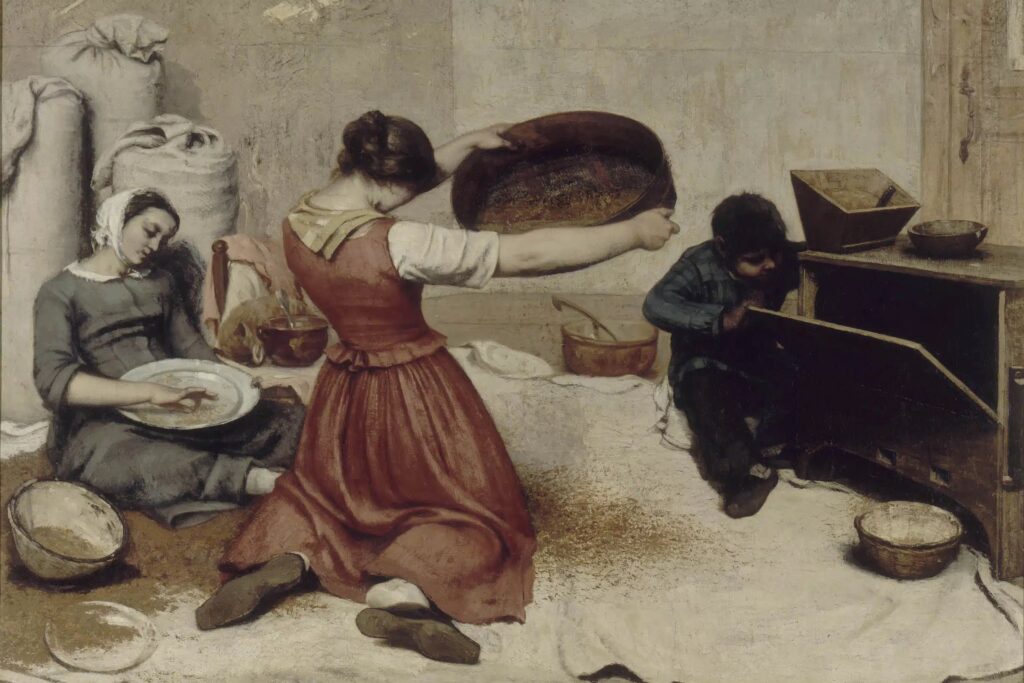
Gustave Courbet, The Wheat Sifters, 1855, Fine Arts Museum of Nantes, Nantes, France.
At first glance, The Wheat Sifters can be seen as a companion piece to The Stone Breakers, showing women engaged in similarly hard, dull labour. The pose of the central figure is deliberately awkward to emphasize effort. The figures are oblivious of us. The lighting, although softer, has the same cool clarity that Jules Bastien-Lepage would go on to use in his images of working women. As in the work of Bastien-Lepage and of Millet, the female figures are sturdy rather than delicate or feminine. Finally, the cramped, sloping space thrusts them towards us.
However, there are significant differences. The women here are Courbet’s own sisters, who in reality would have been unlikely to have engaged in such menial work. The figure on the right has fallen asleep at her task, a theme repeated in Courbet’s Sleeping Spinner (1853), giving the possibility of respite. The presence of the child, again not working, but curiously looking, adds another narrative which softens the relentlessness of the task. Equally, he is looking at a mechanical winnowing device, suggesting that mechanisation is coming to ease the work.
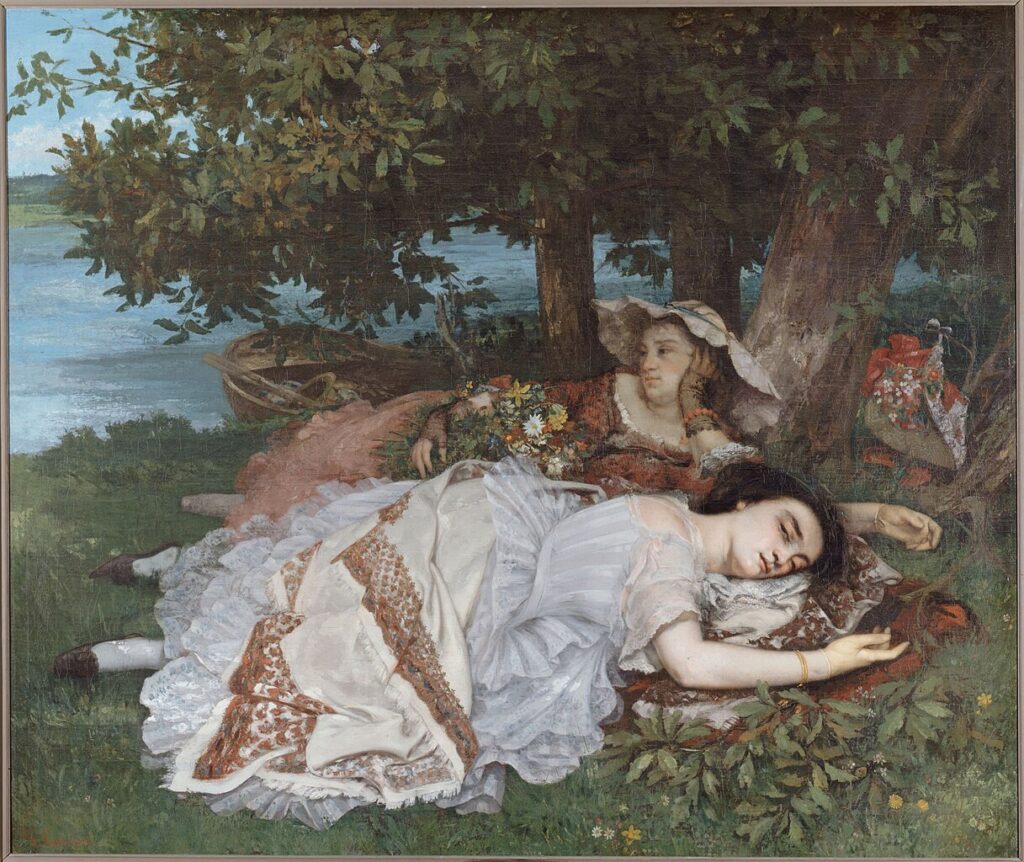
Gustave Courbet, Young Ladies on the Banks of the Seine (Summer), 1857, Petit Palais, Paris, France.
Young Women on the Banks of the Seine (Summer) shows Courbet’s changing palette and increased interest in landscape during the late 1850s. Sunny blues and greens replace the earthy tones of his earlier work, and both the style and the location seem to look forward to the work of the Impressionists. It might also be read as a transitional painting between his realist subjects and a later focus on overtly eroticized nudes, particularly evident in the sleepy, sultry outward gaze of the dark-haired figure.
Courbet takes what appears to be a harmless and traditional subject—pretty women in a landscape setting—and gives it an unsettling and controversial twist. Respectable women would not lounge around on the grass, showing their ankles and petticoats. Their cheap finery is chosen to look artificial and tawdry beside the real beauty of nature. A man’s hat in the boat creates an unseen, dubious third person in the painting. As Édouard Manet would later do with Dejeuner sur l’Herbe (The Luncheon on the Grass), Courbet is showing the seedy underbelly of Parisian life.
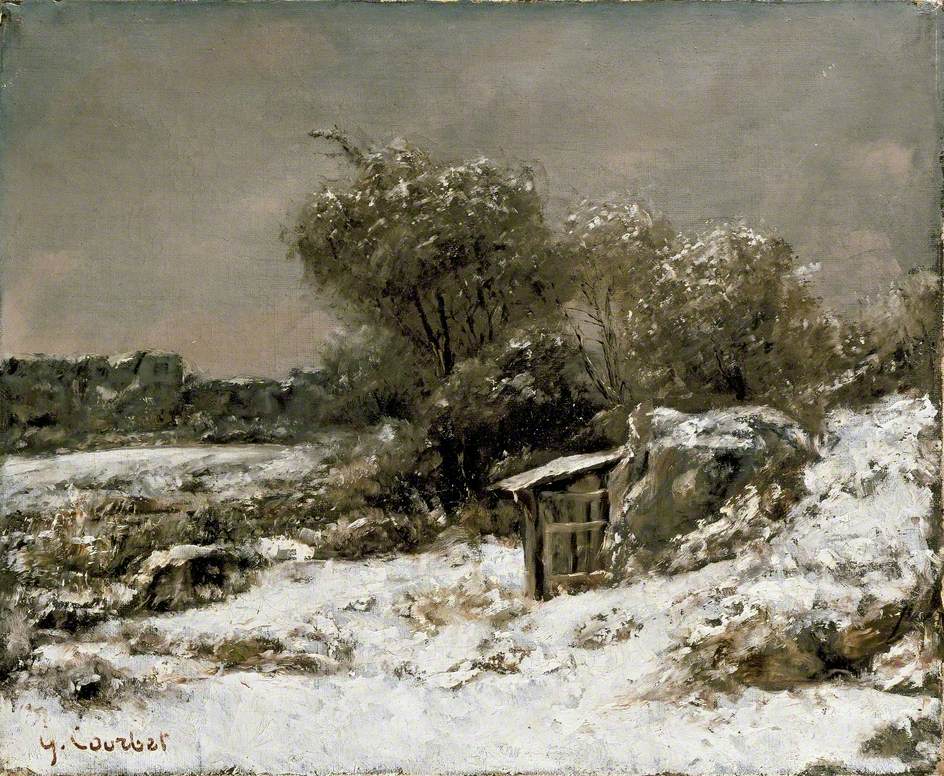
Gustave Courbet, Winter Scene, c. 1865–1873, Ashmolean Museum, Oxford, UK.
Increasingly during the 1860s, Courbet turned to pure landscape painting. The countryside around Ornans, which had frequently featured in the background of his figurative work, became the subject in itself: rocky outcrops, woodland, and babbling streams. Hunting and animal scenes added another autobiographical layer, as Courbet was fond of the sport. However, the shift was also a commercial one. Landscapes sold well and despite his radical and difficult reputation, Courbet wanted, and needed, financial success.
Some of these landscapes were executed outside, and the small scale and vigorous brushwork of Winter Scene suggests it may well have been painted on the spot. There is no narrative here and very little evidence of humanity beyond a tumbledown shed. Instead, the artist is interested in the technical difficulties of rendering snow and of working with such a limited range of color. Winter landscapes had been common in 17th-century Dutch art, but Courbet was also tapping into a renewed contemporary interest among artists like Claude Monet.
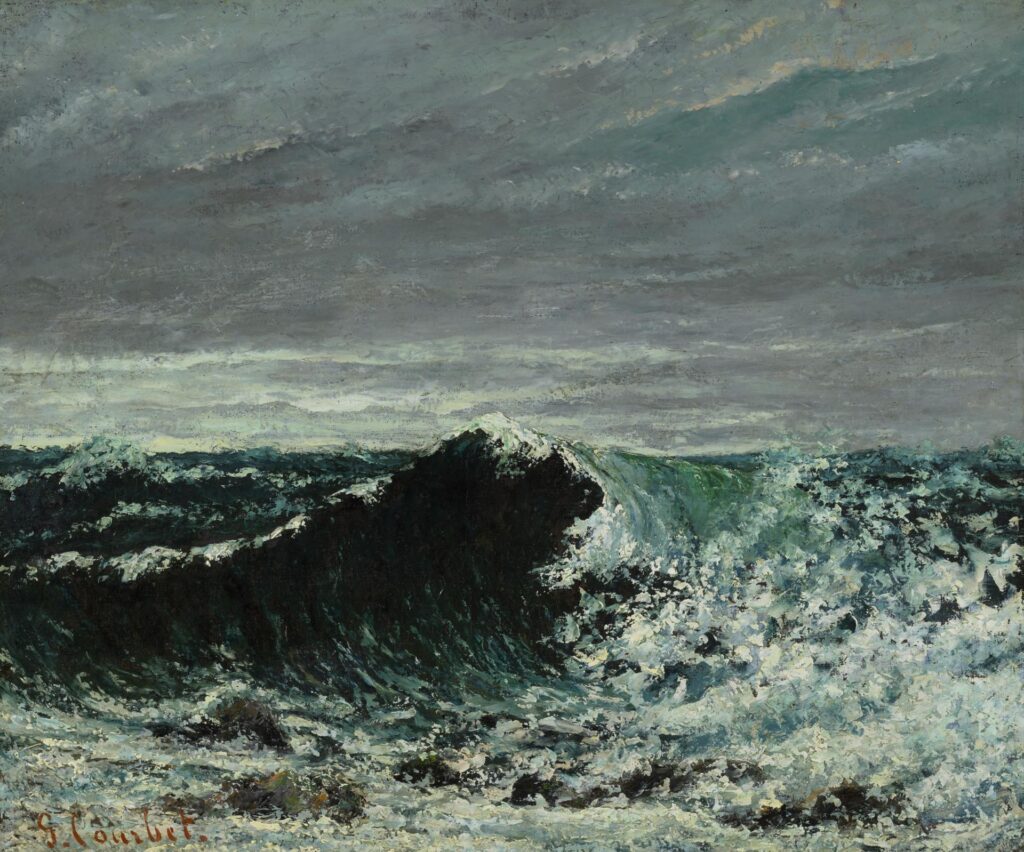
Gustave Courbet, The Wave, 1869, National Galleries of Scotland, Edinburgh, UK.
By 1870, Courbet was perhaps best known for his seascapes. The subject had attracted him since his very first days as an artist, when he visited Normandy in 1841. However, it was a series of visits to the region from 1859 and a friendship with Eugène Boudin, known for his big-skied beach scenes, which crystallized his interest. Unlike many 19th-century artists who showed fishermen or holiday-makers, Courbet rarely populates his images of the sea. Instead, he focused on the drama and power of nature itself.
His seascapes divide into two groups. Works he called marines show calm water, flat horizons, and big skies. In comparison, The Wave is one of many paintings that focus on stormy waters and crashing breakers. Using heavy impasto and often working with a palette knife, Courbet solidifies the sea, giving it weight and an almost sculptural presence. Equally, the reduction of the composition to just sea and sky, without any scaling detail, gives these paintings an abstracted quality.
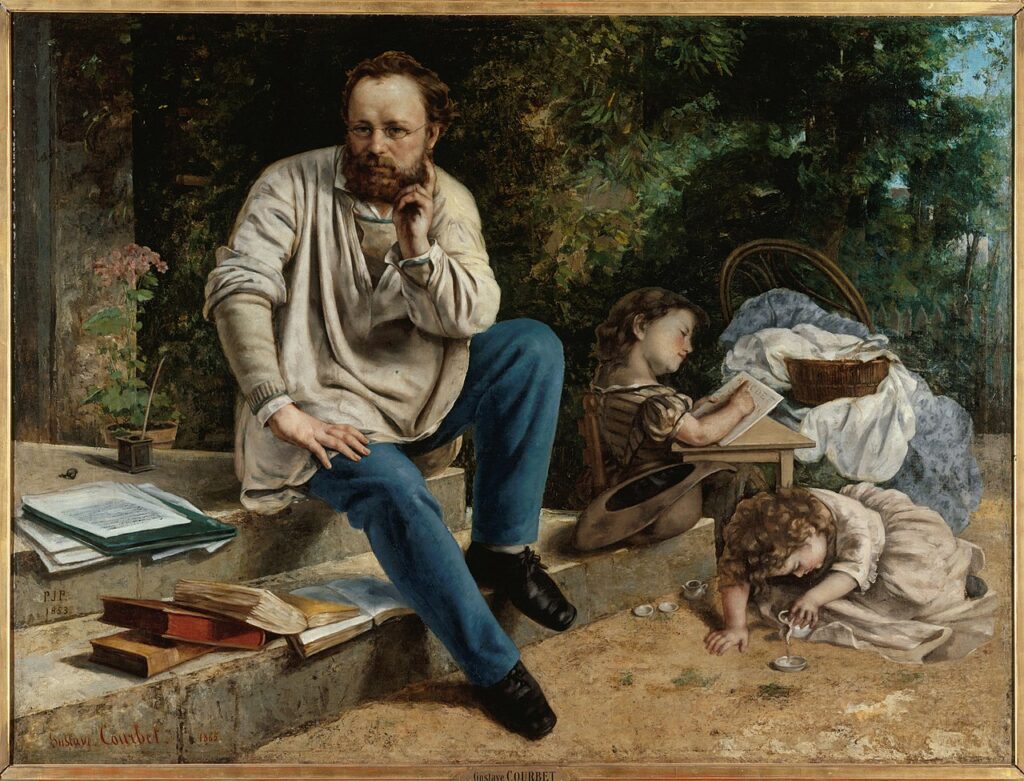
Gustave Courbet, Proudhon and his Children, 1865, Petit Palais, Paris, France.
Courbet was not known as a portraitist, but as well as his enthusiasm for self-representation, he painted many images of his family and friends. Famously, he showed himself meeting his patron Alfred Bruyas, who commissioned the work, in Bonjour, Monsieur Courbet (1854). An early painting from his Bohemian days in Paris recorded his friendship with poet Charles Baudelaire, who sits poring over a book by candlelight, studious apart from his flamboyant yellow cravat.
The portraits also chart Courbet’s political heroes. A lost image of Jean Journet from 1850 showed the socialist as a modern-day pilgrim, spreading his gospel of utopian harmony. This portrait of the philosopher Pierre-Joseph Proudhon shows the anarchist wearing his worker’s smock but with the high forehead and reading glasses of an intellectual surrounded by his books. He is also a family man, playing in the garden with his children, a deliberately unthreatening and idealized image. In reality, Proudhon was released from prison only shortly before his untimely death and lived in abject poverty.
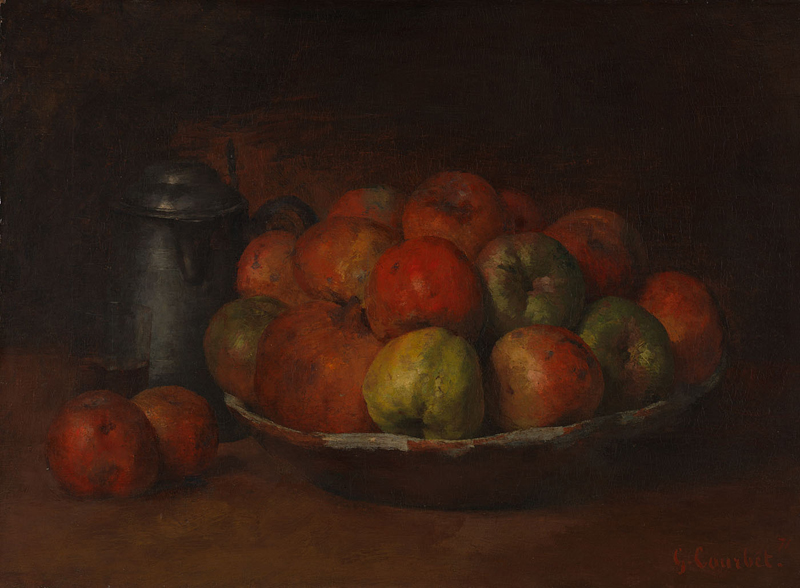
Gustave Courbet, Still Life with Apples and a Pomegranate, 1871–1872, National Gallery, London, UK.
Courbet turned to still life late in his career out of necessity. Sentenced to six months in prison as a result of his role in the failed Paris Commune of 1871, he was eventually allowed painting materials but no model, so made do with fruit and flowers brought on visits by his sister. He continued to paint still lifes after his release, discovering that they sold well. In a sense, he was going back to his early appreciation of Dutch art, although still life was enjoying a revival more generally following the rediscovery of Jean Siméon Chardin‘s work during the 1860s. Monet and Manet both produced still life at around the same time.
The lusciously rich color and the sheen on the rounded fruit give this a warmth and vitality. This seems strikingly at odds with Courbet’s situation as a failed, incarcerated revolutionary and with his reputation as a purveyor of cold, harsh “reality”. However, he had always sought to be a recorder of what he saw. Equally, as his landscapes proved, he was an artist who loved the tactile application of his materials. The apparent simplicity of a bowl of apples gave him the freedom to simply enjoy painting.
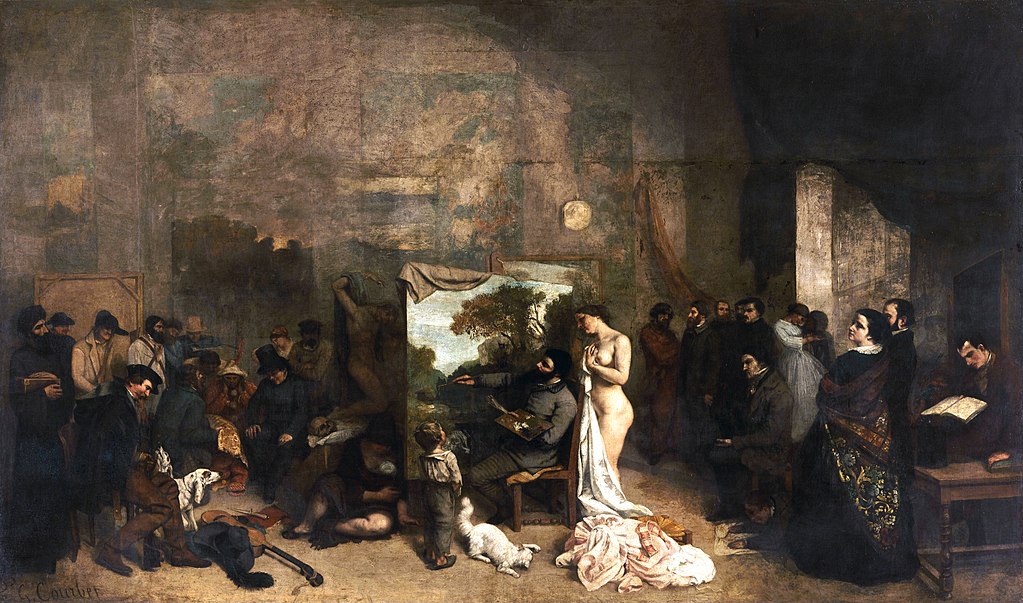
Gustave Courbet, The Painter’s Studio, 1854–1855, Musée d’Orsay, Paris, France.
In the end, if you want to understand Courbet, The Painter’s Studio is the picture you need to look at. Subtitled A real allegory summing up seven years of my artistic and moral life, it is as complex and contradictory as the man himself, who sits centre-stage, working on a huge landscape. That he is painting a landscape perhaps shows his true artistic enthusiasm, but equally, it symbolizes his desire to paint reality itself.
By Courbet’s side stand a female nude, a small boy, and a playful cat representing innocence and truth, although the nude also nods to the academic tradition on which Courbet has turned his back. The whole world is watching, divided into two distinct groups. On the right are Courbet’s supporters, sympathizers, and friends, many of them recognizable portraits; on the left is a hodgepodge of the poor and dispossessed, political radicals, and symbols of the past (Romanticism and the Academy).
The Artist’s Studio is big, bombastic and self-centered. It shares the sloping ground and closed off space of many of Courbet’s works as well as the limited palette, the plain background, and, despite the tripartite structure and the painter at the centre, the lack of compositional focus. But the more you look at it, the more you see. Nothing is straightforward in Courbet’s art. His paint is textured and varied. The subjects are ambiguous. If you just dismiss him as a rebel, you miss seeing him as an artist.
Get your daily dose of art
Click and follow us on Google News to stay updated all the time

DailyArt Magazine needs your support. Every contribution, however big or small, is very valuable for our future. Thanks to it, we will be able to sustain and grow the Magazine. Thank you for your help!

Catriona Miller is an art historian and freelance writer on art. Having studied at Oxford and St Andrews, she is currently researching issues of nationalism and identity in British landscape painting. She has taught art history and lectures on art history and art appreciation.

Leigh is a writer, reader, art lover, radio nerd and herbalist based in Nashville, TN.
Józef Chełmoński masterfully portrayed life in the Polish countryside. His paintings reveal a subtle connection between human and nature,...
Kinga Dobosz 21 August 2025
From the clatter of Parisian cafés to the hushed drama of the Salon, Édouard Manet was at the epicenter of 19th-century art’s most daring...
Joanna Kaszubowska 25 August 2025
Grant Wood’s 1930 painting American Gothic helped establish the Regionalist movement and shatter the big-city monopoly on fine art. His work...
Theodore Carter 25 August 2025
Realism with a capital “R” was an art movement in the middle years of the 19th century. It was not just about representing real life—the...
Catriona Miller 13 May 2025

.jpg)


.jpg)


