

Masterpiece Story: Jahangir Preferring a Sufi Shaikh to Kings by Bichitr
Why would a powerful emperor place a spiritual leader above other rulers, including the King of England? Bichitr’s Jahangir Preferring a Sufi...
James W Singer 8 November 2026
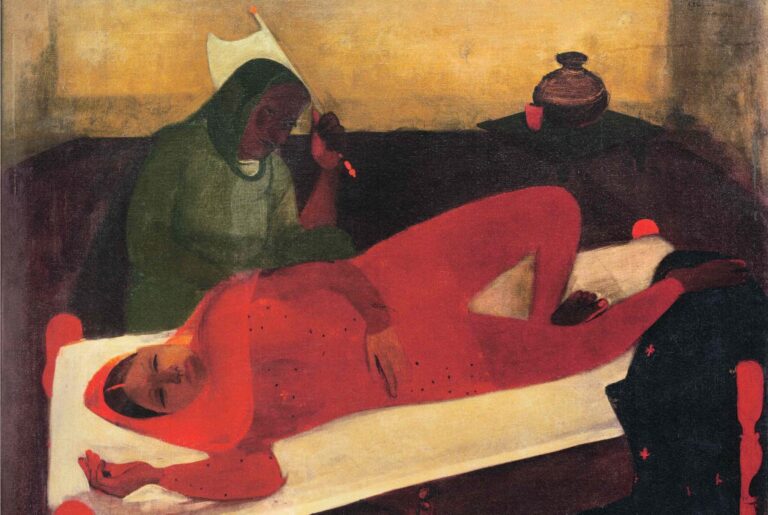
Amrita Sher-Gil, Woman on Charpoy, 1940, National Gallery of Modern Art, New Delhi, India. Detail.
Amrita Sher-Gil’s work has long been examined through the binaries of modernist and traditional, East and West. These debates have often overshadowed her choice of subjects, particularly in her later paintings. With its reclining figure, incandescent red, and intimate portrayal of women’s lives, Woman on Charpoy stands as one of the most compelling paintings of early 20th-century Indian art.
Amrita Sher-Gil grew up between European and Indian cultural worlds. Her return to India in 1934 marked a turning point in her artistic career. Sher-Gil began searching for a visual language that could express her understanding of Indian life without simply reproducing European conventions. By the late 1930s, in the final phase of her short but transformative career, she had developed a distinctive approach to spatial arrangement, expressive use of color, and psychologically ambiguous figures. Her paintings increasingly focused on women engaged in everyday activities—resting, bathing, dressing, or sitting together. Works such as Three Girls (1935), Bride’s Toilet (1937), and Haldi Grinders (1940) demonstrate her sustained interest in the intimate worlds of women.
Following her marriage to Victor Egan in 1938, Sher-Gil returned to India and spent considerable time at the family estate in Saraya (a village in the Gorakhpur district of present-day Uttar Pradesh, India), where Egan practised medicine. Her stay brought her into close contact with women and their everyday routines. She observed the contradictions of domestic existence, particularly how a life of material comfort could become stifling, while women’s talents and knowledge remained insufficiently utilized. Their experiences were further shaped by the restrictions imposed by feudal social structures. The women she encountered often inhabited a world of domestic seclusion, where leisure could become an expression of ennui rather than contentment.
This awareness informs the atmosphere of Woman on Charpoy, in which a seemingly ordinary moment of repose becomes more psychologically complex than it first appears.
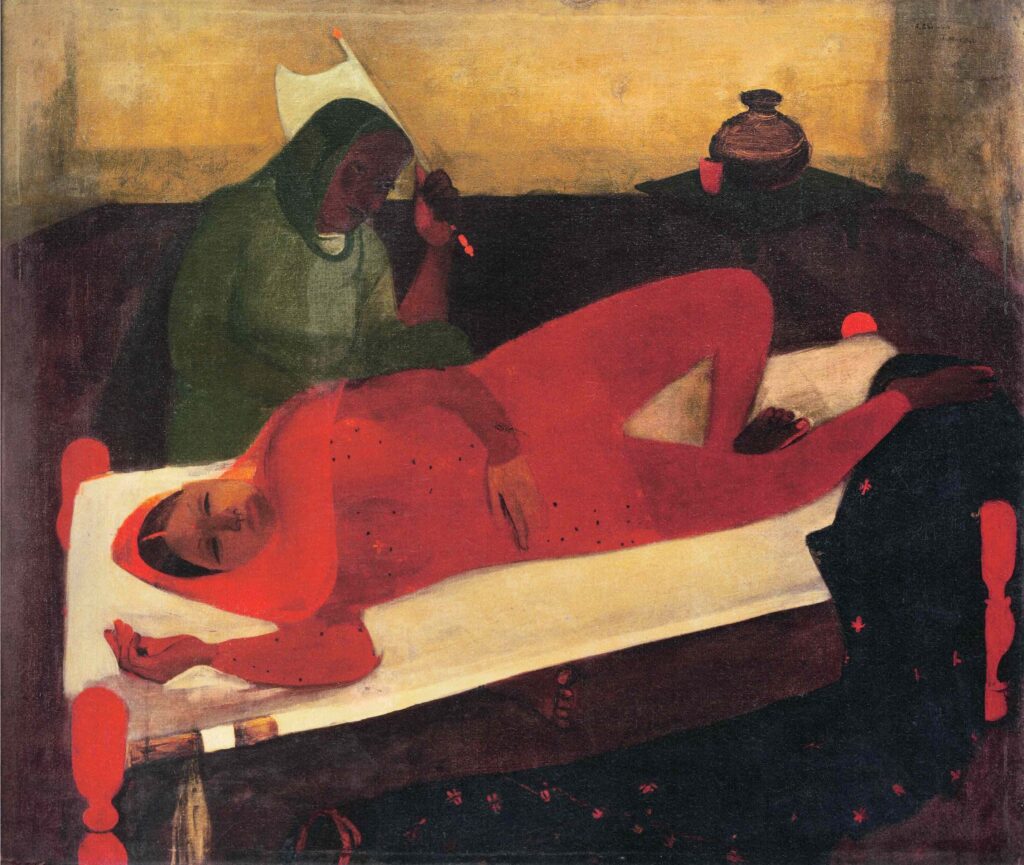
Amrita Sher-Gil, Woman on Charpoy, 1940, National Gallery of Modern Art, New Delhi, India.
Following her marriage to Victor Egan in 1938, Sher-Gil returned to India and spent considerable time at the family estate in Saraya (a village in the Gorakhpur district of present-day Uttar Pradesh, India), where Egan practised medicine. Her stay brought her into close contact with women and their everyday routines. She observed the contradictions of domestic existence, particularly how a life of material comfort could become stifling, while women’s talents and knowledge remained insufficiently utilized. Their experiences were further shaped by the restrictions imposed by feudal social structures. The women she encountered often inhabited a world of domestic seclusion, where leisure could become an expression of ennui rather than contentment.
This awareness informs the atmosphere of Woman on Charpoy, in which a seemingly ordinary moment of repose becomes more psychologically complex than it first appears.
Woman Resting on Charpoy is an oil on canvas measuring 85 x 72.4 cm (33.5 x 28.5 in.), completed in June 1940. The painting depicts a woman reclining diagonally across the charpoy, or a traditional, hand-woven bed from the Indian subcontinent. The main figure is modelled on Tejwant Kaur (Teji), Sher-Gil’s cousin. Her vivid red clothing blazes against the muted surroundings, drawing immediate attention to her reclining body. Beside her, another woman sits holding a hand fan. The surrounding objects–the hand fan, pot of water, and metal glass–suggest the oppressive heat of an Indian afternoon and stillness.
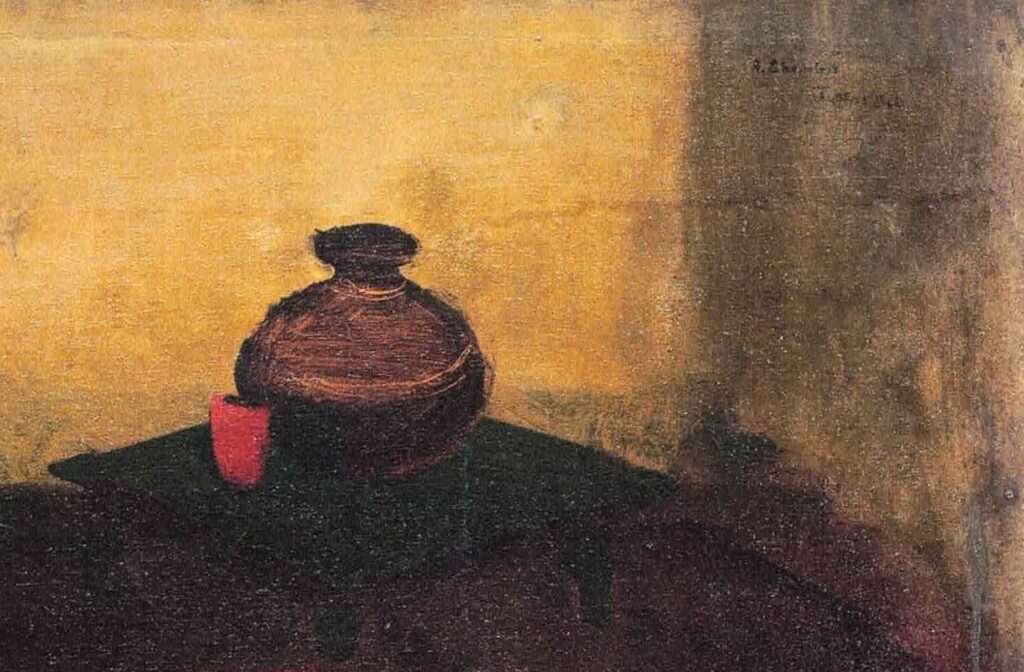
Amrita Sher-Gil, Woman on Charpoy, 1940, National Gallery of Modern Art, New Delhi, India. Detail.
Sher-Gil produced stunning observational paintings that captured intimate details of quotidian life. The two women occupy the same space, yet their contrasting postures and gestures suggest different relationships to it.
The reclining woman wears a vibrant red tunic, leggings, and dupatta. Her sindoor, the traditional vermilion red powder on her forehead and hands associated with marriage, situates her within the social conventions of the household. One hand rests on her stomach, while the other lies beside her head. Her discarded shawl and relaxed posture suggest a moment of unguarded repose, as she might be resting, waiting, ill, or absorbed in her own thoughts.
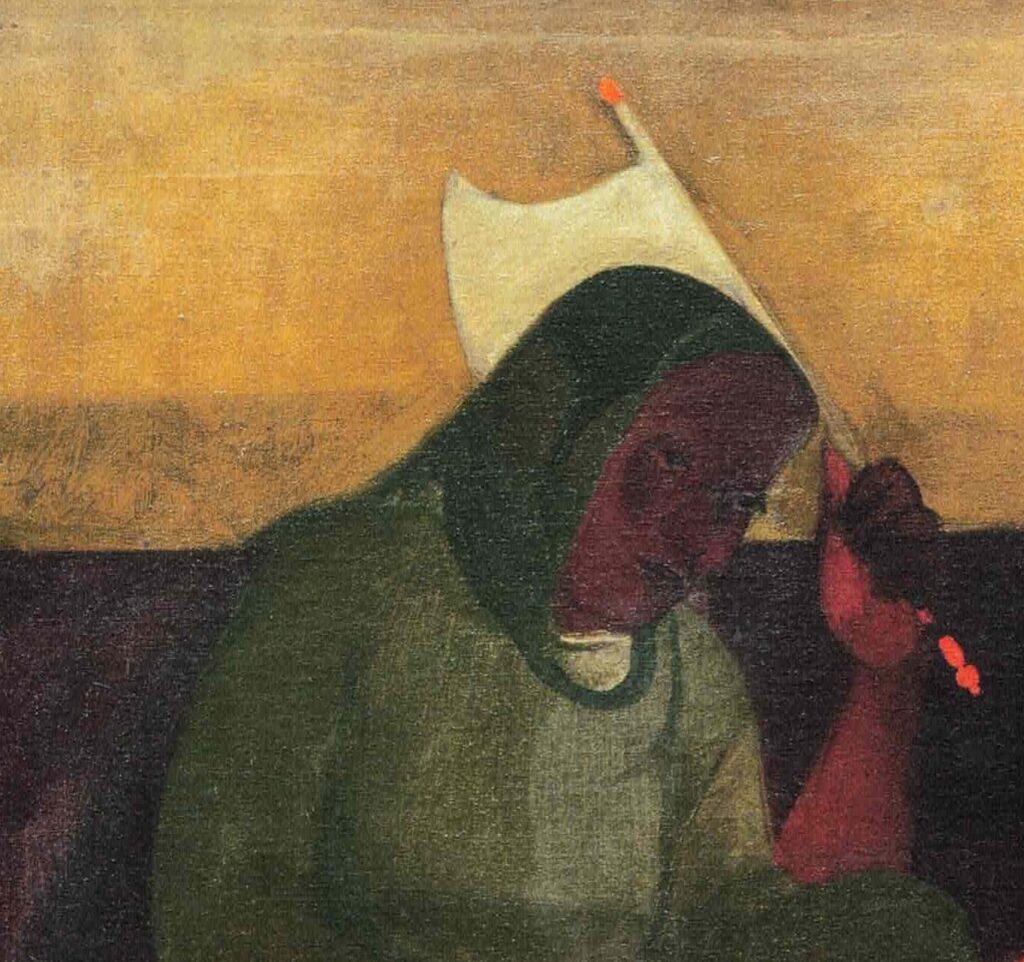
Amrita Sher-Gil, Woman on Charpoy, 1940, National Gallery of Modern Art, New Delhi, India. Detail.
Beside the charpoy, the second woman sits holding a hand fan. Dressed in white beneath a light green covering cloth, she occupies a lower position in the composition. Her legs are loosely arranged, with one visible beneath the bed. Her eyes express a sense of dismay or disenchantment that contrasts with the reclining woman’s apparent comfort. While she attends to the latter’s needs, her gaze appears detached from the task. Their relationship thus extends beyond rest and service, suggesting different experiences of domestic life.
The painting’s flattened perspective reinforces this relationship. The charpoy, reclining body, and attendant are arranged within a compressed pictorial space, with limited depth separating the figures from their surroundings. The bed becomes both a physical object and a central compositional structure around which the women’s bodies are organized. Rather than establishing a conventional narrative setting, Sher-Gil directs attention towards their gestures, postures, and emotional distance between the figures.
I have just finished a picture—a girl in red-flowered clothes is reclining on a charpoy, its posts of an incandescent red rise round her like tongues of flame.
Amrita Sher-Gil: A Self-Portrait in Letters and Writings, ed. Vivan Sundaram, Vol. II, New Delhi, 2010.
Within patriarchal structures, domestic life was often organized around the authority of the male of the household. Sher-Gil, however, places women at the centre of this intimate environment. The bed, afternoon rest, and the act of attending to another woman become the principal subjects. The domestic interior emerges as a space of female experience, where rest and care coexist, although the unequal distribution of labour remains visible. The interior emerges as a space of female experience, shaped by both intimacy and constraint.
Why did Amrita Sher-Gil paint such a scene? The reclining woman’s body has often been interpreted through the language of sexuality. Her diagonal positioning and the arrangement of her legs have been described as provocative or suggestive. Yet such readings risk reducing her to an object of desire. Her posture may equally suggest physical exhaustion, comfort, or the freedom to occupy space without performing a social role.
Sher-Gil’s painting resists a singular interpretation of the female body. The reclining woman is neither simply an erotic figure nor merely a representation of domestic idleness. Her stillness remains open to interpretation, inviting consideration of how women inhabit and negotiate the spaces of everyday life.
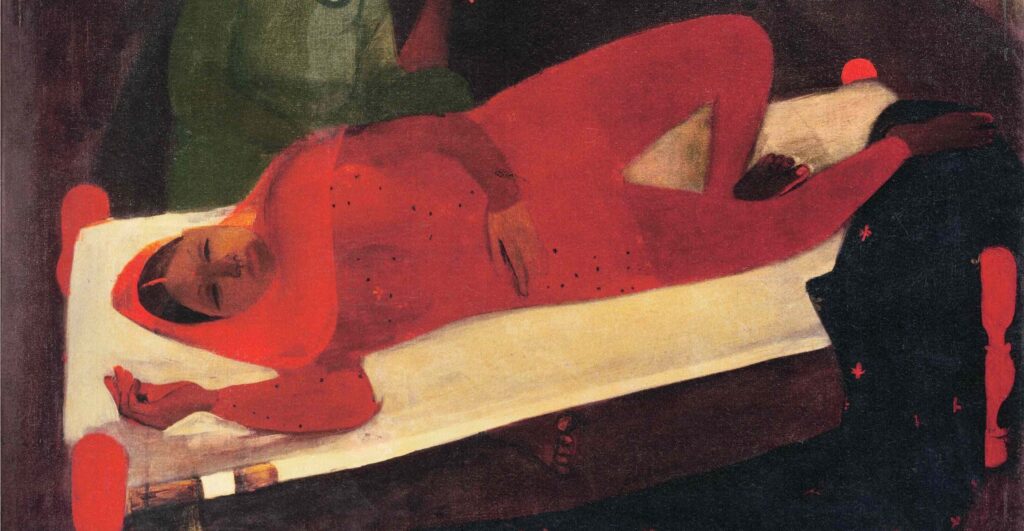
Amrita Sher-Gil, Woman on Charpoy, 1940, National Gallery of Modern Art, New Delhi, India.
Red dominates the visual composition of Sher-Gil’s Woman on Charpoy, appearing in the woman’s clothing and the charpoy’s striking framework. Its intensity draws the viewer’s attention towards the reclining figure, establishing her as the painting’s central presence. Within Indian cultural contexts, red carries associations with marriage, auspiciousness, and feminine identity. Yet its significance in Sher-Gil’s painting extends beyond these conventional meanings.
The vivid red color contrasts with the woman’s languid posture, creating a tension between chromatic intensity and physical stillness. Against the muted tones of the domestic interior, the color appears almost incandescent. Its visual intensity suggests vitality and sensuality, while the woman’s stillness evokes repose and inwardness. Rather than simply describing the figure, color becomes an expressive element that shapes the painting’s emotional atmosphere, making it central to the work’s psychological ambiguity.
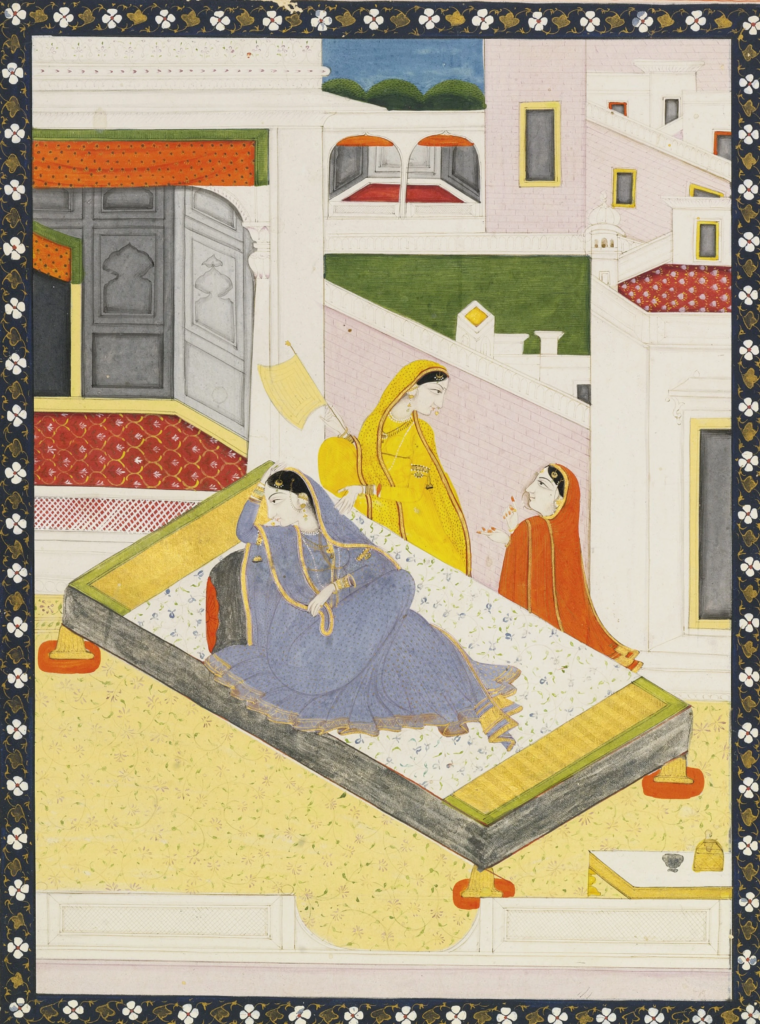
An illustration from the Rasikapriya Series, A Nayika Pines for Her Absent Love, 1830, Pahari school, India. Sotheby’s.
Sher-Gil’s letters reveal her growing interest in Indian miniature painting, particularly the Rajput and Pahari traditions. Her Woman on Charpoy recalls the intimate interiors of Mughal zenana paintings, where women and their attendants inhabit spaces shaped by domestic hierarchies and relationships of care. The attendant holding a fan in Sher-Gil’s painting similarly connects the reclining woman’s leisure with another woman’s labor.
The reclining figure also invites comparison with the Nāyikā of Indian miniature painting, whose emotional state is conveyed through posture, gesture, and the presence or absence of a beloved. The Nāyikā, or heroine anxiously awaiting her absent lover, offers a suggestive parallel. Although Sher-Gil’s woman cannot be definitively identified with this heroine, the comparison introduces the possibility of reading her repose as an expression of inward longing.
Sher-Gil transforms these established visual conventions into a modern domestic scene. The relationship between the two women recalls the social structures of miniature painting, while the reclining figure’s ambiguous expression leaves her emotional experience open to interpretation.
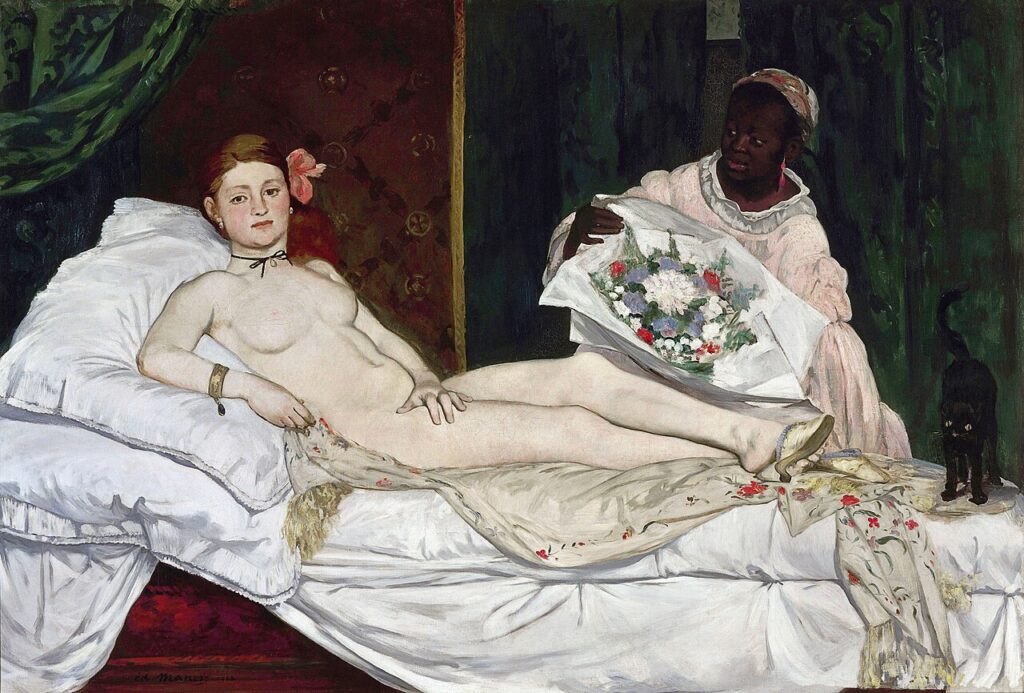
Édouard Manet, Olympia, 1863, Musée d’Orsay, Paris, France.
Trained in Paris under Pierre Vaillant and Lucien Simon, Amrita Sher-Gil encountered the European tradition of the reclining female figure, from Titian’s Venus of Urbino to Édouard Manet’s Olympia. Her admiration for Paul Gauguin, whose treatment of color and the female figure informed works such as Self-Portrait as a Tahitian, further shaped her engagement with modernist representations of women. These influences converge in Woman on Charpoy, where the reclining figure recalls the sensual presence of European painting while remaining grounded in an Indian domestic environment.
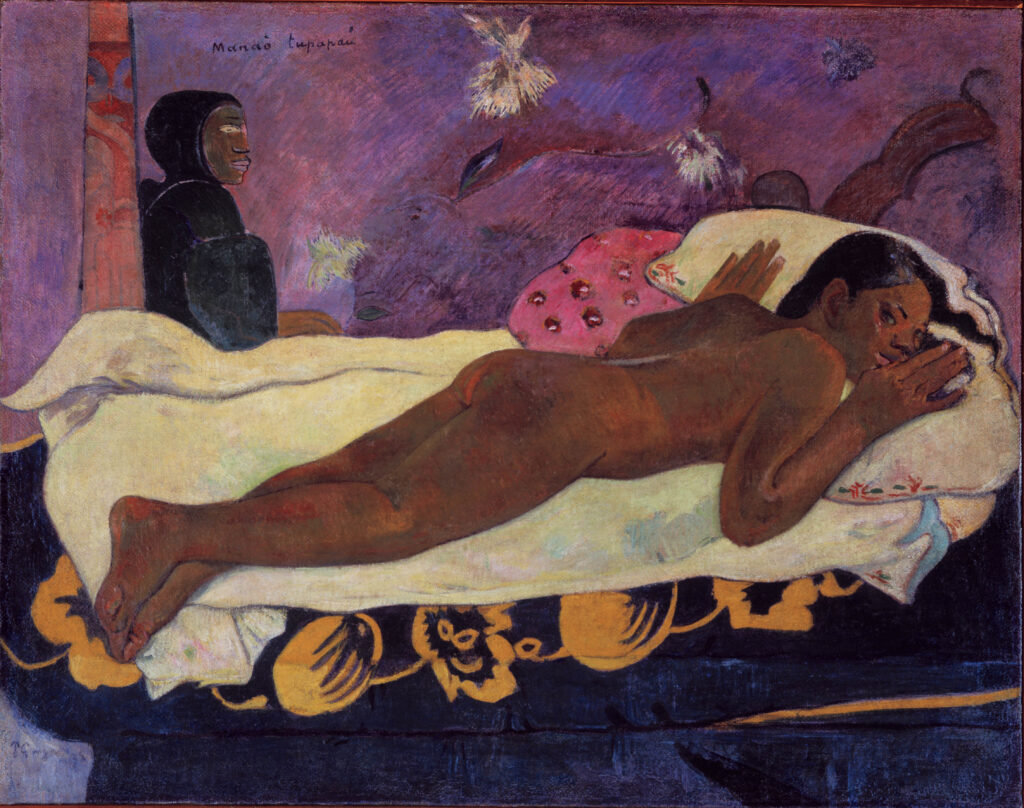
Paul Gauguin, Manaò Tupapaú (The Spirit of the Dead Keep Watch), 1892, Buffalo AKG Art Museum, Buffalo, NY, USA.
Unlike the idealised nude or the exoticised odalisque, Sher-Gil’s woman is clothed and rests upon a traditional charpoy. The attendant holding a fan and the intimate domestic setting transform the familiar reclining pose. The female body is no longer isolated as an object of contemplation but situated within the social relationships of everyday life.
Sher-Gil thus reworks the European reclining female motif through the material and cultural realities of Indian domesticity. Sensuality emerges through the physical presence of the resting body, while the attendant introduces questions of care and dependence. By relocating the reclining figure within an Indian household, Sher-Gil creates a modern representation of female experience that resists both idealisation and exoticisation.
Rana, Subir. “Framing the Political, Rebellious and ‘Desiring’ Body: Amrita Sher-Gil and the ‘Modern’ in Painting.” India International Centre Quarterly 44, no. 2 (Autumn 2017): 35–53. https://www.jstor.org/stable/26317442.
Amrita Sher-Gil: A Self-Portrait in Letters and Writings, ed. Vivan Sundaram, New Delhi: Tulika Books, 2010.
“Speaking Through the Subaltern.” SAAG Anthology. https://www.saaganthology.com/article/speaking-through-the-subaltern.
DailyArt Magazine needs your support. Every contribution, however big or small, is very valuable for our future. Thanks to it, we will be able to sustain and grow the Magazine. Thank you for your help!

Shivani is fascinated by art narratives and history. She likes spending her time in historic neighborhoods, sketching, and collecting textures from nature. This process inspires her writing and her view on life. She studied Art History and Aesthetics at the Maharaja Sayajirao University of Baroda, Gujarat, India.


Chris Dobson was born in Preston, UK. He likes to play chess, visit museums and model for art classes in Amsterdam. He can be followed on Instagram @litterarum_magister.
Why would a powerful emperor place a spiritual leader above other rulers, including the King of England? Bichitr’s Jahangir Preferring a Sufi...
James W Singer 8 November 2026
Judith and Holofernes is a Caravaggio masterpiece that captures Biblical murder and drama. Rarely has death been captured so intensely and violently...
James W Singer 13 September 2026
Explore an astonishing 1915 nude self portrait by American modernist painter Florine Stettheimer.
Candy Bedworth 21 September 2026
Winslow Homer (1836–1910) was one of the leading American Realist painters. His painting The Veteran in a New Field is a masterpiece of late...
James W Singer 30 August 2026