


Marcel Duchamp’s Fountain and Why It Matters
Few artists have been as versatile and as bold as Marcel Duchamp (1887-1968). He was a painter, a sculptor, and a photographer; he was a seminal...
Guest Author 3 December 2024
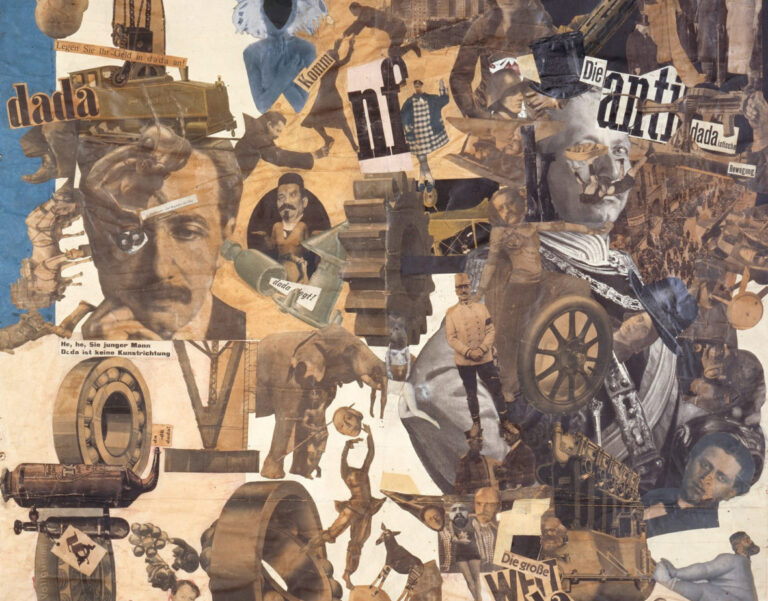
Hannah Höch, Cut with the Kitchen Knife Through the Last Weimar Beer-Belly Cultural Epoch of Germany, 1919, Neue Nationalgalerie, Berlin, Germany. Arthur.io. Detail.
In a movement dominated almost entirely by men, Hannah Höch (1889–1978) secured her place as one of the few women associated with Berlin Dada. Recognized as a pioneer of photomontage, she used this technique to challenge the social norms and gender constructions of her time. It is this combination that makes her work particularly compelling today.
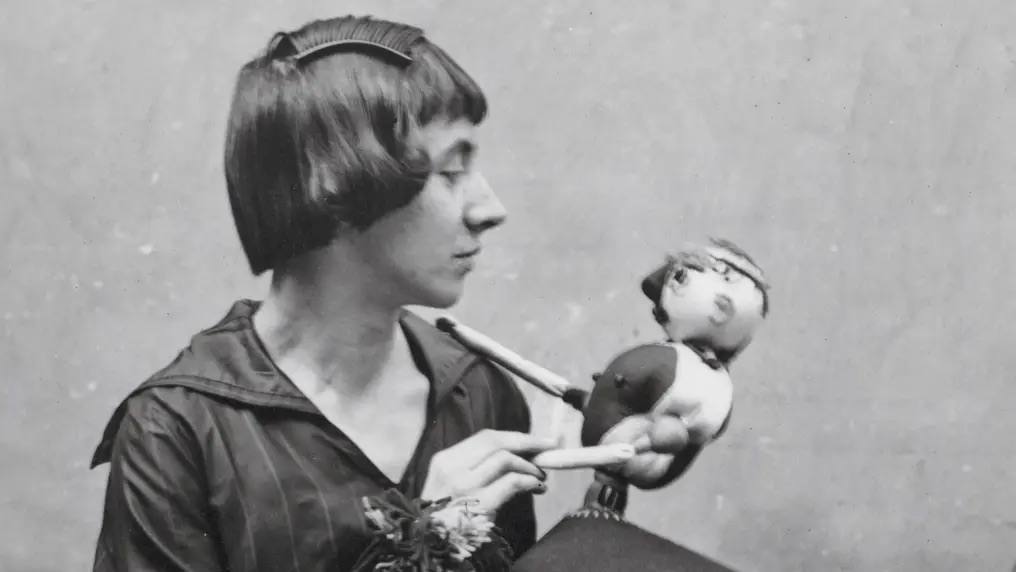
Portrait of Hannah Höch, 1920s, Berlinische Galerie, Berlin, Germany.
The absence of key women throughout art history has been a persistent pattern that does not stem from a lack of talent, but rather from structural barriers deeply rooted in the patriarchal system. In this regard, it is essential to begin by mentioning several feminist scholars who have critically reflected on this exclusion in order to make it visible and question it. Among them, Linda Nochlin stands out—in her seminal essay Why Have There Been No Great Women Artists?, she dismantled the myth of the “artistic genius” as an innate quality, arguing instead that it is a social construct that has historically favored men and actively excluded women.
Similarly, Griselda Pollock argued that art history has been constructed from a male perspective that has relegated women to the private sphere and to roles such as mother or muse. Along the same lines, Whitney Chadwick expanded upon this idea by noting that women were excluded because they did not fit the traditional and dominant model of the autonomous, original, and visionary artist.
Scholars such as Estrella de Diego and Patricia Mayayo have called for a profound revision of the artistic canon to recover the contributions of marginalized women artists. In this sense, it is necessary to look at Hannah Höch’s work from a feminist standpoint, as her marginalization is not a question of talent but the result of a structural system of exclusion that can only be understood by analyzing context, artwork, and the historical conditions that constrained women artists.
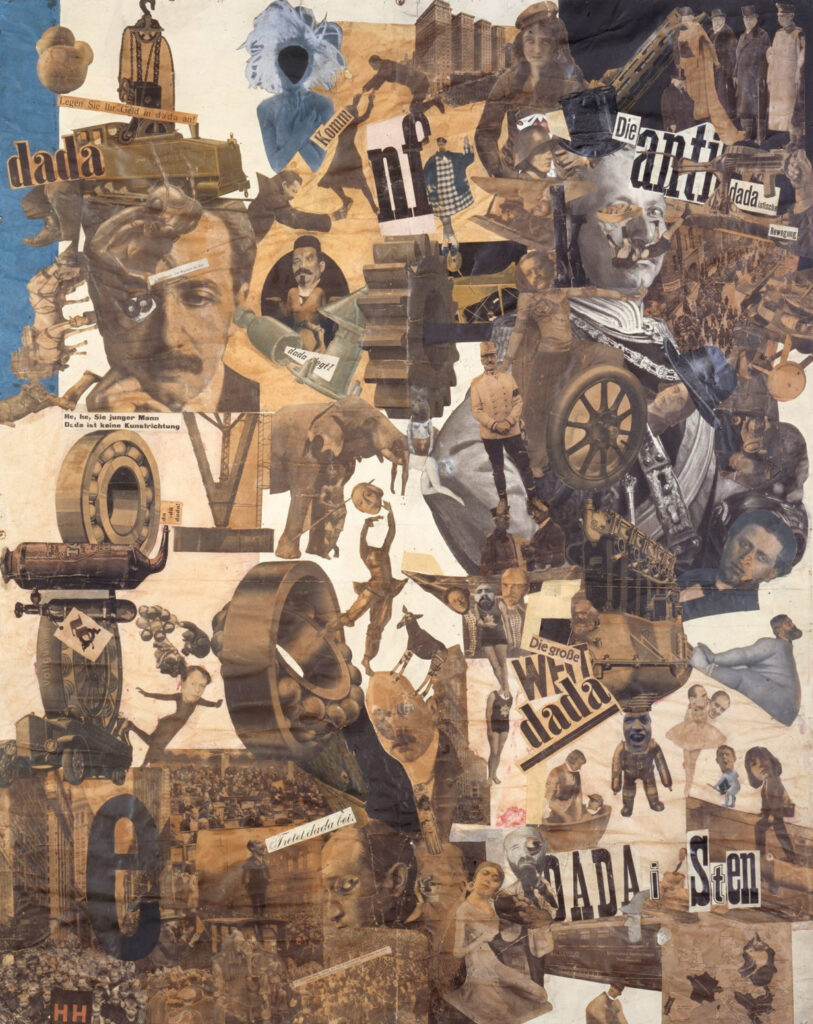
Hannah Höch, Cut with the Kitchen Knife Through the Last Weimar Beer-Belly Cultural Epoch of Germany, 1919, Neue Nationalgalerie, Berlin, Germany. Arthur.io.
In Cut with the Kitchen Knife Through the Last Weimar Beer-Belly Cultural Epoch of Germany (1919), Hannah Höch’s choice of photomontage was not merely an aesthetic commitment associated with Dadaism but also a deeply political and gendered decision.
This technique, based on cutting and recomposing images taken from printed media, challenged traditional artistic conventions while simultaneously drawing upon practices conventionally considered “feminine,” such as sewing, embroidery, and domestic handicrafts. In doing so, Höch transferred these forms of knowledge into the artistic sphere, asserting their value as legitimate modes of creation and subverting their supposedly decorative or secondary status. Thus, in her hands, the domestic realm became a critical tool.
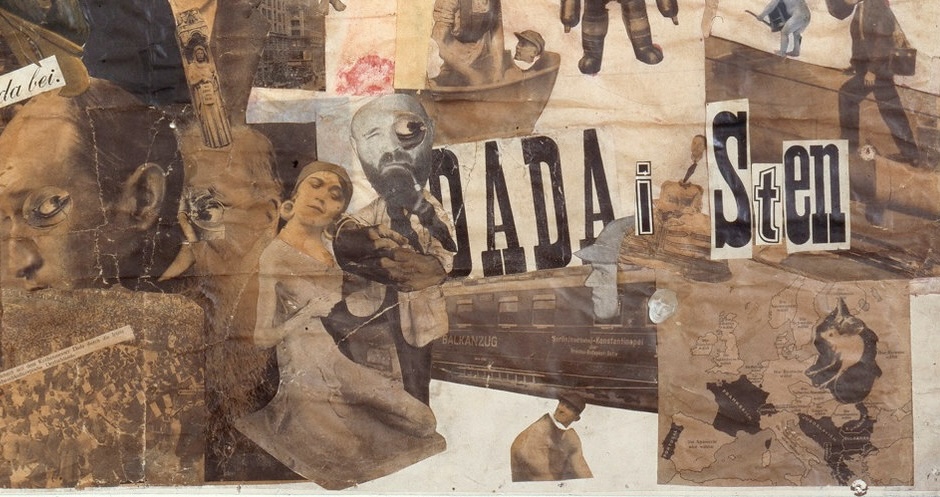
Hannah Höch, Cut with the Kitchen Knife Through the Last Weimar Beer-Belly Cultural Epoch of Germany, 1919, Neue Nationalgalerie, Berlin, Germany. SmartHistory. Detail.
A clear example of this redefinition can be found in the map of women’s suffrage in Europe located in the lower-right section of the composition. This visual element may be interpreted as a form of “political stitching” between countries, linking the visual discourse to the struggle for women’s rights and citizenship.
Cut with the Kitchen Knife… offers a sharp critique of gender roles in postwar Germany by visually confronting the old patriarchal order—represented by politicians, military figures, and members of the bourgeoisie—with the emerging forces of modernity, namely Dadaism, technology, and emancipated women. Through collage, Höch ridicules male figures of power, fragmenting them and stripping them of their authority.
At the same time, she gives visibility to the “New Woman”—athletes, dancers, and artists—without reproducing the idealization promoted by magazines and mass media. Through these elements, the work pays tribute to women while issuing a warning: freedom should not come at the cost of transforming emancipation into yet another consumable stereotype.
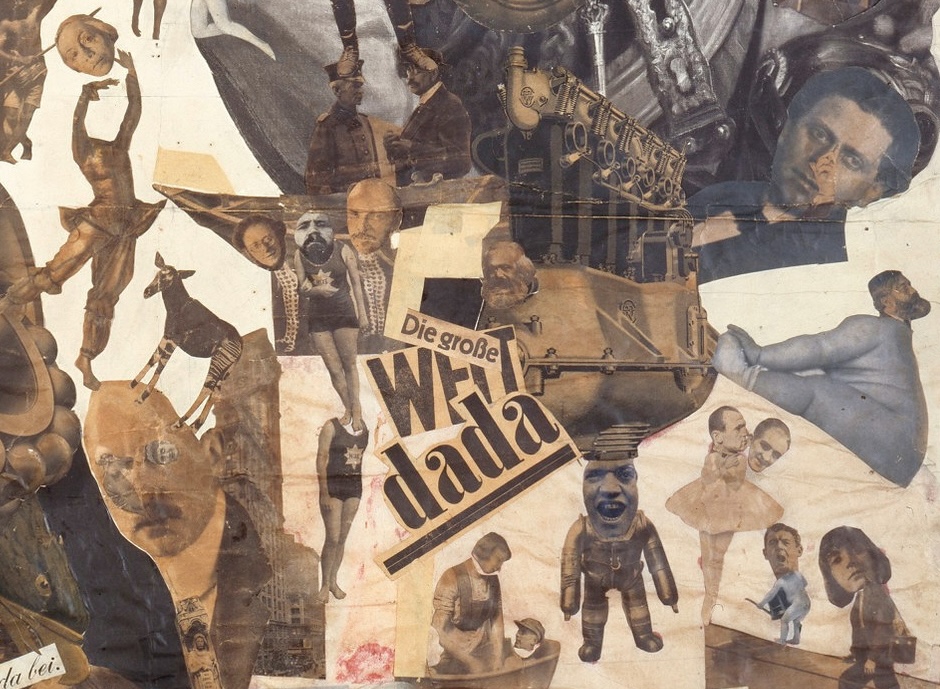
Hannah Höch, Cut with the Kitchen Knife Through the Last Weimar Beer-Belly Cultural Epoch of Germany, 1919, Neue Nationalgalerie, Berlin, Germany. SmartHistory. Detail.
Another revolutionary aspect of Höch’s work lies in the way it blurs traditional gender boundaries through the creation of hybrid bodies that combine feminine and masculine traits—mustached heads placed on female bodies, high-heeled legs attached to sculptural male torsos, and similar combinations. This deliberate deconstruction of fixed identities anticipates proto-queer interpretations and challenges dominant heteronormative assumptions, suggesting that identity itself is a dismantlable construct, a collage in its own right.
Finally, the powerful symbolism of the work’s title, Cut with the Kitchen Knife…, cannot be overlooked. A domestic utensil traditionally associated with women is transformed into a political weapon used to “cut through” patriarchal culture. In this way, the artist reclaims the domestic sphere as a site of resistance, elevating the everyday and the feminine into the realm of artistic avant-garde.
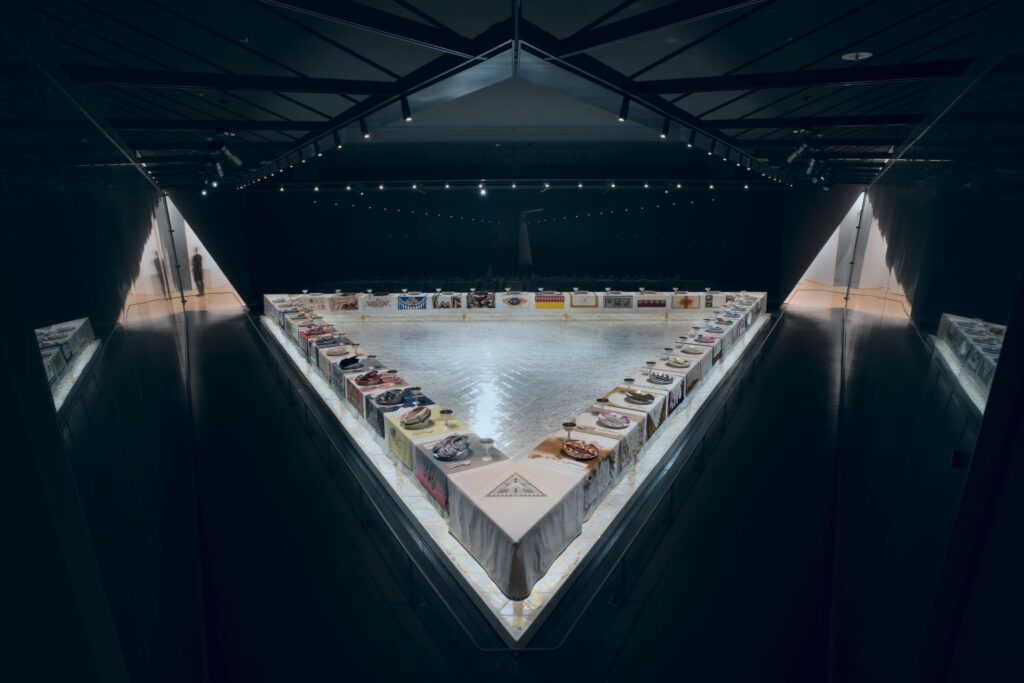
Judy Chicago, The Dinner Party, 1974–1979, Brooklyn Museum, New York City, NY, USA. Photo: Donald Woodman. © Judy Chicago.
This gesture anticipates strategies later employed by feminist artists in the 1970s, such as Judy Chicago’s The Dinner Party and Martha Rosler’s short film Semiotics of the Kitchen, both of which revalue domestic space as a locus of power. In this sense, and echoing Virginia Woolf’s famous statement that “a woman must have money and a room of her own,” Hannah Höch’s work suggests that women also need a “knife of their own” with which to sever the constraints imposed by the patriarchal system.
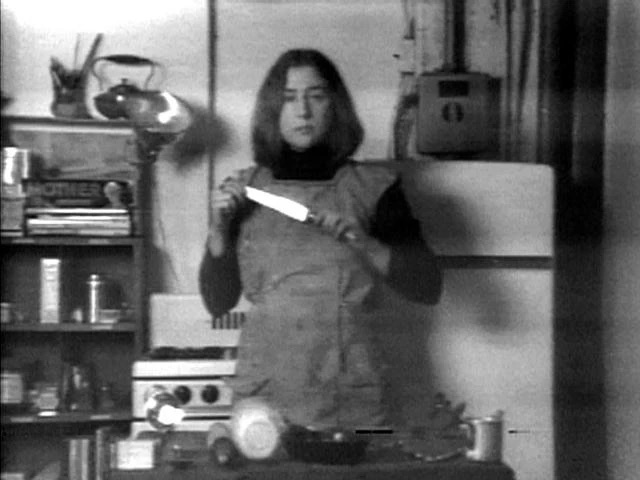
Martha Rosler, Semiotics of the Kitchen, 1975, Museo Nacional Centro de Arte Reina Sofía, Madrid, Spain.
Recognizing Hannah Höch’s work requires placing her within a female genealogy of artists whose contributions have historically been silenced or reduced to personal aspects of their lives. In Höch’s case, her relationship with Raoul Hausmann has often overshadowed analyses of her artistic production, reinforcing the need to focus on her creative achievements rather than on the romantic relationships that surrounded her, as has happened to so many women artists.
Traditional interpretations of Cut with the Kitchen Knife… have tended to minimize its critical engagement with gender, an omission that still persists in some contemporary readings. It is therefore important to remember that Höch was not an isolated figure but part of a broader tradition shared with artists such as Suzanne Valadon, Sophie Taeuber-Arp, Leonora Carrington, and Remedios Varo, all of whom challenged the norms and limitations of art from their own perspectives. Reclaiming these voices contributes to the construction of a more equitable, pluralistic, and representative history of art.
Author’s bio:
Lara Martínez Ródenas recently graduated with a bachelor’s degree in Art History from the Complutense University of Madrid. She is seeking opportunities to further develop her knowledge and experience in art history and cultural management while contributing to projects that promote cultural engagement.
Whitney Chadwick, Mujer, arte y sociedad, London: Ediciones Destino, 1992.
Linda Nochlin, Why Have There Been No Great Women Artists?, London: Thames & Hudson Ltd, 2021.
Giselda Pollock, Vision and Difference: Feminism, Femininity and Histories of Art, London: Routledge, 2020.
Virginia Wolf, Una habitación propia, Barcelona: Austral, 2016.
DailyArt Magazine needs your support. Every contribution, however big or small, is very valuable for our future. Thanks to it, we will be able to sustain and grow the Magazine. Thank you for your help!

This is our guest profile for occasional authors. If you have an interesting story about art to tell, send it to our Editor-in-chief Kate at [email protected]. You might be the next here!

Few artists have been as versatile and as bold as Marcel Duchamp (1887-1968). He was a painter, a sculptor, and a photographer; he was a seminal...
Guest Author 3 December 2024
Considered a pivotal moment in art history, a lot has been said about the Dada movement. Rejecting everything (even themselves!) Dada members...
Amélie Pascutto 3 December 2024
In addition to Marcel Duchamp’s famous readymades, during his life he created less known works that were provocative and caused a scandal among the...
Caroline Galambosova 15 September 2026
Voices of Dada is part of a popular series of archival audio CDs exploring 20th-century avant-garde and modern art. The album features interviews and...
Zuzanna Stańska, Aniela Rybak-Vaganay 15 September 2026