

Masterpiece Story: Girl in a Blue Dress by Gwen John
Discover how artist Gwen John transformed simple compositions into breathtaking glimpses of her complex inner world.
Candy Bedworth 20 July 2026
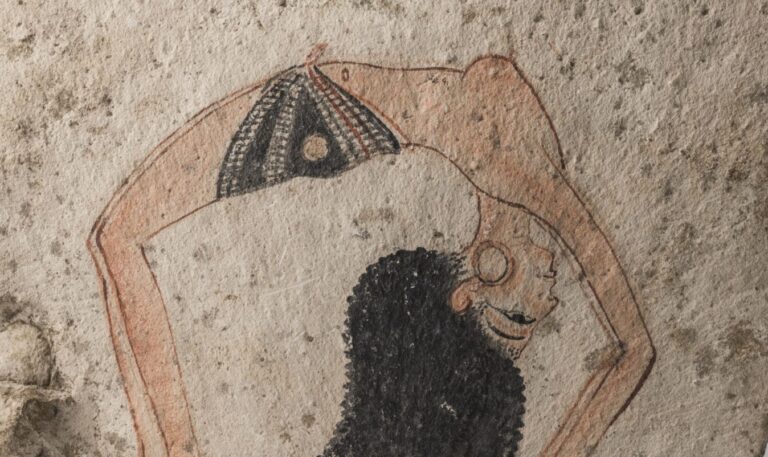
Ostracon of a Dancer, ca. 1280 BCE, Museo Egizio, Turin, Italy. Museum’s website. Detail.
Ostracon of a Dancer is one of the boldest and most individualized masterpieces of ancient Egyptian art. Its composition and remarkable sense of movement distinguish it from the more formal conventions that typically characterize Egyptian artistic tradition.
Western civilization has been fascinated with ancient Egyptian art for more than 4,500 years. The most notable admirers were the ancient Greeks, the ancient Romans, and much later the 19th-century French. The Egyptian arts continue to hold a foundational corner in the Western art tradition because they have a sense of timelessness that evokes beauty and admiration.
However, even the tradition-bound ancient Egyptian culture experienced artistic evolution over time. It would be erroneous to believe that ancient Egyptian art did not change over 2,000 years – it is not a stagnant artifact, but an evolving aesthetic with sometimes drastic developments. One of the boldest and most individually styled masterpieces of ancient Egyptian art is the Ostracon of a Dancer.
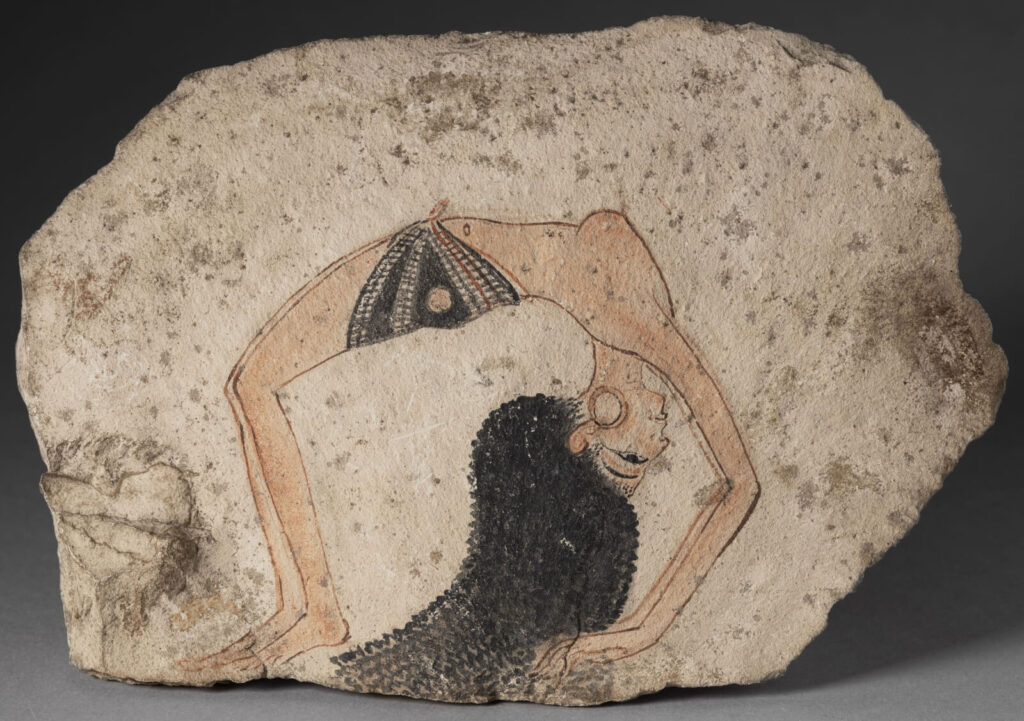
Ostracon of a Dancer, ca. 1280 BCE, Museo Egizio, Turin, Italy. Museum’s website.
Ostracon of a Dancer is a small masterpiece measuring 17 cm wide, 11.5 cm high, and 4 cm thick (6.70 × 4.52 × 1.57 in). It is fashioned from black ink and colored pigments on a flake of limestone, known as an ostracon, which is a Greek word meaning potshard. It depicts a slim and flexible dancer bending backwards in an acrobatic pose. The topless woman exposes her breasts in the air while her luscious black hair cascades to the floor. Her feet and hands support her body like structural footings of a bridge.
She is simply clothed with a small cloth skirt wrapped around her waist and large gold hoop earrings adorning her ears. She wears no shoes, no shirt, and no other accessories besides the thick black heavy eyeliner. Why is such a seductive woman recorded on a piece of broken limestone?
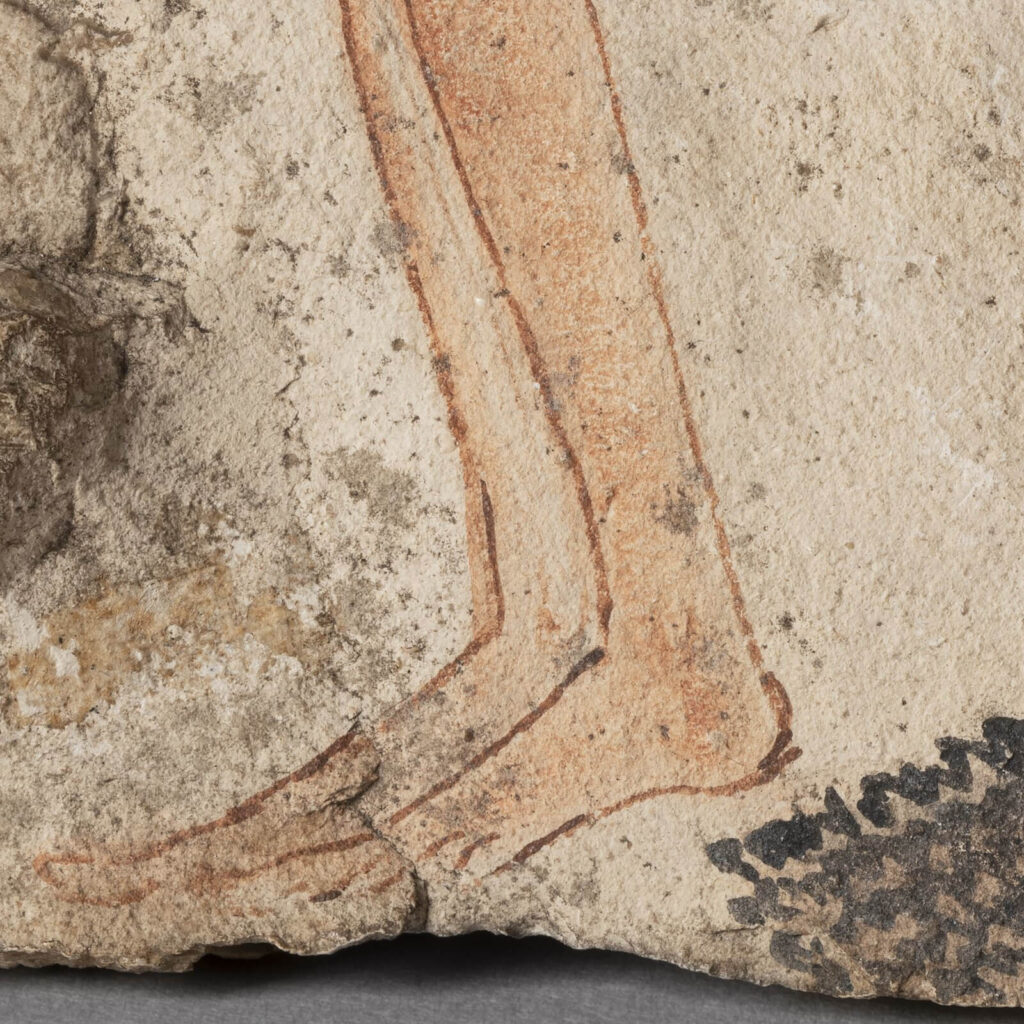
Ostracon of a Dancer, ca. 1280 BCE, Museo Egizio, Turin, Italy. Detail.
Within art history, ostracon has taken on the meaning of any small piece of stone or broken pottery that is used for artistic or literary purposes. Many of our modern insights into ancient cultures derive from the ostraca found during archaeological excavations of temples, tombs, and marketplaces. Ostraca favor the thoughts of the everyday person rather than the elite or rulers. For example, a pharaoh would most likely commission a large wall relief and not a small pottery shard. Therefore, why do ostraca exist?
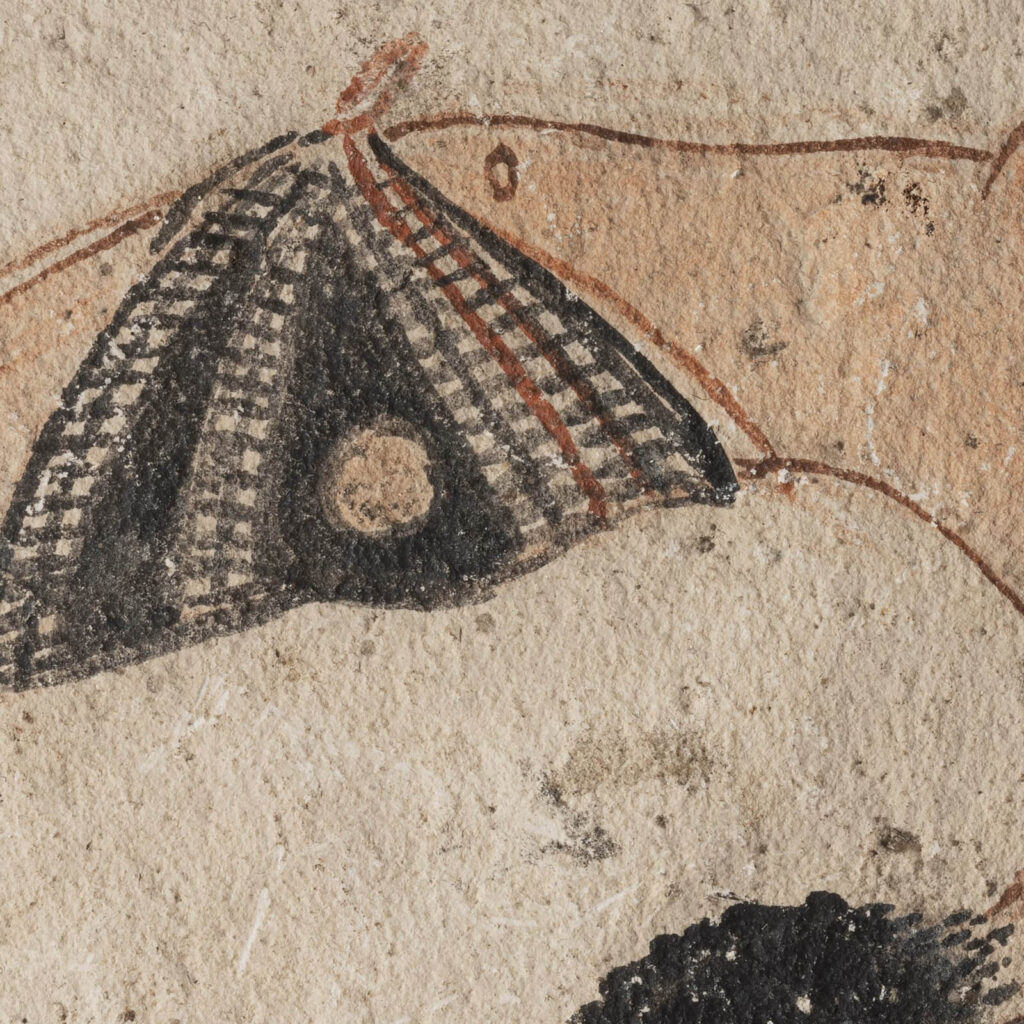
Ostracon of a Dancer, ca. 1280 BCE, Museo Egizio, Turin, Italy. Detail.
Ostracon of a Dancer was created by a skilled artist who clearly worked within the ancient Egyptian traditions of painting. Most contemporary viewers can identify this piece as being ancient Egyptian. It has that signature style of depicting hands, limbs, and feet as repetitive echoing lines. One foot is fully depicted and the second foot is a mere echo. The same is said for the hands.
However, a contemporary viewer with a stronger sense of Egyptian tradition feels that this image breaks from the normal. It is not the tighter, more formal, more authoritative modeling of the human body seen in countless reliefs and paintings. The canonical grid of human proportions, used by traditional artists, does not seem to be easily applied. The dancer is more fluid, more expressive, and certainly more seductive than most Egyptian queens and priestesses.
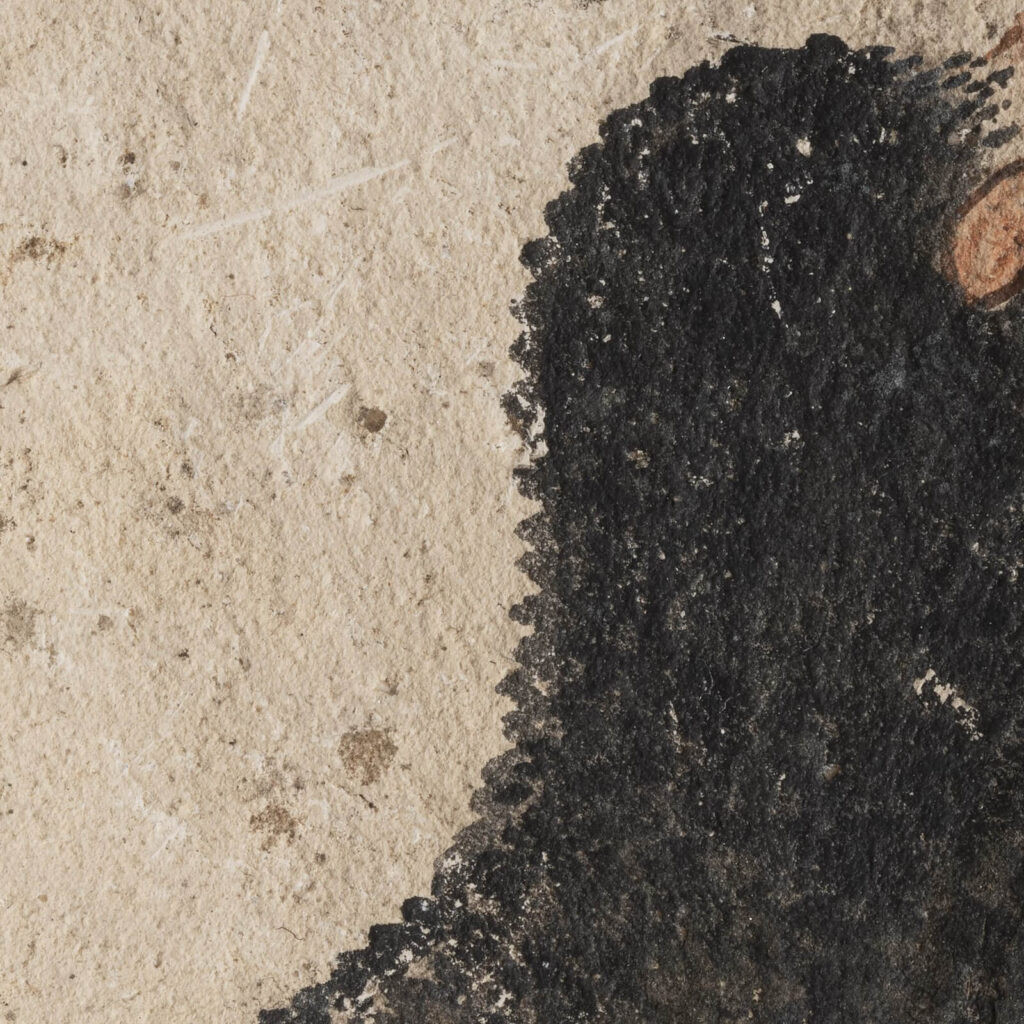
Ostracon of a Dancer, ca. 1280 BCE, Museo Egizio, Turin, Italy. Detail.
The acrobatic dancer was captured upon this small piece of limestone for one of three possible reasons. The first and most unlikely theory is that it was a practice sketch for a larger, more formal piece. Many ostraca were used for this purpose, and their later larger products have been found. However, this dancer has not been found in any known or any discovered location other than this ostracon.
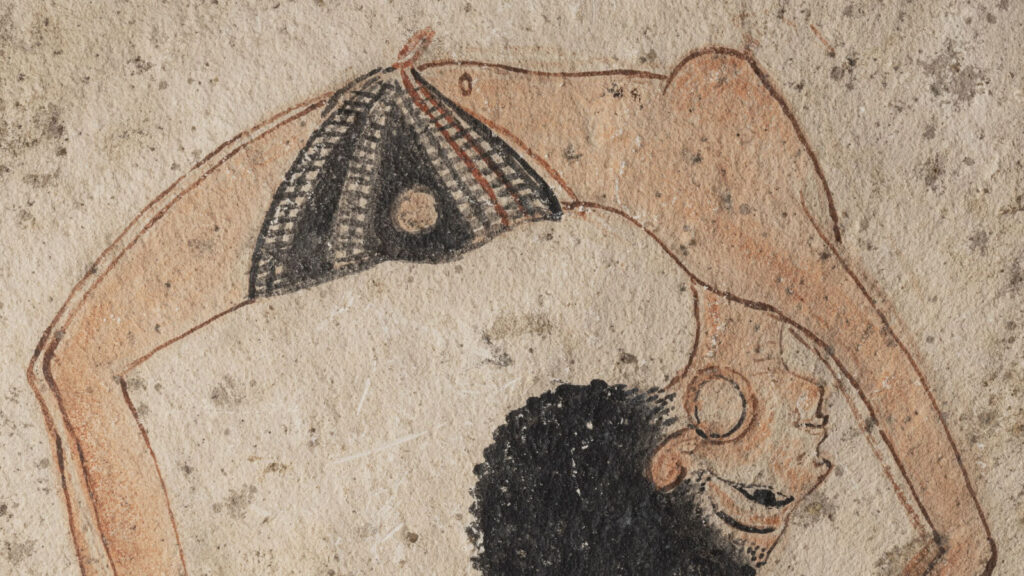
Ostracon of a Dancer, ca. 1280 BCE, Museo Egizio, Turin, Italy. Detail.
The second theory is that it records an event. Many ostraca are covered by the scribblings and writings of people to record events, documents, and thoughts. Contracts and purchase agreements on ostraca have been found throughout Egypt, giving a sense of the ancient economic situation. Some record everyday dramas or events. While other ostraca visually depict glimpses into local life and what may have occurred in the street or nearby village. Perhaps the artist of this piece attended a banquet and viewed a talented dancer do this acrobatic pose? Was the artist impressed and felt driven to capture the scene?
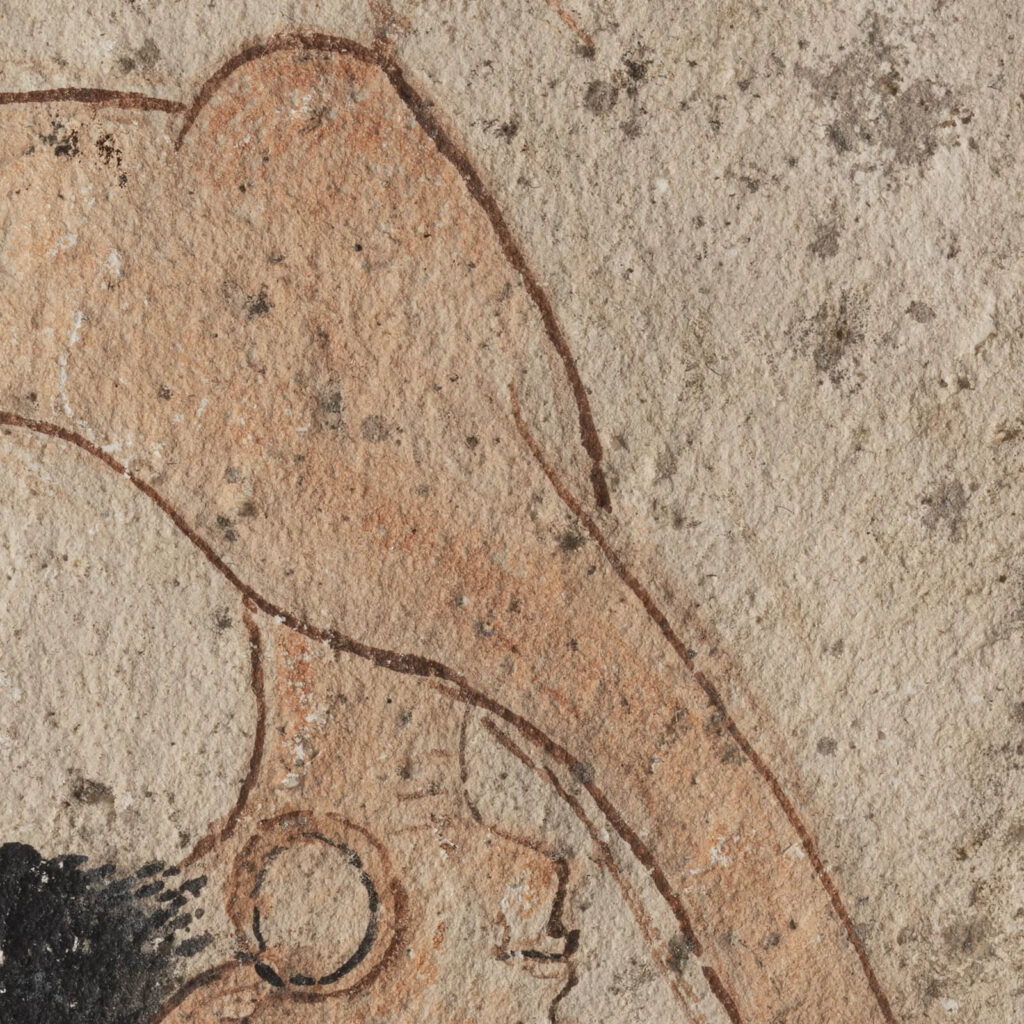
Ostracon of a Dancer, ca. 1280 BCE, Museo Egizio, Turin, Italy. Detail.
The third and most likely theory is that the Ostracon of a Dancer was created for the sheer enjoyment and pleasure of the viewer. The dancer is depicted with the typical Egyptian features associated with traditional female beauty during the 19th dynasty (1295–1189 BCE), with her thick, black, luscious hair, wide eyes, thin waist, svelte arms and legs, and a full, round bosom. She is the ideal of ancient Egyptian feminine beauty under Pharaoh Ramesses II (r. 1279–1213 BCE). Therefore, it is reasonably suggestible that this piece is intended for the heterosexual male gaze. The typical beautiful woman in art for men to admire – some archetypes of Western civilization have not changed in four millennia!
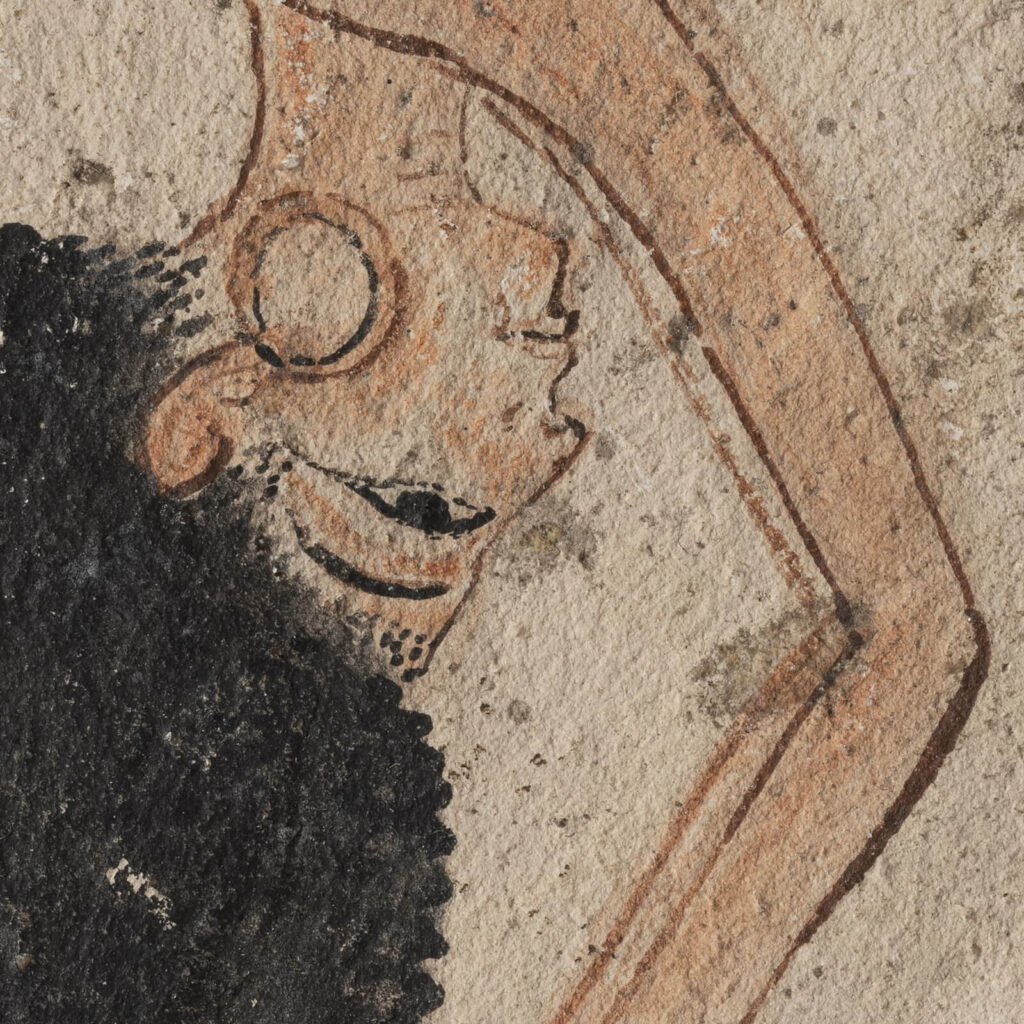
Ostracon of a Dancer, ca. 1280 BCE, Museo Egizio, Turin, Italy. Detail.
Would it be appropriate to suggest this image is an early form of erotica? Could we be viewing ancient Egyptian pornography? The answer is yes to erotica, but no to pornography. Bare-chested women were not a social taboo. However, they were sexualized. Topless women were very common as dancers to entertain at large banquets and even community parades. Nudity or partial exposure was not shocking or even very noteworthy. For example, children frequently went entirely nude until the age of 12 due to the cost of clothing and the hot Egyptian climate. However, topless dancers were definitely sexualized in Egyptian culture.
Just like today’s exotic dancers, ancient Egyptian banquet dancers were held within the same bohemian, questionable demi-mondaine light. There were social stigmas, and it was not a job palatable to everyone’s taste and lifestyle. However, a successful and particularly beautiful dancer could win many admirers, perhaps gain a rich protector, and even perhaps attract a good husband.
Therefore, it is possible that this beautiful dancer represents either an admired individual or a social ideal. She could be a portrait or an archetype. Only the original artist could tell us. Regardless of the artist’s creative thoughts and artistic intentions, Ostracon of a Dancer continues to captivate the modern viewer with its beauty and mystery.
“Ostracon of a Dancer,” Museo Egizio online collection. Retrieved 12 July 2026.
Málek Jaromír: Egypt: 4000 Years of Art, Phaidon Press Limited, London, UK, 2003.
Smith W. Stevenson, William Kelly Simpson: Art and Architecture of Ancient Egypt, Yale University Press, New Haven, CT, USA, 1998.
DailyArt Magazine needs your support. Every contribution, however big or small, is very valuable for our future. Thanks to it, we will be able to sustain and grow the Magazine. Thank you for your help!

James W. Singer is an art historian and fine art photographer. He earned a Bachelor of Arts in Art History from the University of Florida. He later moved to Paris, France. He currently writes “Masterpiece” articles for DailyArt Magazine.
Discover how artist Gwen John transformed simple compositions into breathtaking glimpses of her complex inner world.
Candy Bedworth 20 July 2026
Félix Vallotton, a Swiss-French painter, is often called the “painter of disquiet.” His works carry tension, mystery, and psychological unease.
Kinga Dobosz 13 July 2026
The Wedding at Cana by Paolo Veronese is a masterpiece of Venetian Renaissance art, elaborating a simple biblical story into epic proportions. The...
James W Singer 12 July 2026
Jan van Os’s Still Life with Carnations and Exotic Fruit is a celebration of summer in its most luxurious form, filled with carefully arranged...
James W Singer 28 June 2026