
Wild Spirits: 5 Animal Paintings by Franz Marc
Examining Franz Marc’s most iconic animal paintings reveals how the German Expressionist used color and form to convey the spiritual essence of...
Lisa Scalone 15 May 2025
Egon Schiele, Portrait of Wally Neuzil, 1912, Leopold Museum, Vienna, Austria.
Egon Schiele lived for 28 years and painted as though he knew exactly how many years he had. Few bodies of work in modern art carry the biographical weight of Egon Schiele’s paintings. From the savage self-portraits of 1910 to the unfinished quiet of The Family, each canvas marks a distinct reckoning. 10 of them tell that story.
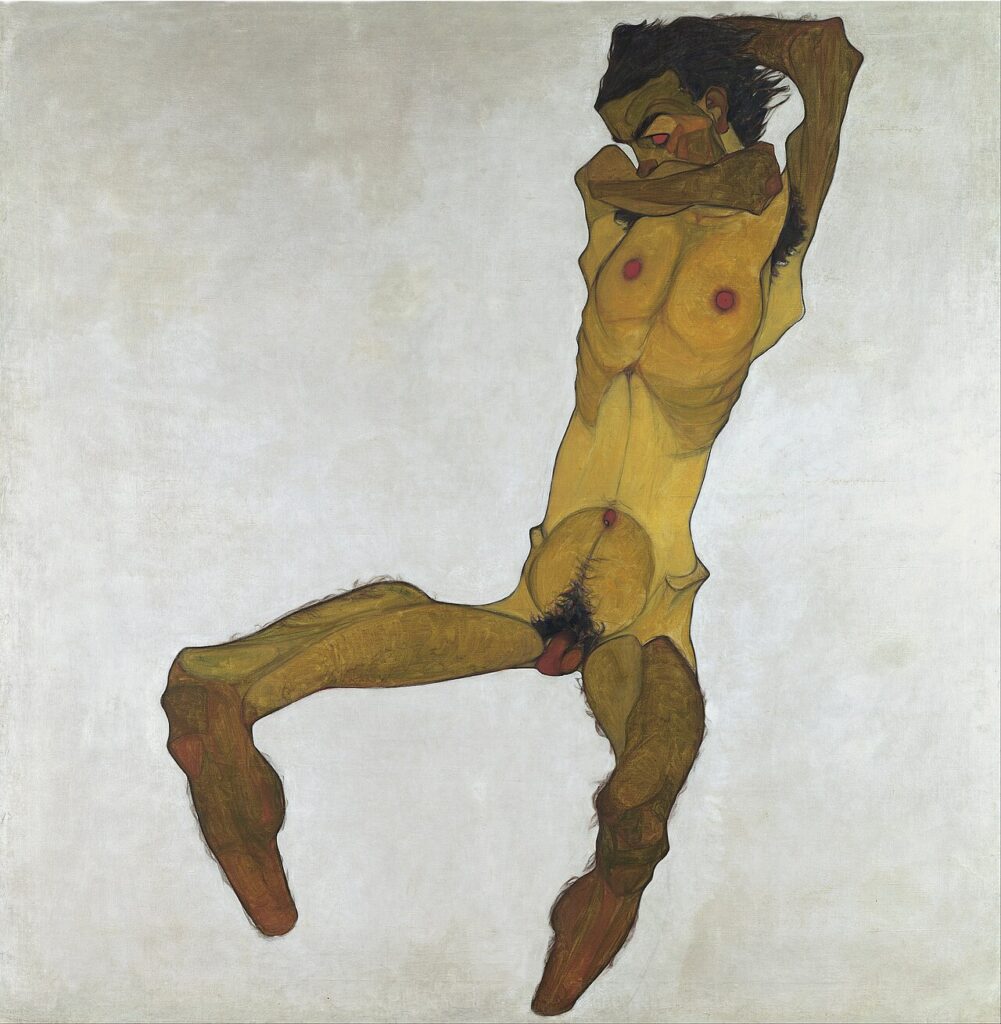
Egon Schiele, Seated Male Nude (Self-Portrait), 1910, Leopold Museum, Vienna, Austria.
Among all Egon Schiele‘s paintings, the self-portraits of 1910 mark the sharpest break from everything that came before. In this work, Schiele places a skeletal, angular figure against a completely bare, colorless ground. He renders his own body with unsparing directness, treating the self as a psychological document rather than a likeness. Furthermore, the total absence of background forces the viewer into direct, unmediated confrontation with the figure. Instead of Klimt‘s ornamental surfaces, Schiele reaches for something rawer and more exposing. This single painting announces his founding conviction that the body tells truths the face cannot.
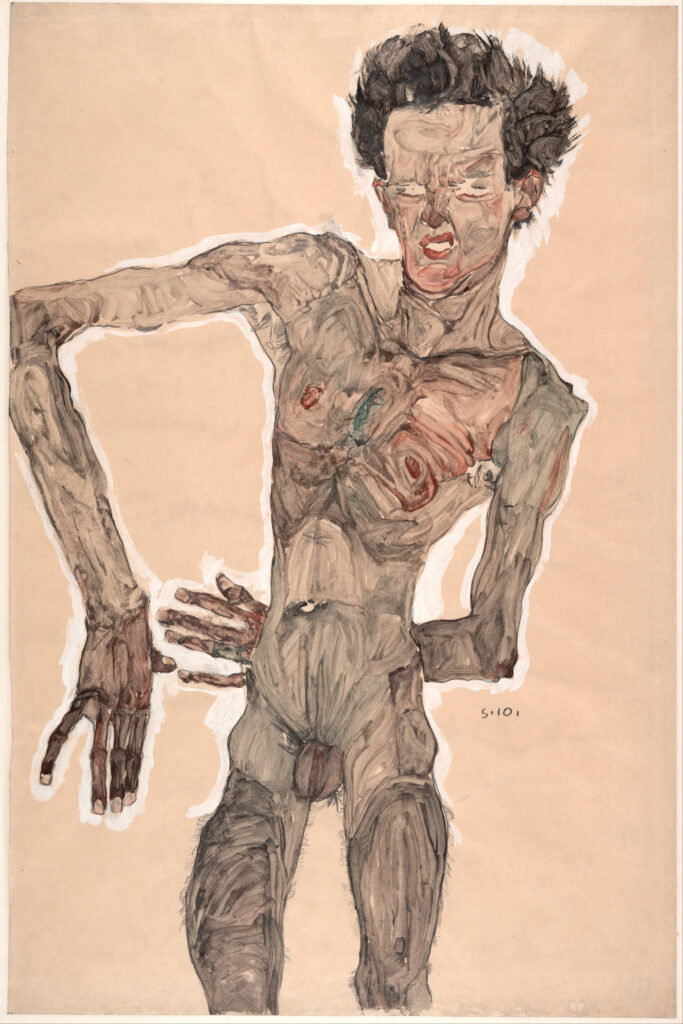
Egon Schiele, Nude Self-Portrait, Grimacing, 1910, Albertina, Vienna, Austria.
The grimace Schiele wears here is not incidental. It functions as the painting’s central argument, a face he twists into a challenge the viewer cannot deflect. Schiele contorts his entire body in sympathy, making discomfort the governing principle of the entire composition. Yet this is not suffering for its own sake. Rather, it connects to a broader Expressionist conviction that authentic emotional truth requires the total dismantling of decorum. No painter working in Vienna in 1910 pushed that conviction further than Schiele did here.
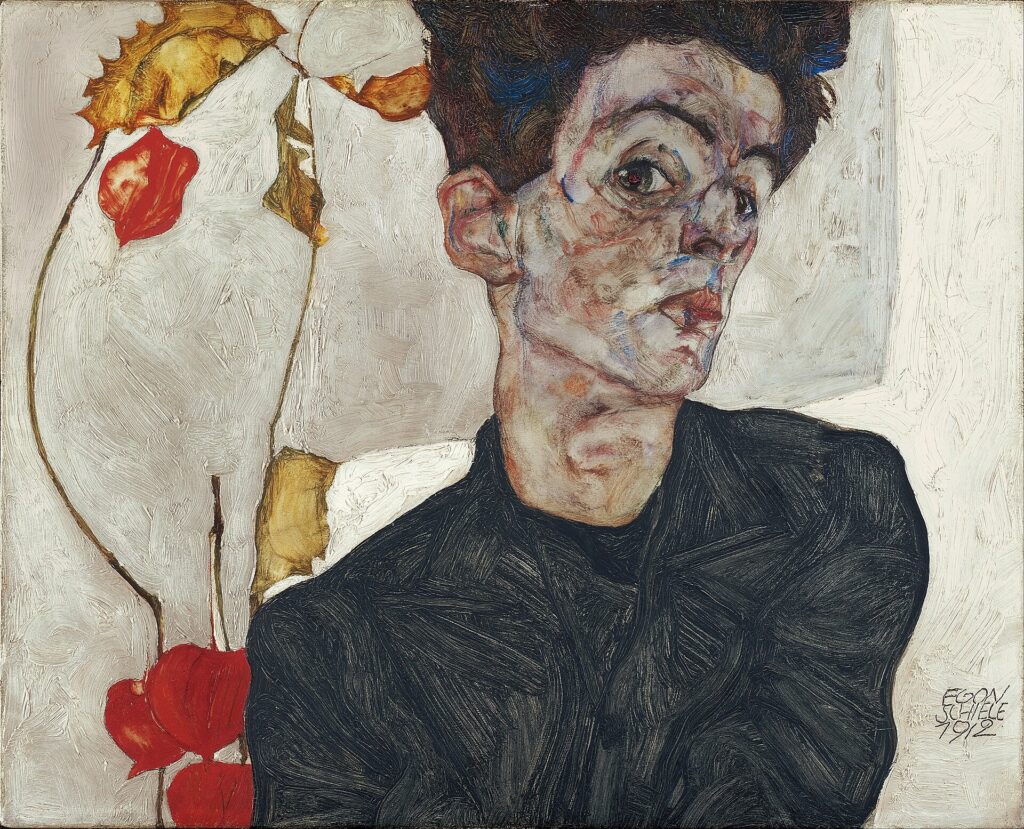
Egon Schiele, Self-Portrait with Chinese Lantern Plant, 1912, Leopold Museum, Vienna, Austria.
By 1912, Schiele had moved beyond the raw aggression of his earlier self-portraits toward a more considered approach. This image draws the eye immediately to the Chinese lantern on his shoulder, its amber warmth contrasting with his pale skin. Schiele uses the plant as more than a compositional device. He treats it as a symbolic counterpoint, a fragile form he presses against a body he consistently renders as exposed. Consequently, among the most recognizable paintings by Egon Schiele, this self-portrait endures because it balances psychological intensity with an unexpected stillness. The gaze neither challenges nor retreats but simply holds.
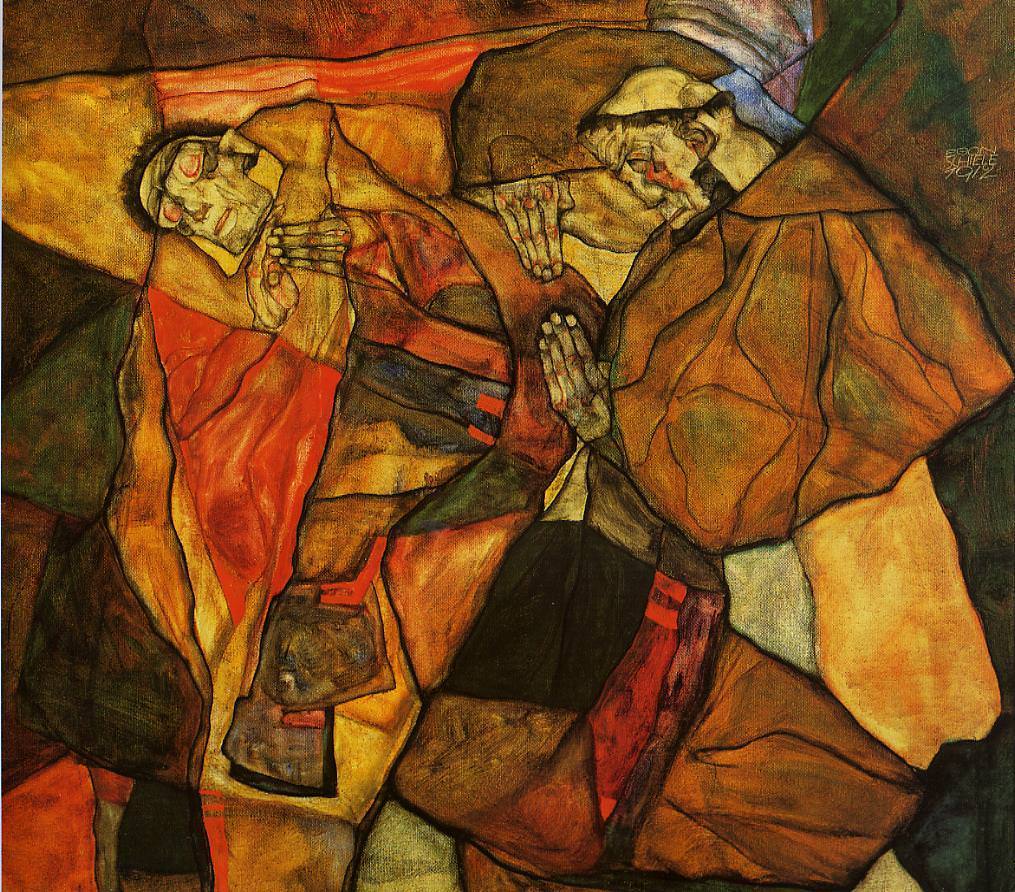
Egon Schiele, Agony, 1912, Neue Pinakothek, Munich, Germany.
Agony is one of the most spiritual works Schiele ever made, and also one of his most formally austere. He painted it amid his 1912 imprisonment, channeling crisis into two elongated figures at the edge of a void. One figure collapses inward while the other bears witness, and together they form a composition of unbearable emotional compression.
Schiele draws on El Greco‘s elongation here, absorbing that influence and pushing it toward something rawer and more psychologically urgent. Similarly, the German Expressionists were mining religious iconography for existential rather than theological meaning, and Schiele belongs squarely in that lineage. Yet no one else made suffering feel quite so structurally inevitable.
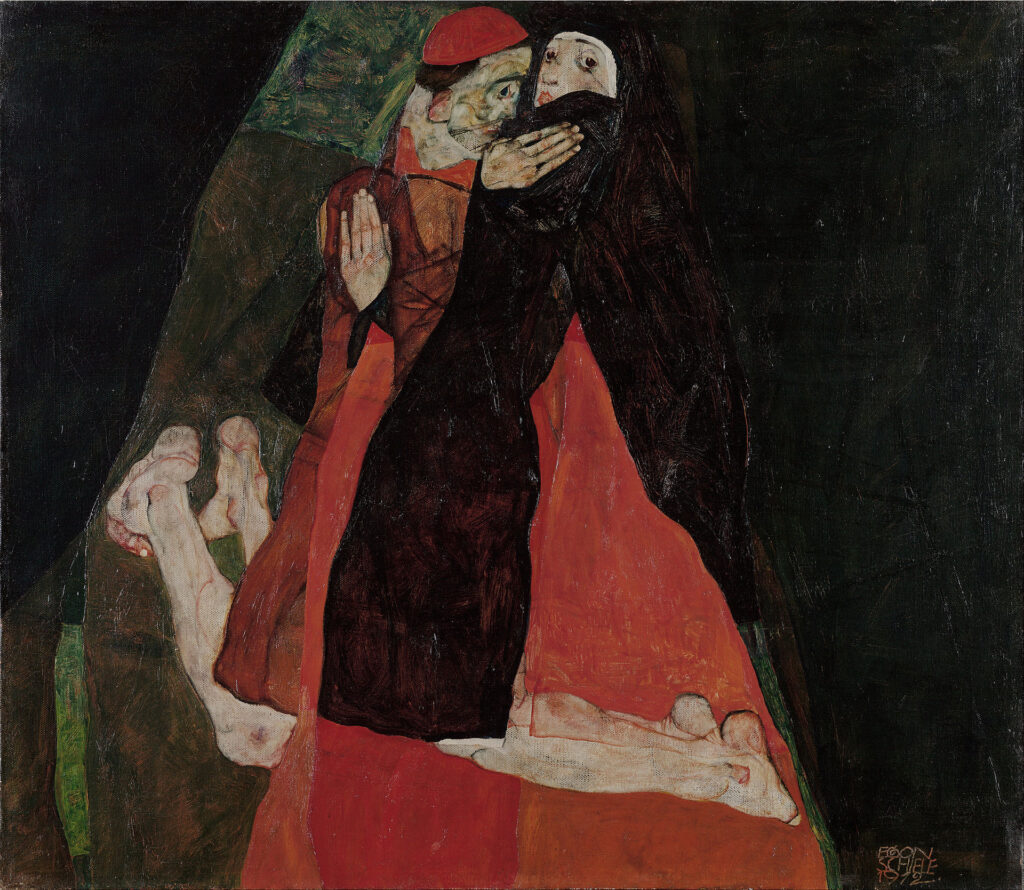
Egon Schiele, Caress (Cardinal and Nun), 1912, Leopold Museum, Vienna, Austria.
What makes this painting so unsettling is precisely what it refuses to do. Schiele does not use these figures as vehicles for anti-clerical satire, which would have been the easier choice. Instead, he fuses religious authority and erotic intimacy into a single, suffocating embrace. The cardinal’s robe burns in a deep, confrontational red that Schiele wields against the figures’ solemnity like a provocation. Furthermore, the two figures press so close that the boundary between devotion and desire becomes impossible to locate. This is not a scandal for its own sake but a genuine inquiry into what the body wants from the spirit.
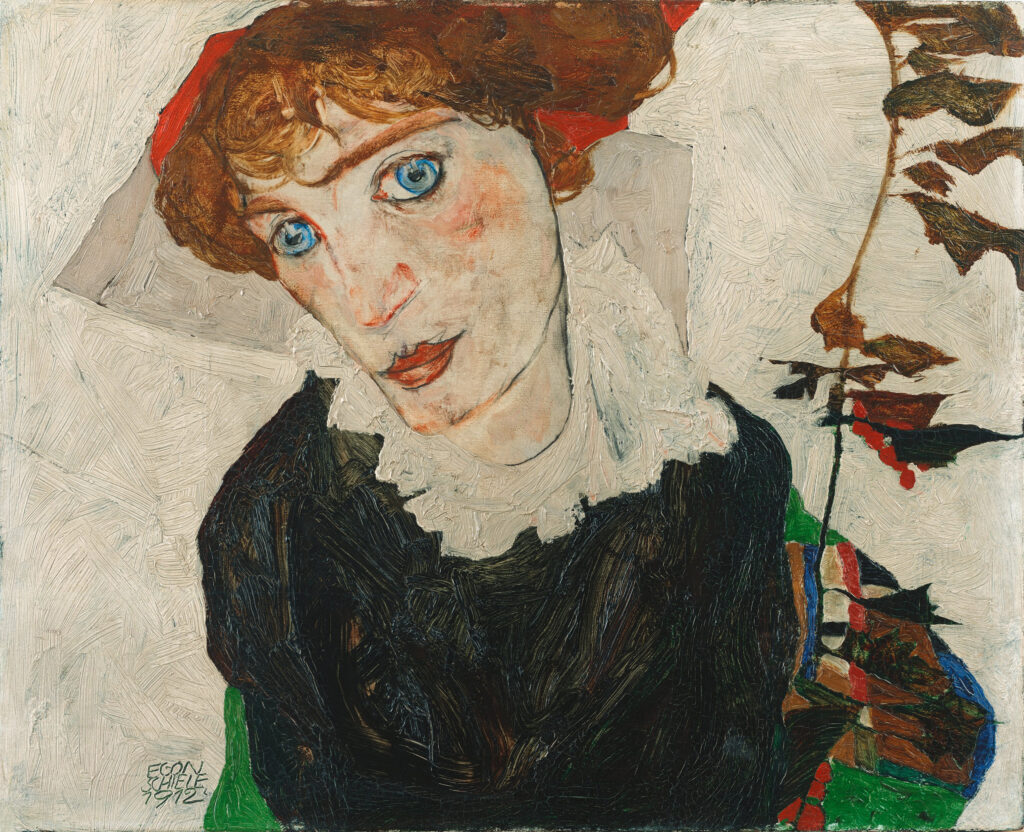
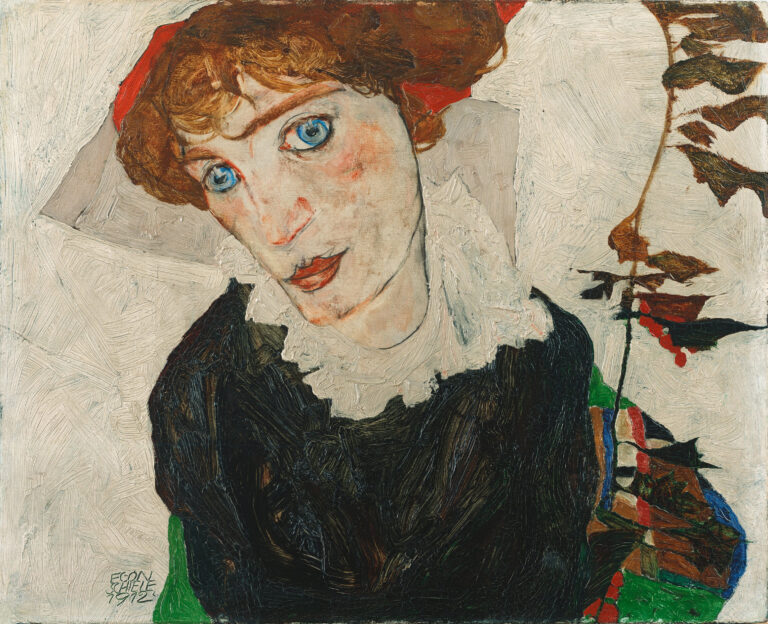
Egon Schiele, Portrait of Wally Neuzil, 1912, Leopold Museum, Vienna, Austria.
Wally Neuzil appears in Schiele’s work more than any other single subject, yet this portrait stands apart. Her gaze meets the viewer with a directness that Schiele rarely allows in his more tortured self-examinations. He renders her with the same unsparing line he applies to his own body, but the emotional register differs entirely. There is a tenderness here that complicates any reading of Egon Schiele’s paintings as driven purely by anguish or provocation. Moreover, the reds he deploys across her lips and complexion carry an intimacy that feels biographical rather than formal. This is a portrait of someone he knew from the inside.

Egon Schiele, Two Girls Lying Entwined, 1915, Albertina Museum, Vienna, Austria.
Schiele’s erotic work has always attracted more scandal than serious attention, and this painting quietly corrects that imbalance. The two figures lie entwined with a tenderness that resists any purely voyeuristic reading. Schiele traces the contours of both bodies with his characteristic searching line, but the composition feels observational rather than staged.
Among the most emotionally complex of Egon Schiele’s paintings, this work stands out because it prioritizes intimacy over provocation. The horizontal arrangement completely fills the frame, giving the two bodies a sense of total self-containment. Schiele does not invite the viewer into this image as much as permit a witnessing.
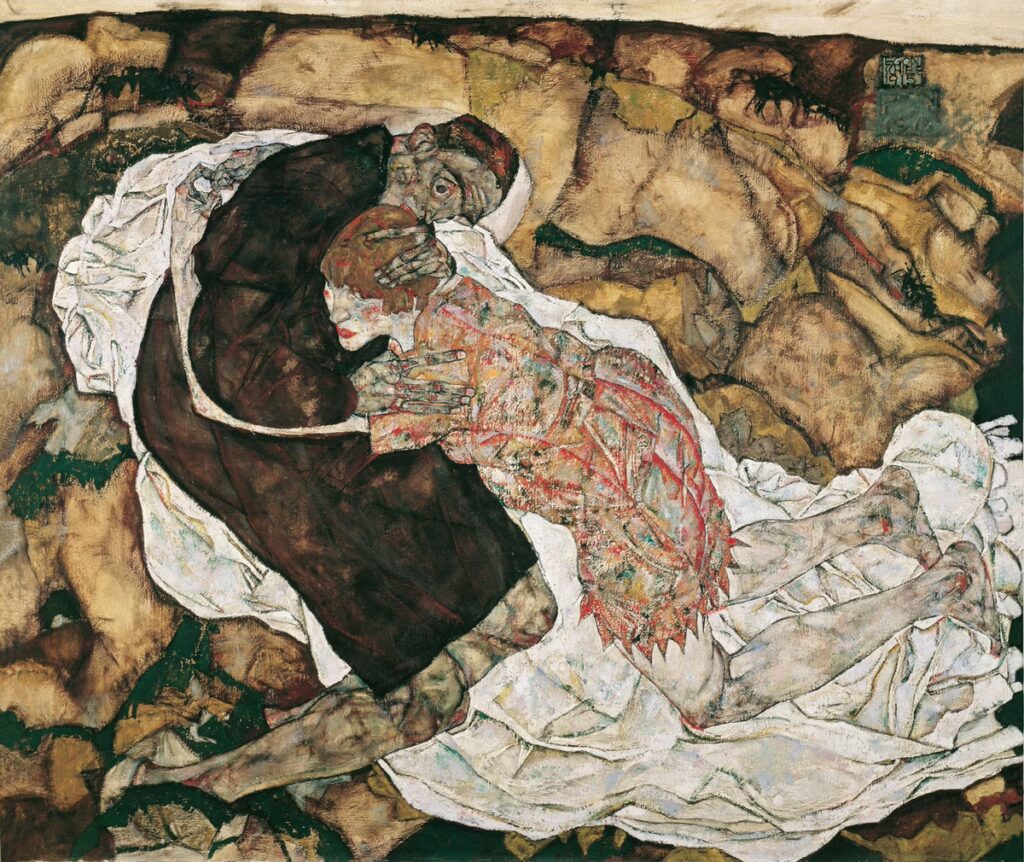
Egon Schiele, Death and the Maiden, 1915, Österreichische Galerie Belvedere, Vienna, Austria.
The artist here takes one of art’s oldest motifs and reverses its power dynamic entirely. In the traditional Death and the Maiden, Death comes for the woman. Here, the dying figure clings to her, making need and loss the governing forces rather than menace. The crumpled ground beneath both figures, resembling a funeral shroud, pulls the composition toward mortality before either figure reaches for it. Schiele painted this the year he abandoned Wally for Edith Harms, and the image reads as both confession and elegy. Nothing else in his body of work carries this much emotional architecture.
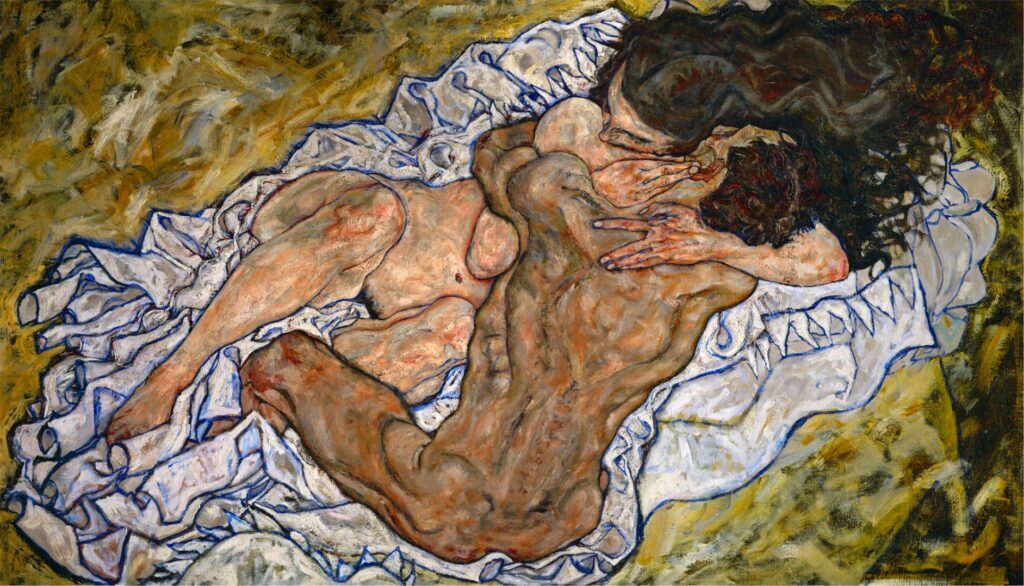
Egon Schiele, Embrace (Lovers II), 1917, Österreichische Galerie Belvedere, Vienna, Austria.
Two years after Death and the Maiden, Schiele returns to the entwined couple but arrives somewhere entirely different. The figures here press together with a warmth that reads less like desperation and more like refuge. Schiele renders both bodies on a pale, luminous ground, replacing the funereal darkness of his earlier work with shelter. This marks a genuine turning point in Egon Schiele’s art, away from anguish and toward something more sustaining. The composition gives equal weight to both figures, neither consuming nor overpowering the other. Schiele had found, however briefly, a different register.
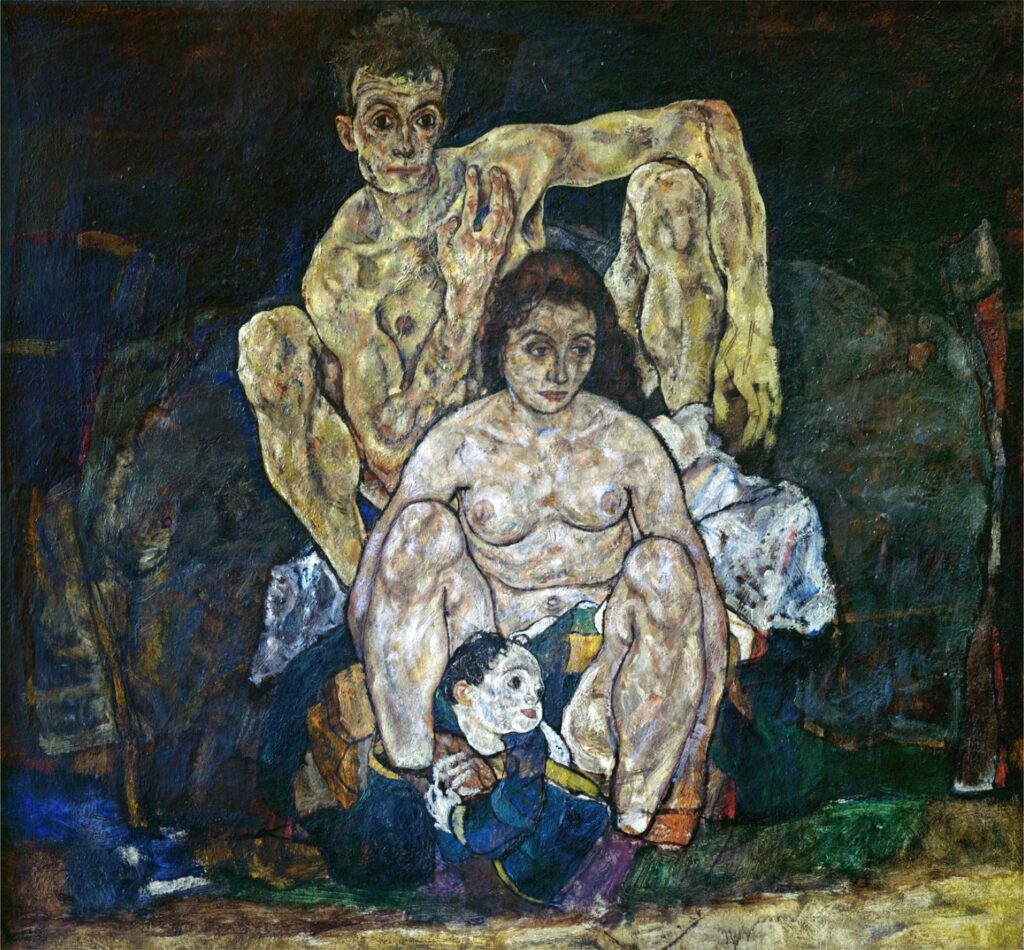
Egon Schiele, The Family (Squatting Couple), 1918, Österreichische Galerie Belvedere, Vienna, Austria.
Schiele never finished this painting, and that fact reshapes everything about how we read it. He died from Spanish flu in October 1918, three days after Edith, at 28. The three figures, a man, a woman, and a child who never existed, arrange themselves with a stillness entirely foreign to his earlier work. Yet this calm does not read as resignation. Rather, it suggests an artist standing at the threshold of a new formal language, one that his death cut short before it could fully form. The Family does not conclude Schiele’s story as much as interrupts it.
Get your daily dose of art
Click and follow us on Google Profile

DailyArt Magazine needs your support. Every contribution, however big or small, is very valuable for our future. Thanks to it, we will be able to sustain and grow the Magazine. Thank you for your help!

I'm Errika Gerakiti, an art writer and curator based in Athens. I write about modern and contemporary art, fashion, and cinema — with a particular interest in the overlooked, the uncomfortable, and the underrepresented. When I'm not writing, I'm curating exhibitions, reading, painting, sculpting, or reading. For longer reads, personal essays, and an occasional science-fiction or horror story, find me on Substack.

As an educator, writer, and neurodivergent creative, I enjoy learning and sharing through nature, the arts and novel experiences.
Examining Franz Marc’s most iconic animal paintings reveals how the German Expressionist used color and form to convey the spiritual essence of...
Lisa Scalone 15 May 2025
The purpose of art for a group of avant-garde individuals at the turn of the 20th century was no longer the realistic rendition of the natural world,...
Guest Author 29 February 2024
Do you know who James Ensor was? James Ensor (1860-1949) was a scandalous, rebellious, and revolutionary Belgian painter with a style that could be...
Andra Patricia Ritisan 13 April 2026
Romani artist Helios Gómez produced some of the most striking Spanish avant-garde graphics in the first half of the 20th century. However, he also...
Candy Bedworth 8 April 2026