

Masterpiece Story: Judith and Holofernes by Caravaggio
Judith and Holofernes is a Caravaggio masterpiece that captures Biblical murder and drama. Rarely has death been captured so intensely and violently...
James W Singer 13 September 2026
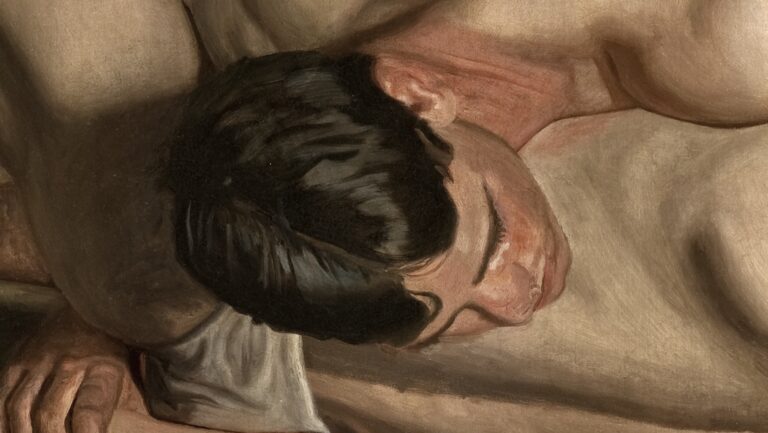
Thomas Eakins, Wrestlers, 1899, Los Angeles County Museum of Art, Los Angeles, CA, USA. Detail.
Thomas Eakins was one of the greatest Realist painters of 19th-century America. Wrestlers explores the interesting dynamic between sports and sexualities.
Born in 1844, Thomas Eakins became a key figure in American Realism. He aimed, like his fellow Realist contemporaries, to represent the world in a truthful, unembellished, and naturalistic manner. Eakins believed that scientific knowledge was a prerequisite to art because science allowed an artist to aim and capture objectivity. Therefore, he promoted this by using life models to achieve anatomical accuracy.
Like the Impressionists, Eakins desired to capture modern fleeting moments, but unlike them, Eakins desired to capture those moments in an Academic and objective style. He sought an almost documentary attitude to his subjects. Wrestlers is a superb culmination of Thomas Eakins’ artistic intentions and of his career. It also sparks undertones of homoeroticism.

Thomas Eakins, Wrestlers, 1899, Los Angeles County Museum of Art, Los Angeles, CA, USA.
Wrestlers is an oil on canvas measuring 48 ⅜ x 60 in. (122.9 x 152.4 cm). It depicts the dark brown interior of an exercise room where five figures are engaged in different activities. The main central figures, in the foreground, are two young men lying on the floor in a “crotch hold” position. Their lithe forms twist and contort as they struggle against each other while sunlight ripples over their muscled bodies, casting shadows. A third athlete exercises on a rowing machine in the background, in the upper left corner of the painting. A fourth athlete, face unseen, stands to the right in the middle ground with his coach, whose face is also unseen. They observe and point to the two wrestlers as they discuss the challenges ahead.

Thomas Eakins, Wrestlers, 1899, Los Angeles County Museum of Art, Los Angeles, CA, USA. Detail.
Thomas Eakins studied at the École des Beaux-Arts in Paris for three years under the guidance of artist Jean-Léon Gérôme (1824–1904). In 1870, he returned to his hometown of Philadelphia to teach at the prestigious Pennsylvania Academy of the Fine Arts. Both institutions were beacons of Academia and the Academic style promoted by famous artists such as Jean-Léon Gérôme, William-Adolphe Bouguereau, and Lawrence Alma-Tadema.
The Academic tradition favored live observation, pencil sketching, and then oil painting its subjects. However, Thomas Eakins replaced pencil sketches with camera photographs. He was a pioneer of multiple-exposure photography with a single camera. He would freeze and capture dramatic moments, and then use his developed prints as guides for his paintings.

Thomas Eakins, Wrestlers, 1899, Los Angeles County Museum of Art, Los Angeles, CA, USA. Detail.
Wrestlers was no exception when it came to Eakins’s use of photography as a tool. When Thomas Eakins approached the subject in May 1899, he enlisted two models to wrestle and hold interesting poses. Joseph McCann, a boxer, is documented as one of the photographed models, though modern art historians are unsure which one he is. Both men are physically similar in stature and build. They are both white men, lean, muscled, and appear to be in their early twenties, with straight brown hair. Without context, they could easily be mistaken for brothers.

Thomas Eakins, Wrestlers, 1899, Los Angeles County Museum of Art, Los Angeles, CA, USA. Detail.
The struggling grip of the two almost-nude wrestlers is homoerotic and could easily inspire erotic fantasies for a homosexual male viewer. Many scholarly papers and articles have been published on the uncertain sexuality of Thomas Eakins and his frequent use of male nudes within his paintings. Was Thomas Eakins a closet homosexual, or at least somewhere along the spectrum of a non-traditional sexuality?
Some viewers and writers believe Wrestlers is a visual metaphor for sexual repression and frustration. As one wrestler dominates and pins the other wrestler to the floor, there are palpable feelings of discomfort, captivity, and submission. These feelings are easily relatable to anyone who has ever felt sexually frustrated or repressed. Therefore, while homosexuality is the most obvious sexuality explored in Wrestlers, it does have the ability to speak to a larger audience.

Thomas Eakins, Wrestlers, 1899, Los Angeles County Museum of Art, Los Angeles, CA, USA. Detail.
Thomas Eakins frequently claimed that nude bodies did not hold any erotic interest for him. He stated that he merely used live models to capture the visual accuracy and objectivity of his subjects. Today, with a wider acceptance of the sexual spectrum of the LGBTQ+ community, the idea of asexuality is not unknown. Perhaps Eakins was asexual and did not have any sexual interest, desire, or admiration for his nude models? However, such an idea was almost impossible to comprehend in 19th-century America.
With the importation of Victorian sexual morals and the promotion of Sigmund Freud’s sexually-infused psychoanalysis, sex and sexuality were frequently on the minds of the 19th-century public. Is it not often believed that the more we deny or suppress something, the more focused and obsessive we become? Therefore, as Eakins denied having any sexuality, the more it fueled speculation on his sexuality. It is like the paradox of denying gossip. The more the victim denies the truth, the more it fans the flames of interest. The best way to kill gossip is to ignore it.

Thomas Eakins, Wrestlers, 1899, Los Angeles County Museum of Art, Los Angeles, CA, USA. Detail.
In the upper left background is a third athlete. He is using a rowing machine to develop his posture and strength. In the true visual sense, he is exercising and preparing himself for the wrestling challenge ahead. In a figurative sense, he is working on building the courage to confront his sexuality within the wrestling ring. The rowing machine does not confront him as does a live competitor. However, is this stretching the sexual interpretation too far? Perhaps the viewer is simply viewing an exercise room where several young men are exercising and competing? Or perhaps it is a room filled with sexual tensions?

Thomas Eakins, Wrestlers, 1899, Los Angeles County Museum of Art, Los Angeles, CA, USA. Detail.
In the right midground are a fourth athlete and his coach. They are represented by the lower half of their bodies. Their torsos and heads are unseen as their bodies extend beyond the edges of the canvas. Thomas Eakins has presented a photograph-like composition where subjects are not entirely captured within the frame of the shot. This style was very popular with Impressionist painters as it implied the continuity of life beyond the canvas borders. It presents the idea that the canvas is just a snapshot, a brief image of a single frame of a single moment in the expansive and time-filled world. It cements the idea of transience and brevity.
However, Eakins used this Impressionist motif but within the context of Realism. He has reframed a revolutionary idea within an Academic context. In this way, he bridges Impressionism and Academicism. He also bridges the idea that sexuality is something to reflect on and discuss with others. Perhaps the coach also represents a confidant, an ally, a friend to the LGBTQ+ community? Perhaps the athlete sees the wrestler’s homoerotica and is sexually curious? Or, could it simply be an athlete seeing the challenge ahead and seeking advice on wrestling technique?

Thomas Eakins, Wrestlers, 1899, Los Angeles County Museum of Art, Los Angeles, CA, USA. Detail.
Wrestlers by Thomas Eakins is truly a culmination of the artist’s career. It was his last genre painting, his last male nude, and his last sporting image. However, as is often seen, the last product is the finest because it is the summit of previous attempts. Eakins explores the physical dimensions of bodies in anatomically different positions, but also explores the spiritual dimensions of sexualities in metaphorically different positions. To participate in wrestling, or any sport, it takes courage, spirit, and a sense of competition.
There is also a perception of sheer pleasure and action. Could these senses and feelings also apply to sexual exploration and experience? Almost everything in life is connected. Life has a curious way of connecting two apparently separate concepts by a linking thread. Therefore, sport and sexuality can be connected, and Wrestlers explores this unusual but interesting dynamic.

Thomas Eakins, Wrestlers, 1899, Los Angeles County Museum of Art, Los Angeles, CA, USA. Detail.
Wendy Beckett, Patricia Wright, Sister Wendy’s 1000 Masterpieces, London: Dorling Kindersley Limited, 1999.
Victoria Charles, Joseph Manca, Megan McShane, and Donald Wigal, 1000 Paintings of Genius, New York: Barnes & Noble Books, 2006.
Helen Gardner, Fred S. Kleiner, and Christin J. Mamiya, Gardner’s Art Through the Ages, 12th ed. Belmont: Thomson Wadsworth, 2005.
Jonathan Katz, “How Portraiture Displays Desire,” Smithsonian Magazine, 6 June 2024. Accessed: Jun 2, 2025.
Wrestlers, Los Angeles County Museum of Art Online Collection. Accessed: May 27, 2025.
DailyArt Magazine needs your support. Every contribution, however big or small, is very valuable for our future. Thanks to it, we will be able to sustain and grow the Magazine. Thank you for your help!

James W. Singer is an art historian and fine art photographer. He earned a Bachelor of Arts in Art History from the University of Florida. He later moved to Paris, France. He currently writes “Masterpiece” articles for DailyArt Magazine.

Univ. of New Orleans, Fine Arts and History; Fine Artist, Professional Graphic Designer, Art Historian, Historian, Musician, worked at the New Orleans Museum of Art and MS Museum of Art; learning enthusiast!
Judith and Holofernes is a Caravaggio masterpiece that captures Biblical murder and drama. Rarely has death been captured so intensely and violently...
James W Singer 13 September 2026
Explore an astonishing 1915 nude self portrait by American modernist painter Florine Stettheimer.
Candy Bedworth 21 September 2026
Winslow Homer (1836–1910) was one of the leading American Realist painters. His painting The Veteran in a New Field is a masterpiece of late...
James W Singer 30 August 2026
At first glance, A Goldsmith in His Shop (1449) appears to depict an ordinary visit to a jeweller. Yet Petrus Christus transformed an ordinary...
Shivani Gupta 23 August 2026

#/media/File:Eakins,_Thomas_(1844-1916)_-_Lottatori_1.jpg)