
Masterpiece Story: Judith and Holofernes by Caravaggio
Judith and Holofernes is a Caravaggio masterpiece that captures Biblical murder and drama. Rarely has death been captured so intensely and violently...
James W Singer 13 September 2026
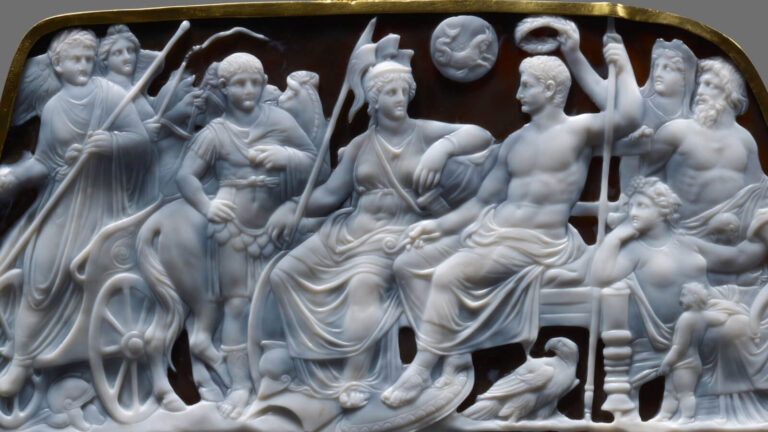
Dioskourides, Gemma Augustea, 9–12 CE, Kunsthistorisches Museum, Vienna, Austria. Museum’s website. Detail.
The Gemma Augustea is the second largest cameo surviving from antiquity, and one of the most artistically valuable pieces of ancient Roman art. It is one of those rare examples where the creator is specifically known by name in ancient literature and therefore can be precisely dated and easily aligned within the history of Rome and Roman art.
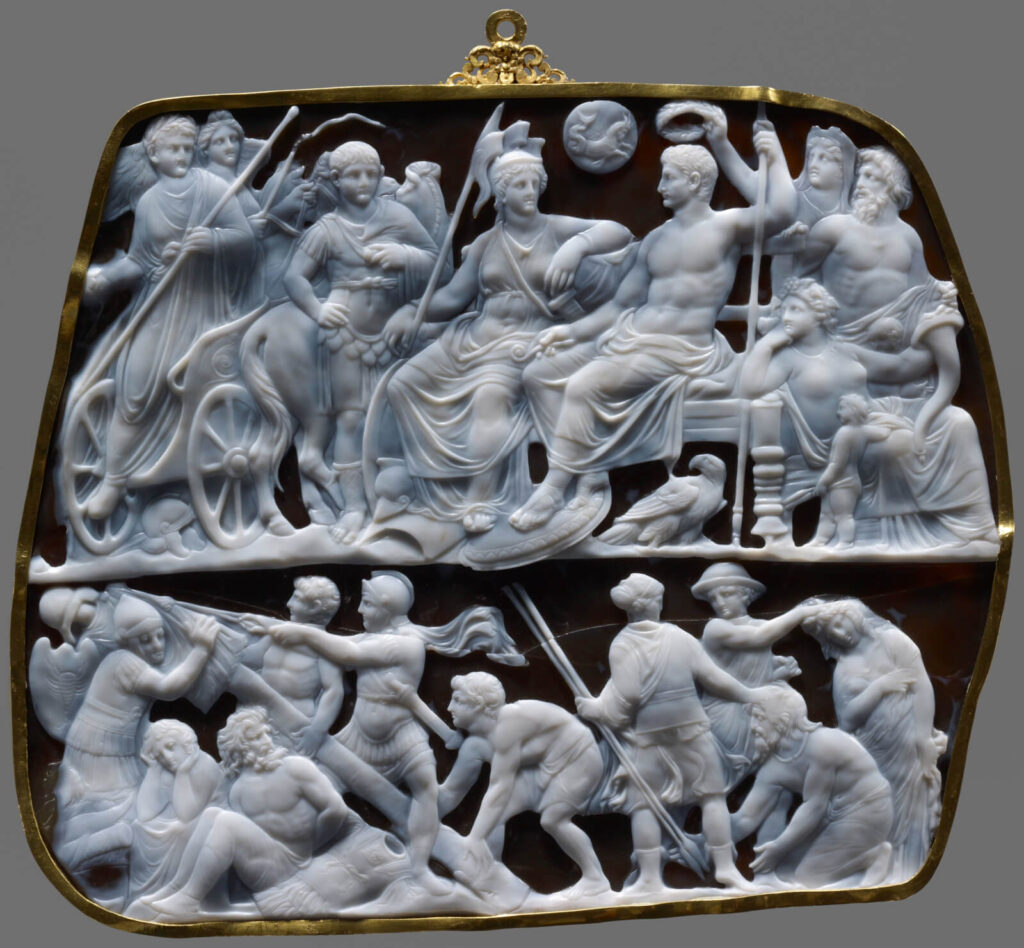
Dioskourides, Gemma Augustea, 9–12 CE, Kunsthistorisches Museum, Vienna, Austria. Museum’s website.
Dioskourides was a Greek artist who lived and worked in Rome at the heart of the ancient Roman Empire during the 1st century CE. He, like many other Greeks, moved to the capital city after the Roman conquest of the Hellenistic world, including Greece. His great artistic skills soon caught the attention of the Emperor Augustus (ruled 27 BCE–4 CE), and he soon joined the imperial cameo workshop. It is under the context of imperial patronage that Dioskourides created the Gemma Augustea. A rare few historians propose the idea that the Gemma Augustea is not the work of Dioskourides because there were so many imitators and forgers contemporary to Dioskourides, but the gem’s superior quality and modeling firmly establish its attribution as Dioskourides.
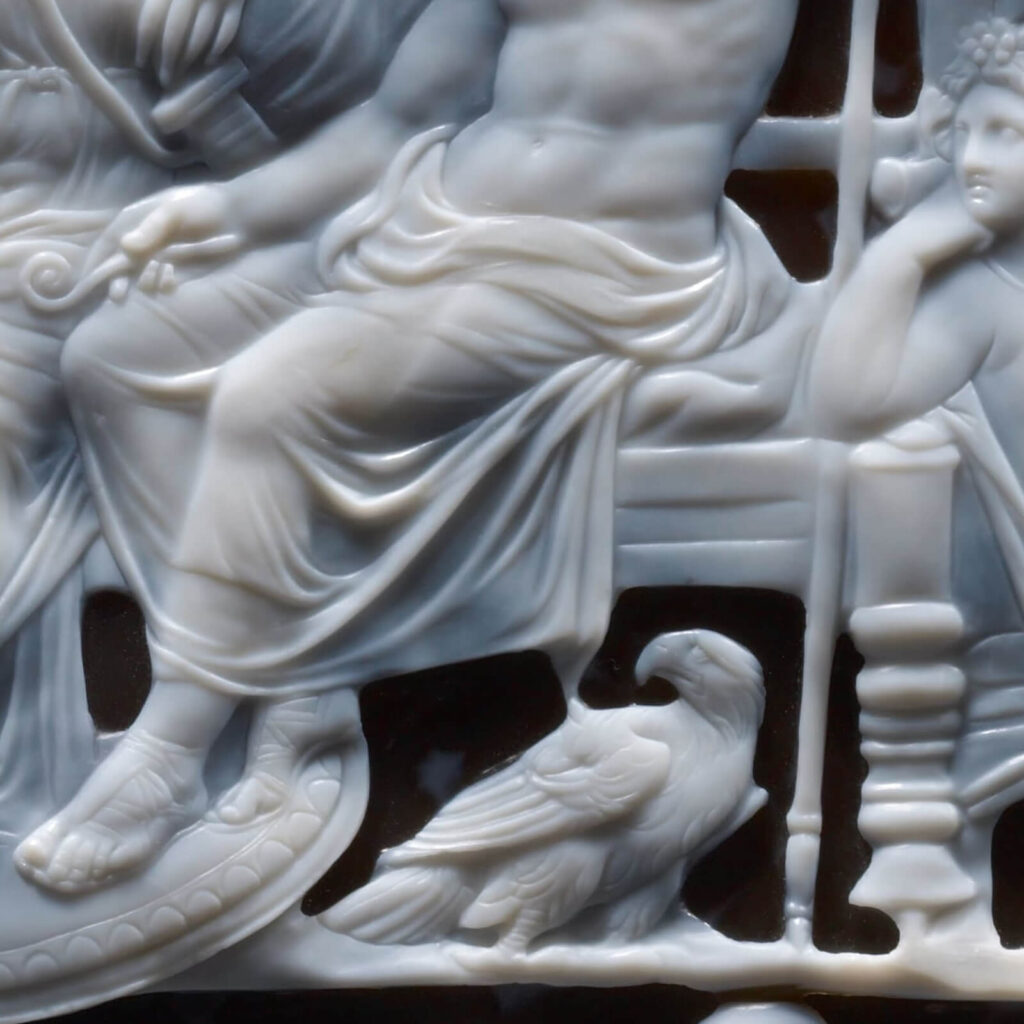
Dioskourides, Gemma Augustea, 9–12 CE, Kunsthistorisches Museum, Vienna, Austria. Detail.
The large cameo celebrates the glory of Emperor Augustus and the victory of his crown prince and stepson, Tiberius, over the Dalmatians during the Great Illyrian Revolt (6-9 CE). It was therefore created between 9 and 12 CE after the victorious suppression of the revolt. Hence, like many ancient Roman artworks and architecture, there is a strong political message of Roman supremacy and dominance. After its initial ownership by Emperor Augustus, its provenance is unknown until it appears again in 1246 within the inventory of the Abbey of Saint-Sernin in Toulouse, France. Later, in the 17th century, it was acquired by Emperor Rudolf II, Holy Roman Emperor, and it was mounted in ornamental gold openwork when it entered the Habsburg family art collection.
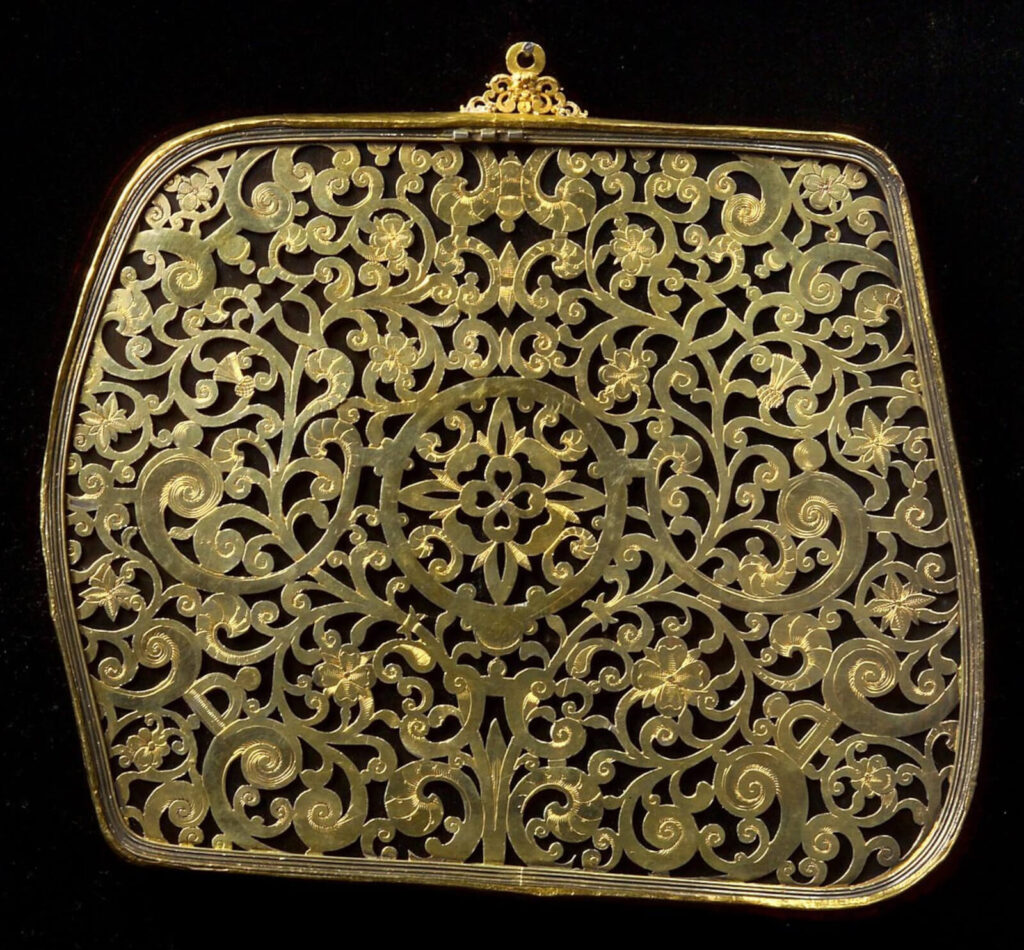
Dioskourides, Gemma Augustea, 9–12 CE, Kunsthistorisches Museum, Vienna, Austria. Reverse. Museum’s website.
Gemma Augustea is a massive medallion measuring 19 cm high by 23 cm wide (about 7.5 in high by 9.1 in wide). It is carved from a double-layered Arabian sardonyx, which is an ornamental onyx stone infused with layers of dark sard (cameo solid background) and milky-white chalcedony (cameo figural foreground). It features two bands or registers of 20 figures with 10 above and 10 below. The upper register features members of the Roman Imperial family surrounded by gods and allegories, while the lower register features victorious gods and captive barbarians.
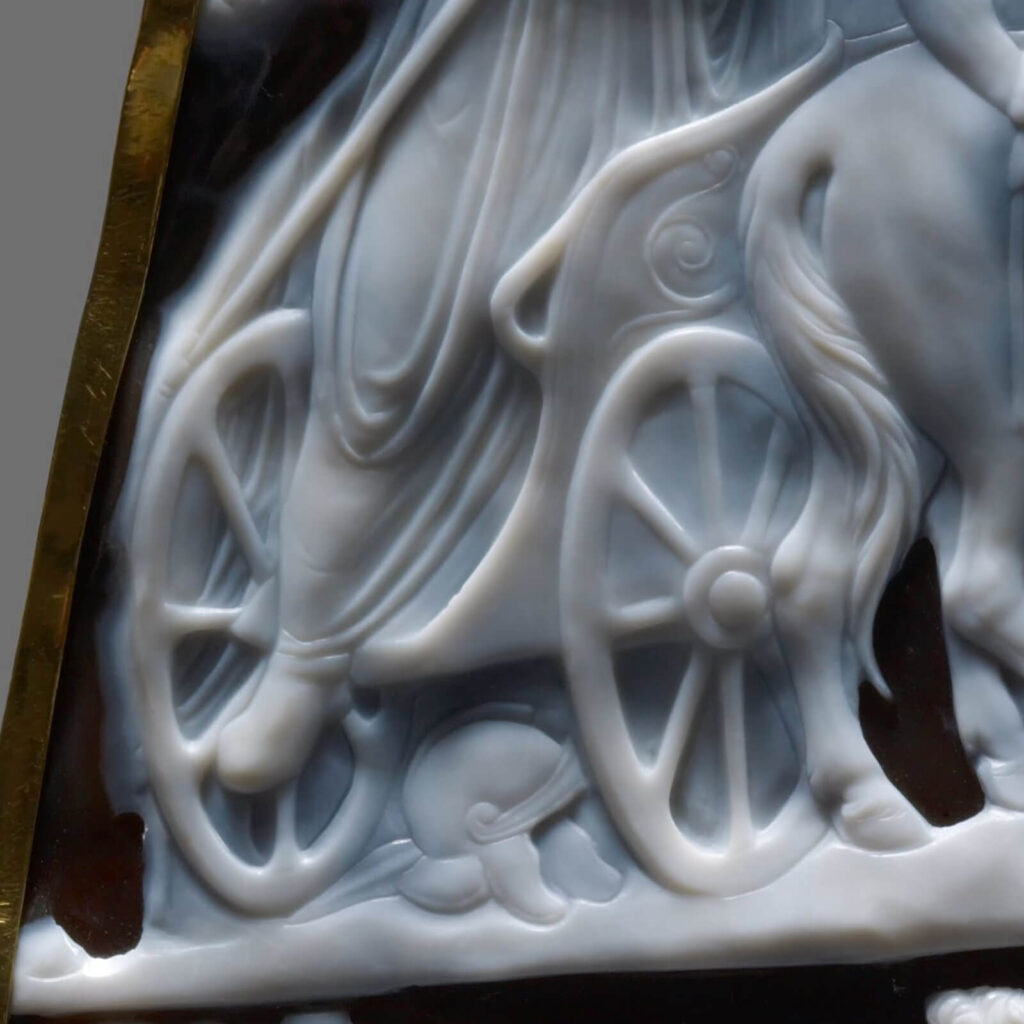
Dioskourides, Gemma Augustea, 9–12 CE, Kunsthistorisches Museum, Vienna, Austria. Detail.
The first emperor of the Romans is featured in the upper register to the slight right of the center. He has a bare chest, sits on a throne, and faces in profile to the left. He is represented in the guise of the god Jupiter, who is the father and king of the Roman gods. Jupiter’s symbol is the eagle, which is depicted sitting on the ground below the throne. Augustus-Jupiter holds a lituus (curved augural staff) in the left hand, symbolizing divine rule over the sky. Augustus-Jupiter holds a long scepter in the right hand, symbolizing earthly rule over the Roman people. Emperor Augustus is solidifying his political position through this strong image of god-king rule.
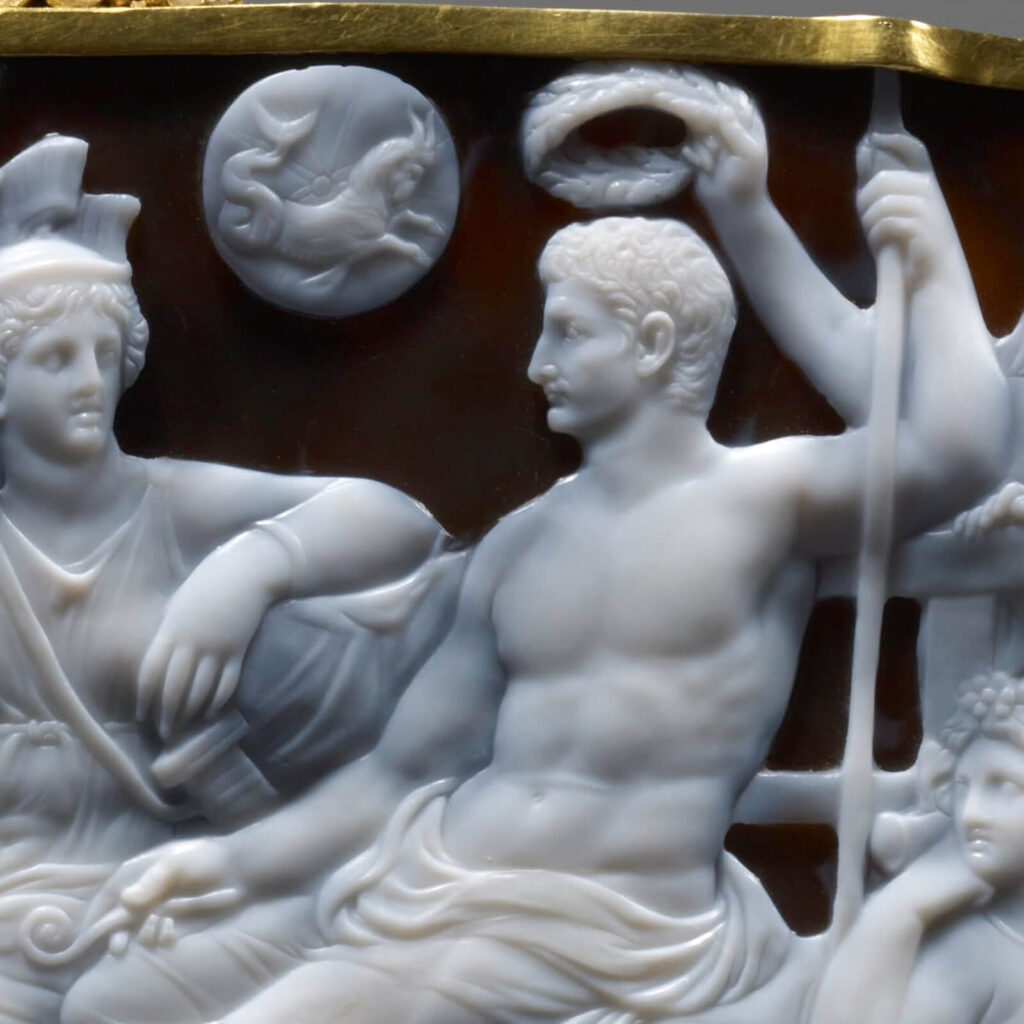
Dioskourides, Gemma Augustea, 9–12 CE, Kunsthistorisches Museum, Vienna, Austria. Detail.
Sitting to the left of Augustus and facing Augustus is an allegory of Roma. This allegorical figure is the protectress of the city of Rome. She wears a warrior’s helmet and a long flowing robe depicted in the famous wet-drapery style that clings and highlights the sensuous form of her body. Her left hand holds a long spear, and a shield leans against her left knee. She is a powerful, feminine image of Rome, the center of the Roman world.
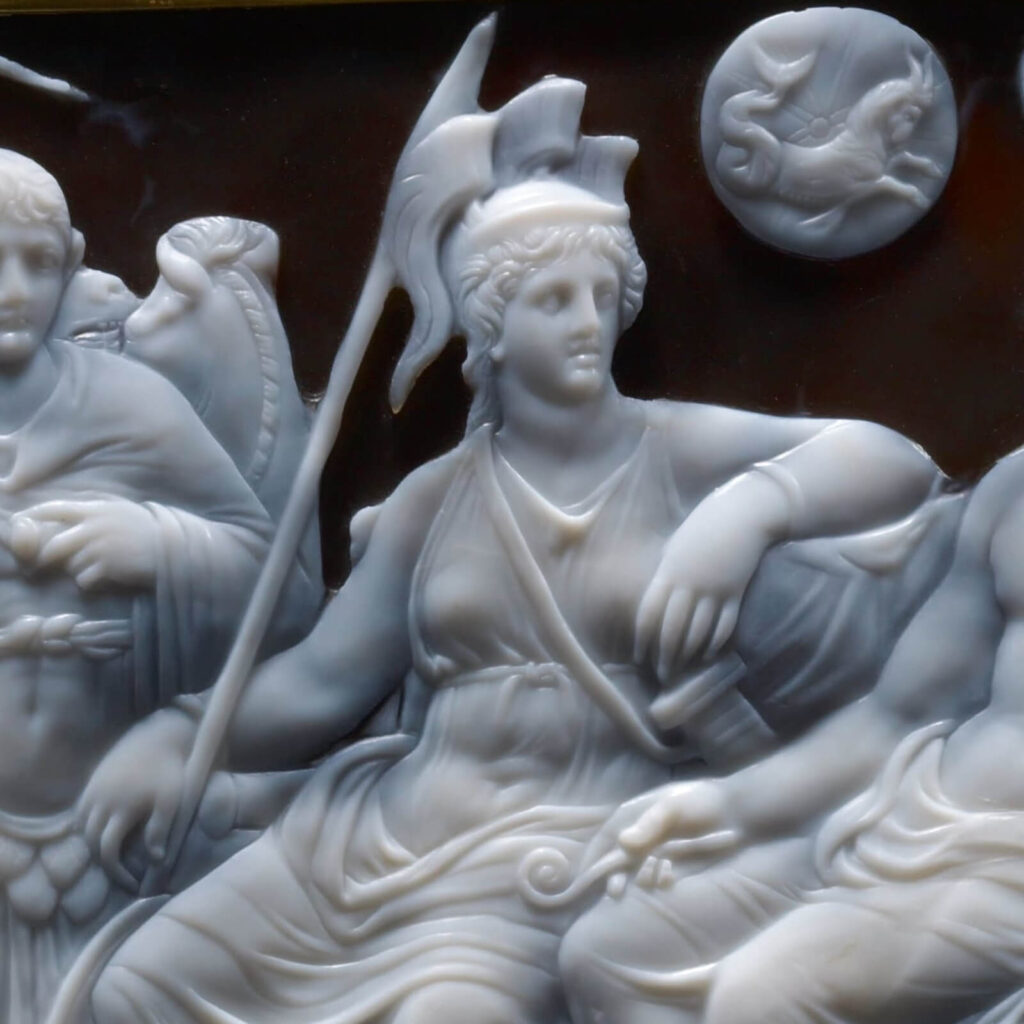
Dioskourides, Gemma Augustea, 9–12 CE, Kunsthistorisches Museum, Vienna, Austria. Detail.
Like a rising moon over a landscape, the zodiac symbol of Capricorn rises between the heads of Rome and Augustus. The Emperor was born under the symbol of Capricorn according to the ancient Roman calendar and the artist Dioskourides includes this natal symbol to further strengthen the divine rule of Augustus. It is interesting to note that Augustus was born on September 23, 63 BCE, according to scholars using our modern Gregorian Calendar. Therefore, using our modern zodiac, Augustus would be a Libra and not a Capricorn. However, at the time of Augustus’s birth, the Roman calendar was not aligned with the solar cycle like the later Julian Calendar introduced in 46 BCE by Julius Caesar. Hence, according to the calendar present at his birth, he was a Capricorn.
To the left of Rome is the great-nephew of Augustus, named Germanicus. He is dressed in his general’s war attire. He was wildly popular in the Roman Empire for his virtuous character, handsome good looks, and war victories. His presence in Gemma Augustea certainly adds to the glory of Augustus’s reign.
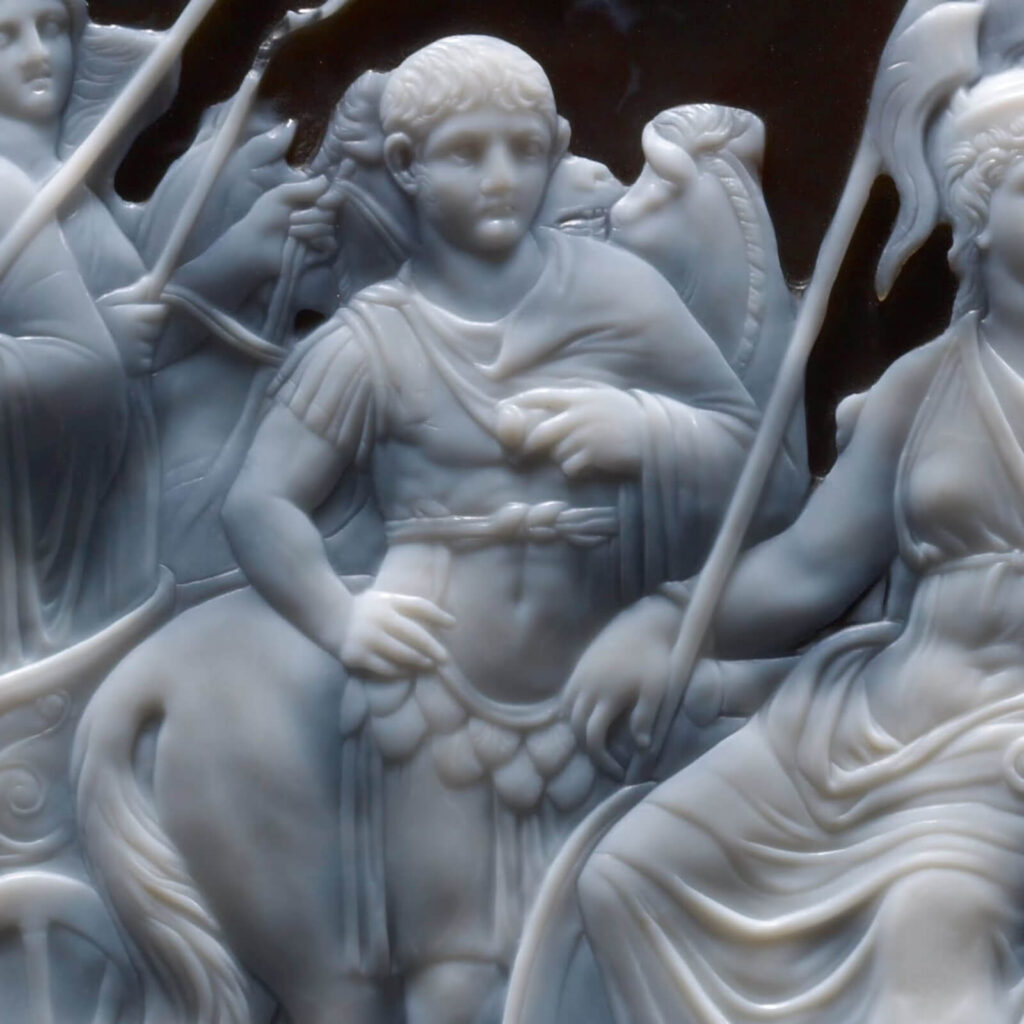
Dioskourides, Gemma Augustea, 9–12 CE, Kunsthistorisches Museum, Vienna, Austria. Detail.
To the left of Germanicus is Tiberius, the crown prince and stepson of Emperor Augustus. He is wearing a long flowing toga, and laurel leaves in his hair symbolizing victory. He stands in a chariot while holding a long scepter. The chariot is being drawn by the allegory of Victory, known as Victoria, symbolizing his defeat of the Dalmatians. Victoria is the Roman equivalent of the Greek Nike and she blesses Tiberius, and indirectly Augustus, with honor. Ironically, Tiberius’s reputation would be deeply tarnished not on the battlefield, but in the bedroom through his scandalous sexual exploits, marking his reign as emperor.
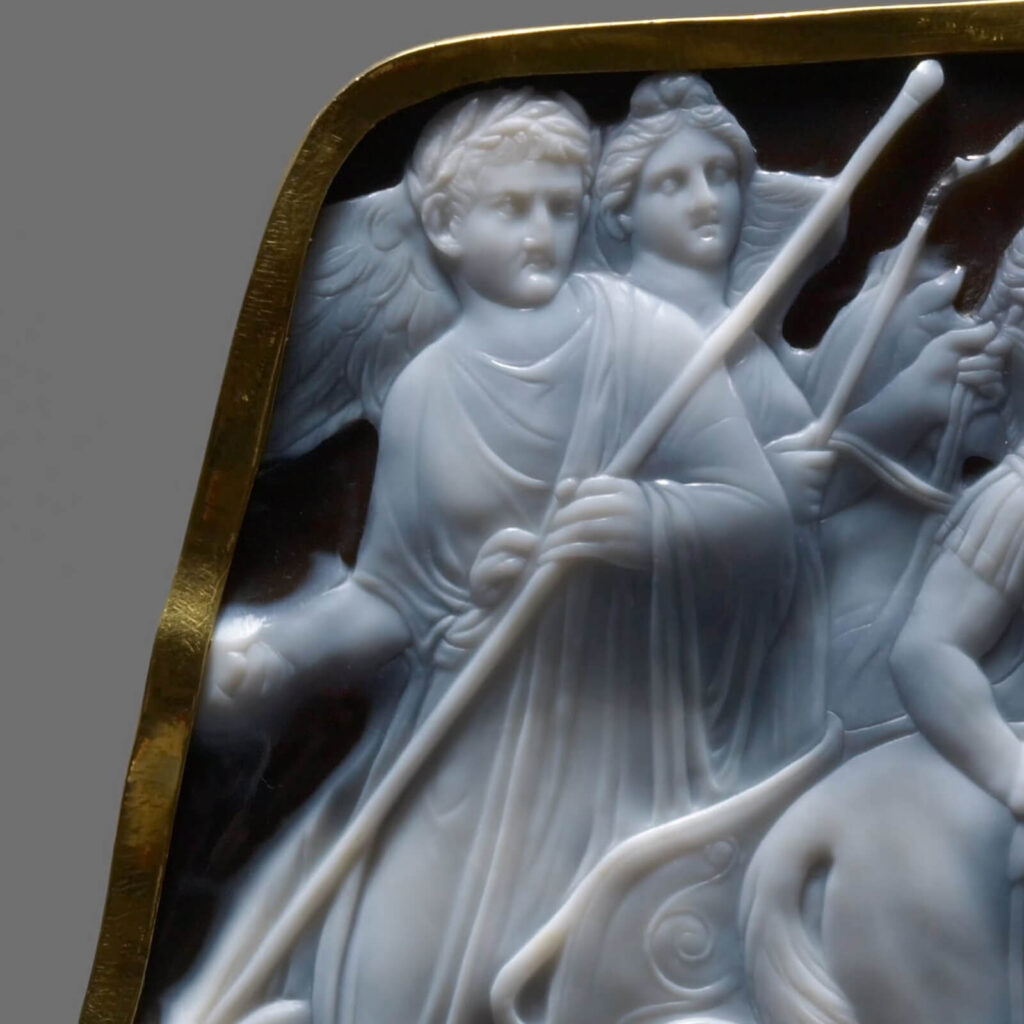
Dioskourides, Gemma Augustea, 9–12 CE, Kunsthistorisches Museum, Vienna, Austria. Detail.
Returning to the right side of Augustus in the upper register is a collection of allegories. Oikumene is physically closest to Augustus. She wears a veil and holds a wreath of oak leaves over Augustus’s head. Oikumene is the allegory of the known inhabited world. She represents the known sphere of influence that Augustus rules. Okeanos, to the right of Oikumene, is the god and personification of the sea. He looks to Augustus as if blessing him with naval power.
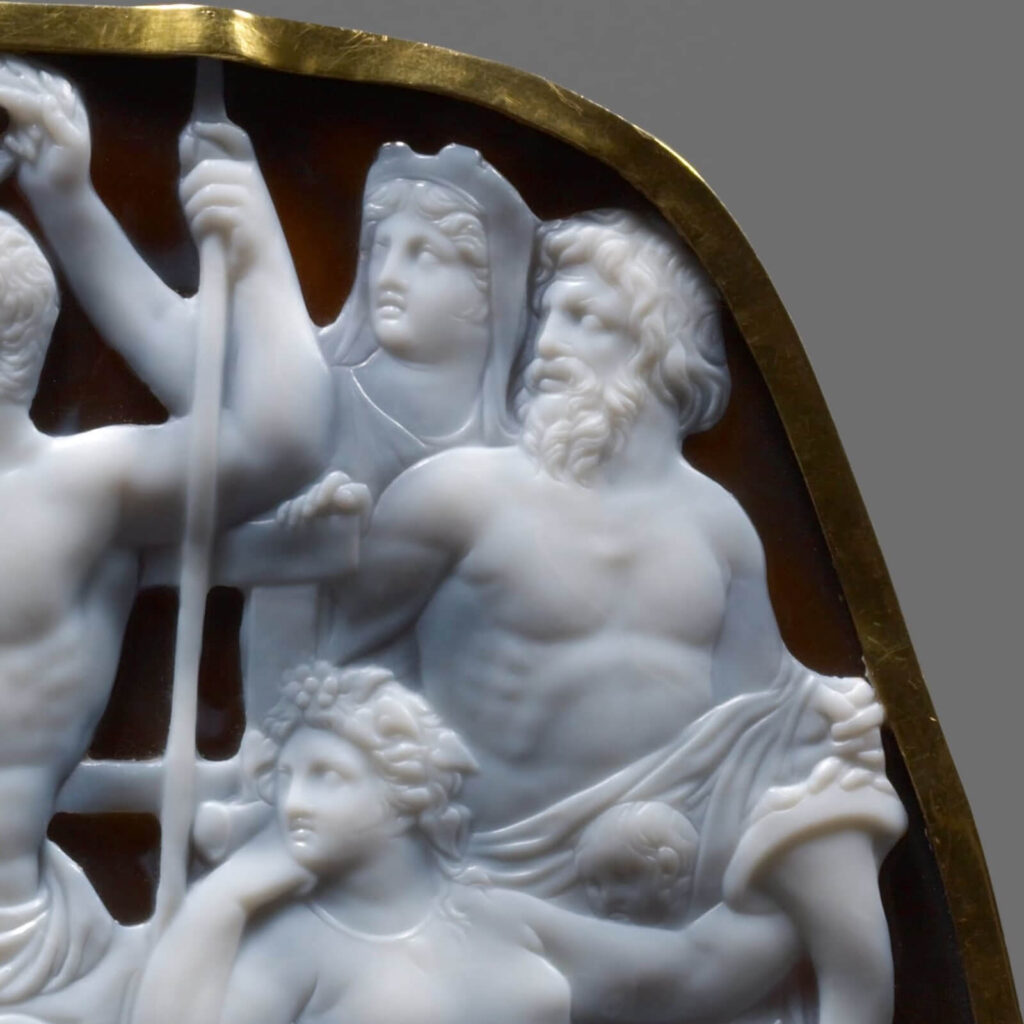
Dioskourides, Gemma Augustea, 9–12 CE, Kunsthistorisches Museum, Vienna, Austria. Detail.
Below Oikumene and Okeanos is a seated female figure who wears fruits and vines in her hair and holds a large cornucopia. She is an allegory of Italy (Italia). Her presence signifies the dominance of the Roman Empire over the Italian peninsula. The cornucopia signifies the prosperity and wealth that Rome brings to its empire. She has two small male boys playing around her lap. Art historians are unsure regarding their significance, but they could be argued as Romulus and Remus, the two twin boys and mythical founders of ancient Rome.
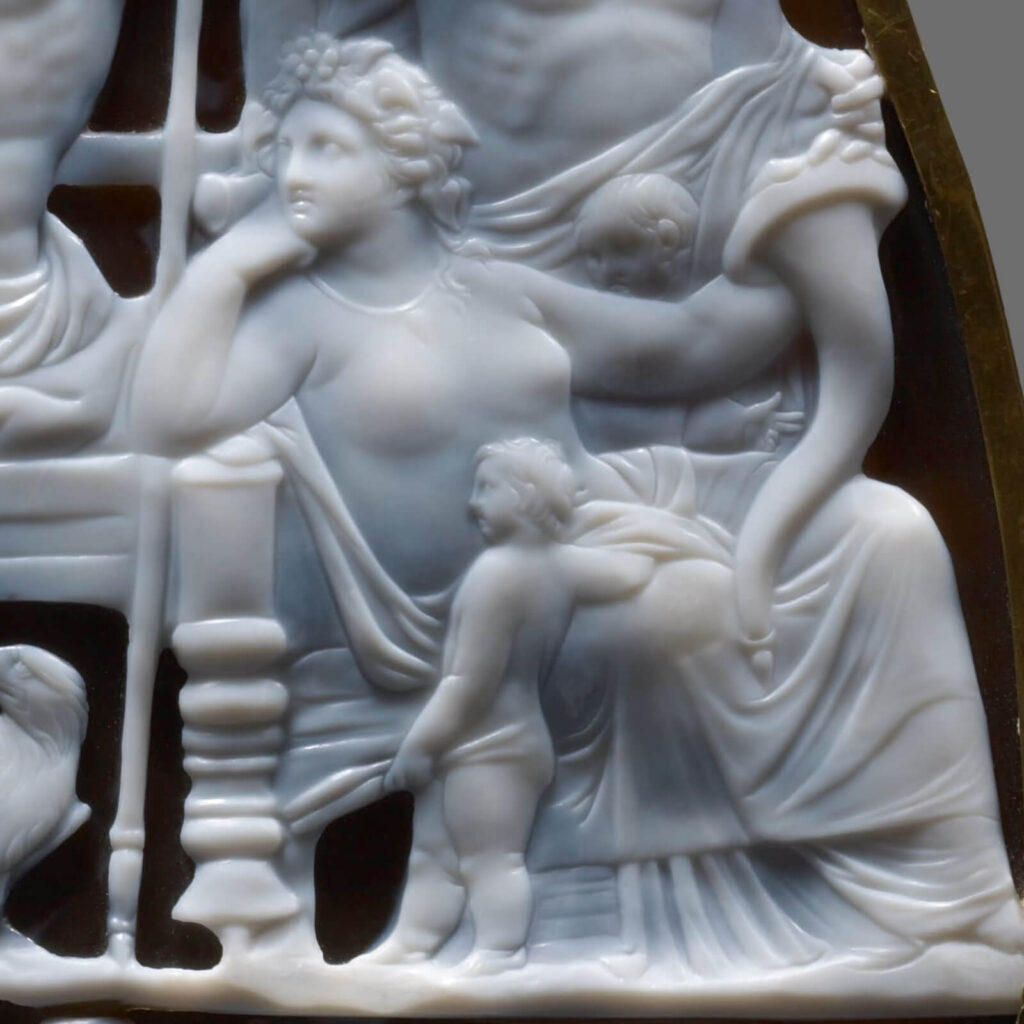
Dioskourides, Gemma Augustea, 9–12 CE, Kunsthistorisches Museum, Vienna, Austria. Detail.
The lower register is visually as interesting as the upper register and perhaps even more interesting because it has a sense of energy and movement. However, symbolically, it is less complex. The 10 figures are a collection of unnamed gods and barbarians interacting with each other. Since the Gemma Augustea was created in celebration of the end of the Great Illyrian Revolt (6–9 CE), the barbarians are probably the revolters now as captives.
The couple sitting on the floor on the left side of the lower register are definitely bound captives. Furthermore, the man crouching on the bottom right and the woman next to him with her hair being pulled, are also bound captives. These four captives are surrounded by six gods who are raising a victory monument known as a tropaion in the center of the lower register.
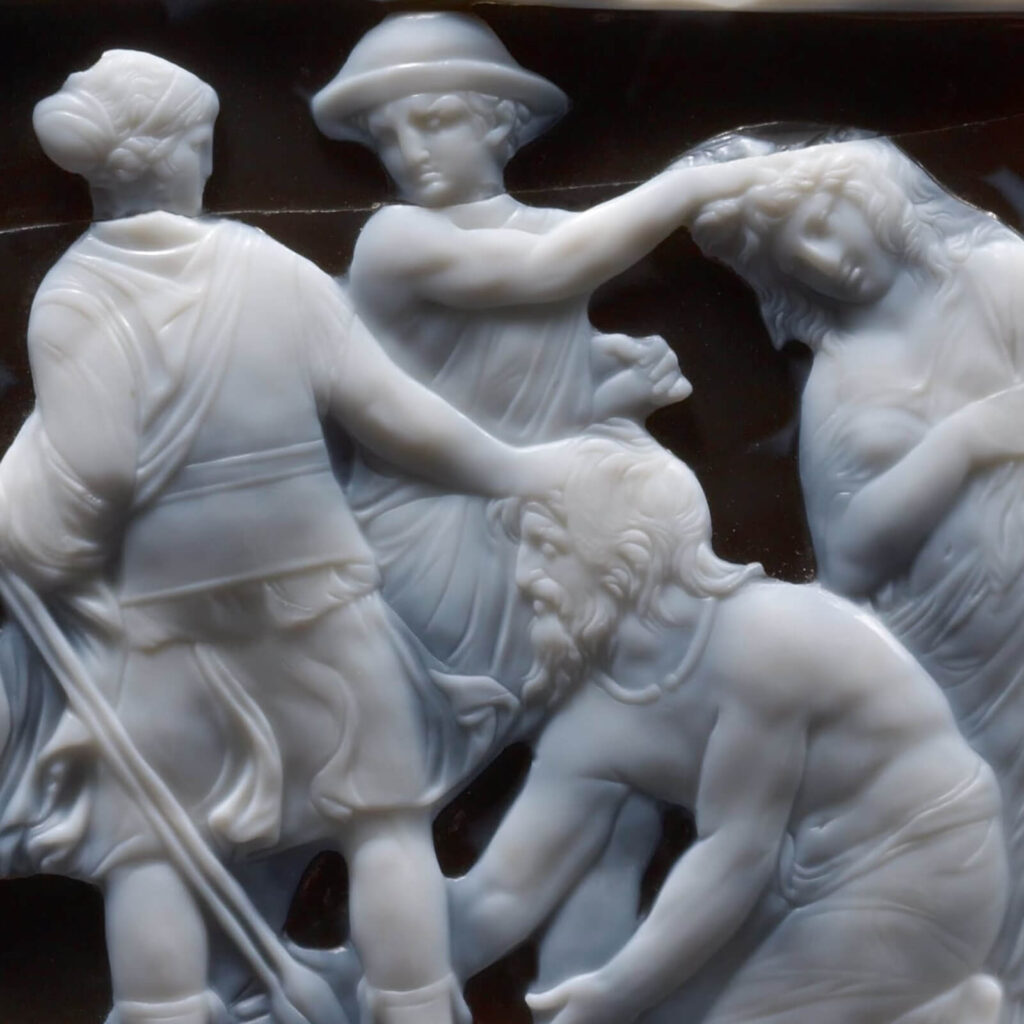
Dioskourides, Gemma Augustea, 9–12 CE, Kunsthistorisches Museum, Vienna, Austria. Detail.
The act of raising a tropaion is what gives historians the context of Tiberius’s victory over the Dalmatians and his triumphal march in Rome upon his return on January 16, 10 CE. Tiberius was at the peak of his popularity when he conquered the Dalmatians as commander-in-chief of the Roman troops. Sadly, his popularity would soon disappear after many sexual scandals, political murders, and social terror. The Gemma Augustea captures the glorious late years of Emperor Augustus and the victorious early years of the future Emperor Tiberius. It was a distinguished time in Roman history and in Roman art.
“Gemma Augustea” Google Arts & Culture. Retrieved 2 May 2026.
“Gemma Augustea” Kunsthistorisches Museum online collection. Retrieved 2 May 2026.
DailyArt Magazine needs your support. Every contribution, however big or small, is very valuable for our future. Thanks to it, we will be able to sustain and grow the Magazine. Thank you for your help!

James W. Singer is an art historian and fine art photographer. He earned a Bachelor of Arts in Art History from the University of Florida. He later moved to Paris, France. He currently writes “Masterpiece” articles for DailyArt Magazine.

Judith and Holofernes is a Caravaggio masterpiece that captures Biblical murder and drama. Rarely has death been captured so intensely and violently...
James W Singer 13 September 2026
Explore an astonishing 1915 nude self portrait by American modernist painter Florine Stettheimer.
Candy Bedworth 21 September 2026
Winslow Homer (1836–1910) was one of the leading American Realist painters. His painting The Veteran in a New Field is a masterpiece of late...
James W Singer 30 August 2026
At first glance, A Goldsmith in His Shop (1449) appears to depict an ordinary visit to a jeweller. Yet Petrus Christus transformed an ordinary...
Shivani Gupta 23 August 2026