Summary
- Christian theologians viewed naturalistic art as a potential distraction from divine truths. The frescoes of Sant Climent de Taüll use monumental figures, vivid colors, and expressive forms to communicate Christ’s divine power.
- Paintings such as Simone Martini’s Annunciation and Byzantine icons used gold and weightless figures to depict a sacred realm beyond time and space.
- The so-called Homunculus Baby Jesus appears as a miniature adult rather than an infant, reflecting medieval beliefs about Christ’s divine wisdom from birth.
- The Renaissance gradually introduced a more naturalistic visual language, emphasizing human anatomy, perspective, realistic spaces, and emotional expression, as seen in the works of Giotto, Masaccio, and Michelangelo.
- Medieval and Renaissance art should be understood as different approaches to representing the world and the divine.
Why medieval artists transformed their classical inheritance
The fall of the Western Roman Empire didn’t cause a sudden loss of artistic ability or even technical knowledge. Still, it coincided with a transformation in the purpose art was expected to serve. Medieval artists inherited many of the techniques and conventions of their artistic ancestors, but increasingly changed and repurposed them to communicate a different kind of reality.
Early Christian theologians such as Tertullian (c. 155–220), Lactantius (c. 250–325), and later Augustine of Hippo (354–430) fiercely criticized aspects of Greco-Roman visual culture, particularly where images were associated with idolatry, deception, or vanity. Building on Platonic philosophy, which viewed the physical world as a copy of its true spiritual forms, and illusionistic art as a copy of a copy, naturalistic art was often seen as a distraction from higher spiritual truths. After all, these were not mere humans we are looking at. A figure could be made larger or flatter, or the scene could be composed of abstract symbols alone, because this art could communicate something that physical accuracy would not.
The frescoes in the central apse of Sant Climent de Taüll, for example, depict Christ as a pantocrator inside a blue mandorla. The grandeur of Byzantine hierarchy is clearly visible given the size and position of Christ compared to the others, but the frescoes also exude an explosive and expressive energy in the use of gold, deep blues, reds, and the intense yet highly stylized expression on Christ’s face. Rather than feeling we are looking at an everyday scene, we are invited to contemplate what we are observing and what it really means. No wonder these images deeply inspired 20th-century modernist and avant-garde painters such as Pablo Picasso and Francis Picabia.
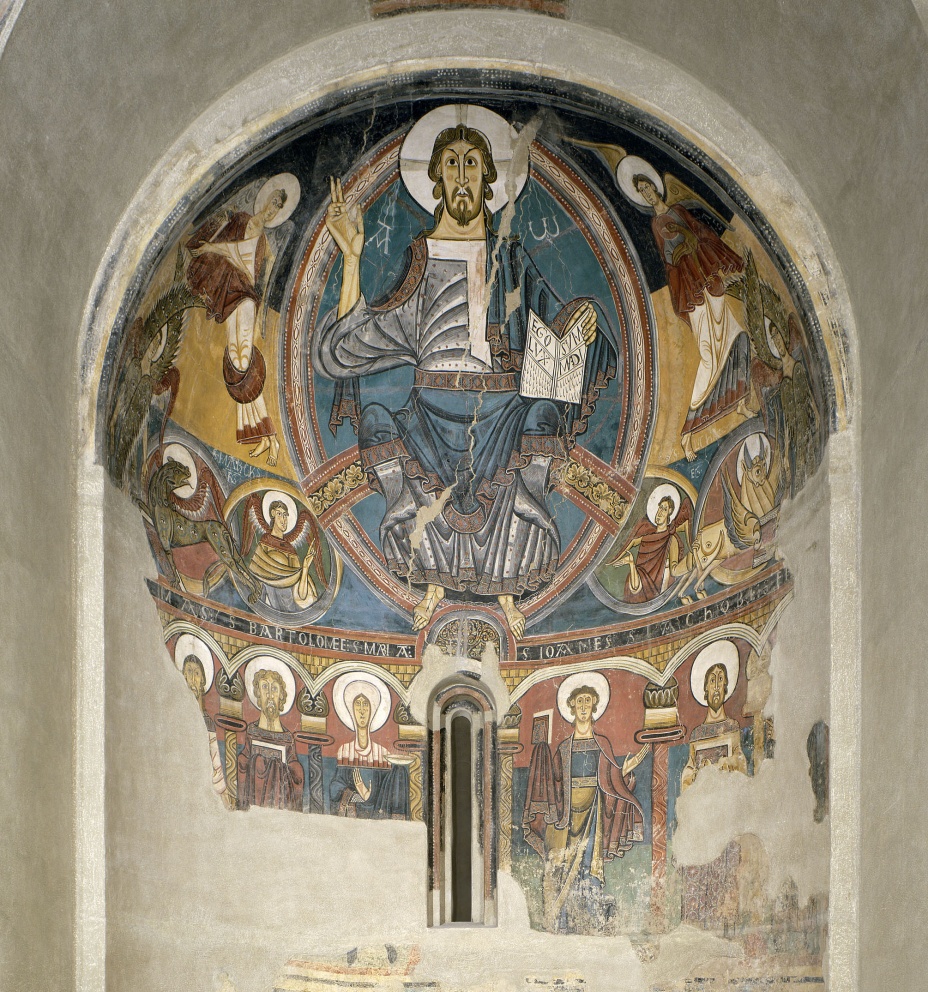
Master of Taüll, central apse of Sant Climent de Taüll, c. 1123, Sant Climent de Taüll, Catalonia, Spain. Museu Nacional d’Art de Catalunya.
The spiritual dimension of the flat golden background
Experiencing the spiritual dimension of medieval art, especially considering its original positions in churches and cathedrals, can be similar to experiencing a meditation room. Both share a spiritual focus supported by visual cues that guide and turn the mind toward a quiet inner truth. For the Church, of course, this came with a specific agenda and iconography. With their characteristic flat golden backgrounds, minimal use of shadows, and lack of architectural perspective, many medieval works transport us to a timeless void where the only stories we can imagine are those told right in front of us.
This apparent “flatness” and the carefully selected color palette are among the first qualities that can make medieval paintings look primitive to a modern viewer. But once we stop expecting the image to be a window out into the physical world, it begins to make sense. Medieval mystics, philosophers, and theologians such as Pseudo-Dionysius the Areopagite (c. 5th–6th century) and Robert Grosseteste (1175–1253) wrote extensively about divine light and can help us understand its significance in medieval art. In his De Mystica Theologia (The Mystical Theology) and De Divinis Nominibus (The Divine Names), Pseudo-Dionysius equated God to an “inaccessible light” that is invisible to human understanding simply because it is too bright and supernatural. Grosseteste wrote an entire treatise on light, De Luce (On Light), stating that light is the first corporeal form created by God and the fundamental building block of the universe.
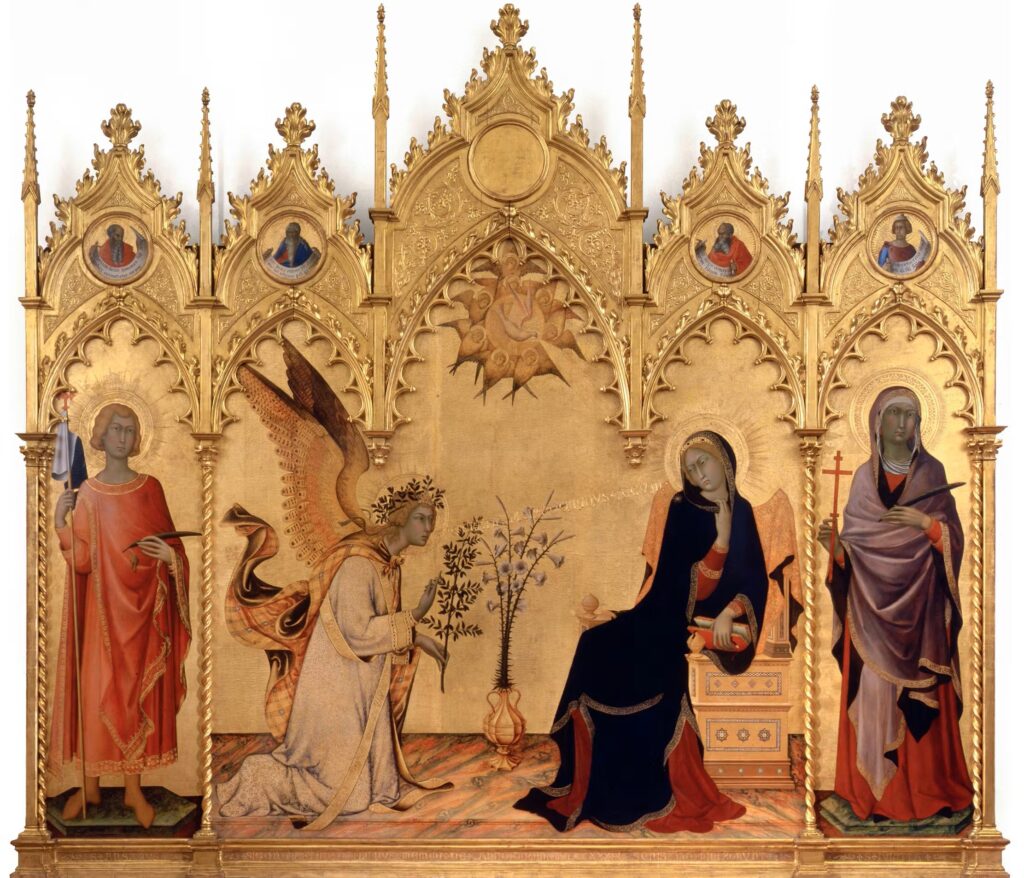
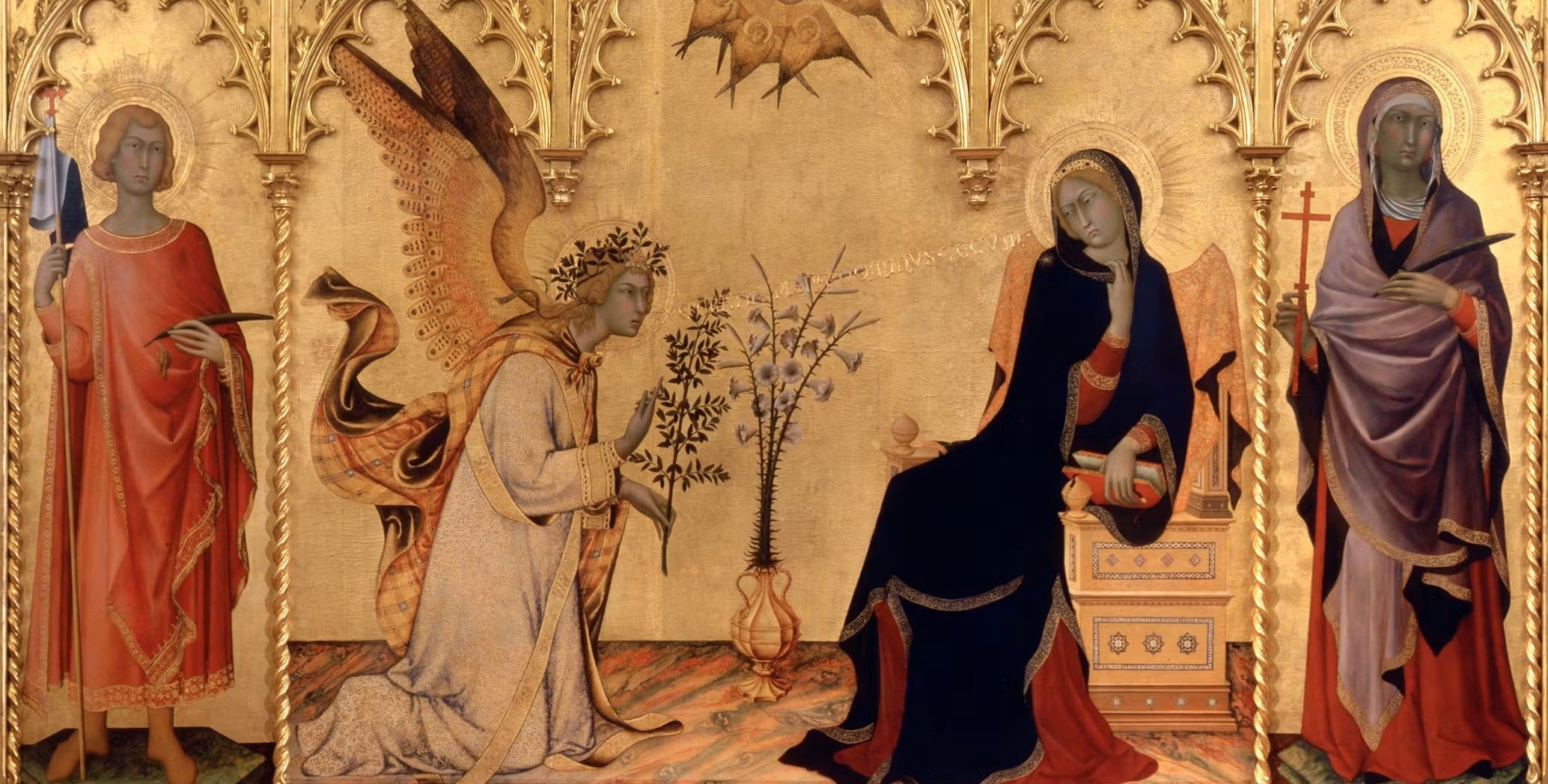
Simone Martini, Lippo Memmi, Annunciation with St. Margaret and St. Ansanus, 1333, Uffizi, Florence, Italy. Museum’s website.
The Annunciation with St. Margaret and St. Ansanus by Simone Martini (1284–1344), a classic example of the International Gothic style, shows us what such a supernatural light might look like. We see an overwhelmingly golden scene and graceful, weightless figures that tell a story of a sacred event and divine elegance rather than a physical reality. There are no visible light sources, and Mary and the angel appear to be self-illuminating. There are no architectural elements that tie the depiction to a specific city or country, stripping the scene of any reference to time or place.
Now imagine this painting in its original position, on the altar of St. Ansanus inside the Siena Cathedral. With its striking black-and-white marble, deep-blue and gold vaulted ceilings, and elaborate mosaic floors, the cathedral’s design reflects, beyond civic pride, a visual path to the heavenly realm. Seen in this context, the painting becomes part of a much larger visual ecosystem.
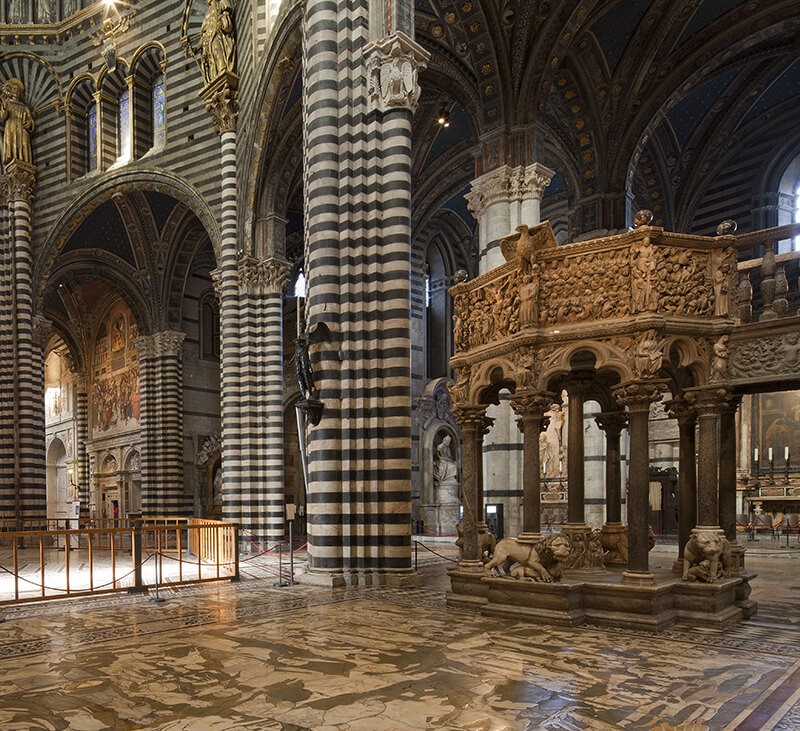
Siena Cathedral, 1215, Siena, Italy. Siena Opera della Metropolitana.
Similarly, Byzantine icons tell a vivid story of the visualization of the sacred. Take, for example, the Church of Christ in Chora (Kariye Mosque) in Istanbul, Turkey. The walls are decorated in shimmering golden mosaics and frescoes capturing heavenly light, the miracles of Jesus, the life of the Virgin Mary, and the harrowing of hell. Here, too, the gold background makes a realm beyond our physical world visible. Rather than asking, “Where is this happening?”, the viewer is encouraged to ask, “What type of world is revealed to me here?”
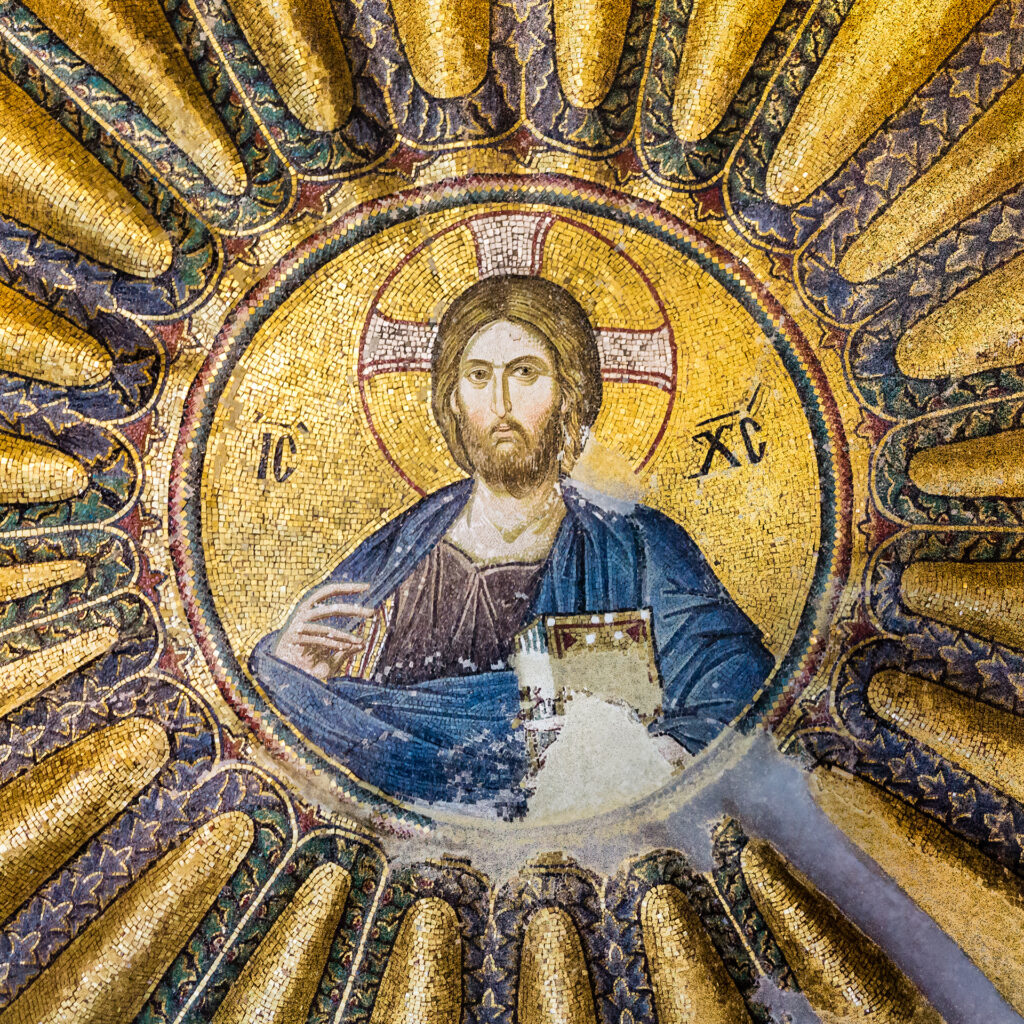
The Chora Church, 1321, Istanbul, Turkey. Chora Museum.
Understanding the Homunculus Baby Jesus
If you have ever looked at a medieval painting of a Madonna and Child and felt weirdly uncomfortable, you might have been looking at the Homunculus Baby Jesus, or the “little man.” This use of the term “homunculus” is a modern invention, but it perfectly captures the strange effect these images can have on us.
Mary sits passively, almost like a throne herself, and holds on her lap what appears to be a little man rather than a baby. In the Byzantine Enthroned Madonna and Child, we see Mary on what appears to be an impossible throne, with no hint of perspective. The Christ Child in her arms does not look like an infant but a fully grown man with adult features and proportions, almost floating, as if Mary cannot feel him in her arms.
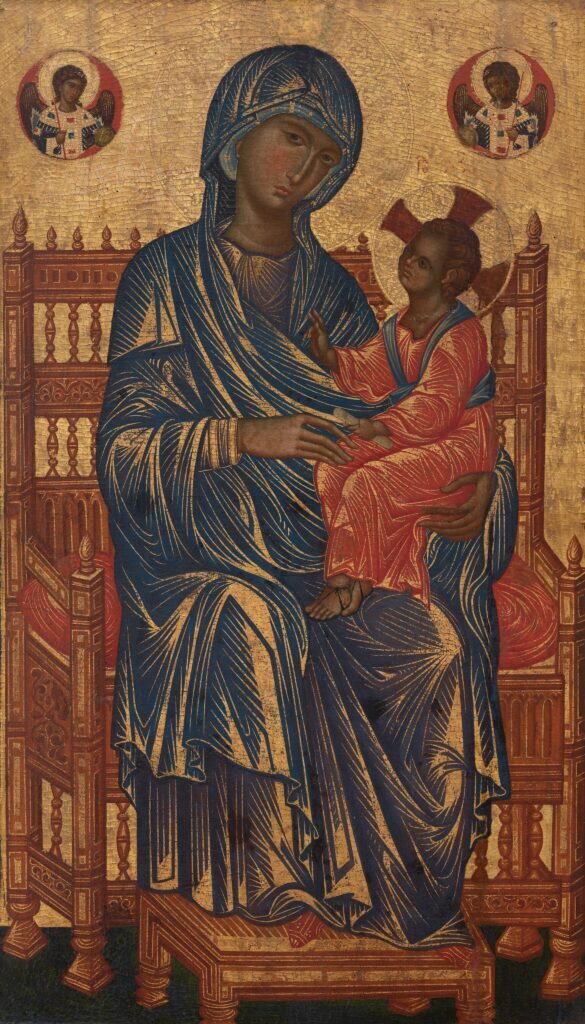
Enthroned Madonna and Child, c. 1250–1275, National Gallery of Art, Washington, DC, USA. Museum’s website.
These strange proportions are not revealing some long-forgotten knowledge of what a baby looks like, but rather a statement about who this particular baby is. In his textbook The First Book of the Sentences, Peter Lombard (1100–1160) wrote that Christ’s soul was complete and the embodiment of wisdom even from birth, and that scriptural mentions of Jesus gaining wisdom were a mere representation of him progressively revealing his pre-existing wisdom. Similarly, in his Summa Theologiae, St. Thomas Aquinas (c. 1225–1274) explains that even from his mother’s womb, Christ’s intellect was able to perceive God’s essence directly, and proposes Christ as a comprehensor who is in full possession of divine wisdom from the very beginning.
As such, portraying the Christ Child as a cute modern infant could have been seen as undermining his divine nature. This so-called homunculus Baby Jesus makes much more sense when we stop expecting a portrait of an ordinary child and understand what the artists were trying to tell us about this awkward baby.
How the Renaissance changed the visual language
Much like the artistic goals changed between the Late Roman period and the medieval period, so too did visual storytelling between the Middle Ages and the Renaissance, this time based on a philosophical shift that viewed the world through the lens of naturalism.
The Renaissance announced the rise of humanism, a cultural and intellectual movement that started in the 14th century. Scholars and writers, led by the Italian poet Francesco Petrarch (1304–1374), began translating and studying classical Greek and Roman manuscripts to revive the moral philosophy and literature of antiquity and to reform an educational system that they felt had become too rigid. For art, this meant that the focus was less on the path to the divine and more on reason and human potential, which was expressed through more realistic depictions of the human form and the natural world. The scientific study of anatomy and linear perspective reflected a new cultural belief that the physical, earthly world was worth studying, measuring, and depicting in its own right.
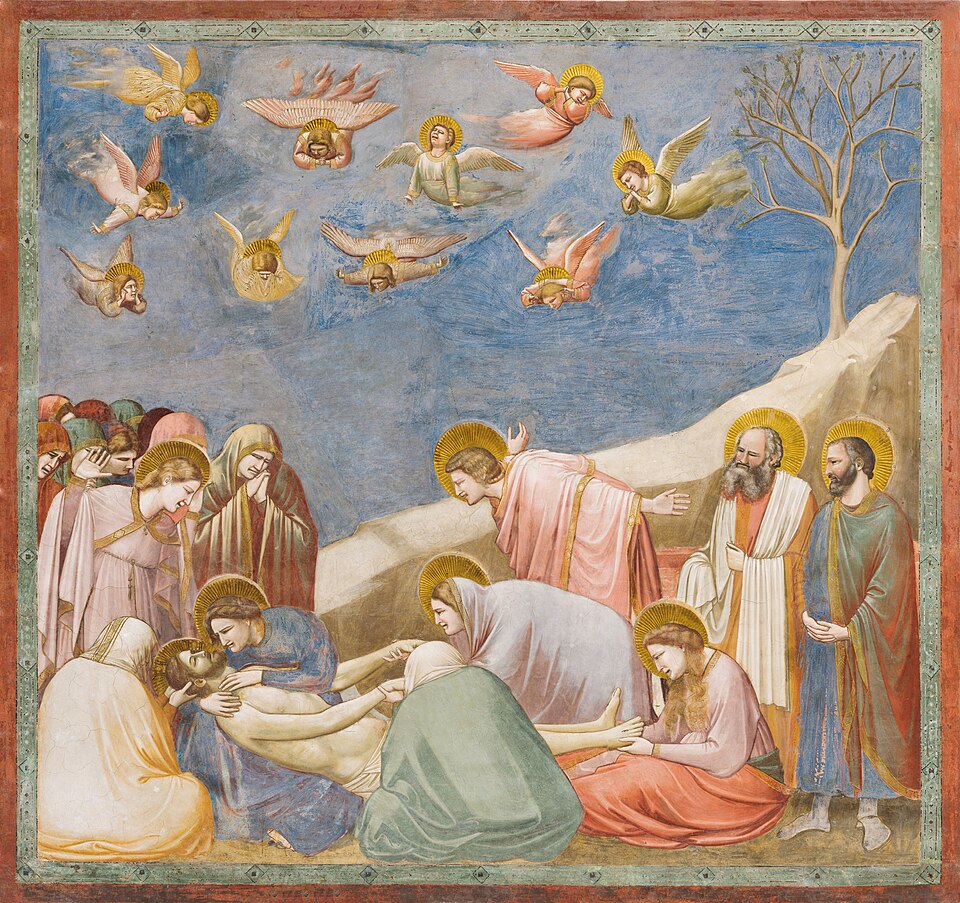
Giotto di Bondone, The Lamentation of Christ, c. 1305, Scrovegni Chapel, Padua, Italy. Catholic Education Resource Center.
Of course, this didn’t mean that Renaissance artists suddenly abandoned religion. Christian stories remained important. What changed was the visual language artists used to tell their stories. They increasingly used the observation of the world around them, introduced saints and biblical figures as more recognizable fellow humans rather than ethereal creatures far removed from us, and used realistic spaces to breathe life into religious as well as secular scenes.
We can see this shift as early as Giotto (c. 1267–1337), often described as a Proto-Renaissance artist, in his Lamentation in the Scrovegni Chapel. The stiff, flat figures are replaced by substantial bodies contorted in grief. Giotto actually complicates the story, but also gives it an important nuance. He was not a Renaissance artist in the full meaning of the word, nor did he simply abandon medieval conventions. But in his Lamentation, we can see how his figures are situated in surroundings we can recognize. They possess weight and volume and communicate raw emotion through their body language and facial expressions. Giotto shows us that the shift toward naturalism was gradual.
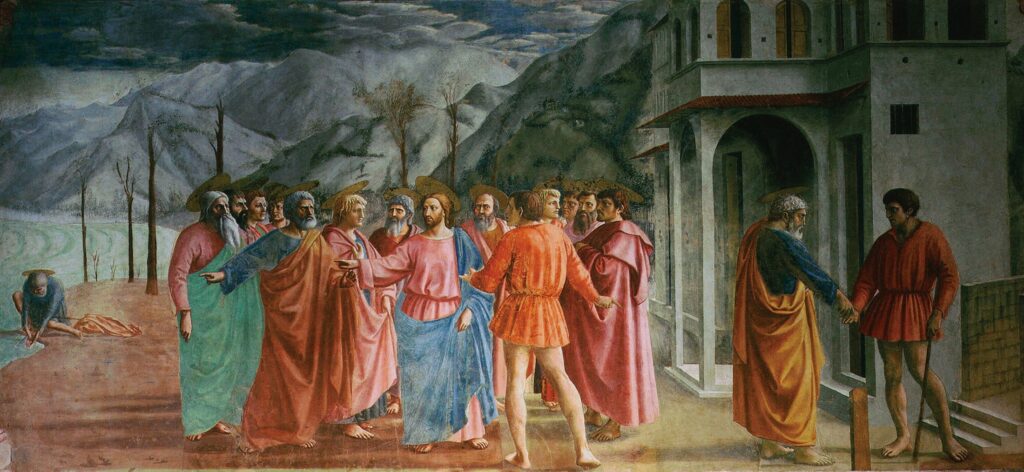
Masaccio, Tribute Money, c. 1423–1427, Brancacci Chapel, Church of Santa Maria del Carmine, Florence, Italy. Encyclopaedia Britannica.
Looking at some later examples, we can see this shift in full swing. In Tribute Money by Masaccio (1401–1428), which can be observed in the Brancacci Chapel in Florence, Christ and his apostles stand proudly like solid Roman statues, in surroundings we feel we can simply wander into ourselves. The religious narrative is merged with natural human forms and impeccable control over perspective. Later, in examples such as Camera degli Sposi by Andrea Mantegna, the illusionistic trickery known as trompe-l’œil—which some medieval thinkers would have criticized as deceptive—takes center stage, and we see a secular celebration of man that moves away from biblical narratives to glorify human power and individualism.
This fascination with the human body reaches some of its most famous expressions in Leonardo da Vinci’s Vitruvian Man and Michelangelo’s David, where mathematical proportion, anatomy, and the so-called ideal male form become subjects worthy of intense artistic study.
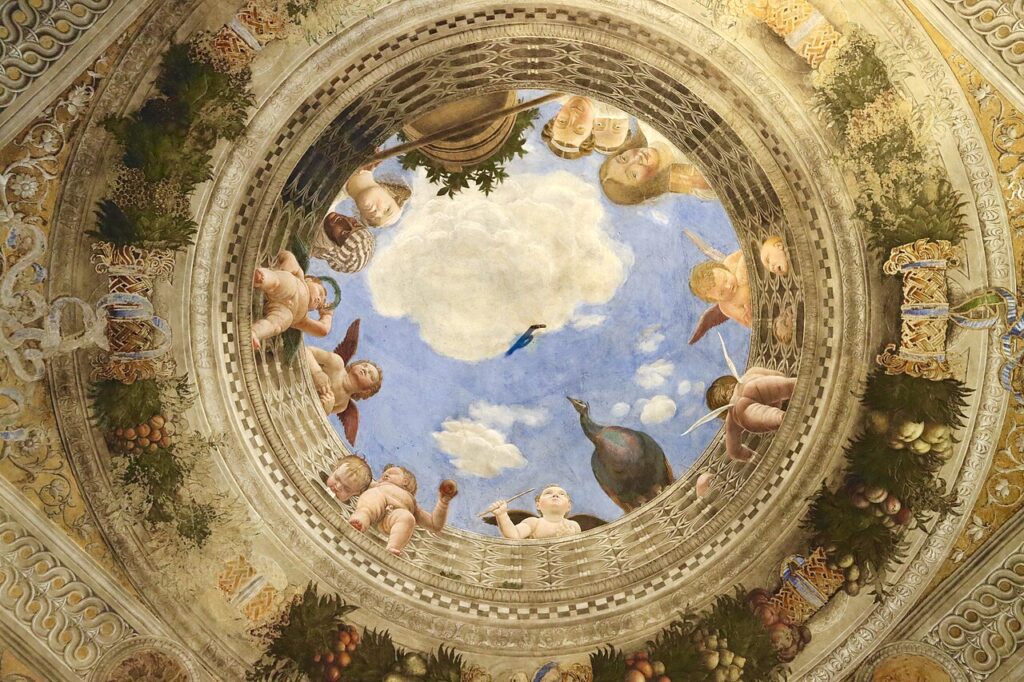
Andrea Mantegna, fresco of the Camera degli Sposi, 1474, Palazzo Ducale, Mantua, Italy. Encyclopaedia Britannica.
When all is said and done, it is important to keep in mind that blindly comparing art from different time periods is not a worthwhile pursuit. While we can study artistic evolution and learn what it tells us about changing worldviews, both medieval and Renaissance artists achieved their goals perfectly. This distinction, however, should not be pushed too far. The difference was not that one period believed in God while the other believed in science and reason, but that artists increasingly developed different ways to represent the world, the human body, and the divine.
And in the end, perhaps this is the best way to understand why medieval art was not meant to be realistic. The artists weren’t trying to simply reproduce the world that appeared before their eyes. They wanted to reveal a world that could not be seen around us, but a hidden one that allowed a divine light and presence to shine through.