

Masterpiece Story: The Veteran in a New Field by Winslow Homer
Winslow Homer (1836–1910) was one of the leading American Realist painters. His painting The Veteran in a New Field is a masterpiece of late...
James W Singer 30 August 2026

Lyonel Feininger, Sailboats, 1929, Detroit Institute of Arts, Detroit, MI, USA. Detail.
Cubism—the word instantly evokes images of Picasso and his figures with multiple noses. However, there is more than just Picasso who excels in this modern style. Lyonel Feininger is one such artist. His Sailboats from 1929 showcases the excitement of the Cubist style as well as the energy of the Jazz Age. It is almost as if Picasso decided to go boating. All aboard!
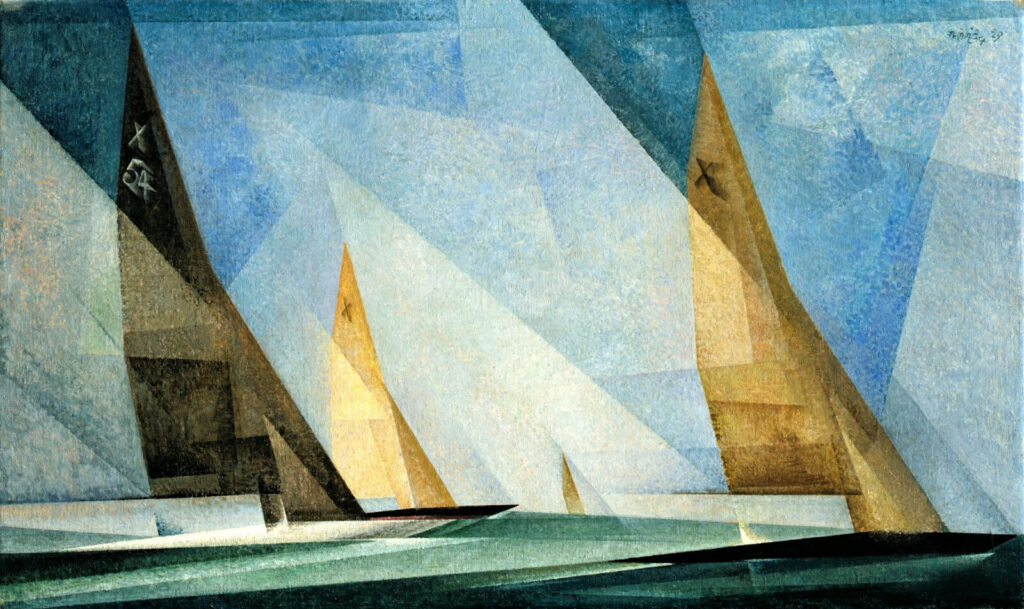
Lyonel Feininger was an American artist who lived and worked in Germany for most of his life. He was the first teacher at the famous Bauhaus School when it opened in 1919, and he taught alongside Paul Klee and Wassily Kandinsky. Feininger was a follower of Precisionism, a form of Cubism, which is sometimes referred to as Synthetic Cubism. Sailboats includes Cubist shapes but has a more romantic, colorful and decorative rendering. Feininger brought warmth into his pieces which contrasted with the more austere styles of other Bauhaus artists.
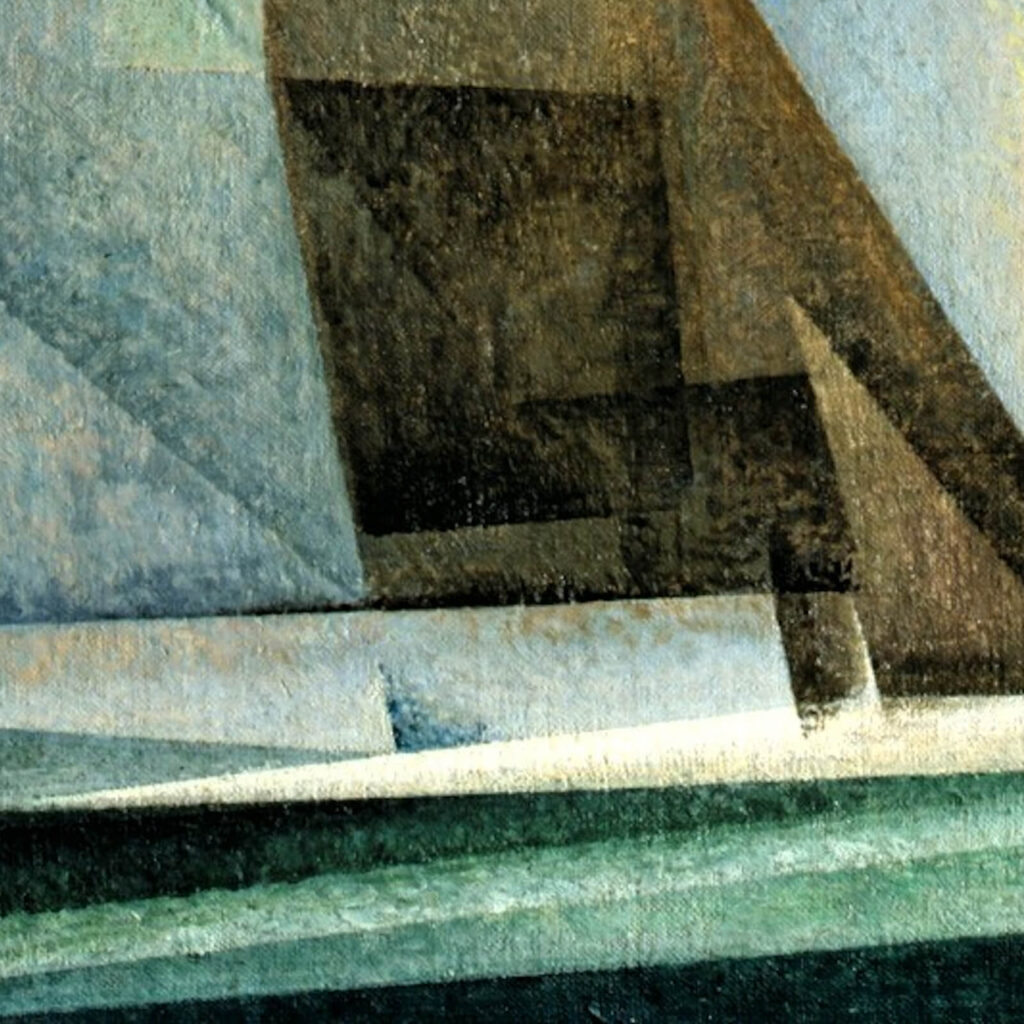
Lyonel Feininger studied in Paris prior to teaching at the Bauhaus School in Weimar. In France, he met artist Robert Delaunay who probably influenced Feininger with his French Orphist ideas of vibrant colors, warm hues, and sharp lines. Feininger fused these Orphist characteristics with Cubist ideas of reduction, fragmentation, and geometric shapes.
Feininger’s style, as seen in Sailboats, is one of the instantly recognizable subjects, cut into sharply delineated planes of great slanted triangles. His planes are like triangular cut pieces of glass. They are sharp, precise, and transparent. This triangular fragmentation would later become Feininger’s signature style and would differentiate him from other followers of Precisionism/Synthetic Cubism.
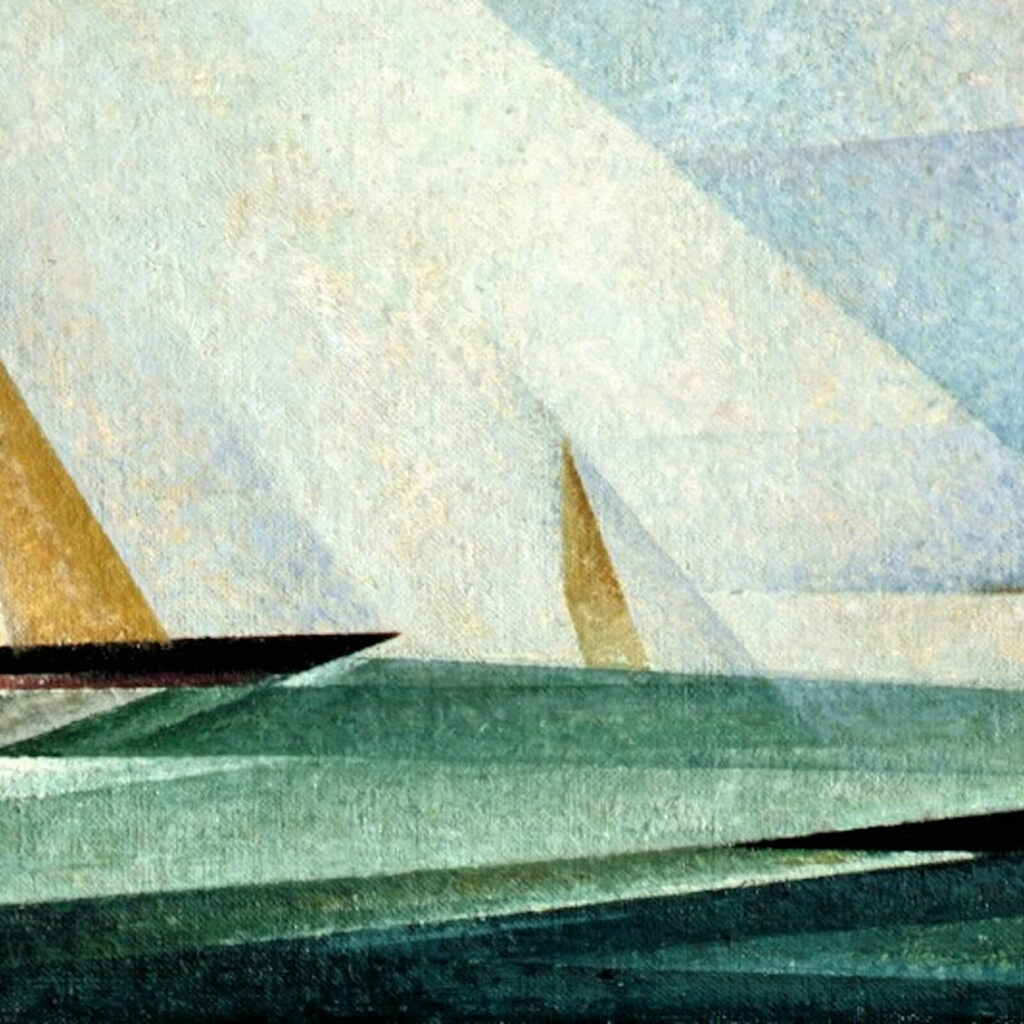
Lyonel Feininger was the only faculty member to work at the Bauhaus School for its entire existence from 1919 to 1933. It closed soon after the Nazi party’s rise to power in Germany. Feininger’s paintings were declared inferior by Adolf Hitler and the Nazi party, and he was even showcased in the infamous Degenerate Art Exhibition of 1937. Thankfully, Feininger had already returned to New York in 1936. Otherwise, we can only speculate on the horrors that may have happened to Feininger if he had remained in Nazi Germany.

The Nazi art criticism was clearly unfounded and deranged. Lyonel Feininger’s Sailboats is now recognized as a tour de force of early 20th-century art. It has an invigorating feeling as both sky and sea break into diagonal shards of blue and white. The view is from a low perspective as if we are on a boat ourselves.
Sweeping lines emphasize the sails as the boats race forward. Are we witnessing a regatta? Are we participating in it? Regardless, we are certainly partaking in the beauty and energy of the moment. Lyonel Feininger’s Sailboats is a wonderful addition to the Detroit Institute of Arts. It is blissfully vibrant and buoyantly vivid. It is simply wonderful.
Wendy Beckett, and Patricia Wright, Sister Wendy’s 1000 Masterpieces, London: Dorling Kindersley Limited, 1999.
Victoria Charles, Joseph Manca, Megan McShane, and Donald Wigal, 1000 Paintings of Genius, New York, NY: Barnes & Noble Books, 2006.
Helen Gardner, Fred S. Kleiner, and Christin J. Mamiya, Gardner’s Art Through the Ages, 12th ed. Belmont, CA: Thomson Wadsworth, 2005.
“Lyonel Feininger”, Union List of Artist Names, Getty Research Institute. Accessed August 16, 2020.
“Sailboats”, Collection, Detroit Institute of Arts. Accessed August 16, 2020.
DailyArt Magazine needs your support. Every contribution, however big or small, is very valuable for our future. Thanks to it, we will be able to sustain and grow the Magazine. Thank you for your help!

James W. Singer is an art historian and fine art photographer. He earned a Bachelor of Arts in Art History from the University of Florida. He later moved to Paris, France. He currently writes “Masterpiece” articles for DailyArt Magazine.
Winslow Homer (1836–1910) was one of the leading American Realist painters. His painting The Veteran in a New Field is a masterpiece of late...
James W Singer 30 August 2026
At first glance, A Goldsmith in His Shop (1449) appears to depict an ordinary visit to a jeweller. Yet Petrus Christus transformed an ordinary...
Shivani Gupta 23 August 2026
With Virgin and Child as a cornerstone of her reputation, Elisabetta Sirani should be recognized as an important Italian Baroque artist. Far more...
James W Singer 16 August 2026
Anthony van Dyck was one of the great portraitists of the 17th century. It is largely through his eyes that we now view the doomed reign of Charles I...
Catriona Miller 17 August 2026